

Ciena advances coherent technology on multiple fronts
- Ciena has unveiled the industry’s first coherent digital signal processor (DSP) to support 1.6-terabit wavelengths
- Ciena announced two WaveLogic 6 coherent DSPs: Extreme and Nano
- WaveLogic 6 Extreme operates at a symbol rate of up to 200 gigabaud (GBd) while the Nano, aimed at coherent pluggables, has a baud rate from 118-140GBd
Part 1: WaveLogic 6 coherent DSPs
Ciena has leapfrogged the competition by announcing the industry’s first coherent DSP operating at up to 200GBd.
The WaveLogic 6 chips are the first announced coherent DSPs implemented using a 3nm CMOS process.
Ciena’s competitors are – or will soon be – shipping 5nm CMOS coherent DSPs. In contrast, Ciena has chosen to skip 5nm and will ship WaveLogic 6 Extreme coherent modems in the first half of 2024.
Using a leading CMOS process enables the cramming of more digital logic and features in silicon. The DSP also operates a faster analogue front-end, i.e. analogue-to-digital converters (ADC) and digital-to-analogue (DAC) converters.
The WaveLogic 6 matches Ciena’s existing WaveLogic 5 family in having two DSPs: Extreme, for the most demanding optical transmission applications, and Nano for pluggable modules.
WaveLogic 6 Extreme is the first announced DSP that supports a 1.6-terabit wavelength; Acacia’s (Cisco) coherent DSP supports 1.2-terabit wavelengths and other 1.2-terabit wavelength DSPs are emerging.
WaveLogic 6 Nano addresses metro-regional networks and data centre interconnect (up to 120km). Here, cost, size, and power consumption are critical. Ciena will offer the WaveLogic 6 in QSFP-DD and OSFP pluggable form factors.
Class 3.5
Network traffic continues to grow exponentially. Ciena notes that the total capacity of its systems shipped between 2010 and 2021 has grown 150x, measured in petabits per second.
Increasing the symbol rate is the coherent engineers’ preferred approach to reduce the cost per bit of optical transport.
Doubling the baud rate doubles the data sent using the same modulation scheme. Alternatively, the data payload can be sent over longer spans.
However, upping the symbol rates increases the optical wavelength’s channel width. Advanced signal processing is needed to achieve further spectral efficiency gains.
One classification scheme of coherent modem symbol rate defines first-generation coherent systems operating at 30-34GBd as Class 1. Class 2 modems double the rate to 60-68GBd. The OIF’s 400ZR standard operating at 64GBd is a Class 2 coherent modem.
Currently-deployed optical transport systems operating at 90-107GBd reside between Class 2 and Class 3 (120-136GBd). Ciena’s WaveLogic 5 Extreme is one example, with its symbol rate ranging from 95-107GBd. Ciena has shipped over 60,000 WaveLogic 5 Extreme DSPs to over 200 customers.
Acacia’s latest CIM-8 coherent modem, now shipping, operates at 140GBd, making it a Class 3 design. Infinera, NEL, and Nokia announced their Class 3 devices before the OFC 2023 conference and exhibition.
Now Ciena, with its 200GBd WaveLogic 6 Extreme, sits alone between Class 3 and Class 4 (240-272GBd).
WaveLogic 6 Extreme
Ciena has extended the performance of all the components of the Extreme-based coherent modem to work at 200GBd.
These components include the DSP’s analogue front-end: the ADCs and DACs, the coherent optics and the modulator drivers and TIAs. All must operate with a 100GHz bandwidth.
To operate at 200GBd, the ADCs and DACs must sample over 200 giga-samples a second. This is pushing ADC and DAC design to the limit.
The coherent modem’s optics and associated electronics must also have a 100GHz operating bandwidth. Ciena developed the optics in-house and is also working with partners to bring the coherent optics to market with a 100GHz bandwidth.
Ciena uses silicon photonics for the Extreme’s integrated coherent receiver (ICR) optics. For the coherent driver modulator (CDM) transmitter, Ciena is using indium phosphide and is also evaluating other technology such as thin-film lithium niobate.
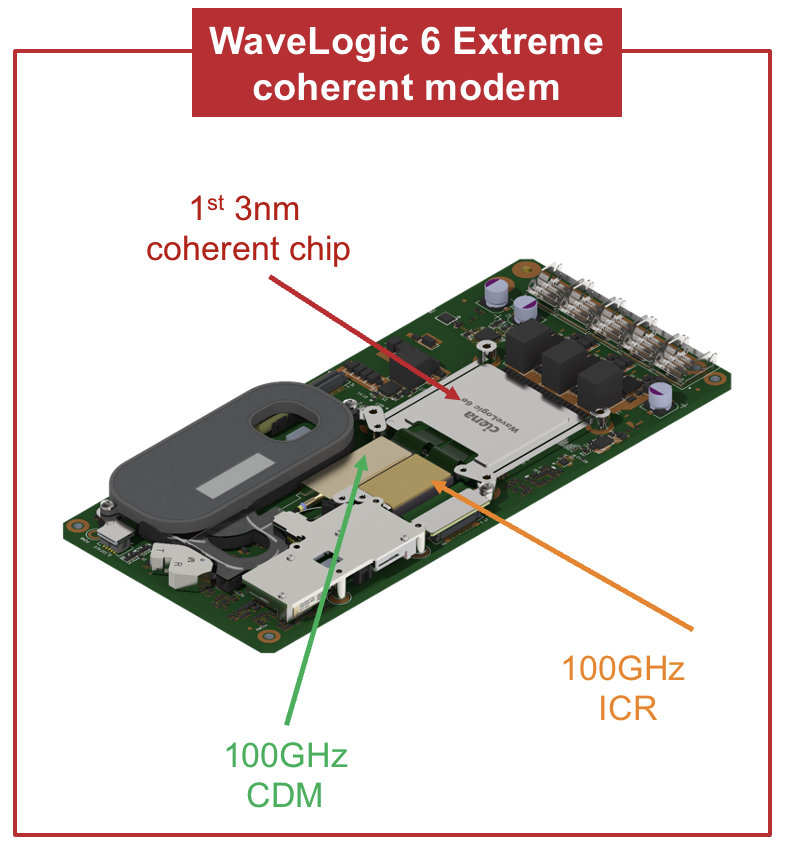
“There are multiple options that are available and being looked at,” says Helen Xenos, senior director of portfolio marketing at Ciena.
Much innovation has been required to achieve the fidelity with 100GHz electro-optics and get the signalling right between the transmitter-receiver and the ASIC, says Xenos.
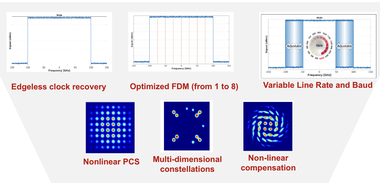
Ciena introduced frequency division multiplexing (FDM) sub-carriers with the WaveLogic 5 Extreme, a technique to help tackle dispersion. With the introduction of edgeless clock recovery, Ciena has created a near-ideal rectangular spectrum with sharp edges.
“First, inside this signal, there are FDM sub-carriers, but you don’t see them because they are right next to each other,” says Xenos. “Getting rid of this dead space between carriers enables more throughput.”
Making the signal’s edges sharper means that wavelengths are packed more tightly, better using precious fibre spectrum. Edgeless clock recovery alone improves spectral efficiency by between 10-13 per cent, says Xenos.
Moving to 3nm allows additional signal processing. As an example, Ciena’s WaveLogic 6 Extreme DSP can select between 1, 2, 4 and 8 sub-carriers based on the dispersion on the link. WaveLogic 5 Extreme supports 4 sub-carrier FDM only.
The baud rate is also adjustable from 67-200GBd, while for the line rate, the WaveLogic 6 supports 200-gigabit to 1.6-terabit wavelengths using probabilistic constellation shaping (PCS).
Another signal processing technique used is multi-dimensional constellation shaping. These are specific modulations that are added to support legacy submarine links.
“For compensated submarine cables that have specific characteristics, they need a specialised type of design also in the DSP,” says Xenos.
Ciena also uses nonlinear compensation techniques to squeeze further performance and allow higher power signals, improving overall link performance.
Ciena can address terrestrial and new and legacy submarine links with the WaveLogic 6 Extreme running these techniques.
Xenos cites performance examples using the enhanced DSP performance of the WaveLogic 6 Extreme.
Using WaveLogic 5, an 800-gigabit wavelength can be sent at 95GBd using a 112.5GHz-wide channel. The 800-gigabit signal can cross several reconfigurable optical add-drop multiplexer (ROADM) hops.
Sending a 1.6-terabit wavelength at 185GBd over a similar link, the signal occupies a 200GHz channel. “And you get better performance because of the extra DSP enhancements,” says Xenos.
The operator Southern Cross has simulated using the WaveLogic 6 Extreme on its network and says the DSP will be able to send one terabit of data over 12,000km.
Optical transport systems benefits
Systems benefits of the Extreme DSP include doubling capacity, transmitting a 1.6-gigabit wavelength, and halving the power consumed per bit.
The WaveLogic 6 Extreme will fit within existing Ciena optical transport kit.
Xenos said the design goal is to get to the next level of cost and power reduction and maximise the network coverage for 800-gigabit wavelengths. This is why Ciena chose to jump to 3nm CMOS for the WaveLogic 6 Extreme, skipping 5nm CMOS.
WaveLogic 6 Nano
The 3nm CMOS WaveLogic 6 Nano addresses pluggable applications for metro and data centre interconnect.
“The opportunity is still largely in front of us [for coherent pluggables],” says Xenos.
The current WaveLogic 5 Nano operating between 31.5-70GBd addresses 100-gigabit to 400-gigabit coherent pluggable applications. These include fixed grid networks using 50GHz channels and interoperable modes such as OpenROADM, 400ZR and 400ZR+. Also supported is the 200-gigabit CableLabs specification.
The WaveLogic 5 Nano is also used in the QSFP-DD module with embedded amplification for high-performance applications.
There is also a new generation of specifications being worked on by standards bodies on client side and line side 800-gigabit and 1.6-terabit interfaces.
Developments mentioned by Xenos include an interoperable probabilistic constellation shaping proposal to be implemented using coherent pluggables.
The advent of 12.8-terabit and 25.6-terabit Ethernet switches gave rise to 400ZR. Now with the start of 51.2-terabit and soon 102.4-terabit switches, the OIF’s 800ZR standard will be needed.

There is also a ‘Beyond 400 Gig’ ITU-T and OpenROADM initiative to combine the interoperable OpenZR+ and the 400-gigabit coherent work of the OpenROADM MSA for a packet-optimised 800-gigabit specification for metro applications.
Another mode is designed to support not just Ethernet but OTN clients.
Lastly, there will also be long-distance modes needed at 400, 600, and 800-gigabit rates.
“With WaveLogic 6 Nano, the intent is to double the capacity within the same footprint,” says Xenos.
In addition to these initiatives, the WaveLogic 6 Nano will address a new application class for much shorter spans – 10km and 20km – at the network edge. The aim is to connect equipment across buildings in a data centre campus, for example.
Some customers want a single channel design and straightforward forward-error correction. Other customers with access to limited capacity will want a wavelength division multiplexed (WDM) solution.
The Nano’s processing and associated optics will be tuned to each application class. “The engineering is done so that we only use the performance and power required for a specific application,” says Xenos.
A Nano-based coherent pluggable connecting campus buildings will differ significantly from a pluggable sending 800 gigabits over 1,000km or across a metro network with multiple ROADM stages, she says.
The WaveLogic 6 Nano will be used with silicon photonics-based coherent optics, but other materials for the coherent driver modulator transmitter may be used.
Availability
Ciena taped out the first 3nm CMOS Extreme and Nano ICs last year.
The WaveLogic 6 Extreme-based coherent modem will be available for trials later this year. Product shipments and network deployments will begin in the first half of 2024.
Meanwhile, shipments of WaveLogic 6 Nano will follow in the second half of 2024.


Deutsche Telekom explains its IP-over-DWDM thinking
Telecom operators are always seeking better ways to run their networks. In particular, operators regularly scrutinise how best to couple the IP layer with their optical networking infrastructure.
The advent of 400-gigabit coherent modules that plug directly into an IP router is one development that has caught their eye.
Placing dense wavelength division multiplexing (DWDM) interfaces directly onto an IP router allows the removal of a separate transponder box and its interfacing.
IP-over-DWDM is not a new concept. However, until now, operators have had to add a coherent line card, taking up valuable router chassis space.

Now, with the advent of compact 400-gigabit coherent pluggables developed for the hyperscalers to link their data centres, telecom operators have realised that such pluggables also serve their needs.
BT will start rolling out IP-over-DWDM in its network this year, while Deutsche Telekom has analysed the merits of IP-over-DWDM.
“The adoption of IP-over-DWDM is the subject of our techno-economical studies,” says Werner Weiershausen, senior architect for the transport network at Deutsche Telekom.
Network architecture
Deutsche Telekom’s domestic network architecture comprises 12 large nodes where IP and OTN backbones align with the underlying optical networking infrastructure. These large nodes – points of presence – can be over 1,000km apart.
Like many operators, Deutsche Telekom has experienced IP annual traffic growth of 35 per cent. The need to carry more traffic without increasing costs has led the operators to adopt coherent technology, with the symbol rate rising with each new generation of optical transport technology.
A higher channel bit rate sends more data over an optical wavelength. The challenge, says Weiershausen, is maintaining the long-distance reaches with each channel rate hike.
Deutsche Telekom’s in-house team forecasts that IP traffic growth will slow down to a 20 per cent annual growth rate and even 16 per cent in future.
Weiershausen says this is still to be proven but that if annual traffic growth does slow down to 16-20 per cent, bandwidth growth issues will remain; it is just that they can be addressed over a longer timeframe.
Bandwidth and reach are long-haul networking issues. Deutsche Telekom’s metro networks, which are horse-shoe-shaped, have limited spans overall.
“For metro, our main concern is to have the lowest cost-per-bit because we are fibre- and spectrum-rich, and even a single DWDM fibre pair per metro horseshoe ring offer enough bandwidth headroom,” says Weiershausen. “So it’s easy; we have no capacity problem like the backbone. Also there, we are fibre-rich but can avoid the costly activation of multiple parallel fibre trunks.”
IP-over-DWDM
IP-over-DWDM is increasingly associated with adding pluggable optics onto an IP core router.
“This is what people call IP-over-DWDM, or what Cisco calls it hop-by-hop approach,” says Dr Sascha Vorbeck, head of strategy and architecture IP-core & transport networks at Deutsche Telekom.

Cisco’s routed optical networking – its term for the hop-by-hop approach – uses the optical layer for point-to-point connections between IP routers. As a result, traffic switching and routing occur at the IP layer rather than the optical layer, where optical traffic bypass is performed using reconfigurable optical add/drop multiplexers (ROADMs).
Routed optical networking also addresses the challenge of the rising symbol rate of coherent technology, which must maintain the longest reaches when passing through multiple ROADM stages.
Deutsche Telekom says it will not change its 12-node backbone network to accommodate additional routing stages.
“We will not change our infrastructure fundamentally because this is costly,” says Weiershausen. “We try to address this bandwidth growth with technology and not with the infrastructure change.”
Deutsche Telekom’s total cost-of-ownership analysis highlights that optical bypass remains attractive compared to a hop-by-hop approach for specific routes.
However, the operator has concluded that the best approach is to have both: some hop-by-hop where it suits its network in terms of distances but also using optical bypass for longer links using either ROADM or static bypass technology.
“A mixture is the optimum from our total cost of ownership calculation,” says Weiershausen. “There was no clear winner.”
Strategy
Deutsche Telecom favours coherent interfaces on its routers for its network backbone because it wants to simplify its network. In addition, the operator wants to rid its network of existing DWDM transponders and their short reach – ‘grey’ – interfaces linking the IP router to the DWDM transponder box.
“They use extra power and are an extra capex [capital expenditure] cost,” says Weiershausen. “They are also an additional source of failures when you have in-line several network elements. That said, heat dissipation of long-reach coherent optical DWDM interfaces limited the available IP router interfaces that could have been activated in the past.
For example, a decade ago, Deutsche Telecom tried to use IP-over-DWDM for its backbone network but had to step back to use an external DWDM transponder box due to heat dissipation problems.
The situation may have changed with modern router and optical interface generations, but this is under further study by Deutsche Telecom and is an essential prerequisite for its evolution roadmap.
Deutsche Telecom is still using traditional DWDM equipment between the interconnection of IP routers with grey interfaces. Deutsche Telecom undertook an evaluation in 2020 and calculated a traditional DWDM network versus a hop-by-hop approach. Then, the hop-by-hop method was 20 per cent more expensive. Deutsche Telecom plans to redo the calculations to see if anything has changed.
The operator has yet to decide whether to adopt ZR+ coherent pluggable optics and a hop-by-hop approach or use more advanced larger coherent modules in its routers. “This is not decided yet and depends on pricing evolution,” says Weiershausen.
With the volumes expected for pluggable coherent optics, the expectation is they will have a notable price advantage compared to traditional high-performance coherent interfaces.
But Deutsche Telekom is still determining, believing that conventional coherent interfaces may also come down markedly in price.
SDN controller
Another issue for consideration with IP-over-DWDM is the software-defined networking (SDN) controller.
IP router vendors offer their SDN controllers, but there also is a need for working with third-party SDN controllers.
For example, Deutsche Telekom is a member of the OpenROADM multi-source agreement and has pushed for IP-over-DWDM to be a significant application of the MSA.
But there are disaggregation issues regarding how a router’s coherent optical interfaces are controlled. For example, are the optical interfaces overseen and orchestrated by the OpenROADM SDN controller and its application programming interface (API) or is the SDN controller of each IP router vendor responsible for steering the interfaces?
Deutsche Telekom says that a compromise has been reached for the OpenROADM MSA whereby the IP router vendors’ SDN controllers oversee the optics but that for the solution to work, information is exchanged with the OpenROADM’s SDN controller.
“That way, the path computation engine (PCE) of the optical network layer, including the ROADMs, can calculate the right path to network the traffic. “Without information from the IP router, it would be blind; it would not work,” says Weiershausen.
Automation
Weiershausen says it is not straightforward to say which approach – IP-over-DWDM or a boundary between the IP and optical layers – is easier to automate.
“Principally, it is the same in terms of the information model; it is just that there are different connectivity and other functionalities [with the two approaches],” says Weiershausen.
But one advantage of a clear demarcation between the layers is the decoupling of the lifecycles of the different equipment.
Fibre has the longest lifecycle, followed by the optical line system, with IP routers having the shortest of the three, with new generation equipment launched every few years.
Decoupling and demarcation is therefore a good strategy here, notes Weiershausen.