

PMC advances OTN with 400 Gigabit processor
Optical modules for the line-side are moving beyond 100 Gigabits to 200 Gigabit and now 400 Gigabit transmission rates. Such designs are possible thanks to compact photonics designs and coherent DSP-ASICs implemented using advanced CMOS processes.
 An example switching application showing different configurations of the DIGi-G4 OTN processor on the line cards. Source: PMC
For engineers, the advent of higher-speed line-side interfaces sets new challenges when designing the line cards for optical networking equipment. In particular, the framer silicon that interfaces to the coherent DSP-ASIC, on the far side of the optics, must cope with a doubling and quadrupling of traffic.
Such line cards for metro network platforms is where PMC-Sierra is targeting its latest 400 Gigabit DIGI-G4 Optical Transport Network (OTN) processor.
The OTN standard, defined by the telecom standards body of the International Telecommunication Union (ITU-T), performs several roles in the network. It is a layer-one technology that packages packet and circuit-switched traffic. OTN wraps traffic in a variety of container sizes for transport, from 1 Gigabit (OTU1) to 100 Gigabit (OTU4). And now 100 Gigabit can be viewed as a sub-frame, multiples of which can be combined to create even larger frames, dubbed OTUCn, where n is a multiple of 100 Gig.
Using OTN, container traffic can be broken up, switched and recombined within new containers before being transmitted optically. OTN also provides forward error correction and network management features.
PMC’s DIGI-G4 OTN processor is aimed at next-generation packet-optical transport systems (P-OTS) adopting 400 Gig line cards, and for platforms for the burgeoning data centre interconnect market.
“The amounts of traffic internet content providers need between their data centres is astonishing; they are talking hundreds of terabits of traffic,” says Hamish Dobson, director of strategic marketing at PMC. Hyper-scale data centre operators, unlike telcos, do not require OTN switching but they are keen on OTN as the DWDM management layer, he says: “I’m not aware of any of the hyper-scale players who are deploying their own networks who are not using OTN as the un-channelised digital wrapper on their systems.”
The DIGI-G4 does more than simply quadruple OTN traffic throughput compared to PMC’s existing DIGI 120G OTN processor. The chip also adds encryption hardware to secure links while supporting the emerging Transport Software-Defined Networking (Transport SDN).
DIGI-G4
The DIGI-G4 increases by fourfold the traffic throughput while halving the power-per-port compared to PMC's DIGI 120G. System designers must control the total power consumption of the line card, given the greater interface density, and when metro equipment platforms’ power profile is already at 500W-per-slot, says Dobson. PMC has halved the power consumption-per-port by implementing the latest OTN processor in a 28 nm CMOS process and by using more power-efficient serialisers/ deserialisers (serdes).
Internet content providers with their use of distributed data centres is one reason for the device’s introduction of the Advanced Encryption Standard (AES-256). Another is the emergence of cloud services and the need to secure individual customer’s traffic.
“We have added a channelised hardware [encryption] engine,” says Dobson. “The encryption engine is capable of being applied to any OTN channel in the device.”
Other features of the Digi-G4 include input/ output (I/O) capable of 28 Gigabit-per-second (Gbps). This enables the DIGI-G4 to connect directly to CFP2 and CFP4 pluggable optics without the need for gearbox devices on the line card, reducing power and overall cost.
The OTN chip is a hybrid design capable of processing 400 Gigabit of packet traffic or 400 Gig of circuit (time-division multiplexed) traffic, or any combination of the two, with a granularity of one gigabit channels. “It can switch a full 400 Gig's worth of one Gigabit ODU0 channels,” says Dobson.
The Digi-G4 also support a pre-standard implementation of the OTUC2 and OTUC4 transport units that are two and four multiples of 100 Gigabit, respectively. The OTUCn standard is not expected to be ratified before 2017.

We will see the capabilities of these new packet-optical systems coming together with SDN to enable interesting things to be done in the metro
Hamish Dobson
Transport SDN
SDN will have a significant effect on the transport network, says Dobson. In particular Transport SDN where SDN is applied to the transport layers of the wide area network (WAN). As such, OTN plays an important role in multi-layer optimisation. Packet-optical transport systems, which support packet and optical within the same platform, are ideal for getting much more efficiency out of the optical spectrum, he says.
Using Transport SDN to co-ordinate packet, OTN and the optical layer, routing decisions can be made aware of available capacity in the optical domain. In turn, network protection decisions can also be based on optical capacity availability. “The DIGI-G4, being a hybrid processor to enable these multi-layer platforms, is an important element to bring this all together,” says Dobson.
OTN also aids the virtualisation of optical resources whereby individual enterprises can be given a simpler, subset view of the network. “We need more than just wavelength granularity in the network,” says Dobson. Since 100 Gigabit and, in future, 200 and 400 Gig lightwaves, are such large pipes, these are inevitably filled with multiple traffic flows. “Channelised OTN and OTN switching are how carriers are going to break down these massive amounts of optical capacity and partition them for various uses,” says Dobson.
A third element whereby OTN aids Transport SDN is the move to on-demand provisioning by adapting capacity at the OTN layer. Dobson cites the ITU-T G.7044/Y.1347 (G.HAO) standard, which the DIGI-G4 supports, whereby frame size can be adjusted using ODUflex without impacting existing network traffic.
“We will see the capabilities of these new packet-optical systems coming together with SDN to enable interesting things to be done in the metro,” says Dobson.
Samples of the DIGI-G4 are already with customers.
Further reading
White Paper: Benefits of OTN in Transport SDN, click here and then 'documentation'

OTN processors from the core to the network edge
The latest silicon design announcements from PMC and AppliedMicro reflect the ongoing network evolution of the Optical Transport Network (OTN) protocol.

"There is a clear march from carriers, led in particular by China, to adopt OTN in the metro"
Scott Wakelin, PMC
The OTN standard, defined by the telecom standards body of the International Telecommunication Union (ITU-T), has existed for a decade but only recently has it emerged as a key networking technology.
OTN's growing importance is due to the enhanced features being added to the protocol coupled with developments in the network. In particular, OTN enhances capabilities that operators have long been used to with SONET/SDH, while also supporting packet-based traffic. Moreover chip vendors are unveiling OTN designs that now span the core to the network edge.
"OTN switching is a foundational technology in the network"
Michael Adams, Ciena
OTN supports 1 Gigabit Ethernet (GbE) with ODU0 framing alongside ODU1 (2.5G), ODU2 (10G), ODU3 (40G) and ODU4 (100G). The standard packs efficiently client signals such as SONET/SDH, Ethernet, video and Fibre Channel, at the various speed increments up to 100Gbps prior to transmission over lightpaths. Meanwhile, the Optical Internetworking Forum (OIF) has recently developed the OTN-over-Packet-Fabric standard that allows OTN to be switched using packet fabrics.
"OTN switching is a foundational technology in the network," says Michael Adams, Ciena’s vice president of product & technology marketing.
Operator benefits
Whereas 10Gbps services matched 10Gbps lightpaths only a few years ago, transport speeds have now surged ahead. Common services are at 1 and 10 GbE while transport is now at 40Gbps and 100Gbps speeds. OTN switching allows client signals to be combined efficiently to fill the higher capacity lightpaths and avoid stranded bandwidth in the network.
OTN also benefits network connectivity changes. With AT&T's Optical Mesh Service, for example, customers buy a total capacity and, using a web portal, can adapt connectivity between their sites as requirements change. "It [OTN] can manage GbE streams and switch them through the network in an efficient manner," says Adams.
The ability to adapt connectivity is also an important requirement for cloud computing, with OTN switching and a mesh control plane seen as a promising way to enable dynamic networking that provides guaranteed bandwidth when needed, says Ciena.
OTN also offers an alternative to IP-over-DWDM, argues Ciena. By adding a 100Gbps wavelength, service routers can exploit OTN to add 10G services as needed rather than keep adding a 10Gbps wavelength for each service using IP-over-DWDM. "To enable service creation quickly, why not put your router network on top of that network versus running it directly?" says Adams.
OTN hardware announcements
The latest OTN chip announcements from PMC and Applied Micro offer enhanced capacity when aggregating and switching client signals, while also supporting the interfacing to various switch fabrics.
PMC has announced two metro OTN processors, dubbed the HyPHY 20Gflex and 10Gflex. The devices are targeted at compact "pizza boxes" that aggregate residential, enterprise and mobile backhaul traffic, as well as packet-optical and optical transport platforms.
AppliedMicro's TPACK unit has unveiled two additions to its OTN designs: a 100Gbps chipset and the TPO134. The company also announced the general availability of its 100Gbps muxponder and transponder OTN design, now being deployed in the network.
 Source: AppliedMicro
"OTN has long had a home in the core of the network," says Scott Wakelin, product manager for HyPHY flex at PMC. "But there is a clear march from carriers, led in particular by China, to adopt OTN in the metro, whether layer-zero or layer-one switched."
Using various market research forecasts, PMC expects the global OTN chip market to reach US $600 million in 2015, the bulk being metro.
PMC and AppliedMicro offer application-specific standard product (ASSP) OTN ICs while AppliedMicro also offers FPGA-based OTN designs.
The benefits of using an FPGA, says AppliedMicro, include time-to-market, the ability to reprogramme the design to accommodate standards’ tweaks, and enabling system vendors to add custom logic elements to differentiate their designs. PMC develops ASSPs only, arguing that such chips offer superior integration, power efficiency and price points.
Both companies, when developing an ASSP, know that the resulting design will be adopted by end customers. When PMC announced its original HyPhy family of devices, seven of the top nine OEMs were developing board designs based on the chip family.
PMC's metro OTN processors
The HyPHY 20Gflex has 16 SFP (up to 5Gbps) and two 10Gbps XFP/SFP+ interfaces, whose streams it can groom using the device's 100Gbps cross-connect. The cross-connect can manipulate streams down to SONET/SDH STS-1/ STM-0 rates and ODU0 (1GbE) OTN channels.
Both ODU0 and ODUflex channels are supported. Before adding ODU0, a Gigabit Ethernet channel could only sit in a 2.5Gbps (ODU1) container, which wastes half the capacity. Similarly by supporting ODUflex, signals such as video can be mapped into frames made up of increments of 1.25Gbps. "For efficient use of resources from the metro into the core, you need to start at the access," said Wakelin.
 Source: PMC
The chip also supports the OTN-over-Packet-Fabric protocol. The devices can interface to OTN, SONET/SDH and packet switch fabrics.
The 20Gflex offers 40Gbps of OTN framing and a further 20Gbps of OTN mapping. The OTN mapping is used for those client signals to be fitted into ODU frames. With the additional 40Gbps interfaces that connect to the switch fabric, the total interface throughput is 100Gbps, matching the device's cross-connect capacity.
Other chip features include Fast Ethernet, Gigabit Ethernet and 10GbE MACs for carrier Ethernet transport, and support for timing over packet standards, including IEEE 1588v2 over OTN, used to carry mobile backhaul timing information.
The 10Gflex variant has similar functionality to the 20Gflex but with lower throughput.
PMC is now sampling the HyPHY Gflex devices to lead customers.
AppliedMicro's OTN designs
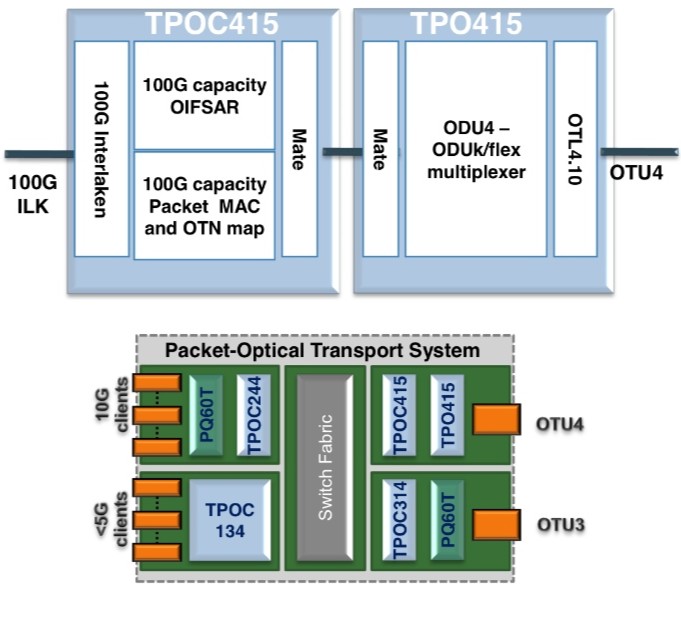
AppliedMicro's TPACK unit has unveiled two OTN designs: a TPO415/C415 OTN multiplexer chipset for use in 100Gbps packet optical transport line cards, and the TPO134 device used at the network edge.
The two devices combined - the TPO415 and TPOC415 - are implemented using FPGAs, what AppliedMicro dubs softsilicon. The two devices interface between the 100Gbps line side and the switch fabric. The TPO415 takes the OTU4 line side OTN signal and demultiplexes it to the various channel constituents. These can be ODU0, ODU1, ODU2, ODU3, ODU4 and ODUflex - capacity from 1Gbps to 100Gbps.

"The [100Gbps muxponder] design comes with an API that makes it look like one component"
Lars Pedersen, AppliedMicro
The TPOC415 has a 100Gbps, 80-channel segmentation and reassembly function (SAR) compliant with the OIF OTN-over-Packet-Fabric standard. The TPOC415 also has a 100Gbps, 80 channel packet mapper function for the transport of Ethernet and MPLS-TP over ODUk or ODUflex. The device's 100Gbps Interlaken interface is used to connect to the switch fabric for packet switching and ODU cross-connection. The devices can also be used in a standalone fashion for designs where the switch fabric does not use Interlaken, or when working with integrated switches and network processors.
 Source: AppliedMicro
"This is the first solution in the market for doing these hybrid functions at 100Gbps," says Lars Pedersen, CTO of AppliedMicro's TPACK.
The second design is the softsilicon TPO134, a 10Gbps add/drop multiplexer that can take in up to 16 clients signals and has two OTU2 interfaces. In between is the cross-connect that supports ODU0, ODU1 and ODUflex channels. Two devices can be combined to support 32 client channels and four OTU2 interfaces. Such a dual-design in a pizza-box system would be used to combine multiple client streams.
Being softsilicon, the TPO134 can also be used for packet optical transport systems. Here by downloading a different FPGA image, the design can also implement the segmentation and reassembly function required for the OIF's OTN-over-Packet-Fabric standard. "The interface to the switch fabric is Interlaken again," says Pedersen.
The TPO134 design doubles the capacity of AppliedMicro's previous add/drop multiplexer designs and is the first to support the OIF standard.
AppliedMicro has also announced the general availability of its 100G muxponder design. The muxponder design is a three-device chipset based on two PQ60 ASSPs and a TPO404 softsilicon design.
The PQ60T devices map 10 and 40Gbps clients into OTN and the TPO404 performs the multiplexing to OTU4 with forward error correction. The client signals supported include SONET/SDH, Ethernet and Fibre Channel. On the line side the design also supports various FEC schemes including an enhanced FEC. The TPO404 differ from the TPOT414/424 devices that link 100GbE and 100Gbps line side.
"The [100Gbps muxponder] design comes with an API [application programming interface] that makes it look [from a software perspective] like one component with some client and line ports, similar to the TPO134 device," says Pedersen.
Further reading:
Transport processors now at 100 Gigabit