

Is traffic aggregation the next role for coherent?
Ciena and Infinera have each demonstrated the transmission of 800-gigabit wavelengths over near-1,000km distances, continuing coherent's marked progress. But what next for coherent now that high-end optical transmission is approaching the theoretical limit? Can coherent compete over shorter spans and will it find new uses?
Part 1: XR Optics
“I’m going to be a bit of a historian here,” says Dave Welch, when asked about the future of coherent.
Interest in coherent started with the idea of using electronics rather than optics to tackle dispersion in fibre. Using electronics for dispersion compensation made optical link engineering simpler.

Dave Welch
Coherent then evolved as a way to improve spectral efficiency and reduce the cost of sending traffic, measured in gigabit-per-dollar.
“By moving up the QAM (quadrature amplitude modulation) scale, you got both these benefits,” says Welch, the chief innovation officer at Infinera.
Improving the economics of traffic transmission still drives coherent. Coherent transmission offers predictable performance over a range of distances while non-coherent optics links have limited spans.
But coherent comes at a cost. The receiver needs a local oscillator - a laser source - and a coherent digital signal processor (DSP).
Infinera believes coherent is now entering a phase that will add value to networking. “This is less about coherent and more about the processor that sits within that DSP,” says Welch.
Aggregation
Infinera is developing technology - dubbed XR Optics - that uses coherent for traffic aggregate in the optical domain.
The 'XR’ label is a play on 400ZR, the 400-gigabit pluggable optics coherent standard. XR will enable point-to-point spans like ZR optics but also point-to-multipoint links.
Infinera, working with network operators, has been assessing XR optics’ role in the network. The studies highlight how traffic aggregation dictates networking costs.
“If you aggregate traffic in the optical realm and avoid going through a digital conversion to aggregate information, your network costs plummet,” says Welch.
Are there network developments that are ripe for such optical aggregation?
“The expansion of bandwidth demand at the network edge,” says Rob Shore, Infinera’s senior vice president of marketing. “It is growing, and it is growing unpredictably.”
XR Optics
XR optics uses coherent technology and Nyquist sub-carriers. Instead of a laser generating a single carrier, pulse-shaping at the optical transmitter is used to create multiple carriers, dubbed Nyquist sub-carriers.
The sub-carriers carry the same information as a single carrier but each one has a lower symbol rate. The lower symbol rate improves tolerance to non-linear fibre effects and enables the use of lower-speed electronics. This benefits long-distance transmissions.
But sub-carriers also enable traffic aggregation. Traffic is fanned out over the Nyquist sub-carriers. This enables modules with different capacities to communicate, using the sub-carrier as a basic data rate. For example, a 25-gigabit single sub-carrier XR module and a 100-gigabit XR module based on four sub-carriers can talk to a 400-gigabit module that supports 16.
It means that optics is no longer limited to a fixed point-to-point link but can support point-to-multipoint links where capacities can be changed adaptively.
“You are not using coherent to improve performance but to increase flexibility and allow dynamic reconfigurability,” says Shore.

Rob Shore
XR optics makes an intermediate-stage aggregation switch redundant since the higher-capacity XR coherent module aggregates the traffic from the lower-capacity edge modules.
The result is a 70 per cent reduction in networking costs: the transceiver count is halved and platforms can be removed from the network.
XR Optics starts to make economic sense at 10-gigabit data rates, says Shore. “It depends on the rest of the architecture and how much of it you can drive out,” he says. “For 25-gigabit data rates, it becomes a virtual no-brainer.”
There may be the coherent ‘tax’ associated with XR Optics but it removes so much networking cost that it proves itself much earlier than a 400ZR module, says Shore.
Applications
First uses of XR Optics will include 5G and distributed access architecture (DAA) whereby cable operators bring fibre closer to the network edge.
XR Optics will likely be adopted in two phases. The first is traditional point-to-point links, just as with 400ZR pluggables.
“For mobile backhaul, what is fascinating is that XR Optics dramatically reduces the expense of your router upgrade cost,” says Welch. “With the ZR model I have to upgrade every router on that ring; in XR I only have to upgrade the routers needing more bandwidth.”
Phase two will be for point-to-multipoint aggregation networks: 5G, followed by cable operators as they expand their fibre footprint.
Aggregation also takes place in the data centre, has coherent a role there?
“The intra-data centre application [of XR Optics] is intriguing in how much you can change in that environment but it is far from proven,” says Welch.
Coherent for point-to-point links will not be used inside the data centre as it doesn’t add value but configurable point-to-multiple links do have merit.
“It is less about coherent and more about the management of how content is sent to various locations in a point-to-multiple or multipoint-to-multipoint way,” says Welch. “That is where the game can be had.”
Uptake
Infinera is working with leading mobile operators regarding using XR Optics for optical aggregation. Infinera is talking to their network architects and technologists at this stage, says Shore.
Given how bandwidth at the network edge is set to expand, operators are keen to explore approaches that promise cost savings. “The people that build mobile networks or cable have told us they need help,” says Shore.
Infinera is developing the coherent DSPs for XR Optics and has teamed with optical module makers Lumentum and II-VI. Other unnamed partners have also joined Infinera to bring the technology to market.
The company will detail its pluggable module strategy including XR Optics and ZR+ later this year.


Infinera rethinks aggregation with slices of light
An optical architecture for traffic aggregation that promises to deliver networking benefits and cost savings was unveiled by Infinera at this week’s ECOC show, held in Dublin.
Traffic aggregation is used widely in the network for applications such as fixed broadband, cellular networks, fibre-deep cable networks and business services.
Infinera has developed a class of optics, dubbed XR optics, that fits into pluggable modules for traffic aggregation. And while the company is focussing on the network edge for applications such as 5G, the technology could also be used in the data centre.
Optics is inherently a point-to-point communications technology, says Infinera. Yet optics is applied to traffic aggregation, a point-to-multipoint architecture, and that results in inefficiencies.
“The breakthrough here is that, for the first time in optics’ history, we have been able to make optics work to match the needs of an aggregation network,” says Dave Welch, founder and chief innovation officer at Infinera.
Infinera proposes coherent sub-carriers for a new class of problem
XR Optics
Infinera came up with the ‘XR’ label after borrowing from the naming scheme used for 400ZR, the 400-gigabit pluggable optics coherent standard.
“XR can do point-to-point like ZR optics,” says Welch. “But XR allows you to go beyond, to point-to-multipoint; ‘X’ being an ill-defined variable as to exactly how you want to set up your network.”
XR optics uses coherent technology and Nyquist sub-carriers. Instead of using a laser to generate a single carrier, pulse-shaping is used at the transmitter to generate multiple carriers, referred to as Nyquist sub-carriers.
The sub-carriers convey the same information as a single carrier but by using several sub-carriers, a lower symbol rate can be used for each. The lower symbol rate improves the tolerance to non-linear effects in a fibre and enables the use of lower-speed electronics.
Infinera first detailed Nyquist sub-carriers as part of its advanced coherent toolkit, and implemented the technology with its Infinite Capacity Engine 4 (ICE4) used for optical transport.
The company is bringing to market its second-generation Nyquist sub-carrier design with its ICE6 technology that supports 800-gigabit wavelengths.
Now Infinera is proposing coherent sub-carriers for a new class of problem: traffic aggregation. But XR optics will need backing and be multi-sourced if it is to be adopted widely.
Network operators will also need to be convinced of the technology’s merits. Infinera claims XR optics will halve the pluggable modules needed for aggregation and remove the need for intermediate digital aggregation platforms, reducing networking costs by 70 percent.
Aggregation optics
XR optics will be required at both ends of a link. The modules will need to understand a protocol that tells them the nature of the sub-carriers to use: their baud rate (and resulting spectral width) and modulation scheme.
Infinera cites as the example a 4GHz-wide sub-carrier modulated using 16-ary quadrature amplitude modulation (16-QAM) that can transmit 25-gigabit of data.
A larger capacity XR coherent module will be used at the aggregation hub and will talk directly with XR modules at the network edge, “casting out” its sub-carriers to the various pluggable modules at the network edge.
For example, the module at the hub may be a 400-gigabit QSFP-DD supporting 16, 25-gigabit sub-carriers, or an 800-gigabit QSFP-DD or OSFP module delivering 32 sub-carriers. A mix of lower-speed XR modules will be used at the edge: 100-gigabit QSFP28 XR modules based on four sub-carriers and single sub-carrier 25-gigabit SFP28s.

“As soon as you have defined that each one of these transceivers is some multiple of that 25-gigabit sub-carrier, they can all talk to each other,” says Welch.
The hub XR module and network-edge modules are linked using optical splitters such that all the sub-channels sent by the hub XR module are seen by each of the edge modules. The hub in effect broadcasts its sub-carriers to all the edge devices, says Welch.
A coding scheme is used such that each edge module’s coherent receiver can pick off its assigned sub-channel(s). In turn, an edge module will send its data using the same frequencies on a separate fibre.
Basing the communications on multiples of sub-carriers means any XR module can talk to any other, irrespective of their overall speeds.
Sub-carriers can also be reassigned.
“In that fashion, today you are a 25-gigabit client module and tomorrow you are 100-gigabit,” says Welch. Reassigning edge-module capacities will not happen often but when undertaken, no truck roll will be needed.
System benefits
In a conventional aggregation network, the edge transceivers send traffic to an intermediate electrical aggregation switch. The switch’s line-side-facing transceivers then send on the aggregated traffic to the hub.
Using XR optics, the intermediate aggregation switch becomes redundant since the higher-capacity XR coherent module aggregates the traffic from the edge. Removing the switch and its one-to-one edge-facing transceivers account for the halving of the overall transceiver count and the overall 70 percent network cost saving (see diagram below).
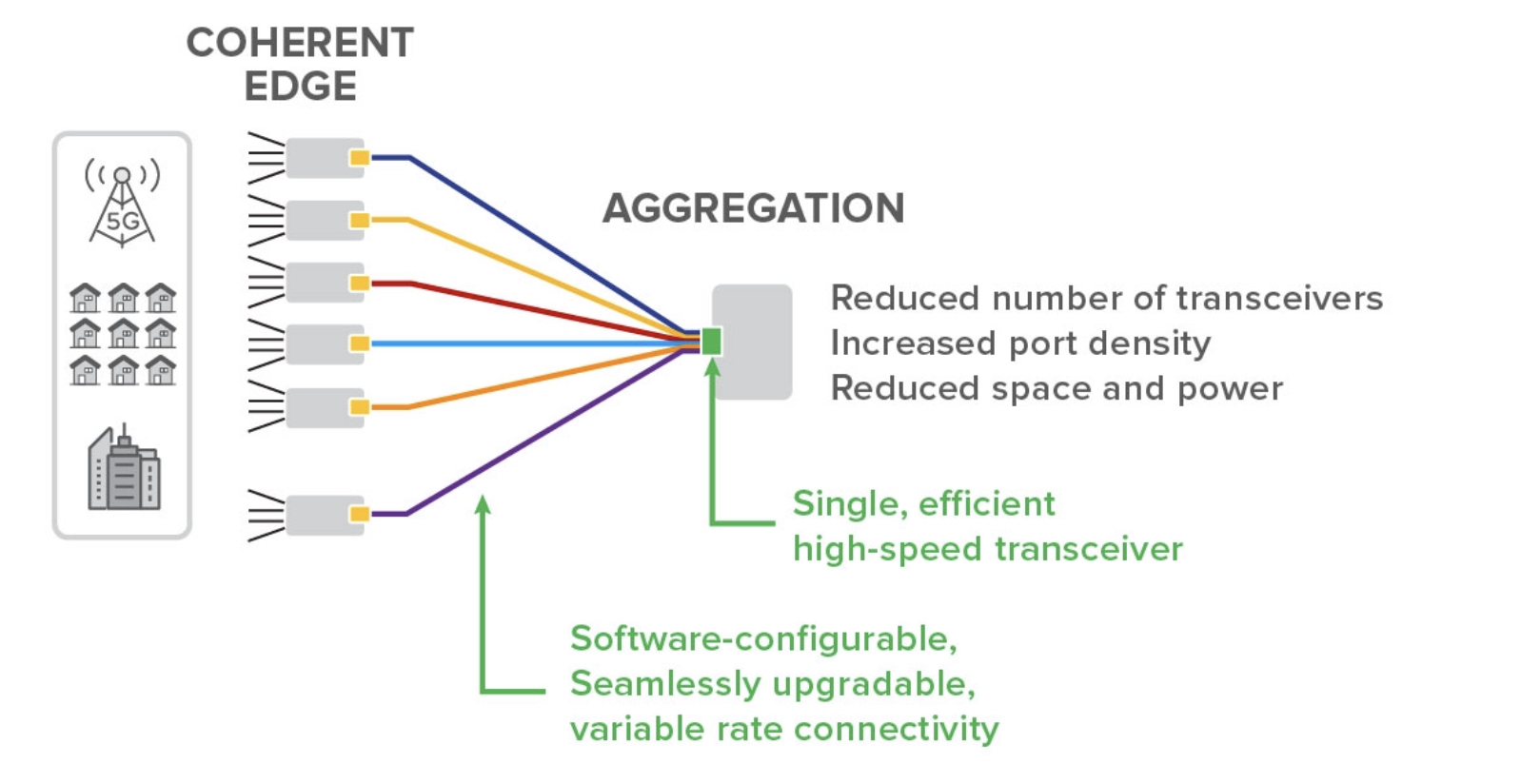
The disadvantage of getting rid of the intermediate aggregation switch is minor in comparison to the plusses, says Infinera.
“In a network where all the traffic is going left to right, there is always an economic gain,” says Welch. And while a layer-2 aggregation switch enables statistical multiplexing to be applied to the traffic, it is insignificant when compared to the cost-savings XR optics brings, he says.
Challenges
XR transceivers will need to support sub-carriers and coherent signal processing as well as the language that defines the sub-carriers and their assignment codes. Accordingly, module makers will need to make a new class of XR pluggable modules.
“We are working with others,” says Welch. “The object is to bring the technology and a broad-base supply chain to the market.” The fastest way to achieve this, says Welch, is through a series of multi-source agreements (MSAs). Arista Networks and Lumentum were both quoted as part of Infinera’s XR Optics press release.
Another challenge is that a family of coherent digital signal processors (DSPs) will need to be designed that fit within the power constraints of the various slim client-side pluggable form factors.
Infinera stresses it is unveiling a technological development and not a product announcement. That will come later.
However, Welch says that XR optics will support a reach of hundreds of kilometres and even metro-regional distances of over 1,000km.
“We are comfortable we are working with partners to get this out,” says Welch. “We are comfortable we have some key technologies that will enhance these capabilities as well.”
Other applications
Infinera’s is focussing its XR optics on applications such as 5G. But it says the technology will benefit many network applications.
“If you look at the architecture in the data centre or look are core networks, they are all aggregation networks of one flavour or another,” says Welch. “Any type of power, cost, and operational savings of this magnitude should be evaluated across the board on all networks.”


Next-generation coherent adds sub-carriers to capabilities
Part 2: Infinera's coherent toolkit
 Source: Infinera
Infinera has detailed coherent technology enhancements implemented using its latest-generation optical transmission technology. The system vendor is still to launch its newest photonic integrated circuit (PIC) and FlexCoherent DSP-ASIC but has detailed features the CMOS and indium phosphide ICs support.
The techniques highlight the increasing sophistication of coherent technology and an ever tighter coupling between electronics and photonics.
The company has demonstrated the technology, dubbed the Advanced Coherent Toolkit, on a Telstra 9,000km submarine link spanning the Pacific. In particular, the demonstration used matrix-enhanced polarisation-multiplexed, binary phased-shift keying (PM-BPSK) that enabled the 9,000km span without optical signal regeneration.
Using the ACT is expected to extend the capacity-reach product for links by the order of 60 percent. Indeed the latest coherent technology with transmitter-based digital signal processing delivers 25x the capacity-reach of 10-gigabit wavelengths using direct-detection, the company says.
Infinera’s latest PIC technology includes polarisation-multiplexed, 8-quadrature amplitude modulation (PM-8QAM) and PM-16QAM schemes. Its current 500-gigabit PIC supports PM-BPSK, PM-3QAM and PM-QPSK. The PIC is expected to support a 1.2-terabit super-channel and using PM-16QAM could deliver 2.4 terabit.
“This [the latest PIC] is beyond 500 gigabit,” confirms Pravin Mahajan, Infinera’s director of product and corporate marketing. “We are talking terabits now.”
Sterling Perrin, senior analyst at Heavy Reading, sees the Infinera announcement as less PIC related and more an indication of the expertise Infinera has been accumulating in areas such as digital signal processing.

Nyquist sub-carriers
Infinera is the first to announce the use of sub-carriers. Instead of modulating the data onto a single carrier, Infinera is using multiple Nyquist sub-carriers spread across a channel.
Using a flexible grid, the sub-carriers span a 37.5GHz-wide channel. In the example shown above, six are used although the number is variable depending on the link. The sub-carriers occupy 35GHz of the band while 2.5GHz is used as a guard band.
“Information you were carrying across one carrier can now be carried over multiple sub-carriers,” says Mahajan. “The benefit is that you can drive this as a lower-baud rate.”
Lowering the baud rate increases the tolerance to non-linear channel impairments experienced during optical transmission. “The electronic compensation is also much less than what you would be doing at a much higher baud rate,” says Abhijit Chitambar, Infinera’s principal product and technology marketing manager.
While the industry is looking to increase overall baud rate to increase capacity carried and reduce cost, the introduction of sub-carriers benefits overall link performance. “You end up with a better Q value,” says Mahajan. The ‘Q’ refers to the Quality Factor, a measure of the transmission’s performance. The Q Factor combines the optical signal-to-noise ratio (OSNR) and the optical bandwidth of the photo-detector, providing a more practical performance measure, says Infinera.
Infinera has not detailed how it implements the sub-carriers. But it appears to be a combination of the transmitter PIC and the digital-to-analogue converter of the coherent DSP-ASIC.
It is not clear what the hardware implications of adopting sub-carriers are and whether the overall DSP processing is reduced, lowering the ASIC’s power consumption. But using sub-carriers promotes parallel processing and that promises chip architectural benefits.
“Without this [sub-carrier] approach you are talking about upping baud rate,” says Mahajan. “We are not going to stop increasing the baud rate, it is more a question of how much you can squeeze with what is available today.“
SD-FEC enhancements
The FlexCoherent DSP also supports enhanced soft-decision forward-error correction (SD-FEC) including the processing of two channels that need not be contiguous.
SD-FEC delivers enhanced performance compared to conventional hard-decision FEC. Hard-decision FEC decides whether a received bit is a 1 or a 0; SD-FEC also uses a confidence measure as to the likelihood of the bit being a 1 or 0. This additional information results in a net coding gain of 2dB compared to hard-decision FEC, benefiting reach and extending the life of submarine links.
By pairing two channels, Infinera shares the FEC codes. By pairing a strong channel with a weak one and sharing the codes, some of the strength of the strong signal can be traded to bolster the weaker one, extending its reach or even allowing for a more advanced modulation scheme to be used.
The SD-FEC can also trade performance with latency. SD-FEC uses as much as a 35 percent overhead and this adds to latency. Trading the two supports those routes where low latency is a priority.
Matrix-enhanced PSK
Infinera has implemented a technique that enhances the performance of PM-BPSK used for the longest transmission distances such as sub-sea links. The matrix-enhancement uses a form of averaging that adds about a decibel of gain. “Any innovation that adds gain to a link, the margin that you give to operators is always welcome,” says Mahajan.
The toolkit also supports the fine-tuning of channel widths. This fine-tuning allows the channel spacing to be tailored for a given link as well as better accommodating the Nyquist sub-carriers.
Product launch
The company has not said when it will launch its terabit PIC and FlexCoherent DSP.
“Infinera is saying it is the first announcing Nyquist sub-carriers, which is true, but they don’t give a roadmap when the product is coming out,” says Heavy Reading’s Perrin. “I suspect that Nokia [Alcatel-Lucent], Ciena and Huawei are all innovating on the same lines.”
There could be a slew of announcements around the time of the OFC show in March, says Perrin: “So Infinera could be first to announce but not necessarily first to market.”