

Nuage uses SDN to aid enterprise connectivity needs
"Across the WAN and out to the branch, the context is increasingly complicated, with the need to deliver legacy and cloud applications to users - and sometimes customers - that are increasingly mobile, spanning several networks," says Brad Casemore, research director, data centre networks at IDC. These networks can include MPLS, Metro Ethernet, broadband and 3G and 4G wireless.
 The data centre is a great microcosm of the network - Houman Modarres
At present, remote offices use custom equipment that require a visit from an engineer. In contrast, VNS uses SDN technology to deliver enterprise services to a generic box, or software that runs on the enterprise's server. The goal is to speed up the time it takes an enterprise to set up or change their business services at a remote site, while also simplifying the service provider's operations.
What has been done
Nuage designed its SDN-enabled connectivity products from the start for use in the data centre and beyond. "The data centre is a great microcosm of the network," says Modarres. "But we designed it in such a way that the end points could be flexible, within and across data centres but also anywhere."
Nuage uses open protocols like OpenFlow to enable the control plane to talk to any device, while its software agents that run on a server can work with any hypervisor. The control plane-based policies are downloaded to the end points via its SDN controller.
Using VNS, services can be installed without a visit from a specialist engineer. A user powers up the generic hardware or server and connects it to the network whereby policies are downloaded. The user enters a sent code that enables their privileges as defined by the enterprise's policies.
"Just as in the data centre, there is a real need for greater agility through automation, programmability, and orchestration," says IDC's Casemore. "One could even contend that for many enterprises, the pain is more acutely felt on the WAN, especially as they grapple with how to adapt to cloud and mobility."
Extending the connectivity end points beyond the data centre has required Nuage to bolster security and authentication procedures. Modarres points out that data centers and service provider central offices are secured environments; a remote office that could be a worker's home is not.
"You need to do authentication differently and IPsec connections are needed for security, but what if you unplug it? What if it is stolen?" he says. "If someone goes to the bank and steals a router, are they a bank branch now?"
To address this, once a remote office device is unplugged for a set time - typically several minutes - its configuration is reset. Equally, when a router is deliberated unplugged, for example during an office move, if notification is given, the user receives a new authentication code on the move's completion and the policies are restored.
Nuage's virtualised services platform comprise three elements: the virtualised services directory (VSD), virtualised services controller (VSC) - the SDN controller - and the virtual routing and switching module (VR&S).
"The only thing we are changing is the bottom layer, the network end point, which used to be in the data centre as the VR&S, and is now broken out of the data centre, as in the network services gateway, to be anywhere," says Modarres. "The network services gateway has physical and virtual form factors based on standard open compute."
Nuage is finding that businesses are benefitting from an SDN approach in surprising ways.
The company cites banks as an example that are forced by regulation to ensure that there are no security holes at their remote locations. One bank with 400 branches periodically sends individuals to each to check the configuration to ensure no human errors in its set-up could lead to a security flaw. With 400 branches, this procedure takes months and is costly.
With SDN and its policy-level view of all locations - what each site and what each group can do - there are predefined policy templates. There may be 10, 20 or 30 templates but they are finite, says Modarres: "At the push of a button, an organisation can check the templates, daily if needed".
This is not why a bank will adopt SDN, says Modarres, but the compliance department will be extremely encouraging for the technology to be used, especially when it saves the department millions of dollars in ensuring regulatory compliance.
Nuage Networks says it has 15 customer wins and 60 ongoing trials globally for its products. Customers that have been identified include healthcare provider UPMC, financial services provider BBVA, cloud provider Numergy, hosting provider OVH, infrastructure providers IDC Frontier and Evonet, and telecom providers TELUS and NTT Communications.

Alcatel-Lucent dismisses Nokia rumours as it launches NFV ecosystem
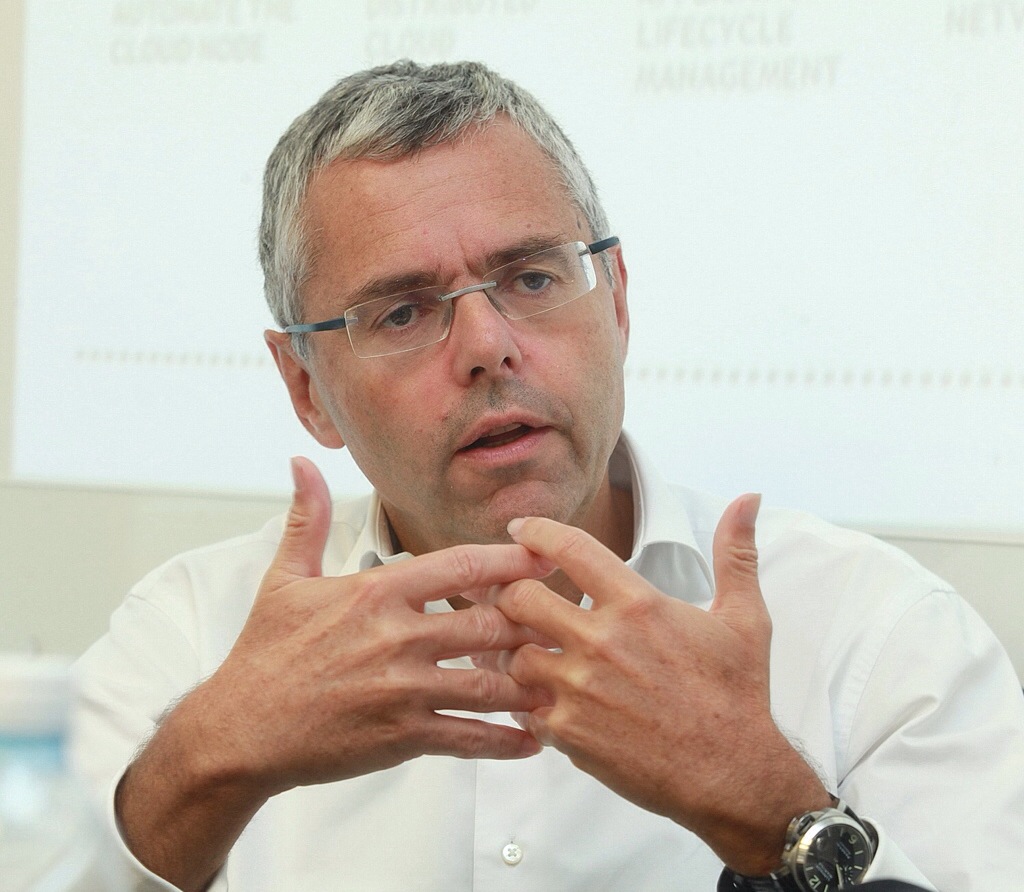 Michel Combes, CEO. Photo: Kobi Kantor.
The CEO of Alcatel-Lucent, Michel Combes, has brushed off rumours of a tie-up with Nokia, after reports surfaced last week that Nokia's board was considering the move as a strategy option.
"You will have to ask Nokia," said Combes. "I'm fully focussed on the Shift Plan, it is the right plan [for the company]; I don't want to be distracted by anything else."
Combes was speaking at the opening of Alcatel-Lucent's cloud R&D centre in Kfar Saba, Israel, where the company's internal start-up CloudBand is developing cloud technology for carriers.
Network Functions Virtualisation
CloudBand used the site opening to unveil its CloudBand Ecosystem Program to spur adoption of Network Functions Virtualisation (NFV). NFV is a carrier-led initiative, set up by the European Telecommunications Standards Institute (ETSI), to benefit from the IT model of running applications on virtualised servers.
Carriers want to get away from vendor-specific platforms that are expensive to run and cumbersome to upgrade when new services are needed. Adding a service can take between 18 months and three years, said Dor Skuler, vice president and general manager of the CloudBand business unit. Moreover, such equipment can reside in the network for 15 years. "Most of the [telecom] software is running on CPUs that are 15 years old," said Skuler.
Instead, carriers want vendors to develop software 'network functions' executed on servers. NFV promises a common network infrastructure and reduced costs by exploiting the economies of scale associated with servers. Server volumes dwarf those of dedicated networking equipment, and are regularly upgraded with new CPUs.
Applications running on servers can also be scaled up and down, according to demand, using virtualisation and cloud orchestration techniques already present in the data centre. "This is about to make the network scalable and automated," said Combes.
Alcatel-Lucent stresses that not all networking functions are suited for virtualisation. Optical transport is one example. Another is routing, which requires dedicated silicon for packet processing and traffic management.
CloudBand was set up in 2011. The unit is focussed on the orchestration and automation of distributed cloud computing for carriers. "How do you operationalise cloud which may be distributed across 20 to 30 locations?" said Skuler.
CloudBand says it can add a "cloud node" - IT equipment at an operator's site - and have it up and running three hours after power-up. This requires processes that are fully automated, said Skuler. Also used are algorithms developed at Alcatel-Lucent Bell Labs that determine the best location for distributed cloud resources for a given task. The algorithms load-balance the resources based on an application's requirements.
The distributed cloud technology also benefits from software-defined networking (SDN) technology from Alcatel-Lucent's other internal venture, Nuage Networks. Nuage Networks automates and sets up network connections between data centres. "Just as SDN makes use of virtualisation to give applications more memory and CPU resources in the data centre, Nuage does the same for the network," said Skuler.
Open interfaces are needed for NFV to succeed and avoid the issue of proprietary solutions and vendor lock-in. Alcatel-Lucent's NFV solution needs to support third-party applications, while the company's applications will have to run on other vendors' platforms. To this aim, CloudBand has set up an NFV ecosystem for service providers, vendors and developers.
"We have opened up CloudBand to anyone in the industry to test network applications on top of the cloud," said Skuler. "We are the first to do that."
So far, 15 companies have signed up to the CloudBand Ecosystem Program including Deutsche Telekom, Telefonica, Intel and HP.
Technologies such as NFV promise operators a way to regain market traction and avoid the commoditisation of transport, said Combes. Operators can manage their networks more efficiently, and create new business models. For example, operators can sell enterprises network functions such as infrastructure-as-a-service and platform-as-a-service.
Does not software functions run on servers undermine a telecom equipment vendor's primary business? "We are still perceived as a hardware company yet 85 percent of systems is software based," said Combes. Moreover, this is a carrier-driven initiative. "This is where our customers want to go," he said. "You either accept there will be a bit of canabalisation or run the risk of being canabalised by IT players or others."
The Shift Plan
Combes has been in place as Alcatel-Lucent's CEO for four months. In that time he has launched the Shift Plan that focusses the company's activities in three broad directions: IP infrastructure including routing and transport, cloud, and ultra-broadband access including wireless (LTE) and wireline (FTTx).
Combes says the goal is to regain the competitiveness Alcatel-Lucent has lost in recent years. The goal is to improve product innovation, quality of execution and the company's cost structure. Combes has also tackled the balance sheet, refinancing company debt over the summer.
The Shift Plan's target is to get the company back on track by 2015: growing, profitable and industry-leading in the three areas of focus, he said.
Nuage Networks uses SDN to tackle data centre networking bottlenecks
 Three planes of the network that host Nuage's .Virtualised Services Platform (VSP). Source: Nuage Networks
Alcatel-Lucent has set up Nuage Networks, a business venture addressing networking bottlenecks within and between data centres.
The internal start-up combines staff with networking and IT skills include web-scale services. "You can't solve new problems with old thinking," says Houman Modarres, senior director product marketing at Nuage Networks. Another benefit of the adopted business model is that Nuage benefits from Alcatel-Lucent's software intellectual property.
"It [the Nuage platform] is a good approach. It should scale well, integrate with the wide area network (WAN) and provide agility"
Joe Skorupa, Gartner
Network bottlenecks
Networking in the data centre connects computing and storage resources. Servers and storage have already largely adopted virtualisation such that networking has now become the bottleneck. Virtual machines on servers running applications can be enabled within seconds or minutes but may have to wait days before network connectivity is established, says Modarres.
Nuage has developed its Virtualised Services Platform (VSP) software, designed to solve two networking constraints.
"We are making the network instantiation automated and instantaneous rather than slow, cumbersome, complex and manual," says Modarres. "And rather than optimise locally, such as parts of the data centre like zones or clusters, we are making it boundless."
"It [the Nuage platform] is a good approach," says Joe Skorupa, vice president distinguished analyst, data centre convergence, data centre, at Gartner. "It should scale well, integrate with the wide area network (WAN) and provide agility."
Resources to be connected can now reside anywhere: within the data centre, and between data centres, including connecting the public cloud to an enterprise's own private data centre. Moreover, removing restrictions as to where the resources are located boosts efficiency.
"Even in cloud data centres, server utilisation is 30 percent or less," says Modarres. "And these guys spend about 60 percent of their capital expenditure on servers."
It is not that the hypervisor, used for server virtualisation, is inefficient, stresses Modarres: "It is just that when the network gets in the way, it is not worthwhile to wait for stuff; you become more wasteful in your placement of workloads as their mobility is limited."

"A lot of money is wasted on servers and networking infrastructure because the network is getting in the way"
Houman Modarres, Nuage Networks
SDN and the Virtualised Services Platform
Nuage's Virtualised Services Platform (VSP) uses software-defined networking (SDN) to optimise network connectivity and instantiation for cloud applications.
The VSP comprises three elements:
- the Virtualised Services Directory,
- the Virtualised Services Controller,
- and the Virtual Routing & Switching module.
The elements each reside at a different network layer, as shown (see chart, top).
The top layer, the cloud services management plane, houses the Virtualised Services Directory (VSD). The VSD is a policy and analytics engine that allows the cloud service provider to partition the network for each customer or group of tenants.
"Each of them get their zones for which they can place their applications and put [rules-based] permissions as to whom can use what, and who can talk to whom," says Modarres. "They do that in user-friendly terms like application containers, domains and zones for the different groups."
Domains and zones are how an IT administrator views the data centre, explains Modarres: "They don't need to worry about VLANs, IP addresses, Quality of Service policies and access control lists; the network maps that through its abstraction." The policies defined and implemented by the VSD are then adopted automatically when new users join.
The layer below the cloud services management plane is the data centre control plane. This is where the second platform element, the Virtualised Services Controller (VSC), sits. The VSC is the SDN controller: the control element that communicates with the data plane using the OpenFlow open standard.
The third element, the Virtual Routing & Switching module (VRS), sits in the data path, enabling the virtual machines to communicate to enable applications rapidly. The VRS sits on the hypervisor of each server. When a virtual machine gets instantiated, it is detected by the VRS which polls the SDN controller to see if a policy has already been set up for the tenant and the particular application. If a policy has been set up, the connectivity is immediate. Moreover, this connectivity is not confined to a single data centre zone but the whole data centre and even across data centres.
More than one data centre is involved for disaster recovery scenarios, for example. Another example involving more than one data centre is to boost overall efficiency. This is enhanced by enabling spare resources in other data centres to be used by applications as appropriate.
Meanwhile, the linking to an enterprise's own data centre is done using a virtual private network (VPN), bridging a private data centre with the public cloud. "We are the first to do this," says Modarres.
The VSP works with whatever server, hypervisor, networking equipment and cloud management platform is used in a data centre. The SDN controller is based on the same operating system that is used in Alcatel-Lucent's IP routers that supports a wealth of protocols. Meanwhile, the virtual switch in the VRS integrates with various hypervisors on the market, ensuring interoperability.
Nuage's Dimitri Stiliadis, chief architect at Nuage Networks, describes its VSP architecture as a distributed implementation of the functions performed by its router products.
The control plane of the router is effectively moved to the SDN controller. The router's 'line cards' become the virtual switches in the hypervisors. "OpenFlow is the protocol that allows our controller to talk to the line cards," says Stiliadis. "While the border gateway protocol (BGP) is the protocol that allows our controller to talk to other controllers in the rest of the network."
Michael Howard, principal analyst, carrier networks at Infonetics Research, says there are several noteworthy aspects to Nuage's product including the fact that operators participated at the company's launch and that the software is not tied to Alcatel-Lucent's routers but will run over other vendors' equipment.
"It also uses BGP, as other vendors are proposing, to tie together data centres and the carrier WAN," says Howard. "Several big operators say BGP is a good approach to integrate data centres and carrier WANs, including AT&T and Orange."
Nuage says that trials of its VSP began in April. The European and North America trial partners include UK cloud service provider Exponential-e, French telecoms service provider SFR, Canadian telecoms service provider TELUS and US healthcare provider, the University of Pittsburgh Medical Center (UPMC). The product will be generally available from mid-2013.
"There are other key use cases targeted for SDN that are not data centre related: content delivery networks, Evolved Packet Core, IP Multimedia Subsystem, service-chaining and cloudbox"
Michael Howard, Infonetics Research
Challenges
The industry analysts highlight that this market is still in its infancy and that challenges remain.
Gartner's Skorupa points out that the data centre orchestration systems still need to be integrated and that there is a need for cheaper, simpler hardware.
"Many vendors have proposed solutions but the market is in its infancy and customer acceptance and adoption is still unknown," says Skorupa.
Infonetics highlights dynamic bandwidth as a key use case for SDNs and in particularly between data centres.
"There are other key use cases targeted for SDN that are not data centre related: content delivery networks, Evolved Packet Core, IP Multimedia Subsystem, service-chaining and cloudbox," says Howard.
Cloudbox is a concept being developed by operators where an intelligent general purpose box is placed at a customer's location. The box works in conjunction with server-based network functions delivered via the network, although some application software will also run on the box.
Customers will sign up for different service packages out of firewall, intrusion detection system (IDS), parental control, turbo button bandwidth bursting etc., says Howard. Each customer's traffic is guided by the SDNs and uses Network Functions Virtualisation - those network functions such as a firewall or IDS formerly in individual equipment - such that the services subscribed to by a user are 'chained' using SDN software.