

Tackling the coming network crunch
 "In the end you run out of the ability to transmit more information along a single-mode fibre"
Ian Giles, Phoenix Photonics
The project, dubbed MODE-GAP, is part of the EC's Seventh Framework programme, and includes system vendor Nokia Siemens Networks (NSN), as well as optical component, fibre firms and several universities.
Current 100 Gigabit-per-second (Gbps) dense wavelength division multiplexing (DWDM) systems are able to transmit a total of 10 terabits-per-second of data across a fibre (100 channels, each at 100Gbps). System vendors have said that with further technology development, 25Tbps will be transported across fibre.
But IP traffic in the network is growing at over 30% each year. And while techniques are helping to improve overall transmission, the rate of progress is slowing down. A view is growing in the industry that without some radical technological breakthrough, new transmission media will be needed in the next two decades to avoid an inevitable capacity bottleneck.
"The Shannon Limit - the amount of information that can be transmitted - depends on the signal-to-noise and the amount of power you can put down a fibre," says Ian Giles, CEO of Phoenix Photonics, a fibre component specialist and one of the companies taking part in the project. "You can enhance transmission capacity by modulation techniques to increase bit rate, WDM and polarisation multiplexing but in the end you run out of the ability to transmit more information along a single-mode fibre."
This 'network crunch' is what the MODE-GAP project is looking to tackle.
Project details
One of the approaches that will be investigated is exploiting the multiple paths light travels down a multimode fibre to enable the parallel transmission of more than one channel.
These multiple paths light takes traveling in a multimode fibre disperses the signal. "The proposal we are making is that we take a low-moded fibre and select specific modes for each channel, or a high-moded fibre and select modal groups that are very similar," says Giles. The idea is that by identifying such modes in the multimode fibre, the dispersion for each mode or model groups will be limited.
But implementing such a spatially modulated system is tricky as the modes need to be identified and then have light launched into them. In turn, the modes must be kept apart along the fibre's span.
The project will tackle these challenges as well as use digital signal processing at the output to separate the transmitted channels. The project consortium believes that up to 10 channels could be used per fibre.

The second approach the MODE-GAP project will explore involves using specialist or photonic bandgap fibre. "The problem with solid core fibre is that the core will scatter light, and with higher intensity, you start to see non-linear scattering," says Giles. "So there is a limit to how much power you can put down a fibre without introducing these non-linear effects."
Photonic bandgap fibre has an air core that doesn't create scattering. As a result the non-linear threshold is some 100x higher, meaning that more power can be put into the fibre.
What next?
The MODE-GAP project is still in its infancy. The goal is to develop a system that allows the multiplexing and demultiplexing of the spatially-separated channels on the fibre. That will be done using multimode fibre but Giles stresses that it could eventually be done using photonic bandgap fibre. "You then enhance capacity: you increase the number of channels, and decrease the non-linearities which means you can increase the amount of information sent per channel," says Giles.
"Up till the spatial modulation part, the system is the same as you have now," he adds. "It is only the spatial modulation part that needs new components." NSN will use any prototype developed within its test-bed where it will be trailed. "They don't want to reinvent their equipment at each end," says Giles.
The project will also look to develop a fibre-amplifier that will boost all the fibre's spatial separated channels.
The project's goal is to demonstrate a working system. "The ultimate is to show the hundredfold improvement," says Giles. "We will do that with multiple channel transmission along a single photonic bandgap fibre and higher capacity [data transmission] per channel."
Project partners
In addition to NSN's systems expertise and test-bed, Eblana Photonics will be developing lasers for the project while Phoenix will address the passive components needed to launch and detect specific modes. OFS Fitel is providing the fibre expertise, while the University of Southampton's Optoelectronics Research Centre is leading the project.
The other universities include the COBRA Institute at the Technische Universiteit Eindhoven which has expertise in the processing and transmission of spatial division multiplexed signals, while the Tyndall National Institute of University College Cork is providing system expertise, detectors, transmitters and some of the passive optics and planar waveguide work.
ESPCI ParisTech, working with the University of Southampton, will provide expertise in surface finishes. "The key here is that for the fibres to be low loss, and to maintain the modes in the fibre, they have to have very good inside surfaces," says Giles.

How ClariPhy aims to win over the system vendors
“We can build 200 million logic gate designs”
Reza Norouzian, ClariPhy
ClariPhy is in the camp that believes that the 100 Gigabit-per-second (Gbps) market is developing faster than people first thought. “What that means is that instead of it [100Gbps] being deployed in large volumes in 2015, it might be 2014,” says Reza Norouzian, vice president of worldwide sales and business development at ClariPhy.
Yet the fabless chip company is also glad it offers a 40Gbps coherent IC as this market continues to ramp while 100Gbps matures and overcomes hurdles common to new technology: The 100Gbps industry has yet to develop a cost-effective solution or a stable component supply that will scale with demand.
Another challenge facing the industry is reducing the power consumption of 100Gbps systems, says Norouzian. The need to remove the heat from a 100Gbp design - the ASIC and other components - is limiting the equipment port density achievable. “If you require three slots to do 100 Gig - whereas before you could use these slots to do 20 or 30, 10 Gig lines - you are not achieving the density and economies of scale hoped for,” says Norouzian.
40G and 100G coherent ASICs
ClariPhy has chosen a 40nm CMOS process to implement its 40Gbps coherent chip, the CL4010. But it has since decided to adopt 28nm CMOS for its 100Gbps design – the CL10010 - to integrate features such as soft-decision forward error correction (see New Electronics' article on SD-FEC) and reduce the chip’s power dissipation.
The CL4010 integrates analogue-to-digital and digital-to-analogue converters, a digital signal processor (DSP) and a multiplexer/ demultiplexer on-chip. “Normally the mux is a separate chip and we have integrated that,” says Norouzian.
The first CL4010 samples were delivered to select customers three months ago and the company expects volume production to start by the end of September. The CL4010 also interoperates with Cortina Systems’ optical transport network (OTN) processor family of devices, says the company.
The start-up claims there is strong demand for the CL4010. “When we ask them [operators]: ‘With all the hoopla about 100 Gig, why are you buying all this 40 Gig?’, the answer is that it is a pragmatic solution and one they can ship today,” says Norouzian.
ClariPhy expects 40Gbps volumes to continue to ramp for the next three or four years, partly because of the current high power consumption of 100Gbps. The company says several system vendors are using the CL4010 in addition to optical module customers.
The 28nm 100Gbps CL10010 is a 100 million gate ASIC. ClariPhy acknowledges it will not be first to market with an 100Gbps ASIC but that by using the latest CMOS process it will be well position once volume deployments start from 2014.
ClariPhy is already producing a quad-10Gbps chip implementing the maximum likelihood sequence estimation (MLSE) algorithm used for dispersion compensation in enterprise applications. The device covers links up to 80km (10GBASE-ZR) but the main focus is for 10GBASE-LRM (220m+) applications. “Line cards that used to have four times 10Gbps lanes now are moving to 24 and will use six of these chips,” says Norouzian. The device sits on the card and interfaces with SFP+ or Quad-SFP optical modules.
“The CL10010 is the platform to demonstrate all that we can do but some customers [with IP] will get their own derivatives”
System vendor design wins
The 100Gbps transmission ASIC market may be in its infancy but the market is already highly competitive with clear supply lines to the system vendors.
Several leading system vendors have decided to develop their own ASICs. Alcatel-Lucent, Ciena, Cisco Systems (with the acquisition of CoreOptics), Huawei and Infinera all have in-house 100Gbps ASIC designs.
System vendors have justified the high development cost of the ASIC to get a time-to-market advantage rather than wait for 100Gbps optical modules to become available. Norouzian also says such internally-developed 100Gbps line card designs deliver a higher 100Gbps port density when compared to a module-based card.
Alternatively, system vendors can wait for 100Gbps optical modules to become available from the likes of an Oclaro or an Opnext. Such modules may include merchant silicon from the likes of a ClariPhy or may be internally developed, as with Opnext.
System vendors may also buy 100Gbps merchant silicon directly for their own 100Gbps line card designs. Several merchant chip vendors are targeting the coherent marketplace in addition to ClariPhy. These include such players as MultiPhy and PMC-Sierra while other firms are known to be developing silicon.
Given such merchant IC competition and the fact that leading system vendors have in-house designs, is the 100Gbps opportunity already limited for ClariPhy?
Norouzian's response is that the company, unlike its competitors, has already supplied 40Gbps coherent chips, proving the company’s mixed signal and DSP expertise. The CL10010 chip is also the first publicly announced 28nm design, he says: “Our standard product will leapfrog first generation and maybe even second generation [100Gbps] system vendor designs.”
The equipment makers' management will have to decide whether to fund the development of their own second-generation ASICs or consider using ClariPhy’s 28nm design.
ClariPhy acknowledges that leading system vendors have their own core 100Gbps intellectual property (IP) and so offers vendors a design service to develop their own custom systems-on-chip. For example a system vendor could use ClariPhy's design but replace the DSP core with the system vendor’s own hardware block and software.
 Source: ClariPhy Communications
Norouzian says system vendors making 100Gbps ASICs develop their own intellectual property (IP) blocks and algorithms and use companies like IBM or Fujitsu to make the design. ClariPhy offers a similar service while also being able to offer its own 100Gbps IP as required. “The CL10010 is the platform to demonstrate all that we can do,” says Norouzian. “But some customers [with IP] will get their own derivatives.”
The firm has already made such custom coherent devices using customers’ IP but will not say whether these were 40 or 100Gbps designs.
Market view
ClariPhy claims operator interest in 40Gbps coherent is not so much because of its superior reach but its flexibility when deployed in networks alongside existing 10Gbps wavelengths. “You don't have to worry about [dispersion] compensation along routes,” says Norouzian, adding that coherent technology simplifies deployments in the metro as well as regional links.
And while ClariPhy’s focus is on coherent systems, the company agrees with other 100Gbps chip specialists such as MultiPhy for the need for 100Gbps direct-detect solutions for distances beyond 40km. “It is very likely that we will do something like that if the market demand was there,” says Norouzian. But for now ClariPhy views mid-range 100Gbps applications as a niche opportunity.
Funding
ClariPhy raised US $14 million in June. The biggest investor in this latest round was Nokia Siemens Networks (NSN).
An NSN spokesperson says working with ClariPhy will help the system vendor develop technology beyond 100Gbps. “It also gives us a clear competitive edge in the optical network markets, because ClariPhy’s coherent IC and technology portfolio will enable us to offer differentiated and scalable products,” says the spokesperson.
The funding follows a previous round of $24 million in May 2010 where the investors included Oclaro. ClariPhy has a long working relationship with the optical components company that started with Bookham, which formed Oclaro after it merged with Avanex.
“At 100Gbps, Oclaro get some amount of exclusivity as a module supplier but there is another module supplier that also gets access to this solution,” says Norouzian. This second module supplier has worked with ClariPhy in developing the design.
ClariPhy will also supply the CL10010 to the system vendors. “There are no limitations for us to work with OEMs,” he says.
The latest investment will be used to fund the company's R&D effort in 100, 200 and 400Gbps, and getting the CL4010 to production.
Beyond 100 Gig
The challenge at higher data rates that 100Gbps is implementing ultra-large ASICs: closing the timings and laying out vast digital circuitry. This is an area the company has been investing in over the last 18 months. “Now we can build 200 million logic gate designs,” says Norouzian.
Moving from 100Gbps to 200Gbps wavelengths will require higher order modulation, says Norouzian, and this is within the realm of its ASIC.
Going to 400Gbps will require using two devices in parallel. One Terabit transmission however will be far harder. “Going to one Terabit requires a whole new decade of development,” he says.
Further reading:
Wireless backhaul: The many routes to packet
ECI Telecom has detailed its wireless backhaul offering that spans the cell tower to the metro network. The 1Net wireless backhaul architecture supports traditional Sonet/SDH to full packet transport, with hybrid options in between, across various physical media.
“We can support any migration scheme an operator may have over any type of technology and physical medium, be it copper, fibre or microwave,” says Gil Epshtein, senior product marketing manager, network solutions division at ECI Telecom.
Why is this important?
Operators are experiencing unprecedented growth in wireless data due to the rise of smart phones and notebooks with 3G dongles for mobile broadband.
Mobile data surpassed voice traffic for the first time in December 2009, according to Ericsson, with the crossover occurring at approximately 140,000 terabytes per month in both voice and data traffic. According to Infonetics Research, mobile broadband subscribers surpassed digital subscriber line (DSL) subscribers in 2009, and will grow to 1.5 billion worldwide in 2014. By then, there will be 3.6 exabytes (3.6 billion gigabytes) per month of mobile data traffic, with two thirds being wireless video, forecasts Cisco Systems.
“The challenge is that almost all the growth is packet internet traffic, and that is not well suited to sit on the classic TDM backhaul network originally designed for voice,” says Michael Howard, principal analyst, carrier and data center networks at Infonetics Research. TDM refers to time division multiplexing based on Sonet/SDH where for wireless backhaul T1/E1lines are used.

“There is a gap between the technology hype and real life”
Gil Epshtein, ECI Telecom
The fast growth also implies an issue of scale, with the larger mobile operators having many cell sites to backhaul. E1/TI lines are also expensive even if prices are coming down, says Howard: “It is much cheaper to use Ethernet as a transport – the cost per bit is enormously better.”
This is why operators are keen to upgrade their wireless backhaul networks from Sonet/SDH to packet-based Ethernet transport. “But there is a gap between the technology hype and real life,” says Epshtein. Operators have already invested heavily in existing backhaul infrastructure and upgrading to packet will be costly. The operators also know that projected revenues from data services will not keep pace with traffic growth.
“Operators are faced with how to build out their backhaul infrastructures to meet service demands at cost points that provide an adequate return on investment,” says Glen Hunt, principal analyst, carrier transport and routing at Current Analysis. Such costs are multi-faceted, he says, on the capital side and the operational side. “Carriers do not want to buy an inexpensive device that adds complexity to network operations which then offsets any capital savings.”
“It is much cheaper to use Ethernet as a transport –the cost per bit is enormously better.”
Michael Howard, Infonetics Research
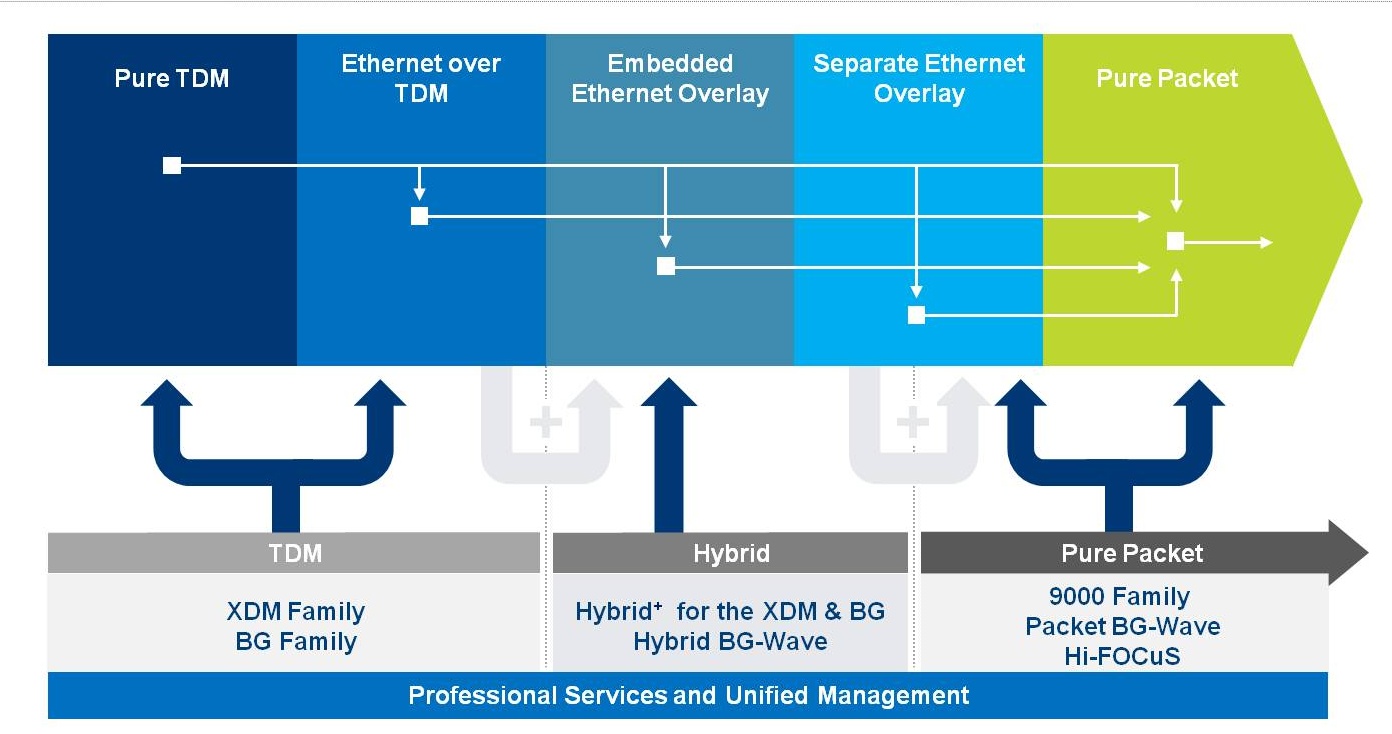
To this aim, ECI offers operators a choice of migration schemes to packet-based backhaul. Its solution supports T1/E1lines and Ethernet frame encapsulation over TDM, Ethernet overlay networks, and packet-only networks (see chart above).
With Ethernet overlay, an Ethernet network runs alongside the TDM network. The two can co-exist within a common network element, what ECI calls embedded Ethernet overlay, or separately using distinct TDM and packet switch platforms. And when an operator adopts all-packet, legacy TDM traffic can be carried over packets using circuit emulation pseudo-wire technology.
“ECI’s offering is significant since it includes all the components and systems necessary to handle nearly any type of backhaul requirement,” says Hunt. The same is true for most of the larger system vendors, he says. However, many vendors integrate third party devices to complete their solutions – ECI itself has done this with microwave. But with 1NET for wireless backhaul, ECI will now offer its own microwave backhaul systems.
According to Infonetics, between 55% and 60% of all backhaul links are microwave outside of North America. And 80% of all microwave sales are for mobile backhaul. Moreover, Infonetics estimates that 70 to 80% of operator spending on mobile backhaul through 2012 will be on microwave. “Those are the figures that explain why ECI has decided to go it alone,” says Howard. Until now ECI has used products from its microwave specialist partner, Ceragon Networks.
“ECI has all the essential features that the other big players have like Ericsson, Alcatel-Lucent, Nokia Siemens Networks and Huawei,” says Howard. What is different is that ECI does not supply radio access network (RAN) equipment such as basestations. “It is ok, though, because almost all of the [operator] backhaul tenders separate between RAN and backhaul,” says Howard.
ECI argues that by adopting a technology-agnostic approach, it can address operators’ requirements without forcing them down a particular path. “Operators are looking for guidance as to which path is best from this transition,” says Epshtein. There is no one-model fits all. “We have so many exceptions you really need to look on a case-by-case basis.”
In developed markets, for example, the building of packet overlay is generally happening faster. Some operators with fixed line networks have already moved to packet and that, in theory, simplifies upgrading the backhaul to packet. But organisational issues across an operator’s business units can complicate and delay matters, he says.
And Epshtein cites one European operator that will use its existing network to accommodate growth in data services over the coming years: “It is putting aside the technology hype and looking at the bottom line."
In emerging markets, moving to packet is happening more slowly as mobile users’ income is limited. But on closer inspection this too varies. In Africa, certain operators are moving straight to all-IP, says Ephstein, whereas others are taking a gradual approach.
What’s been done?
ECI has launched new products as well as upgraded existing ones as part of its 1NET wireless backhaul offering.
The company has announced its BG-Wave microwave systems. There are two offerings: an all-packet microwave system and a hybrid one that supports both TDM and Ethernet traffic. ECI says that having its own microwave products will allow it to gain a foothold with operators it has not had design wins before.
“ECI will need to prove the value of its microwave products with actual field deployments”
Glen Hunt, Current Analysis
ECI has announced two additional 9000 carrier Ethernet switch routers (CESR) families: the 9300 and 9600. These have switching capacities and a product size more suited to backhaul. The switches support Layer 3 IP-MPLS and Layer 2 MPLS-TP, as well as the SyncE and IEEE 1588 Version 2 synchronisation protocols.
ECI has also upgraded its XDM multi-service provisioning platform (MSPP) to enable an embedded overlay with Ethernet and TDM traffic supported within the platform.
“When an operator is choosing to add packet backhaul to existing TDM backhaul, typically it is a separate network – they keep voice on TDM and add a second network for packet,” says Howard. This hybrid approach involves adding another set of equipment. “ECI has added functions to existing equipment, which operators may already have, that allows two networks to run over a single set of products.”
Also included in the solution are ECI’s BroadGate and its Hi-FOCuS multi-service access node (MSAN). This is not for operators to deploy the platform for wireless backhaul but rather those operators that have the MSAN can now use it for backhauling traffic, says Ephstein. This is useful in dense urban areas and for operators offering wholesale services to other operators.
All the network elements are controlled using ECI’s LightSoft management system.
“ECI’s solution has the advantage that all the systems use the same operating system and support the same features,” says Hunt. He cites the example of MPLS-TP which is implemented on ECI’s carrier Ethernet and optical platforms.
“ECI has a full range of platforms that all work together to meet the needs of mobile as well as fixed operator,” says Hunt. “ECI will need to prove the value of its microwave products with actual field deployments.”
Operator interest
ECI has secured general telecom wins with large incumbent operators in Western Europe and has been winning business in Eastern Europe, Russia, India and parts of Asia.
ECI’s sweet spot has been its relationship with Tier 2 and Tier 3 operators, says Hunt, and since the company offers broadband access, optical transport, and carrier Ethernet, it can use these successes to help expand into areas such as wireless backhaul.
But wireless backhaul is already a key part of the company’s business, accounting for over 30% of revenues, says Ephstein. Late last year ECI estimated that it was carrying between 30% and 40% of the mobile backbone traffic in India, a rapidly growing market.
As for 1NET wireless backhaul, ECI has announced one win so far - Israeli mobile operator Cellcom which has selected the 9000 CESR family. “Cellcom shows that ECI can continue to expand its presence in the network - in this case leveraging business Ethernet services to add backhaul,” says Hunt.
In addition one European operator, as yet unnamed, has selected ECI’s embedded overlay. “Several other operators are in various stages of selecting the right option for them,” says Ephstein.
- For some ECI wireless backhaul papers and case studies, click here