

Hyperscalers' needs drive a new class of coherent DSP

Coherent digital signal processors (DSPs) companies have supported two families of coherent chips for some time. That’s because no single coherent DSP can meet all the market’s requirements.
The coherent DSP used for highest-performance optical transmissions must include advanced coding techniques, forward error correction, and a high symbol rate to send as much data as possible on a single wavelength and maximise reach.
In contrast, a DSP for coherent pluggable modules needs to be power-efficient and compact to meet the optical module’s power envelope and size constraints; a 400ZR QSFP-DD and a CFP2-DCO 400ZR+ being examples.
According to Ciena, now there is a need for a third category of coherent DSP for 1.6 terabit-per-second (Tbps) and 3.2Tbps transmissions over short distances for next-generation switch routers.
Carrying data centre payloads
The need comes from the hyperscalers, as with most emerging coherent optical applications. The new coherent DSP design is needed since it is the only way to support multi-terabit data rates for this application, says Ciena.
“Data centre switch routers with new 51.2- and 102.4-terabit switch chipsets will need greater than 400 gigabit-per-wavelength connectivity,” said Helen Xenos, senior director, portfolio marketing at Ciena, during a talk at NGON & DCI World, held in Barcelona in June.
The coherent DSP will connect equipment within a data centre and between data centre buildings on campus. A 1-10km reach for the 1.6Tbps or 3.2Tbps wavelength transmissions is needed using an industry-standard pluggable such as a QSFP-DD or a OSFP pluggable form factor.
“It would have to be a specific, very low-cost design,” says Xenos.
Coherent evolution
Applications using coherent optical technology continue to grow.
Subsea, long-haul, metro, and 80-120km data centre interconnect are all well-known markets for coherent optics, said Xenos. Now, coherent is moving to the access network and for unamplified single-channel links.
“There is no one coherent optical design that will be cost-optimal across all of these applications,” said Xenos. “This is why multiple coherent optical modem designs are required.”
Xenos last presented at NGON & DCI World in pre-pandemic 2019. Then, the questions were whether 800-gigabit wavelengths would be needed and what optical performance 400-gigabit coherent pluggables would deliver.
Much has since changed. There has been a broad deployment of optical transport equipment using 800-gigabit wavelengths while the coherent pluggable market has gone from strength to strength.
For the high-end, up to 800 gigabits per wavelength, 7nm CMOS DSPs are used, operating at a symbol rate of 90-110 gigabaud (GBd).
For 400-gigabit coherent pluggables operating, the symbol rate is 60-70GBd, while the optics used is mainly silicon photonics.
800-gigabit market
Ciena started shipping 800-gigabit capable optical modules in April 2020.
Since then, the company has seen strong uptake, with hyperscalers leading the way.

Also, a broad deployment of colourless, flexible grid optical line systems has helped 800-gigabit technology adoption.
Xenos cited, among others, Altibox, which brings high capacity connectivity from Norway to key digital hubs in Europe.
“They turned up the longest 800-gigabit wavelength between Copenhagen and Amsterdam, and that was over 1,100 kilometres,” she said.
400-gigabit pluggables
Xenos points out that there has been a halving of the power-per-bit at 400Gbps.
 Source: Ciena.
In 2017, Ciena offered a 400-gigabit 60GBd modem design in a 5×7-inch package.
“Now we have a pluggable 400-gigabit QSFP-DD at 60GBd pluggable, so the same type of design, the same simple feature set required with a 400ZR,” said Xenos.
Optical performance is also being pushed to 70GBd in the QSFP-DD, with the module having a higher output power.
Near-term designs
Ciena says the next two to three generations of coherent DSPs will use 5nm and 3nm CMOS.
New promising materials for optical modulation are emerging, such as thin-film lithium niobite, and barium titanate, which is compatible with silicon photonics.
“[A] Higher baud [rate] will reduce cost-per-bit and get more capacity using a single wavelength,” says Xenos. “Also, there will be more intelligence and programmability as we move forward to enable more automated networks.”
She says a 160GBd symbol rate is needed to send 800 gigabits over long-distance spans.
The key for all the different modem designs is to develop something better while choosing the right technologies so that new products are available promptly.
“It’s essential to make the right technology choice that will give the right reliability and be commercially available,” says Xenos.
Three nanometre CMOS promises more significant performance benefits for a DSP design, but developing the process technology is challenging for the leading chip fabrication plants. In addition, a 3nm CMOS process will be costly.
Award
Ciena won the optical vendor of the year award, one of the five prizes presented at the NGON & DCI World show.


ADVA and II-VI’s coherent partnership

- ADVA and II-VI have jointly developed a 100-gigabit coherent DSP
- Both companies plan to use the 2.0-2.5W, 7nm CMOS Steelerton DSP for a 100ZR QSFP28 module
- II-VI’s ASIC design team engineered the DSP while ADVA developed the silicon photonics-based optics.
ADVA and II-VI have joined forces to define a tiny coherent digital signal processor (DSP) that fits inside a QSFP28 optical module.
The Steelerton DSP can send a 100-gigabit dense wavelength-division multiplexing (DWDM) transmission over 80-120km, carrying wireless backhaul and access traffic.
“It is backhaul of broadband, it is backhaul of mobile, and it definitely moves outdoors,” says Christoph Glingener, CTO at ADVA.
The module also serves metro networks with its 300km reach using optical amplification.
II-VI and ADVA now join such established coherent players as Ciena, Huawei, Infinera, Nokia as well as Marvell, NEL, and Acacia, now part of Cisco.
Effect Photonics announced at OFC earlier this year its coherent market entry with its acquisition of the Viasat DSP team.
Motivation
ADVA says it entered the coherent DSP market after failing to find a design suited for backhaul, a coherent market that promises highest unit volumes.
Backhaul has become even more important market for ADVA given its merger with broadband equipment maker ADTRAN.
II-VI also notes how access rates are moving from 10 to 100 gigabits.
“We were looking to develop a DSP capable to target a market that is underserved and where we can differentiate. This analysis led us to the 100ZR with a purpose-built DSP solution” says John DeMott, vice president product management, coherent and tunable product lines at II-VI.
The 100-gigabit coherent market for access contrasts with 400-gigabit coherent that uses modules such as 400ZR and 400ZR+ to connect data centres.
ADVA did consider existing suppliers’ coherent DSPs but deemed them too big and power-hungry for this application. This is what led to the II-VI partnership.
“We found a partner in II-VI that was willing to do this, but to get to the required power envelopes, we needed a 7nm DSP,” says Glingener. “And 7nm CMOS technology is not cheap.“
II-VI has a staff of mixed-signal and ASIC engineers in Germany that designed the Steelerton chip.
The two firms now have their own 100-gigabit DSP and can start developing coherent product roadmaps.
Applications
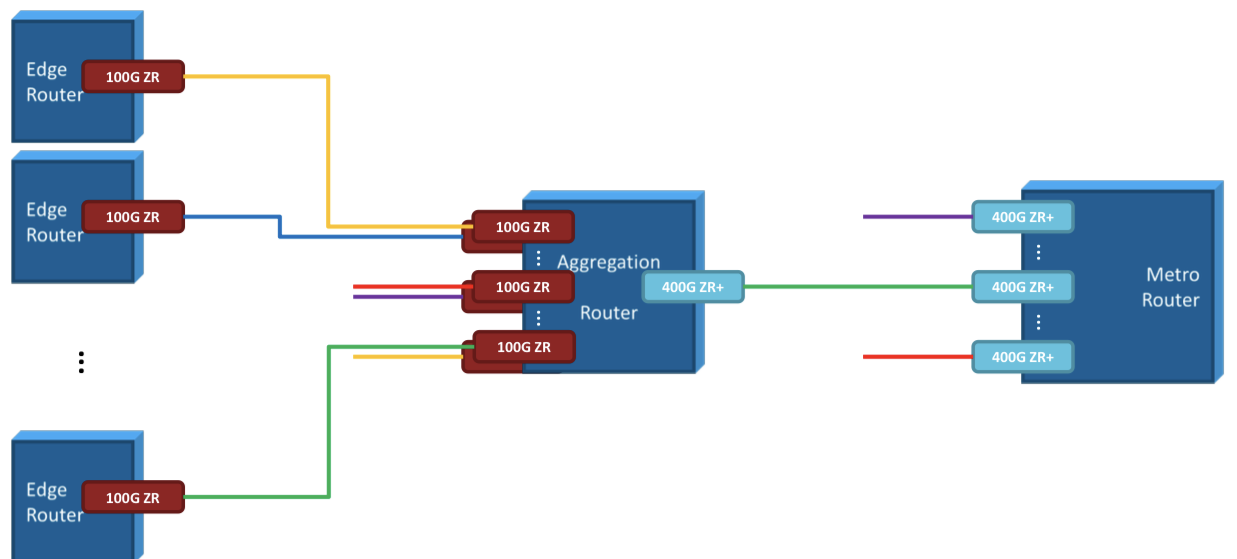
The 100ZR module will be deployed at aggregation sites.
ADVA shows how the 100ZR module is used for edge aggregation (see diagram).


Another application is 100-gigabit data-centre interconnect (DCI) for enterprises; hyperscalers require 400 gigabit and higher rates for DCI.
II-VI says the DSP is suited for access and metro applications. The 100ZR module fits a wavelength in a 50GHz channel to enable 96 DWDM wavelengths across the C-band. The 100ZR module has a maximum reach of 300km when used with amplification.
“The 22dB loss budget supports up to 80km without in-line amplification and up to 300km with in-line amplification, limited by chromatic dispersion,” says DeMott.
II-VI highlights several use-cases for the 100ZR module.
One is IP-over-DWDM, connecting edge routers to an aggregation router (see diagram) or a muxponder. The aggregated 100-gigabit wavelengths are sent to a metro router using a 400-gigabit 400ZR+ coherent module. II-VI also has 400ZR+ modules.
Two factors dictate the 100ZR module design: power consumption and the form factor.
Even a module power consumption of 10W is too high for access. Also, the DSP and optics must fit inside a QSFP28 since this is a common form factor for access equipment uplinks.
The resulting DSP has a power consumption of 2.0-2.5W and the chip is a fifth the size of other 7nm coherent DSPs. The 100ZR QSFP28 module – the DSP and optics – consumes 5.0-5.5W.
The DSP is stripped down to its essential features to achieve the power target. For example, the DSP uses one modulation format only: dual-polarisation, quadrature phase-shift keying (DP-QPSK).
“You de-feature the DSP down to a level that you can meet the power envelope, and it is not that complicated anymore,” says Glingener.
ADVA developed the silicon photonics analogue front end for the module that uses a single laser. To fit the DSP and the optics in a QSFP28 also proved an integration challenge.
The Steelerton DSP is taped out and both companies expect to have 100ZR prototype modules in the second half of this year.
What next
ADVA is planning a 100ZR+ module that will have enhanced optical performance that will be available in prototype form in early 2023.
ADVA’s coherent module interest remains broadband. Possible developments include a 5nm CMOS 200-gigabit DSP or a cheaper, more power-efficient, second-generation 100-gigabit design.
ADVA is also exploring concepts such as a parallel design, a 4x100G implementation.
Meanwhile, II-VI is looking at high-end coherent designs, which may include multiple sources for silicon photonics
“The next obvious steps are 800 gigabits and 1.6 terabits,” says DeMott. “There is a lot of [industry] activity, so those would be directions we’re considering.” II-VI has in-house optics for high-end coherent designs.
There will be a market for 800-gigabit coherent modules, says DeMott, but hyperscalers already are asking for 1.6-terabit designs.
“These are divergent DSPs,” says DeMott. “You can’t do a DSP that does 1.6 terabits, 800 gigabits and 400 gigabits; it’s either a 1.6-terabit or a 400/ 800-gigabit DSP design.”