

Books of 2024: Part 3
Gazettabyte is asking industry figures to pick their reads of the year. In the penultimate entry, Prof. Yosef Ben Ezra, Dave Welch, William Webb, and Abdul Rahim share their favourite reads.
Professor Yosef Ben Ezra, PhD, CTO, NewPhotonics
My reading in 2024 continued to augment my technical knowledge with insights on how to bring innovation to the market.
As part of our mission to shift the industry with innovative products, I have been focussing on decision-making as the key to transitioning from technology development to product-market impact and fit. Our company entered a new phase at the beginning of last year, moving from an early-stage technology start-up to a customer-centred growth company. In reading The Lean Startup: How Today’s Entrepreneurs Use Continuous Innovation to Create Radically Successful Businesses by Eric Ries, I better understood how we must apply evidence-based decision-making even as we establish a more agile environment where rapid experimentation and learning from customer input takes precedence over extensive planning and development cycles. This insight was critical as we moved from research to delivering a product that met market demand.
Another instrumental read in 2024 was Thinking, Fast and Slow by Daniel Kahneman. With our team growing quickly, the company leadership began facing significantly broader input and issues tied to decision-making that reached beyond engineering. Kahneman’s insights on the interplay between two systems of thinking—intuitive and deliberate—provided an expanded mindset for dealing with a range of cognitive perspectives and biases that influence contextual, practical, and effective decision-making, which is vital to our progress.
The final book I’ll reference has proven to be an essential follow-up to an earlier read that played an instrumental role in starting our company: Blue Ocean Strategies. We strongly identify with this, so Peter Thiel’s Zero to One: Notes on Startups, or How to Build the Future, was an excellent follow-up for me. Ultimately, it spotlights the importance of originality and boldness in innovation. It aligns strongly with our aim to avoid imitation and incremental improvements to connectivity and instead seek transformative advances that offer substantial, long-term value.
I identify strongly with the idea of pursuing a daring and groundbreaking product introduction that reaches new heights, like the distinction Thiel explains in horizontal versus vertical innovation.
Dave Welch, CEO and Founder, AttoTude
One Summer: America, 1927, by Bill Bryson. A fun read about a similarly fascinating time of technology, politics, and human behavior.
William Webb, Independent Consultant, Board Member and Author
I much prefer fact to fiction and often read books about politics, economics and philosophy. But occasionally Amazon suggests something different and I give it a try. Two such random suggestions this year stood out.
The first is Ingrained: The Making of a Craftsman by Callum Robinson. A true story of a woodworker in Scotland with his own small company that has to suddenly change tack when a major client cancelled a huge order. It’s beautifully written with a love for woodwork, craftsmanship and friends. It’s not normally my sort of thing, but this book is one that you won’t put down and will make you think again about what’s important in life.
My second suggestion is completely different – Why Machines Learn: The Elegant Maths Behind Modern AI by Anil Ananthaswamy. The book sets out the mathematics behind how large language models and other AI systems work. It is written for someone with fairly rudimentary mathematical skills. It isn’t a light read, but I found it valuable to understand just how models are trained and the compromises and choices behind it all. AI is so important for the future and now I feel that I’ve got a good handle on how it works.
Abdul Rahim, Ecosystem Manager, PhotonDelta
The book I enjoyed most this year is Overcrowded: Designing Meaningful Products in a World Awash with Ideas, by Roberto Verganti.
The book treats innovation as a gift towards the beneficiaries of innovation and presents a framework for innovation of meaning. This framework is different from design thinking, which is geared towards finding solutions to a problem in an empathetic manner. Roberto’s framework requires a sparring partner who challenges, questions and criticises in the journey of innovation of meaning. The photonics integrated circuit (PIC) community can learn a lot from this book.
The other book I read – well, listened to – is How to Win Friends and Influence People, by Dale Carnegie. This one needs no explanation.


AI’s next wave

The spectacular rise in the capabilities of artificial intelligence (AI) is directly attributable to the scaling of the computing hardware used to train AI models.
“People discovered early on that if you increase the size of those models and the amount of data to train those models, you get a big step-up in accuracy and performance,” says Nigel Toon, CEO and chairman of AI processor firm Graphcore. “The results have been stunning.”
Toon cites research that shows that for large language models the size of the model and the data must be scaled equally.
However, AI developers have started to see a slowdown in the gains achieved solely by such scaling. This is leading to new thinking in how engineers build an AI model and how it generates its output when prompted. The result is a new wave of AI, says Toon.
Model changes
Toon introduces several concepts to explain the characteristics of AI’s latest wave.
Instead of a single model containing all the learned information, models can be combined, each with its own expertise, an approach known as a mixture of experts.
GPT-4 was the first time OpenAI started down this path with some eight experts, says Toon, while DeepSeek, a Chinese research company, has taken it much further by using many experts, he says.
“Rather than having one model that contains all the information, you end up with many more models, each of which is an expert in a particular area,” says Toon. “Then you find a way of working out which of those experts you will call upon at any particular moment.”
Another crucial development is how the model performs its reasoning, referred to as agentic AI. What is notable about agentic workflows is that instead of producing a one-shot output, the model performs what Toon calls a chain of thought. The model goes back and does some reflection, says Toon. The results are promising, delivering performance akin to using a much larger model.
We are thus on the cusp of a new wave of AI, says Toon, with Open AI’s o1 release one of the first indications of this. DeepSeek also uses a reasoning approach coupled with its large mixture-of-experts.
This ability to go back and apply reasoning is also important in terms of context, a concept that reflects how much of a view an AI model can keep track of.
Toon cites the example of using a large language model to generate a long piece of text or an AI model creating a video sequence. Maintaining context across a whole piece becomes more and more difficult, especially with video.
“In generating that, you want to go back, you want to try different trains of thought, you want to pull in different pieces of information, and you probably want to pull in different experts,” says Toon. “The complexity of the models you end up building and the inference process that you apply over those models are just increasing.”
AI system scaling
Toon stresses that the next wave of AI will require continual computing and networking system scaling.
“On the one hand, you can say the age of scaling is maybe over, but it is one-dimensional scaling that is over,” says Toon. “The models will still get bigger and will be much more complex.”
The next wave of models will need more computing power and their underlying structure will change. They will consist of multiple models working together, and there will be numerous steps before the model generates its output.
Toon expects clusters of AI accelerators such as graphics processing units (GPUs) to become larger still while the way the accelerators interact will also change: “It’s going to become more complex.” The way a GPU talks to memory will also change because of the need to store context. “You will want to pull pieces back and forth,” says Toon.
So not only will the model’s make-up change, but inferencing will becoming increasingly important.
“Rather than just producing a set of tokens, it’s going backwards and forwards, maybe producing multiple sets of tokens, working out which are the right ones, and changing things,” says Toon. “There’s a real imperative here [with inferencing], because that is cost to the user.”
Performing the inferencing promptly and computationally efficiently will thus be key.
Open-source AI
Toon is a proponent of an open-source approach to AI.
“When you’re in a phase of dynamic innovation, which we’re still at, sharing that knowledge across different innovative groups will allow people to move forward much more quickly.”
Adopting an open-source approach will benefit more responsible AI. “The more eyeballs you have on it from clever people, the better it will be,” says Toon.
Graphcore
Softbank Group acquired Toon’s company, Graphcore, in July 2024 as part of the Group’s broader AI strategy.
“Distinct from the Vision Fund, [a huge technology investment fund managed by Softbank], we are a SoftBank Group company,” says Toon. “We sit alongside ARM under the SoftBank Group, which is helping us build the next generation of products.”
Softbank’s telecommunications arm, Softbank Corp., is one of several Asian telcos that view AI as a crucial business opportunity.
In September, SoftBank Corp announced that it is working with photonics chip specialist, NewPhotonics, to develop technology for linear pluggable optics, co-packaged optics, and an all-optics switch fabric for the AI-RAN initiative.
Toon notes a growing divide in AI strategy between Asia, and the US and Europe. “I’m not sure if it’s a good thing, but it is part of what is going on in the world,” he says. He is also a member on the UK Research and Innovation (UKRI) board, a non-government body sponsored by the UK’s Department of Science, Innovation and Technology. “It helps to steer £9 billion ($11.5 billion) from the UK government into universities and the research councils that fit within UKRI and Innovate UK,” says Toon.
Toon authored the book: How AI thinks: How we built it, how it can help us, and how we can control it, that was published in 2024.

ECOC 2023 industry reflections - Part 2
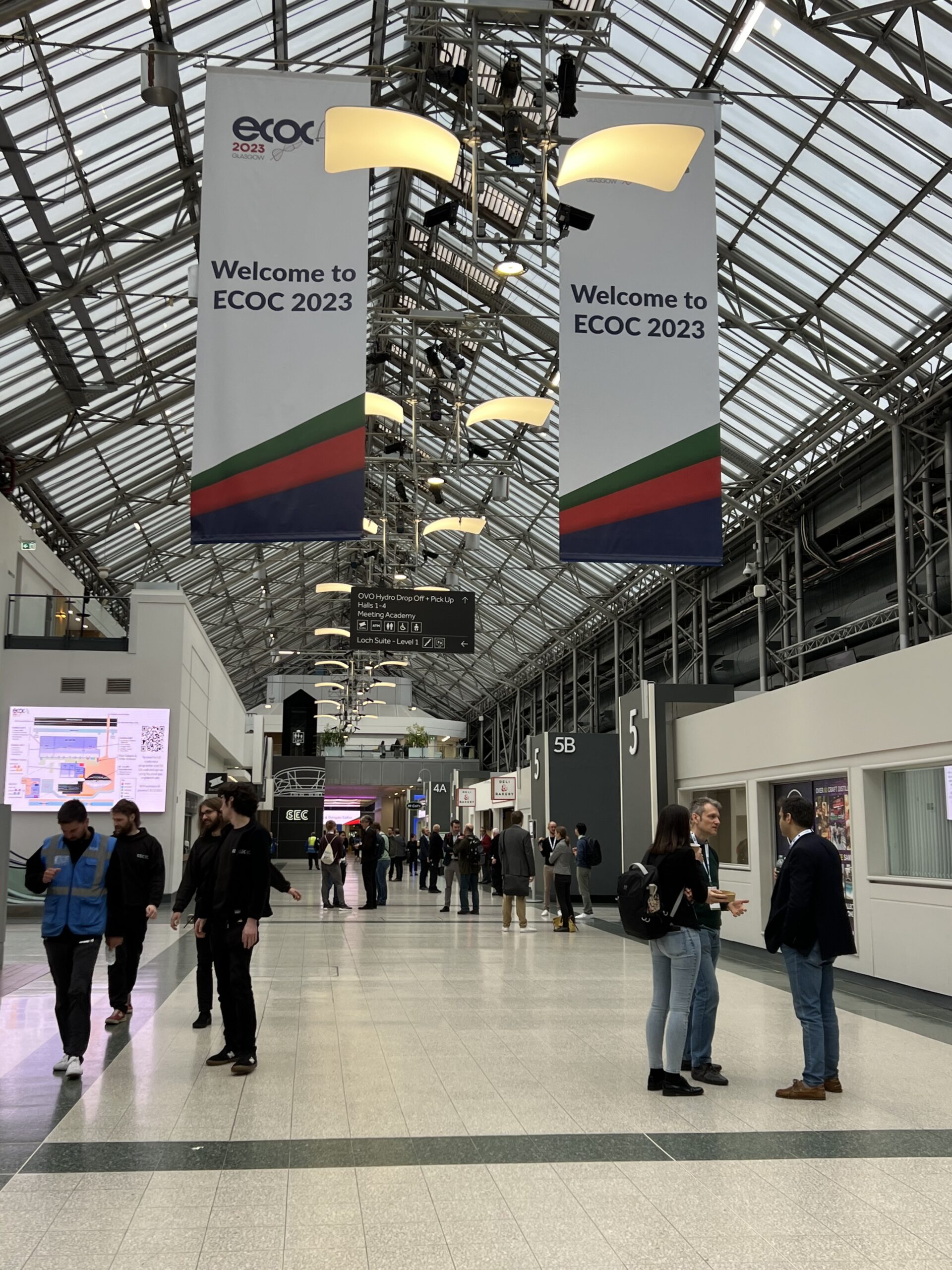
Gazettabyte is asking industry figures for their thoughts after attending the recent ECOC show in Glasgow. In particular, what developments and trends they noted, what they learned and what, if anything, surprised them. Here are more responses from LightCounting, Hyper Photonix, NewPhotonics, and Broadcom.
Vladimir Kozlov, CEO of LightCounting, a market research company
Demand for optical connectivity in data centres has accelerated innovation in the industry. ECOC 2023 offered numerous start-ups and established vendors another opportunity to disclose their latest achievements.
The improved reliability of quantum dot lasers was a pleasant surprise. Alfalume presented the latest quantum dot comb laser developments, including continuous power up to 250 mW with a power conversion efficiency of a quarter (25%) and efficient operation of up to 100oC. Preliminary test data suggests that quantum dot lasers offer superior reliability compared to their quantum well counterparts. It would be great to have a reliable laser source, finally.
Cisco and Intel deserve much credit for bringing silicon photonics-based transceivers to the market, but numerous vendors are entering the race now.
All the leading foundries offer photonic integrated circuits with integrated laser chips. TSMC disclosed its plans to use a 7nm CMOS process to manufacture photonic chips. Recently formed OpenLight offers fully tested photonic integrated circuit designs, which can be produced at several foundries, including Tower Semiconductor.
Many transceiver suppliers have internally designed optical engines. They all plan to reduce the manufacturing cost of silicon photonics-based transceivers, fulfilling the potential of CMOS technology. Competition among suppliers enabled huge reductions in the cost of CMOS-based ICs. Let us see if this works for CMOS-based photonic integrated circuits.
Brad Booth, director of technology and strategy at Hyper Photonix, and a consultant
There was good attendance at ECOC considering some companies continue to limit travel. Linear drive pluggable optics (LPO) is gaining traction but still has hurdles to address. Meanwhile, the 800-gigabit train is pulling into the station with a ZR digital signal processor and client-side modules.
What surprised me at the show? The shift to start-ups. It is reminiscent of the Gigabit Ethernet days.
Yaniv BenHaim, founder & CEO of NewPhotonics
There were some notable trends at ECOC. One is that 800-gigabit optical transceivers are ramping. At least three vendors were giving private demos of 8×100-gigabit DR enabled with the coming availability of 200G EMLs and photodetectors.
The industry is also optimistic about linear drive pluggable optics (LPO), helped by the buzz created by Nvidia, saying it will make the technology available in AI clusters by year-end. Data centres and networking companies are also pushing LPO and evaluating it and will likely announce findings by OFC 2024.
Another upcoming technology, like optical processing, as demonstrated by our company, NewPhotonics, can further advance power savings and range with both traditional optical modules and LPOs. At ECOC, we showed 224 gigabit-per-second (Gbps) optical input-output driving more than 10km of fibre using Intel’s new 224Gbps serialiser-deserialiser (serdes). We also showed NewPhotonics’ optical serdes multiplexing and demultiplexing multiple optical 112Gbps PAM-4 in the optical time domain.
Companies providing coherent technology continue to promote using coherent transceivers in the data centre. We don’t see any reason to do so when PAM-4 non-coherent solutions can cater for data centre needs and also go beyond 10km.
The market is moving forward in using 224 gigabits, which will disrupt optical transceivers and the active optical cable markets. It seems co-packaged optics will be delayed further as the electrical solutions for 50-terabit and 100-terabit switches are already there using electrical serdes.
The optical communication market had no new surprises based on wavelength division multiplexing PAM-4 and 16-QAM. Some ideas exist for replacing the DSP functions with analogue implementations. NewPhotonics is the only company pushing for an all-optical solution instead of an analogue or a digital signal processor solution.
Rajiv Pancholy, director of hyperscale strategy & products, optical systems division at Broadcom
It was evident at ECOC 2023 that the emergence of large networking clusters enabling the connectivity of graphics processing units (GPUs) for recommendation engines and large language models has substantially increased the ratio of photonic to copper links inside data centres. The optics industry has been waiting for an all-to-all connectivity killer app to increase volumes and therefore investment, and that app might have arrived.
Companies demonstrated excellent progress on 200 gigabit per lane optical components. Several companies are sampling 200 gigabit EMLs and plan production in 2024. Several companies also announced plans to release 200 gigabit per lane VCSELs. There was some early demonstration of 200 gigabit per lane silicon photonics, but it is still being determined when the technology will be ready for production.
Lastly, start-ups at the show focused on delivering novel optical interconnect technologies with micro-LEDs, comb lasers, and advanced packaging that reinforces a general trend towards high-density photonic integrated circuits, electrical interconnect simplification, and co-packaging. Though it’s still being determined when these optical technologies will come to market, Broadcom is not the only company working on co-packaged optics. We believe you will need co-packaged optics much sooner than five years from now.