

Lumentum’s CTO discusses photonic trends
CTO interviews part 2: Brandon Collings
- The importance of moving to parallel channels will only increase given the continual growth in bandwidth.
- Lumentum’s integration of NeoPhotonics’ engineers and products has been completed.
- The use of coherent techniques continues to grow, which is why Lumentum acquired the telecom transmission product lines and staff of IPG Photonics.
“It has changed quite significantly given what Lumentum is engaging in,” he says. “My role spans the entire company; I’m engaged in a lot of areas well beyond communications.”
A decade ago, the main focus was telecom and datacom. Now Lumentum also addresses commercial lasers, 3D sensing, and, increasingly, automotive lidar.
Acquisitions
Lumentum was busy acquiring in 2022. The deal to buy NeoPhotonics closed last August. The month of August was also when Lumentum acquired IPG Photonics’ telecom transmission product lines, including its coherent digital signal processing (DSP) team.
NeoPhotonics’ narrow-linewidth tunable lasers complement Lumentum’s modulators and access tunable modules. Meanwhile, the two companies’ engineering teams and portfolios have now been merged.
NeoPhotonics was active in automotive lidar, but Lumentum stresses it has been tackling the market for several years.
“It’s an area with lots of nuances as to how it is going to be adopted: where, how fast and the cost dependences,” says Collings. “We have been supplying illuminators, VCSELs, narrow-linewidth lasers and other technologies into lidar solutions for several different companies.”
Lumentum gained a series of technological capabilities and some products with the IPG acquisition. “The big part was the DSP capability,” says Collings.
ROADMs
Telecom operators have been assessing IP-over-DWDM anew with the advent of coherent optical modules that plug directly into an IP router.
Cisco’s routed optical networking approach argues the economics of using routers and the IP layer for traffic steering rather than at the optical layer using reconfigurable optical add-drop multiplexers (ROADMs).
Is Lumentum, a leading ROADM technology supplier, seeing such a change?
“I don’t think there is a sea change on the horizon of moving from optical to electrical switching,” says Collings. “The reason is still the same: transceivers are still more expensive than optical switches.”
That balance of when to switch traffic optically or electrically remains at play. Since IP traffic continues to grow, forcing a corresponding increase in signalling speed, savings remain using the optical domain.
“There will, of course, be IP routers in networks but will they take over ROADMs?” says Collings. “It doesn’t seem to be on the horizon because of this growth.”
Meanwhile, the transition to more flexible optical networking using colourless, directionless, contentionless (CDC) ROADMs, is essentially complete.
Lumentum undertook four generations of switch platform design in the last decade to enable CDC-ROADM architectures that are now dominant, says Collings.
Lumentum moved from a simple add-drop to a route-and-select and a colourless, contentionless architecture.
A significant development was Lumentum’s adoption of liquid-crystal-on-silicon (LCOS) technology that enabled twin wavelength-selective switches (WSSes) per node that adds flexibility. LCOS also has enabled a flexible grid which Lumentum knew would be needed.
“We’re increasingly using MEMS technology alongside LCOS to do more complex switching functions embedded in colourless, directionless and contentionless networks today,” says Collings.
Shannon’s limit
If the last decade has been about enabling multiplexing and demultiplexing flexibility, the next challenge will be dealing with Shannon’s limit.
“We can’t stuff much more information into a single optical fibre – or that bit of the amplified spectrum of the optical fibre – and go the same distance,” says Collings. “We’ve sort of tapped out or reached that capacity.”
Adding more capacity requires amplified fibre bandwidth, such as using the L-band alongside the C-band or adding a second fibre.
Enabling such expansion in a cost- and power-efficient way will be fundamental, says Collings, and will define the next generation of optical networks.
Moreover, he expects consumer demand for bandwidth growth to continue. More sensing and more up-hauling of data to the cloud for processing will occur.
Accordingly, optical transceivers will continue to develop over the next decade.
“They are the complement requirement for scaling bandwidth, cost and power effectively,” he says.
Parallelism
Continual growth of bandwidth over the next decade will cause the industry to experience technological ceilings that will drive more parallelism in communications.
“If you look in data centres and datacom interconnects, they have long moved to parallel interface implementations because they felt that bandwidth ceiling from a technological, power dissipation or economic reason.”
Coherent systems have a symbol rate of 128 gigabaud (GBd), and the industry is working on 256GBd systems. Sooner or later, the consensus will be that the symbol rate is fast enough, and it is time to move to a parallel regime.
“In large-scale networks, parallelism is going to be the new thing over the next ten years,” says Collings.
Coherent technology
Collings segments the coherent optical market into three.
There are high-end coherent designs for long-haul transport developed by optical transport vendors such as Ciena, Cisco, Huawei, Infinera and Nokia.
Then there are designs such as 400ZR developed for data centre interconnect. Here a ‘pretty aggressive’ capability is needed but not full-scale performance.
At the lower end, there are application areas where direct-detect optics is reaching its limit. For example, inside the data centre, campus networks and access networks. Here the right solution is coherent or a ‘coherent-light’ technology that is a compromise between direct detection and full-scale coherence used for the long haul.
“So there is emerging this wide continuum of applications that need an equal continuum of coherent technology,” says Collings.
Now that Lumentum has a DSP capability with the IPG acquisition, it can engage with those applications that need solutions that use coherent but may not need the highest-end performance.
800 gigabits and 1.6 terabits
There is also an ongoing debate about the role of coherent for 800-gigabit and 1.6-terabit transceivers, and Collings says the issues remain unclear.
There’s a range of application requirements: 500m, 2km, and 10km. A direct-detect design may meet the 500m application but struggle at 2k and break down at 10km. “There’s a grey area, just in this simple example,” he says.
Also, the introduction of coherent should be nuanced; what is not needed is a long-haul 5,000km DSP. It is more a coherent-light solution or a borrowing from coherent technologies, says Collings: “You’re still trying to solve a problem that you can almost do with direct detect but not quite.”
The aim is to use the minimum needed to accomplish the goal because the design must avoid paying the cost and power to implement the full complement coherent long-haul.
“So that’s the other part of the grey area: how much you borrow?” he says. “And how much do you need to borrow if you’re dealing with 10km versus 2km, or 800 gigabits versus 1.6 terabits.”
Data centres are already using parallel solutions, so there is always the option to double a design through parallelism.
“Eight hundred gigabit could be the baseline with twice as many lanes as whatever we’re doing at 400 gigabits,” he says. “There is always this brute force approach that you need to best if you’re going to bring in new technologies.”
Optical interconnect
Another area Lumentum is active is addressing the issues of artificial intelligence machine-learning clusters. The machine-learning architectures used must scale at an unprecedented rate and use parallelism in processors, multiple such processors per cluster, and multiple clusters.
Scaling processors requires the scaling of their interconnect. This is driving a shift from copper to optics due to the bandwidth growth involved and the distances: 100, 200 and 400 gigabits and lengths of 30-50 meters, respectively.
The transition to an integrated optical interconnect capability will include VCSELs, co-packaged optics, and much denser optical connectivity to connect the graphic processing units (GPUs) rather than architectures based on pluggables that the industry is so familiar with, says Collings.
Co-packaged optics address a power dissipation interconnect challenge and will likely first be used for proprietary interconnect in very high density GPU artificial intelligence clusters.
Meanwhile, pluggable optics will continue to be used with Ethernet switches. The technology is mature and addresses the needs for at least two more generations.
“There’s an expectation that it’s not if but when the switchover happens to co-packaged optics and the Ethernet switch,” says Collings.
Material systems
Lumentum has expertise in several material systems, including indium phosphide, silicon photonics and gallium arsenide.
All these materials have strengths and weaknesses, he says.
Indium phosphide has bandwidth advantages and is best for light generation. Silicon is largely athermal, highly parallelisable and scalable. Staff joining from NeoPhotonics and IPG have strengthened Lumentum’s silicon photonics expertise.
“The question isn’t silicon photonics or indium phosphide. It’s how you get the best out of both material systems, sometimes in the same device,” says Collings. “Sticking in one sandbox is not going to be as competitive as being agile and having the ability to bring those sandboxes together.”


Lumentum bulks up with NeoPhotonics buy

Lumentum is to acquire fellow component and module specialist, NeoPhotonics, for $918 million.
The deal will expand Lumentum’s optical transmission product line, broadening its component portfolio and boosting its high-end coherent line-side product offerings.
Gaining NeoPhotonics’ 400-gigabit coherent offerings will enable Lumentum to better compete with Cisco and Marvell. Lumentum will also gain a talented team of photonics experts as it looks to address new opportunities.
Alan Lowe, Lumentum’s president and CEO, stressed the importance of this collective optical expertise.
Speaking on the call announcing the agreement, Lowe said the expanded know-how would benefit Lumentum’s traditional markets and accelerate its entrance into other, newer markets.
Transaction details
Lumentum will pay $16 in cash for each share of NeoPhotonics, valuing the company at $918 million. Lumentum will also pay $50 million to NeoPhotonics “for growth capex and working capital.”
Cost savings of $50 million in annual run-rate are expected within two years of the deal closing, with 60 per cent of the savings coming from the cost of goods sold.
The deal is reminiscent of Lumentum’s acquisition of Oclaro for $1.8 billion in 2018. Oclaro was also focussed on transmission components and modules.
The acquisition is expected to close in the second half of 2022, subject to the approval of NeoPhotonics’ stockholders and regulatory bodies.
Background
Lumentum’s announcement follows its failed bid early this year for the laser company, Coherent. II-VI ended up winning the bid, paying $6.9 billion.
Coherent’s lasers are used in many markets and the deal would have diversified Lumentum’s business beyond communications and smartphones.
Now, the proposed acquisition of NeoPhotonics boosts Lumentum’s core communications business unit. NeoPhotonics’ focus is cloud and networking although the company has been using its coherent expertise to address LiDAR and medical markets.
Vladimir Kozlov, CEO of market research firm LightCounting, does not see any inconsistency in Lumentum’s strategy to first diversify and then strengthen its core business. “There are many directions to accelerate company growth,” he says.
Lumentum tried one way with Coherent, it didn’t work out, now it is trying another with NeoPhotonics. “You take opportunities as they come along,” says Kozlov.
NeoPhotonics has also been impacted by the trade restrictions on Huawei, a significant customer of the company. NeoPhotonics has had to adapt to on-off sales to Huawei in recent years. Huawei also has a long-term strategy to develop its optical components including tunable lasers for which NeoPhotonics has been their leading supplier.
“That certainly added pressure on NeoPhotonics to be acquired,” says Kozlov.
Business opportunities
Lumentum’s business is split 60 per cent cloud and networking and 40 per cent 3D Sensing, LiDAR, and commercial lasers for industrial applications.
Lumentum’s cloud and networking products include reconfigurable optical add-drop multiplexing (ROADM) sub-systems, optical components for high-speed client-side and line-side modules, and coherent optical modules.
NeoPhotonics brings ultra narrow-linewidth tunable lasers, silicon photonics-based components and transceivers, and high-speed coherent modules and components. NeoPhotonics also has passive and planar lightwave circuit components and an RF chip design capability using gallium arsenide and silicon germanium.
Tim Jenks, president, CEO and chairman of NeoPhotonics, said combining the two firms would accelerate its business developing high-speed optical communications.
In turn, their combined R&D and technology teams can address new markets such as the life sciences, industrial applications, and green markets such as energy efficiency, electric vehicles and climate change green manufacturing concerns.
But no detail was forthcoming on the call beyond Lowe saying the merger will expand the collective know-how and accelerate its entrance into these markets.
Lowe also highlighted the strong growth in high-speed ports due to the 30 per cent year-on-year growth in internet bandwidth.
LightCounting says the dense wavelength division multiplexing (DWDM) coherent market will experience a compound annual growth rate (CAGR) of 20 per cent over the next five years; the general optical market is growing at a 14 per cent CAGR.
Both companies have indium-phosphide components for coherent systems while NeoPhotonics has pluggable 400ZR and ZR+ products as well as silicon photonics components for coherent. Gaining NeoPhotonics’ ultra-narrow linewidth lasers will make Lumentum an even stronger laser supplier.
LightCounting’s Kozlov notes the importance of scale, especially when target markets are not huge and the number of large customers is limited. This is the case with 400ZR/ ZR+ coherent DWDM transceivers that NeoPhotonics started selling in 2021.
Amazon is the biggest buyer of such modules and it uses three suppliers. NeoPhotonics is a distant third in the race behind Acacia, now part of Cisco, and Inphi, part of Marvell. But unlike Acacia and Inphi, NeoPhotonics does not have its own coherent DSP.
Joining forces with Lumentum, NeoPhotonics is more likely to win a larger share of business at key customers, says LightCounting. The new Lumentum may still be third in the race, but it is no longer a distant third.
Recent announcements
Lumentum started shipping its 400-gigabit CFP2-DCO coherent module earlier this year. Its range of indium-phosphide coherent components operates at a 96-gigabaud (GBd) symbol rate that supports up to 800-gigabit wavelengths. Lumentum is developing components that will operate at 128GBd.
Lumentum also has a directly modulated laser (DML) supporting 100-gigabit wavelengths. Such a laser is used for 100-gigabit and 400-gigabit client-side pluggables. The company is also developing electro-absorption modulated laser (EML) technology that supports 200 gigabits and higher performance per lane.
Meanwhile, NeoPhotonics is shipping 400ZR QSFP-DD and OSFP 400ZR coherent optical modules. NeoPhotonics also has a multi-rate CFP2-DCO module with a reach of 1,500km at 400 gigabits. And like Lumentum, the company has indium-phosphide technology that supports 130GBd coherent components.
Kozlov believes Lumentum is in a good position.
On the call announcing the deal, Lumentum also delivered its latest quarterly results. “They can hardly keep up with demand,” he says.
The issue of shortages is getting worse. This is not because the shortages themselves are getting worse but that demand is ramping faster than the shortage issue can be resolved. “It’s a good problem to have,” says Kozlov.
Industry consolidation
The Lumentum-NeoPhotonics deal follows the recent announcement of the merger of two other mature optical players such as the systems vendors: ADTRAN and ADVA.
LightCounting’s Kozlov agrees consolidation is happening among mature optical component and optical networking companies but he points out that many new optical start-ups are emerging and not just in China.
“At the telecommunications part of CIOE (China International Optoelectronic Exposition), 500 companies were exhibiting,” says Kozlov. “And with the trade barriers, there is an extra incentive for companies in the West to double down on what they have been doing and maybe new companies to be formed.”
Companies have concerns about buying stuff from overseas so local companies are getting more business.
“We are going to see more consolidation but also new vendors entering the market and competing with the bigger guys,” says Kozlov.


100-gigabaud optics usher in the era of terabit transmissions
Telecom operators are in a continual battle to improve the economics of their optical transport networks to keep pace with the relentless growth of IP traffic.
One approach is to increase the symbol rate used for optical transmission. By operating at a higher baud rate, more data can be carried on an optical wavelength.

Ferris Lipscomb
Alternatively, a higher baud rate allows a simpler modulation scheme to be used, sending the same amount of data over greater distances. That is because the fewer constellation points of the simpler modulation scheme help data recovery at the receiver.
NeoPhotonics has detailed two optical components - a coherent driver-modulator and an intradyne coherent receiver (micro-ICR) - that operate at over 100 gigabaud (GBd). The symbol rate suits 800-gigabit systems and can enable one-terabit transmissions.
NeoPhotonics’ coherent devices were announced to coincide with the ECOC 2020 show.
Class 60 components
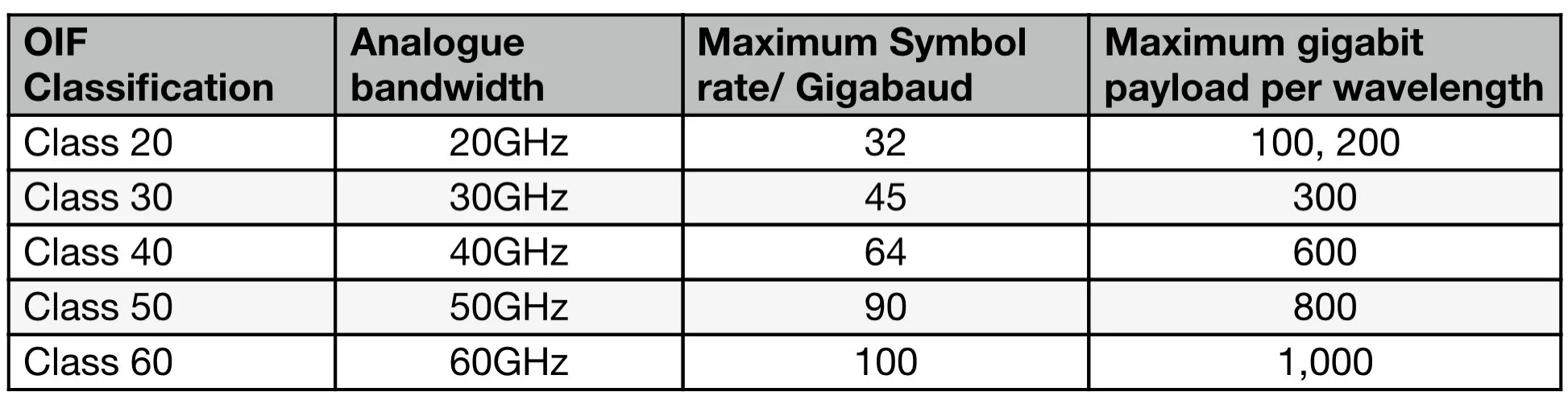
The OIF has a classification scheme for coherent optical components based on their analogue bandwidth performance.
A Class 20 receiver, for example, has a 3-decibel (dB) bandwidth of 20GHz. NeoPhotonics announced at the OFC 2019 show Class 50 devices with a 50GHz 3dB bandwidth. The Class 50 modulator and receiver devices are now deployed in 800-gigabit coherent systems.
NeoPhotonics stresses the classes are not the only possible operating points. “It is possible to use baud rates in between these standard numbers,” says Ferris Lipscomb, vice president of marketing at NeoPhotonics. “These classes are shorthand for a range of possible baud rates.”
“To get to 96 gigabaud, you have to be a little bit above 50GHz, typically a 55GHz 3dB bandwidth,” says Lipscomb. “With Class 60, you can go to 100 gigabaud and approach a terabit.”
It is unclear whether one-terabit coherent transponders will be widely used. Instead, Class 60 devices will likely be the mainstay for transmissions up to 800 gigabits, he says.
Source: NeoPhotonics, Gazettabyte
Design improvements
Several aspects of the components are enhanced to achieve Class-60 performance.
At the receiver, the photodetector’s bandwidth needs to be enhanced, as does that of the trans-impedance amplifier (TIA) used to boost the received signals before digitisation. In turn, the modulator driver must also be able to operate at a higher symbol rate.
“This is mainly analogue circuit design,” says Lipscomb. “You have to have a detector that will respond at those speeds so that means it can’t be a very big area; you can’t have much capacitance in the device.”
Similarly, the silicon germanium drivers and TIAs, to work at those speeds, must also keep the capacitance down given that the 3dB bandwidth is inversely proportional to the capacitance.
Systems vendors Ciena, Infinera, and Huawei all have platforms supporting 800-gigabit wavelengths while Nokia‘s latest PSE-Vs coherent digital signal processor (DSP) supports up to 600 gigabit-per-wavelength.
Next-generation symbol rate
The next jump in symbol rate will be in the 120+ gigabaud range, enabling 1.2-terabit transmissions.
“As you push the baud rate higher, you have to increase the channel spacing,” says Lipscomb. “Channels can’t be arbitrary if you want to have any backward compatibility.”
A 50GHz channel is used for 100- and 200-gigabit transmissions at 32GBd. Doubling the symbol rate to 64GBd requires a 75GHz channel while a 100GBd Class 60 design occupies a 100GHZ channel. For 128GBd, a 150GHz channel will be needed. “For 1.2 terabit, this spacing matches well with 75GHz channels,” says Lipscomb.
It remains unclear when 128GBd systems will be trialled but Lipscomb expects it will be 2022, with deployments in 2023.
Upping the baud rate enhances the reach and reduces channel count but it does not improve spectral efficiency. “You don’t start getting more data down a fibre,” says Lipscomb.
To boost transport capacity, a fibre’s C-band can be extended to span 6THz, dubbed the C++ band, adding up to 50 per cent more capacity. The L-band can also be used and that too can be extended. But two sets of optics and optical amplification are required when the C and L bands are used.
400ZR and OpenZR+
Lipscomb says the first 400ZR coherent pluggable deployments that link data centres up to 120km apart will start next year. The OIF 400ZR coherent standard is implemented using QSFP-DD or OSFP client-side pluggable modules.
“There is also an effort to standardise around OpenZR+ that has a little bit more robust definition and that may be 2022 before it is deployed,” says Lipscomb.
NeoPhotonics is a contributor member to the OpenZR+ industry initiative that extends optical performance beyond 400ZR’s 120km.
800-gigabit coherent pluggable
The OIF has just announced it is developing the next-generation of ZR optics, an 800-gigabit coherent line interface supporting links up to 120km. The 800-gigabit specification will also support unamplified fixed-wavelength links 2-10km apart.
“This [800ZR standard] will use between Class 50 and Class 60 optics and a 5nm CMOS digital signal processor,” says Lipscomb.
NeoPhotonics’ Class 60 coherent modulator and receiver components are indium phosphide-based. For the future 800-gigabit coherent pluggable, a silicon photonics coherent optical subassembly (COSA) integrating the modulator with the receiver is required.
NeoPhotonics has published work showing its silicon photonics operating at around 90GBd required for 800-gigabit coherent pluggables.
“This is a couple of years out, requiring another generation of DSP and another generation of optics,” says Lipscomb.

NeoPhotonics’ growing 400G coherent pluggable portfolio
NeoPhotonics has unveiled its first two 400-gigabit coherent pluggable modules that support the OIF’s 400ZR coherent standard and extended ZR+ modes.
The company has delivered samples of its ClearLight CFP2-DCO module for trials. The CFP2-DCO supports 400ZR, metro, and long-haul optional transmissions.
NeoPhotonics has also delivered to a hyperscaler the first samples of a 400-gigabit OSFP pluggable that supports 400ZR and 400ZR+.
Both modules use Inphi’s latest Canopus 7nm CMOS coherent digital signal processor (DSP) chip.
Module types
The OIF has developed the 400ZR standard to enable 400-gigabit signals to be sent between switches or routers in data centres up to 120km apart.
The main three pluggable modules earmarked for 400ZR are the QSFP-DD, OSFP and CFP2-DCO.
These modules differ in size and power envelope, ranging from the QSFP-DD, which is the most compact and has the smallest power envelope, to the CFP2-DCO module which supports the highest power and size.
It is the two client-side module form factors – the QSFP-DD and the OSFP – that will be mainly used for 400ZR.
“The CFP2 has more of a power envelope available so it tends to be used for longer reach applications,” says Ferris Lipscomb, vice president of marketing at NeoPhotonics.
These applications include specialist data-centre-interconnect applications and the metro and long-haul needs of the telecom operators.
400G CFP2-DCO
NeoPhotonics’ ClearLight CFP2-DCO uses an extension of a fibre’s C-band spectrum, what Huawei calls the Super C-band while NeoPhotonics refers to its implementation as C++.
The Super C-band covers 6THz of the spectrum compared to the standard C-band’s 4THz. The extended band can fit 120, 50GHz-wide channels or 80, 75GHz-wide channels.
NeoPhotonics can send 64-gigabaud (GBd), 400-gigabit signals over a 75GHz channel such that using ClearLight CFP2-DCO modules, 32 terabits can be sent overall.
The CFP2-DCO module uses NeoPhotonics’s ultra narrow-band line-width tunable laser that has had its tuning range extended to span the Super C-band. NeoPhotonics also uses its 64GBd intradyne coherent receiver (ICR) and coherent driver modulator.
The ClearLight CFP2-DCO can also send 400-gigabit signals over distances greater than 400ZR’s 120km. In addition, the module supports 200-gigabit transmissions over greater distances.
Sending a 200-gigabit at 64GBd using a 75GHz channel and quadrature phase-shift keying (QPSK) modulation, an optical signal-to-noise ratio (OSNR) of under 14dB is needed. Alternatively, using a 50GHz channel at 32GBd and 16-ary quadrature amplitude modulation (16-QAM), the OSNR is 16dB.
“With these [decibel] numbers, lower is better,” says Lipscomb. “You can go further with 64 gigabaud and QPSK; it’s 2dB better.”
Lipscomb says one use case for the 400-gigabit CFP2-DCO promises significant volumes: “The Super C-band has been used for deployments particularly by the Chinese carriers where they want to get more channels down a fibre.”
OSFP
NeoPhotonics has also unveiled its ClearLight OSFP module that enables the 400ZR standard and 400-gigabit transmissions for metro.
The module incorporates NeoPhotonics’s nano integrated tunable laser assembly (Nano-ITLA) and its silicon photonics-based coherent optical sub-assembly (COSA) that integrates the coherent receiver and modulator driver functions.
The OSFP tunes over 75GHz- or 100GHz-spaced channels, enabling 85 and 64 channels, respectively, as specified by the OIF. The OSFP also supports longer metro reaches at 400 gigabits.
NeoPhotonics also makes arrayed waveguide gratings (AWG) suited for 64GBd and 75GHz channel spacings that both modules support. “You need broader passbands and different channel spacings for 64 gigabaud,” says Lipscomb.
ZR+ interop?
Lipscomb is not a proponent of enforcing standardisation for the ZR+ extended modes, as has been done with 400ZR, despite the resulting lack of interoperability between optical modules from different vendors.
“There will always be the temptation in cases where you need it, to give up interoperability for increased [optical] performance,” he says.

Data centre interconnect drives coherent
-
NeoPhotonics announced at OFC a high-speed modulator and intradyne coherent receiver (ICR) that support an 800-gigabit wavelength
-
It also announced limited availability of its nano integrable tunable laser assembly (nano-ITLA) and demonstrated its pico-ITLA, an even more compact silicon photonics-based laser assembly
-
The company also showcased a CFP2-DCO pluggable
NeoPhotonics unveiled several coherent optical transmission technologies at the OFC conference and exhibition held in San Diego last month.
“There are two [industry] thrusts going on right now: 400ZR and data centre interconnect pizza boxes going to even higher gigabits per wavelength,” says Ferris Lipscomb, vice president of marketing at NeoPhotonics.

Ferris Lipscomb
The 400ZR is an interoperable 400-gigabit coherent interface developed by the Optical Internetworking Forum (OIF).
Optical module makers are developing 400ZR solutions that fit within the client-side QSFP-DD and OSFP pluggable form factors, first samples of which are expected by year-end.
800-gigabit lambdas
Ciena and Infinera announced in the run-up to OFC their latest coherent systems - the WaveLogic 5 and ICE6, respectively - that will support 800-gigabit wavelengths. NeoPhotonics announced a micro intradyne coherent receiver (micro-ICR) and modulator components that are capable of supporting such 800-gigabit line-rate transmissions.
NeoPhotonics says its micro-ICR and coherent driver modulator are class 50 devices that support symbol rates of 85 to 90 gigabaud required for such a state-of-the-art line rate.
The OIF classification defines categories for devices based on their analogue bandwidth performance. “With class 20, the 3dB bandwidth of the receiver and the modulator is 20GHz,” says Lipscomb. “With tricks of the trade, you can make the symbol rate much higher than the 3dB bandwidth such that class 20 supports 32 gigabaud.” Thirty-two gigabaud is used for 100-gigabit and 200-gigabit coherent transmissions.
Class 50 refers to the highest component performance category where devices have an analogue bandwidth of 50GHz. This equates to a baud rate close to 100 gigabaud, fast enough to achieve data transmission rates exceeding a terabit. “But you have to allow for the overhead the forward-error correction takes, such that the usable data rate is less than the total,” says Lipscomb (see table).

Source: Gazettabyte, NeoPhotonics
Silicon photonics-based COSA
NeoPhotonics also announced a 64-gigabaud silicon photonics-based coherent optical subassembly (COSA). The COSA combines the receiver and modulator in a single package that is small enough to fit within a QSFP-DD or OSFP pluggable for applications such as 400ZR.
Last year, the company announced a similar COSA implemented in indium phosphide. In general, it is easier to do higher speed devices in indium phosphide, says Lipscomb, but while the performance in silicon photonics is not quite as good, it can be made good enough.
“It [silicon photonics] is now stretching certainly into the Class 40 [that supports 600-gigabit wavelengths] and there are indications, in certain circumstances, that you might be able to do it in the Class 50.”
Lipscomb says NeoPhotonics views silicon photonics as one more material that complements its indium phosphide, planar lightwave circuit and gallium arsenide technologies. “Our whole approach is that we use the material platform that is best for a certain application,” says Lipscomb.
In general, coherent products for telecom applications take time to ramp in volumes. “With the advent of data centre interconnect, the volume growth is much greater than it ever has been in the past,” says Lipscomb.
NeoPhotonics’ interested in silicon photonics is due to the manufacturing benefits it brings that help to scale volumes to meet the hyperscalers’ requirements. “Whereas indium phosphide has very good performance, the infrastructure is still limited and you can’t duplicate it overnight,” says Lipscomb. “That is what silicon photonics does, it gives you scale.”
NeoPhotonics also announced the limited availability of its nano integrable tunable laser assembly (nano-ITLA). “This is a version of our external cavity ITLA that has the narrowest line width in the industry,” says Lipscomb.
The nano-ITLA can be used as the source for Class 50, 800-gigabit systems and current Class 40 600 gigabit-per-wavelength systems. It is also small enough to fit within the QDFP-DD and OSFP client-side modules for 400ZR designs. “It is a new compact laser that can be used with all those speeds,” says Lipscomb.
NeoPhotonics also showed a silicon-photonics based pico-ITLA that is even smaller than the nano-ITLA.“The [nano-ITLA’s] optical cavity is now made using silicon photonics so that makes it a silicon photonics laser,” says Lipscomb.
Instead of having to assemble piece parts using silicon photonics, it can be made as one piece. “It means you can integrate that into the same chip you put your modulator and receiver on,” says Lipscomb. “So you can now put all three in a single COSA, what is called the IC-TROSA.” The IC-TROSA refers to an integrated coherent transmit-receive optical subassembly, defined by the OIF, that fits within the QSFP-DD and OSFP.
Despite the data centre interconnect market with its larger volumes and much faster product uptakes, indium phosphide will still be used in many places that require higher optical performance. “But for bulk high-volume applications, there are lots of advantages to silicon photonics,” says Lipscomb.
400ZR and 400ZR+
A key theme at this year’s OFC was the 80km 400ZR. Also of industry interest is the 400ZR+, not an OIF specification but an interface that extends the coherent range to metro distances.
Lipscomb says that the initial market for the 400ZR+ will be smaller than the 400ZR, while the ZR+’s optical performance will depend on how much power is left after the optics is squeezed into a QSFP-DD or OSFP module.
“The next generation of DSP will be required to have a power consumption low enough to do more than ZR distances,” he says. “The further you go, the more work the DSP has to do to eliminate the fibre impairments and therefore the more power it will consume.”
Will not the ZR+ curtail the market opportunity for the 400-gigabit CFP2-DCO that is also aimed at the metro?
“It’s a matter of timing,” says Lipscomb. “The advantage of the 400-gigabit CFP2-DCO is that you can almost do it now, whereas the ZR+ won’t be in volume till the end of 2020 or early 2021.”
Meanwhile, NeoPhotonics demonstrated at the show a CFP2-DCO capable of 100-gigabit and 200-gigabit transmissions.
NeoPhotonics has not detailed the merchant DSP it is using for its CFP2-DCO except to say that it working with ‘multiple ones’. This suggests it is using the merchant coherent DSPs from NEL and Inphi.

NeoPhotonics ups the baud rate for line and client optics
- Neophotonics’ 64 gigabaud optical components are now being designed into optical transmission systems. The components enable up to 600 gigabits per wavelength and 1.2 terabits using a dual-wavelength transponder.
- The company’s high-end transponder that uses Ciena’s WaveLogic Ai coherent digital signal processor (DSP) is now shipping.
- NeoPhotonic is also showcasing its 53 gigabaud components for client-side pluggable optics capable of 100-gigabit wavelengths at the current European Conference on Optical Communication (ECOC) show being held in Rome.
NeoPhotonics says its family of 64 gigabaud (Gbaud) optical components are being incorporated within next-generation optical transmission platforms.
 Ferris LipscombThe 64Gbaud components include a micro intradyne coherent receiver (micro-ICR), a micro integrable tunable laser assembly (micro-ITLA) and a coherent driver modulator (CDM).
The micro-ICR and micro-ITLA are the Optical Internetworking Forum’s (OIF) specification, while the CDM is currently being specified.
“Three major customers have selected to use all three [64Gbaud components] and several others are using a subset of those,” says Ferris Lipscomb, vice president of marketing at NeoPhotonics.
NeoPhotonics also unveiled and demonstrated two smaller 64Gbaud component designs at the OFC show held in March. The devices - a coherent optical sub-assembly (COSA) and a nano-ITLA - are aimed at 400-gigabit coherent pluggable modules as well as compact line-card designs.
“These [two compact components] continue to be developed as well,” says Lipscomb.
Baud rate and modulation
The current 100-gigabit coherent transmission uses polarisation-multiplexing, quadrature phase-shift keying (PM-QPSK) modulation operating at 32 gigabaud. The 100 gigabits-per-second (Gbps) data rate is achieved using four bits per symbol and a symbol rate of 32Gbaud.
Optical designers use two approaches to increase the wavelength’s data rate beyond 100Gbps. One approach is to increase the modulation scheme beyond QPSK using 16-ary quadrature amplitude modulation (16-QAM) or 64-QAM, the other is to increase the baud rate.
“The baud rate is the on-off rate as opposed to the bit rate. That is because you are packing more bits in there than the on-off supports,” says Lipscomb. “But if you double the on-off rate, you double the number of bits.”
Doubling the baud rate from 32Gbaud to 64Gbaud achieves just while using 64-QAM trebles the data sent per symbol compared to 100-gigabit PM-QSPK. Combining the two - 64Gbaud and 64-QAM - creates the 600 gigabits per wavelength.
A higher baud rate also has a reach advantage, says Lipscomb, with its lower noise. “For longer distances, increasing the baud rate is better.”
But doubling the baud rate requires more capable DSPs to interpret things at twice the rate. “And such DSPs now exist, operating at 64Gbaud and 64-QAM,” he says.
Three major customers have selected to use all three [64Gbaud components] and several others are using a subset of those
Coherent components
NeoPhotonics’ 64Gbaud optical components are suitable for line cards, fixed-packaged transponders, 1-rack-unit modular platforms used for data centre interconnect and the CFP2 pluggable form factor.
For data centre interconnect using 600-gigabits-per-wavelength transmissions, the distance achieved is up to 100km. For longer distances, the 64Gbaud components achieve metro-regional reaches at 400Gbps, and 2,000km for long-haul at 200Gbps.
But to fit within the most demanding pluggable form factors such as the OSFP and QSFP-DD, smaller componentry is required. This is what the coherent optical sub-assembly (COSA) and nano-ITLA are designed to address. The COSA combines the coherent modular driver and the ICR in a single gold-box package that is no larger than the individual 64Gbaud micro-ICR and CDM packages.
 Source: Gazettabyte
“There is a lot of interest in 400-gigabit applications for a CFP2, and in that form factor you can use the separate components,” says Lipscomb. “But for data centre interconnect, you want to increase the density as much as possible so going to the smaller OSPF or QSFP-DD requires another generation of [component] shrinking.”
NeoPhotonics says there are two main approaches. One, and what NeoPhotonics has done with the nano-ITLA and COSA, is to separate the laser from the remaining circuitry such that two components are needed overall. A benefit of a separate laser is also lower noise. “But the ultimate approach would be to put all three in one gold box,” says Lipscomb.
For data centre interconnect, you want to increase the density as much as possible so going to the smaller OSPF or QSFP-DD requires another generation of [component] shrinking
Both approaches are accommodated as part of the OIF’s Integrated Coherent Transmitter-Receiver Optical Sub-Assembly (IC-TROSA) project.
Another challenge to achieving coherent designs such as the emerging 400ZR standard using the OSFP or QSFP-DD is accommodating the DSP with the optics while meeting the modules’ demanding power constraints. This requires a 7nm CMOS DSP and first samples are expected by year-end with limited production occurring towards the end of 2019. Volume production of coherent OSFP and QSFP-DD modules are expected in 2020 or even 2021, says Lipscomb.
100G client-side wavelengths
NeoPhotonics also used the OFC show last March to detail its 53Gbaud components for client-side pluggables that are 100-gigabit single-wavelength and four-wavelength 400-gigabit designs. Samples of these have now been delivered to customers and are part of demonstrations at ECOC this week.
The components include an electro-absorption modulated laser (EML) and driver for the transmitter, and photodetectors and trans-impedance amplifiers for the receiver path. The 53Gbaud EML can operate uncooled, is non-hermetic and is aimed for use with OSFP and QSFP-DD modules.
To achieve a 100-gigabit wavelength, 4-level pulse-amplitude modulation (PAM-4) is used and that requires an advanced DSP. Such PAM-4 DSPs will only be available early next year, says NeoPhotonics.
The first 400-gigabit modules using 100-gigabit wavelengths will gain momentum by the end of 2019 with volume production in 2020, says Lipscomb.
The various 8-wavelength implementations such as the IEEE-defined 2km 400GBASE-FR8 and 10km 400GBASE-LR8 are used when data centre operators must have 400-gigabit client interfaces.
The adoption of 100-gigabit single-wavelength implementations of 400 gigabits, in contrast, will be adopted when it becomes cheaper on a cost-per-bit basis, says Lipscomb: “It [100-gigabit single-wavelength-based modules] will be a general replacement rather than a breaking of bottlenecks.”
NeoPhotonics is also making available its DFB laser technology for silicon-photonics-based modules such as the 2km 400G-FR4, as well as the 100-gigabit single-wavelength DR1 and the parallel-fibre 400-gigabit DR4 standards.
WaveLogic AI transponder
NeoPhotonics has revealed it is shipping its first module using Ciena’s WaveLogic Ai coherent DSP. “We are shipping in modest volumes right now,” says Lipscomb.
The company is one of three module makers, the others being Lumentum and Oclaro, that signed an agreement with Ciena to use of its flagship WaveLogic Ai DSP for their coherent module designs.
Lipscomb describes the market for the module as a niche given its high-end optical performance, what he describes as a fully capable, multi-haul transponder. “It has lots of features and a lot of expense too,” he says. “It is applied to specific cases where long distance is needed; it can go 12,000km if you need it to.”
The agreement with Ciena also includes the option to use future Ciena DSPs. “Nothing is announced yet and so we will have to see how that all plays out.”
NeoPhotonics samples its first CFP-DCO products
 The company has announced two such CFP Digital Coherent Optics (CFP-DCO) modules: a 100 gigabit-per-second (Gbps) module and a dual-rate 100Gbps and 200Gbps one.
“Our rationale [for entering the CFP-DCO market] is we have all the optical components and the [merchant coherent] DSPs are now becoming available,” says Ferris Lipscomb (pictured), vice president of marketing at NeoPhotonics. “It is possible to make this product without developing your own custom DSP, with all the expense that entails.”
-DCO versus -ACO
The pluggable transceiver line-side market is split between Digital Coherent Optics and Analog Coherent Optics (ACO) modules.
Optical module makers are already supplying the more compact CFP2 Analog Coherent Optics (CFP2-ACO) transceivers. The CFP2-ACO integrates the optics only, with the accompanying coherent DSP-ASIC chip residing on the line card. The CFP2-ACO suits system vendors that have their own custom DSP-ASICs and can offer differentiated, higher-transmission performance while choosing the optics in a compact pluggable module from several suppliers.
In contrast, the CFP-DCO suits more standard deployments, and for those end-customers that do not want to be locked into a single vendor and a proprietary DSP. The -DCO is also easier to deploy. In China, currently undertaking large-scale 100-gigabit optical transport deployments, operators want a module that can be deployed in the field by a relatively unskilled technician. Deploying an ACO requires an engineer to perform the calibration due to the analogue interface between the module and the DSP, says NeoPhotonics.
The DCO also suits those systems vendors that do not have their own DSP and do not want to source a merchant coherent DSP and implement the analogue integration on the line card.
Our rationale [for entering the CFP-DCO market] is we have all the optical components and the [merchant coherent] DSPs are now becoming available
One platform, two products
The two announced ClearLight CFP-DCO products are a 100 gigabit-per-second (Gbps) module implemented using polarisation multiplexing, quadrature phase-shift keying modulation (PM-QPSK), and a module that supports both 100Gbps and 200Gbps using PM-QPSK and 16 quadrature amplitude modulation (PM-16QAM), respectively.
The two modules share the same optics and DSP-ASIC. Where they differ is in the software loaded onto the DSP and the host interface used. The lower-speed module has a 4 by 25-gigabit interface whereas the 200-gigabit CFP-DCO uses an 8 by 25-gigabit-wide interface. “The 100-gigabit CFP-DCO plugs into existing client-side slots whereas the 200-gigabit CFPs have to plug into custom designed equipment slots,” says Lipscomb.
The 100-gigabit CFP-DCO has a reach of 1,000km plus and has a power consumption under 24W. Lipscomb points out that the actual specs including the power consumption are negotiated on a customer-by-customer basis. The 200-gigabit CFP-DCO has a reach of 500km.
NeoPhotonics says it is using a latest-generation 16nm CMOS merchant DSP. NTT Electronics (NEL) and Clariphy have both announced 16nm CMOS coherent DSPs.
“We are designing to be able to second-source the DSP,” says Lipscomb. “There are currently only two merchant suppliers but there are others that have developments but are not yet at the point where they would be in the market.”
The CFP-DCO modules also support flexible grid that can fit a carrier within the narrower 37.5GHz channel to increase overall transmission capacity sent across a fibre’s C-band.
NeoPhotonics’s 100Gbps CFP-DCO is already sampling and it expected to be generally available in mid-2017, while the 200Gbps CFP-DCO is expected to be available one-quarter later.
“For 200-gigabit, you need to have customers building slots,” says Lipscomb. “For 100-gigabit, there are lots of slots available that you can plug into; 200-gigabits will take a little bit longer.”
NeoPhotonics’ CFP-DCO delivers the line rate used by the Voyager white box packet optical switch being developed as part of the Telecom Infra Project backed by Facebook and ten operators including Deutsche Telekom and SK Telecom. But the one-rack-unit Voyager packet optical platform uses four 5"x7" modules not pluggable CFP-DCOs to achieve the total line rate of 800Gbps.
Roadmap
NeoPhotonics is developing coherent module designs that will use higher baud rates than the standard 32-35 gigabaud (Gbaud), such as 45Gbaud and 64Gbaud.
The company also plans to develop a CFP2-DCO. Such a module is expected around 2018 once lower-power DSP-ASICs become available that can fit within the 12W power envelope of the CFP2. Such merchant DSP-ASICs will likely be implemented in a more advanced CMOS process such as 12nm or even 7nm.
Acacia Communications is already sampling a CFP2-DCO. Acacia designs its own silicon photonics-based optics and the coherent DSP-ASIC.
NeoPhotonics is also considered future -ACO designs beyond the CFP2 such as the CFP8, the 400-gigabit OSFP form factor and even the CFP4. “We are studying it but we don't know yet which directions things are going to go,” says Lipscomb.
Corrected on Dec 22nd. The Voyager box does not use pluggable CFP-DCO modules.
NeoPhotonics showcases a CFP2-ACO roadmap to 400G
The company demonstrated the CFP2-ACO module transmitting at 100 gigabit using polarisation multiplexed, quadrature phase-shift keying (PM-QPSK) modulation at the recent OFC show. The line-side module is capable of transmitting over 1,000km and also supports PM-16QAM that doubles capacity over metro network distances.
 Ferris LipscombThe CFP2-ACO is a Class 3 design: the control electronics for the modulator and laser reside on the board, alongside the coherent DSP-ASIC chip.
At OFC, NeoPhotonics also demonstrated single-wavelength 400-gigabit transmission using more advanced modulation and a higher symbol rate, and a short-reach 100-gigabit link for inside the data centre using 4-level pulse-amplitude modulation (PAM4) signalling.
Roadmap to 400 gigabit
One benefit of the CFP2-ACO is that the pluggable module can be deployed only when needed. Another is that the optics will work with coherent DSP-ASICs for different systems vendors and merchant chip suppliers.
“After a lot of technology-bragging about the CFP2-ACO, this is the year it is commercial,” says Ferris Lipscomb, vice president of marketing at NeoPhotonics.
Also demonstrated were the components needed for a next-generation CFP2-ACO: NeoPhotonics’ narrow line-width tunable laser and its higher-bandwidth integrated coherent receiver. To achieve 400 gigabit, 32-QAM and a 45 gigabaud symbol rate were used.
Traditional 100-gigabit coherent uses a 32-gigabaud symbol rate. That combined with QPSK and the two polarisations results in a total bit rate of 2 polarisations x 2bits/symbol x 32 gigabaud or 128 gigabits: a 100-gigabit payload and the rest overhead bits. Using 32-QAM instead of QPSK increases the number of bits encoded per symbol from 2 to 5, while increasing the baud rate from 32 to 45 gigabaud adds a speed-up factor of 1.4. Combining the two, the resulting bit rate is 45 gigabaud x 5bits/symbol x 2 polarisations or 450 gigabit overall.
After a lot of technology-bragging about the CFP2-ACO, this is the year it is commercial
Using 32-QAM curtails the transmission distance to 100km due to the denser constellation but such distances are suited for data centre interconnect applications.
“That was the demo [at OFC] but the product is also suitable for metro distances of 500km using 16-QAM and long-haul of 1,000km using 200 gigabit and 8-QAM,” says Lipscomb.
PAM4
The PAM4 demonstration highlighted NeoPhotonics’ laser and receiver technology. The company showcased a single-wavelength link running at 112 gigabits-per-second using its 56Gbaud externally modulated laser (EML) with an integrated driver. The PAM4 link can span 2km in a data centre.
“What is not quite ready for building into modules is the [56Gbaud to 112 gigabit PAM4] DSP, which is expected to be out in the middle to the second half of the year,” says Lipscomb. The company will develop its own PAM4-based optical modules while selling its laser to other module makers.
Lipscomb says four lanes at 56 gigabaud using PAM4 will deliver a cheaper 400-gigabit solution than eight lanes, each at 25 gigabaud.
Silicon Photonics
NeoPhotonics revealed that it is supplying new 1310nm and 1550nm distributed feedback (DFB) lasers to optical module players that are using silicon photonics for their 100-gigabit mid-reach transceivers. These include the 500m PSM-4, and the 2km CWDM4 and CLR4.
Lipscomb says the benefits of its lasers for silicon photonics include their relatively high output power - 40 to 60mW - and the fact that the company also makes laser arrays which are useful for certain silicon photonics applications.
NeoPhotonics’ laser products have been for 100-gigabit modules with reaches of 2km to 10km. “Silicon photonics is usually used for shorter reaches of a few hundred meters,” says Lipscomb. “This new product is our first one aimed at the short reach data centre market segment.”
“Our main products have been for 100-gigabit modules for the longer reaches of 2km to 10km,” says Lipscomb. “Silicon photonics is usually used for shorter reaches of a few hundred meters, and this new [laser] product is our first one aimed at the short reach data centre market segment."
The company says it has multiple customer engagements spanning various wavelength plans and approaches for Nx100-gigabit data centre transceiver designs. Mellanox Technologies is one vendor using silicon photonics that NeoPhotonics is supplying.
NeoPhotonics to expand its tunable laser portfolio
Part 1: Tunable lasers
NeoPhotonics will become the industry's main supplier of narrow line-width tunable lasers for high-speed coherent systems once its US $17.5 million acquisition of Emcore's tunable laser business is completed. Gazettabyte spoke with Ferris Lipscomb of NeoPhotonics about Emcore's external cavity laser and the laser performance attributes needed for metro and long haul.
 Key specifications and attributes of Emcore's external cavity laser and NeoPhotonics's DFB laser array. Source: NeoPhotonics.
Emcore and NeoPhotonics are leading suppliers of tunable lasers for the 100 Gigabit coherent market, according to market research firm Ovum. NeoPhotonics will gain Emcore's external cavity laser (ECL) on the completion of the deal, expected in January. The company will also gain Emcore's integrable tunable laser assembly (ITLA), micro ITLA, tunable XFP transceiver, tunable optical sub-assemblies, and 10, 40, 100 and 400 Gig integrated coherent transmitter products.
Emcore's ECL has a long history. Emcore acquired the laser when it bought Intel's optical platform division for $85 million in 2007, while Intel acquired the laser from New Focus in 2002 in a $50 million deal. Meanwhile, NeoPhotonics bought Santur's distributed feedback (DFB) tunable laser array in 2011 in a $39 million deal.
The two lasers satisfy different needs: Emcore's is suited for high-speed long distance transmission while NeoPhotonics's benefits metro and intermediate distances.
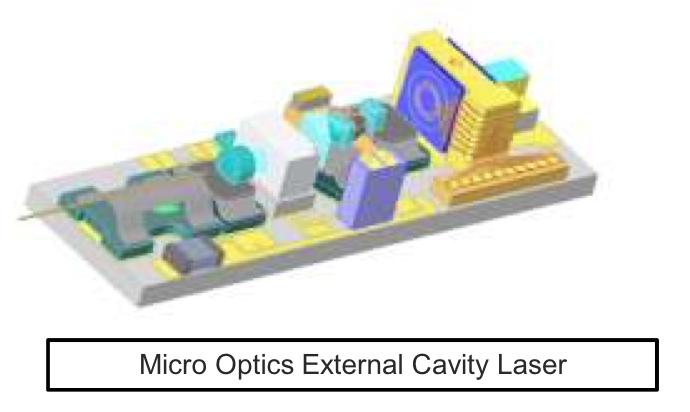
The Emcore laser uses mirrors and optics external to the gain medium to create the laser's relatively long cavity. This aids high-performance coherent systems as it results in a laser with a narrow line-width. Coherent detection uses a mixing technique borrowed from radio where an incoming signal is recovered by compared it with a local oscillator or tone. "The narrower the line-width, the more pure that tone is that you are comparing it to," says Lipscomb.
 Source: NeoPhotonics
A narrower line-width also means less digital signal processing (DSP) is needed to resolve the ambiguity that results from that line-width, says Lipscomb: "And the more DSP power can be spent on either compensating fibre impairments or going further [distances], or compensating the higher-order modulation schemes which require more DSP power to disentangle."
The ECL has a narrow line-width that is specified at under 100kHz. "It is probably closer to 20kHz," says Lipscomb. One of the laser's drawbacks is that its uses a mechanical tuning mechanism that is relatively slow. It also has a lower output power of 16dBm compared to NeoPhotonics's DFB laser array that is up to 18dBm.
The metro market for 100 Gig coherent will emerge in volume towards the end of 2015 or early 2016
In contrast, NeoPhotonics' DFB laser array, suited to metro and intermediate reach applications, has a wider line-width specified at 300kHz, although 200kHz is typical. The DFB design comprises multiple lasers integrated compactly. The laser design also uses a MEMS that results in efficient coupling and the higher - 18dBm - output power. "Using the MEMS structure, you can integrate the laser with other indium phosphide or silicon photonics devices," says Lipscomb. "That is a little bit harder to do with the Emcore device."
 Source: NeoPhotonics
It is the compactness and higher power of the DFB laser array that makes it suited to metro networks. The higher output power means that one laser can be used for both transmission and the local oscillator used to recover the received coherent signal. "More power can be good if you can live with the broader line-width," says Lipscomb. "It reduces overall system cost and can support higher-order modulation schemes over shorter distances."
Market opportunities
NeoPhotonics' focus is on narrow line-width lasers for coherent systems operating at 100 Gigabit and greater speeds. Lipscomb says the metro market for 100 Gig coherent will emerge in volume towards the end of 2015 or early 2016. "The distance here is less and therefore less compensation is needed and a little bit more line-width is tolerable," he says. "Also cost is an issue and a more integrated product can have potentially a lower cost."
For long haul, and especially at transmission rates of 200 and 400 Gig, the demands placed on the DSP are considerable. This is where Emcore's laser, with is narrow line-width, is most suited.
System vendors are already investigating 400 Gig and above transmission speeds. "For the high-end, line-width is going to be a critical factor," says Lipscomb. "Whatever modulation schemes there are to do the higher speeds, they are going to be the most demanding of laser performance."
For Part 2: Is the tunable laser market set for an upturn? click here
NeoPhotonics' PIC transceiver tackles PON business case
Gazettabyte completes its summary of optical announcements at ECOC, held in Amsterdam. In the third and final part, NeoPhotonics’ GPON multiport transceiver is detailed.
Part 3: NeoPhotonics
 “Anything that can be done to get high utilisation of your equipment, which represents your up-front investment, helps the business case"
Chris Pfistner, NeoPhotonics
NeoPhotonics has announced a Gigabit passive optical network (GPON) transceiver designed to tackle the high up-front costs operators face when deploying optical access.
The GPON optical line terminal (OLT) transceiver has a split ratio of 1:128 - a passive optical network (PON) supporting 128 end points - yet matches the optical link budget associated with smaller split ratios. The transceiver, housed in an extended SFP module, has four fibre outputs, each supporting a conventional GPON OLT. The transceiver also uses a mode-coupling receiver implemented using optical integration.
According to NeoPhotonics, carriers struggle with the business case for PON given the relatively low take-up rates by subscribers, at least initially. “Anything that can be done to get high utilisation of your equipment, which represents your up-front investment, helps the business case,” says Chris Pfistner, vice president of product marketing at NeoPhotonics. “With a device like this, you can now cover four times the area you would normally cover.”
The GPON OLT transceiver, the first of a family, has been tested by operator BT that has described the technology as promising.
Reach and split ratio
The GPON transceiver supports up to 128 end points yet meets the GPON Class B+ 28dB link budget optical transceiver specification.
The optical link budget can be traded to either maximise the PON’s distance, limited due to the loss per fibre-km, or to support higher split ratios. However, a larger split ratio increases the insertion loss due to the extra optical splitter stages the signal passes through. Each 1:2 splitter introduces a 3.5dB loss, eroding the overall optical link budget and hence the PON’s reach.
GPON was specified with a Class B 20dB and Class C 30dB link budget. However once PON deployments started a 28dB Class B+ was created to match the practical requirements of operators. For Verizon, for example, a reach of 10-11km covers 95% of its single family units, says NeoPhotonics.
Operators wanting to increase the split ratio to 1:64 need an extra 4dB. This has led to the 32dB link budget Class C+. For shorter runs, in such cases as China, the Class C+ is used for a 1:128 split ratio. “They [operators] are willing to give up distance to cover an extra 1-by-2 split,” says Pfistner.
NeoPhotonics supports the 1:128 split ratio without suffering such loss by introducing two techniques: the mode-coupling receiver (MCR) and boosting the OLT transceiver's transmitter power.
A key issue dictating a PON performance is the sensitivity of the OLT's burst mode receiver. The upstream fibres are fed straight onto the NeoPhotonics’ MCR, eliminating the need for a 4x1 combiner (inverse splitter) and a resulting 6dB signal loss.
 The GPON OLT transceiver showing the transmit and the mode-coupling receiver. Source: NeoPhotonics
The MCR is not a new concept, says Pfistner, and can be implemented straightforwardly using bulk optics. But such an implementation is relatively large. Instead, NeoPhotonics has implemented the MCR as a photonic integrated circuit (PIC) fitting the design within an extended SFP form factor.
“The PIC draws on our long experience of planar lightwave circuit technology, and [Santur’s] indium phosphide array technology, to do fairly sophisticated devices,” says Pfistner. NeoPhotonics acquired Santur in 2011.
The resulting GPON transceiver module fits within an SFP slot but it is some 1.5-2cm longer than a standard OLT SFP. Most PON line cards support four or eight OLT ports. Pfistner says a 1:4 ratio is the sweet spot for initial rollouts but higher ratios are possible.
On the transmit side, the distributed feedback (DFB) laser also goes through a 1:4 stage which introduces a 6dB loss. The laser transmit power is suitably boosted to counter the 6dB loss.
Operators
BT has trialled the optical performance of a transceiver prototype. “BT confirmed that the four outputs each represents a Class B+ GPON OLT output,” says Pfistner. Some half a dozen operators have expressed an interest in the transceiver, ranging from making a request to working with samples.
China is one market where such a design is less relevant at present. That is because China is encouraging through subsidies the rollout of PON OLTs even if the take-up rate is low. Pfistner, quoting an FTTH Council finding, says that there is a 5% penetration typically per year: “Verizon has been deploying PON for six years and has about a 30% penetration.”
Meanwhile, an operator only beginning PON deployments will first typically go after the neighbourhoods where a high take-up rate is likely and only then will it roll out PON in the remaining areas.
After five years, a 25% uptake is achieved, assuming this 5% uptake a year. At a 4x higher split ratio, that is the same bandwidth per user as a standard OLT in a quarter of the area, says NeoPhotonics.
“One big concern that we hear from operators is: Now I'm sharing the [PON OLT] bandwidth with 4x more users,” says Pfistner. “That is true if you believe you will get to the maximum number of users in a short period, but that is hardly ever the case.”
And although the 1:128 split ratio optical transceiver accounts for a small part of the carrier’s PON costs, the saving the MCR transceiver introduces is at the line card level. "That means at some point you are going to save shelves and racks [of equipment],” says Pfistner.
Roadmap
The next development is to introduce an MCR transceiver that meets the 32dB Class C+ specification. “A lot of carriers are about to make the switch from B+ to C+ in the GPON world,” says Pfistner. There will also be more work to reduce the size of the MCR PIC and hence the size of the overall pluggable form factor.
Beyond that, NeoPhotonics says a greater than 4-port split is possible to change the economics of 10 Gigabit PON, for GPON and Ethernet PON. “There are no deployments right now because the economics are not there,” he adds.
“The standards effort is focussed on the 'Olympic thought': higher bandwidth, faster, further reach, mode-coupling receiver (MCR) whereas the carriers focus is: How do I lower the up-front investment to enter the FTTH market?” says Pfistner.
Further reading:
GPON SFP Transceiver with PIC based Mode-Coupled Receiver, Derek Nesset, David Piehler, Kristan Farrow, Neil Parkin, ECOC Technical Digest 2012 paper.
Lightwave: Mode coupling receiver increases PON split ratios, click here
Ovum: Lowering optical transmission cost at ECOC 2012, click here
Summary Gazettabyte stories from ECOC 2012, click here