

Books of 2023 - Final part
Gazettabyte has been asking industry figures to pick their reads of the year. In the final part, contributions are from Larry Dennison, Tim Doiron, Catherine White and Neil McRae.
Larry Dennison, Network Research Group, Nvidia
At this point in my life, book reading is to unwind and is mostly fiction. I get nearly everything else from reading selected technical papers, the daily news and Real Clear Politics. There is just so much cognitive dissonance in the news and editorials that I retreat into fantasy for some down-time.
The best books for me this year are the Beware of Chicken series. This is a light-hearted, martial arts/ cultivation world. Most of the world believes that ‘one strives for the heavens alone’. The main protagonist believes that ‘everything is connected’ and that relationships and doing the right thing are most important. This creates a central set of likeable characters who prevail and grow when challenges arise.
The other series is The Wandering Inn, a truly massive work with a multitude of likable and unlikable characters. Very rich world building, the main character is Erin who was transported from Earth and becomes an inn keeper. Erin sees the good in nearly everyone, including goblins, which results in her finding ways of dispelling prejudice. It isn’t always happy but there is always a sense of noble conduct.
Tim Doiron, Vice President, Solution Marketing, Infinera
In recent years, my reading has leaned toward technology, leadership, marketing, and history. However, with a son who recently completed his master’s degree in psychology, I found myself in 2023 developing an interest in topics related to human behavior and how people are wired.
In parallel with my newfound interest in psychology, I was asked to give a presentation at one of our recent leadership events. In that presentation, I referenced four books that had an impact on me and my thinking in 2023.
Three of these books were written in the past few years and the fourth is an older one that I revisited to prepare for my presentation. I’ll explain.
The first book is Think Again: The Power of Knowing What You Don’t Know, by Adam Grant, an organisational psychologist and well-known author. In Think Again, Grant identifies four styles commonly used to approach problems: preacher, prosecutor, politician, and scientist. While each of these approaches might be useful under certain situations, Grant argues that we should spend more time thinking like a scientist. We need to remain curious, challenging our own positions and assumptions and inviting others around us to do the same.
The world is changing fast, and positions that were accurate yesterday may not hold for today or tomorrow. For most of us in the technology industry, thinking like a scientist might come naturally, but we may not always apply it when making tradeoffs or debating strategies with colleagues. The second book is Dare to Lead: Bare Work. Tough Conversations. Whole Hearts. by Brenee Brown.
Brown is a research professor and storyteller in areas of shame, empathy, courage, and vulnerability. Brown has worked with all types of companies and organisations. To be courageous, you must be vulnerable. And vulnerability involves fear, uncertainty, and risk. If you find yourself thinking about effective leadership, this is a great book.
If we are going to think like a scientist and be courageous leaders, how do we solidify and anchor change in our organizations and our companies? That’s where John P. Kotter’s Leading Change comes in. I read this book 20 years ago and revisited it in preparation for my leadership presentation. We need to anchor change in the company culture if it’s going to stick. While this book isn’t new, the eight steps Kotter outlines for helping transform any organisation remain relevant.
Finally, as a marketeer I am always thinking about effective communications. Earlier this year, one of my colleagues at Infinera shared Smart Brevity: The Power of Saying More with Less by Jim VandeHei, Mike Allen and Roy Schwartz.
In our digital and social-media infused life, the ability to deliver relevant, concise, and impactful information has never been more important. This book provided some useful tips and scenarios and was a fast read. Maybe I don’t need to write all those white papers after all. Nice!
Catherine White, Researcher, Optical and Quantum technology, BT.
One book I read is Wasteland: The Dirty Truth About What We Throw Away, Where It Goes, and Why It Matters by Oliver Franklin-Wallis.
Technology has contributed to creating more waste than providing good solutions to solving the harm waste creates. There is also much work to be done to reclaim valuable materials.
At BT, there are programmes to reclaim and recycle materials from technical waste, among other initiatives for sustainability. For example, BT Group looks to circular networks in sustainability drive.
Wasteland is well written and brings home – in great detail – what we all basically know and must not ignore. It is also a fascinating, and sometimes horrifying journey waste takes once we say goodbye to it.
Another book I read is Novacene: The Coming Age of Hyperintelligence by James Lovelock. I am a great admirer of Lovelock and his early work on ecology. He was a brilliant, multi-talented engineer, and his Gaia theory, though it has a New Age association to some people, was based on computer simulations.
Lovelock lived for over a century, and his final book was published a few years ago, providing a startling vision of the future in which the predominant new intelligent life forms of the galaxy will be artificial, and the first of them (at least on this planet) created by us.
I am not sure he is right. I hope he is not because the thought is unsettling (though he has been proved to be prescient about many things). But his ideas are thought-provoking, even as a strawman to criticise, and it is the final work of a great individual.
During a break in Devon, I picked up a secondhand copy of a book of short stories The Rest of the Robots by the classic sci-fi author, Isaac Asimov.
It’s not his best robot book but I found an interesting story within this book in which the robotic proof-reader makes changes to the meaning of the text it is correcting, to match hard coded AI ethical rules that subsume other rules, with unintended effects.
Asimov had remarkable perception of the future but reading his work makes it clear he did not go far enough in predicting the sophistication with which AI would be able to reason. However, he was right about the unpredictability, and that is the key message for me. We finally need a robot psychologist like Asimov’s Susan Calman!
Neil McRae, Chief Network Strategist, Juniper Networks
The first book I read earlier this year was I May Be Wrong: And Other Wisdoms from Life as a Forest Monk, by Björn Natthiko Lindeblad.
I was recommended to read this by a friend. He recommended the book to help me with a big change in my life that I was going through, having left the company I worked for 12 years and sensing it was going to be more difficult than I might like to admit.
The book is the story of the author, a monk in Thailand. What I liked about this book is how closely the author seemed to mirror my thinking but from a totally different vantage point and wildly different life choices. He illustrates the struggle of being a monk and the realities of life, but it also teaches that the simplest things will make a difference in the world.
I found this approach inspiring, and the ending, well, I’m not going to give it away, but in a world where mental health is increasingly important, this energised me and got me moving on my next journey much quicker.
Through the Glass Ceiling to the Stars: The Story of the First American Woman to Command a Space Mission by Eileen Collins and Jonathan Ward is the amazing life story of Eileen Collins, the first female Space Shuttle Command and Pilot.
I have been fortunate to meet Eileen on many occasions, and the book surprised me in the way that Eileen had to deal with some brutal highs and lows, with immense mental strength during difficult times for her and for NASA and the Space Shuttle programme, and then the pressure of being the public face of the return to flight programme.
She is known for being the first female space shuttle pilot and commander, but Eileen was also the first woman to fly the F-15 fighter jet.
The book tells me that if you are determined enough and hungry enough, the sky is not the limit.


Neil McRae: What’s next for the telecom industry
In a talk at the FutureNet World conference, held in London on May 3-4, Neil McRae explains why he is upbeat about the telecoms industry’s prospects
Neil McRae is tasked with giving the final talk of the two-day FutureNet World conference.
“Yeah, I’m on the graveyard shift,” he quips.
McRae, the former chief network architect at BT, is now chief network strategist at Juniper Network.
The talk’s title is “What’s Next”, McRae’s take on the telecom industry and how it can grow.
McRae starts with how, as a 15-year-old, he had attended an Apple Macintosh computer event at a Novotel Hotel in Hammersmith, London, possibly even this one hosting this conference.
An Apple representative had asked for his feedback as a Macintosh programmer. McRae then listed all the shortfalls programming the PC. Later, he learnt that he had been talking to Steve Jobs.
Perhaps this explains his continual focus on customers and meeting their needs.
What customers care about, says McRae, is ‘new stuff’ that makes a difference in their lives. “Quite often in telecoms, we accidentally change the world without even thinking about it,” he says
McRae cites as an example using FaceTime to watch a newborn grandchild halfway across the world.
“We do it all the time; it is a phenomenal thing about our industry,” says McRae.
The Unvarnished Truth
McRae moves to showing several market and telco survey charts from IDC and Analysys Mason, what he calls ‘The unvarnished truth’.
The first slide shows how the European enterprise communication service market is set to grow at a compound annual growth rate (CAGR) of 3% between 2020 and 2025.
“Three per cent growth, who thinks that is a great business for telcos?” says McRae. “And enterprise is what we are all depending on for big growth and change because [the] consumer [market] is pretty much flat,” says McRae.
Another chart shows similar minimal growth: a forecast that Western Europe’s mobile retail service market will grow from $102 billion in 2016 to $109 billion by 2026. Yet mobile is where the telcos spend a ton of money, he says.
“So, who thinks we should continue doing what we are doing?” McRae asks the audience.
Another forecast showing global fixed and mobile service revenues is marginally better since it includes developing nations that still lack telecommunications services.
In the UK, 95 per cent of the population is on the internet, in Europe it is 84%, says McRae: “The UK is a tough place to be to grow business.”
Telco transformation
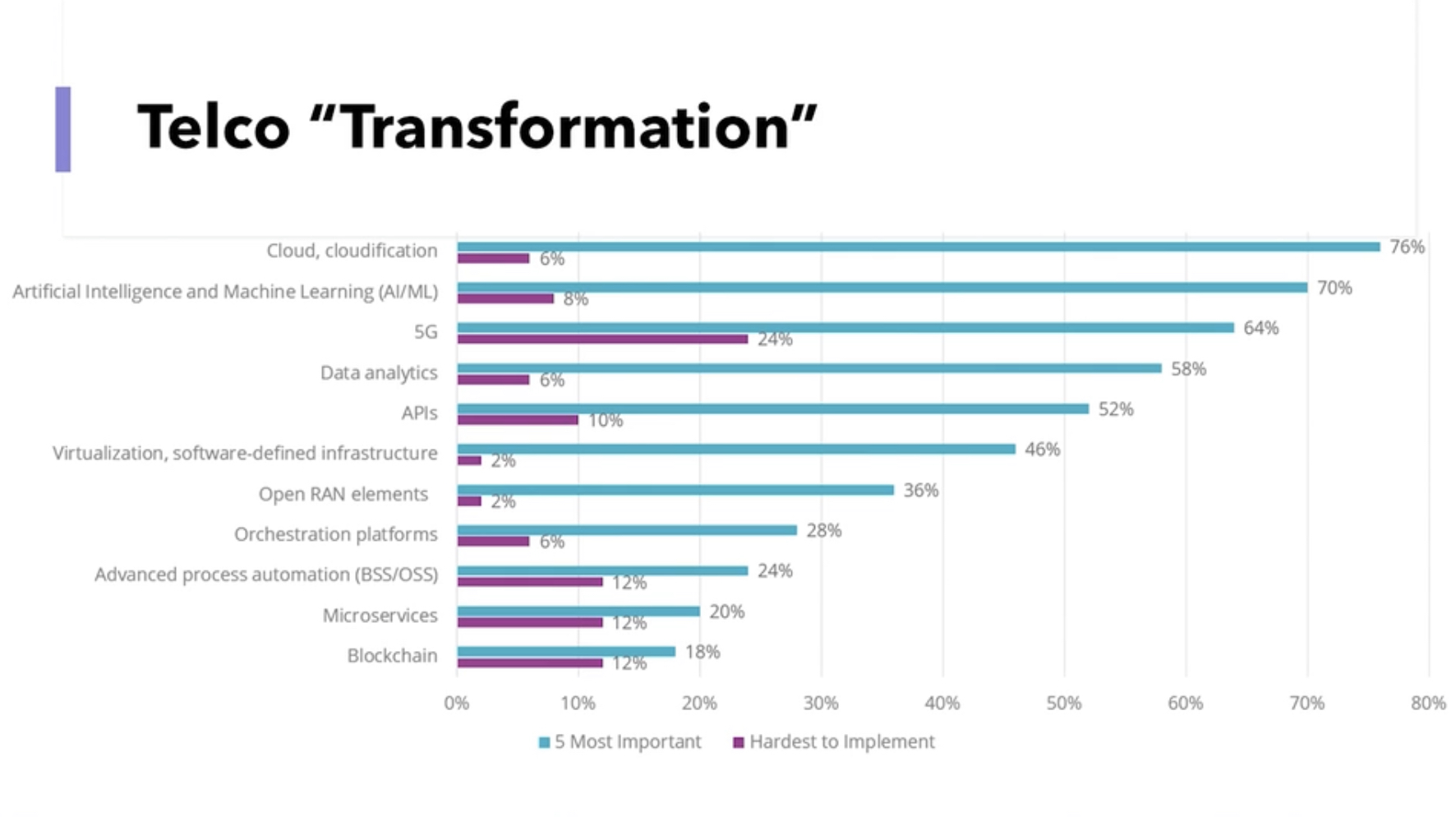
Another slide (see above), the results of a telco survey, shows a list of topics and their impact on telco transformation. McRae asks the audience to respond to those they think will ‘save’ the industry.
He goes through the list: cloud and cloudification, artificial intelligence (AI) and machine learning, 5G, and data analytics. The audience remains muted.
The next item is application programming interfaces (APIs). Again the audience is quiet. “You have been talking about APIs for two days!” says McRae.
“The right APIs,” shouts an audience member. “Ah, yes, the right APIs,” says McRae.
McRae continues down the list, virtualisation and software-defined infrastructure, OpenRAN elements – “not sure what the elements mean” – orchestration platforms, advanced process automation (OSS/BSS), micro-services, and blockchain.
McRae says he has spent the equivalent of a small nation’s budget over his career on OSS and BSS. “Nothing is automated, and I can’t get the data I need,” he says.
McRae gives his view. He believes the cloud will help telcos, but what most excites him is AI and machine learning, and data analytics.
“Learning the insights the data tells us and using them, putting a pound sign on them,” says McRae. “We have done some of that, but there is much more to do.”
He puts up a second survey showing the priorities of European operators: customer experience and increasing operational agility.
“Finally, after years, telcos realise that customers are important,” he says.
Opportunities
The survey also highlights the telcos’ belief that they can deliver solutions for industries and enterprise customers.
“This is a massive opportunity for telcos that allows us to grow revenues, create cool technology and hire amazing engineers,” says McRae.
The transformation needed in telecoms is about customers and taking risks with customers, he says.
One opportunity is digitalisation. McRae points outs that digitalisation is a process that never stops.
The three leading Chinese operators are keenly pursuing what they call industrial digitalisation or industrial internet. For China Telecom, industrial digitalisation now accounts for a quarter of its service revenues.
“Today, it is about cloud, cloud technologies, and smartphones, but tomorrow it could be about wearables or technology that is tracking what you are doing and making your life easier,” says McRae.
Digitalisation is an expertise that the telecom industry is not putting enough effort into, he says: “And as telcos, we have a massive right to play here.”
Another opportunity is AI and data, learning from the insights present in data to grow revenue.
“We have more data than most organisations, we haven’t used it very well, and we can build upon it,” says McRae, adding that AI needs the network to be valuable and improve our lives.
With data and AI, trust is vital. “If we are not trusted as an industry, we are dead,” says McRae. But because telcos are trusted entities, they can help other organisations improve trustworthiness.
Another opportunity is using the network for humans to interact in advanced ways. Since telecoms is a resource-heavy industry, such network-aided interaction would be immediately beneficial.
For this, what is needed is a cloud-native platform that integrates well with the network, and cloud platforms are generally poorly integrated with the network, he says.
He ends his talk by returning to customers and what they want: customers expect networks and services to be always present.
This explains the telcos’ continual marginal growth, he says: “The reason we have this is because there is a big chunk of customers’ lives where they can’t rely upon the network.”
Different thinking is needed if the network is to grow beyond the smartphone. Population coverage is not enough; what is needed is total coverage.
“Wherever I am, I want to use my device, to be connected, for the things that I don’t even know is doing stuff to be able to do them without worrying about connectivity,” he says.
And that is why 6G must be about 100 per cent connectivity,” says McRae: “Either we can do it, or someone else is going to.”
With that, FutureNet comes to ends, and McRae quickly departs to embark on the next chapter in his career. `
Neil McRae will be one of the speakers at the DSP Leaders World Forum, May 23-24, 2023.

BT’s Open RAN trial: A mix of excitement and pragmatism

“We in telecoms, we don’t do complexity very well.” So says Neil McRae, BT’s managing director and chief architect.
He was talking about the trend of making network architectures open and in particular the Open Radio Access Network (Open RAN), an approach that BT is trialling.
“In networking, we are naturally sceptical because these networks are very important and every day become more important,” says McRae
Whether it is Open RAN or any other technology, it is key for BT to understand its aims and how it helps. “And most importantly, what it means for customers,” says McRae. “I would argue we don’t do enough of that in our industry.”
Open RAN
Open RAN has become a key focus in the development of 5G. Open RAN is backed by leading operators, it promises greater vendor choice and helps counter the dependency on the handful of key RAN vendors such as Nokia and Ericsson. There are also geopolitical considerations given that Huawei is no longer a network supplier in certain countries.
“Huawei and China, once they were the flavour of the month and now they no longer are,” says McRae. “That has driven a lot of concern – there are only Nokia and Ericsson as scaled players – and I think that is a thing we need to worry about.”
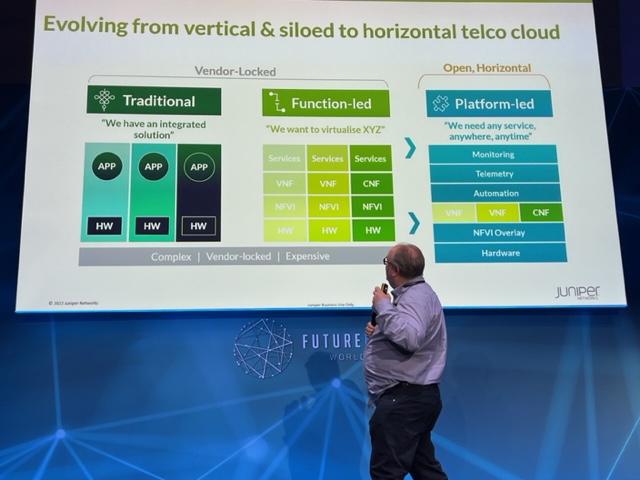
McRae points out that Open RAN is an interface standard rather than a technology.
“Those creating Open RAN solutions, the only part that is open is that interface side,” he says. ”If you think of Nokia, Ericsson, Mavenir, Rakuten and Altiostar – any of the guys building this technology – none of their technology is specifically open but you can talk to it via this open interface.”
Opportunity
McRae is upbeat about Open RAN but much work is needed to realise its potential.
“Open RAN, and I would probably say the same about NFV (network functions virtualisation), has got a lot of momentum and a lot of hype well before I think it deserves it,” he says.
Neil McRaeBT favours open architectures and interoperability. “Why wouldn’t we want to to be part of that, part of Open RAN,” says McRae. “But what we are seeing here is people excited about the potential – we are hugely excited about the potential – but are we there yet? Absolutely not.”
BT views Open RAN as a way to support the small-cell neutral host model whereby a company can offer operators coverage, one way Open RAN can augment macro cell coverage.
Open RAN can also be used to provide indoor coverage such as in stadiums and shopping centres. McRae says Open RAN could also be used for transportation but there are still some challenges there.
“We see Open RAN and the Open RAN interface specifications as a great way for building innovation into the radio network,” he says. “If there is one part that we are hugely excited about, it is that.”
BT’s Open RAN trial
BT is conducting an Open RAN trial with Nokia in Hull, UK.
“We haven’t just been working with Nokia on this piece of work, other similar experiments are going on with others,” says McRae.
McRae equates Open RAN with software-defined networking (SDN). SDN uses several devices that are largely unintelligent while a central controller – ’the big brain’ – controls the devices and in the process makes them more valuable.
“SDN has this notion of a controller and devices and the Open RAN solution is no different: it uses a different interface but it is largely the same concept,” says McRae.
This central controller in Open RAN is the RAN Intelligent Controller (RIC) and it is this component that is at the core of the Nokia trial.
“That controller allows us to deploy solutions and applications into the network in a really simple and manageable way,” says McRae.
The RIC architecture is composed of a near-real-time RIC that is very close to the radio and that makes almost instantaneous changes based on the current situation.
There is also a non-real-time controller – that is used for such tasks as setting policy, the overall run cycle for the network, configuration and troubleshooting.
“You kind of create and deploy it, adjust it or add or remove things, not in real-time,” says McRae. “It is like with a train track, you change the signalling from red to green long before the train arrives.”
BT views the non-real-time aspect of the RIC as a new way for telcos to automate and optimise the core aspects of radio networking.
McRae says the South Bank, London is one of the busiest parts of BT’s network and the operator has had to keep adding spectrum to the macrocells there.
“It is getting to the point where the macro isn’t going to be precise enough to continue to build a great experience in a location like that,” he says.
One solution is to add small cells and BT has looked at that but has concluded that making macros and small cells work together well is not straightforward. This is where the RIC can optimise the macro and small cells in a way that improves the experience for customers even when the macro equipment is from one vendor and the small cells from another.
“The RIC allows us to build solutions that take the demand and the requirements of the network a huge step forward,” he says. “The RIC makes a massive step – one of the biggest steps in the last decade, probably since massive MIMO – in ensuring we can get the most out of our radio network.”
BT is focussed on the non-real-time RIC for the initial use cases it is trialling. It is using Nokia’s equipment for the Hull trial.
BT is also testing applications such as load optimisation between different layers of the network and between different neighbouring sites. Also where there is a failure in the network it is using ‘Xapps’ to reroute traffic or re-optimise the network.
Nokia also has AI and machine learning software which BT is trialling. BT sees AI and machine learning-based solutions as a must as ultimately human operators are too slow.
Trial goals
BT wants to understand how Open RAN works in deployment. For example, how to manage a cell that is part of a RIC cluster.
In a national network, there will likely be multiple RICs used.
“We expect that this will be a distributed architecture,” says McRae. “How do you control that? Well, that’s where the non-real-time RIC has a job to do, effectively to configure the near-real-time RIC, or RICs as we understand more about how many of them we need.”
Another aspect of the trial is to see if, by using Open RAN, the network performance KPIs can be improved. These include time on 4G/ time on 5G, and the number of handovers and dropped calls.
“Our hope and we expect that all of these get better; the early signs in our labs are that they should all get better, the network should perform more effectively,” he says.
BT will also do coverage testing which, with some of the newer radios it is deploying, it expects to improve.
“We’ve done a lot of learning in the lab,” says McRae. “Our experience suggests that translating that into operational knowledge is not perfect. So we’re doing this to learn more about how this will work and how it will benefit customers at the end of the day.”
Openness and diversity
Given that Open RAN aims to open vendor choice, some have questioned whether BT’s trial with Nokia is in the spirit of the initiative.
“We are using the Open RAN architecture and the Open RAN interface specs,” says McRae. “Now, for a lot of people, Open RAN means you have got to have 12 vendors in the network. Let me tell you, good luck to everyone that tries that.”
BT says there are a set of flavours of Open RAN appearing. One is Rakuten and Symphony, another is Mavenir. These are end-to-end solutions being built that can be offered to operators as a solution.
“Service providers are terrible at integrating things; it is not our core competency,” says McRae. “We have got better over the years but we want to buy a solution that is tested, that has a set of KPIs around how it operates, that has all the security features we need.”
This is key for a platform that in BT’s case serves 30 million users. As McRae puts it, if Open RAN becomes too complicated, it is not going to get off the ground: “So we welcome partnerships, or ecosystems that are forming because we think that is going to make Open RAN more accessible.”
McRae says some of the reaction to its working with Nokia is about driving vendor diversity.
BT wants diverse vendors that can provide it with greater choice and benefit from competition. But McRae points out that many of the vendors’ equipment use the same key components from a handful of chip companies; and chips that are made in two key locations.
“What we want to see is those underlying components, we want to see dozens of companies building them all over the world,” he says. “They are so crucial to everything we do in life today, not just in the network, but in your car, smartphone, TV and the microwave.”
And while more of the network is being implemented in software – BT’s 5G core is all software – hardware is still key where there are are packet or traffic flows.
“The challenge in some of these components, particularly in the radio ecosystem, is you need strong parallel processing,” says McRae. “In software that is really difficult to do.”
“Intel, AMD, Broadcom and Qualcomm are all great partners,“ says McRae. “But if any one of these guys, for some reason, doesn’t move the innovation curve in the way we need it to move, then we run into real problems of how to grow and develop the network.”
What BT wants is as much IC choice as possible, but how that will be achieved McRae is less certain. But operators rightly have to be concerned about it, he says.

Nokia's 4.8-terabit FP5 packet-processing chipset

Part 1: IP routing: Nokia’s latest FP5 and router platforms
Nokia has unveiled its latest packet-processing silicon that will be the mainstay of its IP router platforms for years to come.
The FP5 chipset is rated at 4.8 terabits-per-second (Tbps), a twelvefold improvement in Nokia’s packet-processing silicon performance in a decade. (See chart.)

Communications service provider (CSP) BT says Nokia’s 7750 router platforms equipped with the FP5 chipset will deliver every use case it needs for its Multi Service Edge; from core routing, MPLS-VPN, broadband network gateways (BNG), to mobile backhaul and Ethernet.
The FP5 announcement comes four years after Nokia unveiled its existing flagship router chipset, the FP4. The FP4 was announced as a 2.4Tbps chipset but Nokia upgraded its packet-processing rating to 3Tbps.
“We announced what we knew but then, through subsequent development and testing, the performance ended up at 3Tbps,” says Heidi Adams, head of IP and optical networks marketing at Nokia.
The FP5 may also exceed its initial 4.8Tbps rating.
Nokia will use the FP5 to upgrade its existing platforms and power new router products; it will not license the chipset nor will it offer it for use in open router platforms.
Nokia’s chipset evolution
At the heart of Nokia’s router silicon is a 2D array of packet processing cores.
The FP3, announced in 2011 by Alcatel-Lucent (acquired by Nokia in 2016), used 288 packet processing cores arranged in a 32×9 array. Each row of cores acted as a packet-processing pipeline that could be partitioned to perform independent tasks. The array’s columns performed table look-ups and each column could be assigned several tasks.
Nokia didn’t detail how the FP4 upgraded the array of cores. But the performance enhancement was significant; the FP4 delivers a 7.5x improvement in packet processing performance compared to the FP3.
The 16nm CMOS FP4 chipset includes a traffic manager (q-chip), packet processor (p-chip), the t-chip that interfaces to the router fabric, and what was then a new chip, the e-chip.
The e-chip acts as a media access controller (MAC) that parcels data from the router’s client-side pluggable optical modules for the p-chip.
Nokia even designed memory for the FP4 whereby instructions can be implemented during memory access and the memory can be allocated to perform different types of look-up and buffering, depending on requirements.
To maximise the memory’s performance, Nokia used advanced packaging for the FP4’s p-chip and q-chip. The resulting 2.5D-packaged p-chip comprises the packet processor die and stacks of memory. The q-chip is also a multi-chip module containing RISC processors and buffering memory.
The FP4 uses 56Gbps PAM-4 serialiser-deserialiser (serdes) interfaces, technology that Nokia secured from Broadcom.
FP5’s features
The FP5 builds on the major architectural upgrade undertaken with the FP4.
Using a 7nm CMOS process technology, Nokia’s FP5 designers have combined on-chip what were two separate FP4 chips: the packet processor (p-chip) and traffic manager (q-chip).
The FP5 chipset consumes a quarter of the power of the FP4 in terms of watts-per-gigabit (0.1W/Gig for the FP5 compared to the FP4’s 0.4W/Gig).
Consolidating two chips into one accounts for part of the power savings. Using 112Gbps serdes and a more advanced CMOS process are other factors.
Nokia has also added encryption hardware blocks to the chip’s ports. The hardware blocks implement the MACsec algorithm and can also encrypt layer 2.5 and layer 3 traffic.
The chipset can handle packet flows as large as 1.6 terabits. “We don’t have any physical interfaces that support flows at that rate,” says Adams. “It’s an indicator that the chipset is ready for much more.”
The e-chip, which Nokia describes as a tremendously important device, has also been upgraded. As well as the MAC function, it acts as an early-stage packet processor, performing pre-processing and pre-classification tasks on the traffic.
The e-chip also performs pre-buffering for the packer processor. Using multiple such devices allows the line card to expand the forwarding limit of the FP5’s packet processor. This enables Nokia’s routers to perform what it calls intelligent aggregation (IA). “We can bring in more traffic, increase the number of ingress ports even if those ports start to get fully loaded, because of the chipset architecture being fully buffered,” says Adams. “The result is a 30 per cent uplift in the stated capacity numbers.”
The FP5 chipset has been taped out and the silicon is being tested in Nokia’s lab.
Router platforms
IP core routers are tasked with moving large amounts of IP traffic across a network backbone. IP edge routers, in contrast, typically aggregate a variety of services such as mobile transport, residential traffic or act as gateways.
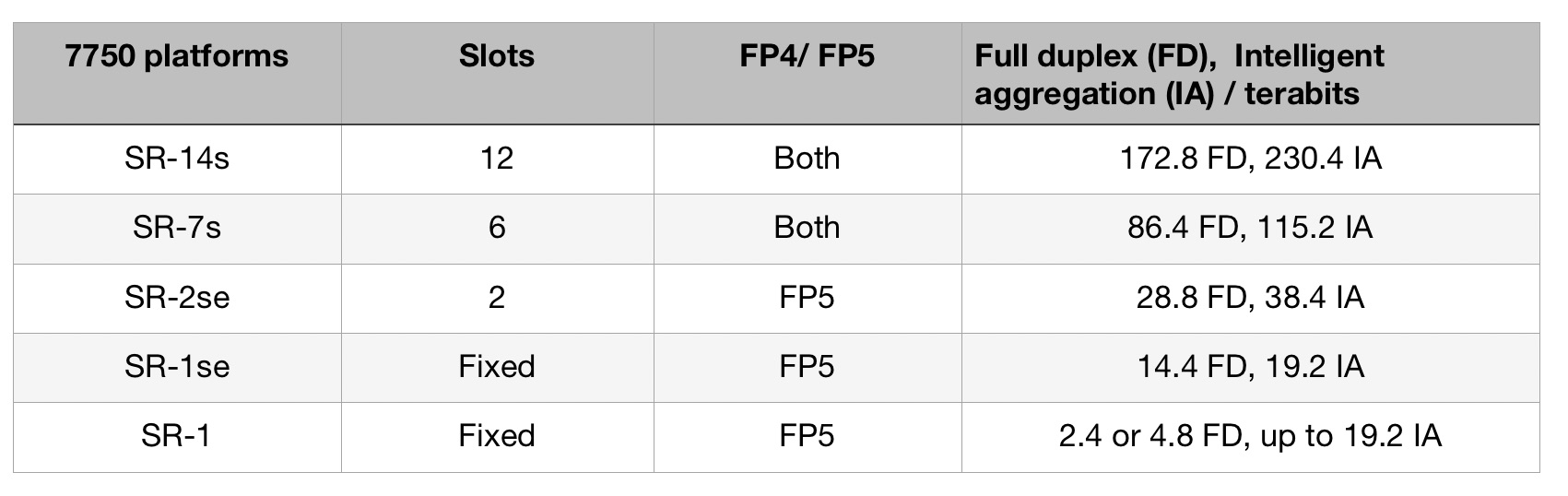
The platforms that will use the FP5 are classified by Nokia as edge routers. “The boundaries have blurred,” says Adams. “It is more important to look at how applications are deployed and what the requirements are.”
The platforms using the FP5 are the existing 7750 SR-14s and 7750-SR7s routers that were announced with the launch of the FP4.
These chassis were designed to accommodate Nokia’s current and next-generation router cards. “This allows operators to retain the same chassis and support a mix of FP4 and FP5 cards, growing into them gradually,” says Adams.
Nokia has announced three other platforms: two mid-range platforms, the 7750 SR2-se and the 7750 SR1-se, and the 7750 SR-1 that will be available in six variants. “They [the SR-1 boxes] are going to be available in a range of configurations and different port speeds,” says Adams.
Platforms using the FP5 chipset will ship in the first half of 2022, starting with the SR-1.
Nokia also announced an FP5 expandable media adaptor (XMA) line card for the non-fixed platforms (the 7750 SR-14s/ SR-7s and SR-2se). The card supports 36 pluggable slots and with 400 Gigabit Ethernet (GbE) has a capacity of 14.4Tbps full-duplex or 19.2Tbps in intelligent aggregation mode.
The card will also support 400ZR and ZR+ coherent modules and is ready for 800GbE pluggables that will double the card’s capacity ratings.
Nokia says the FP5 improves the throughput of the XMA card by a factor of three: Nokia’s 4.8Tbps XMA (12Tbps IA) uses four FP4 chipsets while the latest 14.4Tbps (19.2Tbps IA) XMA uses six FP5 chipsets.
Custom silicon versus disaggregated designs
Nokia says the benefits of having its own chipset justify the intellectual effort and development expense, even when advanced merchant silicon is available and certain CSPs are embracing open disaggregated routers.
“We feel there is a need in the industry for platforms based on this kind of technology,” says Adams.
What is important is the total cost of ownership and that Nokia’s systems are deployed in critical networks where resiliency, reliability, the feature set and network security are all critical, says Adams.
Nokia also points to the progress it has made since the launch of the FP4. “We have secured 350 projects, two-thirds of which were new footprints or competitive displacements,” says Adams. Nokia’s IP revenues in 2020 were $3.2 billion.
That said, Nokia also partners with merchant silicon vendors: the 7250 IXR interconnect router uses merchant silicon, for example.
“If I look at disaggregation, absolutely, it is an interesting area,” says Adams. “But I think it is very early days.”
Neil McRae, managing director and chief architect at BT, says that while some operators are looking at disaggregated software and hardware, BT doesn’t believe this is necessarily the best solution in terms of performance, reliability or cost.
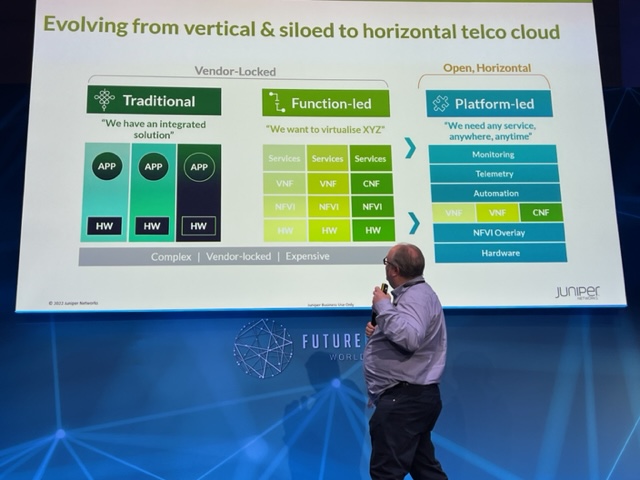
“Increasingly, the ratio of capital investment in core networking is moving towards optical transceivers than router silicon,” says McRae. “But to get the most out of the network and the router, using custom silicon for the most demanding cases still delivers the best outcomes.
“In our live network but also in our testing, the integrated solution is more reliable, easier to operate and a significant improvement from a total cost of ownership point of view,” says McRae.
BT says it will be able to scale interfaces on the 7750 from 1-400Gbs using the FP5 and Nokia’s SR-OS routing networking software.
BT also highlights the importance of reliability under demand, pointing out how the CSP’s traffic has doubled during the pandemic without impacting its customers.
“Nokia’s understanding of how the underlying silicon is going to react in different situations gives them a significant advantage in building the software on top that performs in challenging situations,” says McRae.
Chip Strategy
Nokia says that were it to sell its FP5 silicon as a standalone product, it would enter a very different design environment.
“You are designing to the requirements of multiple customers versus designing for your systems,” says Adams.
Nokia’s belief is that there is strong demand for platforms designed to purpose.
“We are staying true to that strategy,” says Adams.

Making optical networking feel like cycling downhill

BT’s chief architect, Neil McRae, is a fervent believer in the internet, a technology built on the continual progress of optical networking. He discussed both topics during his invited talk at the recent OFC 2021 virtual conference and exhibition.
Neil McRae’s advocacy of the internet as an educational tool for individuals from disadvantaged backgrounds stems from his childhood experiences.
“When I was a kid, I lived in a deprived area and the only thing that I could do was go to the library,” says McRae, chief architect and managing director for architecture and technology strategy at BT.
His first thought on discovering the internet was just how much there was to read.
“If I’m honest, everything I’ve learnt in technology has been pretty much self-taught,” says McRae.
This is why he so values the internet. It has given him a career where he has travelled widely and worked with talented and creative people.
“Anyone who is out there in the world can do the same thing,” he says. “I strongly believe that the internet brings opportunities to people who are willing to spend the time to learn.”
Optical networking
McRae surveyed the last 20 years of optical networking in his OFC talk. He chose the period since it was only at the end of the last century that the internet started to have a global impact.
“The investment in networking [during this period] has been orders of magnitude bigger than prior years,” says McRae. “There has also been a lot of deregulation across the world, more telecoms companies, more vendors and ultimately more people getting connected.”
In 2000, networks used the SONET/SDH protocol and fixed wavelengths. “We have brought in many new technologies – coherent, coloured optics, programable lasers and silicon photonics – and they have been responsible for pretty significant changes.”
McRae likens optical network to gears on a bike. “It powers the rest of what we do in the network and without those advances, we wouldn’t be the digitally connected society we are today,” says McRae. “If I think about the pandemic of the last year, can you imagine what the pandemic would have been like if it had happened in the year 2000?”
McRae says he spends a fifth of his time on optical networking. This is more than previously due to the relentless growth in network bandwidth.
“Ultimately, if you get optical wrong, it feels like you are in the wrong gear cycling uphill,” says McRae. “If you get it right, you are in the right gear, you are going as fast as you can go and it feels like a downhill ride.”
And it’s not just bandwidth but also from a cost, capability and customer experience perspective. “We recognise the value that it brings to all the other layers right up to the application,” he says.
Research
BT Labs has an optical networking programme that is run by Professor Andrew Lord. The programme’s remit is to help BT address existing and future issues.
“There is a longer-term research aspect to what Andrew and his team do, but there are some here-and-now issues that they support me on like the hollow-core fibre work and some of the 400-gigabit [coherent] platforms we have been reviewing recently,” he says.
He cites as examples the work the programme did for BT’s next-generation optical platform that was designed for growth and which indeed has grown massively in the last decade. “We have launched optical services as a product because of the platform,” says McRae.
The programme has also helped Openreach, BT Group’s copper and fibre plant subsidiary, with its fibre-to-the-premise (FTTP) deployments that use such technologies as GPON and XGS-PON.
Reliable, dynamic, secure networks
McRae admits he is always nervous about predicting the future. But he is confident 400 gigabits will be a significant optical development over the next decade.
This includes inside the data centre, driven by servers, and in the network including long haul.
“The challenge will be around getting the volume and interoperability as quickly as we possibly can,” says McRae.
The other big opportunity is the increased integration of IP and optical using a control plane aligned to both.
“The biggest networking technology out there is IP,” says McRae. “And that will not change in the coming decade.”
The Layer-3 capabilities include working around issues but it is bad at managing bandwidth. Optical is the opposite: great at managing bandwidth but less dynamic for working around problems. Merging the two promises significant benefits.
This idea, advocated as IP-over-DWDM, has long been spoken of but has not been deployed widely. The advent of 400-gigabit coherent implemented using client-side modules means that the line-side interface density can equal that of the host. And other developments such as software-defined networking and artificial intelligence also help.
Software-defined networking will make a big difference because it will enable the move to automation and that will enable new technologies such as artificial networking (AI) and machine-learning to be introduced.
McRae talks of a control plane capable of deciding which interface to send packets down and also determine what paths to create across the optical infrastructure.
“We have seen some of that but we have not seen enough,” says McRae. AI and machine-learning technologies will provide networks with almost autonomous control over which paths to use and enable for the various traffic types the network sees.
McRae stresses that it is getting harder to get the maximum out of the network: “If we maintain human intervention, the network will never see its full potential because of complexity, demands and scale.”
He predicts that once the human component is taken out of the network, some of the silos between the different layers will be removed. Indeed, he believes networks built by AI and aided by automation will look very different to today’s networks.
Another technology McRae highlights is hollow-core fibre which BT Labs has been researching.
“Increasingly, we are starting to reach some limits although many folks have said that before, but hollow-core fibre gives us some interesting and exciting opportunities around latency and the total use of a fibre,” says McRae.
There are still challenges to be overcome such as manufacturing the fibre at scale but he sees a path in many parts of the network where hollow-core fibre could be valuable to BT.
Quantum key distribution (QKD) and the importance of network security is another area starting to gain momentum.
“We have gone from a world where people were scared to send an email rather than a fax to one where the network is controlling mission-critical use cases,” says McRae. “The more secure and reliable we make those networks, the more it will help us in our everyday lives.”
McRae believes this is the decade where the underlying optical network capability coupled with QKD security will take effect.
Making a difference
McRae has run several events involving children with autism although during the pandemic this has not happened. He uses gaming as a way to demonstrate how electronics works – switching things on and off – and then he introduces the concept of computer programming.
“I find that kids with autism get it really quickly” he says. BT runs such events two or three times a year.
McRae also works with children who are learning to program but find it difficult. “Again, it is something self-taught for me,” he says although he quips that the challenge he has is that he teaches them bad programming habits.
“I’m keen to find the next generation of fantastic engineers; covid has shown us that we need them more than ever,” he says.