

ECI Telecom’s next-generation metro packet transport family
- The Native Packet Transport (NPT) family targets the cost-conscious metro network
- Supports Ethernet, MPLS-TP and TDM
- ECI claims a 65% lower total cost of ownership using MPLS-TP and native TDM
 NPT's positioning as part of the overall network. Source: ECI Telecom
ECI Telecom has announced a product line for packet transport in the metro. The Native Packet Transport (NPT) family aims to reduce the cost of operating packet networks while supporting traditional time division multiplexing (TDM) traffic.
“Eventually, in terms of market segments, it [NPT] is going to replace the multi-service provisioning platform,” says Gil Epshtein, product market manager at ECI Telecom. “The metro is moving to packet and so it is moving to new equipment to support this shift.”
The NPT is ECI’s latest optimised multi-layer transport (OMLT) architecture, and is the feeder or aggregator platform to the optical backbone, addressed by the company's Apollo OMLT product family announced in 2011.
 “The whole point of shifting to packet is to lower the [transport] cost-per-bit”
Gil Epshtein, ECI Telecom
Packet transport issues
“Building carrier-grade packet transport is proving more costly than anticipated,” says Epshtein. “Yet the whole point of shifting to packet is to lower the [transport] cost-per-bit.”
Several packet control plane schemes can be used for the metro, a network that can be divided further into the metro core and metro access/ aggregation. The two metro segments can use either IP/MPLS (Internet Protocol/ Multiprotocol Label Switching) or MPLS-TP (Multiprotocol Label Switching Transport Profile). Alternatively, the two metro segments can use different schemes: the metro core IP/MPLS and metro access MPLS-TP, or MPLS-TP for the core and Ethernet for metro access.
Based on total cost of ownership (TCO) analysis, ECI argues that the most cost-effective packet control plane scheme is MPLS-TP. “The NPT product line is based on MPLS-TP, designed to simplify and make MPLS affordable for transport networks,” says Epshtein.
Three issues contribute to the cost of building and operating packet-based transport. The first is capital expenditure (capex) – the cost of the equipment and what is needed to make the network carrier grade such as redundancy and availability.
The second is operational expenditure or opex. Factors include the training and expertise needed by the staff, and their number and salaries. In turn, issues such as network availability, equipment footprint and the power consumption requirements.
“More and more operators view opex as a key factor in their TCO considerations,” says Epshtein. Operators look at the entire network and want to know what its cost of operation will be.
A third cost factor is the existence of both TDM and packet data in the operators’ networks. “When you look at the overall TCO, you need to take this into consideration,” says Epshtein. For some operators it [TDM] is more significant but it is always there, he says.
The NPT family is being aimed at various customers. One is operators that want to extend MPLS from the core to the metro network. “Here, TDM is not a factor,” says Epshtein. “We find this in wireless backhaul, in triple-play, carriers-of-carriers and business applications.” The second class of operators is those with legacy TDM traffic. Also being targeted are utilities. “Here reliability and security are key.”
Analysis
The choice of packet control plane - whether to use IP/MPLS or MPLS-TP - impacts both capex and opex. How the TDM traffic is handled, whether using circuit emulation over packets or native TDM, also impacts overall costs.
According to ECI, the number of network elements grows some tenfold with each segment transition towards the network edge. In the network core there are 100s of network elements, 1000s in the metro core and 10,000s in the metro access. The choice of packet control plane for these network elements clearly impacts the overall cost, especially in the cost-conscious metro as the number of platforms grows. “A network element based on MPLS-TP is lower cost than IP/MPLS,” says Epshtein. “The main reason being it is a lot less complex.”
He stresses that MPLS-TP is not a competing standard to IP/MPLS; IP/MPLS is the defacto standard in the network core. Rather, MPLS-TP is a derivative designed for transport. The debate here, says Epshtein, is what is best for metro.
“The main difference between the two standards is the control plane, not the data plane,” says Epshtein. MPLS-TP removes unnecessary control plane functions supported by IP/MPLS leading to simpler metro platform functionality, and simpler management and operation of the equipment. “We believe MPLS-TP is more suited to the metro due to its simplicity, scalability and capex benefits.”
Working with market research company, ACG Research, the TCO analysis (opex and capex) over five years using MPLS-TP was 55% lower than using IP/MPLS for metro packet transport (with no TDM traffic).
The cost savings was even greater with both packet and some TDM traffic.
Using the NPT, capex goes up 5% due to the line cards needed to support native TDM traffic. But for IP/MPLS using circuit emulation capex increases 37%, resulting in the NPT having a 66% lower capex overall. The resulting opex is also 64% lower. Overall TCO is lowered by 65% using MPLS-TP and native TDM compared to IP/MPLS and circuit emulation.
NPT portfolio
ECI says its NPT supports circuit emulation and native TDM. Having circuit emulation enables the network to converge to packet only. But native TDM simplifies the interfacing to legacy networks and also has lower latency than circuit emulation.
 The NPT packet switch and TDM switch fabrics and the traffic types carried over each. Source: ECI Telecom
There are five NPT platforms ranging from the NPT-1020 for metro access to the NPT-1800 for the metro core. The NPT-1020 has a 10 or 50 Gigabit packet switch capacity option and a TDM capacity of 2.5 Gigabit. The NPT-1800 has a packet switching capacity of 320 or 640 Gigabit and 120 Gigabit for TDM.
The metro aggregation NPT-1600 and 1600c (160 Gig packet/120 Gig TDM capacity) platforms are available now. The remaining platforms will be available in the first half of 2013.
ECI says it has already completed several trials with existing and new customers. "We have already won a few deals," says Epshtein.
The platforms are managed using ECI’s LightSoft software, the same network management system used for the Apollo. ECI has added software specifically for packet transport including service provisioning, performance management and troubleshooting.
Further information, click here.

The OTN transport and switching market
 Source: Infonetics Research
The OTN transport and switching market is forecast to grow at a 17% compound annual growth rate (CAGR) from 2011 to 2016, outpacing the 5.5% CAGR of the optical equipment market (WDM, SONET/SDH). So claims a recent study on the OTN equipment marketplace by Infonetics Research.
A Q&A with report author, Andrew Schmitt, principal analyst for optical at Infonetics.
How should OTN (Optical Transport Network) be viewed? As an intermediate technology bridging the legacy SONET/SDH and the packet world? Or is OTN performing another, more fundamental networking role?
There is a deep misconception that once the voyage to an all-packet nirvana is complete, there is no need for SONET/SDH or an equivalent technology. This isn’t true. Networks that are 100% packet still need an OSI layer 1 mechanism, and to date this is mostly SDH and increasingly OTN.
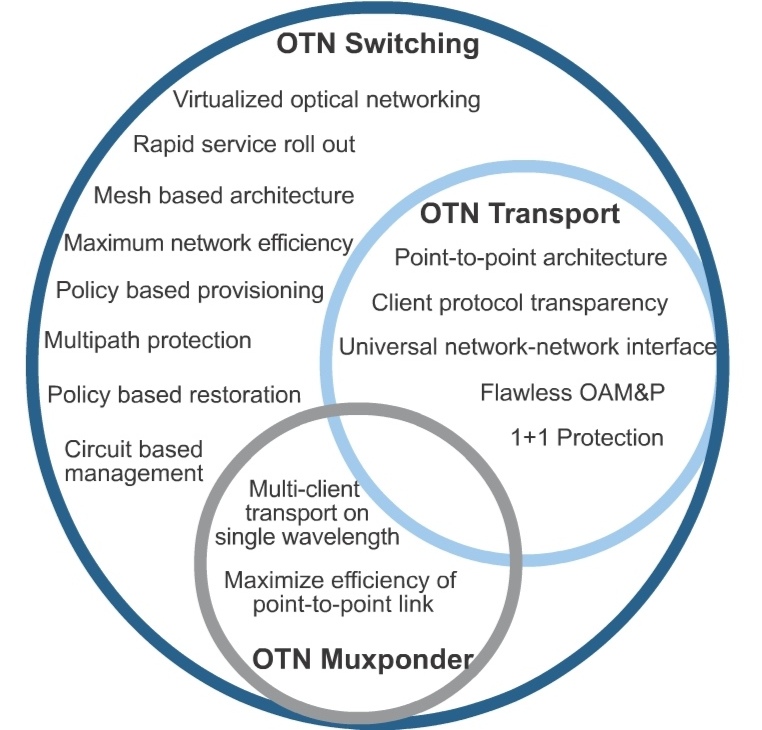
OTN should be viewed as the carrier transport protocol for the foreseeable future. For many carriers, OTN will be used not just for carrying a single packet client, but for interleaving multiple clients onto the same wavelength. This is OTN switching, and it is a superset of OTN transport functionality.
Most people talk about the OTN market but they fail to distinguish between whether OTN is used as a point-to-point technology or as a switching technology that allows the creation of an electronic mesh network.
What is OTN doing within operators' networks that accounts for their strong investment in the technology?
OTN is the new physical layer protocol carrying out the OSI [Open Systems Interconnection] layer 1 functions. Carriers are investing in OTN as part of their continuing investments in WDM [wavelength division multiplexing] equipment, most of which supports OTN transport, a maturing market. The new market is that of OTN switching, which resembles the SONET/SDH multiplexing scheme, but with much better features and management.
OTN switching deployments are directly related to large scale deployments of 40G and 100G transport networks as part of what I like to call The Optical Reboot. As these new wavelength speeds are rolled out, often on unused fibre, other technologies are being introduced at the same time – things like OTN switching and new control plane methods.
"People are underestimating how hard it is to build this [OTN] hardware and combine it with control plane software"
Please explain the difference between the main platforms - OTN transport, OTN switching and P-OTS. And will they have the same relative importance by 2016?
OTN switching is a superset of OTN transport, and the differences are shown in a Venn diagram (chart above) from a recent whitepaper I wrote, Integrated OTN Switching Virtualizes Optical Networks. Somewhere between the two is the muxponder application, which is good for low-volume deployments but becomes expensive and tough to manage when used in quantity.
P-OTS (packet-optical transport systems) are boxes that combine both layer 1 (SONET/SDH and/or OTN switching) with layer 2 (Ethernet, MPLS-TP, other circuit-oriented Ethernet (COE) protocols) in the same hardware and management platform.
Cisco was one of the early leaders in this space with some creative brute-force upgrades to the venerable 15454 platform. Since then, many legacy SONET/SDH multi-service provisioning platforms (MSPPs) have seen upgrades to carry Ethernet. Some of the best examples of this platform type are the Fujitsu 9500, Tellabs' 7100, and Alcatel-Lucent's 1850.
You say a big vendor battle is brewing in the P-OTS space: Cisco, Tellabs, and Alcatel-Lucent are the top 3 vendors, but Fujitsu, Ciena, and Huawei are gaining. What factors will determine a vendor's P-OTS success here?
It really depends. In the metro-regional applications of bigger boxes, things like 100G optics and OTN switching will be more important, as the layer 2 functions are handed off to dedicated layer 2/3 machines. As you get closer to the edge, though, OTN switching will have no importance and everything will depend on the layer 2 and layer zero features.
For layer 2, this means supporting a lightweight circuit-oriented Ethernet protocol with awareness of all the various service types that might be in play. For layer zero, it is all about cheap tunable optics (tunable XFP and SFP+), but particularly ROADMs. I think BTI Photonics, Cyan, Transmode, and ADVA Optical Networking are some of the smaller players to watch here. Mobile backhaul, data centre interconnect, and enterprise data services are the big engines of growth here.
Were there any surprises as part of your research for the report?
There just are not that many vendors shipping OTN switching systems today. I think people are underestimating how hard it is to build this hardware and combine it with control plane software. In 2011, only Ciena, Huawei, and ZTE shipped OTN switching for revenue. This year we should see Alcatel-Lucent, Infinera, Nokia Siemens, and maybe a few more.
Is there one OTN trend currently unclear that you'd highlight as worth watching?
Yes: It isn’t clear to what degree carriers want integrated WDM optics in OTN switches. In the past, big SONET/SDH switches like Ciena’s CoreDirector were always shipped with short-reach optics that connected it to standalone WDM systems. I think going forward, OTN switching and the WDM transport functions must be built into the same hardware in order to get the benefits of OTN switching at the best price, and that’s why I wrote the Integrated OTN Switching white paper – to try to communicate why this is important. It is a shift in the way carriers use this equipment, though, and as you know, some carrier habits are hard to break.
Further reading
OTN Processors from the core to the network edge, click here