

ECOC 2015 Review - Part 1
- Several companies announced components for 400 gigabit optical transmission
- NEL announced a 200 gigabit coherent DSP-ASIC
- Lumentum ramps production of its ROADM blades while extending the operating temperature of its tunable SFP+
400 gigabit
Oclaro, Teraxion and NeoPhotonics detailed their latest optical components for 400 gigabit optical transmission using coherent detection.
Oclaro and Teraxion announced 400 gigabit modulators for line-side transmission; Oclaro’s based on lithium niobate and Teraxion’s an indium phosphide one.
NeoPhotonics outlined other components that will be required for higher-speed transmission: indium phosphide-based waveguide photo-detectors for coherent receivers, and ultra-narrow line-width lasers suited for higher order modulation schemes such as dual-polarisation 16-quadrature amplitude modulation (DP-16-QAM) and DP-64-QAM.
There are two common approaches to achieve higher line rates: higher-order modulation schemes such as 16-QAM and 64-QAM, and optics capable of operating at higher signalling rates.
Using 16-QAM doubles the data rate compared to quadrature phase-shift keying (QPSK) modulation that is used at 100 Gig, while 64-QAM doubles the data rate again to 400 gigabit.
Higher-order modulation can use 100 gigabit optics but requires additional signal processing to recover the received data that is inherently closer together. “What this translates to is shorter reaches,” says Ferris Lipscomb, vice president of marketing at NeoPhotonics.
These shorter distances can serve data centre interconnect and metro applications where distances range from sub-100 kilometers to several hundred kilometers. But such schemes do not work for long haul where sensitivity to noise is too great, says Lipscomb.
What we are seeing from our customers and from carriers looking at next-generation wavelength-division multiplexing systems for long haul is that they are starting to design their systems and are getting ready for 400 Gig
Lipscomb highlights the company’s dual integrable tunable laser assembly (iTLAs) with its 50kHz narrow line-width. “That becomes very important for higher-order modulation because the different states are closer together; any phase noise can really hurt the optical signal-to-noise ratio,” he says
The second approach to boost transmission speed is to increase the signalling rate. “Instead of each stream at 32 gigabaud, the next phase will be 42 or 64 gigabaud and we have receivers that can handle those speeds,” says Lipscomb. The use of 42 gigabaud can be seen as an intermediate step to a higher line rate - 300 gigabit – while being less demanding on the optics and electronics than a doubling to 64 gigabaud.
Oclaro’s lithium niobate modulator supports 64 gigabaud. “We have increased the bandwidth beyond 35 GHz with a good spectral response – we don’t have ripples – and we have increased the modulator’s extinction ratio which is important at 16-QAM,” says Robert Blum, Oclaro’s director of strategic marketing.
We have already demonstrated a 400 Gig single-wavelength transmission over 500km using DP-16-QAM and 56 gigabaud
Indium phosphide is now coming to market and will eventually replace lithium niobate because of the advantages of cost and size, says Blum, but lithium niobate continues to lead the way for highest speed, long-reach applications. Oclaro has been delivering its lithium niobate modulator since the third quarter of the year.
Teraxion offers an indium phosphide modulator suited to 400 gigabit. “One of the key differentiators of our modulator is that we have a very high bandwidth such that single-wavelength transmission at 400 Gig is possible,” says Martin Guy, CTO and strategic marketing at Teraxion. “We have already demonstrated a 400 Gig single-wavelength transmission over 500km using DP-16-QAM and 56 gigabaud.”
“What we are seeing from our customers and from carriers looking at next-generation wavelength-division multiplexing systems for long haul is that they are starting to design their systems and are getting ready for 400 Gig,” says Blum.
Teraxion says it is seeing a lot of activity regarding single-wavelength 400 Gig transmission. “We have sampled product to many customers,” says Guy.
NeoPhotonics says the move to higher baud rates is still some way off with regard systems shipments, but that is what people are pursuing for long haul and metro regional.
200 Gig DSP-ASIC
Another key component that will be needed for systems operating at higher transmission speeds is more powerful coherent digital signal processors (DSPs). NTT Electronics (NEL) announced at ECOC that it is now shipping samples of its 200 gigabit DSP-ASIC, implemented using a 20nm CMOS process.
Dubbed the NLD0660, the DSP features a new core that uses soft-decision forward error correction (SD-FEC) that achieves a 12dB net coding gain. Improving the coding gain allows greater spans before optical regeneration or longer overall reach, says NEL. The DSP-ASIC supports several modulation formats: DP-QPSK, DP-8-QAM and DP-16-QAM, for 100 Gig, 150 Gig and 200 Gig rates, respectively. Using two NLD0660s, 400 gigabit coherent transmission is achieved.
NEL announced its first 20nm DSP-ASIC, the lower-power 100 gigabit NLD0640 at OFC 2015 in March. At the same event, ClariPhy demonstrated its own merchant 200 gigabit DSP-ASIC.
Reconfigurable optical add/ drop multiplexers
Lumentum gave an update on its TrueFlex route & select architecture Super Transport Blade, saying it has now been qualified, with custom versions of the line card being manufactured for equipment makers. The Super Transport Blades will be used in next-generation ROADMs for 100 gigabit metro deployments. The Super Transport Blade supports flexible grid, colourless, directionless and contentionless ROADM designs.
“This is the release of the full ROADM degree for next-generation networks, all in a one-slot line card,” says Brandon Collings, CTO of Lumentum. “It is a pretty big milestone; we have been talking about it for years.”
Collings says that the cards are customised to meet an equipment maker’s particular requirements. “But they are generally similar in their core configuration; they all use twin wavelength-selective switches (WSSes), those sort of building blocks.”
This is the release of the full ROADM degree for next-generation networks, all in a one-slot line card. It is a pretty big milestone; we have been talking about it for years
Lumentum also announced 4x4 and 6x6 integrated isolator arrays. “If you look at those ROADMs, there is a huge number of connections inside,” says Collings. The WSSes can be 1x20 and two can be used - a large number of fibres - and at certain points isolators are required. “Using discrete isolators and needing a large number, it becomes quite cumbersome and costly, so we developed a way to connect four or six isolators in a single package,” he says.
A 6x6 isolator array is a six-lane device with six hardwired input/ output pairs, with each input/ output pair having an isolator between them. “It sounds trivial but when you get to that scale, it is truly enabling,” says Collings.
Isolators are needed to keep light from going in the wrong direction. “These things can start to accumulate and can be disruptive just because of the sheer volume of connections that are present,” says Collings.
Tunable transceivers
Lumentum offers a tunable SFP+ module that consumes less than 1.5W while operating over a temperature range of -5C to +70C. At ECOC, the company announced that in early 2016 it will release a tunable SFP+ with an extended temperature range of -5C to +85C.
Further information
Heading off the capacity crunch, click here
For the ECOC Review, Part 1, click here

Huawei joins imec to research silicon photonics
Huawei has joined imec, the Belgium nano-electronics research centre, to develop optical interconnect using silicon photonics technology. The strategic agreement follows Huawei's 2013 acquisition of former imec silicon photonics spin-off, Caliopa.
 Source: Gazettabyte
“Having acquired cutting-edge expertise in the field of silicon photonics thanks to our acquisition of Caliopa last year, this partnership with imec is the logical next move towards next-generation optical communication,” says Hudson Liu, CEO at Huawei Belgium.
Imec's research focus is to develop technologies that are three to five years away from production. "Imec works with leading IC manufacturers and fabless companies in the field of CMOS fabrication," says Philippe Absil, department director for 3D and optical technologies at imec. "One of the programmes with our co-partners is about optical interconnect and silicon photonics, and Huawei is one of the participating companies."
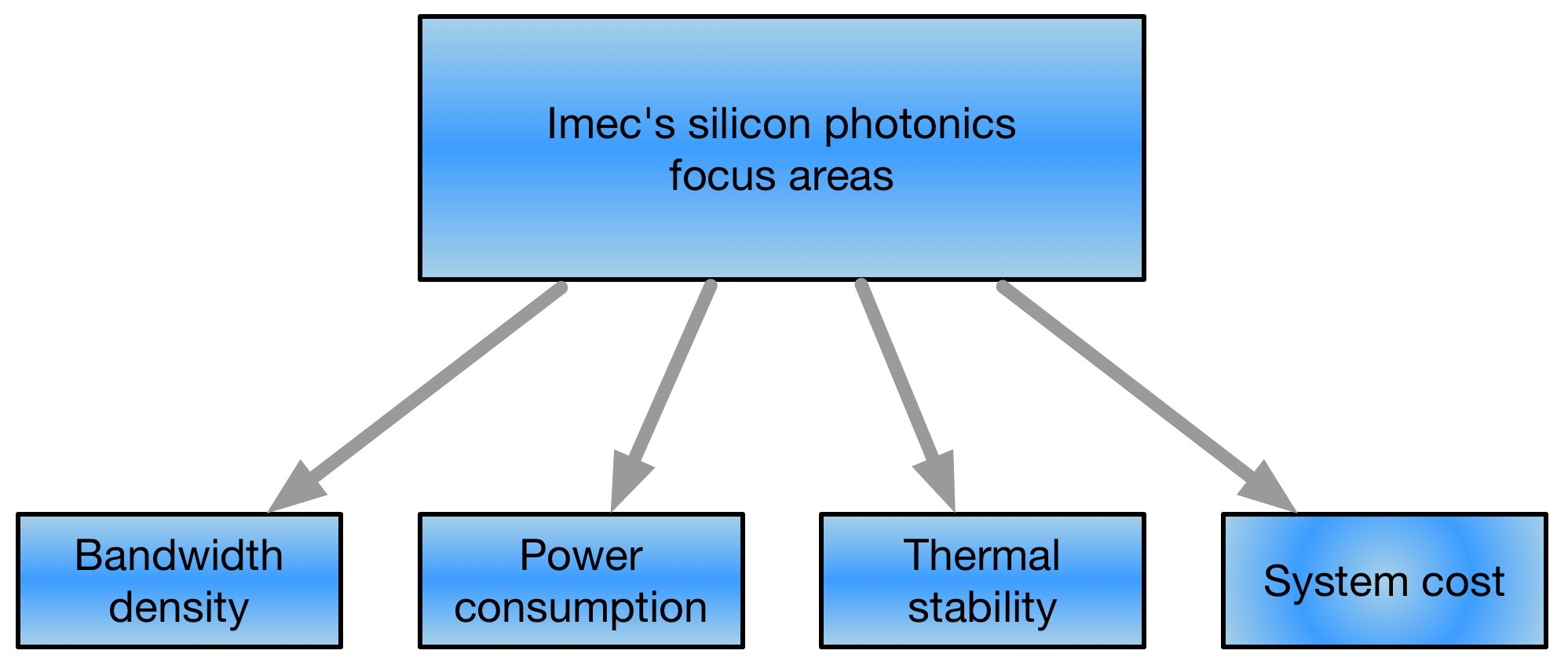
Imec's research concentrates on board-to-board and chip-to-chip interconnect. The optical interconnect work includes increasing interface bandwidth density, reducing power consumption, and achieving thermal stability and system-cost reduction.
The research centre has demonstrated high-bandwidth interfaces as part of work with Chiral Photonics that makes multi-core fibre. Imec has developed a 2D ring of grating couplers that allow coupling between the silicon photonics chip and Chiral's 61-core fibre. "A grating coupler is a sub-wavelength structure that diffracts the light from a waveguide in a vertical direction towards the fibre above the chip," says Absil. This contrasts to traditional edge coupling to a device, achieved by dicing or cleaving a facet on the waveguide, he says.
Another research focus is how to reduce device power consumption and achieve thermal stability. One silicon photonics component that dictates the overall power consumption is the modulator, says Absil. "The Mach-Zehnder modulator is known to consume significant amounts of power for chip-to-chip distances," he says. "The alternative is to use resonating-based modulators but these have to be thermally controlled, and that has an associated power consumption."
Imec is looking at ways to reduce the thermal control needed and is investigating the addition of materials to silicon to create resonator modulators that do away with the need for heating.
The system-cost reduction work looks at packaging. "Eventually, we want to get the optical transceiver inside a host IC," says Absil. "That package has to enable an optical pass-through, whether it is fibre or an optically-transparent package." Such a requirement differs from established CMOS packaging technology. "The programme is also looking to explore new types of packaging for enabling this optical pass-through," he says.
Absil says certain programme elements are two years away from being completed. "In the programme, we have topics that are closer to being adopted and some that are further away, maybe even to 2020."
Multi-project wafer service
Imec is part of the a consortium of EC research institutes that provide low-cost access to companies that don't have the means to manufacture their own silicon photonics designs. Known as Essential, the EC's Seventh Framework (FP7) programme is an extension of the ePIXfab silicon photonics multi-project wafer initiative. "Imec is offering one flavour of the technology, Leti is also offering a flavour, and then there is IHP and VTT," says Absil. Once the Essential FP7 project is completed, the service will be continued by the Europractice IC service.
Has imec seen any growth now that the funding for OpSIS, the multi-project wafer provider, has come to an end? "We see decent contributions but I wouldn't say it is exponential growth," says Absil, who notes that the A*STAR Institute of Microelectronics in Singapore that OpSIS used continues to offer a multi-project wafer service.
Status of silicon photonics
Despite announcements from Acacia and Intel, and Finisar revealing at ECOC '14 that it is now active in silicon photonics, 2014 has been a quiet year for the technology.
"Right now it is a bit quiet because companies are investing in development," says Absil. "There is not so much incentive to publish this work." Another factor he cites for the limited news is that there are vertically-integrated vendors that are putting the technology in their servers rather than selling silicon-photonics products directly.
"This is only first generation," says Absil. "As it picks up, there will be more incentive to work on a second generation of silicon photonics which will depart from what we know from the early work published by Intel and Luxtera."
The opportunities this next-generation technology will offer are 'quite exciting', says Absil.