

Ciena's stackable platform for data centre interconnect
Ciena is the latest system vendor to unveil its optical transport platform for the burgeoning data centre interconnect market. Data centre operators require scalable platforms that can carry significant amounts of traffic to link sites over metro and long-haul distances, and are power efficient.
The Waveserver stackable interconnect system delivers 800 Gig traffic throughput in a 1 rack unit (1RU) form factor. The throughput comprises 400 Gigabit of client-side interfaces and 400 Gigabit coherent dense WDM transport.
For the Waveserver’s client-side interfaces, a mix of 10, 40 and 100 Gigabit interfaces can be used, with the platform supporting the latest 100 Gig QSFP28 optical module form factor. One prominent theme at the recent OFC 2015 show was the number of interface types now supported in a QSFP28.
On the line side, Ciena uses two of its latest WaveLogic 3 Extreme coherent DSP-ASICs. Each DSP-ASIC supports polarisation multiplexing, 16 quadrature amplitude modulation (PM–16-QAM), equating to 200 Gigabit transmission capacity.
The Extreme was chosen rather than Ciena’s more power-efficient WaveLogic 3 Nano DSP-ASIC to maximise capacity over a fibre. “The amount of fibre the internet content providers have tends to be limited so getting high capacity is key,” says Michael Adams, vice president of product and technical marketing at Ciena. The Nano DSP-ASIC does not support 16-QAM.
A rack can accommodate up to 44 Waveserver stackable units to deliver 88 wavelengths, each 50GHz wide, or 17.6 Terabit-per-second (Tbps) of capacity. And up to 96 wavelengths, or 19.2Tbps, is supported on a fibre pair.
"We are going down the path of opening the platform to automation"
“We could add flexible grid and probably get closer to 24 or 25 Tbps,” says Adams. Flexible grid refers to moving off the C-band's set ITU grid by using digital signal processing at the transmitter. By shaping the signal before it is sent, each carrier can be squeezed from a 50GHz channel into a 37.5GHz wide one, boosting overall capacity carried over the fibre.
Adams says that it is not straightforward to compare the power consumption of different vendors’ data centre interconnect platforms but Ciena believes its platform is competitive. He estimates that the Waveserver consumes between 1W and 1.5W per Gigabit line side.
Ciena has stated that between five and 10 percent of its revenues come from web-scale customers, and accounts for a third of its total 100 Gig line-side port shipments.
Web-scale companies include Internet content providers, providers of data centre co-location and interconnect, and enterprises. Web-scale companies also drive the traditional telecom optical networking market as they also use large amounts of the telcos' network capacity to link their sites.
The global data centre interconnect market grew 16 percent in 2014 to reach $US 2.5 billion, according to market research firm, Ovum. Almost half of the spending was by the communications service providers whereas the Internet content providers spending grew 64 percent last year.
Open software
Ciena also announced an open application development environment, dubbed emulation cloud, that allows applications to be developed without needing Waveserver hardware.
One obvious application is the moving server virtual machines between data centres. But more novel applications can be developed by the data centre operators and third-party developers. Ciena cites what it calls an augmented reality application that allows a mobile phone to be pointed at a Waveserver to inform the of user the status of the machine: which ports are active and what type of bandwidth each port is consuming. “It can also show power and specific optical parameters of each line port,” says Adams. “Right there, you have all the data you need to know.”
The Waveserver platform also comes with software that allows data centre managers to engineer, plan, provision and operate links via a browser. More sophisticated users can benefit from Ciena’s OPn architecture and a set of open application programming interfaces (APIs).
“We are going down the path of opening the platform to automation,” says Adams. “We can foresee for the most sophisticated users, plugging into APIs and going to some very specific optical parameters and playing with them.”
Waveserver Status
Ciena is demonstrating its Waveserver platform to over 100 customers, as part of an annual event at the company’s Ottawa site.
“We are well engaged with a variety of Internet content providers,” says Adams. “We will be in trials with many of those folks this summer.” General availability is expected at the end of the third quarter.
In May, Ciena announced it had entered a definitive agreement to acquire Cyan. Cyan announced its own N-Series data centre interconnect platform earlier this year. Ciena says it is premature to comment on the future of the N-Series platform.

Ciena uses software to dip into the photonic layer
Ciena has enhanced its control plane and line elements to enable software to control the optical networking layer. The additions are part of Ciena's OPn network architecture evolution to enable greater visibility and automation. "It is about putting software into a system to allow you to program the photonic line," says Michael Adams, vice president of product & technology marketing at Ciena.

"For an SDN controller to control a photonic line, we need to present it as a programmable layer. The infrastructure is now there to be programmed."
Michael Adams, Ciena
Dubbed WaveLogic Photonics, the enhancements address the optical line system, made up of Ciena's WaveLogic coherent module, amplifier and reconfigurable optical add/ drop multiplexer (ROADM) elements. Ciena's ROADM is colourless and directionless and supports flexible-grid lightpaths, while the contentionless attribute will be added in the second half of the year.
Making the optical layer programmable is tricky. The OTN, Ethernet and IP networking layers above the line system are digital, lending themselves to software control. The optical layer, however, is not. Its performance is determined by linear and non-linear fibre transmission effects and parameters such as the optical signal-to-noise ratio.
"We believe the photonic line is equally important to be programmed, but the challenge has been that it is an analogue domain," says Adams.
To this aim, Ciena's WaveLogic Photonics introduces three changes:
- The OneConnect Intelligent Control Plane has been extended to include the photonic layer.
- Software-based line monitoring has been added to Raman to simplify amplifier deployment.
- Network analytics has been introduced to identify faults and optical signal loss.
By extending the OneConnect Control Plane to the photonic level, service providers can offer customers more tailored service-level agreements (SLAs). Customers that want protection against double fibre cuts can add automated optical restoration. After the first cut, the 50-millisecond OTN layer restoration kicks in. If a second cut occurs, OneConnect will restore the network in tens of seconds. At present, a truck roll and manual repair is needed after the second cut and that can take hours to repair. "The combination of the two [OTN and optical restoration] gives you a much more flexible system of SLAs that can be offered," says Adams.
The second line system enhancement, dubbed Smart Raman, adds a software-based optical time-domain reflectometer (OTDR) to Ciena's hybrid Raman/ EDFA amplifiers to simplify their deployment. The OTDR enables the amp to monitor and characterise the line.
"The Raman provides simple and controlled turn-up and will not turn on until it has checked that the surrounding fibre does not have any high losses," says Adams. Such automation replaces the careful manual configuration otherwise required when deploying high-powered Raman amps.
Ciena is also using the line data collected by the OTDR to provide network analytics. The line's condition can be plotted over time, helping identify any degradation in line elements. The analytics will also locate faults across fibre spans without requiring a truck roll. "Now from the NOC [network operations centre], that [fault] visibility is within 3m," says Adams.
Comcast has already used Smart Raman and the analytics as part of a Terabit trial conducted with Ciena. The cable operator located signal loss points on the line. "Comcast was able to recover several dBs of margin on that fibre," says Adams. "With 16-QAM used for the Terabit trial, they were able to go much farther; they achieved 1,000km even on marginal fibre." Ciena will also introduce advanced 16-QAM signaling in the second half of the year.
Ciena says WaveLogic Photonics should be viewed as enhancing the OneConnect control plane at the OTN and optical levels, while paving the way for software-defined networking (SDN) and applications-driven automation.
"For an SDN controller to control a photonic line, we need to present it as a programmable layer," says Adams. "The infrastructure is now there to be programmed."
The Smart Raman and analytics software is available and shipping in volume, says Ciena, while the photonic additions to the control plane are being trialled by customers and will be available in several weeks as part of the Release 10.0 software for Ciena's 6500 platform.
See also:
Ovum: Ciena launches WaveLogic Photonics, click here
Apps over packet-optical: Ciena boosts 6500's packet handling
 Source: Ciena
Ciena has enhanced its packet-optical equipment portfolio by adding packet support to its flagship 6500 platform.
Cards and software from Ciena's established Carrier Ethernet packet platforms have been added to the 6500, a packet-optical platform that features reconfigurable optical add-drop multiplexing (ROADM), WaveLogic3 coherent transponders, Optical Transport Network (OTN) switching and SONET/SDH aggregation. The system vendor has also developed packet aggregation and switch fabric cards for the 6500.
"You can now use the 6500 for 100 percent packet switching, 100 percent OTN switching, or any mix in between," says Michael Adams, vice president of product and technical marketing at Ciena.
The development is part of a general trend to combine optical and packet to create scalable, manageable networks. It also addresses the operators' growing need for programmable networks to deliver cloud-based services and dynamic bandwidth.
Applications
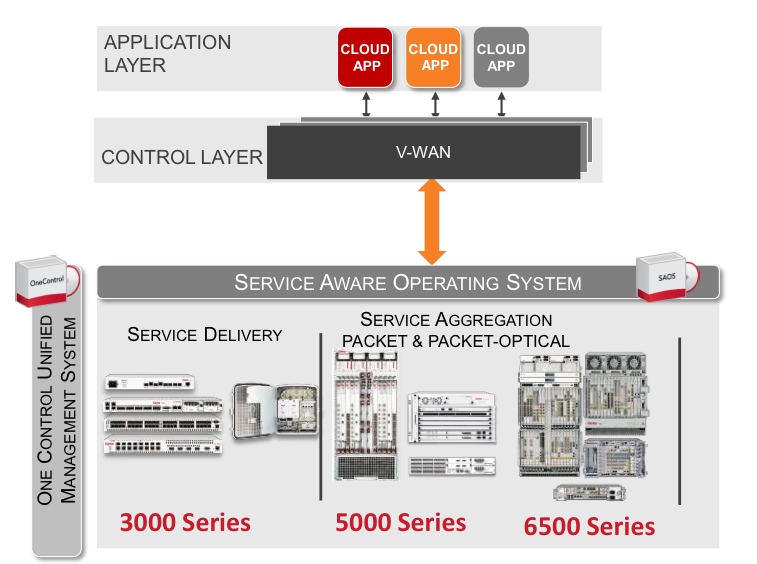
Ciena has a virtual wide-area network (VWAN) control layer that resides above the networking layer that abstracts the hardware and through which software applications can be executed (see chart).
"We have a scheduler 'app' through the control layer VWAN that allows bandwidth to change between sites, for example," says Adams. "Every night I want to do a backup between these times and I want this much bandwidth as I do it."
Another application is machine-to-machine communication that can be used to link data centres. "If you can virtualise within a data centre, why not virtualise across data centres?" says Adams.
As [servers'] virtual machines move between data centres, the performance of the network becomes key. Ciena has an application programming interface (API) that links to the server's hypervisor that allows machine-to-machine communication to be intercepted to benefit the bandwidth made available for the virtual machine traffic. "We are not doing it today but we have the software to link between two data centres," says Adams.
6500 enhancements
Until now it has been difficult to combine packet with packet optical, requiring different platforms, each with their own management system, says Adams. "It has been hard to take a base station that needs only packet, put the Carrier Ethernet traffic onto a ring [network] and then onto a 100 Gigabit wavelength," he says. "You either built pure packet or used a form of packet optical but it was hard to mix."
Ciena has added hardware and software to the 6500 from its existing packet platforms. The packet platforms are used to deliver Ethernet services and infrastructure and are a $40 million-a-quarter business for Ciena, with over 300,000 network elements deployed.
The service-aware operating system (SAOS), developed for the Ethernet packet platforms, has also been ported onto the 6500's new packet and fabric cards.
With the 6500 running the same software as its packet platforms, service management across the network becomes simpler. "Now, one system can deploy services, and look at performance visualisation between the layers," says Adams.
Ciena's latest hardware cards include blades with 1 and 10 Gigabit-per-second (Gbps) aggregation that operate independently of the 6500's switch fabric. "You don't touch the fabric, just run [them] over a WDM wavelength," says Adams. The stackable blades support 120Gbps to 300Gbps of packet traffic.
Meanwhile, the 6500 switch fabric cards add 600 Gigbit or 1.2 Terabit packet switching capacity that will be increased further in future.
"We have got these blades that can be stacked besides each other for resiliency or scale," says Adams. "And if you want to scale those up, there is a [switch] fabric solution."
Further reading:
100 Gigabit and packet optical loom large in the metro
P-OTS 2.0: 60-second interview with Heavy Reading's Sterling Perrin