

ADTRAN-ADVA's metro-access play

ADTRAN and ADVA have agreed to merge after a long courtship.
The two CEOs have spoken regularly over the years but several developments spurred them to act.
The merger combines ADTRAN’s expertise in access technologies with ADVA’s metro wavelength-division multiplexing (WDM) know-how to create a ‘metro-core-to-door’ company with revenues of $1.2 billion.
ADTRAN and ADVA a better path forward together than separately
As such, the merger promises to double their size and networking skills. Yet the stock market appeared underwhelmed by the announcement, with ADTRAN’s shares down 16% for the rest of the week after the deal was announced.
Market research analysts, however, are more upbeat.
“ADTRAN and ADVA have a better path forward together than separately,” said John Lively, principal analyst at LightCounting Market Research, in a research note.
The deal is expected to close in the second or third quarter of 2022 but only after several hurdles are overcome in what is described as a complex deal.
Motivation
The two companies describe the merger as a logical outcome given recent developments in the marketplace.
“Our combination will make us one of the largest Western suppliers for the markets we serve,” said Tom Stanton, CEO and chairman of ADTRAN, on the call announcing the deal. The word “Western” is noteworthy, reflecting how geopolitics is one catalyst motivating the merger.
The deal will also reposition the two companies with their rivals. ADTRAN will distance itself from broadband competitors such as Calix while ADVA will diversify its business from its current larger competitors, Ciena and Infinera. The new company’s revenues will also approach those of the two players.
The product portfolios of ADTRAN and ADVA have almost no overlap. ADTRAN offers fibre access and connectivity solutions while ADVA addresses metro WDM, data centre interconnect, business Ethernet, network synchronisation and network functions virtualisation (NFV) expertise.
Once combined, each company will seek to expand its sales in the other’s main market.
The US accounts for 74 per cent of ADTRAN’s revenues, while Europe accounts for 21 per cent. Meanwhile, Europe accounts for 62 per cent of ADVA’s business while the US is 29 per cent. The remaining revenues come from the Asia Pacific: ADTRAN, 5 per cent, and ADVA, 9 per cent.
Also cited as a factor is the wave of investment in fibre, not just by communications service providers (CSPs) and public utilities but also government-backed stimulus plans in the US and Europe.
In the US, $66 billion in investment was mentioned spread across programmes such as the infrastructure bill, the second phase of the Rural Digital Opportunity Fund (RDOF), and state-level funding for high-speed broadband.
In Europe, the sum is similar: $35 billion in government funding for high-speed broadband in the European Union, and $30 billion in public and private funding for fibre builds in the UK alone.
“There is an ongoing global fibre investment opportunity that we believe will create sustained momentum for years to come,” said Stanton.
Moreover, having access and second-mile technologies, the new company can better win business. “There is not a customer that we sell to today that, when they are upgrading their access infrastructure, is not also upgrading their middle-mile,” said Stanton.
Becoming a larger player will help, he said: “We see our customers making a significant capital investment to transition their supply chain to trusted vendors.”

Another merger catalyst is the opportunity created by US and European service providers that no longer use Chinese vendors and in some cases are replacing equipment already deployed.
In the US, this is less of an issue due to the fewer deployments while in Europe the process started 18 months ago. Stanton expects Latin America to follow.
“The market opportunity is not just created by all the stimulus but it is also because of the displacement of Eastern vendors,” said Stanton.
There is a land grab going on, he says, and the company that gets there first wins.
“Once you get entrenched in a carrier, regardless of size – the larger ones tend to have two [vendors] and the smaller ones, one – once you are entrenched, it is very difficult to get pulled out,” said Stanton.
Analysis
LightCounting’s view of the merger is positive.
Lively says the merger will not reshape the optical networking industry but it will be attractive to Tier 2 and Tier 3 CSPs that want to buy access and aggregation equipment from a single supplier.
LightCounting notes that the deal values ADVA at $931 million, 1.3x its most recent four quarters of sales.
This is a relatively low valuation: the 2015 Infinera-Transmode merger was 2.6x while the Cisco-Acacia Communications deal, which closed earlier this year, was 7.7x. Of recent deals, only the 2020 Ribbon-ECI Telecom deal was lower, at 1.2x.
LightCounting says one reason for the lower valuation could be ADVA’s port shipments; the vendor is one of the smallest dense WDM suppliers.
The merger’s impact will mostly be felt by the competitors of the existing two companies, says Lively. The new ADTRAN’s sales will be 20 per cent greater than Infinera but still a third of the size of Fiberhome and Ciena.

The importance of size is something both companies stress.
“Our industry has been consolidating and there is an underlying notion that scale matters,” says Stephan Rettenberger, senior vice president, marketing and investor relations at ADVA.
Doubling in size, the new company will be in the same bracket as Infinera while Ciena will be about 3x its size, notes Rettenberger: “The companies that we used to worry about the most are not as distant as before.”
At first glance, the merger between a US and an European company raises questions about the integration challenge. But both firms have American CEOs and both have operations in the US and Germany.
ADTRAN acquired Nokia Siemens Networks’ fixed-line broadband access unit in 2011 while ADVA more recently acquired US firms, MRV Communications and Overture.

Brian Protiva, CEO of ADVA and a co-founder of the company in 1994, is the longest-serving CEO in the optical industry. As such he will have thought long and hard about the deal.
“This business combination is not only about growing the business,” says Protiva. “These two businesses fit perfectly together to address existing market and technology requirements, and we are well-positioned to lead the transition to access and edge convergence.”
Service providers do not need separate infrastructure for business services, residential broadband, and/ or 5G xHauling, he says.
Mechanics
The proposed deal is an all-stock one with ADTRAN and ADVA combining to form ADTRAN Holdings.
Each ADVA share will be swapped for 0.8244 shares of the new company while ADTRAN shares will be exchanged on a one-for-one basis. ADTRAN shareholders will own 54 per cent of the combined company while ADVA shareholders will own 46 per cent, assuming all of the ADVA shares are swapped.
But the new holding company must first be approved by German regulators, expected to occur by November. A three-month offer period then starts during which a minimum of 70 per cent of ADVA shares must be surrendered.
Stanton will continue as CEO and chairman at the new company while ADVA’s Protiva will join as executive vice chairman.
“I’m convinced that Tom is the right person to run the combined company,” says Protiva. “He executes to plan, is well-liked by customers, and thinks very similarly to our ADVA leadership around people first and the customer experience.” Stanton is also a long-serving CEO, heading ADTRAN since 2005.
Protiva will support Stanton during the integration period and then be involved in the corporate strategic direction of ADTRAN, as a board member, using his many long-term relationships in the combined markets.
After that, Protiva says he may return to Egora, a holding company out of which ADVA was born.
ADVA’s CTO, Christoph Glingener, will retain his role with the new company. ADTRAN and ADVA will have a combined annual R&D budget of $250 million.
”The stock exchange offer needs to pass all types of regulatory groups and needs to be accepted by the ADTRAN and ADVA shareholders,” stresses Rettenberger. “There is still a long path to closing.”


Telefónica tackles video growth with IP-MPLS network
- Telefónica’s video growth in one year has matched nine years of IP traffic growth
- Optical mesh network in Barcelona will use CDC-ROADMs and 200-gigabit coherent line cards
Telefónica has started testing an optical mesh network in Barcelona, adding to its existing optical mesh deployment across Madrid. Both mesh networks are based on 200-gigabit optical channels and high-degree reconfigurable add-drop multiplexers (ROADMs) that are part of the optical infrastructure that underpins the operator’s nationwide IP-MPLS network that is now under construction.
 Maria Antonia CrespoThe operator decided to become a video telco company in late 2014 to support video-on-demand and over-the-top streaming video services.
Telefónica realised its existing IP and aggregation networks would not be able to accommodate the video traffic growth and started developing its IP-MPLS network.
“What we are seeing is that the traffic is growing very quickly,” says Maria Antonia Crespo, IP and optical networking director at Telefónica. “In one year we are getting the same
figures as we got from internet traffic in the last nine years.”
The operator is rolling out the IP-MPLS network across Spain. Juniper Networks and Nokia are the suppliers of the IP router equipment, while Huawei and Nokia were chosen to supply the optical networking equipment.
IP-MPLS
Telefónica set about reducing the number of layers and number of hops when designing its IP-MPLS network. “At each hop, we have to invest money if we want to increase capacity,” says Crespo.
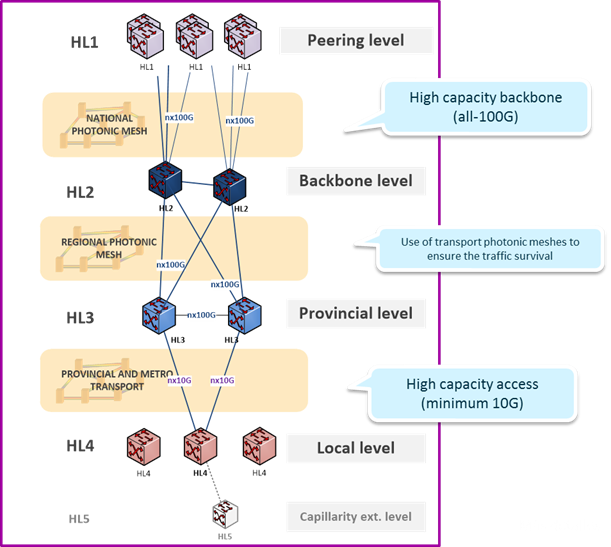
The result is an IP-MPLS network comprising four layers (see diagram). The uppermost Layer 1, dubbed HL1, connects the network to the internet world, while HL2 is a backbone transit layer. The HL3 layer is also a transit layer but at the provincial level. Spain is made up of 52 provinces. HL4 is where the services will reside, where Telefonica will deliver such services as Layer 2 and Layer 3 virtual private networks.
Between HL1 and HL2 is a national GMPLS-based photonic mesh, says Crespo, and between HL3 and HL4 there are the metro mesh networks. “Now we are deploying two GMPLS-based mesh networks, in Madrid and Barcelona,” she says. “Then, in the rest of the country, we are deploying [optical] rings.”
Systems requirements
Telefónica says it had several requirements when choosing the optical transport equipment, requirements common to both its backbone and regional networks.
One is the need to scale capacity at 10 gigabits and 100 gigabits, while network availability and robustness are also key. Telefónica says its network is designed to withstand two or more simultaneous fibre failures. “We have long experience with the GMPLS control plane to support different fibre impairments in the network,” says Alberto Colomer, optical technology manager at Telefónica.
The operator also wants its equipment to support high-speed interfaces and more granular rates to allow it to transition away from legacy traffic such as SDH and 1GbE. Operational improvements are another requirement: Telefónica wants to reduce the manual intervention its network needs. Optical time-domain reflectometers (OTDR) are being integrated into the network to monitor the fibre, as is the ability to automatically equalise the different optical channels.
 Alberto ColomerLastly, Telefónica is looking to reduce its capital expenditure and operational expense. It is deploying flexible rate 200-gigabit transponders in its Barcelona and Madrid networks and the same line cards will support 400-gigabit and even 1 terabit channels in future, as well as flexible grid to support the most efficient use of a fibre’s spectrum.
The 200-gigabit transponders use 16-quadrature amplitude modulation (16-QAM). Such transponders have enough reach to span each of the two cities but Colomer says Telefónica is still studying how many ROADM stages the 16-QAM transponders can cross.
It is like a pilot changing the engines while flying a plane
The ROADMs Telefónica is deploying in Madrid are directionless and are able to support up to 20 degrees. “You need some connectivity inside the mesh but also the mesh has to be connected to rings that cover all the counties around Madrid,” says Colomer.
Barcelona will be the first location where the ROADMs will also be colourless and contentionless (CDC-ROADMs). “We need to understand in a better way what are the advantages that come with that functionality,” says Colomer.
Telefónica has deployed Huawei’s Optix OSN 9800 platform in Madrid while in Barcelona Nokia’s 1830 Photonic Service Switch with the latest PSE-2 Coherent DSP-ASIC technology is being deployed.
Nokia’s PSS-1830 is designed to support the L-band as well as the C-band but Telefonica does not see the need for the L-band in the near future. “We are going in the direction of increasing capacity per channel: 400-gigabit channels and one terabit channels,” says Colomer. By deploying a photonic mesh and high-degree ROADMs, it will also be possible to increase capacity on a specific link by adding a fibre pair.
Status
The mesh in Madrid is already completed while Telefónica is deploying optical rings around Barcelona while it tests the contentionless ROADMs. These deployments are aligned with the IP-MPLS deployment, says Crespo, which is expected to be completed by 2018.
Crespo says the nationwide IP-MPLS rollout is a challenge. The deployment involves learning new technology that needs to be deployed alongside its existing network. "My boss likens it to a pilot changing the engines while flying a plane," says Crespo. "We are testing in the labs, duplicating it [the network], and migrating the traffic without impacting the customer."

OIF prepares for virtual network services
The Optical Internetworking Forum has begun specification work for virtual network services (VNS) that will enable customers of telcos to define their own networks. VNS will enable a user to define a multi-layer network (layer-1 and layer-2, for now) more flexibly than existing schemes such as virtual private networks.
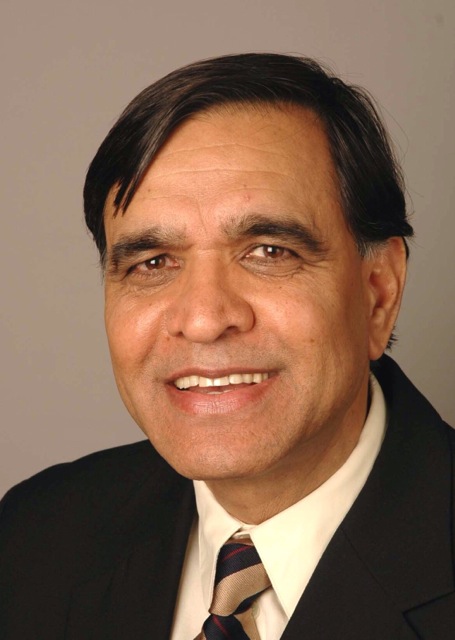 Vishnu Shukla"Here, we are talking about service, and a simple way to describe it [VNS] is network slicing," says OIF president, Vishnu Shukla. "With transport SDN [software-defined networking], such value-added services become available."
The OIF work will identify what carriers and system vendors must do to implement VNS. Shukla says the OIF already has experience working across multiple networking layers, and is undertaking transport SDN work. "VNS is a really valuable extension of the transport SDN work," says Shukla.
The OIF expects to complete its VNS Implementation Agreement work by year-end 2015.
Meanwhile, the OIF's Carrier Working Group has published its recommendations document, entitled OIF Carrier WG Requirements for Intermediate Reach 100G DWDM for Metro Type Applications, that provides input for the OIF's Physical Link Layer (PLL) Working Group.
The PLL Working Group is defining the requirements needed for a compact, low-cost and low-power 100 Gig interface for metro and regional networks. This is similar to the OIF work that successfully defined the first 100 Gig coherent modules in a 5x7-inch MSA.
The Carrier Working Group report highlights key metro issues facing operators. One is the rapid growth of metro traffic which, according to Cisco Systems, will surpass long-haul traffic in 2014. Another is the change metro networks are undergoing. The metro is moving from a traditional ring to a mesh architecture with the increasing use of reconfigurable optical add/drop multiplexers (ROADMs). As a result, optical wavelengths have further to travel, must contend with passing through more ROADMs stages and more fibre-induced signal impairments.
Shukla stresses there are differences among operators as to what is considered a metro network. For example, metro networks in North America span 400-600km typically and can be as much as 1,000km. In Europe such spans are considered regional or even long-haul networks. Metro networks also vary greatly in their characteristics. "Because of these variations, the requirements on optical modules varies so much, from unit to unit and area to area," says Shukla.
Given these challenges, operators want a module with sufficient optical performance to contend with the ROADM stages, and variable distances and network conditions encountered. "Sometimes we feel that the requirements [between metro and long-haul] won't be that much [different]," says Shukla. Indeed, the Carrier Working Group report discusses how the boundaries between metro and long-haul networks are blurring.
Yet operators also want such robust optical module performance at a greatly reduced price. One of the report's listed requirements is the need for the 100 Gig intermediate-reach interfaces to cost 'significantly' less than the cheapest long-haul 100 Gig.
To this aim, the report recommends that the 100 Gig pluggable optical modules such as the CFP or CFP2 be used. Standardising on industry-accepted pluggable MSAs will drive down cost as happened with the introduction of 100 Gig long haul 5x7-inch MSA modules.
Metro and regional coherent interfaces will also allow the specifications to be relaxed in terms of the DSP-ASIC requirements and the modulation schemes used. "When we come to the metro area, chances are that some of the technologies can be done more simply, and the cost will go down," says Shukla. Using pluggables will also increase 100 Gig line card densities, further reducing cost, while the report also favours the DSP-ASIC being integrated into the pluggable module, where possible.
Contributors to the Carrier Working Group report include representatives from China Telecom, Deutsche Telekom, Orange, Telus and Verizon, as well as module maker Acacia.
Verizon readies its metro for next-generation P-OTS
Verizon is preparing its metro network to carry significant amounts of 100 Gigabit traffic and has detailed its next-generation packet-optical transport system (P-OTS) requirements. The operator says technological advances in 100 Gig transmission and new P-OTS platforms - some yet to be announced - will help bring large scale 100 Gig deployments in the metro in the next year or so.
 Glenn Wellbrock
The operator says P-OTS will be used for its metro and regional networks for spans of 400-600km. "That is where we have very dense networks," says Glenn Wellbrock, director of optical transport network architecture and design at Verizon. "The amount of 100 Gig is going to be substantially higher than it was in long haul."
Verizon announced in April that it had selected Fujitsu and Coriant for a 100 Gig metro upgrade. The operator has already deployed Fujitsu's FlashWave 9500 and the Coriant 7100 (formerly Tellabs 7100) P-OTS platforms. "The announcement [in April] is to put 100 Gig channels in that embedded base," says Wellbrock.
The operator has 4,000 reconfigurable optical add/ drop multiplexers (ROADMs) across its metro networks worldwide and all support 100 Gig channels. But the networks are not tailored for high-speed transmission and hence the cost of 100 Gig remains high. For example, dispersion compensation fibre, and Erbium-doped fibre amplifiers (EDFA) rather than hybrid EDFA-Raman are used for the existing links. "It [the network] is not optimised for 100 Gig but will support it, and we are using [100 Gig] on an as-needed basis," says Wellbrock.
The metro platform will be similar to those used for Verizon's 100 Gig long-haul in that it will be coherent-based and use advanced, colourless, directionless, contentionless and flexible-grid ROADMs. "But all in a package that fits in the metro, with a much lower cost, better density and not such a long reach," says Wellbrock.
The amount of 100 Gig is going to be substantially higher than it was in long haul
One development that will reduce system cost is the advent of the CFP2-based line-side optical module; another is the emergence of third- or fourth-generation coherent DSP-ASICs. "We are getting to the point where we feel it is ready for the metro," says Wellbrock. "Can we get it to be cost-competitive? We feel that a lot of the platforms are coming along."
The latest P-OTS platforms feature enhanced packet capabilities, supporting carrier Ethernet, multi-protocol label switching - transport profile (MPLS-TP), and high-capacity packet and Optical Transport Network (OTN) switching. Recently announced P-OTS platforms suited to Verizon's metro request-for-proposal include Cisco Systems' Network Convergence System (NCS) 4000 and Coriant's mTera. Verizon says it expects other vendors to introduce platforms in the next year.
Verizon still has over 250,000 SONET elements in its network. Many are small and reside in the access network but SONET also exists in its metro and regional networks. The operator is keen to replace the legacy technology but with such a huge number of installed network elements, this will not happen overnight.
Verizon's strategy is to terminate the aggregated SONET traffic at its edge central offices so that it only has to deal with large Ethernet and OTN flows at the network node. "We plan to terminate the SONET, peel out the packets and send them in a packet-optimised fashion," says Wellbrock. In effect, SONET is to be stopped from an infrastructure point of view, he says, by converting the traffic for transport over OTN and Ethernet.
SDN and multi-layer optimisation
The P-OTS platform, with its integrated functionality spanning layer-0 to layer-2, will have a role in multi-layer optimisation. The goal of multi-layer optimisation is to transport services on the most suitable networking layer, typically the lowest, most economical layer possible. Software-defined networking (SDN) will be used to oversee such multi-layer optimisation.
However, P-OTS, unlike servers used in the data centre, are specialist rather than generic platforms. "Optical stuff is not generic hardware," says Wellbrock. Each P-OTS platform is vendor-proprietary. What can be done, he says, is to use 'domain controllers'. Each vendor's platform will have its own domain controller, above which will sit the SDN controller. Using this arrangement, the vendor's own portion of the network can be operated generically by an SDN controller, while benefitting from the particular attributes of each vendor's platform using the domain controller.
There is always frustration; we always want to move faster than things are coming about
Verizon's view is that there will be a hierarchy of domain and SDN controllers."We assume there are going to be multiple layers of abstraction for SDN," says Wellbrock. There will be no one, overriding controller with knowledge of all the networking layers: from layer-0 to layer-3. Even layer-0 - the optical layer - has become dynamic with the addition of colourless, directionless, contentionless and flexible-grid ROADM features, says Wellbrock.
Instead, as part of these abstraction layers, there will be one domain that will control all the transport, and another that is all-IP. Some software element above these controllers will then inform the optical and IP domains how best to implement service tasks such as interconnecting two data centres, for example. The transport controller will then inform each layer its particular task. "Now I want layer-0 to do that, and that is my Ciena box; I need layer-1 to do this and that happens to be a Cyan box; and we need MPLS transport to do this, and that could be Juniper," says Wellbrock, pointing out that in this example, three vendor-domains are involved, each with its own domain controller.
Is Verizon happy with the SDN progress being made by the P-OTS vendors?
"There is always frustration; we always want to move faster than things are coming about," says Wellbrock. "The issue, though, is that there is nothing I see that is a showstopper."
100 Gigabit: The Coming Metro Opportunity
Gazettabyte has published a Position Paper on the coming 100 Gigabit metro opportunity. (Click here to download a copy.) There has been several announcements in recent weeks from system and component vendors addressing 100 Gigabit metro networks.

The 19-page report looks at the status of the 100 Gigabit market, the drivers for 100 Gigabit deployment, the technology options and their merits. The paper then states how 100 Gigabit technologies such as direct-detection point-to-point, direct-detection WDM and coherent will fare in the metro.
Gazettabyte interviewed over 20 operators, system vendors, optical module and component makers for the Position Paper.
These include ADVA Optical Networks, Alcatel-Lucent, Brocade, BT, BTI Systems, Ciena, Cisco Systems, Cyoptics, John D'Ambrosia - chair of IEEE 100 Gig backplane study group, ECI Telecom, Ericsson, Finisar, Huawei, Infinera, Ixia, Juniper Networks, MultiPhy, Nokia Siemens Networks, Oclaro, Opnext, Level 3 Communications, Transmode, Verizon and ZTE.
Look forward to any comments you may have regarding the report, its position and conclusions.
Transmode chooses coherent for 100 Gigabit metro
Transmode has detailed its 100 Gigabit metro strategy based on a stackable rack, a concept borrowed from the datacom world.
The Swedish system vendor has adopted coherent detection technology for 100 Gigabit-per-second (Gbps) optical transmission, unlike other recent metro announcements from ADVA Optical Networking and MultiPhy based on 100Gbps direct-detection.

"Metro is a little bit diverse. You see different requirements that you have to adapt to."
Sten Nordell, Transmode
"We are getting requests for this and we think 2012 is when people are going to put in a low number of [100Gbps] links into the metro," says Sten Nordell, CTO at Transmode.
The 100Gbps requirements Transmode is seeing include connecting data centres over various distances. The data centres can be close - tens of kilometers - or hundreds of kilometers apart.
"They [data centre operators] want to get more capacity over longer distances over the fibre they have rented," says Nordell. "That is why we are going down the standards path of coherent technology that gives you that boost in power and distance."
Nordell says that customers typically only want one or two 100Gbps light paths to expand fibre capacity or to connect IP routers over a link already carrying multiple 10Gbps light paths. "Metro is a little bit diverse," he says. "You see different requirements that you have to adapt to."
Rack system approach
Transmode has adopted a stackable approach to its 100Gbps TM-series of chassis. The TM-2000 is a 4U-high dual 100Gbps rack that implements transponder, muxponder or regeneration functions. "We have borrowed from Ethernet switches - you add as you grow," says Nordell.
Up to four TM-2000 are used with one TM-301 or TM-3000 master rack, with the architecture supporting up to 80, 100Gbps wavelengths overall.
"If you have too many ROADMs in the way it is going to hurt you. We have seen that with 40 Gig."
The system also uses daughter boards that support various client-side interfaces while keeping the 100Gbps line-side interface - the most expensive system component - intact. "You can install a muxponder of 10x10Gig modules,” says Nordell. "When an IP router upgrades to a 100 Gig interface, you take out the daughter board and put in a 100 Gig transponder."
Transmode will offer two line-side coherent options, with a reach of 750km or 1,500km. "We want to make sure that customers' metro and long-haul requirements will be covered," says Nordell.
 The reach of various 100Gbps technologies for the metro edge, core and regional networks. Source: Gazettabyte
The company chose coherent technology because it is an industry-backed standard. "We can benefit from coherent technology," he says. "If the industry aligns, the volumes of the components come down in price."
Coherent also simplifies the setting up and commissioning of agile photonic networks, especially as more ROADMs are introduced in the metro. "Coherent will help simplify this. All the others are more complex," he says. "Beforehand metro was more point-to-point, now we are seeing more flexibility."
Transmode recently announced it is supplying its systems to Virgin Mobile for mobile backhaul. "That is a metro network with all ROADMs in it," says Nordell. Such networks support multiple paths and that translates to a need for greater reach. "The power budget we need to have in the metro is going up a little bit."
Direct-detection technology was considered by Transmode but it chose coherent as it gives customers a better networking design capability.
Direct detection is also not as spectrally efficient as coherent: 200GHz or 100GHz-wide channels for a 100Gbps signal rather that coherent's 50GHz. "If you have too many ROADMs in the way it is going to hurt you, says Nordell.”We have seen that with 40 Gig."
The TM-2000 rack will begin testing in customers' networks at the start of 2012, with limited availability from mid-2012. The platform and daughter boards will be available in volume by year-end 2012.