

Ranovus shows 200 gigabit direct detection at ECOC
Ranovus has announced it first direct-detection optical products for applications including data centre interconnect.
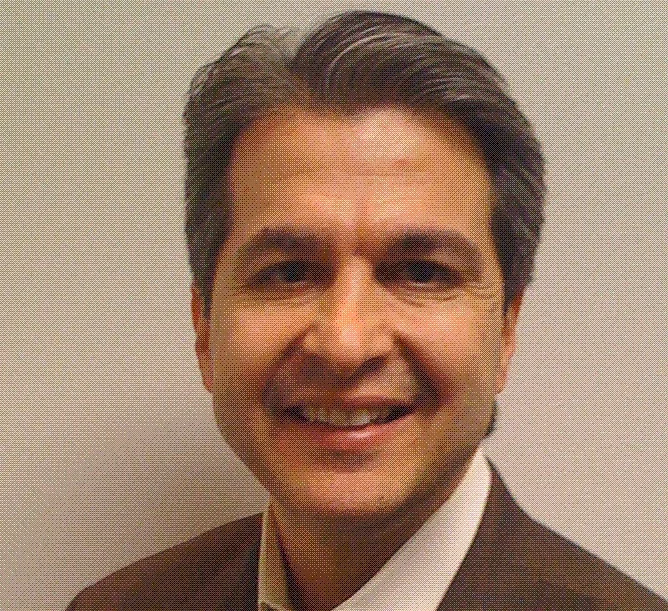 Saeid AramidehThe start-up has announced two products to coincide with this week’s ECOC show being held in Dusseldorf, Germany.
One product is a 200 gigabit-per-second (Gbps) dense wavelength-division multiplexing (WDM) CFP2 pluggable optical module that spans distances up to 130km. Ranovus will also sell the 200Gbps transmitter and receiver optical engines that can be integrated by vendors onto a host line card.
The dense WDM direct-detection solution from Ranovus is being positioned as a cheaper, lower-power alternative to coherent optics used for high-capacity metro and long-haul optical transport. Using such technology, service providers can link their data centre buildings distributed across a metro area.
The cost [of the CFP2 direct detection] proves in much better than coherent
“The power consumption [of the direct-detection design] is well within the envelope of what the CFP2 power budget is,” says Saeid Aramideh, a Ranovus co-founder and chief marketing. The CFP2 module's power envelop is rated at 12W and while there are pluggable CFP2-ACO modules now available, a coherent DSP-ASIC is required to work alongside the module.
“The cost [of the CFP2 direct detection] proves in much better than coherent does,” says Aramideh, although he points out that for distances greater than 120km, the economics change.
The 200Gbps CFP2 module uses four wavelengths, each at 50Gbps. Ranovus is using 25Gbps optics with 4-level pulse-amplitude modulation (PAM-4) technology provided by fabless chip company Broadcom to achieve the 50Gbps channels. Up to 96, 50 Gbps channels can be fitted in the C-band to achieve a total transmission bandwidth of 4.8 terabits.
Ranovus is demonstrating at ECOC eight wavelengths being sent over 100km of fibre. The link uses a standard erbium-doped fibre amplifier and the forward-error correction scheme built into PAM-4.
Technologies
Ranovus has developed several key technologies for its proprietary optical interconnect products. These include a multi-wavelength quantum dot laser, a silicon photonics based ring-resonator modulator, an optical receiver, and the associated driver and receiver electronics.
The quantum dot technology implements what is known as a comb laser, producing multiple laser outputs at wavelengths and grid spacings that are defined during fabrication. For the CFP2, the laser produces four wavelengths spaced 50GHz apart.
For the 200Gbps optical engine transmitter, the laser outputs are fed to four silicon photonics ring-resonator modulators to produce the four output wavelengths, while at the receiver there is an equivalent bank of tuned ring resonators that delivers the wavelengths to the photo-detectors. Ranovus has developed several receiver designs, with the lower channel count version being silicon photonics based.
The quantum dot technology implements what is known as a comb laser, producing multiple laser outputs at wavelengths and grid spacings that are defined during fabrication.
The use of ring resonators - effectively filters - at the receiver means that no multiplexer or demultiplexer is needed within the optical module.
“At some point before you go to the fibre, there is a multiplexer because you are multiplexing up to 96 channels in the C-band,” says Aramideh. “But that multiplexer is not needed inside the module.”
Company plans
The startup has raised $35 million in investment funding to date. Aramideh says the start-up is not seeking a further funding round but he does not rule it out.
The most recent funding round, for $24 million, was in 2014. At the time the company was planning to release its first product - a QSFP28 100-Gigabit OpenOptics module - in 2015. Ranovus along with Mellanox Technologies are co-founders of the dense WDM OpenOptics multi-source agreement that supports client side interface speeds at 100Gbps, 400Gbps and terabit speeds.
However, the company realised that 100-gigabit links within the data centre were being served by the coarse WDM CWDM4 and CLR4 module standards, and it chose instead to focus on the data centre interconnect market using its direct detection technology.
Ranovus has also been working with ADVA Optical Networking with it data centre interconnect technology. Last year, ADVA Optical Networking announced its FSP 3000 CloudConnect data centre interconnect platform that can span both the C- and L-bands.
Also planned by Ranovus is a 400-gigabit CFP8 module - which could be a four or eight channel design - for the data centre interconnect market.
Meanwhile, the CFP2 direct-detection module and the optical engine will be generally available from December.

Photonics and optics: interchangeable yet different
Many terms in telecom are used interchangeably. Terms gain credibility with use but over time things evolve. For example, people understand what is meant by the term carrier [of traffic] or operator [of a network] and even the term incumbent [operator] even though markets are now competitive and 'telephony' is no longer state-run.
"For me, optics is the equivalent of electrical, and photonics is the equivalent of electronics - LSI, VLSI chips and the like" - Mehdi Asghari
Operators - ex-incumbents or otherwise - also do more that oversee the network and now provide complex services. But of course they differ from service providers such as the over-the-top players [third-party providers delivering services over an operator's infrastructure, rather than any theatrical behaviour] or internet content providers.
Google is an internet content provider but with its gigabit broadband service it is rolling out in the US, it is also an operator/ carrier/ communications service provider. And Google may soon become a mobile virtual network operator.
So having multiple terms can be helpful, adding variety especially when writing, but the trouble is it is also confusing.
Recent discussions including interviewing silicon photonics pioneer, Richard Soref, raised the question whether the terms photonics and optics are the same. I decided to ask several industry experts, starting with The Optical Society (OSA).
Tom Hausken, the OSA's senior engineering & applications advisor, says that after many years of thought he concludes the following:
-
People have different definitions for them [optics and photonics] that range all over the map.
-
I find it confusing and unhelpful to distinguish them.
-
The National Academies's report is on record saying there is no difference as far as that study is concerned.
-
That works for me.
Michael Duncan, the OSA's senior science advisor, puts the difference down to one of cultural usage. "Photonics leans more towards the fibre optics, integrated optics, waveguide optics, and the systems they are used in - mostly for communication - while optics is everything else, especially the propagation and modification of coherent and incoherent light," says Duncan. "But I could easily go with Tom's third bullet point."
"Photonics does include the quantum nature, and sort of by convention, the term optics is seen to mean classical" - Richard Soref
Duncan also cites Wikipedia, with its discussion of classical optics that embraces the wave nature of light, and modern optics that also includes light's particle nature. And this distinction is at the core of the difference, without leading to an industry consensus.
"Photonics does include the quantum nature, and sort of by convention, the term optics is seen to mean classical," says Richard Soref. He points out that the website Arxiv.org categorises optics as the subset of physics, while the OSA Newsletter is called Optics & Photonics News, covering all bases.
"Photonics is the larger category, and I might have been a bit off base when throwing around the optics term," says Soref. If only everyone was as off base as Professor Soref.
"We need to remember that there is no canonical definition of these terms, and there is no recognised authority that would write or maintain such a definition," says Geoff Bennett, director, solutions and technology at Infinera. For Bennett, this is a common issue, not confined to the terms optics and photonics: "We see this all the time in the telecoms industry, and in every other industry that combines rapid innovation with aggressive marketing."
That said, he also says that optics refers to classical optics, in which light is treated as a wave, whereas photonics is where light meets active semiconductors and so the quantum nature of light tends to dominate. Examples of the latter would be photonic integrated circuits (PICs). "These contain active lasers components, semiconductor optical amplifiers and photo-detectors " says Bennett. "All of these rely on quantum effects to do their job."
"We need to remember that there is no canonical definition of these terms, and there is no recognised authority that would write or maintain such a definition" - Geoff Bennett
Bennett says that the person who invented the term semiconductor optical amplifier (SOA) was not aware of the definition because the optical amplifier works on quantum principles, the same way a laser does. "So really it should be a semiconductor photonic amplifier," he says.
"At Infinera, we seem for the most part to have abided to the definitions in terminology that we use, but I can’t say that this was a conscious decision," says Bennett. "I am sure that if our marketing department thought that photonic sounded better than optical in a given situation they would have used it."
Mehdi Asghari, vice president, silicon photonics research & development at Mellanox, says optics refers to the classical use and application of light, with light as a ray. He describes optics as having a system-level approach to it.
"We create a system of lenses to make a microscope or telescope to make an optical instrument using classical optics models or we use optical components to create an optical communication system," he says. This classical or system-level perspective makes it optics or optical, a term he prefers. "We are not concerned with the nature - particle versus wave - of light, rather its classical behaviour, be it in an instrument or a system," he says.
But once things are viewed closer, at the device level, especially devices comparable in size of photons, then a system-level approach no longer works and is replaced with a quantum approach. "Here we look at photons and the quantum behaviour they exhibit," says Asghari.
In a waveguide, be it silicon photonics (integrated devices based on silicon), a planar lightwave circuit (glass-based integrated devices), or a PIC based on III-V or active devices, the size of the structure or device used is often comparable or even smaller than the size of the photons it is manipulating, he says: "This is where we very much feel the quantum nature of light, and this is where light becomes photons - photonics - and not optics."
ADVA Optical Networking's senior principal engineer, Klaus Grobe, held a discussion with the company's physicists, and both, independently, had the same opinion.
"Both [photonics and optics] are not strictly defined," he says. "Optics clearly also includes classic school-book ray optics and the like. Photonics already deals with photons, the wave-particle dualism, and hence, at least indirectly, with quantum mechanics, and possibly also quantum electro-dynamics (QED)."
Since in fibre-optics for transport, ray-propagation models no longer can be used, and also since they rely on the quantum-mechanical behaviour, for example of diode receivers, fibre-optics are better filed under photonics, says Grobe: "But they are not called fibre-photonics".
So, the industry view seems to be that the two terms are interchangeable but optics implies the classical nature of light while photonics suggests light as particles. Which term includes both seems to be down to opinion. Some believe optics covers both, others believe photonics is the more encompassing term.
Mellanox's Asghari once famously compared photons and electrons to cats and dogs. Electrons are like dogs: they behave, stick by you and are loyal; they do exactly as you tell them, he said, whereas cats are their own animals and do what they like. Just like photons. So what is his take?
He believes optics is more general than photonics. He uses the analogy of electrical versus electronics to make his point. An electronics system or chip is still an electrical device but it often refers to the integrated chip, while an electrical system is often seen as global and larger, made up of classical devices.
"For me, optics is the equivalent of electrical, and photonics is the equivalent of electronics - LSI, VLSI chips and the like," says Asghari. "One is a subset or specialised version of the other due to the need to get specific on the quantum nature of light and the challenges associated with integration."
"Optics refers to all types of cats, be it the tiger or the lion or the domestic pet. Photonics refers to the so called domestic cat that has domesticated and slaved us to look after it" - Mehdi Asghari
To back up his point, Ashgari says take a look at older books and publications that use the term optics. The term photonics started to be used once integration and size reduction became important, just as how electrical devices got replaced with electronic devices.
Indeed, this rings true in the semiconductor industry: microelectronics has now become nano-electronics as CMOS feature sizes have moved from microns to nanometer dimensions.
And this is why optical fibre or the semiconductor optical amplifier are used because these terms were invented and used when the industry was primarily engaged with the use of light at a system level and away from the quantum limits and challenges of integration.
"In short, photonics is used when we acknowledge that light is made of photons with all the fun and challenges that photons bring to us and optics is when we deal with light at a system level or a classical approach is sufficient," says Asghari.
Happily, cats and dogs feature here too.
"Optics refers to all types of cats, be it the tiger or the lion or the domestic pet," says Asghari. "Photonics refers to the so called domestic cat that has domesticated and slaved us to look after it."
Last word to Infinera's Bennett: "I suppose the moral is: be aware of the different meanings, but don’t let it bug you when people misuse them."