

Paying homage to Harald Bock

Harald Bock, described by an optical networking executive as one of the great people of our industry, has died. Former colleagues describe the man and their sense of loss
Those who knew and worked with Harald Bock have been stunned by his sudden passing at 55. For them, Harald was a valued and much-admired friend, a deep thinker who made his views heard, quietly yet powerfully.
Last February, Harald changed jobs, becoming chief product officer at Ekinops after six years at Infinera. He was excited by the role and enjoyed his introductory period travelling to Ekinops’ sites, meeting colleagues and customers, and working on the company’s strategy.
Sylvain Quartier, Ekinops’ chief marketing & strategy officer, says it took the company a year to find the right candidate. Ekinops knew of Harald’s optical networking expertise but was impressed with his keenness to expand into what, for him, were new product areas such as routeing and cybersecurity.
“We needed someone expert in one domain and with good experience in product strategy,” says Quartier. “He was full of joy and happy to work.”
During Harald’s short spell at the company, he sharpened Ekinops’s product plans. “We’re executing his roadmap and strategy today,” says Quartier. “In six months, he had a great impact.”
Career
Harald earned his PhD in physics, specialising in polymer materials.
“Polymers may become an important material system for future high-speed [optical] modulators,” says Uwe Fischer, who was chief technology officer (CTO) at former optical networking firm, Coriant. “He was ahead of his time by doing something in his PhD thesis which is about to become important in business and technology.”
Harald’s career spanned some notable optical networking firms: Marconi, Nokia Siemens Networks, Coriant, and Infinera. He was part of Uwe Fischer’s team at Nokia Siemens Networks and Coriant. Harald’s strength was as a technologist, and had roles in several CTO offices.
Stefan Voll, then a lead product line manager and now senior director of business development at Adtran, worked with Harald at Nokia Siemens Networks in 2012.
The two were tasked with carving out the optical business of Nokia Siemens Networks in what was to become Coriant. “The carve-out was a big achievement,” says Voll. Harald represented the CTO office and Voll led the product line manager team and the two were tasked with making the product portfolio not only viable but profitable. This required aligning technical aspects with business needs, setting the foundation for Coriant’s operations.
At Coriant, Harald contributed to the development of Groove, one of the first compact modular platform for metro wavelength division multiplexing (WDM) and long-haul networks. Harald continued in the CTO office at Infinera after it acquired Coriant in 2019.
More recently, Harald served as editor of the Optical Internetworking Forum’s (OIF) 1600ZR project, taking over the role after an OIF member stepped down. The work involves standardising 1600-gigabit coherent optics for high-capacity networks. “He stepped in as smooth as possible,” says Karl Gass, optical vice chair of the OIF’s physical link layer (PLL) working group. “He knew how to manage personalities and get things done.”
Work ethic
Christian Uremovic, senior director of solution marketing at Nokia Optical Networks, worked with Harald at Coriant and Infinera. “He was a respected and valued technology guide for product line management and sales and for us in marketing,” says Uremovic. It wasn’t always an easy role; groups in the company would pull in different directions, and bringing it all together was a challenge. “Sometimes you had to make difficult decisions,” says Uremovic.
“He would like to understand basic technologies, and when, at executive meetings, he wanted to bring his opinion and convince others, he would talk quietly,” says Ekinop’s Quartier. “Everybody would be quiet because you wanted to hear him, and he made a strong impression.” With this quiet manner, Harald would progress the discussion and bring everybody in the right direction, says Quartier.
It is something Robert Richter, managing director and senior vice president, customer executive, product marketing office, at Nokia, highlights: “Harald would reiterate his view calmly, even if it annoyed some leaders, but it was always positive,” he says, adding that Harald was not the kind of guy who did what management told him. But he was always trying to change opinions constructively.
Voll reinforces this, saying Harald would not let shortcuts slide, ensuring all critical aspects were covered. “He was not afraid of conflict.” Harald would broaden discussions to bring in new angles to the point where it could be annoying. “But it was always valuable,” says Voll. “He was not fast, and that’s because he was a deep thinker. He reacted in meetings, but not immediately; he needed some time putting his thoughts together.”
Voll says Harald was focused on long-term technology trends, five to six years out, compared to product line managers’ shorter-term view. “He taught me to assess competitiveness through metrics like capacity per power consumption,” says Voll. Harald would say: “Convert it into capacity per volume or per power consumption.” Ten years ago, these were not usual metrics, but Harald used them to measure product plans. Harald would also also look product optimisations, such as whether a platform’s chips had features that were not used.
Maxim Kuschnerov, Director of R&D, at Huawei, worked with Harald at Coriant. He recalls a meeting he had with Deutsche Telekom presenting Huawei’s research topics. Afterwards, a Deutsche Telekom executive remarked that although it was framed as a research discussion, Kuschnerov kept steering the conversation toward commercial applications and customer value: “It reminds me of a guy at Coriant who talks about use cases a lot — Harald Bock”. Smiling, Kuschnerov replied: “Where do you think I was taught to think like that? I worked with Harald!”
Traits
Ekinops’ Quartier highlights Harald’s general cheerfulness: “He was always smiling, which was much appreciated.”
Richter, who worked with Harald for 18 years at Nokia Siemens Networks and Coriant, describes him as the most empathetic person he has met. “He was always listening to people and was very patient,” he says. Harald would bring cakes to the office from vacations and would never speak ill of others. He’d keep positive even during challenging times and in that sense, he was a role model, says Richter: “It was always a pleasure to talk to him over a coffee. He was open to a dialogue.”
Harald had an impressive fitness routine. “He’d bike 20km, swim for an hour, then come to the office relaxed,” says Voll. Until recently, Fischer and Harald would go biking on 40-kilometre rides. “Sometimes he was behind in my slipstream, then we change positions,” says Fischer. “We were proud of the competitive speed and times we could achieve together.” He was a keen water polo player in his youth.

Fluent in English, French, and his native German, Harald read books in all three languages. He adored France – his wife is French – with its pastries and Brittany with its Hydrangeas. He said how the Hydrangeas in his garden struggled, yet on seeing the flourishing bands of colour in Brittany (pictured), he was determined to try again.
Legacy
When colleagues talk about Harald, they recount his warmth and character.
Uremovic recollects sharing an office and hearing Harald’s diplomatic charm on calls. These experiences have shaped his ability to connect better with others. He will also miss their talks: “To me, he was like a big brother.”
Harald made a deep impression during his short time at Ekinops. “We miss him,” says Quartier. “We will always have his memory at Ekinops.”
Fischer highlights their shared interests in life – sport and a love of France.”There was a lot of mutual understanding which we didn’t need to put into words,” says Fischer. “Sometimes, when you feel close to somebody, you don’t even need to talk.”
Fischer, who has watched Harald’s career over the years, laments a life cut short. “He was at the peak of his career,” he says. ”He brought to Ekinops all his experience of the last 20 to 30 years so this period was maybe the most impactful time of his life.”
Richter’s grief over his lost colleague is evident in his sombre tone and demeanour, perhaps the deepest tribute one can pay to someone held so dear.


OIF adds a short-reach design to its 1600ZR/ ZR+ portfolio
The OIF (Optical Internetworking Forum) has broadened its 1600-gigabit coherent optics specification work to include a third project, complementing the 1600ZR and 1600ZR+ initiatives.
The latest project will add a short-reach ‘coherent-lite’ digital design to deliver a reach of 2km to 20km and possibly 40km with a low latency below 300ns
The low latency will suit workloads and computing resources distributed across data centres.
“The coherent-lite is more than just the LR (long reach) work that we have done [at 400 gigabits and 800 gigabits],” says Karl Gass, optical vice chair of the OIF’s physical link layer (PLL) working group, adding that the 1600-gigabit coherent-lite will be a distinct digital design.
Doubling the data rate from 800 gigabits to 1600 gigabits is the latest battle line between direct-detect and coherent pluggable optics for reaches of 2km to 40km.
At 800 gigabits, the OIF members debated whether the same coherent digital signal processor would implement 800ZR and 800-gigabit LR. Certain OIF members argued that unless a distinct, coherent DSP is developed, a coherent optics design will never be able to compete with direct-detect LR optics.
“We have that same acknowledgement that unless it’s a specific design for [1600 gigabit] coherent-lite, then it’s not going to compete with the direct detect,” says Gass.
OIF’s 1600-gigabit specification work
The OIF’s 1600-gigabit roadmap has evolved rapidly in the last year.
In September 2023, the OIF announced the 1600ZR project to develop 1.6-terabit coherent optics with a reach of 80km to 120km. In January 2024, the OIF announced it would undertake a 1600ZR+ specification, an enhanced version of 1600ZR with a reach of 1,000km.
The OIF’s taking the lead in ZR+ specification work is a significant shift in the industry, promising industry-wide interoperability compared to the previous 400ZR+ and 800ZR+ developments.
Now, the OIF has started a third 1600-gigabit coherent-lite design.
1600ZR development status
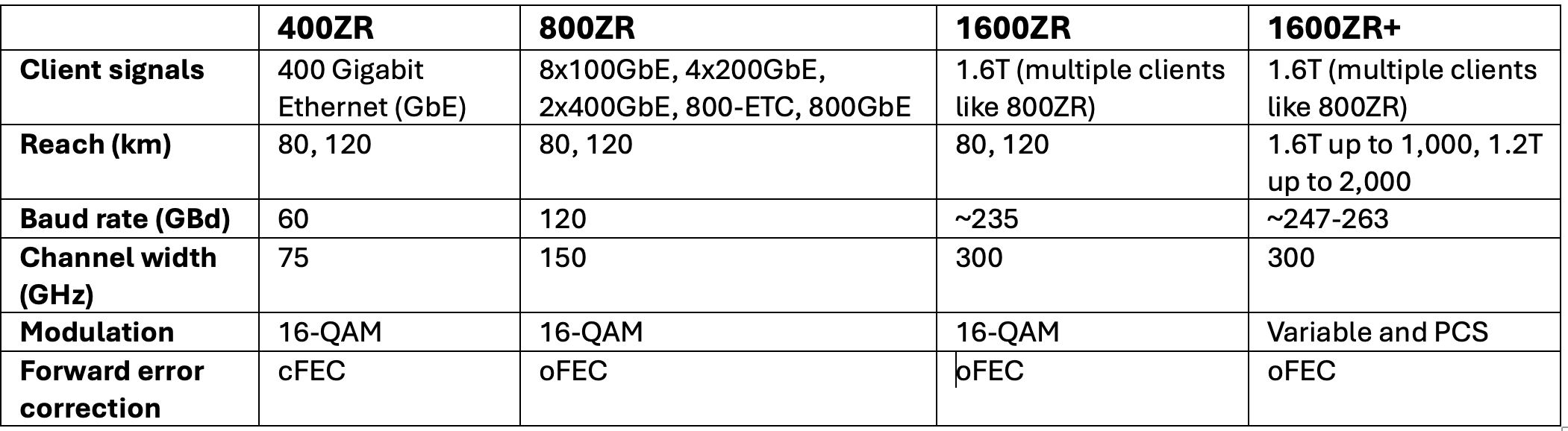
Work remains to complete the 1600ZR Implementation Agreement, the OIF’s specification document. However, member companies have agreed upon the main elements, such as the framing schemes for the client side and the digital signal processing and using oFEC as the forward error correction scheme.
oFEC is a robust forward error correction scheme but adds to the link’s latency. It has also been chosen as the forward error correction scheme for 1600ZR. The OIF members want the ‘coherent-lite’ version to use a less powerful forward error correction to achieve lower latency.
The 1600ZR symbol rate chosen is around 235 gigabaud (GBd), while the modulation scheme is 16-ary quadrature amplitude modulation (16-QAM). The specified reach will be 80km to 120km. (See table below.)
The members will likely agree on the digital issues this quarter before starting the optical specification work. Before completing the Implementation Agreement, members must also spell out interoperability testing.
1600ZR+ development status
The 1600ZR+ work still has some open questions.
One is whether members choose a single carrier, two sub-carriers, or four to achieve the 1,000km reach. The issue is equalisation-enhanced phase noise (EEPN), which imposes tighter constraints on the received laser. Using sub-carriers, the laser constraints can be relaxed, enabling more suppliers. The single-carrier camp argues that sub-carriers complicate the design of the coherent digital signal processor (DSP).
The workgroup members have also to choose the probabilistic constellation shaping to use. Probabilistic constellation shaping gain can extend the reach, but it can also reduce the symbol rate and, hence, the bandwidth specification of the coherent modem’s components.
The symbol rate of the 1600ZR+ is targeted in the range of 247GBd to 263GBd.
Power consumption
The 1600ZR design’s power consumption was hoped to be 26W, but it is now expected to be 30W or more. The 1600ZR+ is expected to be even higher.
The coherent pluggable’s power consumption will depend on the CMOS process that the coherent DSP developers choose for their 1600ZR and 1600ZR+ ASIC designs. Will they choose the state-of-the-art 3nm CMOS process or wait for 2nm or even 1.8nm to become available to gain a design advantage?
Timescales
The target remains to complete the 1600ZR Implementation Agreement document quickly. Gass says the 1600ZR and 1600ZR+ Implementation Agreements could be completed this year, paving the way for the first 1600ZR/ZR+ products in 2026.
“We are being pushed by customers, which isn’t a bad thing,” says Gass.
The coherent-lite design will be completed later given that it has only just started. At present, the OIF will specify the digital design and not the associated optics, but this may change, says Gass.


The OIF’s 400ZR coherent interface starts to take shape
Part 2: Coherent developments
The Optical Internetworking Forum’s (OIF) group tasked with developing two styles of 400-gigabit coherent interface is now concentrating its efforts on one of the two.
When first announced last November, the 400ZR project planned to define a dense wavelength-division multiplexing (DWDM) 400-gigabit interface and a single wavelength one. Now the work is concentrating on the DWDM interface, with the single-channel interface deemed secondary.
 Karl Gass"It [the single channel] appears to be a very small percentage of what the fielded units would be,” says Karl Gass of Qorvo and the OIF Physical and Link Layer working group vice chair, optical, the group responsible for the 400ZR work.
The likelihood is that the resulting optical module will serve both applications. “Realistically, probably both [interfaces] will use a tunable laser because the goal is to have the same hardware,” says Gass.
The resulting module may also only have a reach of 80km, shorter than the original goal of up to 120km, due to the challenging optical link budget.
Origins and status
The 400ZR project began after Microsoft and other large-scale data centre players such as Google and Facebook approached the OIF to develop an interoperable 400-gigabit coherent interface they could then buy from multiple optical module makers.
The internet content providers’ interest in an 80km-plus link is to connect premises across the metro. “Eighty kilometres is the magic number from a latency standpoint so that multiple buildings can look like a single mega data centre,” says Nathan Tracy of TE Connectivity and the OIF’s vice president of marketing.
Since then, traditional service providers have shown an interest in 400ZR for their metro needs. The telcos’ requirements are different to the data centre players, causing the group to tweak the channel requirements. This is the current focus of the work, with the OIF collaborating with the ITU.
The catch is how much can we strip everything down and still meet a large percentage of the use cases
“The ITU does a lot of work on channels and they have a channel measurement methodology,” says Gass. “They are working with us as we try to do some division of labour.”
The group will choose a forward error correction (FEC) scheme once there is common agreement on the channel. “Imagine all those [coherent] DSP makers in the same room, each one recommending a different FEC,” says Gass. “We are all trying to figure out how to compare the FEC schemes on a level playing field.”
Meeting the link budget is challenging, says Gass, which is why the link might end up being 80km only. “The catch is how much can we strip everything down and still meet a large percentage of the use cases.”
The cloud is the biggest voice in the universe
400ZR form factors
Once the FEC is chosen, the power envelope will be fine-tuned and then the discussion will move to form factors. The OIF says it is still too early to discuss whether the project will select a particular form factor. Potential candidates include the OSFP MSA and the CFP8.
 Nathan TracyThe industry assumption is that the 80km-plus 400ZR digital coherent optics module will consume around 15W, requiring a very low-power coherent DSP that will be made using 7nm CMOS.
“There is strong support across the industry for this project, evidenced by the fact that project calls are happening more frequently to make the progress happen,” says Tracy.
Why the urgency? “The cloud is the biggest voice in the universe,” says Tracy. To support the move of data and applications to the cloud, the infrastructure has to evolve, leading to the data centre players linking smaller locations spread across the metro.
“At the same time, the next-gen speed that is going to be used in these data centres - and therefore outside the data centres - is 400 gigabit,” says Tracy.
OIF moves to raise coherent transmission baud rate
"We want the two projects to look at those trade-offs and look at how we could build the particular components that could support higher individual channel rates,” says Karl Gass of Qorvo and the OIF physical and link layer working group vice chair, optical.
 Karl Gass
The OIF members, which include operators, internet content providers, equipment makers, and optical component and chip players, want components that work over a wide bandwidth, says Gass. This will allow the modulator and receiver to be optimised for the new higher baud rate.
“Perhaps I tune it [the modulator] for 40 Gbaud and it works very linearly there, but because of the trade-off I make, it doesn’t work very well anywhere else,” says Gass. “But I’m willing to make the trade-off to get to that speed.” Gass uses 40 Gbaud as an example only, stressing that much work is required before the OIF members choose the next baud rate.
"We want the two projects to look at those trade-offs and look at how we could build the particular components that could support higher individual channel rates”
The modulator and receiver optimisations will also be chosen independent of technology since lithium niobate, indium phosphide and silicon photonics are all used for coherent modulation.
The OIF has not detailed timescales but Gass says projects usually take 18 months to two years.
Meanwhile, the OIF has completed two projects, the specification outputs of which are referred to as implementation agreements (IAs).
One is for integrated dual polarisation micro-intradyne coherent receivers (micro-ICR) for the CFP2. At OFC 2015, several companies detailed first designs for coherent line side optics using the CFP2 module.
The second completed IA is the 4x5-inch second-generation 100 Gig long-haul DWDM transmission module.