

Juniper Networks to acquire Aurrion for $165 million
The announcement of the acquisition was low key. A CTO blog post and a statement that Juniper Networks had entered into an agreement to acquire Aurrion, the fabless silicon photonics start-up. No fee was mentioned.
However, in the company's US Securities and Exchange Commission filing, Juniper values the deal at approximately $165 million. "The Company believes the acquisition will help to fuel its long-term competitive advantage by enabling cost-effective, high-density, high-speed optical networks," it said. The deal is expected to be closed this quarter.

But the deal is significant for a number of reasons.
First, Aurrion, like Intel, is a proponent of heterogeneous integration, combining indium phosphide and other technologies on a silicon wafer platform through bonding. The approach has still to be proven in commercial volumes but it promises the use of III-V materials on 12-inch silicon wafers manufactured in a chip fabrication plant.
Aurrion has made tunable lasers for telecom that cover both the C- and L-bands, as well as uncooled laser arrays for datacom applications. The start-up has also been developing high-speed transceivers for the data centre.
The company has also been working on the manufacturing aspects of silicon photonics, a considerable undertaking. These include automated wafer-scale testing, connecting fibre to a silicon photonics chip, and packaging.
Juniper is thus getting an advanced silicon photonics technology suited for volume manufacturing that it will use to advance its data centre networking offerings.
Juniper may choose to make its own optical transceivers but, more likely, it will use silicon photonics as part of its switch designs to tackle issues of data centre scaling and the continual challenge of growing power consumption. It could also use the technology for its IP core routers and longer term, to tackle I/O issues alongside custom ASICs.
Systems vendors drive silicon photonics
The Aurrion acquisition also highlights how it is systems vendors that are acquiring silicon photonics start-ups rather than the traditional optical component and module makers.
This is partly a recognition that silicon photonics' main promise is as a systems technology. Acacia, the coherent transmission specialist, is one company that has shown how silicon photonics can benefit optical module design but the technology's longer-term promise is for systems design rather than optical modules.
A consequence of such acquisitions by systems vendors is that technology being developed by silicon-photonics start-ups is being swallowed within systems houses for their own use and not for the merchant market. Systems vendors have deep pockets to develop the technology but it will be for their own use. For the wider community, silicon photonics technology being developed by the likes of Aurrion is no longer available.
This is what AIM Photonics, the US public-private partnership that is developing technology for integrated photonics, is looking to address: to advance the manufacturing of silicon photonics, making the resulting technology available to small to medium sized businesses and entrepreneurial ventures. However, AIM Photonics is one year into a five-year venture.
Implications
Should major systems vendors owning silicon photonics technology in-house concern the traditional optical component vendors?
Not for now.
Optical transceiver sales continue to grow and the bulk of designs are not integrated. And while silicon photonics is starting to be used for integrated designs, it is competing against the established technologies of indium phosphide and gallium arsenide.
But as photonics moves closer to the silicon and away from a system's faceplate, silicon photonics becomes more strategically important and this is where systems vendors can start developing custom designs.
Must the systems houses own the technology to do that?
Not necessarily, but they will need silicon photonics design expertise, and in the case of Juniper, it can hit the ground running with Aurrion.
Longer term, it will be the much larger chip industry that will drive silicon photonics rather than the optical industry. There are chip foundries now that are making silicon photonic ICs as there are top-ten chip companies such as Intel and STMicroelectronics. But ultimately it will be a very different supply chain that will take shape.
It is early days but Juniper's acquisition is the latest indicator that it is the systems vendors that are moving first at the very beginnings of this new ecosystem.

Colt's network transformation
Colt's technology and architecture specialist, Mirko Voltolini, talks to Gazettabyte about how the service provider has transformed its network from one based on custom platforms to an open, modular design.
It was obvious to Colt that something had to change. Its network architecture based on proprietary platforms running custom software was not sustainable; the highly customised network was cumbersome, resistant to change and expensive to run. The network also required a platform to be replaced - or at least a new platform added alongside an existing one - every five to seven years.
 Mirko Voltolini
"The cost of this approach is enormous," says Mirko Voltolini, vice president technology and architecture at Colt Technology Services. "Not just in money but the time it takes to roll out a new platform."
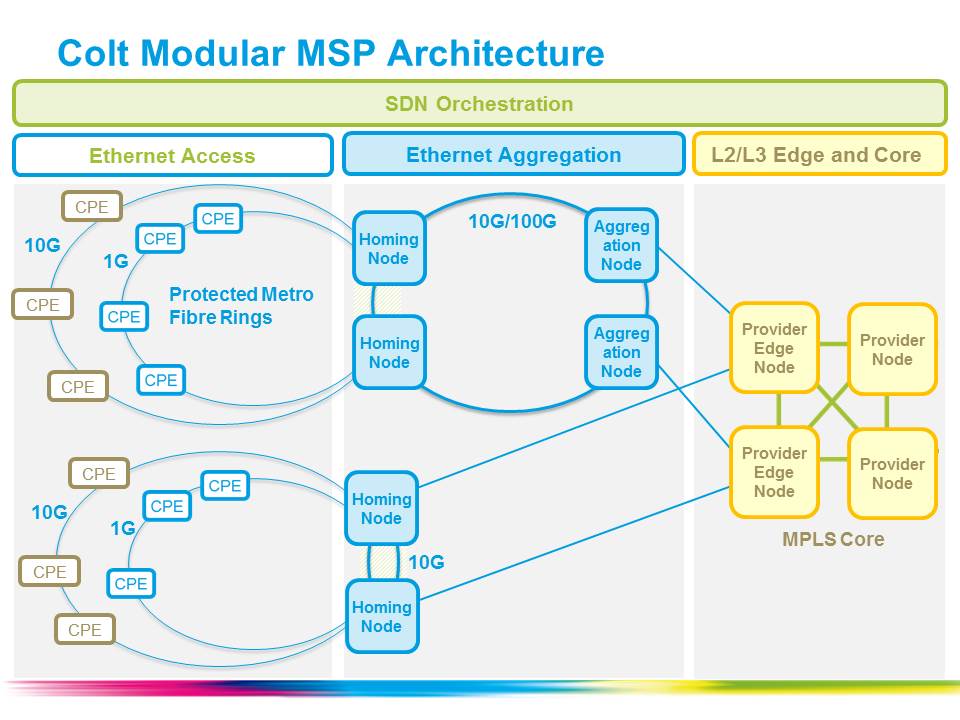
Instead, the service provider has sought a modular approach to network design using standardised platforms that are separated from each other. That way, a new platform with a better feature set or improved economics can be slotted in without impacted the other platforms. Colt calls its resulting network a modular multi-service platform (MSP).
The MSP now delivers the majority of Colt's data networking and all-IP services. These includes Carrier Ethernet point-to-point, hub-and-spoke and private networks services, as well as internet access, IP VPNs and VoIP IP-based services.
The vendors chosen for the MSP include Cyan with its Z-Series packet-optical transport system (P-OTS) and Blue Planet software-defined networking (SDN) platform and Accedian Networks' customer premise equipment (CPE). Cyan's Z-Series does not support IP, so Colt uses Juniper Networks' and Alcatel-Lucent's IP edge platforms. Colt also has a legacy 20-year-old SDH network but despite using a P-OTS platform, it has decided to leave the SDH platform alone, with the modular MSP running alongside it.
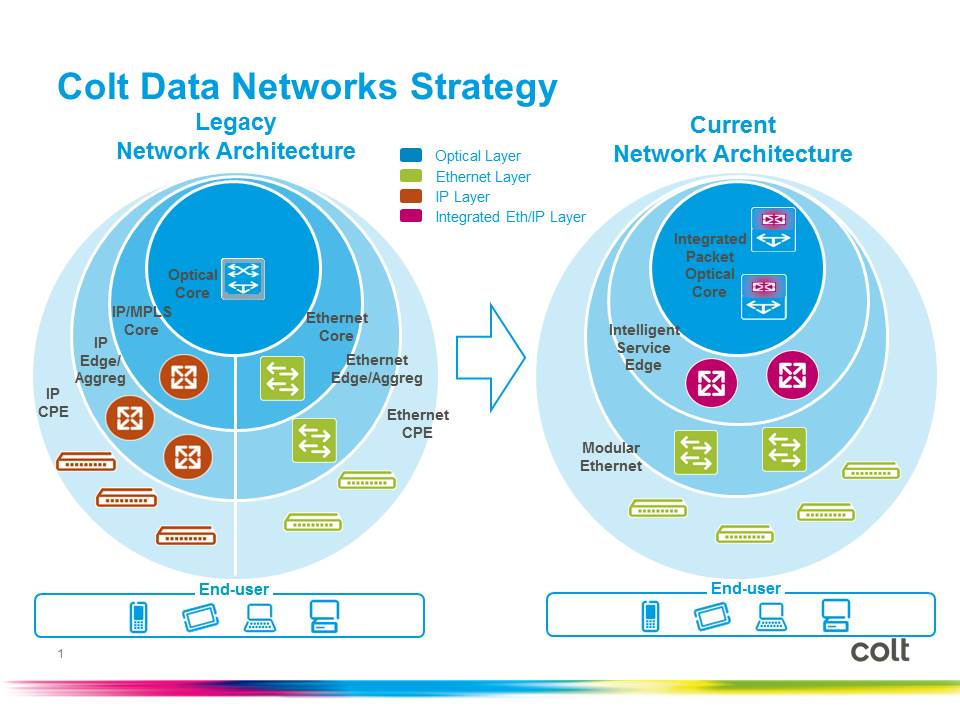
Colt chose its vendors based on certain design goals. "The key was openness," says Voltolini. "We didn't want to have a closed system." It was Cyan's management system, the Blue Planet platform, that led Colt to choose Cyan.
Associated with Blue Planet is an ecosystem that allows the management software to control other vendors' platforms. Cyan uses 'element adapters' that mediate between its SDN interface software and the proprietary interfaces of its vendor partners. Cyan says that its Z-Series P-OTS appears as a third-party piece of equipment to its Blue Planet software in the same way as the other vendors' equipment are; a view confirmed by Colt. "Because of its openness, we have been able to integrate other vendors to use the same management system as if they were Cyan components," says Voltolini.

"Cyan was probably the best option available and we decided to go with it," says Voltolini. The company was looking at what was available two years ago and Voltolini points out that the market has evolved significantly since then. "In the end, if you want to move ahead, you need to make decisions," he says. "We are quite happy with what we have picked and we continue to improve it."
Colt says that as well as SDN, network functions virtualisation (NFV) is also important. "With the same modular platform we have created a virtual component which is a layer-3 CPE," says Voltolini. The company is issuing a request-for-information (RFI) regarding other CPE functions like firewalls, load-balancers and other networking components.
Benefits and lessons learned
Adopting the MSP has speeded up Colt's service delivery. Before the modular network, it would take between 30 and 45 days for Colt to fulfil a customer's request for a three-month-long Ethernet link upgrade, from 100 Megabit to 200 Megabit. Now, such a request can be fulfilled in seconds. "We didn't need any more layer-3 CPE and we can upgrade remotely the bandwidth," says Voltolini.
Colt also estimates that it will halve its operational costs once the new network is fully deployed; the network went live in November 2013 and has not been deployed in all locations. The operational expense improvement and the greater service flexibility both benefit Colt's bottom line, says Voltolini.
A key lesson learned from the network transformation is the importance of leading staff through change rather than any technological issues. "The technology has been a challenge but in the end, with the suppliers, you can design anything you want if you have the right level of collaboration," says Voltolini. "But when you completely transform the way you deliver services, you are touching everything that is part of the engine of the company."
Colt cites aspects such as engineering solutions, service delivery, service operations, systems and processes, and the sales process. "You need to lead the transition is such a way that everybody is going to follow you," says Voltolini.
Colt encountered obstacles created because of the staff's natural resistance to change. "Certain things took longer," says Voltolini. "We had to overcome obstacles that weren't really obstacles, just people's fear of change."
Is Broadcom’s chip powering Juniper’s Stratus?
Part 1: Single-layer switch architectures
Juniper Networks’ Stratus switch architecture, designed for next-generation data centres, is several months away from trials. First detailed in 2009, Stratus is being engineered as a single-layer switch with an architecture that will scale to support tens of thousands of 10 Gigabit-per-second (Gbps) ports.

Stratus will be in customer trials in early 2011.
Andy Ingram, Juniper Networks
Data centres use a switch hierarchy, made up of three layers commonly. Multiple servers are connected to access switches, such as top-of-rack designs, which are connected to aggregation switches whose role is to funnel traffic to large, core data centre switches.
Moving to a single-layer design promises several advantages. Not only does a single-layer architecture reduce the overall number of managed platforms, bringing capital and operational expense savings, it also reduces switch latency.
Broadcom’s IC for Stratus?
The Stratus architecture has yet to be detailed by Juniper. But the company has said that the design will be based on a 64x10Gbps ASIC building block dubbed a path-forwarding engine (PFE).
“The building block – the PFE – that can have that kind of density (64x10Gbps) gives us the ability to build out the network fabric in a very economical way,” says Andy Ingram, vice president of product marketing and business development of the fabric and switching technologies business group at Juniper Networks.
Stratus is being designed to provide any-to-any connectivity and operate at wire speed. “You have a very dense, very high-cross-sectional bandwidth fabric,” says Ingram. “The only way to make it economical is to use dense ASICs.”
Broadcom’s latest StrataXGS Ethernet switch family - the BCM56840 series - comprises three devices to date, the largest of which - the BCM56845 – also has 64x10Gbps ports.
Juniper will not disclose whether it is using its own ASIC or a third-party device for Stratus.
Broadcom, however, has said that its BCM56840 series is being used by vendors developing flat, single-layer switch architectures. “Anyone using merchant Ethernet switching silicon to build a single-stage environment is probably using our technology,” says Nick Ilyadis, chief technical officer for Broadcom’s infrastructure networking group.
Stratus will be in customer trials in early 2011. “In a lot less than 6 months”, says Ingram. “We have some customers that have some very difficult networking challenges that are signed up to be our early field trials and we will work with them extensively.”
The timeline aligns with Broadcom’s claim that samples of the BCM56840 ICs have been available for months and will be in production by year-end.
According to Broadcom, only a handful of switch vendors have the resources to design such a complex switch ASIC and also expect to recoup their investment. Moreover, a switch vendor using Broadcom's IC has plenty of scope to differentiate their design using software, and even FPGA hardware if needed. It is software that brings out the many features of the BCM56845, says Broadcom.
The BCM56845
Broadcom’s BCM56840 ICs share a common feature set but differ in their switching capacity. The largest, the BCM56845, has a switching capacity of 640Gbps. The device’s 64x10 Gigabit Ethernet (GbE) ports can also be configured as 16x40 GbE ports.
The BCM56845 supports data center bridging (DCB), the Ethernet protocol enhancement that enables lossless transmission of storage and high-performance computing traffic. It also supports the Fibre Channel over Ethernet (FCoE) protocol that frames Fibre Channel storage traffic over DCB-enhanced Ethernet.
Besides DCB Ethernet, the series switch includes layer 3 packet processing and routeing. There is also a multi-stage content-aware engine that allows higher layer, more complex packet inspection (layer 4 to 7 of the Open Systems Interconnection model) and policy management.
The content-aware functional block can also be used for packet cut-through; a technique to reduce switch latency by inspecting header information and forwarding all the while the packet’s payload is arriving. Broadcom says the switch’s latency is less than one microsecond.
Most importantly, the BCM56845 addresses the move to a flatter switching architecture in the data centre.
It supports the Transparent Interconnection of Lots of Links (TRILL) standard ratified by the Internet Engineering Task Force (IETF) in July. Ethernet uses a spanning tree technique to avoid the creation of loops within a network. However the spanning tree becomes unwieldy as the Ethernet network size grows and works only at the expense of halving the available networking bandwidth. TRILL is designed to allow much larger Ethernet networks while using all available bandwidth.
Broadcom has its own protocol know as HiGig that adds tags to packets. Using HiGig, a very large logical switch can be created and managed, made up of multiple interconnected switches. Any port of the IC can be configured as a HiGig port.
So has Broadcom’s BCM56845 been chosen by Juniper Networks for Stratus? “I really can’t comment on which customers are using this,” says Ilyadis.
Click here for Part 2: Ethernet switch chips
Click here for Part 3: Networking developments
Still some way to go
Part 1: The vision .... back in 2000
I came across this article (below) on the intelligent all-optical network. I wrote it in 2000 while working at the EMAP magazine, Communications Week International, later to become Total Telecom.
What is striking is just how much of the vision of a dynamic photonic layer is still to be realised. Back then it had also been discussed for over a decade. And bandwidth management, like in 2000, is still largely at the electrical layer.
And yet much progress has been made in networking technology. But the way the network has evolved means that a more flexible photonic layer, while wanted by operators, is only one aspect of the network optimisation they seek to reduce the cost of transporting bits.
The second and third parts of the dynamic optical networking briefing will discuss how often operators reconfigure their networks and what is required, as well as developments in reconfigurable optical add-drop multiplexer (ROADM) and control plane technologies that promise to increase the flexibility of the photonic layer.
--+++--
Seeing the light (April 17th, 2000)
The next generation of networks is coming, with abundant bandwidth and flexible services available on-demand, and intelligent management and provisioning at the optical layer. Roy Rubenstein finds out what's in store and who's set fair in this optical future.
For all its air of novelty, all-optical networking is actually a mature idea. Discussed for the best part of a decade, all-optical networks have perennially promised to deliver the next generation of “intelligent” services, yet besides the stir caused by the arrival of dense wavelength division multiplexing (DWDM), forcing greater capacity over fiber networks, there has been little in the way of tangible development.
Now, with limited ceremony, optical networking is reasserting itself, and the signs are that you could reap the benefits sooner than you think.
What excites operators most is the prospect of bandwidth on demand: high-speed links set up with little more than a few mouse clicks. But the technology is creating dilemmas as well as opportunities. On the one hand, the newer operators can enter the market with a sleeker network - fewer layers and fewer nodes - accompanied by the latest billing and management software. On the other hand, incumbent operators are facing the dilemma of when to embrace the technology and how to integrate it with their legacy equipment.
“Most of the network planners agree this is the way to go,” says Barry Flanigan, senior consultant at Ovum Ltd., of London. "The question is the precise technology and timing."
Flexible bandwidth
Flexible bandwidth provisioning will enable a range of services that have not been practicable until now. For example, network planners in corporations will no longer have to guess - and live with the consequences - each time they budget their capacity requirements and agree horribly rigid contract terms.
In fact all manner of on-tap services become possible when bandwidth is set up and collapsed on an hourly or minute-by-minute basis. One example is bandwidth trading between carriers, enabling operators with their own networks to grab business such as voice services while demand is there, and off load capacity when it is not.
A further example is the broadcasting of sporting events. Instead of satellite coverage, a TV company could set up a cheaper terrestrial network link to each sporting venue, but provision capacity only for the duration of the event. And content providers can offer services locally. Opening pipes, a provider can download and store video on demand on a country-by-country basis ready for delivery, before closing the links.
“That way the service seems a lot quicker,” says Andy Wood, chief technology officer at Storm Telecommunications Ltd., based in London.
Adding intelligence
The key to this flexible bandwidth provisioning is optical switches, which introduce “intelligence” to the optical layer. An optical switch-whether electrically based or all-optical-routes complete wavelengths of light packed with up to 10 megabits of data.
“The scenario today is that bandwidth management is at the electrical layer,” says Richard Dade, director for industry liaison, optical networking group, at Lucent Technologies Inc., Murray Hill, New Jersey. “By the end of this year-2001 it will transition into the optical layer.”
This is also the view of Nick Critchell, product marketing manager for core optical internetworking products at San Jose, California-based Cisco Systems Inc. “Looking forward two years to the core routing, it will provide intelligent switching and intelligent restoration,” he says.
But others question the impact such technologies are having on the awareness of the underlying optical network. “Intelligence may be too strong a word for it,” says Dr. David Huber, chief executive of Corvis Corp., the Columbia, Maryland-based optical networking technology start-up.
What interests him is the sheer data traffic-handling capabilities--transporting terabits of data--and network efficiencies that all-optical switches promise. For example Huber predicts network utilization will exceed 80% using all optical switches. Current network utilization figures are below 50%.
When it comes to the operators, it seems the newer breed is keenest to embrace the technology. For them, adopting intelligent optical switching provides a simpler network, removing the need for Sonet/Synchronous Digital Hierarchy (SDH) transmission equipment. They also gain in reduced operating costs and system efficiencies through the use of the latest network operating system, billing and management systems.
Established operators, in contrast, have an enormous legacy of network equipment. “Different telecoms operators have different levels of awareness [in adopting intelligent optical networks],” is the view of Margaret Hopkins, principal analyst at Cambridge, England-based consultancy Analysys Ltd.
And Hopkins is quick to stress that whatever the merits of the latest optical switching, it will not cause more established technologies to disappear any time soon. “Sonet gives you very fast reconfiguration [if a fiber is cut],” says Hopkins, pointing out that optical networks have some way to go before assuming this role. “For other users, SDH performs functions such as mixing different types of traffic - pulse coded modulated voice and IP - on the one wavelength. This is important, because a wavelength is an awful lot of capacity."
Some way to go
The future of Sonet/SDH is also secure while voice-over-Internet protocol (VoIP) traffic remains low, particularly as a proportion of all voice traffic. “With voice on packet networks, growth has been modest from a European perspective,” says Eric Owen, London-based senior director for European telecommunications at International Data Corp., Framingham, Massachusetts. “When asked about VoIP - medium-to-large enterprises across Europe - only 4% to 5% are doing it,” he says.
But operators are aware that they cannot afford to ignore intelligent optical switches, and several are already trialing the technology including MCI WorldCom Inc. and Williams Communications Inc.
One next-generation carrier has been bolder still. “The first indication of an optical switching network is the announcement from Storm,” says Chris Lewis, managing director of research and consulting at the Yankee Group Europe, of Watford, England. “Storm is basing its case on being able to switch in bandwidth pretty quickly,” he adds.
Storm, a carriers’ carrier, announced last month that it has acquired $100 million-worth of dark fiber to which it will connect optical equipment from Chelmsford, Massachusetts-based Sycamore Networks Inc. “It's the first example we've come across of concrete plans,” says Lewis.
The significance of Storm's announcement is the promise of bandwidth on demand. Mark Stewart, Storm Telecom's business development director, says its network users - carriers, large corporations and Internet service providers - can have the bandwidth they require, with costs based on usage. “A customer may need five STM-1, 155-megabit-persecond links one week and nine the next,” says Stewart.
Currently, an STM-16 (2.5 gigabits per second) link must be leased long-term to guarantee capacity, but through Storm users can buy the bandwidth they need in increments as small as 45 megabits per second, available for lease for “a short period,” according to the company. Storm has yet to finalize its service details, but claims 75% of its network will be up and running by the end of the summer.
The budding pan-European carrier is an example of what Analysys’ Hopkins refers to as a newer operator “configuring more interesting services more quickly.”
For “older” operators, meanwhile, expanding capacity involves adding overlays to their networks. Investing in the latest networking technology is seen as a strategic move, which needs to be taken, but which cannot be implemented in one fell swoop. “They have a share price - they don’t want to be seen to be a dinosaur,” says Hopkins.
And when they do add the latest IP technologies to their infrastructure, they “don’t get the simplification benefits,” she says.
Key stage
Equipment vendors, meanwhile, share the view that flexible switching is a key stage in the evolution of an all-optical layer. “All vendors are working on this: not just to get capacity but to exploit these wavelengths,” says Ovum's Flanigan.
At present the bulk of the public network is still based on Sonet/SDH transmission technology, to which DWDM has been added to meet the demand for IP traffic. “[U.S. long-distance operator] Sprint now has 80% of their routes on WDM,” says Bill Anderson, director of optical networking research at Morristown, New Jersey-based Telcordia Technologies Inc.
Yet while it has fulfilled a need in addressing the steep demand for capacity in recent years, DWDM is some way from being the solution to flexible, “intelligent” bandwidth provisioning. “DWDM can be seen as large, relatively dumb pipes,” says Anderson.
The issue, according to Rick Dodd, director of marketing strategy at optical networking specialist Ciena Corp., of Linthicum, Maryland, stems from the nature of Sonet/SDH technology.
“A lot of human intervention has been traded for intelligence,” he says, referring to the economic realities when SDH technology was first introduced around 10 years ago. Then, the manual setting up of links made sense, but with a decade of improvement in the performance/cost of microprocessors and memory, this is no longer the case.
Economical touch
“It’s very economical to add software and application-specific integrated circuits to the optical infrastructure to deliver a whole new type of network,” says Dodd.
Sycamore Networks is one vendor seeking to exploit this shift. It describes itself as a developer of hardware and software for next-generation optical networks. “What we call intelligent optical networks,” says Jeff Kiel, Sycamore's vice president of product marketing.
Kiel points out that currently Sonet/SDH equipment converts the data into optical form and manages traffic across the network. Sycamore Networks, for one, argues that with intelligent switch technology operators no longer even have to buy SDH equipment.
“You can provide the SDH framing - the same functionality - but subsume it into the optical layer,” says Kiel. Instead of having an IP device connecting to SDH equipment, which in turn connects to DWDM and ultimately fiber, the number of layers in the network can now be limited to three: the IP device linking directly to the intelligent optical network, which in turn connects to the fiber.
Lucent's Dade agrees that SDH can be bypassed, but believes, like Analysys’ Hopkins, that its course has not been run just yet.
“Our projections are that there is still a long life for Sonet/SDH services,” he says. “There will be strong growth for Sonet/SDH and stronger growth for intelligent optical network equipment.”
Carriers and manufacturers alike are looking to collapse telecoms networks into two layers. At the upper, switched layer, asynchronous transfer mode (ATM) and IP are being consolidated and are pulling in certain core SDH functions. The challenge is to ensure that the reconfiguration at the optical layer matches the tried-and-tested reliability of the SDH layer.
Having intelligent switching devices at the optical level is a precondition of this, and raises the prospect of a network with the intelligence to adapt itself--what Dennis Jennings, Telcordia Technologies’ vice president for next-generation networks, calls a dynamic reconfigurable network.
The Optical Domain Service Interconnect (ODSI) initiative [the ODSI merged with the OIF’s signaling workgroup], set up in January [2000] by 50 vendors and service providers, is working to develop a signaling scheme to ensure better communication between the two layers. “In the next year or two carriers will replace networks with two layers,” predicts Jennings.
One consequence of the increasing awareness at the optical layer is that assigning bandwidth may no longer be the preserve of operators. If the ODSI initiative proves successful, an IP router will be able to request an extra wavelength from the optical layer whenever it detects congestion, and relinquish it once the data surge passes.
“Optical networking will enable the provisioning of bandwidth to be instantaneously available,” says Alan Taylor, consulting engineer for Europe at backbone router company Juniper Networks Inc., of Mountain View, California.
“The ODSI is focused on a very simple problem,” says Rick Thompson, senior product marketing manager at Sycamore Networks, one of the co-founders of the initiative. “[The problem] has been deliberately scaled down with the aim of a quick deployment.”
Current routers can view the bandwidth between points, but no signaling scheme is available to enable an extra wavelength to be requested. ODSI intends to extend the signaling of the Multiprotocol Label Switching protocol (MPLS), which is used by routers to establish a path through the network for a given packet stream.
“This signaling between the data and the optical layers promises dynamic self-reconfiguring networks rather than ones needing human intervention,” claims Telcordia's Jennings.
A framework document has been completed and was discussed at an ODSI meeting held in Chicago on 6 April. Completion of the signaling extension is expected within the next three months.
ODSI is not developing a standard, but rather an open framework which the initiative’s members will adopt. Interoperability testing will then ensue.
“You can expect large scale deployment in 2001,” says Thompson.
The equipment vendors
The latest optical switch from Sycamore Networks Inc., the SN 16000, illustrates how optical nodes are gaining in awareness. Switching wavelengths - a necessary requirement if bandwidth is to be provisioned ‘in Seconds’ - is just one of its attributes. The node can also discover a network’s topology, so that should a fiber linking two cities be cut, the traffic can be rerouted on a different path.
This “intelligence” can even take into account the dispersion characteristics of the fiber. Thus if the original path is based on a Sonet OC-192 link, the switch redistributes the data accounting for the fiber’s nature.
Williams Communications Inc., a carrier based in Tulsa, Oklahoma, is trialing an intelligent optical switch from Ciena Corp. in addition to adopting Sycamore’s equipment. Dubbed Multiwave Coredirector, Ciena’s switch is also network-aware, and through the use of the optical signaling and routing protocol (OSRP) can communicate with other Ciena optical switches to determine the network’s status as well as planning the best path for traffic.
“We are enabling optical carriers to deliver optical bandwidth very quickly. In a variety of sizes--wavelengths and fractions of wavelengths - and employed with a variety of priorities,” says Ciena's Dodd. According to the vendors this flexibility can boost carriers’ revenues and have an impact on the implementation cost. “If you look at where service providers are spending their money, for every $1 spent on equipment, $2 to $4 is spent making it run,” says Dodd.
Williams’ appetite for trialing technology is not confined to Ciena and Sycamore's electrical-based optical switches. It is also trialing an all-optical cross-connect switch from Corvis Corp.
According to the carrier not only will an all-optical switch ease the huge increase in expected traffic, it will also help meet the variable demand in bandwidth as traffic becomes increasingly unpredictable, with applications such as video broadcast across the Internet becoming commonplace.
Andy Wright, chief technologist for optical networking at Williams describes Corvis’ technology as suited to “ultra long-haul networking,” removing the need for regenerators as the wavelengths are routed from one end of the optical layer to the other.
Regeneration equipment for a channel can cost between $60,000 and $70,000, says Wright. For a typical 100-channel site the cost is $7 million. By eliminating regeneration, what is required is a $100,000 optical amplifier, “a scale change in prices.”
Qwest Communications Corp., meanwhile, believes all-optical networking will drive down its operating costs by as much as 70%.
Lucent Technologies Inc. is another vendor developing an all-optical switch. “In our view the optical-electrical-optical conversion when routing a wavelength should not happen,” says Dade. Having an all-optical implementation is not only intrinsically cheaper, he says, but extraordinarily flexible. Lucent's Lambdarouter switch is currently being trialled by a U.S. long-distance operator and will be in production by year end.
But the view of Cisco Systems' Nick Critchell is that all-optical switching has still to prove it is reliable enough to be deployed across optical networks. That said, he is in no doubt about the technology’s merit. “We are moving [to develop an all-optical switch] and will be in that space,” he says.
Other sections of this briefing:
Part 2: ROADMS: reconfigurable but still not agile
Part 3: To efficiency and beyond
Differentiation in a market that demands sameness
At first sight, optical transceiver vendors have little scope for product differentiation. Modules are defined through a multi-source agreement (MSA) and used to transport specified protocols over predefined distances.

“Their attitude is let the big guys kill themselves at 40 and 100 Gig while they beat down costs"
Vladimir Kozlov, LightCounting
“I don’t think differentiation matters so much in this industry,” says Daryl Inniss, practice leader components at Ovum. “Over time eventually someone always comes in; end customers constantly demand multiple suppliers.”
It is a view confirmed by Luc Ceuppens, senior director of marketing, high-end systems business unit at Juniper Networks. “We do look at the different vendors’ products - which one gives the lowest power consumption,” he says. “But overall there is very little difference.”
For vendors, developing transceivers is time-consuming and costly yet with no guarantee of a return. The very nature of pluggables means one vendor’s product can easily be swapped with a cheaper transceiver from a competitor.
Being a vendor defining the MSA is one way to steal a march as it results in a time-to-market advantage. There have even been cases where non-founder companies have been denied sight of an MSA’s specification, ensuring they can never compete, says Inniss: “If you are part of an MSA, you are very definitely at an advantage.”
Rafik Ward, vice president of marketing at Finisar, cites other examples where companies have an advantage.
One is Fibre Channel where new data rates require high-speed vertical-cavity surface-emitting lasers (VCSELs) which only a few companies have.
Another is 100 Gigabit-per-second (Gbps) for long-haul transmission which requires companies with deep pockets to meet the steep development costs. “One hundred Gigabit is a very expensive proposition whereas with the 40 Gigabit Ethernet LR4 (10km) standard, existing off-the-shelf 10Gbps technology can be used,” says Ward.
 "One hundred Gigabit is a very expensive proposition"
Rafik Ward, Finisar
Ovum’s Inniss highlights how optical access is set to impact wide area networking (WAN). The optical transceivers for passive optical networking (PON) are using such high-end components as distributed feedback (DFB) lasers and avalanche photo-detectors (APDs), traditionally components for the WAN. Yet with the higher volumes of PON, the cost of WAN optics will come down.
“With Gigabit Ethernet the price declines by 20% each time volumes double,” says Inniss. “For PON transceivers the decline is 40%.” As 10Gbps PON optics start to be deployed, the price benefit will migrate up to the SONET/ Ethernet/ WAN world, he says. Accordingly, those transceiver players that make and use their own components, and are active in PON and WAN, will most benefit.
“Differentiation is hard but possible,” says Vladimir Kozlov, CEO of optical transceiver market research firm, LightCounting. Active optical cables (AOCs) have been an area of innovation partly because vendors have freedom to design the optics that are enclosed within the cabling, he says.
AOCs, Fibre Channel and 100Gbps are all examples where technology is a differentiator, says Kozlov, but business strategy is another lever to be exploited.
On a recent visit to China, Kozlov spoke to ten local vendors. “They have jumped into the transceiver market and think a 20% margin is huge whereas in the US it is seen as nothing.”
The vendors differentiate themselves by supplying transceivers directly to the equipment vendors’ end customers. “They [the Chinese vendors] are finding ways in a business environment; nothing new here in technology, nothing new in manufacturing,” says Kozlov.
He cites one firm that fully populated with transceivers a US telecom system vendor’s installation in Malaysia. “Doing this in the US is harder but then the US is one market in a big world,” says Kozlov.
Offshore manufacturing is no longer a differentiator. One large Chinese transceiver maker bemoaned that everyone now has manufacturing in China. As a result its focus has turned to tackling overheads: trimming costs and reducing R&D.
“Their attitude is let the big guys kill themselves at 40 and 100 Gig while they beat down costs by slashing Ph.Ds, optimising equipment and improving yields,” says Kozlov. “Is it a winning approach long term? No, but short-term quite possibly.”