

IOWN’s all-photonic network vision

What is the best way to send large amounts of data between locations? Its a question made all the more relevant with the advent of AI, and one that has been preoccupying the Innovative Optical and Wireless Network (IOWN) Global Forum that now has over 160 member companies and organisations
Optical networking has long established itself as the high-speed communications technology of choice for linking data centres or large enterprises’ sites.
The IOWN Global Forum aims to take optical networking a step further by enabling an all-optical network, to reduce the energy consumption and latency of communication links. Latency refers to the time it takes transmitted data to start arriving at the receiver site.
“The IOWN all-photonic network is the infrastructure for future enterprise networking,” says Masahisa Kawashima, IOWN technology director, IOWN development office, NTT Technology working group chair, IOWN Global Forum.

“The main significance of IOWN is setting a roadmap,” says Jimmy Yu, vice president and optical transport senior analyst at Dell’Oro. “It helps component and systems companies understand what technology and architectures that companies, such as NTT, are interested in for a next-generation optical and wireless network. It also fosters industry collaboration.”
IOWN architecture
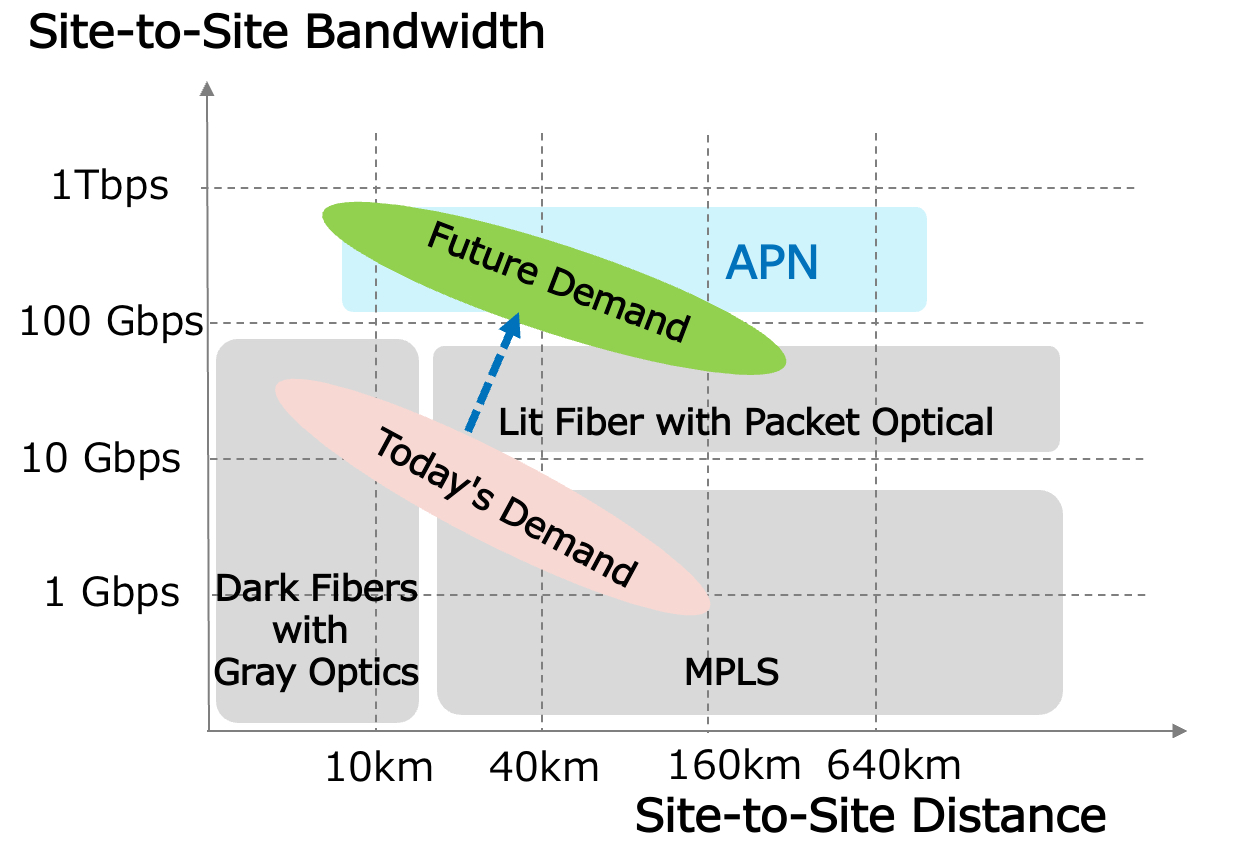
The IOWN Global Forum’s all-optical network (APN) is to enable optical connectivity from edge devices to data centres at speeds exceeding 100 gigabits-per-second (Gbps).
The Forum envisions energy and latency performance improvements by driving optics to the endpoints. Linking endpoints will require a staged adoption of photonic technology as it continues to mature.
Professor Ioannis Tomkos, a member of the Optical Communications Systems & Networks (OCSN) Research Lab/Group at the Electrical and Computer Engineering Department at the University of Patras, says the aim of the IOWN Global Forum is to gradually replace electronics-based transmission, switching, and even signal processing functions with photonics. The OCSN Group recently joined the IOWN Global Forum.
The Forum has defined a disaggregated design for the all-photonic network. The following stages will include using optics to replace copper interconnect within platforms, interfacing photonics to chips, and, ultimately, photonic communications within a chip.
“If information-carrying light signals can remain in the optical domain and avoid opto-electronic and electro-optical conversions, that will ensure enhanced bandwidth and much reduced power consumption per bit,” says Tomkos.
The IOWN Global Forum was created in 2019 by Japanese service provider, NTT, Sony, and Intel. Since then, it has grown to over 160 members, including cloud players Google, Microsoft, and Oracle, telecom service providers British Telecom, Orange, KDDI, Telefónica, and companies such as Nvidia.
The Forum has developed an IOWN framework that includes the all-photonic network, digital twin computing (DTC), and a ‘cognitive foundation’ (CF). Digital twin computing enables the creation of virtual representations of physical systems, while the cognitive foundation is the architecture’s brain, allocating networking and computing resources as required.
“We expect future societies will be more data-driven and there will be many applications that collect huge real-time sensor data and analyse them,” says Kawashima. “The IOWN all-photonic network and disaggregated computing platforms will enable us to deploy digital twin application systems in an energy-efficient way.”
Optical infrastructure
The IOWN Global Forum’s all-photonic network uses open standards, such as the OpenROADM (Open reconfigurable optical add-drop multiplexing) Multi-Source Agreement (MSA), the OIF and the OpenZR+ MSA pluggable coherent optics, and the OpenXR Optics Forum standards. The IOWN Global Forum also adheres to the ‘white box’ platform designs defined by the Telecom Infra Project (TIP).
“There is a lot of similarity with the approach and objectives of TIP,” says an unnamed industry veteran who has observed the IOWN Global Forum’s organisation since its start but whose current employer is not a member. “Although the scope is not the same, I cannot help but wonder why we don’t combine the two as an industry.”
Kawashima says that optical hardware, such as ROADMs, pluggable optics, and transponder boards, is located at one site and operated by one organisation. Now, the Forum has disaggregated the design to enable the ROADM and transponders to be in different locations: the transponder can be deployed at a customer’s premises, remote from the ROADM’s location.
“We allow the operator of the switch node to be different from the operator of the aggregator node, and we allow the operator of the transponder node to be different from the operator of the ROADM nodes,” says Kawashima.
The disaggregation goal is to encourage the growth of a multi-operator ecosystem, unlike how optical transport is currently implemented. It is also the first stage in making the infrastructure nodes all-optical. Separating the transponder and the ROADMs promises to reduce capital expenditure, as the transceiver nodes can be upgraded separately from the ROADMs that can be left unchanged for longer.
Kawashima says that reducing infrastructure capital expenditure promises reduced connectivity prices: “Bandwidth costs will be cheaper.”
Service providers can manage the remote transponders at the customers’ sites, creating a new business model for them.
Early use cases
IOWN has developed several use cases as it develops the technology.
One is a data centre interconnect for financial service institutions that conduct high-frequency trading across geographically dispersed sites.
Another is remote video production for the broadcast industry. Here, the broadcast industry would use an all-photonic network to connect the site where the video feed originates to the cloud, where the video production work is undertaken.
A third use case is for AI infrastructure. An enterprise would use the all-photonic network to link its AI product development engineers to GPU resources hosted in the cloud.
If the network is fast enough and has sufficiently low latency, the GPUs can source data from the site, store it in their memory, process it, and return the answer. The aim is for enterprises not to need to upload and store their data in the cloud. “So that customers do not have to be worried about data leakages,” says Kawashima.
The Forum also publishes documents. “Once the proof-of-concept is completed, that means that our solution is technically proven and is ready for delivery,” says Kawashima.
Goals
At OFC 2025, held earlier this year, NTT, NTTCom, Orange, and Telefónica showcased a one terabit-per-second optical wavelength circuit using the IOWN all-photonics network.

The demonstration featured a digital twin of the optical network, enabling automated configuration of high-speed optical wavelength circuits. The trial showcased the remote control of data centre communication devices using an optical supervisory channel.
The Forum wants to prove the technical feasibility of the infrastructure architecture by year-end. It looks to approve the remote GPUs and financial services use cases.
“What we are trying to achieve this year is that the all-photonic network is commercially operable, as are several use cases in the enterprise networking domain,” says Kawashima.
IOWN’s ultimate success will hinge on the all-photonic network’s adoption and economic viability. For Kawashima, the key to the system architecture is to bring significant optical performance advantages.
Tomkos cautions that this transformation will not happen overnight and not without the support of the global industry and academic community. But the promise is growth in the global network’s throughput and reduced latency in a cost and power-efficient way.


Ribbon offers for trial its 1.2T wavelength 9408 platform
Add Your Into Content Here

Ribbon Communications has started working with operators to trial its latest Apollo 9408 optical transport platform that supports 1.2 terabits per second (Tbps) optical wavelengths.
The company’s modular platform can also send 800 gigabit-per-second (Gbps) wavelengths over 1,000km and 400Gbps wavelengths over ultra-long-haul networks.
“We have conducted trials, including one with a Tier 1 European provider,” says Jonathan Homa, senior director of solutions marketing at Ribbon. “You can get 1.2 terabits within major cities, 800 gigabits covering major states or regions, and 400 gigabits for about as long as you want to go.”
“The Apollo 9408 is Ribbon’s first disaggregated transponder unit or compact modular box using the CIM 8 for up to 1.2Tbps of wavelength speed,” says Jimmy Yu, vice president at market research firm Dell’Oro Group.
Yu believes the product has shipped to a customer this quarter and is likely the first commercial shipment of a 1.2Tbps wavelength system for network deployment.
Acacia’s CIM 8 pluggable coherent modem
The Apollo 9408 uses Acacia’s pluggable Coherent Interconnect Module (CIM 8) coherent modem. The CIM 8 uses Acacia’s 5nm CMOS Jannu digital signal processor (DSP) and its silicon photonics-based coherent optics operating at a symbol rate of up to 140 gigabaud.
“The advantage of this smaller transistor geometry is not only the higher density per die but also lower power and faster processing speed,” says Yu. “All the things needed to help service providers achieve cost and power efficiencies.” This is why the market looks forward to the next generation of coherent DSPs, says Yu.
Acacia started shipping the CIM 8 at the year’s start, and Ribbon says the module’s availability enables the company to leapfrog existing 7nm CMOS-based coherent optical transport solutions.
Before 1.2 Tbps-capable wavelengths, the highest speed was 800Gbps, delivered by Ciena, Huawei, and Infinera, says Yu.
“Ciena was first to market and captured the lion’s share of shipment volumes,” says Yu. “We peg Ciena’s market share of 800 Gbps-capable wavelengths at approximately 70 per cent of the cumulative shipments through 2Q 2023. That is a huge share, benefiting from being first to market.”
Compact modular platform
The compact modular platform format was developed to meet the large-scale data centre operators’ computing needs. The platform is used for data centre interconnect applications while the large communications service providers are become interested in the platform form factor.

Compact modular platforms are 600mm deep and use front-to-back airflow for cooling. In contrast, standard telecom equipment is 300mm deep and uses a left-to-right airflow. The compact modular format thus suits data centres with alternate hot and cold aisles of equipment. The platforms face each other, so the air in a cold aisle is blown through each platform, exiting in the adjacent hot aisles. The efficient cooling scheme enables the equipment to be run hotter.
“With the compact modular platform’s front and back airflow, we can run the CIM 8 to 1.2 terabits,” says Homa. “In our standard [telecom] platform [the Apollo 9600 series], we’re using the same CIM 8 pluggable, but from a power dissipation point of view, we can only run it to 800 gigabits.”
The 9408 supports different channel plans depending on how the platform is used. For a cost-optimised transmission, a 400Gbps wavelength fits in a 75GHz channel, and a performance-optimised 800Gbps or 1.2Tbps wavelength fits in a 150GHz channel.
“With continuous baud rate control from 68-140Gbaud, the CIM 8 can accommodate any channel width such as 112.5GHz with networks that have flexible grid ROADMs [reconfigurable optical add/drop multiplexers],” says Homa. “It also uses probabilistic constellation shaping to maximise the line rate for that channel width.”
Configurations
The Apollo 9408 is a two rack unit (2RU) platform. For high-performance optical transport, it holds four MPJ1200_2 sleds. The sleds slot into the compact modular platform, with each sled hosting two CIM 8 modules. The power consumption of the double CIM 8 sled is 270W or less than 0.12W/gigabit. The total transport capacity is thus 9.6 terabits.
Ribbon plans to double the CIM 8s within the 2RU capacity platform to offer 19.2 terabits of capacity.
Alternatively, the 2RU rack can hold up to four MPQ_8 sleds hosting eight 400-gigabit coherent optical modules for a total capacity of 12.8 terabits. Ribbon uses 64 gigabaud 400-gigabit QSFP-DDs that use a transmit power of 0dBm and are OpenROADM MSA compliant.
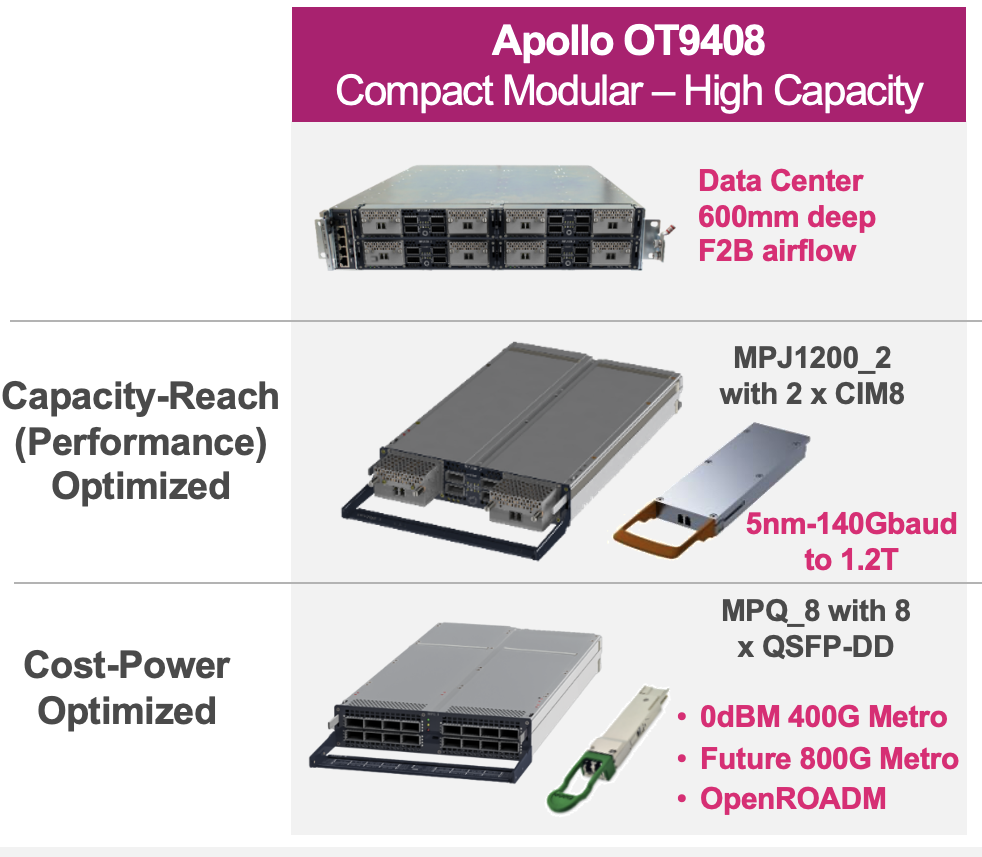
“The MPQ_8 is also designed to accept a new generation of 124Gbaud 800Gbps QSFP-DD pluggables currently in development and expected to be available in early 2025,” says Homa.
Ribbon also offers its standard telecom Apollo 9600 series platforms, from the smallest 2RU 9603 to the 5RU 9608 to the largest 15RU 9624 chassis. The Apollo 9600 modular platforms can use two CIM 8s in the TM800_2 double-slot card for performance-optimised transmission to 800 gigabits, or two CFP2-DCO modules in the TM400_2 single-card slot card for cost-optimised transmission to 400 gigabits.
Industry timing
Optical system vendors that don’t develop their own coherent DSP chips or modems, such as Ribbon, have several supply options. The leading merchant DSP suppliers include Acacia, NEL and Marvell. There are also competitor optical transport providers that source their coherent modem solutions. Ribbon discussed with several coherent modem suppliers but chose Acacia’s CIM 8 for the 9408. Ribbon has worked with Acacia for a decade.
The CIM 8’s 5nm Jannu DSP leapfrogs the 90-100GBd 7nm CMOS generation of coherent DSPs now deployed. This year, 5nm CMOS coherent DSPs have been announced by Nokia and Infinera. Merchant suppliers NEL and Marvell have also detailed their latest coherent DSPs. All these devices operate at symbol rates in the region of 130-150GBd.
Acacia also supplies the CIM 8 to other optical transport vendors such as Cisco, Acacia’s parent company, ZTE, and Adtran. Cisco has announced its Network Convergence System (NCS) 1014 compact modular platform that includes a 2.4Tbps transponder Line using the CIM 8. In March, Adtran reported sending an 800-gigabit signal over 2,200km using the CIM 8 as part of a networking trial. The route included 14 route-and-select flexible-grid ROADMs.
“It will be interesting to see the market dynamics unfold over the next year. There will be more system suppliers of 1.2 Tbps-capable wavelengths,” says Dell’Oro’s Yu. “Many system vendors will use the CIM 8, and some will use NEL’s ExaSpeed GAIA DSP. Some will also develop in-house DSPs such as Huawei and Nokia.”
Every dense wavelength division multiplexing (DWDM) system vendor will have a 1.2 Tbps-capable line card available for sale before the end of 2024, except for Ciena, says Yu: “This is because Ciena will come out with a 1.6 Tbps-capable DSP on a 3nm process node in 2024, one to two years ahead of any other vendors.”
Earlier this year, Ciena announced its WaveLogic 6, the first coherent DSP that operates at 200GBd. Ciena says it will offer its optical transport systems using its 3nm CMOS coherent DSP in the second half of 2024.
Homa believes that the next jump will be 240-plus GBd coherent DSPs, likely implemented using an even smaller 2nm CMOS process node.
The OIF’s 1600ZR 1.6-terabit coherent pluggable module standard will use a 240GBd symbol rate DSP.


Marvell kickstarts the 800G coherent pluggable era
Marvell has become the first company to provide an 800-gigabit coherent digital signal processor (DSP) for use in pluggable optical modules.
The 5nm CMOS Orion chip supports a symbol rate of over 130 gigabaud (GBd), more than double that of the coherent DSPs for the OIF’s 400ZR standard and 400ZR+.
Meanwhile, a CFP2-DCO pluggable module using the Orion can transmit a 400-gigabit data payload over 2,000km using the quadrature phase-shift keying (QPSK) modulation scheme.
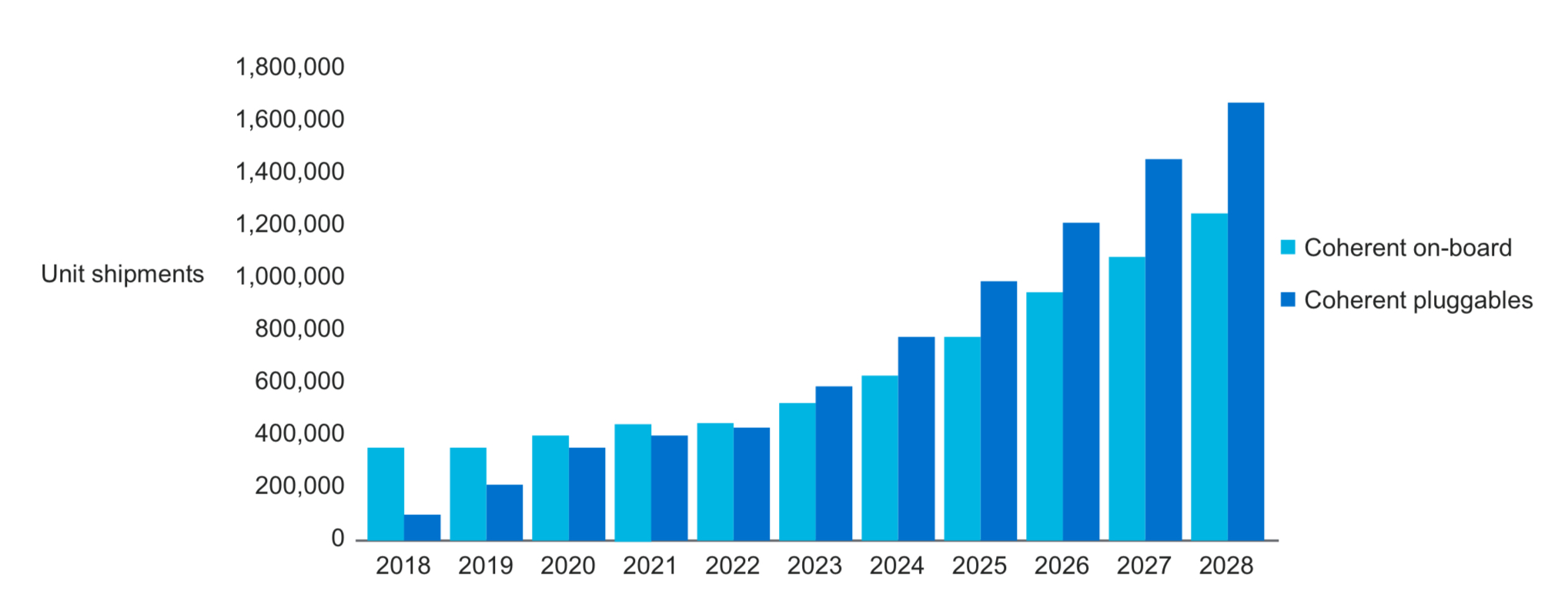
The Orion DSP announcement is timely, given how this year will be the first when coherent pluggables exceed embedded coherent module port shipments.
“We strongly believe that pluggable coherent modules will cover most network use cases, including carrier and cloud data centre interconnect,” says Samuel Liu, senior director of coherent DSP marketing at Marvell.
Marvell also announced its third-generation ColorZ pluggable module for hyperscalers to link equipment between data centres. The Orion-based ColorZ 800-gigabit module supports the OIF’s 800ZR standard and 800ZR+.
Fifth-generation DSP
The Orion chip is a fifth-generation design yet Marvell’s first. First ClariPhy and then Inphi developed the previous four generations.
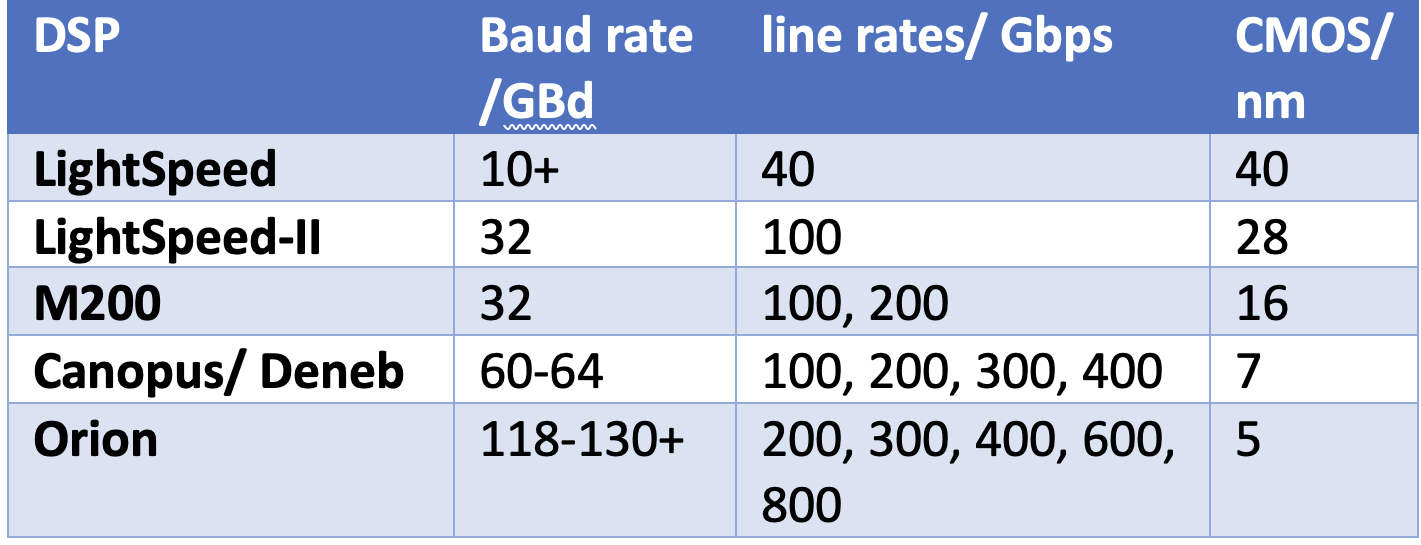
Inphi bought ClariPhy for $275 million in 2016, gaining the first two generation devices: the 40nm CMOS 40-gigabit LightSpeed chip and a 28nm CMOS 100- and 200-gigabit Lightspeed-II coherent DSP products. The 28nm CMOS DSP is now coming to the end of its life, says Liu.
Inphi added two more coherent DSPs before Marvell bought the company in 2021 for $10 billion. Inphi’s first DSP was the 16nm CMOS M200. Until then, Acacia (now Cisco-owned) had been the sole merchant company supplying coherent DSPs for CFP2-DCOs pluggable modules.
Inphi then delivered the 7nm 400-gigabit Canopus for the 400ZR market, followed a year later by the Deneb DSP that supports several 400-gigabit standards. These include 400ZR, 400ZR+, and standards such as OpenZR+, which also has 100-, 200-, and 300-gigabit line rates and supports the OpenROADM MSA specifications. “The cash cow [for Marvell] is [the] 7nm [DSPs],” says Liu.
The Inphi team’s first task after the acquisition was to convince Marvell’s CEO and its chief financial officer to make the most significant investment in a coherent DSP. Developing Orion cost between $100M-300M.
“We have been quiet for the last two years, not making any coherent DSP announcements,” says Liu. “This [the Orion] is the one.”
Marvell views being first to market with a 130GBd-plus generation coherent DSP as critical given how pluggables, including the QSFP-DD and the OSFP form factors, account for over half of all coherent ports shipped.
“It is very significant to be first to market with an 800ZR plug and DSP,” says Jimmy Yu, vice president at market research firm Dell’Oro Group. “I expect Cisco/Acacia to have one available in 2024. So, for now, Marvell is the only supplier of this product.”
Yu notes that vendors such as Ciena and Infinera have had 800 Gigabit-per-second (Gbps) coherent available for some time, but they are for metro and long-haul networks and use embedded line cards.
Use cases
The Orion DSP addresses hyperscalers’ and telecom operators’ coherent needs. The DSP also implements various coherent standards to ensure that the vendors’ pluggable modules work with each other.
Liu says a DSP’s highest speed is what always gets the focus, but the Orion also supports lower line rates such as 600, 400 and 200Gbps for longer spans.
The baud rate, modulation scheme, and the probabilistic constellation shaping (PCS) technique are control levers that can be varied depending on the application. For example, 800ZR uses a symbol rate of only 118GBd and the 16-QAM modulation scheme to achieve the 120km specification while minimising power consumption. When performance is essential, such as sending 400Gbps over 2,000km, the highest baud rate of 130GBd is used along with QPSK modulation.
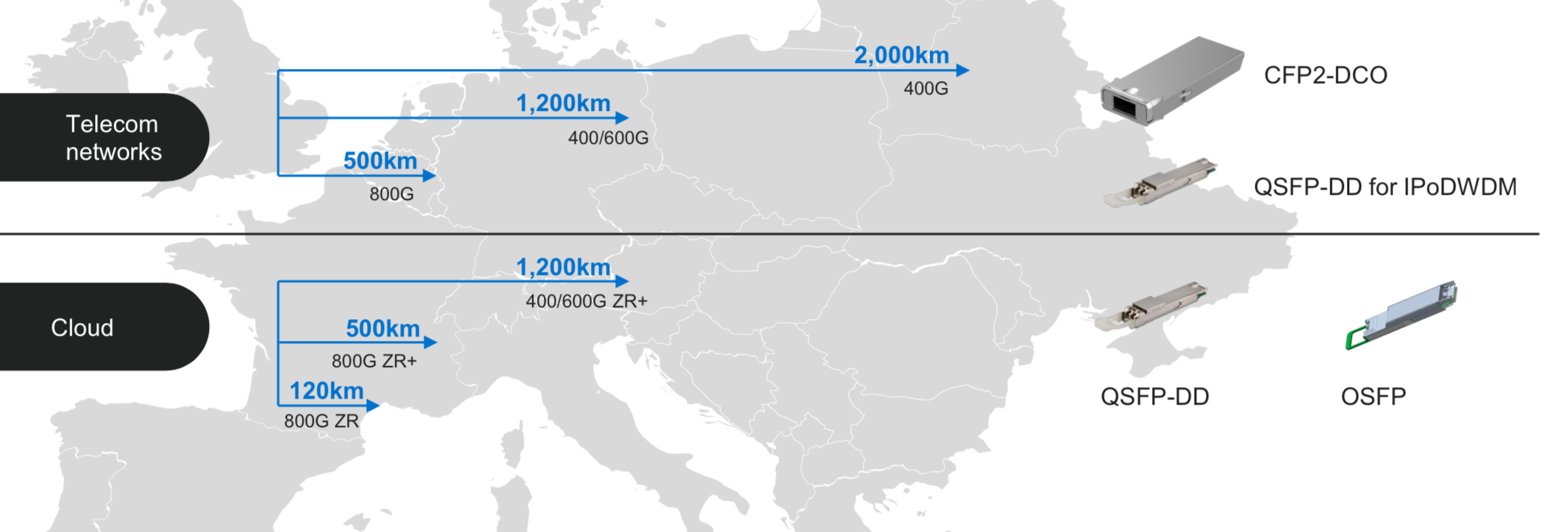
China is one market where Marvell’s current 7nm CFP2-DCOs are used to transport wavelengths at 100Gbps and 200Gbps.
Using the Orion for 200-gigabit wavelengths delivers an extra 1dB (decibel) of optical signal-to-noise ratio performance. The additional 1dB benefits the end user, says Liu: they can increase the engineering margin or extend the transmission distance. Meanwhile, probabilistic constellation shaping is used when spectral efficiency is essential, such as fitting a transmission within a 100GHz-width channel.
Liu notes that the leading Chinese telecom operators are open to using coherent pluggables to help reduce costs. In contrast, large telcos in North America and Europe use pluggables for their regional networks. Still, they prefer embedded coherent modems from leading systems vendors for long-haul distances greater than 1,000km.
Marvell believes the optical performance enabled by its 130GBd-plus 800-gigabit pluggable module will change this. However, all the leading system vendors have all announced their latest generation embedded coherent modems with baud rates of 130GBd to 150GBd, while Ciena’s 200GBd 1.6-terabit WaveLogic 6 coherent modem will be available next year.
The advent of 800-gigabit coherent will also promote IP over DWDM. 400ZR+ is already enabling the addition of coherent modules directly to IP routers for metro and metro regional applications. An 800ZR and 800ZR+ in a pluggable module will continue this trend beyond 400 gigabit to 800 gigabits.
The advent of an 800-gigabit pluggable also benefits the hyperscalers as they upgrade their data centre switches from 12.8 terabits to 25.6 and 51.2 terabits. The hyperscalers already use 400ZR and ZR+ modules, and 800-gigabit modules, which is the next obvious step. Liu says this will serve the market for the next four years.
Fujitsu Optical Components, InnoLight, and Lumentum are three module makers that all endorsed the Orion DSP announcement.
ColorZ 800 module
In addition to selling its coherent DSPs to pluggable module and equipment makers, Marvell will sell to the hyperscalers its latest ColorZ module for data centre interconnect.
Marvell’s first-generation product was the 100-gigabit coherent ColorZ in 2016 and in 2021 it produced its 400ZR ColorZ. Now, it is offering an 800-gigabit version – ColorZ 800 – to address 800ZR and 800ZR+, which include OpenZR+ and support for lower speeds that extend the reach to metro regional and beyond.

“We are first to market on this module, and it is now sampling,” says Josef Berger, associate vice president of marketing optics at Marvell.
Marvell addressing its module for the hyperscaler market rather than telecoms makes sense, says Yu, as it is the most significant opportunity.
“Most communications service providers’ interest is in having optical plugs with longer reach performance,” says Dell’Oro’s Yu. “So, they are more interested in ZR+ optical variants with high launch power of 0dBm or greater.”
Marvell notes a 30 per cent cost and power consumption reduction for each generation of ColorZ pluggable coherent module.
Liu concludes by saying that designing the Orion DSP was challenging. It is a highly complicated chip comprising over a billion logic gates. An early test chip of the Orion was used as part of a Lumentum demonstration at the OFC show in March.
The ColorZ 800 module will start being sampled this quarter.
What follows the Orion will likely be a 1.6-terabit DSP operating at 240GBd. The OIF has already begun defining the next 1.6T ZR standard.

North American operators in an optical spending rethink
Optical transport spending by the North American operators dropped 13 percent year-on-year in the third quarter of 2014, according to market research firm Dell'Oro Group.
Operators are rethinking the optical vendors they buy equipment from as they consider their future networks. "Software-defined networking (SDN) and Network Functions Virtualisation (NFV) - all the futuristic next network developments, operators are considering what that entails," says Jimmy Yu, vice president of optical transport research at Dell’Oro. "Those decisions have pushed out spending."
NFV will not impact optical transport directly, says Yu, and could even benefit it with the greater signalling to central locations that it will generate. But software-defined networks will require Transport SDN. "You [as an operator] have to decide which vendors are going to commit to it [Transport SDN]," says Yu.
SDN and NFV - all the futuristic next network developments, operators are considering what that entails. Those decisions have pushed out spending
The result is that the North American tier-one operators reduced their spending in the third quarter 2014. Yu highlights AT&T which during 2013 through to mid 2014 undertook robust spending. "What we saw growing [in that period] was WDM metro equipment, and it is that spending that has dropped off in the third quarter," says Yu. For equipment vendors Ciena and Fujitsu that are part of AT&T's Domain 2.0 supplier programme, the Q3 reduced spending is unwelcome news. But Yu expects North American optical transport spending in 2015 to exceed 2014's. This, despite AT&T announcing that its capital expenditure in 2015 will dip to US $18 billion from $21 billion in 2014 now that its Project VIP network investment has peaked.
But Yu says AT&T has other developments that will require spending. "Even though AT&T may reduce spending on Project VIP, it is purchasing DirecTV and the Mexican mobile carrier, lusacell," he says. "That type of stuff needs network integration." AT&T has also committed to passing two million homes with fibre once it acquires DirecTV.
Verizon is another potential reason for 2015 optical transport growth in North America. It has a request-for-proposal for metro DWDM equipment and the only issue is when the operator will start awarding contracts. Meanwhile, each year the large internet content providers grow their optical transport spending.
Dell'Oro expects 2014 global optical transport spending to be flat, with 2015 forecast to experience three percent growth
Asia Pacific remains one of the brighter regions for optical transport in 2014. "Partly this is because China is buying a lot of DWDM long-haul equipment, with China Mobile being one of the biggest buyers of 100 Gig," says Yu. EMEA continues to under-perform and Yu expects optical transport spending to decline in 2014. "But there seems to be a lot of activity and it's just a question of when that activity turns into revenue," he says.
Dell'Oro expects 2014 global optical transport spending to be flat compared to 2013, with 2015 forecast to experience three percent growth. "That growth is dependent on Europe starting to improve," says Yu.
One area driving optical transport growth that Yu highlights is interconnected data centres. "Whether enterprises or large companies interconnecting their data centres, internet content providers distributing their networks as they add more data centres, or telecom operators wanting to jump on the bandwagon and build their own data centres to offer services; that is one of the more interesting developments," he says.
Optical transport to grow at a 10% CAGR through 2017
- Global optical transport market to reach US $13bn in 2017
- 100 Gigabit to grow at a 75% CAGR
 "I won't be surprised if it [100 Gig] grows even faster"
Jimmy Yu, Dell'Oro Group
The Dell'Oro Group forecasts that the global optical transport market will grow to US $13 billion in 2017, equating to a 10-percent compound annual growth rate (CAGR).
In 2012 SONET/SDH sales declined by over 20 percent, greater than Dell'Oro expected, while wavelength-division multiplexing (WDM) equipment sales held their own.
Regions
Dell'Oro expects optical transport growth across all the main regions, with no one region dominating. The market research company does foresee greater growth in Europe given the prolonged underspend of recent years.
European operators are planning broadband access investment such as fibre-to-the-cabinet/ VDSL vectoring as well as fibre-to-the-home. "That will drive demand for backhaul bandwidth and that is where WDM fits in well," says Jimmy Yu, vice president, microwave transmission, mobile backhaul and optical transport at Dell'Oro.
Technologies
Forty and 100 Gigabit optical transport will be the main WDM growth areas through 2017. Yu expects 40 Gigabit demand to grow over the forecast period even if the growth rate will taper off due to demand for 100 Gigabit.
The 100 Gigabit market continues to exceed Dell'Oro's forecasted growth. The market research company predicts 100-Gbps wavelength shipments to grow at a 75 percent CAGR over the next five years, accounting for 60 percent of the WDM capacity shipments by 2017. "I won't be surprised if it [100 Gig] grows even faster," says Yu.
"A lot of people wonder why have 40 Gig when there is 100 Gig? But that granularity does help service providers; having 40 Gig and 100 Gig rather than going straight from 10 Gig to 100 Gig," says Yu. The 100 Gig sales span metro and long-haul networks with the latter generating greater revenue due to the systems being pricier. "Forty Gigabit sales were predominantly long haul originally but we are seeing a good chunk of growth in metro as well," says Yu.
The current forecast does not include 400Gbps optical transport sales though Yu does expect sales to start in 2016.
Dell'Oro is seeing sales of 100 Gigabit direct detection but says it will remain a niche market. "We are talking tens of [shipped] units a quarter," says Yu.
There are applications where customers will need links of 80km or several hundred kilometers and will want the lowest cost solution, says Yu: "There is a market for direct detection; it will not be a significant driver for 100 Gig but it will be there."
60-second interview with .... Dell'Oro's Jimmy Yu
"For the year, it is going to be a fivefold growth rate [for 100 Gig transport]."
Jimmy Yu, Dell'Oro
Q: That fact that the market is down 5 percent on a year ago. Why is this?
A: There are a few factors. First, the macro-economy in Europe continues to get worse; that causes a slowdown.
A second factor is that in North America there was a decline in the second quarter, which is pretty unusual. Part of it, we think, might be that operators have caught up with a lot of the spending to increase broadband, after adding [to the network] for a couple of good years.
The third issue is that the China market has had a really slow start. And while there has been talk about the Chinese market softening, it seems that the CapEx [capital expenditure] is there for a strong second half.
What categories does Dell'Oro include when it talks about optical transport?
There are two main pieces: WDM [wavelength division multiplexing], both metro and long haul, and the multi-service multiplexer used for aggregation. The third piece, which is really small, is optical switching - optical cross-connect used in the core and lately more so in the metro.
According to Dell'Oro, wavelength division multiplexing was up 5 percent in the first half of 2012 compared to the same period a year ago, due to demand for 40 Gig and 100 Gig. What is happening in these two markets?
At 100 Gig we are at an inflection point where demand growth rates are really high. We've got a doubling in demand and shipments quarter-on-quarter [in the second quarter]. For the year, it is going to be a fivefold growth rate.
Also the 40 Gig is still growing. It has been around for a few years so its growth rate is not as strong [as 100 Gig transport] but it is still a significant part of the market.
Has the market settled on particular modulation scheme, especially at 40 Gig?
For 100 Gig the majority [deployed] is coherent. There is one company at least, ADVA Optical Networking, which is coming out with its direct-detection scheme for 100 Gig. This has now been shipping for one quarter. There is a market for the price point and the lower-span link of direct-detection.
For 40 Gig there is still a mix of modulations. Vendors coming out with 100 Gig coherent are also coming out with 40 Gig coherent options. So coherent at 40 Gig is now approaching half of the total market and is happening pretty quickly.
As for [40 Gig] DQPSK [differential quadrature phase-shift keying] modulation, it is probably a little bit more than DPSK [differential phase-shift keying].
You also report a rise in the adoption of optical packet products and that it contributed close to one-third of the optical market revenues in the first half 2012. Why is that?
The optical packet platform is a wider definition than just packet optical transport systems (P-OTS).
One reason why optical packet is growing is that with traditional P-OTS, you have cross-connect and switching capabilities in a WDM system so as you go to higher 40 and 100 Gig wavelengths you want some bandwidth management in that system.
Another thing is that people are trying to make the aggregation layer - the traditional SONET/SDH - more Ethernet friendly and MPLS-TP [multiprotocol label switching, transport profile] is gaining traction.
Combined, we are seeing this optical packet market has grown 12 percent year-on-year in the second quarter whereas the overall market has declined.
Dell'Oro said Huawei has 20 percent market share, which other vendors have double-digit market share?
Besides Huawei, the other vendors with double-digit percentage for the quarter - in order - are ZTE, Alcatel-Lucent and Ciena.
Did you see anything in this latest study that was surprising?
There was nothing in this quarter but I saw it last quarter. The legacy equipment – traditional SONET/SDH – is declining. Most of the market decline for optical is in legacy.
SONET/SDH sales in the second quarter of 2012 declined by 20 percent year-on-year. It is finally happening: the market is shifting away from SONET/SDH.