

From spin-out to scale-up: OpenLight’s $34M funding
Part 1: Start-up funding
OpenLight Photonics, a Santa Barbara-based start-up specialising in silicon photonics, has raised $34 million in an oversubscribed Series A funding round.
The start-up will use the funding to expand production and its photonic integrated circuit (PIC) design staff.
OpenLight Photonics raises $34M in an oversubscribed Series A.
“We’re starting to get customers taking in production mask sets, so it’s about scaling operations and how we handle production,” says OpenLight CEO, Adam Carter (pictured). The start-up needs more PIC designers to work with customers.
Technology
OpenLight’s technology originated at Aurrion, a fabless silicon photonics start-up from the University of California, Santa Barbara.
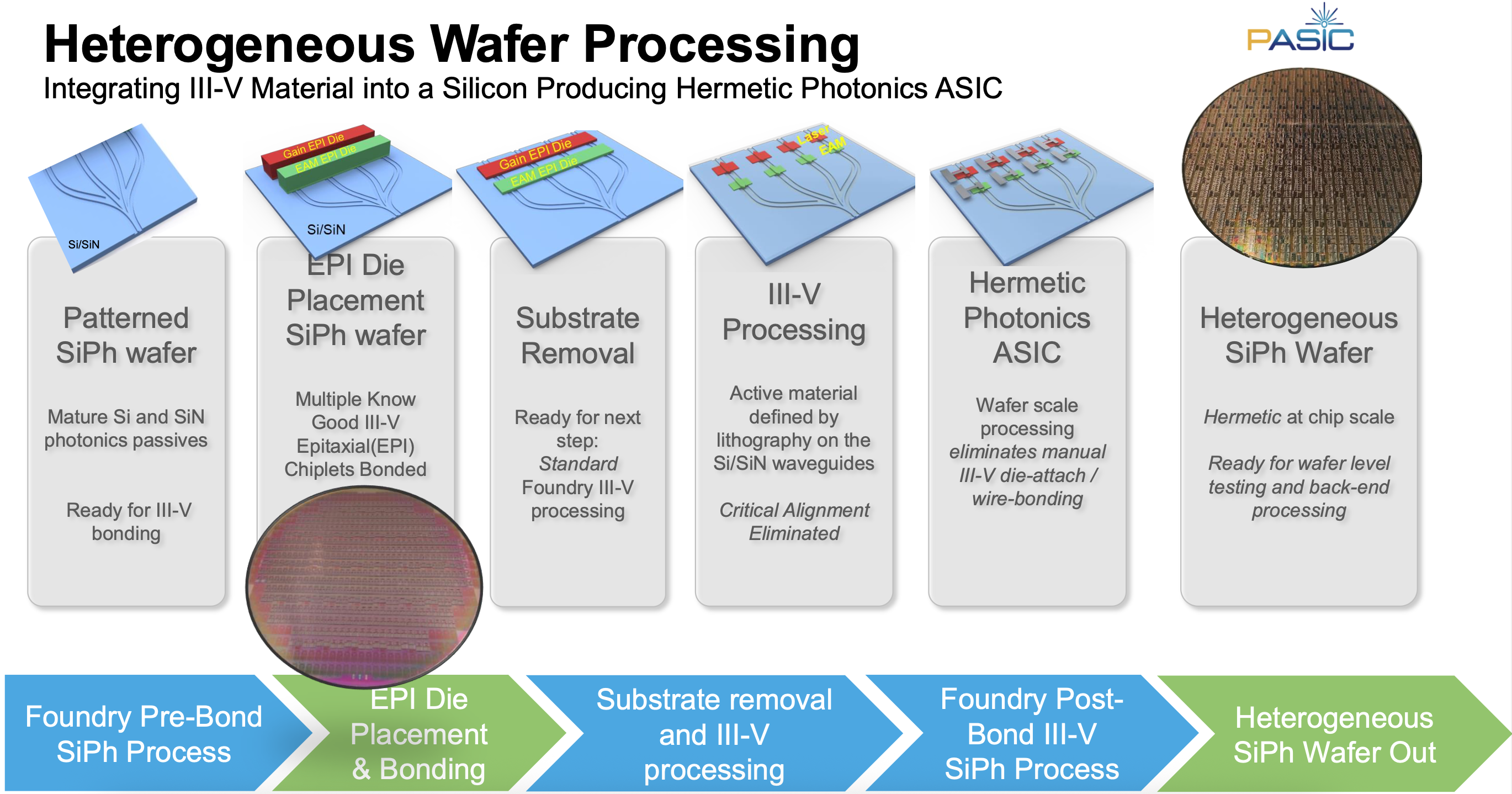
Aurrion’s heterogeneous integration silicon photonics technology supports III-V materials, enabling components such as lasers, modulators, and optical amplification to be part of a photonic integrated circuit (PIC). Intel has its own heterogeneous integration silicon photonics process, which it has used to make millions of pluggable optical transceivers. OpenLight is offering the technology to customers effectively as a photonic ASIC design house.
Juniper Networks bought Aurrion in 2016 and, in 2022, spun out the unit that became OpenLight. Electronic design tool specialist Synopsys joined Juniper in backing the venture. Synopsys announced it was acquiring simulation company Ansys, a $35 billion deal it completed in July. Given that Synopsys would be focused on integrating Ansys, it suggested to OpenLight in January that they should part ways.
Funding
“We were only looking for $25 million to start with, and we finished at $34 million,” says Carter. Capricorn Investment Group was a late entrant and wanted to co-lead the funding round. Given initial commitments from other funders, Mayfield and Xora Innovation, set specific ownership percentages, it required an increase to accommodate Capricorn.
Xora’s first contact with OpenLight was after it approached the start-up’s stand at the OFC 2025 event held in March.
Juniper—now under HPE—is also an investor. The company played a key role in helping OpenLight while it sought funding. “Juniper could see that we were very close to an intercept point regarding our business model and our customers, so that’s why Juniper invested,” says Carter.
HPE continually looks at technologies it will require; silicon photonics with heterogeneous integration is one such technology, says Carter. However, HPE has no deal with OpenLight at this time.
Design roadmap
OpenLight is developing a 1.6-terabit PIC, now at an advanced prototype (beta) stage. The design uses eight channels for a 1.6T-DR8 OSFP pluggable design, implemented using four lasers and eight modulators, each operating at 200 gigabit-per-second (Gbps).
Carter says the first wafers will come from foundry Tower Semiconductor around October. This will be OpenLight’s largest production run — 100 wafers in four batches of 25. Some ten customers will evaluate the PICs, potentially leading to qualification.
A coarse wavelength division multiplexing (CWDM) 1.6-terabit design will follow in 2026. The CWDM uses 4 wavelengths, each at 200Gbps, on a fibre, with two such paths used for the 1.6T OSFP-XD 2xFR4 optical module.
The company is also pushing to develop 400Gbps channels, increasing the frequency response and improving the extinction ratio through process changes.
“We’ve got a whole series of experiments coming out over the next few months,“ says Carter. The frequency response of the indium phosphide modulator has already been improved by 10 gigahertz (GHz) to 90-95GHz. The process changes will be adopted for some alpha sample wafers in production that may enable modulation at 400Gbps, hence a 3.2-terabit PIC design.
“If we can show some good 3.2-terabit eyes, just as a demo, it shows that there’s a technology route to get there whenever 3.2-terabit modules are needed,” he says.
Customer growth
OpenLight’s customers have grown from three in 2023 to 17 last year to 20 actively designing. “We are growing the pipeline,” says Carter.
Early adopters were start-ups, but now larger firms are engaging Openlight. “Investors noted start-ups take more risk, but now bigger companies are coming in to drive volume,” says Carter.
Optical interconnect will drive initial volumes, but automotive and industrial sensing will follow. “The mix will change, but for the next couple of years, the revenues will be from optical interconnect,” says Carter.
Co-packaged optics is another interconnect opportunity. Here, OpenLight’s integrated laser technology would not be needed, given the co-packaged optics designs favour external laser sources. Instead, the company can offer integrated indium phosphide modulator banks or modulator banks with semiconductor optical amplifiers (SOAs), their compact size—“microns, not millimetres”—aiding packaging.
In addition to the foundry Tower Semiconductor for its wafers, OpenLight partners with Jabil, Sanmina, and TFC for the packaging and does its testing via ISC, an ASE subsidiary.
“They know test and certain customers with ISC, and ASE could do a complete turnkey solution,” says Carter. “But our priority is to get the test area set up to deal with the production; we’ve not had 100 wafers in a year being delivered for test.”
Silicon photonics
Carter, who was at Cisco when it acquired Lightwire in 2012, says silicon photonics’ potential to shrink optical designs was already recognised then. Since then, a lot of progress has been made, but now the focus is on building the supporting ecosystem. This includes a choice of foundries offering optical process design kits (PDKs) and outsourced assembly and test houses (OSATs) that can handle volumes.
Until now, silicon photonics has been all passive circuits. Now OpenLight, working with Tower and its PDK, is offering customers the ability to design and make heterogeneous integrated silicon photonics circuits. “Every customer gets the same PDK,” says Carter.
And it need not just be indium phosphide. The idea is to expand the PDK to support modulation materials such as polymer and thin-film lithium niobate. “If it is a better material, we’ll integrate it,” he says.
Having secured the funding, Carter is clear about the company’s priority: “It’s all about execution now.”


Nokia buys Elenion for its expertise and partnerships

Nokia will become the latest systems vendor to bolster its silicon photonics expertise with the acquisition of Elenion Technologies.
The deal for Elenion, a privately-held company, is expected to be completed this quarter, subject to regulatory approval. No fee has been disclosed.
“If you look at the vertically-integrated [systems] vendors, they captured the lion’s share of the optical coherent marketplace,” says Kyle Hollasch, director of optical networking product marketing at Nokia. “But the coherent marketplace is shifting to pluggables and it is shifting to more integration; we can’t afford to be left behind.”
Elenion Technologies
Elenion started in mid-2014, with a focus of using silicon as a platform for photonics. “We consider ourselves more of a semiconductor company than an optics company,” says Larry Schwerin, CEO of Elenion.
Elenion makes photonic engines and chipsets and is not an optical module company. “We then use the embedded ecosystem to offer up solutions,” says Schwerin. “That is how we approach the marketplace.”
The company has developed a process design kit (PDK) for photonics and has built a library of circuits that it uses for its designs and custom solutions for customers.
A PDK is a semiconductor industry concept that allows circuit designers to develop complex integrated circuits without worrying about the underlying transistor physics. Adhering to the PDK ensures the circuit design is manufacturable at a chip fabrication plant (fab).
But developing a PDK for optics is tricky. How the PDK is designed and developed must be carefully thought through, as has the manufacturing process, says Elenion.

“We got started on a process and developed a library,” says Larry Schwerin, CEO of Elenion. “And we modelled ourselves on the hyperscale innovation cycle, priding ourselves that we could get down to less than three years for new products to come out.”
The “embedded ecosystem” Elenion refers to involves close relationships with companies such as Jabil to benefit from semiconductor assembly test and packaging techniques. Other partnerships include Molex and webscale player, Alibaba.
Elenion initially focussed on coherent optics, providing its CSTAR coherent device that supports 100- and 200-gigabit transmissions to Jabil for a CFP2-DCO pluggable module. Other customers also use the design, mostly for CFP2-DCO modules.
The company has now developed a third-generation coherent design, dubbed CSTAR ZR, for 400ZR optics. The optical engine can operate up to 600 gigabits-per-second (Gbps), says Elenion.
Elenion’s work with the cloud arm of Alibaba covers 400-gigabit DR4 client-side optics as well as an 800-gigabit design.
Alibaba Cloud has said the joint technology development with Elenion and Hisense Broadband covers all the production stages: the design, packaging and testing of the silicon photonics chip followed by the design, packaging, assembly and testing of the resulting optical module.
Bringing optics in-house
With the acquisition of Elenion, Nokia becomes the latest systems vendors to buy a silicon photonics specialist.
Cisco Systems acquired Lightwire in 2012 that enabled it to launch the CPAK, a 100-gigabit optical module, a year ahead of its rivals. Cisco went on another silicon photonics shopping spree more recently with the acquisition of Luxtera in 2019, and it is the process of acquiring leading merchant coherent player, Acacia Communications.
In 2013 Huawei bought the Belgium silicon photonics start-up, Caliopa, while Mellanox Technologies acquired silicon photonics firm, Kotura, although subsequently, it disbanded its silicon photonics arm.
Ciena bought the silicon-photonics arm of Teraxion in 2016 and, in the same year, Juniper bought silicon photonics start-up, Aurrion Technologies.
Markets
Nokia highlights several markets – 5G, cloud and data centres – where optics is undergoing rapid change and where the system vendor’s designs will benefit from Elenion’s expertise.
“5G is a pretty obvious one; a significant portion of our optical business over the last two years has been mobile front-haul,” says Nokia’s Hollasch. “And that is only going to become more significant with 5G.”
Front-haul is optics-dependent and requires new pluggable form factors supporting lower data rates such as 25Gbps and 100Gbps. “This is the new frontier for coherent,” says Hollasch.
Nokia is not looking to be an optical module provider, at least for now. “That one we are treading cautiously,” says Hollasch. “We, ourselves, are quite a massive customer [of optics] which gives us some built-in scale straight away but our go-to-market [strategy] is still to be determined.”
Not being a module provider, adds Schwerin, means that Nokia doesn’t have to come out with modules to capitalise on what Elenion has been doing.
Nokia says both silicon photonics and indium phosphide will play a role for its coherent optical designs. Nokia also has its own coherent digital signal processors (DSPs).
“There is an increasingly widening application space for silicon photonics,” says Hollasch. “Initially, silicon photonics was looked at for the data centre and then strictly for metro [networks]; I don’t think that is the case anymore.”
Why sell?
Schwerin says the company was pragmatic when it came to being sold. Elenion wasn’t looking to be acquired and the idea of a deal came from Nokia. But once the dialogue started, the deal took shape.
“The industry is in a tumultuous state and from a standpoint of scenario planning, there are multiple dynamics afoot,” says Schwerin.
As the company has grown and started working with larger players including webscales, their requirements have become more demanding.
“As you get more into bigs, they require big,” says Schwerin. “They want supply assurance, and network indemnification clauses come into play.” The need to innovate is also constant and that means continual investment.
“When you weigh it all up, this deal makes sense,” he says.
Schwerin laughs when asked what he plans to do next: “I know what my wife wants me to do.
“I will be going with this organisation for a short while at least,” he says. “You have to make sure things go well in the absorption process involving big companies and little companies.”