

Telefónica tackles video growth with IP-MPLS network
- Telefónica’s video growth in one year has matched nine years of IP traffic growth
- Optical mesh network in Barcelona will use CDC-ROADMs and 200-gigabit coherent line cards
Telefónica has started testing an optical mesh network in Barcelona, adding to its existing optical mesh deployment across Madrid. Both mesh networks are based on 200-gigabit optical channels and high-degree reconfigurable add-drop multiplexers (ROADMs) that are part of the optical infrastructure that underpins the operator’s nationwide IP-MPLS network that is now under construction.
 Maria Antonia CrespoThe operator decided to become a video telco company in late 2014 to support video-on-demand and over-the-top streaming video services.
Telefónica realised its existing IP and aggregation networks would not be able to accommodate the video traffic growth and started developing its IP-MPLS network.
“What we are seeing is that the traffic is growing very quickly,” says Maria Antonia Crespo, IP and optical networking director at Telefónica. “In one year we are getting the same
figures as we got from internet traffic in the last nine years.”
The operator is rolling out the IP-MPLS network across Spain. Juniper Networks and Nokia are the suppliers of the IP router equipment, while Huawei and Nokia were chosen to supply the optical networking equipment.
IP-MPLS
Telefónica set about reducing the number of layers and number of hops when designing its IP-MPLS network. “At each hop, we have to invest money if we want to increase capacity,” says Crespo.
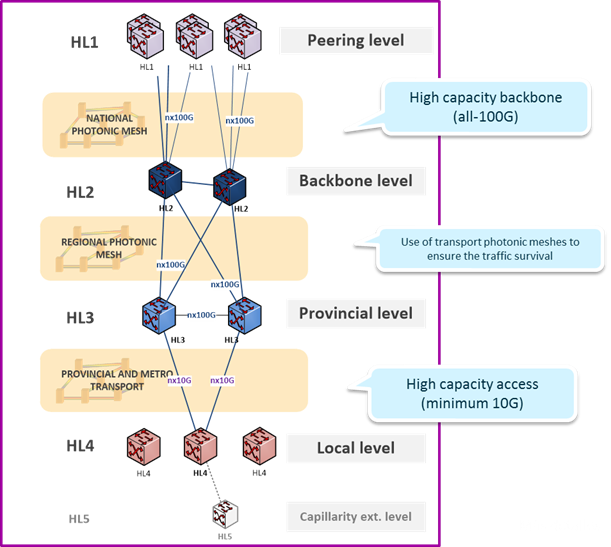
The result is an IP-MPLS network comprising four layers (see diagram). The uppermost Layer 1, dubbed HL1, connects the network to the internet world, while HL2 is a backbone transit layer. The HL3 layer is also a transit layer but at the provincial level. Spain is made up of 52 provinces. HL4 is where the services will reside, where Telefonica will deliver such services as Layer 2 and Layer 3 virtual private networks.
Between HL1 and HL2 is a national GMPLS-based photonic mesh, says Crespo, and between HL3 and HL4 there are the metro mesh networks. “Now we are deploying two GMPLS-based mesh networks, in Madrid and Barcelona,” she says. “Then, in the rest of the country, we are deploying [optical] rings.”
Systems requirements
Telefónica says it had several requirements when choosing the optical transport equipment, requirements common to both its backbone and regional networks.
One is the need to scale capacity at 10 gigabits and 100 gigabits, while network availability and robustness are also key. Telefónica says its network is designed to withstand two or more simultaneous fibre failures. “We have long experience with the GMPLS control plane to support different fibre impairments in the network,” says Alberto Colomer, optical technology manager at Telefónica.
The operator also wants its equipment to support high-speed interfaces and more granular rates to allow it to transition away from legacy traffic such as SDH and 1GbE. Operational improvements are another requirement: Telefónica wants to reduce the manual intervention its network needs. Optical time-domain reflectometers (OTDR) are being integrated into the network to monitor the fibre, as is the ability to automatically equalise the different optical channels.
 Alberto ColomerLastly, Telefónica is looking to reduce its capital expenditure and operational expense. It is deploying flexible rate 200-gigabit transponders in its Barcelona and Madrid networks and the same line cards will support 400-gigabit and even 1 terabit channels in future, as well as flexible grid to support the most efficient use of a fibre’s spectrum.
The 200-gigabit transponders use 16-quadrature amplitude modulation (16-QAM). Such transponders have enough reach to span each of the two cities but Colomer says Telefónica is still studying how many ROADM stages the 16-QAM transponders can cross.
It is like a pilot changing the engines while flying a plane
The ROADMs Telefónica is deploying in Madrid are directionless and are able to support up to 20 degrees. “You need some connectivity inside the mesh but also the mesh has to be connected to rings that cover all the counties around Madrid,” says Colomer.
Barcelona will be the first location where the ROADMs will also be colourless and contentionless (CDC-ROADMs). “We need to understand in a better way what are the advantages that come with that functionality,” says Colomer.
Telefónica has deployed Huawei’s Optix OSN 9800 platform in Madrid while in Barcelona Nokia’s 1830 Photonic Service Switch with the latest PSE-2 Coherent DSP-ASIC technology is being deployed.
Nokia’s PSS-1830 is designed to support the L-band as well as the C-band but Telefonica does not see the need for the L-band in the near future. “We are going in the direction of increasing capacity per channel: 400-gigabit channels and one terabit channels,” says Colomer. By deploying a photonic mesh and high-degree ROADMs, it will also be possible to increase capacity on a specific link by adding a fibre pair.
Status
The mesh in Madrid is already completed while Telefónica is deploying optical rings around Barcelona while it tests the contentionless ROADMs. These deployments are aligned with the IP-MPLS deployment, says Crespo, which is expected to be completed by 2018.
Crespo says the nationwide IP-MPLS rollout is a challenge. The deployment involves learning new technology that needs to be deployed alongside its existing network. "My boss likens it to a pilot changing the engines while flying a plane," says Crespo. "We are testing in the labs, duplicating it [the network], and migrating the traffic without impacting the customer."

ECI Telecom’s next-generation metro packet transport family
- The Native Packet Transport (NPT) family targets the cost-conscious metro network
- Supports Ethernet, MPLS-TP and TDM
- ECI claims a 65% lower total cost of ownership using MPLS-TP and native TDM
 NPT's positioning as part of the overall network. Source: ECI Telecom
ECI Telecom has announced a product line for packet transport in the metro. The Native Packet Transport (NPT) family aims to reduce the cost of operating packet networks while supporting traditional time division multiplexing (TDM) traffic.
“Eventually, in terms of market segments, it [NPT] is going to replace the multi-service provisioning platform,” says Gil Epshtein, product market manager at ECI Telecom. “The metro is moving to packet and so it is moving to new equipment to support this shift.”
The NPT is ECI’s latest optimised multi-layer transport (OMLT) architecture, and is the feeder or aggregator platform to the optical backbone, addressed by the company's Apollo OMLT product family announced in 2011.
 “The whole point of shifting to packet is to lower the [transport] cost-per-bit”
Gil Epshtein, ECI Telecom
Packet transport issues
“Building carrier-grade packet transport is proving more costly than anticipated,” says Epshtein. “Yet the whole point of shifting to packet is to lower the [transport] cost-per-bit.”
Several packet control plane schemes can be used for the metro, a network that can be divided further into the metro core and metro access/ aggregation. The two metro segments can use either IP/MPLS (Internet Protocol/ Multiprotocol Label Switching) or MPLS-TP (Multiprotocol Label Switching Transport Profile). Alternatively, the two metro segments can use different schemes: the metro core IP/MPLS and metro access MPLS-TP, or MPLS-TP for the core and Ethernet for metro access.
Based on total cost of ownership (TCO) analysis, ECI argues that the most cost-effective packet control plane scheme is MPLS-TP. “The NPT product line is based on MPLS-TP, designed to simplify and make MPLS affordable for transport networks,” says Epshtein.
Three issues contribute to the cost of building and operating packet-based transport. The first is capital expenditure (capex) – the cost of the equipment and what is needed to make the network carrier grade such as redundancy and availability.
The second is operational expenditure or opex. Factors include the training and expertise needed by the staff, and their number and salaries. In turn, issues such as network availability, equipment footprint and the power consumption requirements.
“More and more operators view opex as a key factor in their TCO considerations,” says Epshtein. Operators look at the entire network and want to know what its cost of operation will be.
A third cost factor is the existence of both TDM and packet data in the operators’ networks. “When you look at the overall TCO, you need to take this into consideration,” says Epshtein. For some operators it [TDM] is more significant but it is always there, he says.
The NPT family is being aimed at various customers. One is operators that want to extend MPLS from the core to the metro network. “Here, TDM is not a factor,” says Epshtein. “We find this in wireless backhaul, in triple-play, carriers-of-carriers and business applications.” The second class of operators is those with legacy TDM traffic. Also being targeted are utilities. “Here reliability and security are key.”
Analysis
The choice of packet control plane - whether to use IP/MPLS or MPLS-TP - impacts both capex and opex. How the TDM traffic is handled, whether using circuit emulation over packets or native TDM, also impacts overall costs.
According to ECI, the number of network elements grows some tenfold with each segment transition towards the network edge. In the network core there are 100s of network elements, 1000s in the metro core and 10,000s in the metro access. The choice of packet control plane for these network elements clearly impacts the overall cost, especially in the cost-conscious metro as the number of platforms grows. “A network element based on MPLS-TP is lower cost than IP/MPLS,” says Epshtein. “The main reason being it is a lot less complex.”
He stresses that MPLS-TP is not a competing standard to IP/MPLS; IP/MPLS is the defacto standard in the network core. Rather, MPLS-TP is a derivative designed for transport. The debate here, says Epshtein, is what is best for metro.
“The main difference between the two standards is the control plane, not the data plane,” says Epshtein. MPLS-TP removes unnecessary control plane functions supported by IP/MPLS leading to simpler metro platform functionality, and simpler management and operation of the equipment. “We believe MPLS-TP is more suited to the metro due to its simplicity, scalability and capex benefits.”
Working with market research company, ACG Research, the TCO analysis (opex and capex) over five years using MPLS-TP was 55% lower than using IP/MPLS for metro packet transport (with no TDM traffic).
The cost savings was even greater with both packet and some TDM traffic.
Using the NPT, capex goes up 5% due to the line cards needed to support native TDM traffic. But for IP/MPLS using circuit emulation capex increases 37%, resulting in the NPT having a 66% lower capex overall. The resulting opex is also 64% lower. Overall TCO is lowered by 65% using MPLS-TP and native TDM compared to IP/MPLS and circuit emulation.
NPT portfolio
ECI says its NPT supports circuit emulation and native TDM. Having circuit emulation enables the network to converge to packet only. But native TDM simplifies the interfacing to legacy networks and also has lower latency than circuit emulation.
 The NPT packet switch and TDM switch fabrics and the traffic types carried over each. Source: ECI Telecom
There are five NPT platforms ranging from the NPT-1020 for metro access to the NPT-1800 for the metro core. The NPT-1020 has a 10 or 50 Gigabit packet switch capacity option and a TDM capacity of 2.5 Gigabit. The NPT-1800 has a packet switching capacity of 320 or 640 Gigabit and 120 Gigabit for TDM.
The metro aggregation NPT-1600 and 1600c (160 Gig packet/120 Gig TDM capacity) platforms are available now. The remaining platforms will be available in the first half of 2013.
ECI says it has already completed several trials with existing and new customers. "We have already won a few deals," says Epshtein.
The platforms are managed using ECI’s LightSoft software, the same network management system used for the Apollo. ECI has added software specifically for packet transport including service provisioning, performance management and troubleshooting.
Further information, click here.
ECI Telecom's Apollo mission
The privately-owned system vendor has launched Apollo, a family of what it calls optimised multi-layer transport platforms.
Event
ECI Telecom has launched a family of platforms that combines optical transmission, Ethernet and optical transport network (OTN) switching and IP routing.
The 9600 series platforms, dubbed Apollo, combines the functionality of what until now has required a packet-optical transport system (P-OTS) and a carrier Ethernet switch router (CESR).
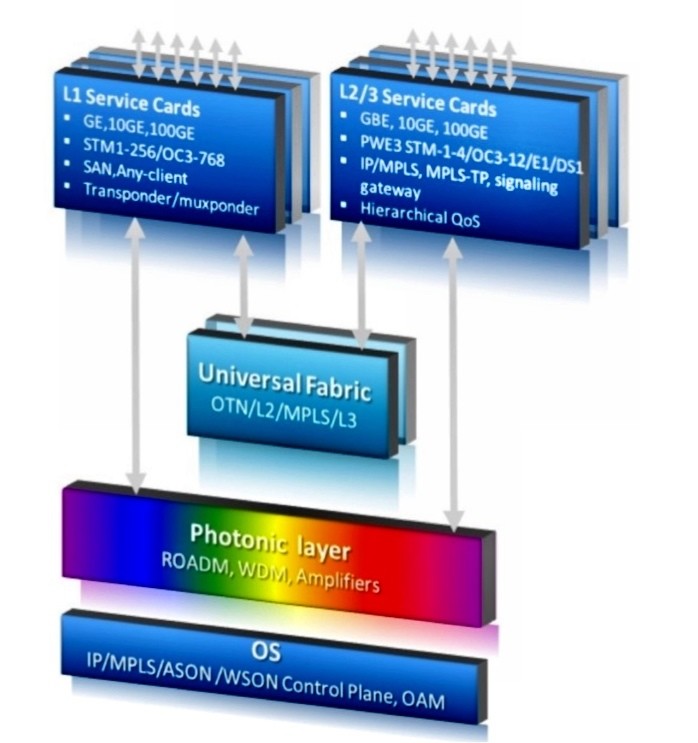 The Apollo 9600 series architecture. Source: ECI Telecom
ECI refers to the capabilities of such a combined platform as optimised multi-layer transport (OMLT). Analysts view the platform as a natural evolution of P-OTS rather than a new category of system.
Why is it important?
ECI's Apollo 9600 series is the first to combine dense wavelength-division multiplexing (DWDM) with carrier Ethernet switch routing. It is also one of the first platforms that bring OTN switching to the metro; until now OTN switching has been confined to the network core.
Apollo addresses a shortfall of packet optical transport, namely its limited layer 2 capabilities, says ECI. This is addressed with Apollo that also adds layer 3 routing, another first.
“In the buying cycle, operators start with optical networking and add carrier Ethernet switch routing,” says Oren Marmur, head of optical networking & CESR lines of Business at ECI Telecom. Now with Apollo, operators can simplify their networks: they don't have to provision, or maintain, two separate platforms.
ECI claims the Apollo platform, with 100 Gigabit-per-second (Gbps) transport and hybrid Ethernet and OTN cards, more than halves the equipment cost compared to using separate ROADM and CESR platforms. The company also says such an Apollo configuration reduces rack space by 38% and power consumption by some 60%.
What has been done
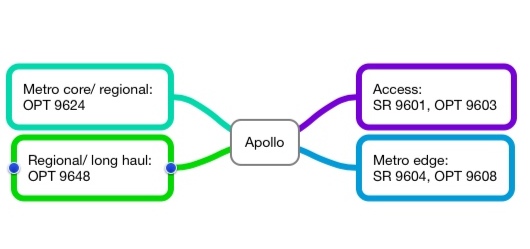
ECI has announced six Apollo platforms that span the access, metro and core networks. The platforms include the SR 9601 and OPT 9603 for metro access and the metro edge SR 9604 and OPT 9608 with four and eight input-output (I/O) cards respectively that support WDM or 100Gbps Ethernet MPLS packet switching. The final two platforms are the OPT 9624 for metro core and the OPT 9648 for regional and long haul, and both can accommodate a terabit universal switch.
Overall Apollo can support 44 or 88 light paths at 10, 40 and 100Gbps, 2-degree and multi-degree colourless, directionless and contentionless ROADMs, OTN and Ethernet switching, and IP/ MPLS and MPLS-TP. "MPLS-TP versus IP/ MPLS is almost a religious issue yet both are valid," says Marmur, who adds that at 40 Gig, ECI will use coherent and direct detection technologies but at 100 Gig it will use only coherent.
The universal fabric of the OPT 9624 and 9648 is cell based - ODUs and packets, not lower-order SONET/SDH traffic. If an operator has any significant amount of SONET/SDH traffic, ECI’s XDM platform or another aggregation box is needed.
The platforms can be configured as CESR platforms, OTN switches, optical transport platforms or combinations of the three.
Analysis
Gazettabyte asked Sterling Perrin, senior analyst at Heavy Reading; Rick Talbot, senior analyst, optical infrastructure at Current Analysis and Dana Cooperson, vice president of the network infrastructure practice at Ovum for their views about the ECI announcement.
Sterling Perrin, Heavy Reading
Apollo has several noteworthy aspects, according to Heavy Reading.
“It is a big announcement for ECI and a big announcement for the industry," says Perrin. “They are doing with the technology some fundamental things that are new.” That said, it remains to be seen how quickly operators will embrace an OMLT-style platform, he says.
Apollo confirms one networking trend - moving the OTN switching fabric into the metro network. So far OTN has been confined largely to the core network. “I know operators are interested but they are still evaluating it,” says Perrin. “But OTN will migrate down from the core to the metro.” Others that have announced such a capability include Ciena and Huawei.
ECI has also put the DWDM transport with the CESR platform. “This is another trend we figured would happen,” he says. “This puts ECI very early, if not first, in doing that function.”
Perrin has his doubts about how quickly the layer 3 functionality added to the platform will be embraced by operators: “What I've seen from the industry is that MPLS-TP will give you that functionality over time as it matures, so this sort of platform may not need the full layer 3 functions.”
The modular nature of the design that allows operators to add the functionality they need helps avoid one issue associated with integrated platforms, paying for functionality that is not needed. And there are cost savings by having a single integrated platform. “You do want to save capex and opex and this is definitely a way to get that done,” says Perrin.
In the network core, the question remains whether packet needs to be combined with the optics. “Metro lends itself more to the integration than the core does,” he says.
ECI’s biggest competitor is probably Huawei and over time also ZTE, says Perrin. ECI has done well in India and other emerging markets that many of the system vendors were ignoring. “Now they have Huawei in the mix, it is definitely tougher,” he says. “This [Apollo] announcement will definitely help them.”
Rick Talbot, Current Analysis
Current Analysis categorises the smaller members of the Apollo family as a packet-optical access (POA) portfolio, playing the same role as Ericsson’s SPO 1400 family and Cisco’s CPT series. The market research firm views the largest two Apollo platforms - the OPT 9624 and 48 - as packet-optical transport systems.
The Apollo POAs bring protocol-agnostic packet switching to the aggregation network, says Talbot, a rarity in this part of the network. Several vendors offer P-OTS with universal switching fabrics but most do not extend that architecture into the aggregation network, Tellabs with the 7100 Nano OTS being the exception. Also the 9600 series IP/ MPLS and MPLS-TP options are very strong, providing what Cisco and Ericsson call unified MPLS, he says.
For Current Analysis, the significance of the portfolio is that the Apollo family delivers converged packet and time-division multiplexing (TDM) switching in a single switch fabric, and provides an infrastructure that extends from the network core to the access network edge.
The switching fabric provides the greatest efficiency for the ultimate traffic type - packets - while simplifying the network architecture and minimising equipment cost. In turn, the breadth of the portfolio provides a common set of capabilities across an operator’s network, minimising training costs and spares inventory.
As for the specification, the wide range of MPLS features integrated into this product family, its terabit universal switch and its 100Gbps DWDM transport capabilities are impressive, says Talbot.
“The primary gap in the portfolio, and it is hard to fault ECI for this, is that the highest capacity member of the family supports ’only’ 1 Terabit-per-second of switching capacity,” he says. “This is not large enough for a Tier 1 core optical switch.”
ECI must first execute on the production of the Apollo family, but if it does, Talbot believe that ECI will capture the interest of larger and more end-to-end operators in markets they already serve.
ECI will also have positioned itself to capture the attention of many European operators and, if it makes a push there, the North American market. However Talbot believes ECI will still be challenged to capture the attention of Tier 1 operators because of the family’s limited maximum scale.
Dana Cooperson, Ovum
Size and scale breeds specialisation, says Cooperson. “Large service providers, including the Tier 1s, won’t be so interested in the OMLT, but they aren’t the target anyway,” she says. Large service providers need plenty of scale when it comes to WDM and CESR functionality, while they also tend to have compartmentalised operations groups. “So an all-in-one product like the OMLT isn’t targeted at them,” she says.
ECI has always done well selling to the Tier 2 and Tier 3 carriers as well as enterprises such as utilities that have carrier-like networks. That is because ECI's modular, packet-based platforms are sized and priced to match such operators' and enterprises’ requirements. “I see the OMLT as a continuation of ECI's positioning of its XDM platform,” she says.
Cooperson says that it can be difficult to position vendors’ switch announcements and that they should do more to explain where they sit. But she stresses that the Apollo 9600 series is very different from Juniper's PTX, for example.
“The PTX is positioned in the core as a lower-cost alternative to core routers, while the OMLT as a CESR or even an OTN switch is meant more for smaller sites,” she says. Also the switch capacities of the smaller Apollo platforms fit with ECI's focus and positioning on smaller customers and smaller sites.
Cooperson also highlights the need for the XDM platform if an operator requires SONET/SDH support but says ECI has alluded to add/drop multiplexer blades as well as packet blades. "The [Apollo] focus is on the packet and photonic bits,” says Cooperson. “ECI did emphasize that the XDM isn’t going anywhere, but we’ll see what happens over time and how much SONET/SDH ECI builds in [if any to the Apollo].”
Further Reading
For accompanying White Papers, click here