

OFC 2014 product round-up - Part 1
Part 1: Line-side technologies
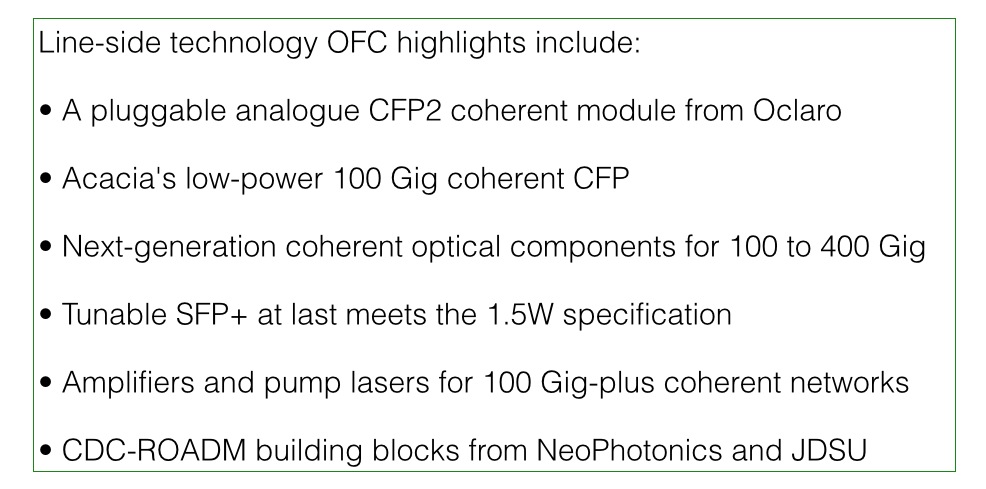
Technologies for 100 Gigabit were prominent at this year's OFC conference and exhibition held in San Francisco earlier this month.
The transition to smaller pluggable modules – client-side CFP2, CFP4 and QSFP28 interfaces - was one 100 Gig trend, another was the first 100 Gig pluggable modules for metro and metro-regional networks. Acacia Communications detailed its low-power AC-100 CFP, while Oclaro demonstrated coherent optics in the smaller CFP2 pluggable module.
To fit within the CFP2, Oclaro has developed a transmitter that combines two tunable lasers (one being for the coherent receiver) and an indium phosphide modulator, and a micro intradyne coherent receiver (micro ICR).
Having 100 Gig coherent optics in a CFP2 will enable equipment makers to double the 100 Gig line ports on their platforms. The optics will also support polarisation multiplexed, 16-quadrature amplitude modulation (PM-16-QAM) and hence 200 Gig transmission. However, given the CFP2's limited power profile, the coherent DSP-ASIC will need to reside on the line card, external to the module. Oclaro says samples of its 'analogue CFP2' will be with customers from the second quarter of the year.
The same coherent optics will also be used for Oclaro's 100 Gig coherent CFP module. "If you combine the [transmitter and micro ICR] optics, you get the CFP2, and the power target is 12W," says Robert Blum, director, product management, 40 and 100 Gig line-side modules at Oclaro. "Combining the optics with a [coherent] DSP in the CFP, the power target is 32W, the highest CFP [power] class."
Oclaro's 100 Gig CFP will be available by year-end, coinciding with a new generation of merchant coherent DSP-ASIC designs. ClariPhy Communications is sampling its LightSpeed-II devices, implemented using a 28nm CMOS process, while NTT Electronics (NEL) is developing its next-generation DSP-ASIC, expected to use an even more advanced CMOS process.
Integrating the DSP chip and optics in a CFP simplifies a line card design and adds flexibility: the same CFP port can be used for line-side or client-side modules. But given that the coherent optics consumes 12W, the next-generation DSP-ASIC must consume no more than 18W typically, with the remaining 2W to accommodate the physical layer ICs, if the CFP's maximum power profile is not to be exceeded.
Acacia Communications' AC-100 coherent CFP module uses the company's DSP-ASIC and photonic integrated circuit (PIC) implemented using silicon photonics. The resulting 100 Gig CFP consumes 24-26W, well within the CFP's maximum 32W.
Meanwhile, Fujitsu Optical Components demonstrated all the components needed to make a 100 Gig coherent CFP, using its indium phosphide modulator to generate a 100 Gig polarisation multiplexed, quadrature phase-shift keying (PM-QPSK) signal, and a micro ICR.
Considering that the 5x7-inch Optical Internetworking Forum (OIF) multi-source agreement (MSA) 100 Gig transponder for long-haul consumes some 80W, with the DSP-ASIC alone consuming over half that, the advent of the coherent CFP and analogue CFP2 highlights the industry’s recent progress in shrinking the size and power consumption of coherent optics.
"Our focus long term is the CFP2. It is where we think the market is going to go in the next two years."
Ferris Lipscomb, NeoPhotonics
Coherent components
NeoPhotonics detailed an integrated coherent transmitter that combines a narrow-linewidth tunable laser and a PM-QPSK modulator in one package. The device joins NeoPhotonics' micro Integrable Tunable Laser Assembly (ITLA) and micro ICR that have already been announced. "These are the next generation, smaller form factor coherent optical components," says Ferris Lipscomb, vice president of marketing at NeoPhotonics. The transmitter supports PM-QPSK and PM-16-QAM such that it can be used for 100, 200 and even as an element to enable 400 Gig transmission.
The device is suited for line card, OIF MSA modules, and pluggable CFP and CFP2 designs. "Our focus long term is the CFP2," says Lipscomb. "It is where we think the market is going to go in the next two years." NeoPhotonics says its coherent devices has been sampling to customers and will be generally available in the second half of the year.
Oclaro announced that its micro ITLA, first detailed at ECOC 2013, now supports a flexible grid; the tunable laser's wavelength can be set independent of the ITU Grid spanning the C-band. Such a capability is required for advanced optical networks based on flexible-grid ROADMs and spectrally-efficient super-channels. "The flexible-grid micro ITLA gives peace of mind [to operators] even if it is not widely used yet," says Oclaro's Blum. The technology used for the micro ITLA is also used for Oclaro's CFP and CFP2 line side modules.
Fujitsu Optical Components announced a lithium niobate modulator that supports 100 Gig PM-QPSK and 400 Gig PM-xQAM signals. The new modulator has the same drive voltage as its existing 100 Gig lithium niobate modulator but is half the size. The company also announced an accompanying ICR that also supports 100 and 400 Gig transmissions in core networks. The company says both devices will be available from July.
Sumitomo Electric Industries detailed its micro ITLA at OFC. The micro ITLA uses a narrower line width laser and reduces power consumption by a fifth. The company also showcased a micro ICR that supports 100 and 200 Gig transmissions, and an indium phosphide based Mach-Zehnder modulator that is smaller and has lower power than a lithium niobate-based version.
Avago Technologies announced its micro ICR at OFC, a demonstration of Avago's broad component portfolio following its acquisition of CyOptics. Finisar was another company that showcased a new portfolio of high-speed optical components following its acquisition of u2t Photonics. These include indium phosphide-based Mach-Zehnder modulators and 100 Gig receivers and photodetectors.
Tunable SFP+
Both JDSU and Oclaro detailed their latest 10 Gigabit tunable SFP+ optical modules. Moving the tunable laser design from an XFP to the SFP+ has been a challenge, meeting the SFP+'s smaller dimensions and 1.5W power consumption.
Oclaro's latest tunable SFP+ now meets the 1.5W SFP+ specification. Oclaro says that to achieve the specification, it produced a more compact integrated laser Mach-Zehnder chip. Oclaro demonstrated the tunable SFP+ operating at 85oC. Beta samples of the tunable SFP+ are being shipped and the module will soon undergo qualification.
JDSU has had a tunable SFP+ product for over a year but its power consumption is 2W. The SFP+ length is also elongated by 4mm to fit the tunable laser. Now, JDSU has announced a revised design that no longer needs the extra 4mm and achieves a power consumption of 1.6W. "We will achieve the 1.5W specification in the near future," says Brandon Collings, JDSU's CTO for communications and commercial optical products.
"The reason why there is a lot of talk about hybrid EDFA-Raman in the industry is that it works very well with coherent."
Rafik Ward, Finisar
Pump lasers and hybrid amplifiers
JDSU also announced pump laser designs. The motivation for these latest pump products is the more demanding link budgets required for 100 Gig-and-greater transmission speeds while still achieving long-distance reaches.
JDSU announced Raman pump lasers for hybrid EDFA-Raman amplifiers. These are more power-efficient and cover the Raman pump wavelengths required, says JDSU: a 600mW output between 1425-1470nm and 550mW at 1470-1495nm. The company has also detailed higher-power 980nm pumps for EDFAs. "More power is almost always a good thing as it allows you a lot more design freedom and performance in your amp," says Collings.
Finisar demonstrated a hybrid EDFA-Raman amplifier for the first time. The hybrid amp is capable of spanning 220km and has a 44dB link loss. "The reason why there is a lot of talk about hybrid EDFA-Raman in the industry is that it works very well with coherent," says Rafik Ward, vice president of marketing at Finisar. Amplifier span distances of 80km are commonly used but the purpose of the demonstration was to showcase the product's capability, says Ward.
WSSes and multicast switches
NeoPhotonics has announced a modular multicast switch that allows an operator to grow a ROADM's node according to demand. The multicast switch is used to add colourless, directionless and contentionless (CDC) attributes to the ROADM. "You can have any wavelength [colourless] from any direction come out at any port [directionless]," says Lipscomb. "And if you have two identical wavelengths coming from different directions, you can drop them through the same switch [contentionless]."
Lipscomb cites as an example an 8-degree ROADM node, with each direction fibre carrying 100 dense WDM channels. Even if only a quarter of the channels are dropped, that is 200 channels, he says: "What we are announcing is a modular multicast switch; you can start with 4 channels and 4 drops and keep adding modular line cards as needed to add more drop ports and more directions."
NeoPhotonics modular multicast switches include such dimensions as 4x4, 4x16 and 8x16. "Carriers don't want to limit their future deployment but they also don't want to spend a lot of money now because they might want to drop 100 channels later," says Lipscomb.
JDSU announced its second-generation twin 1x20 wavelength-selective switch (WSS) that fits on a single-slot card. The twin WSS is used for advanced flexible-grid CDC-ROADM nodes.
The latest twin 1x20 WSS has the same functionality as JDSU's current twin 1x20 WSS that has been available for a year but which occupies two chassis slots. "It has the same capability but is considerably smaller," says Collings.
Indeed, the twin WSS is sufficiently compact that other functions can be added to the card such as amplification, optical power monitoring and optical service channels, communication channels between nodes used for such tasks as provisioning, power management and firmware updates.
For the OFC 2014 product round-up - Part 2, click here

Amplifiers come to the fore to tackle agile network challenges
The growing sophistication of high-speed optical transmission based on 100 Gigabit-plus lightpaths and advanced ROADMs is rekindling interest in amplifier design.

Raman is a signature of the spread of 100 Gig but also the desire of being upgradable to higher bit rates
Per Hansen, II-VI
For the last decade, amplifier designers have been tasked with reducing the cost of Erbium-doped fibre amplifiers (EDFAs). "Now there is a need for new solutions that are more expensive," says Daryl Inniss, vice president and practice leader, components at market research firm, Ovum. "It is no longer just cost-cutting."
Higher output power amplifiers are needed to boost 100 Gig-plus signals that have less energy. Such amplifiers must also counter greater losses incurred by sophisticated colourless, directionless and contentionless (CDC) ROADM nodes. System vendors also require more power-efficient and compact amplifiers to maximise the chassis slots available for revenue-generating 100 Gig transponders.
Such requirements have created interest in all amplifier types, not just EDFAs but hybrid EDFA-Raman and Raman amplifiers.
"Improving the optical signal-to-noise ratio (OSNR) is of paramount consideration to enable higher capacity and reach for 100 Gig-plus lambdas," says Madhu Krishnaswamy, director, product line management at JDSU. "Raman amplification is becoming increasingly critical to delivering this OSNR improvement, largely in long haul."
Other developments include micro-amplifiers that boost single channels, and arrayed amplifiers used with ROADM nodes. These developments are also driving optical components: power-efficient, integrated pump lasers are needed for such higher-power amplifiers.
Operators' requirements span all three amplifier classes: EDFA, hybrid EDFA-Raman and all-Raman, says Anuj Malik, manager, solutions marketing at Infinera: "Some networks require a high OSNR and use hybrid amplifiers but some networks are prone to fibre cuts and hence avoid hybrid as fibre splices can cause more problems with Raman."
Raman differs from EDFA in several ways. Raman has a lower power efficiency, the optical pump power needed to pump an amplifier to achieve a certain gain and output power. This requires higher power to be launched into a Raman amplifier, raising safety issues for staff and equipment. The high launch power requires a sound connection between the Raman pump source and the fibre to avoid equipment being damaged, hence Infinera's reference to fibre splices.
Yet if Raman has a lower power efficiency, it has notable benefits when compared to an EDFA.
An EDFA performs lumped amplification, boosting the signal at distinct points in the network, every 80km commonly. Raman amplifies the signal as it travels down the fibre.
"With Raman amplification the gain is out in the fibre span, and Raman delivers a lower equivalent noise figure - a big advantage," says Per Hansen, head of product marketing, amplifier business unit at II-VI." The company II-VI acquired Oclaro's amplifier business in November 2013.
An amplifier's noise figure is a measure of performance in the network. All amplifiers introduce noise so that the input signal-to-noise ratio divided by the output signal-to-noise ratio is always greater than one. "Raman gives you a significantly better noise figure, an improvement in the range of 3 to 5dB," says Hansen.
EDFA designs continue to progress alongside the growing interest in hybrid and all-Raman. JDSU says that higher output power EDFAs, greater than 24dBm, are increasingly relevant for 96-plus channel systems that support super-channels and flexible grid ROADMs in the metro and long haul.
"Switchable-gain EDFAs to optimise the noise figure over a wider dynamic range of operation is another element enhancing overall system OSNR," says Krishnaswamy. "This is also common for metro and long haul."
Hybrid amplification combines the best characteristics of EDFA and Raman. In a hybrid, Raman is the first amplification stage where noise figure performance is most important, while the EDFA, with its power efficiency, is used as the second stage, boosting the signal to a higher level.
According to Finisar, 100 Gig uses the same receiver OSNR as 10 Gig transmissions. However, the transmission power per channel at 100 Gig is reduced, from 0 to 1dBm at 10 Gig to -2 to -3dBm at 100 Gig, due to non-linearity transmission issues. "Immediately you lose a few dBs in the OSNR," says Uri Ghera, CTO of the optical amplifier products at Finisar.
An overwhelming portion of WANs worldwide have adopted hybrid EDFA-Raman and this trend is expected to continue for the foreseeable future.
For 400 Gigabit transmission, the weaker signal sent requires the OSNR at the receiver to be 4-10dBm higher, says Ghera: "This is why you need hybrid Raman-EDFA."
Moving to a narrower channel spacing using a flexible grid also places greater demands on amplifiers. "Because of super-channels, if before we were talking about 100 channels [in the C-band], for a channel spacing of 37.5GHz it is more like 130 channels," says Ghera. "If you want the same power per channel, it means higher-output amplifiers."
The spectrum amplified by an EDFA is determined by the fibre. EDFAs amplify the 35nm-wide C-band spanning 1530 to 1565nm, and also the separate L-band at 1570 to 1605nm, if that is used. In contrast, the spectrum amplified by Raman is determined by the pump laser's wavelength. This leads to another benefit of all-Raman: far broader spectrum amplification, 100nm and wider.
Xtera is a proponent of all-Raman amplification. The system vendor has demonstrated 60nm- and even 100nm-wide spectrum amplification, broader than the C and L bands combined.
Xtera conducted trials with Verizon in 2013 using its Nu-Wave Optima platform and Raman operating over a 61nm window. The trials are detailed in Table 1.
Between 15 and 40 Terabits were sent over 4,500km and 1,500km, respectively, using several modulation schemes and super-channel arrangements. In comparison, state-of-the-art 100 Gig-plus systems achieve 16 Terabit typically across the C-band, and are being extended to 20-24 Terabit using closer-spaced channels. Using 16-QAM modulation, the reach achieved is 600km and more.
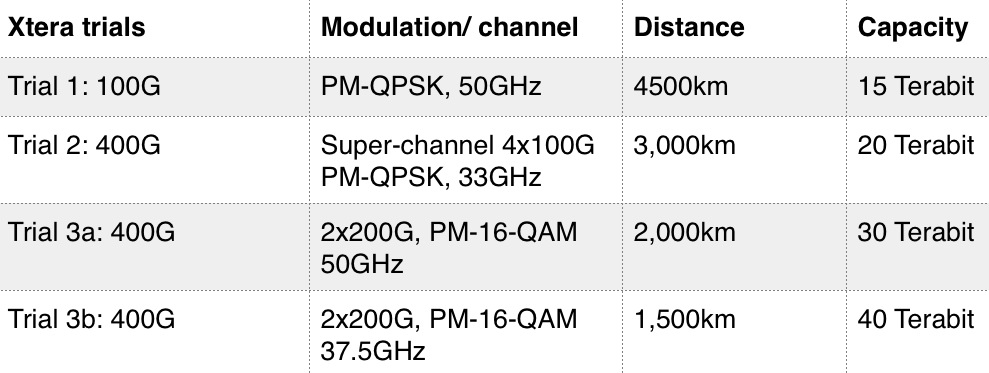 Table 1: Xtera's Verizon trial results using a 61nm spectrum and all-Raman amplification.
JDSU says hybrid amplification remains the most cost-competitive way to deliver the required OSNR and system capacity, while all-Raman can potentially increase system capacity.
Overall, it is network capacity and reach requirements that drive amplifier choice, says Krishnaswamy: "An overwhelming portion of WANs worldwide have adopted hybrid EDFA-Raman and this trend is expected to continue for the foreseeable future."
Meanwhile, the single channel micro-amp, sits alongside or is integrated within the transmitter. Operators want a transponder that meets various requirements for their reconfigurable networks. "If you look into the numbers, you want to boost the signal early on before it is attenuated," says II-VI's Hansen. "That gives you the best OSNR performance."
"This [single-channel amp] is a type that was rare in old systems," adds Finisar's Ghera. "It is also a market that is growing the fastest for us."
The micro-amp needs to be compact and low power, being alongside the power-hungry 100 Gig coherent transmitter. This is driving uncooled pump laser development and system integration.
Similar design goals apply to arrayed amplifiers that counter losses in ROADM add/ drop cards. "If you have some of the features of colourless, directionless and contentionless, you incur bigger losses in the node but you can make it up with other amps, one of these being arrayed amps," says Hansen.
Arrayed designs can have eight or more amps to support multiple-degree nodes so that achieving a power-efficient, compact design is paramount. Hence II-VI's development of an uncooled dual-chip pump laser integrated in a package. "Having four packages to pump eight amps in a small space that do not require cooling is a huge advantage," says Hansen.
The amplifier design challenges are set to continue.
One, highlighted by Infinera, is expanding amplification to the L-band to double overall capacity. JDSU highlights second-order and third-order Raman designs that use a more complex pump laser arrangement to improve system OSNR. Lowering the noise figure of EDFAs will be another continuing design goal, says JDSU.
II-VI expects further challenges in miniaturising single-channel and arrayed amplifier designs. Finisar also cites the need for more compact designs, citing putting an EDFA in an XFP package as an example.
Another challenge is producing high-power Raman amplifiers that can bridge extremely long spans, 300 to 400km. Such an amplifier must be able to read lots of physical parameters associated with the span and set the line accordingly, said Gheri.
II-VI's Hansen says the adoption of Raman and arrayed amplifiers is a good indicator of the wider deployment of next-generation network architectures. "Raman is a signature of the spread of 100 Gig but also the desire of being upgradable to higher bit rates," he says.
The article first appeared as an OFC 2014 show preview piece