

Q&A with Richard Soref - Final Part
In the final part of the interview with Gazettabyte, Richard Soref talks about hybrid and monolithic integration, mid-infrared optics, how his photonics predictions made in a 2006 paper have fared, 2-micron-based optical communications, and his talk at OFC in March.
 "In a rosy future, every smart phone, tablet, wrist watch, and hand-held device would contain one of these chemical-medical-physical sensors."
Richard Soref
Q: The distinction between monolithic and hybrid integration? Arguably all silicon photonics is hybrid integration.
RS: Silicon photonics is mostly monolithic and that is its advantage. Hybrid integration occurs when structures from two different material systems are combined, usually by bonding. When describing the construction of silicon photonics, if we include the germanium laser on silicon, then it is possible to make every component in a chip network from Group IV materials, and this qualifies as monolithic integration.
How important is optical performance using either hybrid or a monolithic design? Is this an academic question or are there differences and hence issues to consider when making a device monolithically or hybridly?
RS: There are real-world issues to consider when evaluating the relative performance of hybrid and monolithic. I don’t know whether hybrid integration is CMOS-foundry-compatible but I suspect that it is. I feel that hybrid integration of III-V laser diodes on silicon or germanium is quite practical, both for telecom and mid infrared. The heterogeneous approach is an excellent, viable solution until germanium-tin (GeSn) laser diodes come along.
Considerable investment is required to make monolithic real. Once actual, it should be more cost-effective than hybrid. The definition of monolithic has vague areas. Is epitaxial growth of III-V on silicon monolithic? Perhaps. If you bond a Group IV nano-membrane onto silicon or germanium, is that monolithic? Probably. We need clearer terminology.
The comparison you’re asking for probably comes down to a performance comparison of III-V and Group IV laser diodes and photo-detectors.
Regarding the economics of silicon photonics, one important issue is the cost of silicon photonics compared to copper. This looks like a major factor limiting silicon photonics adoption. Do you have a view on cost?
RS: These economics are outside my areas of expertise, but I’ll take a stab at it.
Active optical cables are one of several possible killer applications of silicon photonics I don’t know the actual numbers but am guessing that the photonic cost is already below the copper coax cost and is capable of further reduction. Data centres are validating silicon photonics adoption.
A general proposition is that ubiquitous photonics could improve our lives. Mass production at very low cost is on the horizon for silicon photonic integrated circuits (PICs). Once the high-volume, high-impact applications are known, the factory can target them. The global silicon infrastructure could push silicon PICs into the lead. Job creation, industrial competitiveness and other benefits to society will flow from high-yield PICs and opto-electronic integrated circuits (OEICs) made on large wafers. Niche applications and boutique chips may offer important functionality but at higher costs, and for those the silicon may not compete well with III-Vs.
In your paper, The Past, Present and Future of Silicon Photonics, published in 2006, you say that no one can foresee the future and that all one can do is make educated guesses. You then go on and make the following predictions shown in the table below.
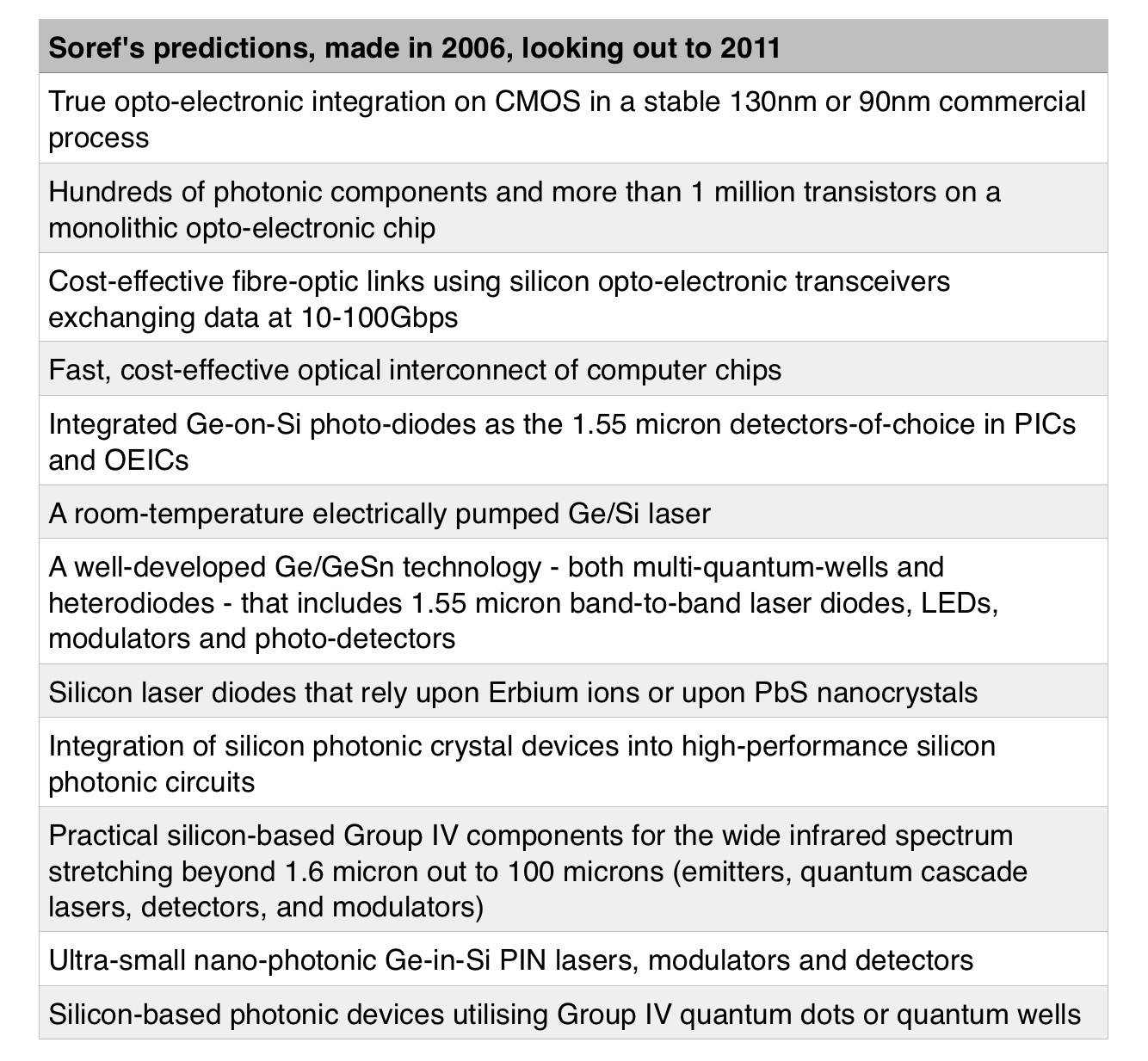
What comments do you have, given the benefit of hindsight?
RS: Well, the scorecard is mixed on these prognostications. A few came true, some are on the verge, others are stuck such as the Erbium-silicon and lead-sulphide-silicon lasers. The mega-transistor OEIC has not yet arrived. The germanium-on-silicon heterolaser diode came true. The high threshold of this laser can be reduced by adding tensile strain and germanium quantum wells, but even after that has been done I feel that this laser’s efficiency will not match that of its III-V competitors.
Efficiency prospects are better for germanium-tin (GeSn). The optically-pumped GeSn laser was just demonstrated in Germany and now we are close to the monolithic on-chip germanium-tin laser diode, although it will emit at 2 microns instead of 1.55 microns.
When I read the press releases of Intel, Cisco, IBM, Mellanox, Luxtera, STMicroelectronics, PhotonIC, IME and imec, I get the impression that major progress has been made in commercial 100 Gigabit-per-second transceiver chips and active optical cables, all of these using hybrid light sources and the germanium photodiodes that I predicted.
Looking at the wide infrared spectrum, the predicted results from 5 to 100 microns have not materialised. However, results are excellent in the 1.6 to 5 micron range. The wavelength-scale components are still on the wanted list, although such modulators and detectors have appeared with a plasmonic flavour.
The GeSn quantum wells arrived in Ghent, Belgium in 2012 and were explored further in Stuttgart, Germany. I believe that a fully fledged silicon-germanium-tin (SiGeSn) technology is unfolding before our eyes today.
The competence of Group IV photonics in so many different scientific areas is its strength and survival mechanism.
In your Photonics West talk in 2013, you talk about silicon opto-electronic mid-infrared system-on-chip. You highlight several interesting application areas including chemical-bio-physical sensing, medical diagnostics, environmental monitoring and high-speed comms at 2 micron. Is sensing a distinct category, and if so, how does it differ from medical diagnostics and environmental monitoring?
RS: Medical diagnostics, industrial process control, and environmental monitoring are all within the same sensing category as chem-bio-physical sensing. That’s why on-chip sensing via photonic techniques is a very broad category. Over time, commercial sales of these photonic sensors - including disposables - could eclipse those of optical interconnects.
How should these mid-infrared applications be seen alongside SiP for telecom and datacoms? Are the two distinct or will developments in mid-infrared applications provide volumes needed that will benefit datacom and telecom silicon photonics at 1.55 microns and below?
RS: Ultra-fast data transmission in the 2 micron band for long-haul and short-haul links arises from the new generation of hollow-core photonic bandgap fibres currently with a loss of 2dB per kilometer. The idea here is that the new 2 micron room-temperature fibre communications will be a practical supplement to current 1.55 micron equipment, and that the various 2 micron connections are not intended to replace existing 1.55 micron infrastructure. In other words, 2 microns expands the global network capacity and does so with low energy consumption. The chip volumes needed at 2 microns will benefit 1.55 microns and vice versa.
What are the main challenges as you see it for these applications? And are these applications a decade behind datacom and telecom because there are no Intels, Ciscos or silicon photonics start-ups driving them?
RS: The main challenge I see for 2 microns is developing the high performance foundry-based room-temperature opto-electronic transceiver chips. I visualise cost-effective germanium-tin (GeSn) photo-detectors and soon GeSn laser diodes integrated in silicon-on-insulator (SOI) waveguide technology with SOI free-carrier modulators. This is a natural sweet-spot for monolithic Group IV photonics.
And no, these applications are not a decade behind because an excellent start has already been made on sensors and 2 microns by researchers in the US, Europe and Asia, even without those start-ups.
The challenge I see in sensors is for practitioners to thread their way through the thicket of reported results on chip-scale refractometers, spectrometers, microfluid channels, label-free detection, resonators, trace-gas concentrators, and plasmonic reflectors, so as to converge upon sensitive, practical solutions.
Parts-per-billion photonic sensors can compete with electronic sensors. Financial investment will actualise the sensor vision and the 2-micron dream. A mixture of technical demonstrators, faith, and venture capital should suffice. Which comes first? Is this a chicken-and-egg question?
At the upcoming OFC 2015 in March, you are to give a talk. What will be the theme?
RS: My mid-infrared talk has a fibre theme and a sensor theme—both about Group IV foundry chips made at low cost. I just described how the fast, energy-efficient 2 micron fibre-optic transceiver chip could be developed with GeSn and SOI. Also, I feel that photonic sensing has tremendous untapped potential including disposables and tiny sensors enabled by battery-powered on-chip nano-lasers.
In a rosy future, every smart phone, tablet, wrist watch, and hand-held device would contain one of these chemical-medical-physical sensors. There are terrific network possibilities. A group of such portable, co-operating sensors, widely dispersed in geography, could be linked by the global cell-phone network or the internet cloud because these photonics will become mainstays of the internet-of-things.
You said as an aside in your 2013 talk that "germanium is the new silicon". What did you mean by that and should we all be looking at 'Germanium Photonics'?
RS: We should be. Germanium has a short wave and a long wave role to play. Germanium shines at 1.6 microns with the laser, the famous photo-detector, and the modulators employing free-carrier, Franz-Keldysh and quantum-confined Stark effects. Germanium is a fine buffer layer on silicon, functioning as an epitaxy platform for SiGeSn. With its high transparency over 1.8 to 15 microns, germanium is superior to silicon over the 8 to 15 micron range where silicon has 2 to 10 dB/cm of loss.
Successful waveguiding experiments in germanium over 2 to 6 microns have confirmed its infrared value for filters, resonators, interconnects and photonic crystals, while waveguide demonstrations over 6 to 14 micron are expected. Germanium is a stellar nonlinear optical material because its third-order susceptibility is much larger than that of silicon. Hence germanium offers superior four-wave mixing, Raman lasing and Brillouin gain, assuming pump wavelengths longer than 3.4 microns. Germanium serves in heterostructures and quantum structures as a barrier to GeSn. Quantum dots are available. Doped germanium can be a plasmonic conductor. Overall, self-contained photonics.
Lastly, what opportunities excite you most and if you were giving advice to young engineers and researchers looking at silicon photonics/ Group IV photonics, what would you recommend they focus on over the next 10 years?
RS: I think that young scientists and engineers entering this field should aim at ambitious, modern goals. They could investigate significant trends-in-motion or exotic emerging directions.
Regarding trends, the young engineers have opportunities for impact in photonic sensors, terabit-per-second optical interconnect devices, analogue-and-digital mixed signal chips, microwave photonics of several kinds, space-division and mode-division multiplexing, night-vision imaging, beam steering, and control of microwave antennas. Their talents could create new PICs and OEICs for practical outcomes.
For the more speculative category, the young scientists could focus on pathfinding forms of optical computing, as opposed to types discredited in the past. They could make advances in quantum integrated photonics, to use Professor Ben Eggleton’s term, getting results in quantum computing, secure communications and metrology.
In a similar vein, some good targets are the Ising machine and the neural-network computer with its training sets. Linear-and-nonlinear optics at Terahertz and long wave infrared could be explored.
I’m excited by the topic of nano-laser diodes; an all-Group IV photonics version rather than the metal-coated kind. I visualise a two-dimensional germanium photonic crystal grown directly on an oxidised SOI waveguide that possess a surface grating. A wavelength-scale GeSn gain region is embedded in the line-defect cavity zone where lateral PIN injection takes place. Then, this surface emitting nano laser is vertically coupled to the SOI beneath it.
For the first part of the interview, click here
Between 1998 and 2003, Professor Soref wrote 36 short poems that were published in internet magazines, some are which are still online. He is also a distinguished photographer, click here to see some of his work. "I gravitate to art forms of which science is one," he says.

Q&A with photonics pioneer, Richard Soref - Part 1
Richard Soref has spent over 50 years researching photonics, contributing groundbreaking work in the areas of liquid crystals, silicon photonics and the broader topic of mid-infrared wavelengths and Group IV photonics. For 27 years he was employed at the Air Force Research Laboratory. He has also worked at the Sperry Research Center, the MIT Lincoln Laboratory, and is now a research professor at the University of Massachusetts in Boston.
In part 1 of a two-part interview with Gazettabyte, he details his research interests, explains what is meant by Group IV photonics, and discusses why photonics has not matched the semiconductor industry in terms of integration, and how that could change.
Optics is a seemingly small subset of physics but really optics is a huge field with a deep, variegated nature waiting to be discovered
Richard Soref
Q: Having gained your Ph.D. in 1963, you have spent your career in what you call the science of light. What is it about photonics that you find so captivating?
RS: I’ve been drawn to its diversity and classical beauty. Photonics used to be called optics until it was re-labelled by the OSA. Optics is a seemingly small subset of physics but really optics is a huge field with a deep, variegated nature waiting to be discovered. To make progress, you need multiple disciplines, and I’ve always been captivated by the materials science aspect that opens the door to new physics and new devices.
Can you outline your career and how you ended up as a research professor at the University of Massachusetts at Boston?
RS: A general outline is that I chose employers who would encourage exploration of new avenues, would give me freedom to fly or fall – and both are built into research. Basic research is where my talents and passion align. And it helps to be obsessive.
In the early years, I worked mostly alone. Then the pleasures of collaboration became important, and for decades I have been fortunate to have outstanding research partners who did heavy lifting of things like quantum mechanics and electromagnetic modelling.
At Lincoln Lab, I continued the nonlinear optical studies that I began during my Stanford Ph.D. work. Sperry Research was an excellent environment until it fell victim to the corporate research shutdown contagion. Ironically or prophetically, impurity-doped silicon infrared sensors were an early focus at Sperry.
Lithium niobate sparked my 40-year interest in electro-optics: Pockels [effect], Kerr [electro-optic effect], Franz-Keldysh [effect] and more. My extensive work on liquid crystals gained a lot of traction, and at an Information Display show I met scientists from South Korea who told me that my early papers helped them with their commercial flat-panel TV products. It was fulfilling to hear that.
Apart from some governmental distractions, the Air Force Research Laboratory (AFRL) years were a happy time and I welcomed the support of the Air Force Office of Scientific Research (AFOSR); the AFOSR is a national treasure.
Fibre-optic telecom emerged in 1985 when I was at AFRL. The fibres needed semiconductor assistance, I felt. That’s when the new silicon insights came to me. I’m glad that I was able in 1989 to identify silicon-on-insulator (SOI) as the primary waveguided-network platform, and I’m gratified that brilliant and innovative research groups around the world entered this field early on. They strived successfully to perfect this technology. To do my part, I tried to surround the problem in a 1985-2015 series of papers, among them my 1991 silicon-germanium-tin (SiGeSn) direct-gap prediction and my 1992 opto-electronic integrated circuit (OEIC) proposal. My most-cited work is a 1987 paper on free-carrier electro-optics.
Summarising, I had two visions at AFRL: Group IV photonics and long-wave integrated optoelectronics, where long wave denotes anything from two to 200 microns, although the mid-infrared wavelengths are key because of their room temperature possibilities. Perhaps there is a third vision: the multi-technology 3D chip on which seven technologies including bio-chemical could be combined.
Sadly those creative years drew to a close when the Massachusetts laboratory was shut down by the Air Force and the party moved to Wright Patterson AFB in Ohio. At that point, I joined the University of Massachusetts in Boston to stay near family and to keep the technical flame alive in research. I’m still collaborating with wonderful people, most of them young.
Can you provide rigour regarding some definitions? Starting with silicon photonics, silicon mid-infrared optics and Group IV photonics, can you define each and do you have a preference for a particular term?
RS: The silicon-photonics term is strongly entrenched in the global community. The phrase includes on-chip germanium photo-detectors and presumably germanium lasers. Nevertheless, I think this term is a bit narrow or misleading about the silicon-germanium-tin materials (SiGeSn) that likely will be used in the monolithic silicon chip of the future.
I am in the minority when I say that I prefer the wider term Group IV photonics (GFP) which takes into account those three-part alloys as well as diamond and graphene. This GFP term was coined in 2003 in my office at Hanscom when Greg Sun and I were dreaming constructively about a new, dedicated IEEE conference, the international meeting I co-founded in 2004.
In the coming years, the purely photonic integrated circuit, the PIC chip, will evolve, after money is spent, into the opto-electronic chip, and the transistors will be CMOS or BiCMOS or heterojunction bipolar
What about the OEIC, how does it differ from silicon photonics? And lastly, nano-photonics, how does it compare to silicon photonics?
RS: The opto-electronic integrated circuit describes the synergistic marriage of nano-photonics and nano-electronics on the same silicon chip. Others have called this an electronic-photonic integrated circuit or EPIC. In essence, the OEIC is a transistorised photonic chip containing electronic intelligence, signal processing, computation, electrical control of active photonic devices, and perhaps RF wireless transceiving capability, which I strongly advocate.
In the coming years, the purely photonic integrated circuit, the PIC chip, will evolve, after money is spent, into the opto-electronic chip, and the transistors will be CMOS or BiCMOS or heterojunction bipolar. These possibilities illustrate the diversity of GFP.
As for nano-photonics, it is a subset of silicon photonics populated by wave-guided components whose smallest cross-section dimension is 15 to 30 percent of the free-space wavelength. Photonics, like electronics, started as micro and shrank to nano. The term nano means nanometer-scale and applies also to quantum-dot diameter, quantum-well layer thickness and photonic-crystal air hole diameter.
In over half a century, electronics has undergone an extraordinary transformation from simple integrated circuits to profoundly complex ones. Yet while integrated optics was spoken of as early as 1969 in the Bell Labs paper by Stuart Miller, integration has been far more modest. Why?
RS: The main roadblock has been the lack of compelling applications for medium scale and large scale photonic integration. Perhaps this was a lack of vision or a lack of market to drive the integration research.
Another inhibiting factor is the large expense, the cost-per-run of making a photonic integrated circuit, although the OPSIS user foundry [before it closed] and other user facilities have mitigated entry costs to some extent. Additional factors are the area-footprint and volume of the photonic building blocks. The photonic device size is generally larger, or much larger, than the size of the modern individual transistor.
Is this about to change?
RS: To some degree, yes. People are packing photonic components together in a circuit but there are limits on how closely this can be done. These constraints lead me to wonder whether photonic integration will follow the same historical path as micro- and nano-electronics, the same developmental story. Will there be a Moore’s law for photonics with PIC packing density doubling every 18 months? The billion-photonic circuit is not on the cards, so I doubt that the law will hold.
The diffraction limit of optics and the single-mode criteria set lower limits on photonic size, although plasmonic devices go below those dimensional limits and are compatible with photonics.
I see glimmers today of where LSI can make a difference. A near-term use is a 128x128 array of electro-optical phase shifters for optical beam steering. More speculatively, we have electro-optical logic arrays, spectrometers on-chip, optical neural networks, dense wavelength-division multiplexers and demultiplexers, quantum processors, and optical computers using dense nano-LED arrays.
The government has deeper pockets than industry for sustained R&D efforts
What are the major challenges today making optical devices using a CMOS fabrication process?
RS: A partially-met challenge is to actualise a stable and reliable process in a 130nm or 65nm CMOS node for manufacturing the active and passive photonic parts of the on-chip network. We need process procedures for principal components which are recipes defined with a new design library. Whether to standardise photonics is an open question. When and where to place transistor circuits on-chip is a challenge. Putting transistors on a separate chip is a near-term alternative.
It takes art as well as science to determine the opto-electronic layering and to decide whether the available processing temperatures necessitate fabrication at the front end or back end of the overall process.
I believe that a manufacturing initiative is an essential next step for GFP to convince friends and skeptics alike of the long-term commercial and military value of GFP offered in new generations of energy-efficient ultra-performance chipsets. The government has deeper pockets than industry for sustained R&D efforts, so I believe that the Department of Defense can be the force driving GFP expansion into higher realms at very low costs per chip.
That’s why I welcome the new 5-year Integrated Photonics Institute project as part of the National Network for Manufacturing Innovation, funded by the RAMI bill [Revitalize American Manufacturing and Innovation Act]. It is a bill that would train the workforce, while public-private partnerships will transform research into products and will deploy infrastructure that supports US-enterprise competitiveness.
For the second part, click here