

Infinera’s ICE flow
Infinera’s newest Infinite Capacity Engine 5 (ICE5) doubles capacity to 2.4 terabits. The ICE, which comprises a coherent DSP and a photonic integrated circuit (PIC), is being demonstrated this week at the OFC show being held in San Diego.
Infinera has also detailed its ICE6, being developed in tandem with the ICE5. The two designs represent a fork in Infinera’s coherent engine roadmap in terms of the end markets they will address.
 Geoff BennettThe ICE5 is targeted at data centre interconnect and applications where fibre in being added towards the network edge. The next-generation access network of cable operators is one such example. Another is mobile operators deploying fibre in preparation for 5G.
First platforms using the ICE5 will be unveiled later this year and will ship early next year.
Infinera’s ICE6 is set to appear two years after the ICE5. Like the ICE4, Infinera’s current Infinite Capacity Engine, the ICE6 will be used across all of Infinera’s product portfolio.
Meanwhile, the 1.2 terabit ICE4 will now be extended to work in the L-band of optical wavelengths alongside the existing C-band, effectively doubling a fibre’s capacity available for service providers.
Infinera’s decision to develop two generations of coherent designs follows the delay in bringing the ICE4 to market.
“The fundamental truth about the industry today is that coherent algorithms are really hard,” says Geoff Bennett, director, solutions and technology at Infinera.
By designing two generations in parallel, Infinera seeks to speed up the introduction of its coherent engines. “With ICE5 and ICE6, we have learnt our lesson,” says Bennett. “We recognise that there is an increased cadence demanded by certain parts of the industry, predominately the internet content providers.”
ICE5
The ICE5 uses a four-wavelength indium-phosphide PIC that, combined with the FlexCoherent DSP, supports a maximum symbol rate of 66Gbaud and a modulation rate of up to 64-ary quadrature amplitude modulation (64-QAM).
Infinera says that the FlexCoherent DSP used for ICE5 is a co-development but is not naming its partners.
Using 64-QAM and 66Gbaud enables 600-gigabit wavelengths for a total PIC capacity of 2.4 terabits. Each PIC is also ‘sliceable’, allowing each of the four wavelengths to be sent to a different location.
Infinera is not detailing the ICE5’s rates but says the design will support lower rates, as low as 200 gigabit-per-second (Gbps) or possibly 100Gbps per wavelength.
Bennett highlights 400Gbps as one speed of market interest. Infinera believes its ICE5 design will deliver 400 gigabits over 1,300km. The 600Gbps wavelength implemented using 64-QAM and 66Gbaud will have a relatively short reach of 200-250km.
“A six hundred gigabit wavelength is going to be very short haul but is ideal for data centre interconnect,” says Bennett, who points out that the extended reach of 400-gigabit wavelengths is attractive and will align with the market emergence of 400 Gigabit Ethernet client signals.
Probabilistic shaping squeezes the last bits of capacity-reach out of the spectrum
Hybrid Modulation
The 400-gigabit will be implemented using a hybrid modulation scheme. While Infinera is not detailing the particular scheme, Bennett cites several ways hybrid modulation can be implemented.
One hybrid modulation technique is to use a different modulation scheme on each of the two light polarisations as a way of offsetting non-linearities. The two modulation schemes can be repeatedly switched between the two polarisation arms. “It turns out that the non-linear penalty takes time to build up,” says Bennett.
Another approach is using blocks of symbols, varying the modulation used for each block. “The coherent receiver has to know how many symbols you are going to send with 64-QAM and how many with 32-QAM, for example,” he says
A third hybrid modulation approach is to use sub-carriers. In a traditional coherent system, a carrier is the output of the transmit laser. To generate sub-carriers, the coherent DSP’s digital-to-analogue converter (DAC) applies a signal to the modulator which causes the carrier to split into multiple sub-carriers.
To transmit at 32Gbaud, four sub-carriers can be used, each modulated at 8Gbaud, says Bennett. Nyquist shaping is used to pack the sub-carriers to ensure there is no spectral efficiency penalty.
“You now have four parallel streams and you can deal with them independently,” says Bennett, who points out that 8Gbaud turns out to be an optimal rate in terms of minimising non-linearities made up of cross-phase and self-phase modulation components.
Sub-carriers can be described as a hybrid modulation approach in that each sub-carrier can be operated at a different baud rate and use a different modulation scheme. This is how probabilistic constellation shaping - a technique that improves spectral efficiency and which allows the data rate used on a carrier to be fine-tuned - will be used with the ICE6, says Infinera.
For the ICE5, sub-carriers are not included. “For the applications we will be using ICE5 for, the sub-carrier technology is not as important,” says Bennett. “Where it is really important is in areas such as sub-sea.”
Silicon photonics has a lower carrier mobility. It is going to be harder and harder to build such parts of the optics in silicon.
Probabilistic constellation shaping
Infinera is not detailing the longer-term ICE6 beyond highlights two papers that were presented at the ECOC show last September that involved a working 100Gbaud sub-carrier-driven wavelength and probabilistic shaping applied to a 1024-QAM signal.
The 100Gbaud rate will enable higher capacity transponders while the use of probabilistic shaping will enable greater spectral efficiency. “Probabilistic shaping squeezes the last bits of capacity-reach out of the spectrum,” says Bennett.
“In ICE6 we will be doing different modulation on each sub-carrier,” says Bennett. “That will be part of probabilistic constellation shaping.” And assuming Infinera adheres to 8Gbaud sub-carriers, 16 will be used for a 100Gbaud symbol rate.
Infinera argues that the interface between the optics and the DSP becomes key at such high baud rates and it argues that its ability to develop both components will give it a system design advantage.
The company also argues that its use of indium phosphide for its PICs will be a crucial advantage at such high baud rates when compared to silicon photonics-based solutions. “Silicon photonics has a lower carrier mobility,” says Bennett. “It is going to be harder and harder to build such parts of the optics in silicon.”
ICE4 embraces the L-band
Infinera’s 1.2 terabit six-wavelength ICE4 was the first design to use Nyquist sub-carriers and SD-FEC gain sharing, part of what Infinera calls its advanced coherent toolkit.
At OFC, Infinera announced that the ICE4 will add the L-band in addition to the C-band. It also announced that the ICE4 has now been adopted across Infinera’s platform portfolio.
The first platforms to use the ICE4 were the Cloud Xpress 2, the compact modular platform used for data centre interconnect, and the XT-3300, a 1 rack-unit (1RU) modular platform targeted at long-haul applications.
A variant of the platform tailored for submarine applications, the XTS-3300, achieved a submarine reach of 10,500km in a trial last year. The modulation format used was 8-QAM coupled with SD-FEC gain-sharing and Nyquist sub-carriers. The resulting spectral efficiency achieved was 4.5bits/s/Hz. In comparison, standard 100-gigabit coherent transmission has a spectral efficiency of 2bits/s/Hz. The total capacity supported in the trial was 18.2 terabits.
Since then, the ICE4 has been added the various DTN-X chassis including the XT-3600 2.4 terabit 4RU platform.

Infinera unveils its next-gen packet-optical platforms
 Source: Infinera
Infinera has unveiled its latest metro products that support up to 200-gigabit wavelengths using CFP2-DCO pluggable modules.
The XTM II platform family is designed to support growing metro traffic, low-latency services and the trend to move sophisticated equipment towards the network edge. Placing computing, storage and even switching near the network edge contrasts with the classical approach of backhauling traffic, sometimes deep within the network.
“If you backhaul everything, you really do not know if it belongs in that part of the network,” says Geoff Bennett, director, solutions and technology at Infinera. Backhauling inherently magnifies traffic whereas operators want greater efficiencies in dealing with bandwidth growth, he says: “This is where the more cloud-like architectures towards the network edge come in.”
But locating equipment at the network edge means it must fit within existing premises or in installed prefabricated huts where space and the power supplied are constrained.
“If you are asking service providers to put more complex equipment there, then you need low power utilisation,” says Bennett. “This has been a key piece of feedback from customers we have been asking as to how they want our existing products to evolve in the metro-access.”
Having a distributed switch fabric is a long-term advantage for Infinera
Infinera says its latest XTM II products are eight times denser in terms of tranmission capacity while setting a new power-consumption low of 20W-27W per 100 gigabits depending on the operating temperature (25oC to 55oC). Infinera claims its nearest metro equipment competitor achieves 47W per 100 gigabits.
Sterling Perrin, principal analyst, optical networking and transport at Heavy Reading, says Infinera has achieved the power-efficient design by using a distributed switch architecture rather that a central switch fabric and adopting the CFP2-DCO pluggable module with its low-power coherent DSP.
“If you have a centralised fabric and you put it into an edge application then for some cases it will be a perfect fit but for many applications, it will be overkill in terms of capacity and hence power,” says Perrin. “Infinera is able to do it in a modular fashion in terms of just how much capacity and power is put in an application.”
Having a distributed switch fabric is a long-term advantage for Infinera for these applications, says Perrin, whereas competitor vendors will also benefit from the CFP2-DCO for their next designs.
And even if a competitor uses a distributed design, they will not leapfrog Infinera, says Perrin, although he expects competitors’ designs to come down considerably in power with the adoption of the CFP2-DCO.
Infinera has chosen not to use its photonic integrated circuit (PIC) technology for its latest metro platform given the large installed base of XTM chassis that already use pluggable modules. “It would make sense that customers would give feedback that they want a product that has industry-leading performance but which is also backwards compatible,” says Bennett.
Infinera has said it will evaluate whether its PIC technology will be applied to each new generation of the product line. “So when you get to the XTM III they will have another round looking at it,” says Perrin. “If I were placing bets on the XTM III, I would say they are going to continue down this route [of using pluggables].”
Perrin expects line-side pluggable technology to continue to progress with companies such as Acacia Communications and the collaboration between Ciena with its WaveLogic DSP technology and several optical module makers.
“At what point is the PIC going to be better than what is available with the pluggables?” says Perrin. “For this application, I don’t see it.”
XTM II family
Infinera has already been shipping upgraded XTM chassis for the last 18 months in advance of the launch of its latest metro cards. The upgraded chassis - the one rack unit (1RU) TM-102/II, the 3RU TM-301/II and the 11RU TM-3000/II - all feature enhanced power management and cooling.
What Infinera is unveiling now are three cards that enhance the capacity and features of the enhanced chassis. The new cards will work with the older generation XTM chassis (without the ‘II’ suffix) as long as a vacant card slot is available and the chassis’ total power supply is not exceeded. This is important given over 30,000 XTM chassis have been deployed.
The Infinera cards announced are the 400-flexponder, a 200-gigabit muxponder, and the EMXP440 packet-optical transport switch. The distributed switch architecture is implemented using the EMXP440 card.
Operators will also be offered Infinera’s Instant Bandwidth feature as part of the XTM II whereby they can pay for the line side capacity they use: either 100-gigabit or 200-gigabit wavelengths using the CFP2-DCO. The Instant Bandwidth offered is not the superchannel format available for Infinera’s other platforms that use its PIC but it does offer operators the option of deploying a higher-speed wavelength when needed and paying later.
400G flexponder
The flexponder can operate as a transponder and as a muxponder. For a transponder, the client signal and line-side data rate operate at the same data rate. In contrast, a muxponder aggregates lower data-rate client signals for transport on a single wavelength.
Infinera’s 400-gigabit flexponder card uses four 100 Gigabit Ethernet QSFP28 client interfaces and two 200-gigabit CFP2-DCO pluggable line-side modules. Each CFP2-DCO can transport data at 100 gigabits using polarisation-multiplexing, quadrature phase-shift keying (PM-QPSK) modulation or at 200 gigabits using 16-ary quadrature amplitude modulation (PM-16QAM).
The 400-gigabit card can thus operate as a transponder when the CFP2-DCO transports at 100 gigabits and as a muxponder when it carries two 100-gigabit signals over a 200-gigabit lambda. Given the card has two CFP2 line-side modules, it can even operate as a transponder and muxponder simultaneously.
The flexponder card also supports OTN block encryption using the AES-256 symmetric key protocol.
The flexponder is an upgrade on Infinera’s existing 100-gigabit muxponder card. The eightfold increase in capacity is achieved by using two 200-gigabit ports instead of a single 100-gigabit module and halving the width of the line card.
Using the flexponder card, the TM-102/II chassis has a transport capacity of 400 gigabits, up to 1.6 terabits with the TM-301/II and a total of 4 terabits using the TM-3000/II platform.
We can dial back the FEC if you need low latency and don't need the reach
200G muxponder
The double-width 200G card includes all the electronics needed for multi-service multiplexing. The line-side optics is a single CFP2-DCO module whereas the client side can accommodate two QSFP28s and 12 SFP+ 10-gigabit modules. The card can multiplex a mix of services including 10GbE, 40GbE, and 100GbE; 8-, 16- and 32-gigabit Fibre Channel; OTN and legacy SONET/SDH traffic.
Other features include support for OTN block encryption using the AES-256 symmetric key protocol.
The card’s forward error correction performance can also be traded to reduce the traffic latency. “We can dial back the FEC if you need low latency and don't need the reach,” says Bennett.
OTN add-drop multiplexing can also be implemented by pairing two of the multiplexer cards.
EMXP440 switch and flexible open line system
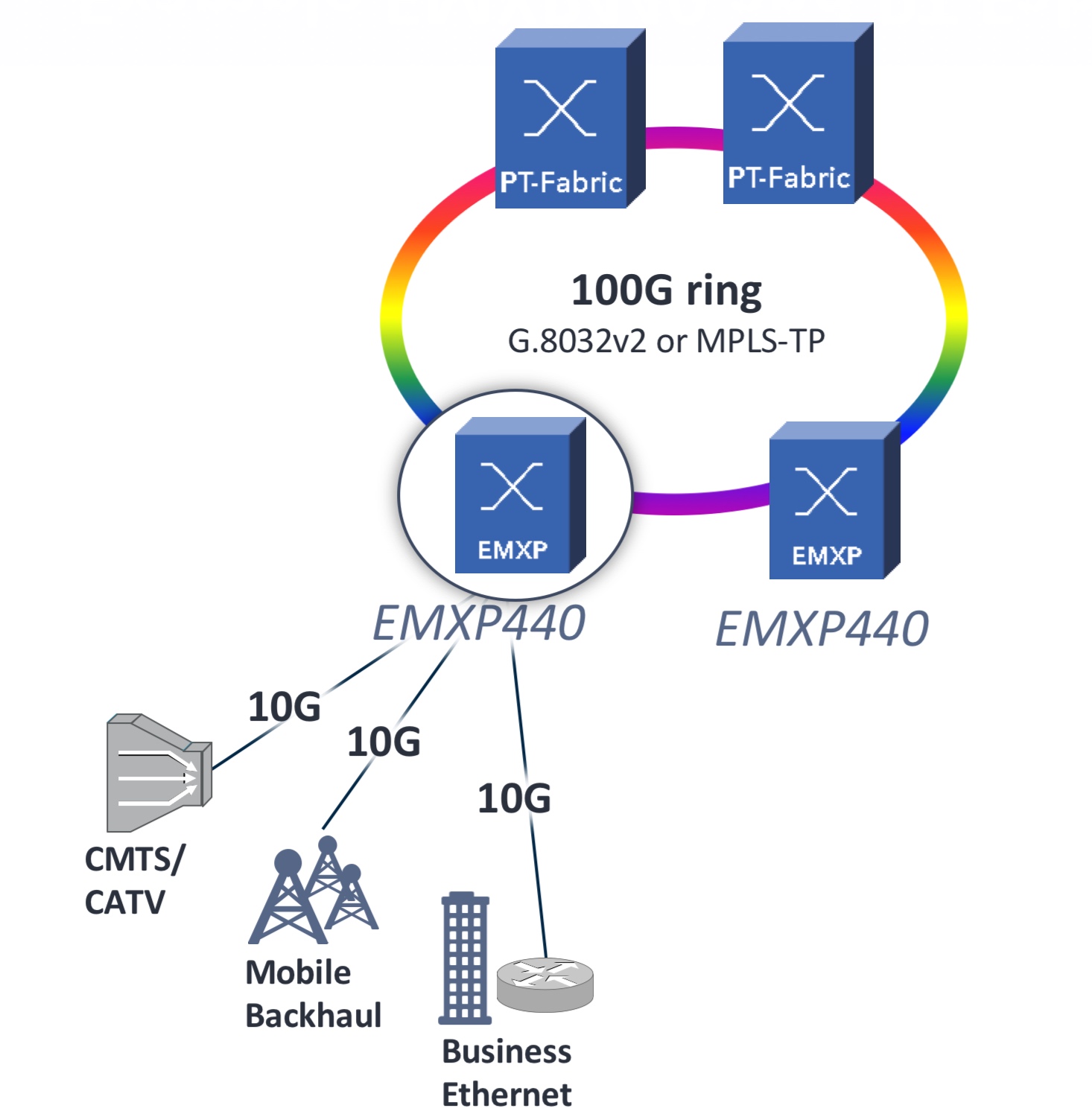
The EMXP440 packet-optical transport switch card supports layer-two functionality such as Carrier Ethernet 2.0 and MPLS-TP. “Mobile backhaul and residential broadband, these are the cards the operators tend to use,” says Bennett.
The two-slot EMXP440 card has two CFP2-DCOs and 12 SFP+ client-side interfaces. The reason why the line side and client side interface capacity differ (400 gigabits versus 120 gigabits) is that the card can be used to build simple packet rings (see diagram, top).
The line-side interfaces can be used for ‘East’ and ‘West' traffic while the SFP+ modules can be used to add and drop signals. The EMXP440 card also has an MPO port such that up to 12 SFP+ further ports can be added using Infinera’s PTIO-10G card, part of its PT Fabric products.
A flexible grid open line system is also available for the XTM II. The XTM II’s 100-gigabit and 200-gigabit wavelengths fit within a 50GHz-wide fixed grid channel but Infinera is already anticipating future higher baud rates that will require channels wider than 50GHz. A flexible grid also improves the use of the fibre’s overall capacity. In turn, RAMAN amplification will also be needed to extend the reach using future higher order modulation schemes such as 32- and 64-QAM.
Infinera says the 400-gigabit flexponder card will be available in the next quarter while the 200-gigabit muxponder and the EMXP440 cards will ship in the final quarter of 2017.
Infinera inches closer to cognitive networking
The second and final part as to how optical networking is becoming smarter
Infinera says it has made it easier for operators to deploy optical links to accommodate traffic growth.
The system vendor says its latest capability, known as Instant Network, also paves the way for autonomous networks that will predict traffic trends and enable capacity as required.
The latest announcement builds on Infinera’s existing Instant Bandwidth feature, introduced in 2012, that uses its photonic integrated circuit (PIC) technology.
Instant Bandwidth exploits the fact that all five 100-gigabit wavelengths of a line card hosting Infinera’s 500-gigabit PIC are lit even though an operator may only need a subset of the 100-gigabit wavelengths. Using Instant Bandwidth, extra capacity can be added to a link - until all five wavelengths are used - in a matter of hours.
The technology allows 100-gigabit wavelengths to be activated in minutes, says Geoff Bennett, director, solutions and technology at Infinera (pictured). It takes several hours due to the processing time for the operator to raise a purchasing order for the new capacity and get it signed off.
Instant Bandwidth has been enhanced since its introduction. Infinera has introduced its latest generation 2.4 terabit PIC which is also sliceable. With a sliceable PIC, individual wavelengths can be sent to different locations using reconfigurable optical add-drop multiplexer (ROADM) technology within the network.
Another feature added is time-based Instant Bandwidth. This allows an operator to add extra capacity without first raising a purchase order. Paying for the extra capacity is dealt with at a later date. This feature has already benefited operators that have experienced a fibre cut and have used Instant Bandwidth to reroute traffic.
Infinera says over 70 of its customers use Instant Bandwidth. These include half of its long-haul customers, its top three submarine network customers and over 60 percent of its data centre interconnect players that use its Cloud Xpress and XTS products. Some of its data centre interconnect customers request boxes with all the licences already activated, says Bennett.
The internet content providers are banging the drum for cognitive networking
Instant Network
Now, with the Instant Network announcement, Infinera has added a licence pool and moveable licences. The result is that an operator can add capacity in minutes rather than hours by using its pool of prepaid licenses.
Equally, if an operator wants to reroute a 100-gigabit or 200-gigabit wavelength to another destination, it can transfer the same licence from the original end-point to the new one.
“They [operators] can activate capacity when the revenue-generating service asks for it,” says Bennett.
Another element of Instant Network still to be introduced is the Automated Capacity Engineering that is part of Infinera’s Xceed software.
 Source: Infinera
“Automated Capacity Engineering will be an application that runs on Xceed,” says Bennett. The Automated Capacity Engineering is an application running on the OpenDaylight open source software-defined networking (SDN) controller that takes advantage of plug-ins that Infinera has added to the Xceed platform such as multi-layer path computation and traffic monitoring.
Using this feature, the SDN orchestrator can request a 100 Gigabit Ethernet private line, for example. If there is insufficient capacity, the Automated Capacity Engineering app will calculate the most cost-effective path and install the necessary licences at the required locations, says Bennett.
“We think this is leading the way to cognitive networking,” he says. “We have the software foundation and the hardware foundation for this.”
Networks that think
With a cognitive network, data from the network is monitored and fed to a machine learning algorithm to predict when capacity will be exhausted. New capacity can then be added in a timely accordingly.
Bennett says internet content providers, the likes of Google, Microsoft and Facebook, will all deploy such technology in their networks.
Being consumers of huge amounts of bandwidth, they will be the first adopters. Wholesale operators which also serve the internet content providers will likely follow. Traditional telecom operators with their more limited traffic growth will be the last to adopt such technology.
But cognitive networking is not yet ready. “The machine learning algorithms are still basic,” says Bennett. “But the biggest thing that is missing is the acceptance [of such technology] by network operations staff.”
However, this is not an issue with the internet content providers. “They are banging the drum for cognitive networking,” says Bennett.
Part 1: Ciena's Liquid Spectrum, click here
Infinera introduces flexible grid 500G super-channel ROADM
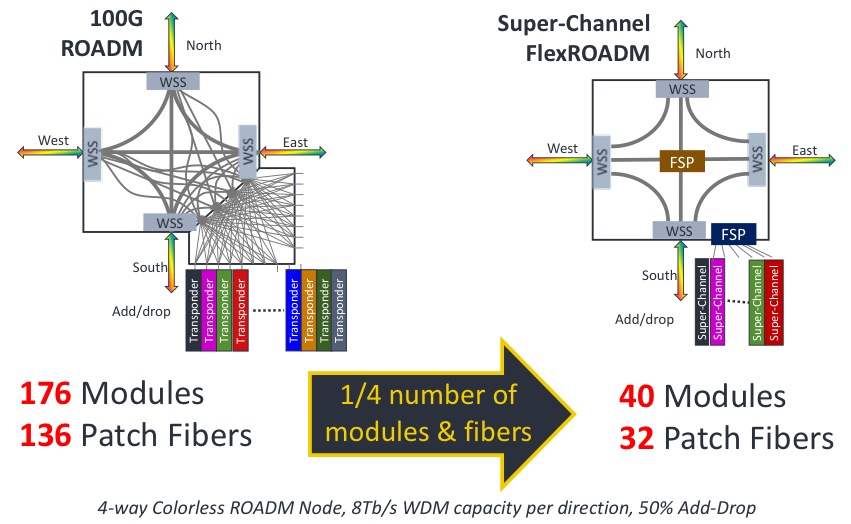 An example showing the impact of a 500G super-channel ROADM node. Source: Infinera
"The FlexROADM will open up the Tier-1 operators in a way Infinera has not been able to do before," says Dana Cooperson, vice president, network infrastructure at market research firm, Ovum. "The DTN-X was necessary but not sufficient; the ROADM is the last piece."
The FlexROADM is claimed to deliver two industry firsts: it can add and drop flexible-grid-based 500 Gig super-channels, and uses the Internet Engineering Task Force’s (IETF) spectrum switched optical networks (SSON).
"SSON is the next generation of WSON [Wavelength Switched Optical Network control plane], except it manages spectrum," says Ron Kline, principal analyst, network infrastructure also at Ovum.
The DTN-X platform combines Infinera's 500 Gig photonic integrated circuits and OTN (Optical Transport Network) switching. With the FlexROADM, Infinera has added switching at the optical layer in 500 Gig increments. Infinera can now offer enhanced multi-layer network optimisation with the combination of electrical and optical switching.
"Optical bypass before was manual using patch cords, now operators can reconfigure with the FlexROADM," says Kline. "It also provides new optical restoration capabilities that Infinera did not have."
The FlexROADM supports up to nine degrees, and is available in colourless, colourless and directionless, and full colourless, directionless and contentionless (CDC) versions.
"The debate about contentionless continues," says Kline. "It is safe to assume that for the majority of applications flexible grid, colourless and directionless will be the high runner." Contentionless will be used by the big carriers, he says, but in certain locations only.
Infinera says the line system announced will support up to 24 Terabit-per-second (Tbps) when it ships in September. The maximum long-haul capacity using its current PM-QPSK super-channels is 9.5Tbps per fibre pair.
"In the future when we enable metro-reach super-channels using PM-16-QAM, they will support 24 Terabit-per-second per fibre pair using the line system we are announcing," says Geoff Bennett, director, solutions and technology at Infinera.
Bennett says the data rate and the spectral efficiency for a given sub-carrier can be varied depending on the reach required. The spacing between sub-carriers that make up a super-channel also can be varied depending on reach. Many different transmission possibilities exist, says Bennett, but to explain the concept, he cites two examples.
The 24Tbps capacity with PM-16-QAM modulation uses pulse shaping at the transmitter to achieve 'Nyquist DWDM' channel spacing, the spacing between channels that approximates the baud rate, says Bennett.
"At this time we are not disclosing the details of the channel spacing, or the number of sub-carriers used by our future line modules," says Bennett. "But the total super-channel spectral width is the equivalent of 200GHz if you are transmitting a one Terabit super-channel, for example." This equates to a spectral efficiency of 5b/s/Hz, and using 16-QAM, the reach achieved will be 600-700km.
"The system we have just launched is designed to operate in long-haul networks and uses PM-QPSK," says Bennett. "For an ultra long-haul reach requirement of 4,500km, the super-channel comprises ten sub-carriers; a total of 500 Gbps over a spectral width of 250 GHz." These line cards are available now, he says.
Infinera continues to make steady market progress, according to Ovum. The company is in the top 10 system vendors globally, while in backbone and 100 Gigabit, Infinera is fourth.