

oDAC: Boosting data centre speeds with less power

Academics have developed an optical digital-to-analogue converter (oDAC) that promises to rethink how high-speed optical transmission is done.
Conceived under the European Commission-funded Flex-Scale project for 6G front-haul, the oDAC also promises terabit links inside the data centre.
The oDAC is expected to deliver a 40 per cent power savings for a 1.6 terabit optical transmitter, the ‘send’ path of an optical module.
“It might not be not 50 or 60 per cent, but in this field, even a 25 per cent power saving turns heads,” says Ioannis Tomkos, a professor at the Department of Electrical and Computer Engineering at the University of Patras, Greece, one of the researchers leading the work.
The first proof-of-concept oDAC photonic integrated circuit (PIC) has sent 250 gigabits per second (Gbps) over a single wavelength as part of the European Proteus programme.
The goal is to bring the oDAC to market in 2026.
High-speed optical transmission challenges
An optical interface acts as a gateway between the electrical and optical domains.
The main two classes of optical interfaces—pluggable modules for the data centre and coherent designs for longer-distance links—continue to grow in data rate.
The upcoming rate today is 1.6 terabits per second (Tbps), with 3.2Tbps optical links are in development. But going faster adds design complexity and consumes extra power.
Faster electrical signalling must use encoding schemes such as 4-level pulse amplitude modulation (PAM-4). And in the optical domain, PAM-4 is used in the data centre while higher-order modulation schemes such as 16-ary quadrature amplitude modulation (16-QAM) are used for long-haul optical transmissions. Quadrature amplitude modulation uses amplitude and phase modulation thyat doubles transmission capacity.
Such schemes require fast analogue-to-digital converters (ADCs), digital-to-analogue converters (DACs), and digital signal processing (DSPs) to compensate for transmission impairments. But as speeds increase, so does the signalling complexity and sampling rates, driving up the overall cost and power consumption.
The trends are leading researchers to consider alternative approaches, such as signal processing in the optical domain, to lessen the demands placed on the DSP and its DACs and ADCs. Researchers are even wondering if such an approach could remove the DSP altogether.
“Step by step,” cautions Tomkos.
Tomkos is working with Professor Moshe Nazarathy, a founder of the oDAC work, at the Faculty of Electrical Engineering at Technion University, Israel.
And it is developing the oDAC where they have first focussed their efforts.
Electronic DAC versus the oDAC
One way to view the oDAC is as a high-speed optical modulator. Another is as a multiplexer of multiple optical amplitude data streams.
The oDAC is a fundamental building block that trades extra optical components to simplify the electrical drivers for the high-speed transmitter. This is how the 40 per cent power saving is achieved.
The oDAC’s architecture is similar to that of a coherent optical transmitter but with notable differences.

In a coherent optical transmitter setup, the laser source is split evenly to feed the in-phase and quadrature Mach-Zehnder modulators (MZMs), with a 90-degree phase shifter in one of the modulator’s arms (see diagram above, left).
In contrast, the oDAC employs a variable splitter and a combiner at the input and output stages, paired with identical Mach-Zehnder modulators (no phase shifter is used in one of the modulator’s arms, see diagram, right). The ODACs can be used in a nested arrangement, as part of in-phase and quadrature arms, for coherent optical transmission.
Conventional electronic DACs (eDACs in the diagram) sample the data at least as high as the symbol rate and have a finite bit resolution, which limits the higher-order modulation schemes that can be used.
They are used to drive the optical Mach-Zehnder modulator, which has a non-linear sine-shaped response. The non-linearity forces the modulator to work only in the linear region of its transfer function. (See graph below.)

This curtailing of the driver saves power but results in ‘modulator loss’ – the full potential of the modulator is not being used, impacting signal recovery at the optical receiver.
In contrast, the oDAC can drive fully the modulator, thereby avoiding the modulator backoff loss.
Another key oDAC benefit is that each of its Mach-Zehnder modulators is driven using simpler PAM driver chips to produce higher-order PAM signals: two standard PAM-4 drivers can produce PAM-16 and using two oDAC PAM-16s can be used to generate PAM-256 (each symbol carrying 4- or 8-bits, respectively).
No commercial electronic PAM-16 drivers exist, says Tomkos.
Scaling data rates using PAM-4 drivers
A PAM-4 driver for the oDAC’s Mach-Zehnder modulator arm produces a four-level “staircase” waveform. Adjusting the oDAC’s splitter ratio to 4:1 and summing the outputs yields 16 distinct levels (diagram, below)

n effect, two simple signals can be stacked in multiple combinations to mimic a complex one. For PAM-16, one Mach-Zehnder modulator handles levels 0, 1, 2, and 3, while the other one, scaled differently (e.g., 0, 4, 8, 12), ensures a sum from 0 to 15.
The catch? Achieving a smooth staircase signal requires precise in-phase combining and level controls so there are no differences between the two Mach-Zehnder arms, which requires careful circuit control.
“Every programmable photonic circuit in general, for whatever application, needs some parametric control of the actual circuit,” says Tomkos. “For our case, it is so that it will not deviate if you change the temperature if you have vibrations or any other environmental changes.”

David Moor, a post-doctorate researcher at ETH-Zürich, part of the Flex-Scale project, and the director of photonic IC design at Emitera, the start-up tasked with bringing the oDAC to market, has been putting the prototype oDAC photonic integrated circuit through lab tests.
To send 500 Gbps over a single wavelength, a two-arm oDAC is used, with each PAM4-driven arm operating at 120 gigabaud symbol rate, or 250Gbps. While using two oDACs feeding an in-phase and quadrature coherent structure, doubles the data rate to 1Tbps.
Then, using a pair of PAM-16 oDACs (each driven by a pair of PAM-4 signals, in-phase and quadrature-combined in a coherent transmitter structure, further doubles the data rate to 1.6Tbps.

Transmissions at 3.2 terabits would need the symbol rate at 240 GBd.
What next?
Professor Nazarathy, working with Professor Birbas and his team at the University of Patras, are developing an FPGA-based control system to ensure the device operates optimally in real-world conditions.
“In the lab, the device has been quite stable,” says Moor. But any environmental changes throw it off track. oDAC device needs robust control to be a commercial product.
A second-generation oDAC photonic integrated circuit design and an FPGA-based control system are in the works and are expected to be up and running in six months.
Applications: Data centres and front-haul
“The higher-order the modulation format used, from 16-QAM to 256-QAM, the less the distance,” says Tomkos. “This is a law of information theory. You cannot do otherwise; nobody can.”
But the benefit of the design grows the higher the modulation order and the higher bit rate. Thus, the oDAC comes into its own when using 16-QAM and higher-order signalling schemes.
Accordingly, the ODAC’s sweet spot is for links up to 20 or even 40km, where terabits of data can be pushed over an optical wavelength. This makes the oDAC concept ideal for “coherent-lite” spans between campuses and when used inside the data centre.


Adtran broadens its OLS and access module offerings
Adtran has unveiled two products before the OFC show in San Francisco taking place at the end of the month.
One is a 50 gigabit-per second (Gbps) SFP56 optical transceiver that uses 4-level pulse-amplitude modulation (PAM-4) for 5G front-haul and enhanced broadband applications.
The second product is the FSP 3000 IP OLS, a compact open line system (OLS) designed for point-to-point links between sites 120km apart.
The OLS has been developed to simplify the setting up of dense wavelength division multiplexing (DWDM) optical links.
Enhancing broadband
Adtran has been developing a range of transceiver products to address specific requirements in the access-aggregation marketplace.
These include the MicroMux Edge Bidi, a QSFP+ pluggable module that supports 4×10 gigabit signals over 40km for mobile backhaul and enterprise wireless applications.
Adtran also offers the AccessWave25, a 25-gigabit tunable wavelength transceiver in an SFP28 form factor with a reach of 40km.
The pluggable module is used to link remote physical layer devices (RPDs) in cable operators’ networks. Cable operators are upgrading their infrastructure from 10 gigabits to 25 gigabits to support DOCSIS 4.0.
“You can argue if DOCSIS 4.0 is here or coming at the year-end,” says Saeid Aramideh, vice president of business development, optical engines business unit, at Adtran. “But there is no argument about the need for 25-gigabit uplinks for the cable MSO market.”
Now Adtran is announcing the AccessWave50, a 50-gigabit SFP56 optical module for fronthaul, part of the radio access network (RAN) and for other developments driving traffic such as smart homes, Internet of Things, and Smart Cities.
Aramideh refers to these applications as driving ‘enhanced’ broadband networks, requiring the upgrading of 25 gigabit links to 50- and even 100-gigabit ones.
Front-haul networks
For mobile, telco operators and RAN equipment makers are working with optical component makers to drive innovation in pluggables for emerging architectures such as enhanced 5G and 6G, says Aramideh.
In mobile networks, the front-haul network carries radio signals using the CPRI (common public radio interface) or enhanced CPRI protocols between the remote radio heads and the baseband units.
For 5G front-haul, the modules used are mainly at 10 gigabits-per-second (Gbps) with some 25-gigabit modules deployed. Adtran’s AccessWave50 addresses the next speed hike.
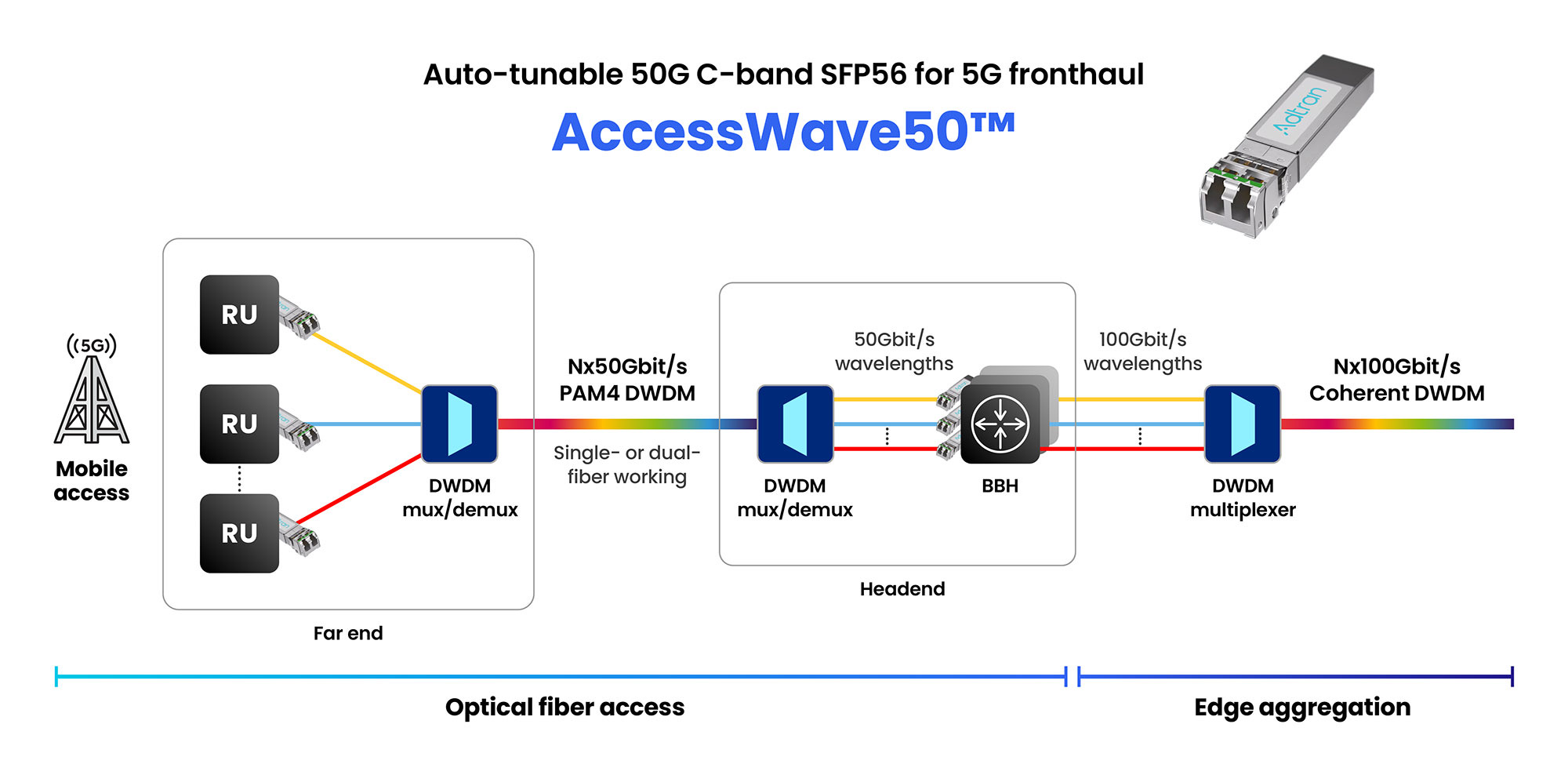
Adtran has designed the AccessWave50 using proprietary signal-shaping and distance optimisation techniques along with 4-level pulse amplitude modulation (PAM-4) to achieve the 50Gbps line rate.
“PAM-4 is proving itself to be a cost-performance-optimised technology and give you spectral efficiency as you go to higher data rates,” says Aramideh. “Of course, it’s not coherent optics, but you don’t need coherent for all applications.”
AccessWave50 uses a tunable laser and has a 15km, not 40km reach, but that is sufficient, says Aramideh, since front-haul networks are latency-constrained. The SFP56 module consumes 2.5W only.
Compact networking
Adtran has also unveiled its latest open line system (OLS) for C-band coherent transceivers.
The company has been providing bespoke OLS systems for hyperscalers. ADVA, the company Adtran acquired in 2022, provided Microsoft with the OLS that, working with the original ColorZ modules from Marvell, enabled 100 gigabit PAM-4 transmissions over 80km links.
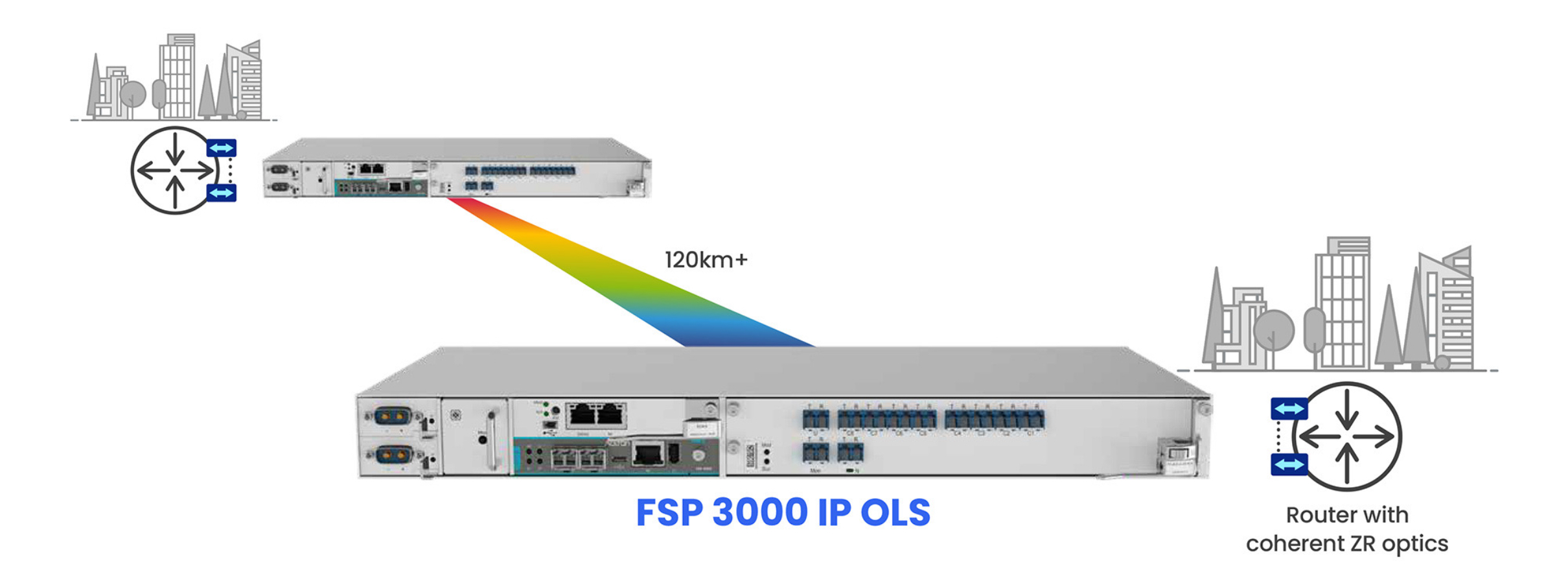
Adtran also provides an OLS for data centre interconnects using 400ZR coherent modules for reaches of 120km.
The latest FSP 3000 IP OLS platform is a compact one-rack (1RU) high box that supports eight wavelengths over 120km.
The platform also includes an OTDR (optical time domain reflectometer) for fibre diagnostics.
The OLS can be used with 400-gigabit, 800-gigabit, and ultimately 1.6 terabit coherent pluggable modules once available.
The OLS is also designed for telecom metro interconnect networks. “Telcos, in response to AI, are also looking for OLS technology tailored to coherent transceivers,” says Stephan Rettenberger, senior vice president of marketing and corporate communications at Adtran.
A chief design challenge has been to fit the OLS into a 1 RU form factor, requiring integration and packaging work. The OLS has also been designed to be set up and operated straightforwardly.
The platform is scalable: two racks stacked double the wavelength counts to 16.
The FSP 3000 IP OLS product is already in the hands of one telco customer, says Rettenberger.
