

Is the tunable laser market set for an upturn?
Part 2: Tunable laser market
"The tunable laser market requires a lot of patience to research." So claims Vladimir Kozlov, CEO of LightCounting Market Research. Kozlov should know; he has spent the last 15 years tracking and forecasting lasers and optical modules for the telecom and datacom markets.
 Source: LightCounting, Gazettabyte
The tunable laser market is certainly sizeable; over half a million units will be shipped in 2014, says LightCounting. But the market requires care when forecasting. One subtlety is that certain optical component companies - Finisar, JDSU and Oclaro - are vertically integrated and use their own tunable lasers within the optical modules they sell. LightCounting counts these as module sales rather than tunable laser ones.
Another issue is that despite the development of advanced reconfigurable optical add/ drop multiplexers (ROADMs) and tunable lasers, the uptake of agile optical networking has been limited.
"Verizon is bullish on getting the next generation of colourless, directionless and contentionless ROADMS to reconfigure the network on-the-fly," says Kozlov. "But I'm not so sure Verizon is going to be successful in convincing the industry that this is going to be a good market for [ROADM] suppliers to sell into."
Reconfigurability helps engineers at installations when determining which channels to add or drop, but there is little evidence of operators besides Verizon talking about using ROADMS to change bandwidth dynamically, first in one direction and then the other, he says.
Another indicator of the reduced status of tunable lasers is NeoPhotonics's intention to purchase Emcore's tunable external cavity laser as well as its module assets for US $17.5 million. Emcore acquired the laser when it bought Intel's optical platform division for $85 million in 2007, while Intel acquired it from New Focus in 2002 for $50 million. NeoPhotonics has also spent more in the past: it bought Santur's tunable laser for $39 million in 2011.
"There was so much excitement with so many players [during the optical bubble of 1999-2000], the market was way too competitive and eventually it drove vendors to the point where they would prefer to sell the business for pennies rather than keep it running," says Kozlov. "Emcore has been losing money, it is not a highly profitable business." Yet for Kozlov, Emcore's tunable laser is probably the best in the business with its very narrow line-width compared to other devices.
Tunable laser market
Tunable lasers have failed to get into the mainstream of the industry. "If you look at DWDM, I'm guessing that 70 percent of lasers sold are still fixed wavelength or temperature-tunable over a few wavelengths," says Kozlov. System vendors such as Huawei and ZTE advertise their systems with tunable lasers. "But when we asked them how they are using tunable lasers, they admitted that the bulk of their shipments are fixed-wavelength devices because whatever little they can save on cost, they will."
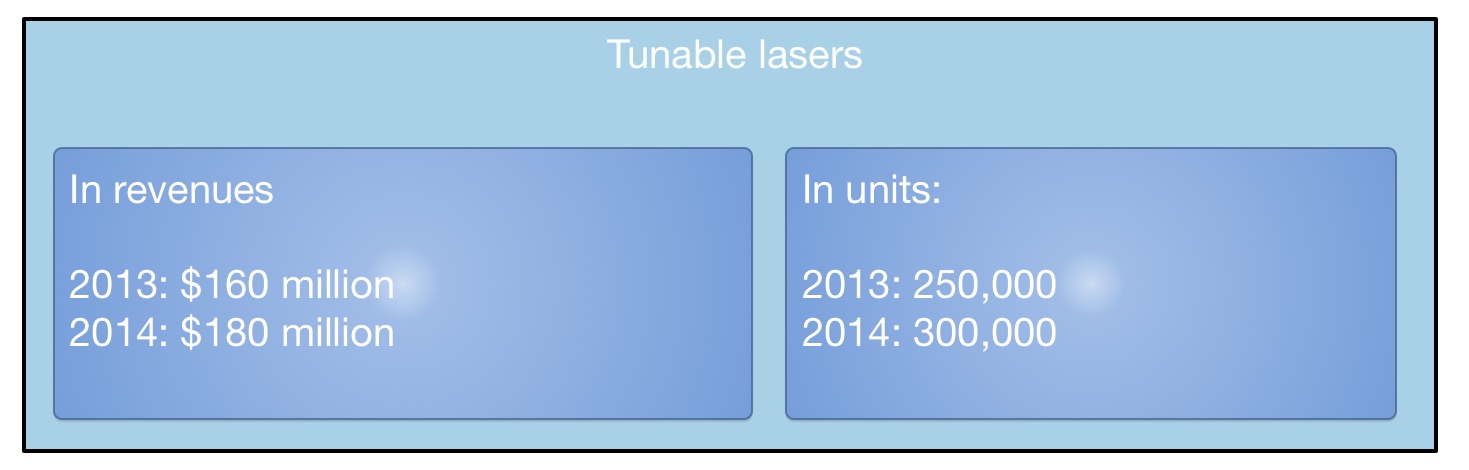
LightCounting valued the 2013 tunable laser market at $160 Million, growing to $180 Million in 2014. This equates to 250,000 units sold in 2013 and 300,000 units this year. "Most of these are for coherent systems," says Kozlov. The number of tunable lasers sold in modules - mainly XFPs but also SFPs and 300-pin modules - is 250,000 million units. "Half a million units a year; if you look at actual shipments, it is quite a lot," says Kozlov.
What next?
"I'm hoping we are reaching the low point in the tunable laser market as vendors are struggling and sales are at a very low valuation," says Kozlov.
The advent of more complex modulation schemes for 400 Gigabit and greater speed optical transmission, and the adoption of silicon photonics-based modulators for long haul will require higher powered lasers. But so much progress has been made by laser designers over the last 15 years, especially during the bubble, that it will last the industry for at least another decade or two, says Kozlov: "Incremental progress will continue and hopefully greater profitability."
For Part 1: NeoPhotonics to expand its tunable laser portfolio, click here

NeoPhotonics to expand its tunable laser portfolio
Part 1: Tunable lasers
NeoPhotonics will become the industry's main supplier of narrow line-width tunable lasers for high-speed coherent systems once its US $17.5 million acquisition of Emcore's tunable laser business is completed. Gazettabyte spoke with Ferris Lipscomb of NeoPhotonics about Emcore's external cavity laser and the laser performance attributes needed for metro and long haul.
 Key specifications and attributes of Emcore's external cavity laser and NeoPhotonics's DFB laser array. Source: NeoPhotonics.
Emcore and NeoPhotonics are leading suppliers of tunable lasers for the 100 Gigabit coherent market, according to market research firm Ovum. NeoPhotonics will gain Emcore's external cavity laser (ECL) on the completion of the deal, expected in January. The company will also gain Emcore's integrable tunable laser assembly (ITLA), micro ITLA, tunable XFP transceiver, tunable optical sub-assemblies, and 10, 40, 100 and 400 Gig integrated coherent transmitter products.
Emcore's ECL has a long history. Emcore acquired the laser when it bought Intel's optical platform division for $85 million in 2007, while Intel acquired the laser from New Focus in 2002 in a $50 million deal. Meanwhile, NeoPhotonics bought Santur's distributed feedback (DFB) tunable laser array in 2011 in a $39 million deal.
The two lasers satisfy different needs: Emcore's is suited for high-speed long distance transmission while NeoPhotonics's benefits metro and intermediate distances.
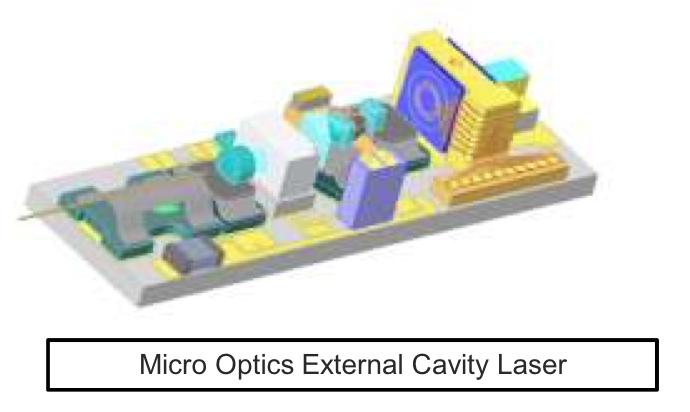
The Emcore laser uses mirrors and optics external to the gain medium to create the laser's relatively long cavity. This aids high-performance coherent systems as it results in a laser with a narrow line-width. Coherent detection uses a mixing technique borrowed from radio where an incoming signal is recovered by compared it with a local oscillator or tone. "The narrower the line-width, the more pure that tone is that you are comparing it to," says Lipscomb.
 Source: NeoPhotonics
A narrower line-width also means less digital signal processing (DSP) is needed to resolve the ambiguity that results from that line-width, says Lipscomb: "And the more DSP power can be spent on either compensating fibre impairments or going further [distances], or compensating the higher-order modulation schemes which require more DSP power to disentangle."
The ECL has a narrow line-width that is specified at under 100kHz. "It is probably closer to 20kHz," says Lipscomb. One of the laser's drawbacks is that its uses a mechanical tuning mechanism that is relatively slow. It also has a lower output power of 16dBm compared to NeoPhotonics's DFB laser array that is up to 18dBm.
The metro market for 100 Gig coherent will emerge in volume towards the end of 2015 or early 2016
In contrast, NeoPhotonics' DFB laser array, suited to metro and intermediate reach applications, has a wider line-width specified at 300kHz, although 200kHz is typical. The DFB design comprises multiple lasers integrated compactly. The laser design also uses a MEMS that results in efficient coupling and the higher - 18dBm - output power. "Using the MEMS structure, you can integrate the laser with other indium phosphide or silicon photonics devices," says Lipscomb. "That is a little bit harder to do with the Emcore device."
 Source: NeoPhotonics
It is the compactness and higher power of the DFB laser array that makes it suited to metro networks. The higher output power means that one laser can be used for both transmission and the local oscillator used to recover the received coherent signal. "More power can be good if you can live with the broader line-width," says Lipscomb. "It reduces overall system cost and can support higher-order modulation schemes over shorter distances."
Market opportunities
NeoPhotonics' focus is on narrow line-width lasers for coherent systems operating at 100 Gigabit and greater speeds. Lipscomb says the metro market for 100 Gig coherent will emerge in volume towards the end of 2015 or early 2016. "The distance here is less and therefore less compensation is needed and a little bit more line-width is tolerable," he says. "Also cost is an issue and a more integrated product can have potentially a lower cost."
For long haul, and especially at transmission rates of 200 and 400 Gig, the demands placed on the DSP are considerable. This is where Emcore's laser, with is narrow line-width, is most suited.
System vendors are already investigating 400 Gig and above transmission speeds. "For the high-end, line-width is going to be a critical factor," says Lipscomb. "Whatever modulation schemes there are to do the higher speeds, they are going to be the most demanding of laser performance."
For Part 2: Is the tunable laser market set for an upturn? click here