

Edgecore exploits telecom’s open-networking opportunity
Edgecore Networks is expanding its open networking portfolio with cell-site gateways and passive optical networking (PON) platforms.
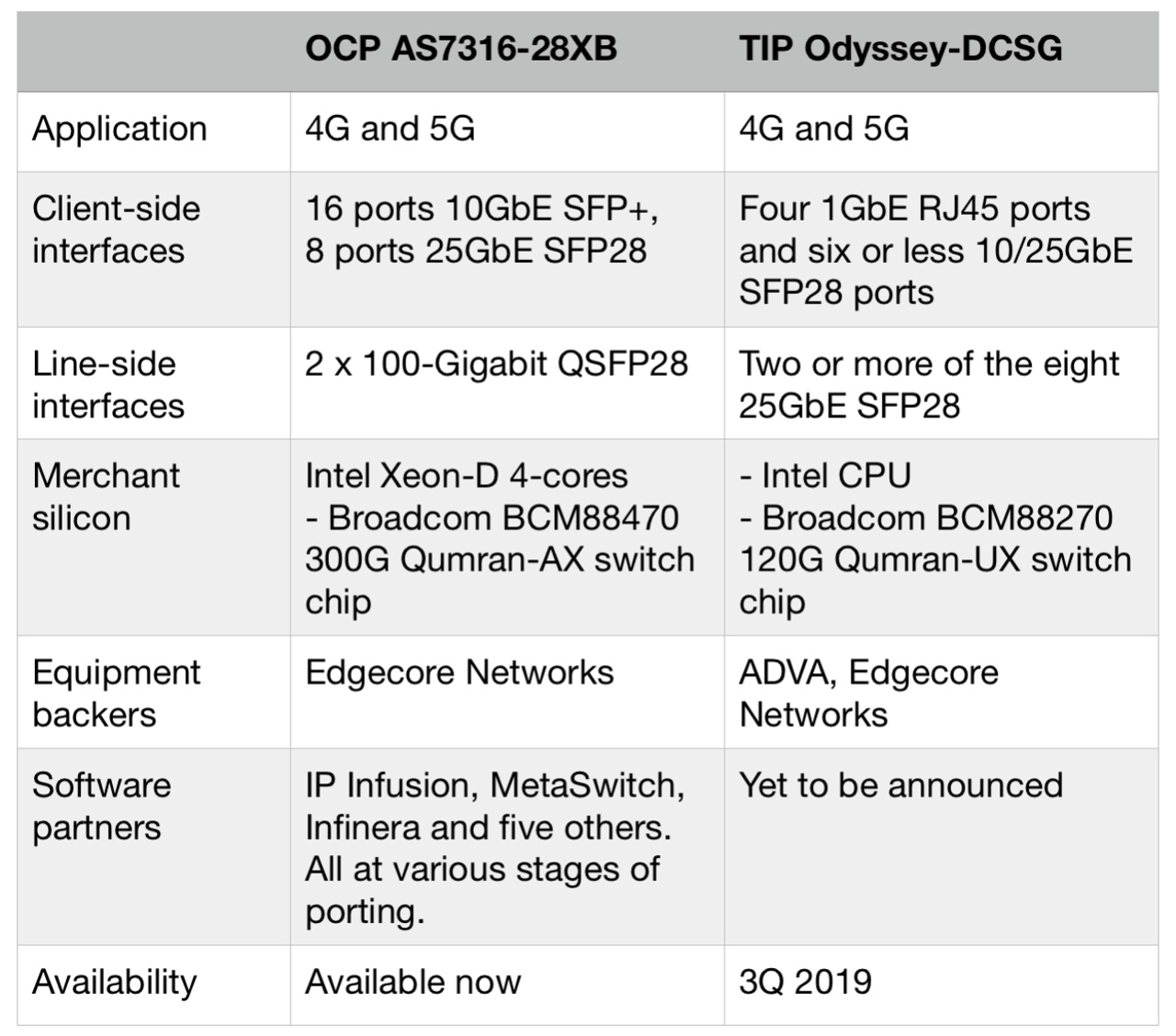
The company is backing two cell-site gateway designs that aggregate traffic from baseband units for 4G and 5G mobile networks. One design is from the Open Compute Project (OCP) that is available now and the second is from the Telecom Infra Project (TIP) that is planned for 2019 (see table).
Edgecore has also announced PON optical line terminal (OLT) platforms addressing 10-gigabit XGS-PON and GPON.
 Source: ADVA, Edgecore Networks
Edgecore is a wholly-ownedsubsidiary of Accton Technology, a Taiwanese original design manufacturer (ODM) employing over 700 networking engineers that reported revenues exceeding $1.2 billion in 2017.
Open networking
Edgecore is a leading proponent of open networking that first data centre operators and now telecom operators are adopting.
Open networking refers to disaggregated designs where the hardware and software comes from separate companies. The hardware is a standardised white box developed in an open framework, while the accompanying software can be commercial code from a company or open-sourced.
Our focus is on all those attributes of open networking: disaggregation, the hardware and software design of standard platforms, and making those designs open
Telecom networks have traditionally been built using proprietary equipment from systems vendors that includes the complete software stack. But the leading telcos have moved away from this approach to avoid being locked into a systems vendor's roadmap. Instead, they are active in open frameworks and are embracing disaggregated open designs, having seen the benefits achieved by the internet content providers that pioneered the approach.
“The IT industry for years have been buying servers and purposing them for whatever application they are designated for, adding an operating system and application software on top,” says Mark Basham, vice president business development and marketing, EMEA at Edgecore. “Now we are seeing the telecom industry shift to that model; they see where the value should be.”
White-box platforms built using merchant silicon promise to reduce the number of specialised platforms in an operator’s network, reducing costs by simplifying platform qualification and support.
“Our focus is on all those attributes of open networking: disaggregation, the hardware and software design of standard platforms, and making those designs open,” says Bill Burger, vice president, business development and marketing for North America at Edgecore.
OCP, TIP and ONF
Edgecore is active in three leading open framework initiatives whose memberships include large-scale data centre operators, telcos, equipment makers, systems integrators, software partners and chip players.
Edgecore is a member of OCP that was founded to address the data centre but now plays an important role in telecoms. The company is also part of TIP that was established in 2016 and includes internet giants Facebook and Microsoft as well as leading telecom operators, systems vendors, components players and others. Edgecore is also a key white-box partner as part of the Open Networking Foundation’s (ONF) reference-design initiative.
 Edgecore Networks' involvement in the ONF's reference design projects. Diagram first published in July 2018. Source: ONF.
Cell-site gateways
Edgecore has announced the availability of its AS7316-26XB, the industry’s first open cell-site gateway white-box design from the OCP that originated as an AT&T specification.
The company is also active in TIP’s cell-site gateway initiative. Edgecore will make and market the Odyssey Disaggregated Cell Site Gateway (Odyssey-DCSG) design that is backed by TIP’s operator members Telefonica, Orange, TIM Brazil and Vodafone. BT is also believed to be backing the TIP gateway.
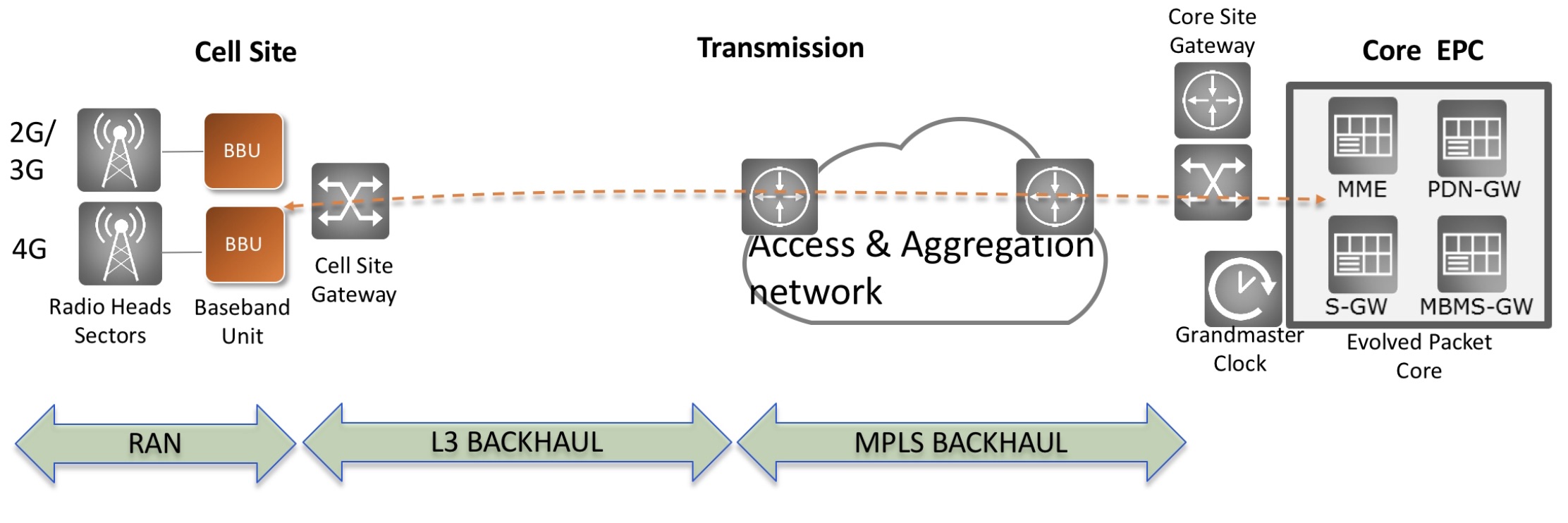
The gateway aggregates the radio baseband unit (BBU) at a cell site back into the transport network.
The OCP cell-site gateway has a more advanced specification compared to the Odyssey. The AS7316-26XB uses a more powerful Intel processor and employs a 300-gigabit Broadcom Qumran-AX switch chip that aggregates the baseband traffic for transmission into the network.
The platform’s client-side interfaces include 16 SFP+ ports that supports either 1 Gigabit Ethernet (GbE) SFP or 10GbE SFP+ pluggable modules, eight 25GbE ports that accommodate either 10GbE SFP+ or 25GbE SFP28 modules, and two 100GbE QSFP28 uplinks. Some of the 25GbE ports could be used to expand the uplink capacity, if needed.
In contrast, the TIP Odyssey-DCSG platform uses a 120-gigabit Qumran switch chip while its interfaces include provide four 1GbE RJ45 ports and eight 10GbE or 25GbE SFP28 ports. Accordingly, the platform’s uplinks are at 25GbE.
“They [the OCP and TIP gateways] are very different boxes in terms of their performance,” says Basham.
Current deployed mobile platforms don't have sufficient capacity to support LTE Advanced Pro, never mind 5G, says Basham: “All the operators are looking at what is the right time to insert these boxes in the network.”
Telcos need to decide how much they are willing to spend up front. They could deploy a larger capacity but costlier cell-site gateway to future-proof their mobile backhaul for up to a decade. Or they could install the smaller-capacity Odyssey-DCSG that will suffice for five years before requiring an upgrade.
Given that the largest operators will deploy the gateways in units of hundreds of thousands, the capital expenditure outlay will be significant.
Basham says there will be a family of cell-site gateways and points out that the TIP specification originally had three ‘service configurations’. The latest TIP specification document now has a fourth service configuration that differs significantly from the other three in its port count and capabilities. “It shows that there is no one-size-fits-all,” says Basham.
The company also has announced two open disaggregated PON products, part of the OCP.
The ASXvOLT16 is a 10-gigabit OLT platform that supports XGS-PON and NG-PON2. The open OLT platform uses Broadcom’s 800-gigabit Qumran-MX switch chip and its BCM68620 Maple OLT device.
The platform’s interfaces includes 16 XFP ports supporting 10-gigabit optics while for the uplink traffic, four 100GbE ports are used. Each 10-gigabit interface will support 32 or 64 PON optical network units (ONU) typically.
“To support NG-PON2 will require the virtual OLT hardware abstraction layer to be adapted slightly, and also firmware to be put on the Broadcom chips,” says Basham. “The big difference between XGS-PON and NG-PON2 is in the plug-in optics.” More costly tunable optics will be required for NG-PON2. The 1 rack unit (1RU) PON OLT design is available now.
Edgecore has also contributed GPON OLT designs that conform with Deutsche Telecom’s Open GPON OLT design. The Edgecore ASGvOLT32 and ASGvOLT64 GPON OLTs support 32- and 64-GPON ports, respectively, while there are two 100GbE and eight 25GbE uplink ports.
The two GPON OLTs will sample in the first quarter of 2019, moving to volume production one quarter later.
We are at the cusp of bringing together all the parts to make Cassini a deployable solution
Cassini
Edgecore is also bringing its Cassini packet-optical transport white-box platform to market.
Like TIP’s Voyager box, Cassini uses the Broadcom StrataXGS Tomahawk 3.2-terabit switch chip. But while the Voyager comes with built-in coherent interfaces based on Acacia’s AC-400 module, Cassini is a modular design that has eight card slots. Each slot can accommodate one of three module options: a coherent CFP2-ACO, a coherent CFP2-DCO or two QSFP28 100-gigabit pluggables. The Cassini platform also has 16 fixed QSFP28 ports.
Accordingly, the 1.5RU Cassini box can be configured using only the coherent interfaces required. The box could be set up as a 3.2-terabit switch using QSFP28 modules only or as a transport box with up to 1.6 terabits of client-side interfaces and 1.6 terabits of line-side coherent interfaces. This contrasts with the 1RU Voyager that offers 2 terabits of switch capacity with its dozen 100-gigabit client-side interfaces and 800 gigabits of coherent line-side capacity.
“We are at the cusp of bringing together all the parts to make Cassini a deployable solution,” says Basham. “The focus is to get it deployed in the market.”
Edgecore sees Cassini as a baseline for future products. One obvious direction is to increase the platform’s capacity using Broadcom’s 12.8-terabit Tomahawk 3 switch chip. Edgecore already offers a Tomahawk 3-based switch for the data centre.
Such a higher-capacity Cassini platform would support 400GbE client-side interfaces and 400- or 800-gigabit coherent line-side interfaces. “We think that there is a future need for such a platform but we are not actively developing it right now,” says Burger.
A second direction for Cassini’s development is as a platform suited to routeing using larger look-up tables and deep buffering. Such a platform would use merchant silicon such as Broadcom’s Jericho chip. “We think there is a need for that as service providers deploy packet transport platforms in their networks,” says Burger.
Business model
The Cassini platform arose as part of Edgecore’s detailed technology planning discussions with its leading internet content provider customers.
“We recognised a need for more modularity in an open-packet transponder, the ability to mix-and-match the number of packet switching interfaces with the coherent optical interfaces,” says Burger.
Edgecore then approached TIP before contributing the Cassini platform to the organisation’s Open Optical and Packet Transport group.
When Edgecore contributes a design to an open framework such as the OCP or TIP, the design undergoes a review resulting in valuable feedback from member companies.
“We end up making modifications to improve the design in some cases and it then goes through an approval process,” says Burger. “After that, we contribute the design package and its available to anyone without any royalty obligation.”
At first glance, it is not obvious how contributing a platform design that other firms can build benefits Edgecore. But Burger says Edgecore benefits is several ways.
The organisation members’ feedback improves the product’s design. Edgecore also raises industry awareness of its platforms including among the OCP’s and TIP’s large service provider members.
Making the design available to members also offers the operators a potential second source for Edcore’s white box designs, strengthening confidence and their appeal.
And once a design is open sourced, software partners including start-ups will investigate the design as a platform for their code which can result in partnerships. “This benefits us and benefits the software companies,” says Burger.
Edgecore stresses that open-networking platforms are going to take time before they become widely adopted across service providers’ networks.
“It is going to be an evolution, starting with high-volume, more standardised use cases,” concludes Burger.
Part 1: TIP white-box designs, click here

TIP launches a disaggregated cell-site gateway design
Four leading telecom operators, members of the Telecom Infra Project (TIP), have developed a disaggregated white-box design for cell sites. The four operators are Orange, Telefonica, TIM Brazil and Vodafone. BT is also believed to be backing the open-design cell-site venture.
 Source: ADVA
The first TIP cell-site gateway product, known as Odyssey-DCSG, is being brought to market by ADVA and Edgecore Networks.
TIP isn’t the only open design framework that is developing cell-site gateways. Edgecore Networks contributed in October a design to the Open Compute Project (OCP) that is based on an AT&T cell-site gateway specification. There are thus two overlapping open networking initiatives developing disaggregated cell-site gateways.
ADVA and Edgecore will provide the standardised cell-site gateways as operators deploy 5G. The platforms will support either commercial cell-site gateway software or open-source code.
“We are providing a white box at cell sites to interconnect them back into the network,” says Bill Burger, vice president, business development and marketing, North America at Edgecore Networks.
“The cell site is a really nice space for a white-box because volumes are high,” says Niall Robinson, vice president, global business development at ADVA. Vodafone alone has stated that it has 300,000 cell-site gateways that will need to be updated for 5G.
Odyssey-DCSG
A mobile cell site comprises remote radio units (RRUs) located on cell towers that interface to the mobile baseband unit (BBU). The baseband unit also connects to the disaggregated cell-site gateway with the two platforms communicating using IP-over-Ethernet. “The cell-site gateway is basically an IP box,” says Robinson.
The Odyssey gateway design is based on a general-purpose Intel microprocessor and a 120-gigabit Broadcom Qumran-UX switch chip.
The white box’s link speeds to the baseband unit range from legacy 10 megabit-per-second (Mbps) to 1 gigabit-per-second (Gbps). The TIP gateway’s uplinks are two 25-gigabit SFP28 modules typically. In contrast, the OCP’s gateway design uses a higher capacity 300-gigabit Qumran-AX switch chip and has two 100-gigabit QSFP28 uplink interfaces. “There is a difference in capacity [for the two designs] and hence in their cost,” says Robinson.
The cell-site gateway is basically an IP box
The cell-site gateways can be connected in a ring with the traffic fed to an aggregation unit for transmission within the network.
Robinson expects other players to join ADVA and Edgecore as project partners to bring the TIP gateway to market. To date, no software partners have been announced. First samples of the platform are expected in the first quarter of 2019 with general availability in the third quarter of 2019.
“Cell-site gateways is one of those markets that will benefit from driving a common design,” says Robinson. The goal is to get away from operators choosing proprietary platforms. “You have one design hitting the market and being chosen by the different end users,” he says. “Volumes go up and costs go down.”
ADVA is also acting as the systems integrator, offering installation, commissioning and monitoring services for the gateway. “People like disaggregation when costs are being added up but end users like things - especially in high volumes - to be reintegrated to make it easy for their operations folk,” says Robinson.
The disaggregated cell-site gateway project is part of TIP’s Open Optical and Packet Transport group, the same group that is developing the Voyager packet-optical white box.
 Source: Gazettabyte
Voyager
ADVA announced recently that the Voyager platform is now available, two years after being unveiled.
The 1-rack-unit Voyager platform uses up to 2 terabits of the 3.2-terabit Broadcom Tomahawk switch-chip: a dozen 100-gigabit client-side interfaces and 800 gigabits of coherent line-side capacity.
Robinson admits that the Voyager platform would have come to market earlier had SnapRoute - providing the platform’s operating system - not withdrawn from the project. Cumulus Networks then joined the project as SnapRoute’s replacement.
“This shows both sides of the white-box model,” says Robinson. How a collective project design can have a key member drop out but also the strength of a design community when a replacement can step in.
TIP has yet to announce Voyager customers although the expectation is that this will happen in the next six months.
Robinson identifies two use cases for the platform: regional metro networks of up to 600km and data centre interconnect.
“Voyager has four networking ports allowing an optical network to be built,” says Robinson. “Once you have that in place, it is very easy to set up Layer-2 and Layer-3 services on top.”
The second use case is data centre interconnect, providing enterprises with Layer-2 trucking connectivity services between sites. “Voyager is not just about getting bits across but about Layer-2 structures,” says Robinson.
The Voyager is not targeted at leading internet content providers that operate large-scale data centres. They will use specific, leading-edge platforms. “The hyperscalers have moved on,” says Robinson. “The Voyager will play in a different market, a smaller-sized data centre interconnect space.”
We will be right at the front and I think we will reap the rewards for jumping in early
Early-mover advantage
Robinson contrasts how the Voyager and TIP’s cell-site gateway were developed. Facebook developed and contributed the Voyager design to TIP and only then did members become aware of the design.
With the cell-site gateway, a preliminary specification was developed with one customer - Vodafone - before it was taken to other operators. These companies that make up a good portion of the cell site market worked on the specification before being offered to the TIP marketplace for development.
“This is the right model for a next-generation Voyager design,” says Robinson. Moreover, rather than addressing the hyperscalers’ specialised requirements involving the latest coherent chips and optical pluggable modules, the next Voyager design should be more like the cell-site gateway, says Robinson: “A little bit more bread-and-butter: go after the 100-gigabit market and make that more of a commodity.”
ADVA also believes in a first-mover advantage with open networking designs such as the TIP cell-site gateway.
“We have been involved for quite some time, as has Edgecore with which we have teamed up,” says Robinson. “We will be right at the front and I think we will reap the rewards for jumping in early.”
Part 2: Open networking, click here
Switch chips not optics set the pace in the data centre
Broadcom is doubling the capacity of its switch silicon every 18-24 months, a considerable achievement given that Moore’s law has slowed down.
Last December, Broadcom announced it was sampling its Tomahawk 3 - the industry’s first 12.8-terabit switch chip - just 14 months after it announced its 6.4-terabit Tomahawk 2.
 Rochan SankarSuch product cycle times are proving beyond the optical module makers; if producing next-generation switch silicon is taking up to two years, optics is taking three, says Broadcom.
“Right now, the problem with optics is that they are the laggards,” says Rochan Sankar, senior director of product marketing at switch IC maker, Broadcom. “The switching side is waiting for the optics to be deployable.”
The consequence, says Broadcom, is that in the three years spanning a particular optical module generation, customers have deployed two generations of switches. For example, the 3.2-terabit Tomahawk based switches and the higher-capacity Tomahawk 2 ones both use QSFP28 and SFP28 modules.
In future, a closer alignment in the development cycles of the chip and the optics will be required, argues Broadcom.
Switch chips
Broadcom has three switch chip families, each addressing a particular market. As well as the Tomahawk, Broadcom has the Trident and Jericho families (see table).

All three chips are implemented using a 16nm CMOS process. Source: Broadcom/ Gazettabyte.
“You have enough variance in the requirements such that one architecture spanning them all is non-ideal,” says Sankar.
The Tomahawk is a streamlined architecture for use in large-scale data centres. The device is designed to maximise the switching capacity both in terms of bandwidth-per-dollar and bandwidth-per-Watt.
“The hyperscalers are looking for a minimalist feature set,” says Sankar. They consider the switching network as an underlay, a Layer 3 IP fabric, and they want the functionality required for a highly reliable interconnect for the compute and storage, and nothing more, he says.
Right now, the problem with optics is that they are the laggards
Production of the Tomahawk 3 integrated circuit (IC) is ramping and the device has already been delivered to several webscale players and switch makers, says Broadcom.
The second, Trident family addresses the enterprise and data centres. The chip includes features deliberately stripped from the Tomahawk 3 such as support for Layer 2 tunnelling and advanced policy to enforce enterprise network security. The Trident also has a programmable packet-processing pipeline deemed unnecessary inlarge-scale data centres.
But such features are at the expense of switching capacity. “The Trident tends to be one generation behind the Tomahawk in terms of capacity,” says Sankar. The latest Trident 3 is a 3.2-terabit device.
The third, Jericho family is for the carrier market. The chip includes a packet processor and traffic manager and comes with the accompanying switch fabric IC dubbed Ramon. The two devices can be scaled to create huge capacity IP router systems exceeding 200 terabits of capacity. “The chipset is used in many different parts of the service provider’s backbone and access networks,” says Sankar. The Jericho 2, announced earlier this year, has 10 terabits of capacity.
Trends
Broadcom highlights several trends driving the growing networking needs within the data centre.
One is how microprocessors used within servers continue to incorporate more CPU cores while flash storage is becoming disaggregated. “Now the storage is sitting some distance from the compute resource that needs very low access times,” says Sankar.
The growing popularity of public cloud is also forcing data centre operators to seek greater servers utilisation to ‘pack more tenants per rack’.
There are also applications such as deep learning that use other computing ICs such as graphics processor units (GPUs) and FPGAs. “These push very high bandwidths through the network and the application creates topologies where any element can talk to any element,” says Sankar. This requires a ‘flat’ networking architecture that uses the fewest networking hops to connect the communicating nodes.
Such developments are reflected in the growth in server links to the first level or top-of-rack (TOR) switches, links that have gone from 10 to 25 to 50 and 100 gigabits. “Now you have the first 200-gigabit network interface cards coming out this year,” says Sankar.
Broadcom has been able to deliver 12.8 terabits-per-second in 16nm, whereas some competitors are waiting for 7nm
Broadcom says the TOR switch is not the part of the data centre network experiencing greatest growth. Rather, it is the layers above - the leaf-and-spine switching layers - where bandwidth requirements are accelerating the most. This is because the radix - the switch’s inputs and outputs - is increasing with the use of equal-cost multi-path (ECMP) routing. ECMP is a forwarding technique to distribute the traffic over multiple paths of equal cost to a destination port. “The width of the ECMP can be 4-way, 8-way and 16-way,” says Sankar. “That determines the connectivity to the next layer up.”
It is such multi-layered leaf-spine architectures that the Tomahawk 3 switch silicon addresses.
Tomahawk 3
The Tomahawk 3 is implemented using a 16nm CMOS process and features 256 50-gigabit PAM-4 serialiser-deserialiser (serdes) interfaces to enable the 12.8-terabit throughput.
“Broadcom has been able to deliver 12.8 terabits-per-second in 16nm, whereas some competitors are waiting for 7nm,” says Bob Wheeler, vice president and principal analyst for networking at the Linley Group.
Sankar says Broadcom undertook significant engineering work to move from the 16nm Tomahawk 2’s 25-gigabit non-return-to-zero serdes to a 16nm-based 50G PAM-4 design. The resulting faster serdes design requires only marginally more die area while reducing the gigabit-per-Watt measure by 40 percent.
The Tomahawk 3 also features a streamlined packet-processing pipeline and improved shared buffering. In the past, a switch chip could implement one packet-processing pipeline, says Wheeler. But at 12.8 terabit-per-second (Tbps), the aggregate packet rate exceeds the capacity of a single pipeline. “Broadcom implements multiple ingress and egress pipelines, each connected with multiple port blocks,” says Wheeler. The port blocks include MACs and serdes. “The hard part is connecting the pipelines to a shared buffer, and Broadcom doesn’t disclose details here.”
 Source: Broadcom.
The chip also has telemetry support that exposes packet information to allow the data centre operators to see how their networks are performing.
Adopting a new generation of switch silicon also has system benefits.
One is reducing the number of hops between endpoints to achieve a lower latency. Broadcom cites how a 128x100 Gigabit Ethernet (GbE) platform based on a single Tomahawk 3 can replace six 64x100GbE switches in a two-tier arangement. This reduces latency by 60 percent, from 1 microsecond to 400 nanoseconds.
There are also system cost and power consumption benefits. Broadcom uses the example of Facebook’s Backpack modular switch platform. The 8 rack unit (RU) chassis uses two tiers of switches - 12 Tomahawk chips in total. Using the Tomahawk 3, the chassis can be replaced with a 1RU platform, reducing the power consumption by 75 percent and system cost by 85 percent.
Many in the industry have discussed the possibility of using the next 25.6-terabit generation of switch chip in early trials of in-package optics
Aligning timelines
Both the switch-chip vendors and the optical module players are challenged to keep up with the growing networking capacity demands of the data centre. The fact that next-generation optics takes about a year longer than the silicon is not new. It happened with the transition from 40-gigabit QSFP+ to 100-gigabit QSFP28 optical modules and now from the 100-gigabit QSFP28 to 200 gigabit QSFP56 and 400-gigabit QSFP-DD production.
“400-gigabit optical products are currently sampling in the industry in both OSFP and QSFP-DD form factors, but neither has achieved volume production,” says Sankar.
Broadcom is using 400-gigabit modules with its Tomahawk 3 in the lab, and customers are doing the same. However, the hyperscalers are not deploying Tomahawk-3 based data center network designs using 400-gigabit optics. Rather, the switches are using existing QSFP28 interfaces, or in some cases 200-gigabits optics. But 400-gigabit optics will follow.
The consequence of the disparity in the silicon and optics development cycles is that while the data centre players want to exploit the full capacity of the switch once it becomes available, they can’t. This means the data centre upgrades conducted - what Sankar calls ‘mid-life kickers’ - are costlier to implement. In addition, given that most cloud data centres are fibre-constrained, doubling the number of fibres to accommodate the silicon upgrade is physically prohibitive, says Broadcom.
“The operator can't upgrade the network any faster than the optics cadence, leading to a much higher overall total cost of ownership,” says Sankar. They must scale out to compensate for the inability to scale up the optics and the silicon simultaneously.
Optical I/O
Scaling the switch chip - its input-output (I/O) - presents its own system challenges. “The switch-port density is becoming limited by the physical fanout a single chip can support, says Sankar: “You can't keep doubling pins.”
It will be increasingly challenging to increase the input-output (I/O) to 512 or 1024 serdes in future switchchips while satisfying the system link budget, and achieving both in a power-efficient manner. Another reason why aligning the scaling of the optics and the serdes speeds with the switching element is desirable, says Broadcom.
Broadcom says electrical interfaces will certainly scale for its next-generation 25.6-terabit switch chip.
Linley Group’s Wheeler expects the 25.6-terabit switch will be achieved using 256 100-gigabit PAM4 serdes. “That serdes rate will enable 800 Gigabit Ethernet optical modules,” he says. “The OIF is standardising serdes via CEI-112G while the IEEE 802.3 has the 100/200/400G Electrical Interfaces Task Force running in parallel.”
But system designers already acknowledge that new ways to combine the switch silicon and optics are needed.
“One level of optimisation is the serdes interconnect between the switch chip and the optical module itself,” says Sankar, referring to bringing of optics on-board to shorten the electrical paths the serdes must drive. The Consortium of On-Board Optics (COBO) has specified just such an interoperable on-board optics solution.
“The stage after that is to integrate the optics with the IC in a single package,” says Sankar.
Broadcom is not saying which generation of switch chip capacity will require in-package optics. But given the IC roadmap of doubling switch capacity at least every two years, there is an urgency here, says Sankar.
The fact that there are few signs of in-package developments should not be mistaken for inactivity, he says: “People are being very quiet about it.”
Brad Booth, chair of COBO and principal network architect for Microsoft’s Azure Infrastructure, says COBO does not have a view as to when in-package optics will be needed.
Discussions are underway within the IEEE, OIF and COBO on what might be needed for in-package optics and when, says Booth: “One thing that many people do agree upon is that COBO is solving some of the technical problems that will benefit in-package optics such as optical connectivity inside the box.”
The move to in-package optics represents a considerable challenge for the industry.
“The transition and movement to in-package optics will require the industry to answer a lot of new questions that faceplate pluggable just doesn’t handle,” says Booth. “COBO will answer some of these, but in-package optics is not just a technical challenge, it will challenge the business-operating model.”
Booth says demonstrations of in-package optics can already be done with existing technologies. And given the rapid timelines of switch chip development, many in the industry have discussed the possibility of using the next 25.6-terabit generation of switch chip in early trials of in-package optics, he says.
There continues to be strong interest in white-box systems and strong signalling to the market to build white-box platforms
White boxes
While the dominant market for the Tomahawk family is the data centre, a recent development has been the use the 3.2-terabit Tomahawk chip within open-source platforms such as the Telecom Infra Project’s (TIP) Voyager and Cassini packet optical platforms.
Ciena has also announced its own 8180 platform that supports 6.4 terabits of switching capacity, yet Ciena says the 8180 uses a Tomahawk 3, implying the platform will scale to 12.8Tbps.
Niall Robinson,vice president, global business development at ADVA, a member of TIP and the Voyager initiative, makes the point that since the bulk of the traffic remains within the data centre, the packet optical switch capacity and the switch silicon it uses need not be the latest generation IC.
“Eventually, the packet-optical boxes will migrate to these larger switching chips but with some considerable time lag compared to their introduction inside the data centre,” says Robinson.
The advent of 400-gigabit client-port optics will drive the move to higher-capacity platforms such as the Voyager because it is these larger chips that can support 400-gigabit ports. “Perhaps a Jericho 2 at 9.6-terabit is sufficient compared to a Tomahawk 3 at 12.8-terabit,” says Robinson.
Edgecore Networks, the originator of the Cassini platform, says it too is interested in the Tomahawk 3 for its Cassini platform.
“We have a Tomahawk 3 platform that is sampling now,” says Bill Burger, vice president, business development and marketing, North America at Edgecore Networks, referring to a 12.8Tbps open networking switch that supports 32, 400-gigabit QSFP-DD modules that has been contributed to the Open Compute Project (OCP).
Broadcom’s Sankar highlights the work of the OCP and TIP in promoting disaggregated hardware and software. The initiatives have created a forum for open specifications, increased the number of hardware players and therefore competition while reducing platform-development timescales.
“There continues to be strong interest in white-box systems and strong signalling to the market to build white-box platforms,” says Sankar.
The issue, however, is the lack of volume deployments to justify the investment made in disaggregated designs.
“The places in the industry where white boxes have taken off continues to be the hyperscalers, and a handful of hyperscalers at that,” says Sankar. “The industry has yet to take up disaggregated networking hardware at the rate at which it is spreading at least the appearance of demand.”
Sankar is looking for the industry to narrow the choice of white-box solutions available and for the emergence of a consumption model for white boxes beyond just several hyperscalers.
TIP tackles the growing complexity of open design
The TIP chairman and vice president, technology innovation at Deutsche Telekom described how the relentless growth of IP traffic is causing production costs to rise yet the average revenues per subscriber for bundled communications services is flat or dipping. “Not a good situation to be in,” he said. The industry is also investing in new technologies including the rollout of 5G.
 Niall Robinson
The industry needs a radically different approach if it is to achieve capital efficiency, said Clauberg, and that requires talent to drive innovation. Garnering such talent needs an industry-wide effort and this is the motivation for TIP.
TIP
Established in 2016, TIP brings together internet giants Facebook and Microsoft with leading telecom operators, systems vendors, components players and others to co-develop open-source designs for telecoms. In the last year, TIP has added 200 companies to total over 500 members.
TIP used its second summit held in Santa Clara, California to unveil several new project groups. These include End-to-End Networking Slicing, Edge Computing, and Artificial Intelligence and Applied Machine Learning.
There are three main project categories within TIP: access, backhaul, and core and management. Access now includes six project groups including the new Edge Computing, backhaul has two, while core and management has three including the new network slicing and artificial intelligence initiatives. TIP has also established what it calls ecosystem acceleration centres and community labs.
“TIP is definitely bigger and, I think, better,” says Niall Robinson, vice president, global business development at ADVA Optical Networking. “As with any organisation there is always initial growing pains and TIP has gone through those.”
Open Optical Packet Transport
ADVA Optical Networking is a member in one of TIP’s more established projects, the Open Optical Packet Transport group which announced the 1-rack-unit Voyager packet transport and routing box last year.
OOPT itself comprises four work groups: Optical Line System, Disaggregated Transponders and Chips, Physical Simulation Environment and the Common API. A fifth group is being considered to tackle routing and software-defined interconnection.
Robinson highlights two activities of the OOPT’s subgroups to illustrate the scope and progress of TIP.
The Common API group in which Robinson is involved aims to bring commonality to the various open source groups’ application programming interfaces (APIs).
Open is great but there are so many initiatives out there that it is really not helping the market
The Open Networking Forum alone has several initiatives: the Central Office Rearchitected as a Data centre (CORD), the Open Networking Operating System (ONOS) SDN controller, the Open Core Model, and the Transport API. Other open initiatives developing APIs include OpenConfig set up by operators, the Open API initiative, and OpenROADM.
“Open is great but there are so many initiatives out there that it is really not helping the market,” says Robinson. An operator may favour a particular system vendor’s equipment that does not support a particular API. Either the operator or the vendor must then develop something, a situation in the case of an operator that can repeat itself many times. The goal of the Common API group’s work is to develop a mapping function between the software-defined networking (SDN) controller and equipment so that any SDN controller can use these industry-initiative APIs.
Robinson’s second example is the work of the OOPT’s Disaggregated Transponders and Chips group that is developing a transponder abstraction interface. The goal is to make it easier for vendors to benefit from the functionality of a transponder’s coherent DSP independent of the particular chip used.
“For ADVA, when we build our own gear we pick a DSP and we have to get our firmware to work with it,” says Robinson. “We can’t change that DSP easily; it’s a custom interface.”
The goal of the work is to develop a transponder abstraction interface that sits between the higher-level functionality software and the coherent DSP. The transponder vendor will interface its particular DSP to the abstraction interface that will then allow a network element’s software to configure settings and get optical monitoring data.
“It doesn’t care or even know what DSP is used, all it is talking to is this common transponder abstraction interface,” says Robinson.
Cassini and Voyager platforms
Edgecore Networks has contributed its packet transponder white box platform to the TIP OOPT group. Like Voyager, the platform uses the Broadcom StrataXGS Tomahawk 3.2 terabit switch chip. But instead of using built-in coherent interfaces based on Acacia’s AC-400 module, Cassini offers eight card slot options. Each slot can accommodate three module options: a coherent CFP2-ACO, a coherent CFP2-DCO or two QSFP28 pluggables. The Cassini platform also has 16 fixed QSFP28 ports.
Accordingly, the 1.5-rack-unit box can be configured as a 3.2 terabit switch using QSFP28 modules only or as a transport box with up to 1.6 terabits of client-side interfaces and 1.6 terabits of line-side coherent interfaces. This contrasts with the Voyager that uses up to 2 terabits of the switch capacity with its dozen 100-gigabit client-side interfaces and 800 gigabits of coherent line-side capacity.
There have also been developments with TIP’s Voyager box. Cumulus Network has replaced Snaproute to provide the platform’s Linux network operating system. ADVA Optical Networking, a seller of the Voyager, says the box will likely be generally available in the first quarter of 2018.
Robinson says TIP will ultimately be judged based on what it ends up delivering. “Eighteen months is not enough time for the influence of something like this to be felt,” he says.
TIP Summit 2017 talks, click here