
Steve Alexander's 30-Year Journey at Ciena
After three decades of shaping optical networking technology, Steve Alexander is stepping down as Ciena’s Chief Technology Officer (CTO).
His journey, from working on early optical networking systems to helping to implement AI as part of Ciena’s products, mirrors the evolution of telecommunications itself.
The farewell
“As soon as you say, ‘Hey guys, you know, there’s an end date’, certain things start moving,” says Alexander reflecting on his current transition period. “Some people want to say goodbye, others want more of your time.”
After 30 years of work, the bulk of it as CTO, Alexander is ready to reclaim his time, starting with the symbolic act of shutting down Microsoft Outlook.
“I don’t want to get up at six o’clock and look at my email and calendar to figure out my day,” he says.
His retirement plans blend the practical and the fun. The agenda includes long-delayed home projects and traveling with his wife. “My kids gave us dancing lessons for a Christmas present, that sort of thing,” he says with a smile.
Career journey
The emergence of the erbium-doped fibre amplifier shaped Alexander’s career.
The innovation sparked the US DARPA’s (Defense Advanced Research Projects Agency) interest in exploring all-optical networks, leading to a consortium of AT&T, Digital Equipment Corp., and MIT Lincoln Labs, where Alexander was making his mark.
“I did coherent in the late 80s and early 90s, way before coherent was cool,” he recalls. The consortium developed a 20-channel wavelength division multiplexing (WDM) test bed, though data rates were limited to around 1 Gigabit-per-second due to technology constraints.
“It was all research with components built by PhD students, but the benefits for the optical network were pretty clear,” he says.
The question was how to scale the technology and make it commercial.
A venture capitalist’s tip about a start-up working on optical amplifiers for cable TV led Alexander to Ciena in 1994, where he became employee number 12.
His first role was to help build the optical amplifier. “I ended up doing what effectively was the first kind of end-to-end link budget system design,” says Alexander. “The company produced its first product, took it out into the industry, and it’s been a great result since.”
The CTO role
Alexander became the CTO at Ciena at the end of the 1990s.
A CTO needs to have a technology and architecture mindset, he says, and highlights three elements in particular.
The first includes such characteristics as education and experience, curiosity, and imagination. Education is essential, but over time, it is interchangeable with experience. “They are fungible,” says Alexander.
Another aspect is curiosity, the desire to know how things work and why things are the way they are. Imagination refers to the ability to envisage something different from what it is now.
“One of the nicest things about the engineering skill set, whatever the field of engineering you’re in, is that with the right tools and team of people, once you have the idea, you can make it happen,” says Alexander.
Other aspects of the CTO’s role are talking, travelling, trouble-making, and tantrum throwing. “Trouble-making comes from the imagination and curiosity, wanting to do things maybe a little bit different than the status quo,” says Alexander.
And tantrums? “When things get really bad, and you just have to make a change, and you stomp your foot and pound the table,” says Alexander.
The third aspect a CTO needs is being in the “crow’s nest”, the structure at the top of a ship’s mast: “The guy looking out to figure out what’s coming: is it an opportunity? A threat? And how do we navigate around it,” says Alexander.
Technology and business model evolution
Alexander’s technological scope has grown over time, coinciding with the company’s expanding reach to include optical access and its Blue Planet unit.
“One of the reasons I stayed at the company for 30 years is that it has required a constant refresh,” says Alexander. “It’s a challenge because technology expands and goes faster and faster.”
His tenure saw the transformation from single-channel Sonet/ SDH to 16-channel WDM systems. But Alexander emphasizes that capacity wasn’t the only challenge.
“It’s not just delivering more capacity to more places, the business model of the service providers relies on more and more levels of intelligence to make it usable,” he says.
The gap between cloud operators’ agility and that of the traditional service providers became evident during Covid-19. “The reason we’re so interested in software and Blue Planet is changing that pretty big gap between the speed at which the cloud can operate and the speed at which the service provider can operate.”
Coherent optics
Ciena is shipping the highest symbol rate coherent modem, the WaveLogic 6 Extreme. This modem operates at up to 200 gigabaud and can send 1.6 terabits of data over a single carrier.
Alexander says coherent optics will continue to improve in terms of baud rate and optical performance. But he wonders about the desired direction the industry will take.
He marvels at the success of Ethernet whereas optical communications still has much to do in terms of standardization and interoperability.
There’s been tremendous progress by the OIF and initiatives such as 400ZR, says Alexander: “We are way better off than we were 10 years ago, but we’re still not at the point where it’s as ubiquitous and standardised as Ethernet.”
Such standardisation is key because it drives down cost.
“People have discussed getting on those Ethernet cost curves from the photonic side for years. But that is still a big hurdle in front of us,” he says.
AI’s growing impact
It is still early days for AI, says Alexander, but there are already glimmers of success. Longer term, the impact will likely be huge.
AI is already having an impact on software development and on network operations.
Ciena’s customers have started by looking to do simple things with AI, such as reconciling databases. Service providers have many such data stores: an inventory database, a customer database, a sales database, and a trouble ticket database.
“Sometimes you have a phone number here, an email there, a name elsewhere, things like a component ID, all these different things,” he says. ”If you can get all that reconciled into a consistent source of knowledge, that’s a huge benefit.”
Automation is another area that typically requires using multiple manual systems. There are also research papers appearing where AI is being used to design photonic components delivering novel optical performance.
AI will also impact the network. Humans may still be the drivers but it will be machines that do the bulk of the work and drive traffic.
“If you are going to centralize learning and distributed inferencing, it’s going to have to be closer to the end user,” says Alexander.
He uses a sports application as an example as to what could happen.
“If you’re a big soccer/ football fan, and you want to see every goal scored in every game that was broadcast anywhere in the world in the last 24 hours, ranked in a top-10 best goals listing, that’s an interesting task to give to a machine,” he says.
Such applications will demand unprecedented network capabilities. Data will need to be collected, and there will be a lot of machine-to-machine interactions to generate maybe a 10-minute video to watch.
“If you play those sorts of scenarios out, you can convince yourself that yes, networks are going to have lots of demand placed on them.”
Personal Reflection
While Alexander won’t miss his early morning Outlook checks, he’ll miss his colleagues and the laboratory environment.
A Ciena colleague, paying tribute to Alexander, describes him as being an important steward of Ciena’s culture. “He always has lived by the credo that if you care for your people, people will care for the company,” he says.
Alexander plans to keep up with technology developments, but he acknowledges that losing the inside view of innovation will be a significant change.
When people have asked him why he has stayed at Ciena, his always has answered the same way: “I joined Ciena for the technology but I stayed because of the people.”
Further Information
Ciena’s own tribute, click here


ADVA's 100 Terabit data centre interconnect platform
- The FSP 3000 CloudConnect comes in several configurations
- The data centre interconnect platform scales to 100 terabits of throughput
- The chassis use a thin 0.5 RU QuadFlex card with up to 400 Gig transport capacity
- The optical line system has been designed to be open and programmable
ADVA Optical Networking has unveiled its FSP 3000 CloudConnect, a data centre interconnect product designed to cater for the needs of the different data centre players. The company has developed several sized platforms to address the workloads and bandwidth needs of data centre operators such as Internet content providers, communications service providers, enterprises, cloud and colocation players.
Certain Internet content providers want to scale the performance of their computing clusters across their data centres. A cluster is a grouping of distributed computing comprising a defined number of virtual machines and processor cores (see Clusters, pods and recipes explained, bottom). Yet there are also data centre operators that only need to share limited data between their sites.
ADVA Optical Networking highlights two internet content providers - Google and Microsoft with its Azure cloud computing and services platform - that want their distributed clusters to act as one giant global cluster.
“The performance of the combined clusters is proportional to the bandwidth of the interconnect,” says Jim Theodoras, senior director, technical marketing at ADVA optical Networking. “No matter how many CPU cores or servers, you are now limited by the interconnect bandwidth.”
ADVA Optical Networking cites a Google study that involved running an application on different cluster configurations, starting with a single cluster; then two, side-by-side; two clusters in separate buildings through to clusters across continents. Google claimed the distributed clusters only performed at 20 percent capacity due to the limited interconnect bandwidth. “The reason you are hearing these ridiculous amounts of connectivity, in the hundreds of terabits, is only for those customers that want their clusters to behave as a global cluster,” says Theodoras.
Yet other internet content providers have far more modest interconnect demands. ADVA cites one, as large as the two global cluster players, that wants only 1.2 terabit-per-second (Tbps) between its sites. “It is normal duplication/ replication between sites,” says Theodoras. “They want each campus to run as a cluster but they don’t want their networks to behave as a global cluster.”
FSP 3000 CloudConnect
The FSP 3000 CloudConnect has several configurations. The company stresses that it designed CloudConnect as a high-density, self-contained platform that is power-efficient and that comes with advanced data security features.
All the CloudConnect configurations use the QuadFlex card that has a 800 Gigabit throughput: up to 400 Gigabit client-side interfaces and 400 Gigabit line rates.
 Jim TheodorasThe QuadFlex card is thin, measuring only a half rack unit (RU). Up to seven can be fitted in ADVA’s four rack-unit (4 RU) platform, dubbed the SH4R, for a line side transport capacity of 2.8 Tbps. The SH4R’s remaining, eighth slot hosts either one or two management controllers.
The QuadFlex line-side interface supports various rates and reaches, from 100 Gigabit ultra long-haul to 400 Gigabit metro/ regional, in increments of 100 Gigabit. Two carriers, each using polarisation-multiplexing, 16 quadrature amplitude modulation (PM-16-QAM), are used to achieve the 400 Gbps line rate, whereas for 300 Gbps, 8-QAM is used on each of the two carriers.
“The reason you are hearing these ridiculous amounts of connectivity, in the hundreds of terabits, is only for those customers that want their clusters to behave as a global cluster”
The advantage of 8-QAM, says Theodoras, is that it is 'almost 400 Gigabit of capacity' yet its can span continents. ADVA is sourcing the line-side optics but uses its own code for the coherent DSP-ASIC and module firmware. The company has not confirmed the supplier but the design matches Acacia's 400 Gigabit coherent module that was announced at OFC 2015.
ADVA says the CloudConnect 4 RU chassis is designed for customers that want a terabit-capacity box. To achieve a terabit link, three QuadFlex cards and an Erbium-doped fibre amplifier (EDFA) can be used. The EDFA is a bidirectional amplifier design that includes an integrated communications channel and enables the 4 RU platform to achieve ultra long-haul reaches. “There is no need to fit into a [separate] big chassis with optical line equipment,” says Theodoras. Equally, data centre operators don’t want to be bothered with mid-stage amplifier sites.
Some data centre operators have already installed 40 dense WDM channels at 100GHz spacing across the C-band which they want to keep. ADVA Optical Networking offers a 14 RU configuration that uses three SH4R units, an EDFA and a DWDM multiplexer, that enables a capacity upgrade. The three SH4R units house a total of 20 QuadFlex cards that fit 200 Gigabit in each of the 40 channels for an overall transport capacity of 8 terabits.
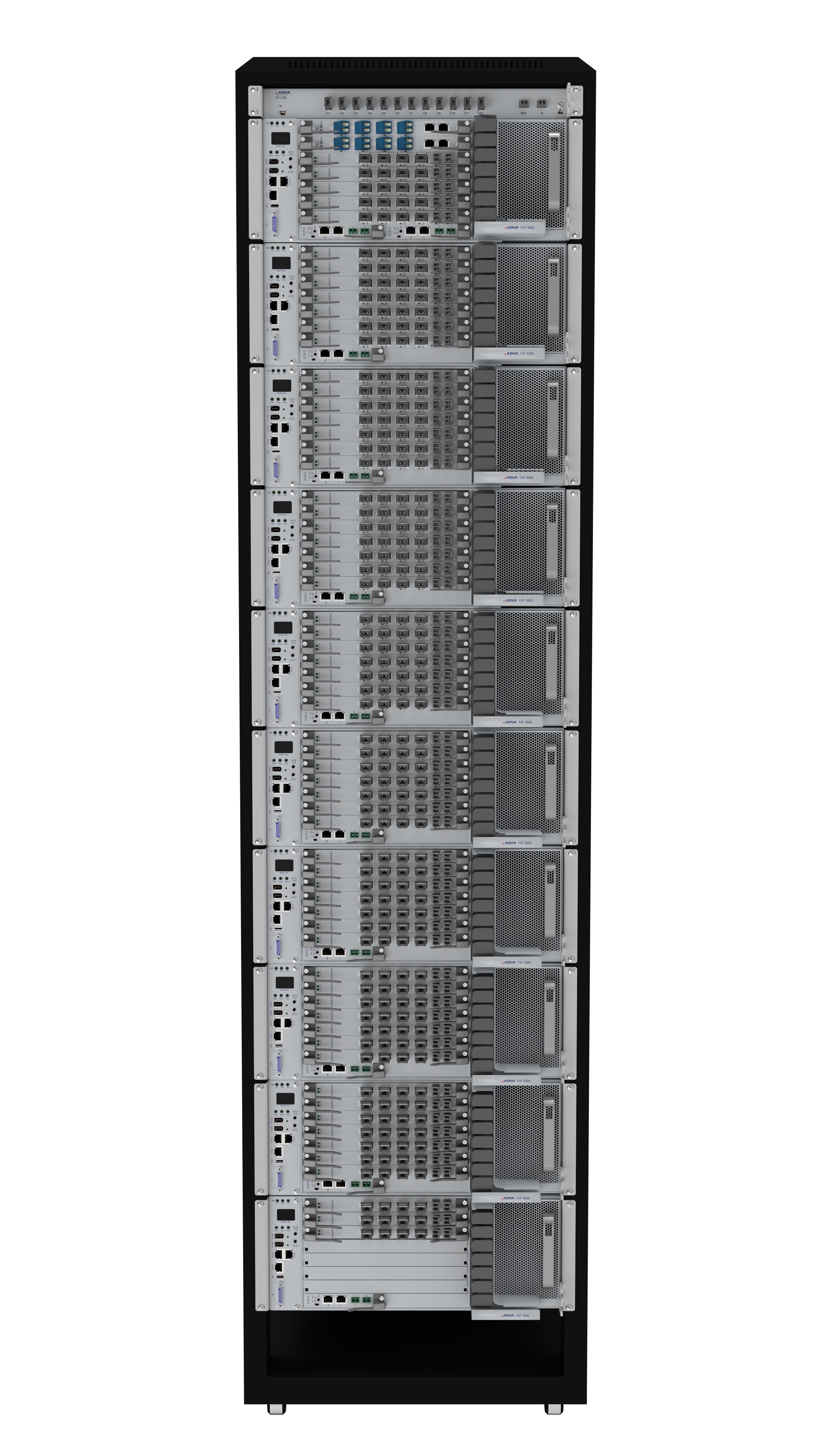 ADVA CloudConnect configuration supporting 25.6 Tbps line side capacity. Source: ADVA Optical Networking
The last CloudConnect chassis configuration is for customers designing a global cluster. Here the chassis has 10 SH4R units housing 64 QuadFlex cards to achieve a total transport capacity of 25.6 Tbps and a throughput of 51.2 Tbps.
Also included are 2 EDFAs and a 128-channel multiplexer. Two EDFAs are needed because of the optical loss associated with the high number of channels, such that an EDFA is allocated for each of the 64 channels. “For the [14 RU] 40 channels [configuration], you need only one EDFA,” says Theodoras.
The vendor has also produced a similar-sized configuration for the L-band. Combining the two 40 RU chassis delivers 51.2Tbps of transport and 102.4 Tbps of throughput. “This configuration was built specifically for a customer that needed that kind of throughput,” says Theodoras.
Other platform features include bulk encryption. ADVA says the encryption does not impact the overall data throughput while adding only a very slight latency hit. “We encrypt the entire payload; just a few framing bytes are hidden in the existing overhead,” says Theodoras.
The security management is separate from the network management. “The security guys have complete control of the security of the data being managed; only they can encrypt and decrypt content,” says Theodoras.
CloudConnect consumes only 0.5W/ Gigabit. The platform does not use electrical multiplexing of data streams over the backplane. The issue with using such a switched backplane is that power is consumed independent of traffic. The CloudConnect designers has avoided this approach. “The reason we save power is that we don’t have all that switching going on over the backplane.” Instead all the connectivity comes from the front panel of the cards.
The downside of this approach is that the platform does not support any-port to any-port connectivity. “But for this customer set, it turns out that they don’t need or care about that.”
Open hardware and software
ADVA Optical Networking claims is 4 RU basic unit addresses a sweet spot in the marketplace. The CloudConnect also has fewer inventory items for the data centre operators to manage compared to competing designs based on 1 RU or 2 RU pizza boxes, it says.
Theodoras also highlights the system’s open hardware and software design.
“We will let anybody’s hardware or software control our network,” says Theodoras. “You don’t have to talk to our software-defined networking (SDN) controller to control our network.” ADVA was part of a demonstration last year whereby an NEC and a Fujitsu controller oversaw ADVA’s networking elements.
Every vendor is always under pressure to have the best thing because you are only designed in for 18 months
By open hardware, what is meant is that programmers can control the optical line system used to interconnect the data centres. “We have found a way of simplifying it so it can be programmed,” says Theodoras. “We have made it more digital so that they don’t have to do dispersion maps, polarisation mode dispersion maps or worry about [optical] link budgets.” The result is that data centre operators can now access all the line elements.
“At OFC 2015, Microsoft publicly said they will only buy an open optical line system,” says Theodoras. Meanwhile, Google is writing a specification for open optical line systems dubbed OpenConfig. “We will be compliant with Microsoft and Google in making every node completely open.”
General availability of the CloudConnect platforms is expected at the year-end. “The data centre interconnect platforms are now with key partners, companies that we have designed this with,” says Theodoras.
Clusters, pods and recipes explained
A cluster is made up of a number of virtual machines and CPU cores and is defined in software. A cluster is a virtual entity, says Theodoras, unrelated to the way data centre managers define their hardware architectures.
“Clusters vary a lot [between players],” says Theodoras. “That is why we have had to make scalability such a big part of CloudConnect.”
The hardware definition is known as a pod or recipe. “How these guys build the network is that they create recipes,” says Theodoras. “A pod with this number of servers, this number of top-of-rack switches, this amount of end-of-row router-switches and this transport node; that will be one recipe.”
Data centre players update their recipes every 18 months. “Every vendor is always under pressure to have the best thing because you are only designed in for 18 months,” says Theodoras.
Vendors are informed well in advance what the next hardware requirements will be, and by when they will be needed to meet the new recipe requirements.
In summary, pods and recipes refer to how the data centre architecture is built, whereas a cluster is defined at a higher, more abstract layer.
OFC 2014 product round-up - Part 1
Part 1: Line-side technologies
Technologies for 100 Gigabit were prominent at this year's OFC conference and exhibition held in San Francisco earlier this month.
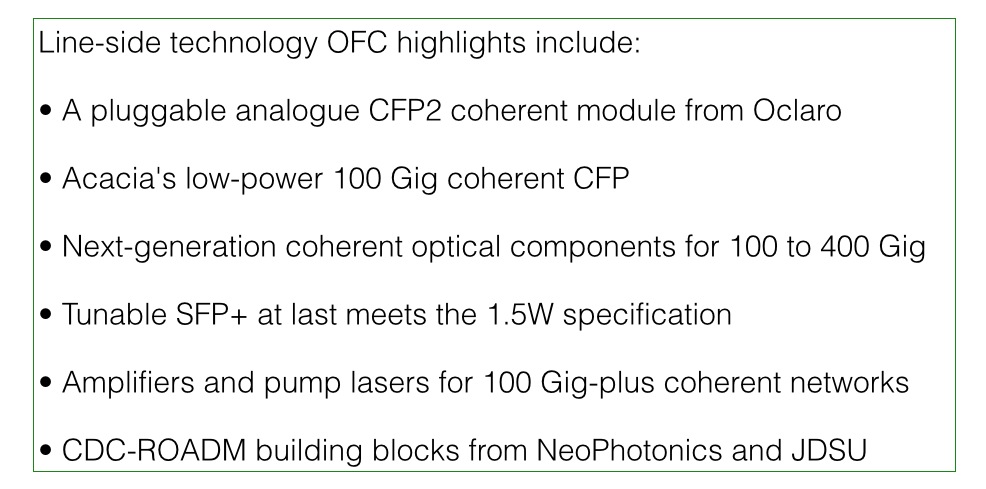
The transition to smaller pluggable modules – client-side CFP2, CFP4 and QSFP28 interfaces - was one 100 Gig trend, another was the first 100 Gig pluggable modules for metro and metro-regional networks. Acacia Communications detailed its low-power AC-100 CFP, while Oclaro demonstrated coherent optics in the smaller CFP2 pluggable module.
To fit within the CFP2, Oclaro has developed a transmitter that combines two tunable lasers (one being for the coherent receiver) and an indium phosphide modulator, and a micro intradyne coherent receiver (micro ICR).
Having 100 Gig coherent optics in a CFP2 will enable equipment makers to double the 100 Gig line ports on their platforms. The optics will also support polarisation multiplexed, 16-quadrature amplitude modulation (PM-16-QAM) and hence 200 Gig transmission. However, given the CFP2's limited power profile, the coherent DSP-ASIC will need to reside on the line card, external to the module. Oclaro says samples of its 'analogue CFP2' will be with customers from the second quarter of the year.
The same coherent optics will also be used for Oclaro's 100 Gig coherent CFP module. "If you combine the [transmitter and micro ICR] optics, you get the CFP2, and the power target is 12W," says Robert Blum, director, product management, 40 and 100 Gig line-side modules at Oclaro. "Combining the optics with a [coherent] DSP in the CFP, the power target is 32W, the highest CFP [power] class."
Oclaro's 100 Gig CFP will be available by year-end, coinciding with a new generation of merchant coherent DSP-ASIC designs. ClariPhy Communications is sampling its LightSpeed-II devices, implemented using a 28nm CMOS process, while NTT Electronics (NEL) is developing its next-generation DSP-ASIC, expected to use an even more advanced CMOS process.
Integrating the DSP chip and optics in a CFP simplifies a line card design and adds flexibility: the same CFP port can be used for line-side or client-side modules. But given that the coherent optics consumes 12W, the next-generation DSP-ASIC must consume no more than 18W typically, with the remaining 2W to accommodate the physical layer ICs, if the CFP's maximum power profile is not to be exceeded.
Acacia Communications' AC-100 coherent CFP module uses the company's DSP-ASIC and photonic integrated circuit (PIC) implemented using silicon photonics. The resulting 100 Gig CFP consumes 24-26W, well within the CFP's maximum 32W.
Meanwhile, Fujitsu Optical Components demonstrated all the components needed to make a 100 Gig coherent CFP, using its indium phosphide modulator to generate a 100 Gig polarisation multiplexed, quadrature phase-shift keying (PM-QPSK) signal, and a micro ICR.
Considering that the 5x7-inch Optical Internetworking Forum (OIF) multi-source agreement (MSA) 100 Gig transponder for long-haul consumes some 80W, with the DSP-ASIC alone consuming over half that, the advent of the coherent CFP and analogue CFP2 highlights the industry’s recent progress in shrinking the size and power consumption of coherent optics.
"Our focus long term is the CFP2. It is where we think the market is going to go in the next two years."
Ferris Lipscomb, NeoPhotonics
Coherent components
NeoPhotonics detailed an integrated coherent transmitter that combines a narrow-linewidth tunable laser and a PM-QPSK modulator in one package. The device joins NeoPhotonics' micro Integrable Tunable Laser Assembly (ITLA) and micro ICR that have already been announced. "These are the next generation, smaller form factor coherent optical components," says Ferris Lipscomb, vice president of marketing at NeoPhotonics. The transmitter supports PM-QPSK and PM-16-QAM such that it can be used for 100, 200 and even as an element to enable 400 Gig transmission.
The device is suited for line card, OIF MSA modules, and pluggable CFP and CFP2 designs. "Our focus long term is the CFP2," says Lipscomb. "It is where we think the market is going to go in the next two years." NeoPhotonics says its coherent devices has been sampling to customers and will be generally available in the second half of the year.
Oclaro announced that its micro ITLA, first detailed at ECOC 2013, now supports a flexible grid; the tunable laser's wavelength can be set independent of the ITU Grid spanning the C-band. Such a capability is required for advanced optical networks based on flexible-grid ROADMs and spectrally-efficient super-channels. "The flexible-grid micro ITLA gives peace of mind [to operators] even if it is not widely used yet," says Oclaro's Blum. The technology used for the micro ITLA is also used for Oclaro's CFP and CFP2 line side modules.
Fujitsu Optical Components announced a lithium niobate modulator that supports 100 Gig PM-QPSK and 400 Gig PM-xQAM signals. The new modulator has the same drive voltage as its existing 100 Gig lithium niobate modulator but is half the size. The company also announced an accompanying ICR that also supports 100 and 400 Gig transmissions in core networks. The company says both devices will be available from July.
Sumitomo Electric Industries detailed its micro ITLA at OFC. The micro ITLA uses a narrower line width laser and reduces power consumption by a fifth. The company also showcased a micro ICR that supports 100 and 200 Gig transmissions, and an indium phosphide based Mach-Zehnder modulator that is smaller and has lower power than a lithium niobate-based version.
Avago Technologies announced its micro ICR at OFC, a demonstration of Avago's broad component portfolio following its acquisition of CyOptics. Finisar was another company that showcased a new portfolio of high-speed optical components following its acquisition of u2t Photonics. These include indium phosphide-based Mach-Zehnder modulators and 100 Gig receivers and photodetectors.
Tunable SFP+
Both JDSU and Oclaro detailed their latest 10 Gigabit tunable SFP+ optical modules. Moving the tunable laser design from an XFP to the SFP+ has been a challenge, meeting the SFP+'s smaller dimensions and 1.5W power consumption.
Oclaro's latest tunable SFP+ now meets the 1.5W SFP+ specification. Oclaro says that to achieve the specification, it produced a more compact integrated laser Mach-Zehnder chip. Oclaro demonstrated the tunable SFP+ operating at 85oC. Beta samples of the tunable SFP+ are being shipped and the module will soon undergo qualification.
JDSU has had a tunable SFP+ product for over a year but its power consumption is 2W. The SFP+ length is also elongated by 4mm to fit the tunable laser. Now, JDSU has announced a revised design that no longer needs the extra 4mm and achieves a power consumption of 1.6W. "We will achieve the 1.5W specification in the near future," says Brandon Collings, JDSU's CTO for communications and commercial optical products.
"The reason why there is a lot of talk about hybrid EDFA-Raman in the industry is that it works very well with coherent."
Rafik Ward, Finisar
Pump lasers and hybrid amplifiers
JDSU also announced pump laser designs. The motivation for these latest pump products is the more demanding link budgets required for 100 Gig-and-greater transmission speeds while still achieving long-distance reaches.
JDSU announced Raman pump lasers for hybrid EDFA-Raman amplifiers. These are more power-efficient and cover the Raman pump wavelengths required, says JDSU: a 600mW output between 1425-1470nm and 550mW at 1470-1495nm. The company has also detailed higher-power 980nm pumps for EDFAs. "More power is almost always a good thing as it allows you a lot more design freedom and performance in your amp," says Collings.
Finisar demonstrated a hybrid EDFA-Raman amplifier for the first time. The hybrid amp is capable of spanning 220km and has a 44dB link loss. "The reason why there is a lot of talk about hybrid EDFA-Raman in the industry is that it works very well with coherent," says Rafik Ward, vice president of marketing at Finisar. Amplifier span distances of 80km are commonly used but the purpose of the demonstration was to showcase the product's capability, says Ward.
WSSes and multicast switches
NeoPhotonics has announced a modular multicast switch that allows an operator to grow a ROADM's node according to demand. The multicast switch is used to add colourless, directionless and contentionless (CDC) attributes to the ROADM. "You can have any wavelength [colourless] from any direction come out at any port [directionless]," says Lipscomb. "And if you have two identical wavelengths coming from different directions, you can drop them through the same switch [contentionless]."
Lipscomb cites as an example an 8-degree ROADM node, with each direction fibre carrying 100 dense WDM channels. Even if only a quarter of the channels are dropped, that is 200 channels, he says: "What we are announcing is a modular multicast switch; you can start with 4 channels and 4 drops and keep adding modular line cards as needed to add more drop ports and more directions."
NeoPhotonics modular multicast switches include such dimensions as 4x4, 4x16 and 8x16. "Carriers don't want to limit their future deployment but they also don't want to spend a lot of money now because they might want to drop 100 channels later," says Lipscomb.
JDSU announced its second-generation twin 1x20 wavelength-selective switch (WSS) that fits on a single-slot card. The twin WSS is used for advanced flexible-grid CDC-ROADM nodes.
The latest twin 1x20 WSS has the same functionality as JDSU's current twin 1x20 WSS that has been available for a year but which occupies two chassis slots. "It has the same capability but is considerably smaller," says Collings.
Indeed, the twin WSS is sufficiently compact that other functions can be added to the card such as amplification, optical power monitoring and optical service channels, communication channels between nodes used for such tasks as provisioning, power management and firmware updates.
For the OFC 2014 product round-up - Part 2, click here
Amplifiers come to the fore to tackle agile network challenges
The growing sophistication of high-speed optical transmission based on 100 Gigabit-plus lightpaths and advanced ROADMs is rekindling interest in amplifier design.

Raman is a signature of the spread of 100 Gig but also the desire of being upgradable to higher bit rates
Per Hansen, II-VI
For the last decade, amplifier designers have been tasked with reducing the cost of Erbium-doped fibre amplifiers (EDFAs). "Now there is a need for new solutions that are more expensive," says Daryl Inniss, vice president and practice leader, components at market research firm, Ovum. "It is no longer just cost-cutting."
Higher output power amplifiers are needed to boost 100 Gig-plus signals that have less energy. Such amplifiers must also counter greater losses incurred by sophisticated colourless, directionless and contentionless (CDC) ROADM nodes. System vendors also require more power-efficient and compact amplifiers to maximise the chassis slots available for revenue-generating 100 Gig transponders.
Such requirements have created interest in all amplifier types, not just EDFAs but hybrid EDFA-Raman and Raman amplifiers.
"Improving the optical signal-to-noise ratio (OSNR) is of paramount consideration to enable higher capacity and reach for 100 Gig-plus lambdas," says Madhu Krishnaswamy, director, product line management at JDSU. "Raman amplification is becoming increasingly critical to delivering this OSNR improvement, largely in long haul."
Other developments include micro-amplifiers that boost single channels, and arrayed amplifiers used with ROADM nodes. These developments are also driving optical components: power-efficient, integrated pump lasers are needed for such higher-power amplifiers.
Operators' requirements span all three amplifier classes: EDFA, hybrid EDFA-Raman and all-Raman, says Anuj Malik, manager, solutions marketing at Infinera: "Some networks require a high OSNR and use hybrid amplifiers but some networks are prone to fibre cuts and hence avoid hybrid as fibre splices can cause more problems with Raman."
Raman differs from EDFA in several ways. Raman has a lower power efficiency, the optical pump power needed to pump an amplifier to achieve a certain gain and output power. This requires higher power to be launched into a Raman amplifier, raising safety issues for staff and equipment. The high launch power requires a sound connection between the Raman pump source and the fibre to avoid equipment being damaged, hence Infinera's reference to fibre splices.
Yet if Raman has a lower power efficiency, it has notable benefits when compared to an EDFA.
An EDFA performs lumped amplification, boosting the signal at distinct points in the network, every 80km commonly. Raman amplifies the signal as it travels down the fibre.
"With Raman amplification the gain is out in the fibre span, and Raman delivers a lower equivalent noise figure - a big advantage," says Per Hansen, head of product marketing, amplifier business unit at II-VI." The company II-VI acquired Oclaro's amplifier business in November 2013.
An amplifier's noise figure is a measure of performance in the network. All amplifiers introduce noise so that the input signal-to-noise ratio divided by the output signal-to-noise ratio is always greater than one. "Raman gives you a significantly better noise figure, an improvement in the range of 3 to 5dB," says Hansen.
EDFA designs continue to progress alongside the growing interest in hybrid and all-Raman. JDSU says that higher output power EDFAs, greater than 24dBm, are increasingly relevant for 96-plus channel systems that support super-channels and flexible grid ROADMs in the metro and long haul.
"Switchable-gain EDFAs to optimise the noise figure over a wider dynamic range of operation is another element enhancing overall system OSNR," says Krishnaswamy. "This is also common for metro and long haul."
Hybrid amplification combines the best characteristics of EDFA and Raman. In a hybrid, Raman is the first amplification stage where noise figure performance is most important, while the EDFA, with its power efficiency, is used as the second stage, boosting the signal to a higher level.
According to Finisar, 100 Gig uses the same receiver OSNR as 10 Gig transmissions. However, the transmission power per channel at 100 Gig is reduced, from 0 to 1dBm at 10 Gig to -2 to -3dBm at 100 Gig, due to non-linearity transmission issues. "Immediately you lose a few dBs in the OSNR," says Uri Ghera, CTO of the optical amplifier products at Finisar.
An overwhelming portion of WANs worldwide have adopted hybrid EDFA-Raman and this trend is expected to continue for the foreseeable future.
For 400 Gigabit transmission, the weaker signal sent requires the OSNR at the receiver to be 4-10dBm higher, says Ghera: "This is why you need hybrid Raman-EDFA."
Moving to a narrower channel spacing using a flexible grid also places greater demands on amplifiers. "Because of super-channels, if before we were talking about 100 channels [in the C-band], for a channel spacing of 37.5GHz it is more like 130 channels," says Ghera. "If you want the same power per channel, it means higher-output amplifiers."
The spectrum amplified by an EDFA is determined by the fibre. EDFAs amplify the 35nm-wide C-band spanning 1530 to 1565nm, and also the separate L-band at 1570 to 1605nm, if that is used. In contrast, the spectrum amplified by Raman is determined by the pump laser's wavelength. This leads to another benefit of all-Raman: far broader spectrum amplification, 100nm and wider.
Xtera is a proponent of all-Raman amplification. The system vendor has demonstrated 60nm- and even 100nm-wide spectrum amplification, broader than the C and L bands combined.
Xtera conducted trials with Verizon in 2013 using its Nu-Wave Optima platform and Raman operating over a 61nm window. The trials are detailed in Table 1.
Between 15 and 40 Terabits were sent over 4,500km and 1,500km, respectively, using several modulation schemes and super-channel arrangements. In comparison, state-of-the-art 100 Gig-plus systems achieve 16 Terabit typically across the C-band, and are being extended to 20-24 Terabit using closer-spaced channels. Using 16-QAM modulation, the reach achieved is 600km and more.
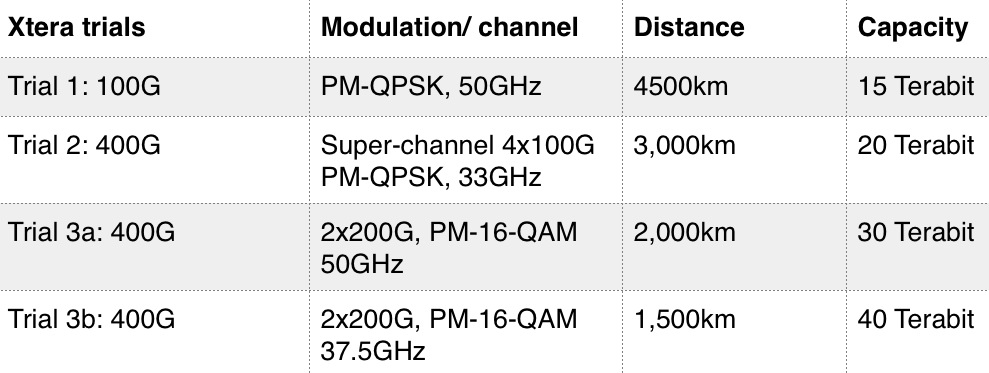 Table 1: Xtera's Verizon trial results using a 61nm spectrum and all-Raman amplification.
JDSU says hybrid amplification remains the most cost-competitive way to deliver the required OSNR and system capacity, while all-Raman can potentially increase system capacity.
Overall, it is network capacity and reach requirements that drive amplifier choice, says Krishnaswamy: "An overwhelming portion of WANs worldwide have adopted hybrid EDFA-Raman and this trend is expected to continue for the foreseeable future."
Meanwhile, the single channel micro-amp, sits alongside or is integrated within the transmitter. Operators want a transponder that meets various requirements for their reconfigurable networks. "If you look into the numbers, you want to boost the signal early on before it is attenuated," says II-VI's Hansen. "That gives you the best OSNR performance."
"This [single-channel amp] is a type that was rare in old systems," adds Finisar's Ghera. "It is also a market that is growing the fastest for us."
The micro-amp needs to be compact and low power, being alongside the power-hungry 100 Gig coherent transmitter. This is driving uncooled pump laser development and system integration.
Similar design goals apply to arrayed amplifiers that counter losses in ROADM add/ drop cards. "If you have some of the features of colourless, directionless and contentionless, you incur bigger losses in the node but you can make it up with other amps, one of these being arrayed amps," says Hansen.
Arrayed designs can have eight or more amps to support multiple-degree nodes so that achieving a power-efficient, compact design is paramount. Hence II-VI's development of an uncooled dual-chip pump laser integrated in a package. "Having four packages to pump eight amps in a small space that do not require cooling is a huge advantage," says Hansen.
The amplifier design challenges are set to continue.
One, highlighted by Infinera, is expanding amplification to the L-band to double overall capacity. JDSU highlights second-order and third-order Raman designs that use a more complex pump laser arrangement to improve system OSNR. Lowering the noise figure of EDFAs will be another continuing design goal, says JDSU.
II-VI expects further challenges in miniaturising single-channel and arrayed amplifier designs. Finisar also cites the need for more compact designs, citing putting an EDFA in an XFP package as an example.
Another challenge is producing high-power Raman amplifiers that can bridge extremely long spans, 300 to 400km. Such an amplifier must be able to read lots of physical parameters associated with the span and set the line accordingly, said Gheri.
II-VI's Hansen says the adoption of Raman and arrayed amplifiers is a good indicator of the wider deployment of next-generation network architectures. "Raman is a signature of the spread of 100 Gig but also the desire of being upgradable to higher bit rates," he says.
The article first appeared as an OFC 2014 show preview piece
Xtera demonstrates 40 Terabit using Raman amplification
- Xtera's Raman amplification boosts capacity and reach
- 40 Terabit optical transmission over 1,500km in Verizon trial
- 64 Terabit over 1,500km in 2015 using a Raman module operating over 100nm of spectrum
 Herve Fevrier
System vendor Xtera is using all these techniques as part of its Nu-Wave Optima system but also uses Raman amplification to extend capacity and reach.
"We offer capacity and reach using a technology - Raman amplification - that we have been pioneering and working on for 15 years," says Herve Fevrier, executive vice president and chief strategy officer at Xtera.
 The distributed amplification profile of Raman (blue) compared to an EDFA's point amplification. Source: Xtera
One way vendors are improving the amplification for 100 Gigabit and greater deployments is to use a hybrid EDFA/ Raman design. This benefits the amplifier's power efficiency and the overall transmission reach but the spectrum width is still dictated by Erbium to around 35nm. "And Raman only helps you have spans which are a bit longer," says Fevrier.
Meanwhile, Xtera is working on programable cards that will support the various transmission options. Xtera will offer a 100nm amplifier module this year that extends its system capacity to 24 Terabit (240, 100 Gig channels). Also planned this year is super-channel PM-QPSK implementation that will extend transmissions to 32 Terabit using the 100nm amplifier module. In 2015 Xtera will offer PM-16-QAM that will deliver the 48 Terabit over 2,000km and the 64 Terabit over 1,500km.
For Part 1, click here
ROADMs and their evolving amplification needs
Technology briefing: ROADMs and amplifiers
Oclaro announced an add/drop routing platform at the recent OFC/NFOEC show. The company explains how the platform is driving new arrayed amplifier and pumping requirements.
 A ROADM comprising amplification, line-interfaces, add/ drop routing and transponders. Source: Oclaro
Agile optical networking is at least a decade-old aspiration of the telcos. Such networks promise operational flexibility and must be scalable to accommodate the relentless annual growth in network traffic. Now, technologies such as coherent optical transmission and reconfigurable optical add/drop multiplexers (ROADMs) have reached a maturity to enable the agile, mesh vision.
Coherent optical transmission at 100 Gigabit-per-second (Gbps) has become the base currency for long-haul networks and is moving to the metro. Meanwhile, ROADMs now have such attributes as colourless, directionless and contentionless (CDC). ROADMs are also being future-proofed to support flexible grid, where wavelengths of varying bandwidths are placed across the fibre's spectrum without adhering to a rigid grid.
Colourless and directionless refer to the ROADM's ability to transmit or drop any light path from any direction or degree at any network interface port. Contentionless adds further flexibility by supporting same-colour light paths at an add or a drop.
"You can't add and drop in existing architectures the same colour [light paths at the same wavelength] in different directions, or add the same colour from a given transponder bank," says Bimal Nayar, director, product marketing at Oclaro's optical network solutions business unit. "This is prompting interest in contentionless functionality."
The challenge for optical component makers is to develop cost-effective coherent and CDC-flexgrid ROADM technologies for agile networks. Operators want a core infrastructure with components and functionality that provide an upgrade path beyond 100 Gigabit coherent yet are sufficiently compact and low-power to minimise their operational expenditure.
ROADM architectures
ROADMs sit at the nodes of a mesh network. Four-degree nodes - the node's degree defined as the number of connections or fibre pairs it supports - are common while eight-degree is considered large.
The ROADM passes through light paths destined for other nodes - known as optical bypass - as well as adds or drops wavelengths at the node. Such add/drops can be rerouted traffic or provisioned new services.
Several components make up a ROADM: amplification, line-interfaces, add/drop routing and transponders (see diagram, above).
"With the move to high bit-rate systems, there is a need for low-noise amplification," says Nayar. "This is driving interest in Raman and Raman-EDFA (Erbium-doped fibre amplifier) hybrid amplification."
The line interface cards are used for incoming and outgoing signals in the different directions. Two architectures can be used: broadcast-and-select and route-and select.
With broadcast-and-select, incoming channels are routed in the various directions using a passive splitter that in effect makes copies the incoming signal. To route signals in the outgoing direction, a 1xN wavelength-selective switch (WSS) is used. "This configuration works best for low node-degree applications, when you have fewer connections, because the splitter losses are manageable," says Nayar.
For higher-degree node applications, the optical loss using splitters is a barrier. As a result, a WSS is also used for the incoming signals, resulting in the route-and-select architecture.
Signals from the line interface cards connect to the routing platform for the add/drop operations. "Because you have signals from any direction, you need not a 1xN WSS but an LxM one," says Nayar. "But these are complex to design because you need more than one switching plane." Such large LxM WSSes are in development but remain at the R&D stage.
Instead, a multicast switch can be used. These typically are sized 8x12 or 8x16 and are constructed using splitters and switches, either spliced or planar lightwave circuit (PLC) based .
"Because the multicast switch is using splitters, it has high loss," says Nayar. "That loss drives the need for amplification."

Add/drop platform
With an 8-degree-node CDC ROADM design, signals enter and exit from eight different directions. Some of these signals pass through the ROADM in transit to other nodes while others have channels added or dropped.
In the Oclaro design, an 8x16 multicast switch is used. "Using this [multicast switch] approach you are sharing the transponder bank [between the directions]," says Nayar.
 The 8-degree node showing the add/drop with two 8x16 multicast switches and the 16-transponder bank. Source: Oclaro
A particular channel is dropped at one of the switch's eight input ports and is amplified before being broadcast to all 16, 1x8 switches interfaced to the 16 transponders.
It is the 16, 1x8 switches that enable contentionless operation where the same 'coloured' channel is dropped to more than one coherent transponder. "In a traditional architecture there would only be one 'red' channel for example dropped as otherwise there would be [wavelength] contention," says Nayar.
The issue, says Oclaro, is that as more and more directions are supported, greater amplification is needed. "This is a concern for some, as amplifiers are associated with extra cost," says Nayar.
The amplifiers for the add/drop thus need to be compact and ideally uncooled. By not needing a thermo-electrical cooler, for example, the design is cheaper and consumes less power.
The design also needs to be future-proofed. The 8x16 add/ drop architecture supports 16 channels. If a 50GHz grid is used, the amplifier needs to deliver the pump power for a 16x50GHz or 800GHz bandwidth. But the adoption of flexible grid and super-channels, the channel bandwidths will be wider. "The amplifier pumps should be scalable," says Nayar. "As you move to super-channels, you want pumps that are able to deliver the pump power you need to amplify, say, 16 super-channels."
This has resulted in an industry debate among vendors as to the best amplifier pumping scheme for add/drop designs that support CDC and flexible grid.
EDFA pump approaches
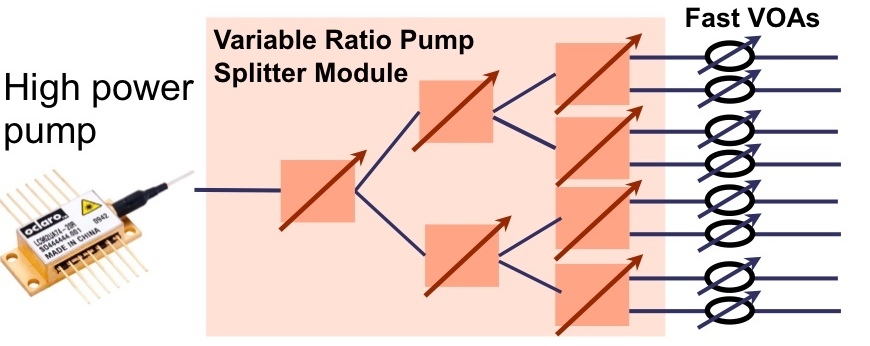
Two schemes are being considered. One option is to use one high-power pump coupled to variable pump splitters that provides the required pumping to all the amplifiers. The other proposal is to use discrete, multiple pumps with a pump used for each EDFA.
 Source: Oclaro
In the first arrangement, the high-powered pump is followed by a variable ratio pump splitter module. The need to set different power levels at each amplifier is due to the different possible drop scenarios; one drop port may include all the channels that are fed to the 16 transponders, or each of the eight amplifiers may have two only. In the first case, all the pump power needs to go to the one amplifier; in the second the power is divided equally across all eight.
Oclaro says that while the high-power pump/ pump-splitter architecture looks more elegant, it has drawbacks. One is the pump splitter introduces an insertion loss of 2-3dB, resulting in the pump having to have twice the power solely to overcome the insertion loss.
The pump splitter is also controlled using a complex algorithm to set the required individual amp power levels. The splitter, being PLC-based, has a relatively slow switching time - some 1 millisecond. Yet transients that need to be suppressed can have durations of around 50 to 100 microseconds. This requires the addition of fast variable optical attenuators (VOAs) to the design that introduce their own insertion losses.
"This means that you need pumps in excess of 500mW, maybe even 750mW," says Nayar. "And these high-power pumps need to be temperature controlled." The PLC switches of the pump splitter are also temperature controlled.
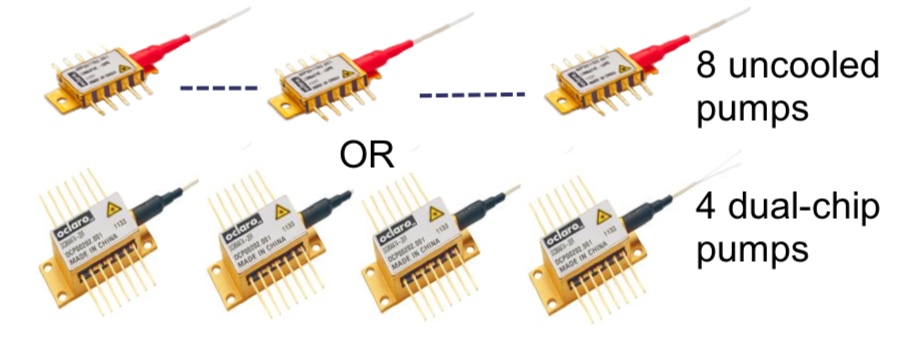
The individual pump-per-amp approach, in contrast, in the form of arrayed amplifiers, is more appealing to implement and is the approach Oclaro is pursuing. These can be eight discrete pumps or four uncooled dual-chip pumps, for the 8-degree 8x16 multicast add/drop example, with each power level individually controlled.
 Source: Oclaro
Oclaro says that the economics favour the pump-per-amp architecture. Pumps are coming down in price due to the dramatic price erosion associated with growing volumes. In contrast, the pump split module is a specialist, lower volume device.
"We have been looking at the cost, the reliability and the form factor and have come to the conclusion that a discrete pumping solution is the better approach," says Nayar. "We have looked at some line card examples and we find that we can do, depending on a customer’s requirements, an amplified multicast switch that could be in a single slot."