

Ranovus shows 200 gigabit direct detection at ECOC
Ranovus has announced it first direct-detection optical products for applications including data centre interconnect.
 Saeid AramidehThe start-up has announced two products to coincide with this week’s ECOC show being held in Dusseldorf, Germany.
One product is a 200 gigabit-per-second (Gbps) dense wavelength-division multiplexing (WDM) CFP2 pluggable optical module that spans distances up to 130km. Ranovus will also sell the 200Gbps transmitter and receiver optical engines that can be integrated by vendors onto a host line card.
The dense WDM direct-detection solution from Ranovus is being positioned as a cheaper, lower-power alternative to coherent optics used for high-capacity metro and long-haul optical transport. Using such technology, service providers can link their data centre buildings distributed across a metro area.
The cost [of the CFP2 direct detection] proves in much better than coherent
“The power consumption [of the direct-detection design] is well within the envelope of what the CFP2 power budget is,” says Saeid Aramideh, a Ranovus co-founder and chief marketing. The CFP2 module's power envelop is rated at 12W and while there are pluggable CFP2-ACO modules now available, a coherent DSP-ASIC is required to work alongside the module.
“The cost [of the CFP2 direct detection] proves in much better than coherent does,” says Aramideh, although he points out that for distances greater than 120km, the economics change.
The 200Gbps CFP2 module uses four wavelengths, each at 50Gbps. Ranovus is using 25Gbps optics with 4-level pulse-amplitude modulation (PAM-4) technology provided by fabless chip company Broadcom to achieve the 50Gbps channels. Up to 96, 50 Gbps channels can be fitted in the C-band to achieve a total transmission bandwidth of 4.8 terabits.
Ranovus is demonstrating at ECOC eight wavelengths being sent over 100km of fibre. The link uses a standard erbium-doped fibre amplifier and the forward-error correction scheme built into PAM-4.
Technologies
Ranovus has developed several key technologies for its proprietary optical interconnect products. These include a multi-wavelength quantum dot laser, a silicon photonics based ring-resonator modulator, an optical receiver, and the associated driver and receiver electronics.
The quantum dot technology implements what is known as a comb laser, producing multiple laser outputs at wavelengths and grid spacings that are defined during fabrication. For the CFP2, the laser produces four wavelengths spaced 50GHz apart.
For the 200Gbps optical engine transmitter, the laser outputs are fed to four silicon photonics ring-resonator modulators to produce the four output wavelengths, while at the receiver there is an equivalent bank of tuned ring resonators that delivers the wavelengths to the photo-detectors. Ranovus has developed several receiver designs, with the lower channel count version being silicon photonics based.
The quantum dot technology implements what is known as a comb laser, producing multiple laser outputs at wavelengths and grid spacings that are defined during fabrication.
The use of ring resonators - effectively filters - at the receiver means that no multiplexer or demultiplexer is needed within the optical module.
“At some point before you go to the fibre, there is a multiplexer because you are multiplexing up to 96 channels in the C-band,” says Aramideh. “But that multiplexer is not needed inside the module.”
Company plans
The startup has raised $35 million in investment funding to date. Aramideh says the start-up is not seeking a further funding round but he does not rule it out.
The most recent funding round, for $24 million, was in 2014. At the time the company was planning to release its first product - a QSFP28 100-Gigabit OpenOptics module - in 2015. Ranovus along with Mellanox Technologies are co-founders of the dense WDM OpenOptics multi-source agreement that supports client side interface speeds at 100Gbps, 400Gbps and terabit speeds.
However, the company realised that 100-gigabit links within the data centre were being served by the coarse WDM CWDM4 and CLR4 module standards, and it chose instead to focus on the data centre interconnect market using its direct detection technology.
Ranovus has also been working with ADVA Optical Networking with it data centre interconnect technology. Last year, ADVA Optical Networking announced its FSP 3000 CloudConnect data centre interconnect platform that can span both the C- and L-bands.
Also planned by Ranovus is a 400-gigabit CFP8 module - which could be a four or eight channel design - for the data centre interconnect market.
Meanwhile, the CFP2 direct-detection module and the optical engine will be generally available from December.

BT makes plans for continued traffic growth in its core
Part 1
 Kevin Smith: “A lot of the work we are doing with the trials have demonstrated we can scale our networks gracefully rather than there being a brick wall of a problem.”
BT is confident that its core network will accommodate the expected IP traffic growth for the next decade. Traffic in BT’s core is growing at between 35 and 40 percent annually, compared to the global average growth rate of 20 to 30 percent. BT attributes the higher growth to the rollout of fibre-based broadband across the UK.
The telco is deploying 100-gigabit wavelengths in high-traffic areas of its network. “These are key sites where we're running out of wavelengths such that we need to implement higher-speed ones,” says Kevin Smith, research leader for BT’s transport networks. The operator is now trialling 200-gigabit wavelengths using polarisation multiplexing, 16-quadrature amplitude modulation (PM-16QAM).
Adopting higher-order modulation increases capacity and spectral efficiency but at the expense of a loss in system performance which can be significant.
Systems vendors use polarisation-multiplexed, quadrature phase-shift keying (PM-QPSK) for 100-gigabit wavelengths. Moving to PM-16QAM doubles the bits on the wavelength but the received data has less tolerance to noise. The result is a 6-decibel loss compared to PM-QPSK, such that the transmission distance drops to a quarter. If PM-QPSK spans a 4,000km link, using PM-16QAM the reach on the same link is only 1,000km.
The transmitted capacity can also be increased by using pulse-shaping at the transmitter to cram a wavelength into a narrower channel. BT’s existing optical network uses fixed 50GHz-wide channels. But in a recent network trial with Huawei, a 3 terabit super-channel was transmitted over a 360km link using a flexible grid.
The super-channel comprised 15 channels, each carrying 200 gigabit using PM-16QAM. Using the flexible grid, each carrier occupied a 33.5GHz channel, increasing fibre capacity by a factor of 1.5 compared to a 50GHz fixed-grid. “For 16-QAM, it [33.5GHz] is pretty close to the limit,” says Smith.
Increasing the baud rate is the most structurally-efficient way to accommodate the high speed
Another way to boost the carrier’s data as well as reduce system cost is to up the signalling rate. Current optical transport systems use a 30Gbaud symbol rate. Here, two carriers each using PM-16QAM are needed to deliver 400 gigabit. Doubling the symbol rate to 60Gbaud enables a single 400 gigabit wavelength. Doubling the baud rate also halves a platform’s transponder count, reducing the overall cost-per-bit, and increases platform density.
“Increasing the baud rate is the most structurally-efficient way to accommodate the high speed,” says Smith. Going to 16QAM increases the data that is carried but at the expense of reach. By increasing the baud rate, reach can be extended while also keeping the modulation rate at a lower level, he says.
BT says it is seeing signs of such ‘flexrate’ transponders that can adapt modulation format and baud rate. “This is a very interesting area we can mine,” says Smith. The fundamental driver is about reducing cost but also giving BT more flexibility in its network, he says.
Traffic growth
Coping with traffic growth is a constant challenge, says BT.
“I’m not worried about a capacity crunch,” says Smith. “A lot of the work we are doing with the trials have demonstrated we can scale our networks gracefully rather than there being a brick wall of a problem.”
The operator is confident that 25 to 30 terabit of traffic can be squeezed into the C-band using flexgrid and narrower bands. Beyond that, BT says broadening the spectral window using additional spectral bands such as the L-band could boost a fibre’s capacity to 100 terabit. Vendors are already looking at extending the spectral window, says BT.
Sliceable transponders
BT is also part of longer-term research exploring an extension to the ‘flexrate' transponder, dubbed the sliceable bit rate variable transponder (S-BVT).
“It is very much early days but the idea is to put multiple modulators on the same big super transponder so that it can kick out super-channels that can be provisioned on demand,” says Andrew Lord, head of optical research at BT.
The large multi-terabit super-channel would be sent out and sliced further down the network by flexible grid wavelength-selective switches such that parts of the super-channel would end up at different destinations. “You don’t need all that capacity to go to one other node but you might need it to go to multiple nodes,” says Lord.
Such a sliceable transponder promises several benefits. One is an ability to keep repartitioning the multi-terabit slice based on demand. “It is a good thing if we see that kind of dynamics happening, but not fast dynamics,” says Lord. The repartitioning would more likely be occasional, adding extra capacity between nodes based on demand. Accordingly, the sliced multi-terabit super-channel would end up at fewer destinations over time.
The sliceable transponder concept also promises cost reduction through greater component integration.
BT stresses this is still early research but such a transponder could end up in the network in five years’ time.
Space-division multiplexing
Another research area that promises to increase significantly the overall capacity of a fibre is space-division multiplexing (SDM).
SDM promises to boost the capacity by a factor of between 10 and 100 through the adoption of parallel transmission paths. The simplest way to create such parallel paths is to bundle several standard single-mode fibres in a cable. But speciality fibre could also be used, either multi-core or multi-mode.
BT says it is not researching spatial multiplexing.
”I’m very much more interested in how we use the fibre we have already got,” says Lord. The priority is pushing channels together as close as possible and getting the 25 terabit figure higher, as well as exploring the L-band. “That is a much more practical way to go forward,” says Lord.
However, BT welcomes the research into SDM. “What it [SDM] is pushing into the industry is a knowledge about how to do integration and the expertise that comes out of that is still really valid,” says Lord. “As it is, I don’t see how it fits.”
OIF moves to raise coherent transmission baud rate
"We want the two projects to look at those trade-offs and look at how we could build the particular components that could support higher individual channel rates,” says Karl Gass of Qorvo and the OIF physical and link layer working group vice chair, optical.
 Karl Gass
The OIF members, which include operators, internet content providers, equipment makers, and optical component and chip players, want components that work over a wide bandwidth, says Gass. This will allow the modulator and receiver to be optimised for the new higher baud rate.
“Perhaps I tune it [the modulator] for 40 Gbaud and it works very linearly there, but because of the trade-off I make, it doesn’t work very well anywhere else,” says Gass. “But I’m willing to make the trade-off to get to that speed.” Gass uses 40 Gbaud as an example only, stressing that much work is required before the OIF members choose the next baud rate.
"We want the two projects to look at those trade-offs and look at how we could build the particular components that could support higher individual channel rates”
The modulator and receiver optimisations will also be chosen independent of technology since lithium niobate, indium phosphide and silicon photonics are all used for coherent modulation.
The OIF has not detailed timescales but Gass says projects usually take 18 months to two years.
Meanwhile, the OIF has completed two projects, the specification outputs of which are referred to as implementation agreements (IAs).
One is for integrated dual polarisation micro-intradyne coherent receivers (micro-ICR) for the CFP2. At OFC 2015, several companies detailed first designs for coherent line side optics using the CFP2 module.
The second completed IA is the 4x5-inch second-generation 100 Gig long-haul DWDM transmission module.
Ciena's Tom Mock reflects on a career in telecom
Working for one technology company for so long may be uncommon, says Mock, but not at Ciena: the CTO has clocked 20 years while the CEO boasts 15 years.
 Tom Mock: “I’m about ready to go do something else.”
Mock studied electrical engineering and was at Scientific Atlanta running a product development group before joining Ciena where he crossed over from engineering to marketing. “I’ve been in telecom pretty much my entire career, 35 years worth of telecom,” says Mock. “I’m about ready to go do something else.”
A work colleague says that if there is one word that describes Mock, it is decency: “He has been a key role model of the ‘do the right thing’ culture at Ciena.”
Mock joined Ciena days before the company went public in 1997. He experienced the optical bubble of 1999-2000 and the bust that followed, and just when he thought the company had put that ‘nuclear winter’ behind it, Ciena endured the 2008 global financial crisis.
Now he leaves Ciena as senior vice president of corporate communications. A role, he says, that involves communicating the company's value proposition to the investment community and media, while helping Ciena’s sales staff communicate the company’s brand. The role also involves explaining the significance of the company’s technology: “It is great we can do 16-QAM [quadrature amplitude modulation] on optical, but why is it important?"
When Mock joined Ciena, optical technology in the form of dense wavelength-division multiplexing (DWDM) was starting to be deployed. “You could go to a service provider and say, look, I can increase the capacity of your network by a factor of 16 just by swapping out the bits at the end of your fibre route,” he says.
I remember sitting at my desk looking at stock prices and market capitalisations and realising that a start-up called Corvis ... had a market capitalisation larger than Ford Motor Company
The optical bubble quickly followed. The internet was beginning to change the world, and large enterprises were taking advantage of communication services in new ways. And with it came the inflated expectation that bandwidth demand would grow through the roof. As a result, optical communications became the hottest technology around.
"I remember sitting at my desk looking at stock prices and market capitalisations and realising that a start-up called Corvis, a competitor of ours started by one of the guys that founded Ciena, Dave Huber, had a market capitalisation larger than Ford Motor Company,” says Mock. Ford was the second largest auto manufacturer in the world at the time.
Yet despite all the expected demand for - and speculation in - bandwidth, conversations with Ciena’s customers revealed that their networks were lightly loaded. The inevitable shake-out, once it came, was brutal, particularly among equipment makers. In the end, all that capacity placed in the network was needed, but only from 2006 as the cloud began to emerge and enterprises started making greater use of computing.
“The one positive that came out of the bubble was that a lot of key technologies that enabled things that happened in the late 2000s were developed in that time,” says Mock.
Ciena made several acquisitions during the optical boom, and has done so since; some successful, others less so. Mock says that with most of the good ones, the technology and the market didn't overlap much with Ciena’s.
Speculation didn't work well for the industry in terms of building infrastructure, and it probably doesn't work well in terms of acquisitions.
One acquisition was Cyras Systems for $2.6 billion in 2000, a company developing 10 Gigabit multi-service provisioning platforms and add/ drop multiplexers. But so was Ciena. “That was one example that didn't work so well but if I look at the one that is going the best - Nortel MEN - that was a place where we didn't have as much technology and market overlap,” he says. That makes streamlining products easier and less disruptive for customers.
“The other thing that is important in a good acquisition is a very good understanding of what the end objective is,” he says. “Speculation didn't work well for the industry in terms of building infrastructure, and it probably doesn't work well in terms of acquisitions.”
Making sure the company cultures fit is also key. “In any of these technology acquisitions, it is not just about buying products and markets, it is about buying the capabilities of a workforce,” says Mock. It is important that the new workforce remains productive, and the way that of done is to make sure the staff feel an important part of the company, he says.
Mock highlights two periods that he found most satisfying at Ciena. One was 2006-2008 before the global economic crisis. Ciena was back of a sound financial footing and was making good money. “There was a similar feeling a year to 18 months after the Nortel acquisition” he says. “The integration had been successful, the people were all pointing in the same direction, and employee morale was pretty high.”
You hear about white boxes in the data centre, there are areas in the network where that is going to happen.
What Mock is most proud of in his time at Ciena is the company’s standing. “We do a perception study with our customers every year to 18 months and one of things that comes back is that people really trust the company,” he says. “Our customers feel like we have their best interest at heart, and that is something we have worked very hard to do; it is also the sort of thing you don't get easily.”
Now the industry is going through a period of change, says Mock. If the last 10-15 years can be viewed as a period of incremental change, people are now thinking about how networks are built and used in new ways. It is about shifting to a model that is more in tune with on-demand needs of users, he says: “That kind of shift typically creates a lot of opportunity.” Networks are becoming more important because people are accessing resources in different places and the networks need to be more responsive.
For Ciena it has meant investing in software as more things come under software control. The benefits include network automation and reduced costs for the operators, but it also brings risk. “There are parts of the infrastructure that are likely to become commoditised,” says Mock. “You hear about white boxes in the data centre, there are areas in the network where that is going to happen.”
We both came from small-town, working-class families. Over the years we have probably been more successful that we ever thought we would be, but a lot of that is due to people helping us along the way.
If this is a notable period, why exit now? “It’s a good time for me,” he says. “And there were some things that my wife and I wanted to start looking at.” Mock’s wife retired two years ago and both are keen to give something back.
“We both came from small-town, working-class families,” he says. “Over the years we have probably been more successful that we ever thought we would be, but a lot of that is due to people helping us along the way.”
Mock and his wife were their families’ first generation that got a good professional education. “One of the things that we have taken on board is helping others gain that same sort of opportunity,” he says.
“I’m excited for Tom but will miss having him around,” says his colleague. “Hopefully, in his next phase, he will make the rest of the world a little more decent as well.”
Plotting transceiver shipments versus traffic growth
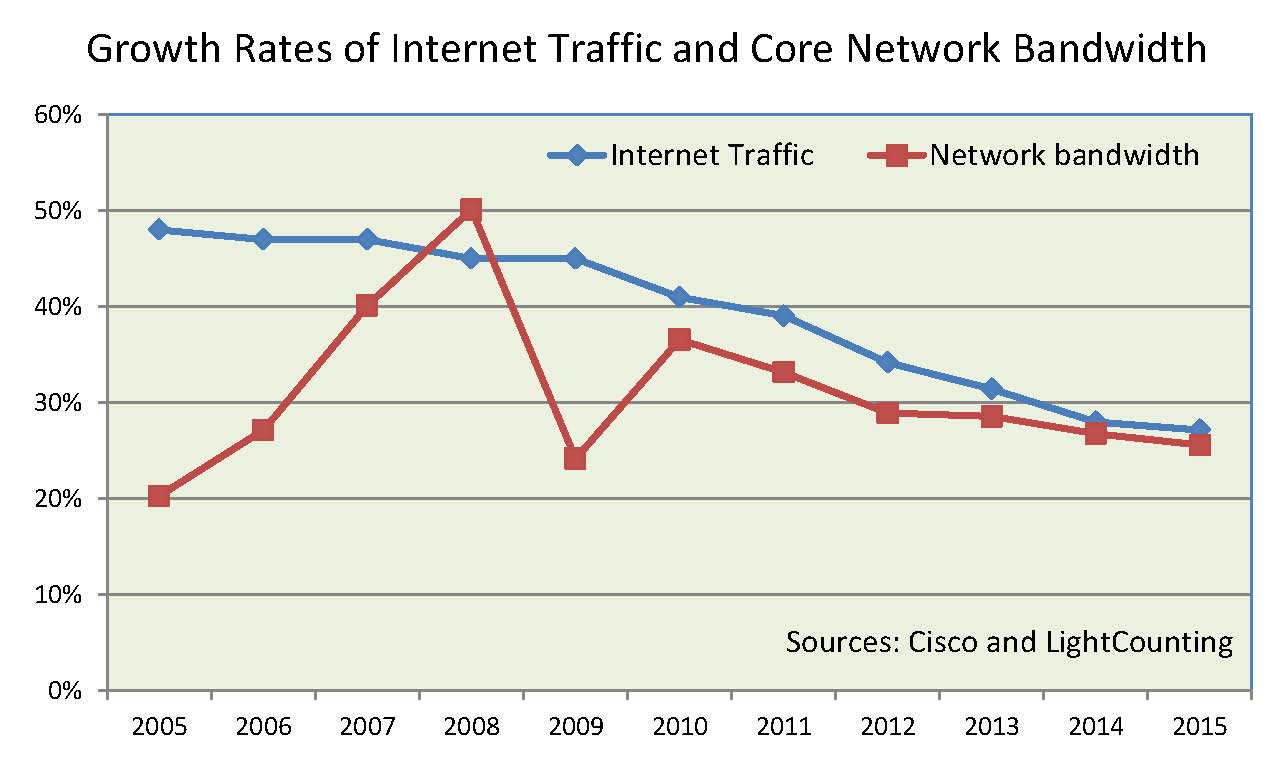
Summing transceiver shipments in the core of the network and plotting the data against traffic growth provides useful insights into the state of the network.
"We use transceiver shipment data [from vendors] to calculate how fast the network is growing and compare it to the traffic growth," says Vladimir Kozlov, CEO of market research firm, LightCounting.
What it reveals is that in 2005-06 there was a significant discrepancy between traffic growth and installed capacity: there was 35-40% traffic growth while investment in dense wavelength division multiplex (DWDM) only grew 20-25%. This gap began to shrink in 2007-08.
LightCounting stresses that network investment must keep track with the traffic growth. "It is not going to be a one-to-one correlation as network efficiency improves over time," says Kozlov. But the gap in the past was too large and probably had to do with unused network capacity.
"As long as the network expansion is to continue just to keep up with traffic, we are looking at sustainable growth," says Kozlov.
Good long-term news for the optical component and module makers.