

DustPhotonics raises funding for 800G and 1.6T modules
- DustPhotonics has raised $24 million in funding.
- The start-up has taped out its 200 gigabit-per-lane optical chip.
- DustPhotonics expects the 1.6-terabit module market to ramp, starting year-end.
DustPhotonics, which develops chips for transmit optical sub-assemblies (TOSAs) for 400 and 800-gigabit pluggable optical modules, has raised $24 million. The funding extends its Series B funding round.
“When you start ramping up products, you have to iron out the creases around supply chain, production, and everything else,” says Ronnen Lovinger, CEO of DustPhotonics.
DustPhotonics has several customers and a backlog of orders for its 400 and 800-gigabit photonic integrated circuits (PICs). The company has also taped out its 200 gigabit-per-lane chip and will have products later this year.
800-gigabit PICs
DustPhotonic’s products include the Carmel-4-DR4, a 400-gigabit DR4 PIC, and several variants of its 800-gigabit Carmel-8.
“Most of our customers and engagements are interested in the 800-gigabit applications,” says Lovinger.
DustPhotonics has developed a way of attaching a laser source to its silicon photonics chip with sub-micron accuracy. The company uses standard off-the-shelf continuous-wave lasers operating at 1310nm.
The efficiency of the laser-attach scheme means one laser can power four channels, or two lasers can be used for a DR8 design, reducing cost and power consumption.
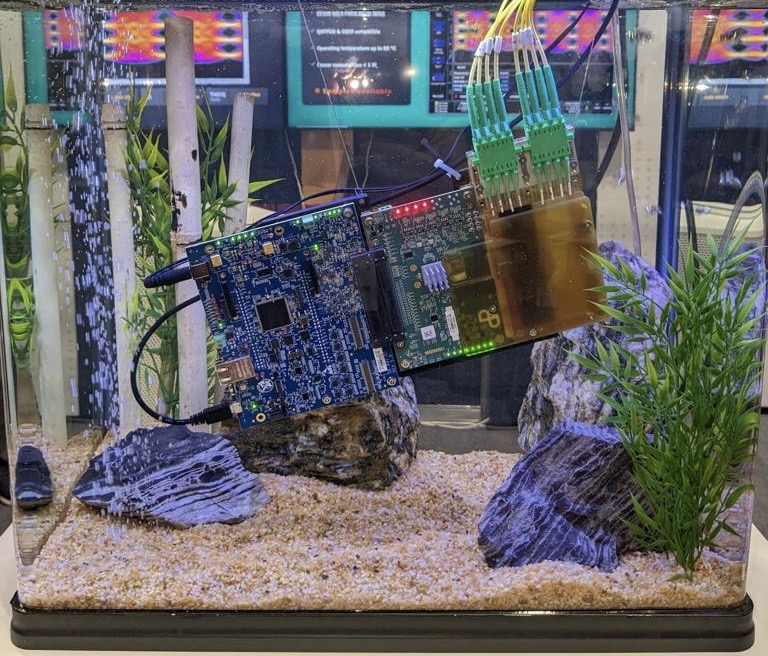
At the ECOC show last October, DustPhotonics unveiled three 800-gigabit Carmel-8 products. The products include a DR8 with a reach of 500m, a 2km DR8+, and an 800-gigabit ‘lite’ version that competes with 100-gigabit VCSEL designs and only uses one laser. Several customers are considering the Carmel-8-Lite for Ethernet and PCI Express applications.
Manufacturing
DustPhotonics is working with foundry Tower Semiconductors as it goes to production.
“Having a strong fab partner is very important for silicon photonics,” says Lovinger, who views Tower as a leading silicon photonics foundry. “We have been working with Tower for five years, and they have been a strong partner.” DustPhotonics is using several partners for device assembly.
DustPhotonics is headquartered in Israel and has 50 staff, 37 of whom are in R&D. Investors in the latest funding round include Sienna Venture Capital, Greenfield Partners, Atreides Management, and Exor Ventures.
Lovinger will attend the OFC show later this month for meetings with customers and prospects. “It is always good to see so many customers under the same roof,” he says.
200-gigabit optical
DustPhotonics has a highly stable silicon-photonics modulator that does not need to be temperature-controlled and operates at 200 gigabits per lane.
Developing a 200 gigabit-per-lane transmit chip means that DustPhotonics can address a 4-lane 800-gigabit DR4 and an 8-lane 1.6-terabit DR8 modules.
Lovinger says that many driver and digital signal processing chip companies already offer 800 gigabit/ 1.6-terabit chips. Thus, he sees the advent of 1.6 terabit modules as straightforward once its TOSA design is ready.
“Once we have 200 gigabits-per-lane, it takes us to 1.6 terabits and, in some configurations, 3.2 terabits,” says Lovinger. “We see the 1.6-terabit market starting at the end of this year and ramping in 2025.”
Lovinger says the progress of pluggable modules is postponing the need for co-packaged optics. That said, the company says it has the technologies needed to address co-packaged optics when the market finally needs it.
200-gigabit optical
DustPhotonics has a highly stable silicon-photonics modulator that does not need to be temperature-controlled and operates at 200 gigabits per lane.
Developing a 200 gigabit-per-lane transmit chip means that DustPhotonics can address a 4-lane 800-gigabit DR4 and an 8-lane 1.6-terabit DR8 modules.
Lovinger says that many driver and digital signal processing chip companies already offer 800 gigabit/ 1.6-terabit chips. Thus, he sees the advent of 1.6 terabit modules as straightforward once its TOSA design is ready.
“Once we have 200 gigabits-per-lane, it takes us to 1.6 terabits and, in some configurations, 3.2 terabits,” says Lovinger. “We see the 1.6-terabit market starting at the end of this year and ramping in 2025.”
Lovinger says the progress of pluggable modules is postponing the need for co-packaged optics. That said, the company says it has the technologies needed to address co-packaged optics when the market finally needs it.

DustPhotonics readies its first optical engine

- DustPhotonics has a silicon photonics modulator capable of 200 gigabits per lane
- The start-up also has developed a precision laser-attach scheme
Ronnen Lovinger waves as he approaches the local train station. DustPhotonics’ CEO is taking me to the company’s offices on the outskirts of Modi’in, halfway between Tel Aviv and Jerusalem.
The site has a striking view of a landscape also halfway between Israel’s flat coastal plain and the steep hills of Jerusalem.
Lovinger has been CEO of DustPhotonics since 2021. Before that, he was chief operating officer (COO) at Innoviz Technologies, joining the lidar firm after 18 years at Mellanox, now part of Nvidia.
Strategic pivotStrategic pivot
DustPhotonics was founded in 2017 and has a staff of 46, 30 being R&D engineers.
The company began by developing multi-mode short-reach, up to 100m, optical transceivers and cables, first at 100 gigabits and then at 400 gigabits.
The start-up also made a single-mode transceiver using discrete components. The company planned to develop an integrated version using silicon photonics, a programme it started in 2018.
DustPhotonics gained a significant design win for its multi-mode transceiver with a customer who was to also act as its channel to market. DustPhotonics then spent two years investing in a high-volume production line in Thailand.
But the anticipated high-volume orders failed to materialise. “After those two years, we shipped 1,000s, not 100,000s of units,” says Lovinger. “It wasn’t the customer’s fault; the market where we had differentiation changed.”

DustPhotonics was forced to change tack. Instead of making modules, it decided to use its silicon photonics expertise to make optical engines.
“Silicon photonics is a very flexible platform, and you can integrate different technologies as well,” says Yoel Chetrit, CTO and vice president of R&D at DustPhotonics. “This gives us a roadmap that is not limited by the standard bandwidth restriction.”
Now the start-up has a 400-gigabit DR4 optical engine, dubbed Carmel, whose qualification is expected to be completed this month. Two DR4 engines enable an 800-gigabit DR8 that fits in an OSFP module.
Lovinger says that at the upcoming OFC show, to be held in March, the company will provide details to customers about the Carmel 8, a single-chip optical engine for 800G DR8 that is small enough to fit within a QSFP-DD module.
DustPhotonics also offers design services. The company it chooses only those projects that promise new markets and customers.
DustPhotonics’s chairman is Avigdor Willenz, a noted Israeli entrepreneur who founded Galileo Technology, was acquired by Marvell, and was chairman of such firms as Annapurna Labs, bought by Amazon, and AI chip company, Habana Labs, bought by Intel.
“He has been in the networking industry for over 30 years,” says Lovinger. “He knows how the architecture of the data centre looks now and how it will be in the future.”
Willenz also has contacts at key large companies and the hyperscalers. “He gets DustPhotonics a foot in the door,” says Lovinger.
1.6 terabit direct-detect modules
DustPhotonics is competing with much larger photonics players that have silicon photonics and indium-phosphide and can make their lasers. These players also sell optical transceivers.
Lovinger stresses that DustPhotonics has its strengths.
“Silicon photonics is a very difficult technology; the bar is very high in the expertise you need,” he says. “Many [firms] are trying, but it is difficult to get there.”
The company has developed a precision laser-attach scheme to the photonic integrated circuit (PIC) that has a sub-micron accuracy. The scheme results in the efficient coupling of light to the PIC. The company uses standard off-the-shelf continuous-wave lasers operating at 1310nm.
The efficiency of the laser attach scheme means two lasers can power an eight-channel design, reducing cost and overall power consumption, says Chetrit.
The company also has a highly stable silicon-photonics modulator that does not need to be temperature controlled and will operate at 200 gigabits per lane.
There is an ongoing industry debate as to whether direct-detect designs can meet all the reaches – 500m, 2km, and 10km – for next-generation 1.6-terabit (8x200Gbps) optical modules. If not, coherent optics will be needed.
“[Achieving] The 2km reach is really a challenge of power and the quality of the modulation,” says Chetrit. DustPhotonics says its direct-detect optical engines will support 1.6-terabit optical modules with a 2km reach.
At last year’s OFC (2022), hyperscalers wondered whether a ‘coherent-light’ design would be needed, says Lovinger: “But things have changed this year; 200 gigabit-per-lane direct detect will happen.”
Two hyperscalers have told DustPhotonics that if it can do this, it will be a game-changer.
“We looked at direct detect versus coherent, and there is no question, going to coherent is just too expensive and too power-hungry,” says Lovinger, adding that using coherent would double costs.
Status
DustPhotonics’ optical engines will be targeted at two markets. One is for pluggable module makers; the other is to supply physical layer (PHY) chip companies that also want optical engines to expand their product portfolio offerings.
The company also offers design capabilities, from photonic elements to complete products. “We don’t call ourselves an [optical] ASIC company, but it may be a similar model,” says Lovinger.
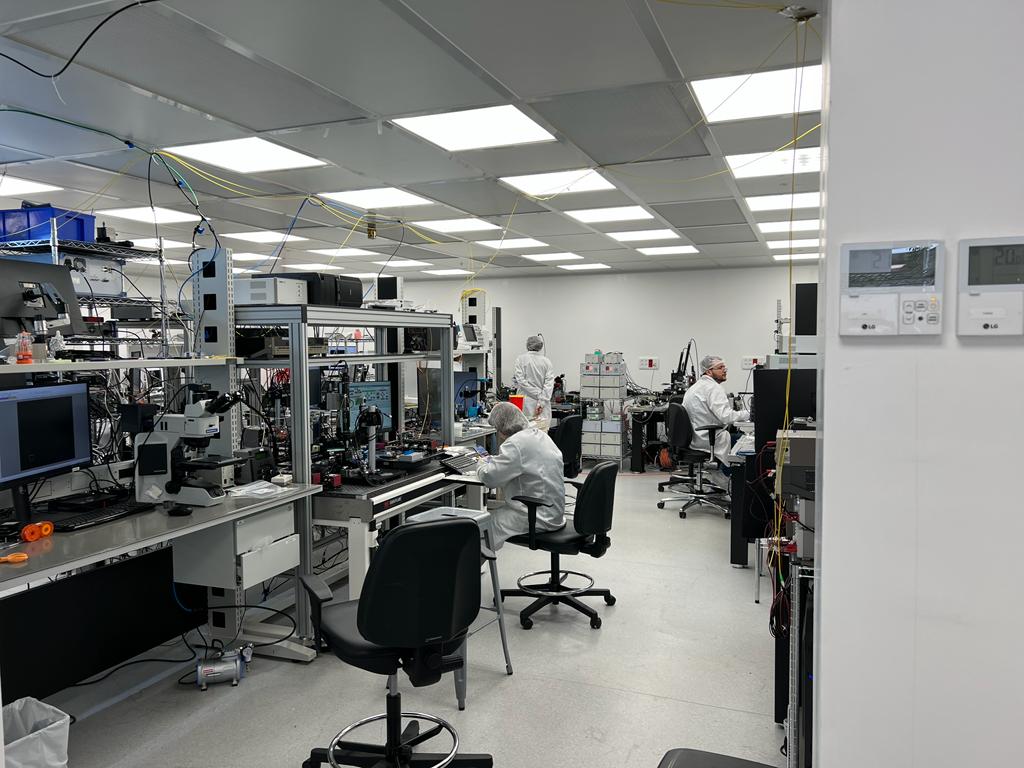
The meeting ends with a quick tour of DustPhotonics’ labs. It is here that R&D takes place, and the lab can sample build up to 1,000 optical engine products a month.
DustPhotonics recently chose Fabrinet as the outsourced assembly and test (OSAT) company. It will do the wafer dicing, burn-in, testing and packaging which will allow for production volumes much higher than in the DustPhotonics lab.
Tower Semiconductor is the silicon photonics foundry DustPhotonics is using.
“When we selected them, Tower had a mature PDK (process design kit), a very flexible process we can work with,” says Chetrit.
The industrial park where DustPhotonics is located is relatively quiet while down the road there is a much busier one. But DustPhotonics chose this one, says Lovinger, and the staff like it here. This is understandable, seeing the views from the elevated office terrace.
Lovinger then drives me to the station in time for my train to Tel Aviv and beyond.

DustPhotonics reveals its optical transceiver play
A start-up that has been active for a year has dropped its state of secrecy to reveal it is already shipping its first optical transceiver product.
The company, DustPhotonics, is backed by private investors and recently received an undisclosed round of funding that will secure the company’s future for the next two years.
Product plans
DustPhotonics' first product is the multi-mode 100m-reach 100GBASE-SR4 QSFP28. The company will launch its first 400-gigabit optical modules later this year.
 Ben Rubovitch
“We probably are going to be one of the first to market with [400-gigabit] QSFP-DD and OSFP multi-mode solutions,” says Ben Rubovitch, CEO of DustPhotonics.
The start-up has developed 50 gigabit-per-lane technology required for higher-speed modules such as the QSFP56, QSFP-DD and OSPF pluggables. The QSFP-DD form factor is designed to be backwards compatible with the QSFP and QSFP28 and is backed by the likes of Facebook and Cisco, while the OSFP is a new form factor supported by Google and switch maker Arista Networks.
DustPhotonics chose the 4-lane 25-gigabit QSFP28 to prove the working of its 50 gigabit-per-lane technology. “The reason we did that is that the PAM-4 chipsets weren’t ready when we started,” says Rubovitch. “So we invested the first year solving the production issues and the optical interface and used the QSFP28 as the platform.”
The challenge with a 50 gigabit-per-lane optical interface is that the photo-detector aperture used is smaller. “So on our QSFP28 we used a small photo-detector to prove the optical solution,” says Rubovitch.
The start-up is now developing faster speed multi-mode designs: a 200-gigabit QSFP56 pluggable, a 400-gigabit QSFP-DD implementing the 400GBASE-SR8 standard and a similar active optical cable variant; products that it hopes to sample in the second quarter of this year. This will be followed by similar SR8 implementations using the OSFP.
 DustPhotonics' optical product roadmap. Source: Gazettabyte/ DustPhotonics.
DustPhotonics is also adapting its optical packaging technology to support single-mode designs: the 500m IEEE 400GBASE-DR4 and the 2km 400G-FR4, part of the 100G Lambda multi-source agreement (MSA). Both the DR4 and FR4 designs use 100-gigabit optical lanes.
Technology
Rubovitch says that despite the many optical transceiver players and the large volumes of modules now manufactured, pluggable optics remain expensive. “The front panel of a top-of-rack switch [populated with modules] costs ten times more than the switch itself,” he says.
DustPhotonics has tackled the issue of cost by simplifying the module’s bill of materials and the overall manufacturing process.
The start-up buys the lasers and electronic ICs needed and adds its own free-space optics for both multi-mode and single-mode transceiver designs. “It is all plastic-molded so we don’t use any glass types or any integrated lasers and that simplifies much of the process,” says Rubovitch. Indeed, he claims the design reduces the bill of materials of its transceivers by between 30 and 50 percent.
The front panel of a top-of-rack switch [populated with modules] costs ten times more than the switch itself
DustPhotonics has also developed a passive alignment process. “We have narrowed the one accurate step - where we align the optics - to one machine,” says Rubovitch. “This compares to two steps ‘accurate’ and one step ‘align’ for active alignment.” Active alignment for a QSFP28 module takes ten minutes, he says, whereas DustPhotonics’ passive alignment process takes under a minute per module.
“There is also a previous manufacturing stage where we place the VCSELs and photo-detectors on a substrate itself and we don’t need accuracy here, unlike other solutions,” he says.
The overall result is a simpler, more cost-effective design. “We are already manufacturing in a volume production line and we see the numbers and how competitive we are, and it is going to create an even larger advantage at 400 gigabits,” says Rubovitch.
DustPhotonics’ passive alignment process takes under a minute per module
What next?
DustPhotonics is also developing embedded optics, where the optics are placed next to an ASIC, and even in-package designs where the optics and ICs are co-packaged.
Rubovitch says such technologies will be needed because of the very high power 100-gigabit electrical transceivers consume on a switch chip, for example, as well the silicon area they require; precious silicon real estate needed to cope with the ever-increasing packet-processing demands. “Bringing the optics very close [to the chip] can help solve those issues for the switch providers,” he says.
As Rockley Photonics’ CEO, Andrew Rickman, observed recently, combining optics with the switch silicon has long been discussed yet has still to be embraced by the switch chip makers. This explains why Rockley developed its own switch ASIC to demonstrate a complete in-packaged reference design.
Rubovitch agrees that the concept of optics replacing electrical interfaces has long been spoken of but that hasn’t happened due to copper speeds continuing to advance. There is already a 100 gigabit-per-lane solution that will meet the demands of the next generation of switch designs, he says: “It really depends on what is going to be the next leap: 200 gigabits or 400-gigabits.”
Using optics to replace electrical interfaces could come with the advent of 25 terabit switch silicon or maybe the generation after. “Or maybe something in between: 25 terabit solutions will start to move gradually to a more packaged solution or at least closer on-board optics,” concludes Rubovitch.