

600-gigabit channels on a fibre by 2017
NeoPhotonics has announced an integrated coherent receiver that will enable 600-gigabit optical transmission using a single wavelength. A transmission capacity of 48 terabits over the fibre’s C-band is then possible using 80 such channels.

NeoPhotonics’ micro integrated coherent receiver operates at 64 gigabaud, twice the symbol rate of deployed 100-gigabit optical transport systems and was detailed at the recent ECOC show.
Current 100 gigabit-per-second (Gbps) coherent systems use polarisation-multiplexing, quadrature phase-shift keying (PM-QPSK) modulation operating at 32 gigabaud. “That is how you get four bits [per symbol],” says Ferris Lipscomb, vice president of marketing at NeoPhotonics.
Optical designers have two approaches to increase the data transmitted on a wavelength: they can use increasingly complex modulation schemes - such as 16 quadrature amplitude modulation (16-QAM) or 64-QAM - and they can increase the baud rate. “You double the baud rate, you double the transmission capacity,” says Lipscomb. “And using 64-QAM and 64 gigabaud, you can go to 600 gigabit per channel; of course when you do that, you reduce the reach.”
The move to the higher 64 gigabaud symbol rate will help Internet content providers increase capacity between their large-scale data centres. Typical transmission distances between sites are relatively short, up to 100km.
Telcos too will benefit from the higher baud rate as it will enable them to use software-defined networking to adapt, on-the-fly, a line card’s data rate and reach depending on the link. Such a flexible rate coherent line card would allow 600Gbps on a single channel over 80km, 400 gigabit (16-QAM) over 400km, or 100 gigabit over thousands of kilometers.
Status
NeoPhotonics says it is now sampling its 64 gigabaud coherent receiver. It is still premature to discuss when the high-speed coherent receiver will be generally available, the company says, as it depends on the availability of other vendors’ components working at 64 gigabaud. These include the modulator, the trans-impedance amplifier and the coherent digital signal processor ASIC (DSP-ASIC).
Lipscomb says that a 64-gigabaud modulator in lithium niobate already exists but not in indium phosphide. The lithium niobate modulator is relatively large and will fit within a CFP module but the smaller CFP2 module will require a 64-gigabaud indium phosphide modulator.
“General availability will be timed based on when our customers are ready to go into production,” says Lipscomb. “Trials will happen in the first half of 2017 with volume shipments only happening in the second half of next year.”
Using 64-QAM and 64 gigabaud, you can go to 600 gigabit per channel
Challenges
A micro integrated coherent receiver has two inputs - the received optical signal and the local oscillator - and four balanced receiver outputs. Also included are two polarisation beam splitters and two 90-degree hybrid mixers.
Lipscomb says Neophotonics worked for over a year to develop its coherent receiver: “It is a complete design from the ground up.”
The slowest element sets the speed at which the receiver can operator such that the design not only involves the detector and trans-impedance amplifier but other elements such as the wirebonds and the packaging. “Everything has to be upgraded,” says Lipscomb. “It is not just a case of plopping in a faster detector and everything works.”
Nano-ICR and the CFP2-DCO
The industry is now working on a successor, smaller coherent detector dubbed the nano integrated coherent receiver (nano-ICR). “It has not all gelled yet but the nano-ICR would be suitable for the CFP2-DCO.”
The CFP2-DCO is a CFP2 Digital Coherent Optics pluggable module that integrates the coherent DSP-ASIC. In contrast, the CFP2 Analog Coherent Optics (CFP2-ACO) modules holds the optics and the DSP-ASIC resides on the line card.
“As the new DSPs come out using the next CMOS [process] nodes, they will be lower power and will be accommodated in the CFP2 form factor,” says Lipscomb. “Then the optics has to shrink yet again to make room for the DSP.”
Lipscomb sees the CFP2-ACO being used by system vendors that have already developed their own DSP-ASICs and will offer differentiated, higher-transmission performance. The CFP2-DCO will be favoured for more standard deployments and by end-customers that do not want to be locked into a single vendor and a proprietary DSP.
There is also the CFP2-DCO’s ease of deployment. In China, currently undertaking large-scale 100-gigabit optical transport deployments, operators want a module that can be deployed in the field by a relatively unskilled technician. “The ACOs with the analogue interface tend to require a lot of calibration,” says Lipscomb. “You can’t just plug it in and it works; you have to run it in, calibrate it and bring it up to get it to work properly.”
The CFP2-DCO module is expected in 2018 as the DSP-ASICs will require an advanced 12nm or even 7nm CMOS process.

Oclaro demonstrates flexible rate coherent pluggable module
- The CFP2 coherent optical module operates at 100 and 200 Gig
- Samples are already with customers, with general availability in the first half of 2015
- Oclaro to also make more CFP2 100GBASE-LR4 products

The CFP2 is not just used in metro/ regional networks but also in long-haul applications
Robert Blum
The advent of a pluggable CFP2, capable of multi-rate long-distance optical transmission, has moved a step closer with a demonstration by Oclaro. The optical transmission specialist showed a CFP2 transmitting data at 200 Gigabits-per-second.
The coherent analogue module demonstration, where the DSP-ASIC resides alongside rather than within the CFP2, took place at ECOC 2014 held in September at Cannes. Oclaro showcased the CFP2 to potential customers in March, at OFC 2014, but then the line side module supported 100 Gig only.
"What has been somewhat surprising to us is that the CFP2 is not just used in metro/ regional networks but also in long-haul applications," says Robert Blum, director of strategic marketing at Oclaro. "We are also seeing quite significant interest in data centre interconnect, where you want to get 400 Gig between sites using two CFP2s and two DSPs." Oclaro says that the typical distances are from 200km to 1,000km.
The CFP2 achieves 200 Gig using polarisation multiplexing, 16-quadrature amplitude modulation (PM-16-QAM) while working alongside ClariPhy's merchant DSP-ASIC. ClariPhy announced at ECOC that it is now shipping its 200 Gig LightSpeed-II CL20010 coherent system-on-chip, implemented using a 28nm CMOS process.
"One of the beauties of an analogue CFP2 is that it works with a variety of DSPs," says Blum. Other merchant coherent DSPs are becoming available, while leading long-haul optical equipment vendors have their own custom coherent DSPs.
Oclaro's CFP2, even when operating at 200 Gig, falls within the 12W module's power rating. "One of the things you need to have for 200 Gig is a linear modulator driver, and such drivers consume slightly more power [200mW] than limiting modulator drivers [used for 100 Gig only]," says Blum.
Oclaro will offer two CFP2 line-side variants, one with linear drivers and one using limiting ones. The limiting driver CFP2 will be used for 100 Gig only whereas the linear driver CFP2 supports 100 Gig PM-QPSK and 200 Gig PM-16-QAM schemes. "Some customers prefer the simplicity of a limiting interface; for the linear interface you have to do more calibration or set-up," says Blum. "Linear also allows you to do pre-emphasis of the signal path, from the DSP all the way to the modulator." Pre-emphasis is used to compensate for signal path impairments.
By consuming under 12W, up to eight line-side CFP2 interfaces can fit on a line card, says Blum, who also stresses the CFP2 has a 0dBm output power at 200 Gig. Achieving such an output power level means the 200 Gig signal is on a par with 100 Gig wavelengths. "When you launch a 200 Gig signal, you want to make sure that there is not a big difference between signals," says Blum.
To achieve the higher output power, the micro integrable tunable laser assembly (micro-iTLA) includes a semiconductor optical amplifier (SOA) with the laser, while SOAs are also added to the Mach–Zehnder modulator chip. "That allows us to compensate for some of the [optical] losses," says Blum.
Customers received first CFP2 samples in May, with the module currently at the design validation stage. Oclaro expects volume shipments to begin in the first half of 2015.
100 Gig and the data centre
Oclaro also announced at ECOC that it has expanded manufacturing capacity for its CFP2-based 100GBASE-LR4 10km-reach module.
One reason for the flurry of activity around 100 Gig mid-reach interfaces that span 500m-2km in the data centre is that the 100GBASE-LR4 module is relatively expensive. Oclaro itself has said it will support the PSM-4, CWDM4 and CLR4 Alliance mid-reach 100 Gig interfaces. So why is Oclaro expanding manufacturing of its CFP2-based 100GBASE-LR4?
It is about being pragmatic and finding the most cost-effective solution for a given problem
"There is no clear good solution to get 100 Gig over 500m or 2km right now," says Blum. "CFP2 is here, it is a mature technology and we have made improvements both in performance and cost."
Oclaro has improved its EML design such that the laser needs less cooling, reducing overall power dissipation. The accompanying electronic functions such as clock data recovery have also been redesigned using one IC instead of two such that the CFP2 -LR4's overall power consumption is below 8W.
Demand has been so significant, says Blum, that the company has been unable to meet customer demand. Oclaro expects that towards year-end, it will have increased its CFP2 100GBASE-LR4 manufacturing capacity by 50 percent compared to six months earlier.
"It is about being pragmatic and finding the most cost-effective solution for a given problem," says Blum. "There are other [module] variants that are of interest [to us], such as the CWDM4 MSA that offers a cost-effective way to get to 2km."
OIF prepares for virtual network services
The Optical Internetworking Forum has begun specification work for virtual network services (VNS) that will enable customers of telcos to define their own networks. VNS will enable a user to define a multi-layer network (layer-1 and layer-2, for now) more flexibly than existing schemes such as virtual private networks.
 Vishnu Shukla"Here, we are talking about service, and a simple way to describe it [VNS] is network slicing," says OIF president, Vishnu Shukla. "With transport SDN [software-defined networking], such value-added services become available."
The OIF work will identify what carriers and system vendors must do to implement VNS. Shukla says the OIF already has experience working across multiple networking layers, and is undertaking transport SDN work. "VNS is a really valuable extension of the transport SDN work," says Shukla.
The OIF expects to complete its VNS Implementation Agreement work by year-end 2015.
Meanwhile, the OIF's Carrier Working Group has published its recommendations document, entitled OIF Carrier WG Requirements for Intermediate Reach 100G DWDM for Metro Type Applications, that provides input for the OIF's Physical Link Layer (PLL) Working Group.
The PLL Working Group is defining the requirements needed for a compact, low-cost and low-power 100 Gig interface for metro and regional networks. This is similar to the OIF work that successfully defined the first 100 Gig coherent modules in a 5x7-inch MSA.
The Carrier Working Group report highlights key metro issues facing operators. One is the rapid growth of metro traffic which, according to Cisco Systems, will surpass long-haul traffic in 2014. Another is the change metro networks are undergoing. The metro is moving from a traditional ring to a mesh architecture with the increasing use of reconfigurable optical add/drop multiplexers (ROADMs). As a result, optical wavelengths have further to travel, must contend with passing through more ROADMs stages and more fibre-induced signal impairments.
Shukla stresses there are differences among operators as to what is considered a metro network. For example, metro networks in North America span 400-600km typically and can be as much as 1,000km. In Europe such spans are considered regional or even long-haul networks. Metro networks also vary greatly in their characteristics. "Because of these variations, the requirements on optical modules varies so much, from unit to unit and area to area," says Shukla.
Given these challenges, operators want a module with sufficient optical performance to contend with the ROADM stages, and variable distances and network conditions encountered. "Sometimes we feel that the requirements [between metro and long-haul] won't be that much [different]," says Shukla. Indeed, the Carrier Working Group report discusses how the boundaries between metro and long-haul networks are blurring.
Yet operators also want such robust optical module performance at a greatly reduced price. One of the report's listed requirements is the need for the 100 Gig intermediate-reach interfaces to cost 'significantly' less than the cheapest long-haul 100 Gig.
To this aim, the report recommends that the 100 Gig pluggable optical modules such as the CFP or CFP2 be used. Standardising on industry-accepted pluggable MSAs will drive down cost as happened with the introduction of 100 Gig long haul 5x7-inch MSA modules.
Metro and regional coherent interfaces will also allow the specifications to be relaxed in terms of the DSP-ASIC requirements and the modulation schemes used. "When we come to the metro area, chances are that some of the technologies can be done more simply, and the cost will go down," says Shukla. Using pluggables will also increase 100 Gig line card densities, further reducing cost, while the report also favours the DSP-ASIC being integrated into the pluggable module, where possible.
Contributors to the Carrier Working Group report include representatives from China Telecom, Deutsche Telekom, Orange, Telus and Verizon, as well as module maker Acacia.
Acacia uses silicon photonics for its 100G coherent CFP
Acacia Communications has revealed the innards of its 100 Gig coherent pluggable module for metro networks. The AC-100 CFP combines a low-power DSP-ASIC with a silicon-photonics-based optics chip. The CFP's reach is 80km to 1,200km, and its power consumption is 24-26W, well within the pluggable's maximum power profile of 32W.
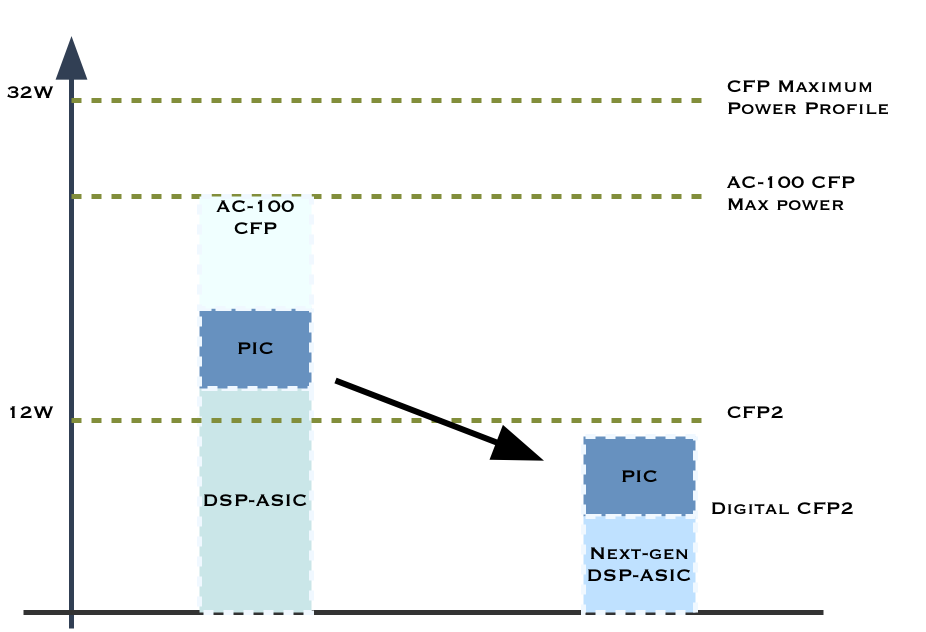 The power consumption of the AC-100 CFP, and its main components, and the target power consumptions of the components needed for a digital CFP2. Source: Gazettabyte
The start-up says it is shipping samples of the AC-100 CFP and already has 15 customers. "That includes some of the bigger [systems] players that have their own internal DSP," says Raj Shanmugaraj, CEO of Acacia. "The coherent CFP is not their focus; they are going after long-haul."
The start-up is shipping samples of the AC-100 CFP and already has 15 customers
Acacia chose to develop it own DSP chips as it sees the technology as core for coherent-based optical transmission. "That is where we see the big market," says Shanmugaraj. "We have a 100 Gig [MSA] that has been shipping, and a 200-400 Gig product that is in development."
DSP-ASIC and silicon photonics
The DSP-ASIC for the AC-100 CFP is Acacia's second chip design. Its first, a DSP-ASIC for its long-haul 5x7-inch OIF MSA transponder, is implemented using a 40nm CMOS process. The latest metro DSP-ASIC uses 28nm CMOS.
The DSP-ASIC includes analogue-to-digital (A/D) and digital-to-analogue (D/A) converters and a serialiser/ deserialiser (Serdes). Also on-chip is the digital signal processor (DSP) that implements soft-decision, forward error correction (SD-FEC) and compensation algorithms for chromatic and polarisation-mode dispersion.
Other DSP-ASIC features include spectral shaping for flexible grid transmission. "The signal processing on the transmit side fits in the one ASIC," says Benny Mikkelsen, CTO at Acacia. Also on-chip are a 100 Gig OTN (Optical Transport Network) framer and a microprocessor to manage the DSP-ASIC and the overall CFP.
The DSP-ASIC consumes 12-14W: the A/D, D/A converters and Serdes consume 5W, while the DSP consumes 7W for an 80km link - the 100 Gig equivalent of the -ZR spec - and 9W for 1,200km transmission due to the more powerful SD-FEC needed.
Mikkelsen says achieving a low-power ASIC requires several approaches. The SD-FEC is designed to be extremely low power, he says, as is the dispersion compensation: "Not just the algorithms but how we code the algorithms." Also, how the ASIC's circuitry is laid out impacts power consumption.
Acacia's engineers have also developed a silicon-photonics chip that combines the coherent transmitter and receiver optics. "The PIC [photonic integrated circuit] is the first silicon-photonics chip targeted at metro/ metro-regional," says Shanmugaraj. "It is an IC that has all the components except the laser, and is co-packaged in a gold box with the drivers and trans-impedance amplifiers."
Acacia's PIC is monolithic; all the functional blocks are implemented in silicon rather than combined silicon and III-V materials, a technique known as heterogeneous integration.
Using silicon photonics rather than indium phosphide has advantages, says Shanmugaraj. Silicon photonics benefits from mature CMOS processes developed for the semiconductor industry: "With the large silicon wafers, you can have thousands of these silicon PICs on them," he says.
Acacia tests the PICs directly on the wafer. This avoids having to dice the wafer and package each die before testing. "We also don't need thermal control [of the chip] or hermetic packaging," says Shanmugaraj. With indium phosphide, the modulators do require thermal cooling, adding to the design complexity and the power consumption. The PIC is 10mm long and consumes less than 5W.

The AC-100 CFP is expected to cost less than half the 5x7-inch 100 Gig coherent MSA which sells for $20,000. "One of the biggest pain points in metro is cost, if you ask most of the service providers," says Shanmugaraj. At below $10,000, the coherent CFP will be cost-competitive with the 100 Gig direct-detection CFP that uses 4x25 Gig wavelengths. However, the 100 Gig direct-detection CFP continues to come down in price as more products come to market.
Roadmap
Acacia will continue to address long-haul and metro, each requiring its own ASIC. "We don't believe that you can have one ASIC that serves both submarine and the metro," says Mikkelsen. In turn, silicon photonics will be used for pluggables while discrete optics will be used for the more demanding submarine.
The company says it is developing a multi-core ASIC to support super-channels and 16-QAM modulation for 200 Gig and 400 Gig transmission. The company says it will provide more details of its flexible, adaptive-rate ASIC at ECOC, to be held in September this year.
The company's product roadmap also features a co-packaged DSP-ASIC and PIC that will fit within a CFP2. Achieving such a pluggable, dubbed a digital CFP2, require a further halving of the DSP-ASIC's power consumption. This, says Acacia, is achievable using the next CMOS process node after 28nm.
The advantages of a digital CFP2 compared to a CFP2 with optics only, with the DSP-ASIC on the line card, include using the DSP-ASIC only when it is needed. When a fault occurs, the relevant pluggable can be replaced rather than having to remove the complete line card. Lastly, new functionality in the DSP-ASIC can be introduced by plugging in the new CFP2 pluggable compared with having to redesign the line card.
See also:
Transmode adopts 100 Gigabit coherent CFPs, click here
ClariPhy samples a 200 Gigabit coherent DSP-ASIC, click here
ClariPhy samples a 200 Gigabit coherent DSP-ASIC
The CL20010 is the first of ClariPhy's LightSpeed-II family of coherent digital signal processing ASICs (DSP-ASICs), manufactured using a 28nm CMOS process. "We believe it is the first 28nm standard product, and leaps ahead of the current generation [DSP-ASIC] devices," says Paul Voois, co-founder and chief strategy officer at ClariPhy.
 Paul Voois
ClariPhy has been shipping its 40 Gigabit coherent CL4010 LightSpeed chip since September 2011. Customers using the device include optical module makers Oclaro, NEC and JDSU. "We continue to go into new deployments but it is true that the 40 Gig market is not growing like the 100 Gig market," says Voois.
With the CL20010, Clariphy now joins NTT Electronics (NEL) as a merchant supplier of high-speed coherent silicon. Clariphy has said that the LightSpeed-II devices will address metro, long-haul and submarine.
No longer do the integrators need to buy a separate transmit multiplexer chip
Using an advanced 28nm CMOS process enables greater on-chip integration. The CL20010 includes the transmit and receive DSPs, soft-decision forward error correction, and mixed signal analogue-to-digital and digital-to-analogue converters. "No longer do the integrators need to buy a separate transmit multiplexer chip," says Voois.
The LightSpeed-II silicon also features an on-chip Optical Transport Network (OTN) framer/ mapper and a general-purpose processor. The general purpose processor enables the chip to be more network aware - for example, the state of a link - and support software-defined networking (SDN) in the WAN.
The LightSpeed-II ICs support three modulation schemes - polarisation-multiplexed, bipolar phase-shift keying (PM-BPSK), quadrature phase-shift keying (PM-QPSK) and 16-quadrature amplitude modulation (PM-16-QAM). Using PM-16-QAM, the CL20010 can support 200 Gigabit traffic. "I believe that is also a first for merchant silicon," says Voois.
Having an on-chip framer enables the transmission of two 100 Gigabit clients signals as a 200 Gigabit OTN signal. In turn, combining two CL20010 devices enables a 400 Gig flexible-grid super-channel to be transmitted. The on-chip transmit DSP enables the CL20010 to support flexible grid, with the dual carrier 400 Gigabit super-channel occupying 75GHz rather than 100GHz. The CL20010 can achieve a reach of 3,500km at 100 Gig, and over 600km at 200 and 400 Gig.
ClariPhy has not announced the power consumption of its chips but says that it is also targeting the metro pluggable market. Given that a CFP coherent module consumes up to 32W and that the optics alone consume 12W, a LightSpeed-II metro DSP-ASIC will likely consume 18-20W.
Merchant market
Many of the leading optical transport equipment makers, such as Alcatel-Lucent, Ciena, Cisco Systems, Huawei and Infinera, use their own coherent DSP-ASICs. More recently, Acacia Communications announced a CFP 100 Gig coherent pluggable module that uses its internally developed DSP-ASIC.
Some of the OEMs will continue to develop internal technology but even they can't cover all possible applications
ClariPhy says that despite the bulk of the 100 Gigabit coherent ports shipped use internally developed designs, there are signs that the market is moving towards adopting merchant silicon. "It doesn't happen all at once," says Voois. "Some of the OEMs will continue to develop internal technology but even they can't cover all possible applications."
He cites coherent silicon for metro networks as an example. Equipment makers are focussed on DSP-ASIC designs that satisfy the most demanding, ultra-long-haul network applications. But such high-performance, high-power chips are not suited for the more cost-conscious, low-power and compact metro requirements.
"Our committed customer base includes a nice spectrum of applications and integration types: OEMs and module vendors; metro, long haul and submarine," says Voois.
General availability of the CL20010 is expected later this year. The company will also be demonstrating the device at OFC 2014.
OFC/NFOEC 2013 product round-up - Part 2
Second and final part
- Custom add/drop integrated platform and a dual 1x20 WSS module
- Coherent receiver with integrated variable optical attenuator
- 100/200 Gigabit coherent CFP and 100 Gigabit CFP2 roadmaps
- Mid-board parallel optics - from 150 to over 600 Gigabit.
- 10 Gigabit EPON triplexer
Add/drop platform and wavelength-selective switches
Oclaro announced an add/drop routing platform for next-generation reconfigurable optical add/drop multiplexers (ROADMs). The platform, which supports colourless, directionless, contentionless (CDC) and flexible grid ROADMs, can be tailored to a system vendor's requirements and includes such functions as cross-connect switching, arrayed amplifiers and optical channel monitors.
 "If we make the whole thing [add/drop platform], we can integrate in a much better way"
Per Hansen, Oclaro
After working with system vendors on various line card designs, Oclaro realised there are significant benefits to engineering the complete design.
"You end up with a controller controlling other controllers, and boxes that get bolted on top of each other; a fairly unattractive solution," says Per Hansen, vice president of product marketing, optical networks solutions at Oclaro. "If we make the whole thing, we can integrate in a much better way."
The increasingly complex nature of the add/drop card is due to the dynamic features now required. "You have support for CDC and even flexible grid," says Hansen. "You want to have many more features so that you can control it remotely in software."
A consequence of the add/drop's complexity and automation is a need for more amplifiers. "It is a sign that the optics is getting mature; you are integrating more functionality within your equipment and as you do that, you have losses and you need to put amplifiers into your circuits," says Hansen.
Oclaro continues to expand its amplifier component portfolio. At OFC/NFOEC, the company announced dual-chip uncooled pump lasers in the 10-pin butterfly package multi-source agreement (MSA) it announced at ECOC 2012.
"We have two 500mW uncooled pumps in a single package with two fibres, each pump being independently controlled," says Robert Blum, director of product marketing for Oclaro's photonic components unit.
The package occupies half the space and consumes less than half the power compared to two standard discrete thermo-electrically cooled pumps. The dual-chip pump lasers will be available as samples in July 2013.
Oclaro gets requests to design 4- and 8-degree nodes; with four- and eight-degree signifying the number of fibre pairs emanating from a node.
"Depending on what features customers want in terms of amplifiers and optical channel monitors, we can design these all the way down to single-slot cards," says Hansen. Vendors can then upgrade their platforms with enhanced switching and flexibility while using the same form factor card.
Meanwhile, Finisar demonstrated at OFC/NFOEC a module containing two 1x20 liquid-crystal-on-silicon-based wavelength-selective switches (WSSes). The module supports CDC and flexible grid ROADMs. "This two-port module supports the next-generation route-and-select [ROADM] architecture; one [WSS] on the add side and one on the drop side," says Rafik Ward, vice president of marketing at Finisar.
100Gbps line side components
NeoPhotonics has added two products to its 100 Gigabit-per-second (Gbps) coherent transport product line.
The first is an coherent receiver that integrates a variable optical attenuator (VOA). The VOA sits in front of the receiver to screen the dynamic range of the incoming signal. "This is even more important in coherent systems as coherent is different to direct detection in that you do not have to optically filter the channels coming in," says Ferris Lipscomb, vice president of marketing at NeoPhotonics.
 "That is the power of photonic integration: you do a new chip with an extra feature and it goes in the same package."
Ferris Lipscomb, NeoPhotonics
In a traditional system, he says, a drop port goes through an arrayed waveguide grating which filters out the other channels. "But with coherent you can tune it like a heterodyne radio," says Lipscomb. "You have a local oscillator that you 'beat' against the signal so that the beat frequency for the channel you are tuned to will be within the bandwidth of the receiver but the beat frequency of the adjacent channel will be outside the bandwidth of the receiver."
It is possible to do colourless ROADM drops where many channels are dropped, and using the local oscillator, the channel of interest is selected. "This means that the power coming in can be more varied than in a traditional case," says Lipscomb, depending on how many other channels are present. Since there can be up to 80 channels falling on the detector, the VOA is needed to control the dynamic range of the signal to protect the receiver.
"Because we use photonic integration to make our integrated coherent receiver, we can put the VOA directly on the chip," says Lipscomb. "That is the power of photonic integration: you do a new chip with an extra feature and it goes in the same package."
The VOA integrated coherent receiver is sampling and will be generally available in the third quarter of 2013.
NeoPhotonics also announced a narrow linewidth tunable laser for coherent systems in a micro integrated tunable laser assembly (micro-ITLA). This is the follow-on, more compact version of the Optical Internetworking Forum's (OIF) ITLA form factor for coherent designs.
While the device is sampling now, Lipscomb points out that is it for next-generation designs such that it is too early for any great demand.
Sumitomo Electric Industries and ClariPhy Communications demonstrated 100Gbps coherent CFP technology at OFC/NFOEC.
ClariPhy has implemented system-on-chip (SoC) analogue-to-digital (ADC) and digital-to-analogue (DAC) converter blocks in 28nm CMOS while Sumitomo has indium phosphide modulator and driver technology as well as an integrated coherent receiver, and an ITLA.
The SoC technology is able to support 100Gbps and 200Gbps using QPSK and 16-QAM formats. The companies say that their collaboration will result in a pluggable CFP module for 100Gbps coherent being available this year.
Market research firm, Ovum, points out that the announcement marks a change in strategy for Sumitomo as it enters the long-distance transmission business.
In another development, Oclaro detailed integrated tunable transmitter and coherent receiver components that promise to enable 100 Gigabit coherent modules in the CFP2 form factor.
The company has combined three functions within the transmitter. It has developed a monolithic tunable laser that does not require an external cavity. "The tunable laser has a high-enough output power that you can tap off a portion of the signal and use it as the local oscillator [for the receiver]," says Blum. Oclaro has also developed a discrete indium-phosphide modulator co-packaged with the laser.
The CFP2 100Gbps coherent pluggable module is likely to have a reach of 80-1,000km, suited to metro and metro regional networks. It will also be used alongside next-generation digital signal processing (DSP) ASICs that will use a more advanced CMOS process resulting in a much lower power consumption .
To be able to meet the 12W power consumption upper limit of the CFP2, the DSP-ASIC will reside on the line card, external to the module. A CFP, however, with its upper power limit of 32W will be able to integrate the DSP-ASIC.
Oclaro expects such an CFP2 module to be available from mid-2014 but there are several hurdles to be overcome.
One is that the next-generation DSP-ASICs will not be available till next year. Another is getting the optics and associated electronics ready. "One challenge is the analogue connector to interface the optics and the DSP," says Blum.
Achieving the CFP2 12W power consumption limit is non-trivial too. "We have data that the transmitter already has a low enough power dissipation," says Blum.
Board-mounted optics
Finisar demonstrated its board-mounted optical assembly (BOA) running at 28Gbps-per-channel. When Finisar first detailed the VCSEL-based parallel optics engine, it operated at 10Gbps.
The mid-board optics, being aimed at linking chassis and board-to-board interconnect, can be used in several configurations: 24 transmit channels, 24 receive channels or as a transceiver - 12 transmit and 12 receive. When operated at full rate, the resulting data rate is 672Gbps (24x28Gbps) simplex.
The BOA is protocol-agnostic operating at several speeds ranging from 10Gbps to 28Gbps. For example 25Gbps supports Ethernet lanes for 100Gbps while 28Gbps is used for Optical Transport Network (OTN) and Fibre Channel. Overall the mid-board optics supports Ethernet, PCI Express, Serial Attached SCSI (SAS), Infiniband, Fibre Channel and proprietary protocols. Finisar has started shipping BOA samples.
Avago detailed samples of higher-speed Atlas optical engine devices based on its 12-channel MicroPod and MiniPod designs. The company has extended the channel speed from 10Gbps to 12.5Gbps and to 14Gbps, giving a total bandwidth of 150Gbps and 168Gbps, respectively.
"There is enough of a market demand for applications up to 12.5Gbps that justifies a separate part number," says Sharon Hall, product line manager for embedded optics at Avago Technologies.
The 12x12.5Gbps optical engines can be used for 100GBASE-SR10 (10x10Gbps) as well as quad data rate (QDR) Infiniband. The extra capacity supports Optical Transport Network (OTN) with its associated overhead bits for telecom. There are also ASIC designs that require 12.5Gbps interfaces to maximise system bandwidth.
The 12x14Gbps supports the Fourteen Data Rate (FDR) Infiniband standard and addresses system vendors that want yet more bandwidth.
The Atlas optical engines support channel data rates from 1Gbps. The 12x12.5Gbps devices have a reach of 100m while for the 12x14Gbps devices it is 50m.
Hall points out that while there is much interest in 25Gbps channel rates, the total system cost can be expensive due to the immaturity of the ICs: "It is going to take a little bit of time." Offering a 14Gbps-per-channel rate can keep the overall system cost lower while meeting bandwidth requirements, she says.
10 Gig EPON
Operators want to increase the split ratio - the number of end users supported by a passive optical network - to lower the overall cost.
A PON reach of 20km is another important requirement to operators, to make best use of their central offices housing the optical line terminal (OLT) that serves PON subscribers.
To meet both requirements, the 10G-EPON has a PRX40 specification standard which has a sufficiently high optical link budget. Finisar has announced a 10G-EPON OLT triplexer optical sub-assembly (OSA) that can be used within an XFP module among others that meets the PRX40 specification.
The OSA triplexer supports 10Gbps and 1G downstream (to the user) and 1Gbps upstream. The two downstream rates are needed as not all subscribers on a PON will transition to a 10G-EPON optical network unit (ONU).
To meet the standard, a triplexer design typically uses an externally modulated laser. Finisar has met the specification using a less complex directly modulated laser. The result is a 10G-EPON triplexer supporting a split ratio of 1:64 and higher, and that meets the 20km reach requirement.
Finisar will sell the OSA to PON transceiver makers with production starting first quarter, 2014. Up till now the company has used its designs for its own PON transceivers.
See also:
OFC/NFOEC 2013 product round-up - Part 1, click here