

NFV moves from the lab to the network
 Dor Skuler
In October 2012, several of the world's leading telecom operators published a document to spur industry action. Entitled Network Functions Virtualisation - Introductory White Paper, the document stressed the many benefits such a telecom transformation would bring: reduced equipment costs, power consumption savings, portable applications, and nimbleness instead of ordeal when a service is launched.
Eighteen months on and much progress has been made. Operators and vendors have been identifying the networking functions to virtualise on servers, and the impact Network Functions Virtualisation (NFV) will have on the network.
A group within ETSI, the standards body behind NFV, is fleshing out the architectural layers of NFV: the virtual network functions layer that resides above the management and orchestration one that oversees the servers, distributed in data centres across the network.
In the lab, network functions have been put on servers and then onto servers in the cloud. "Now we are at the start of the execution phase: leaving the lab and moving into first deployments in the network," says Dor Skuler, vice president and general manager of CloudBand, the NFV spin-in of Alcatel-Lucent. Skuler views 2014 as the year of experimentation for NFV. By 2015, there will be pockets of deployments but none at scale; that will start in 2016.
SDN is a simple way for virtual network functions to get what they need from the network through different commands
Deploying NFV in the network and at scale will require software-defined networking (SDN). That is because network functions make unique requirements of the network, says Skuler. Because the network functions are distributed, each application must make connections to the different sites on demand. "SDN is a simple way for virtual network functions to get what they need from the network through different commands," he says.
CloudBand's customers include Deutsche Telekom, Telefonica and NTT. Overall, the company says it is involved in 14 customer projects.
CloudBand 2.0
CloudBand has developed a management and orchestration platform, and launched an 'ecosystem' that includes 25 companies. Companies such as Radware and Metaswitch Networks are developing virtual network functions that use the CloudBand platform.
More recently, CloudBand has upgraded its platform, what it calls CloudBand 2.0, and has launched its own virtualised network functions (VNFs) for the Long Term Evolution (LTE) cellular standard. In particular, VNFs for the Evolved Packet Core (EPC), IP Multimedia Subsystem (IMS) and the radio access network (RAN). "These are now virtualised and running in the cloud," says Skuler.
SDN technology from Nuage Networks, another Alcatel-Lucent spin-in, has been integrated into the CloudBand node that is set up in a data centre. The platform also has enhanced management systems. "How to manage the many nodes into a single logical cloud, with a lot of tools that help applications," says Skuler. CloudBand 2.0 has also added support for OpenStack alongside its existing support for CloudStack. OpenStack and CloudStack are open-source platforms supporting cloud.
For the EPC, the functions virtualised are on the network side of the basestation: the Mobility Management Entity (MME), the Serving Gateway and Packet Data Network Gateway (S- and P-Gateways) and the Policy and Charging Rules Function (PCRF).
IMS is used for Voice over LTE (VoLTE). "Operators are looking for more efficient ways of delivering VoLTE," says Skuler. This includes reducing deployment times and scalability, growing the service as more users sign up.
The high-frequency parts of the radio access network, typically located in a remote radio head (RRH), cannot be virtualised. What can is the baseband processing unit (BBU). The BBUs run on off-the-shelf servers in pools up to 40km away from the radio heads. "This allows more flexible capacity allocation to different radio heads and easier scaling and upgrading," says Skuler.
Skuler points out that virtualising a function is not simply a case of putting a piece of code on a server running a platform such as CloudBand. "The VNF itself needs to go through a lot of change; a big monolithic application needs to be broken up into small components," he says.
"The VNF needs to use the development tools we offer in CloudBand so it can give rules so it can run in the cloud." The VNF also needs to know what key performance indicators to look at, and be able to request scaling, and inform the system when it is unhealthy and how to remedy the situation.
These LTE VNFs are designed to run on CloudBand and on other vendors' platforms. "CloudBand won't be run everywhere which is why we use open standards," says Skuler.
Pros and cons
The benefits from adopting NFV include prompt service deployment, "Today it can take 9-18 months for an operator to scale [a service]," says Skuler. The services, effectively software on servers, can scale more easily whereas today, typically, operators have to overprovision to ensure extra capacity is in place.
Less equipment also needs to be kept by operators for maintainance. "A typical North America mobile operator may have 450,000 spare parts," says Skuler; items such as line cards and power supplies. With automation and the use of dedicated servers, the number of spare parts held is typically reduced by a factor of ten.
Services can be scaled and healed, while functionality can be upgraded using software alone. "If I have a new verison of IMS, I can test it in parallel and then migrate users; all behind my desk at the push of a button," says Skuler.
The NFV infrastructure - comprising compute, storage, and networking resources - reside at multiple locations - the operator's points-of-presence. These resources are designed to be shared by applications - VNFs - and it is this sharing of a common pool of resources that is one of the biggest advantages of NFV, says Skuler.
But there are challenges.
"Operating [existing] systems has been relatively simple; if there is a faulty line card, you simply replace it," says Skuler. "Now you have all these virtual functions sitting on virtual machines across data centres and that creates complexities."
An application needs to be aware of this and provide the required rules to the management and orchestration system such as CloudBand. Such systems need to provide the necessary operational tools to operators to enable automated upgrades and automated scaling as well as pinpoint causes of failures.
For example, an IMS core might have 12 tiers. In cloud-speak, a tier is one of a set of virtual machines making up a virtual network function. Examples of a tier include a load balancer, an application or a database server. Each tier consists of one or more virtual machines. Scaling of capacity is enabled by adding or removing virtual machines from a tier.
In a cloud deployment, these linkages between tiers must be understood by the system to allow scaling. Two tiers may be placed in the same data centre to ensure low latency, but an extra pair of the tier-pair may be placed in separate sites in case one pair goes down. SDN is used to connect the different sites, says Skuler: "All this needs to be explained simply to the system so that it understands it and execute it".
That, he says, is what CloudBand does.
See also:
Telcos eye servers and software to meet networking needs, click here

Alcatel-Lucent dismisses Nokia rumours as it launches NFV ecosystem
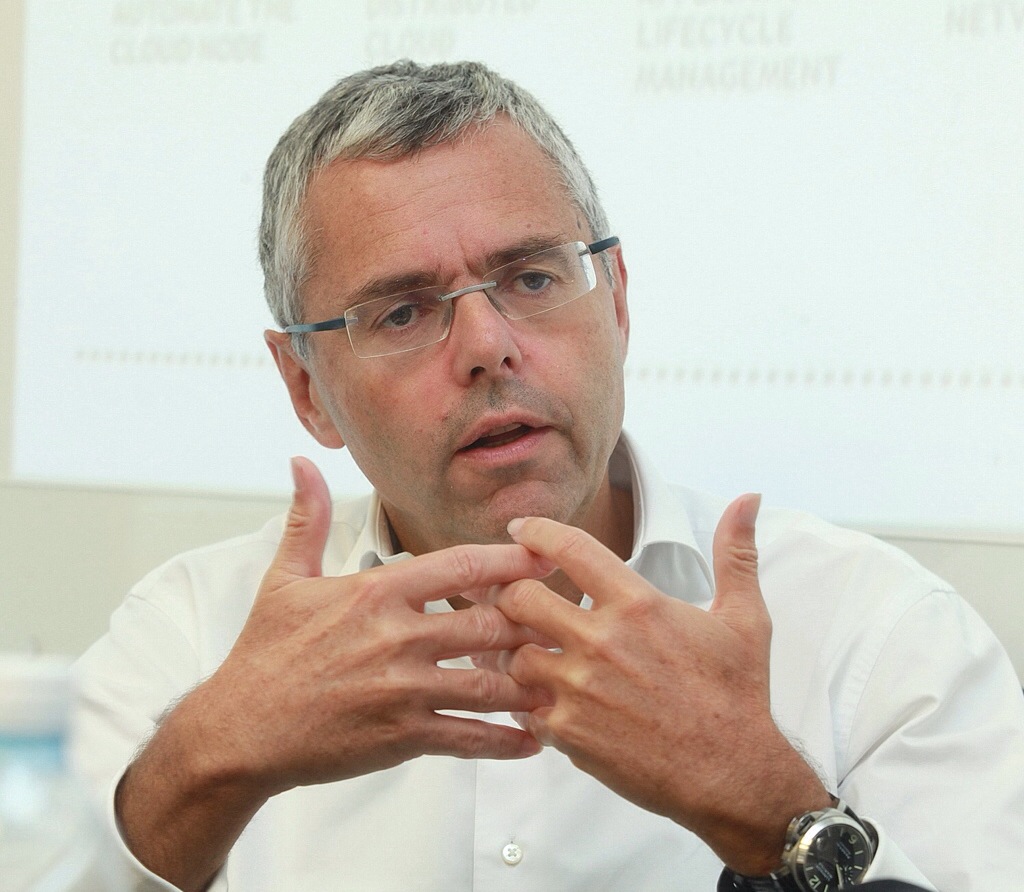 Michel Combes, CEO. Photo: Kobi Kantor.
The CEO of Alcatel-Lucent, Michel Combes, has brushed off rumours of a tie-up with Nokia, after reports surfaced last week that Nokia's board was considering the move as a strategy option.
"You will have to ask Nokia," said Combes. "I'm fully focussed on the Shift Plan, it is the right plan [for the company]; I don't want to be distracted by anything else."
Combes was speaking at the opening of Alcatel-Lucent's cloud R&D centre in Kfar Saba, Israel, where the company's internal start-up CloudBand is developing cloud technology for carriers.
Network Functions Virtualisation
CloudBand used the site opening to unveil its CloudBand Ecosystem Program to spur adoption of Network Functions Virtualisation (NFV). NFV is a carrier-led initiative, set up by the European Telecommunications Standards Institute (ETSI), to benefit from the IT model of running applications on virtualised servers.
Carriers want to get away from vendor-specific platforms that are expensive to run and cumbersome to upgrade when new services are needed. Adding a service can take between 18 months and three years, said Dor Skuler, vice president and general manager of the CloudBand business unit. Moreover, such equipment can reside in the network for 15 years. "Most of the [telecom] software is running on CPUs that are 15 years old," said Skuler.
Instead, carriers want vendors to develop software 'network functions' executed on servers. NFV promises a common network infrastructure and reduced costs by exploiting the economies of scale associated with servers. Server volumes dwarf those of dedicated networking equipment, and are regularly upgraded with new CPUs.
Applications running on servers can also be scaled up and down, according to demand, using virtualisation and cloud orchestration techniques already present in the data centre. "This is about to make the network scalable and automated," said Combes.
Alcatel-Lucent stresses that not all networking functions are suited for virtualisation. Optical transport is one example. Another is routing, which requires dedicated silicon for packet processing and traffic management.
CloudBand was set up in 2011. The unit is focussed on the orchestration and automation of distributed cloud computing for carriers. "How do you operationalise cloud which may be distributed across 20 to 30 locations?" said Skuler.
CloudBand says it can add a "cloud node" - IT equipment at an operator's site - and have it up and running three hours after power-up. This requires processes that are fully automated, said Skuler. Also used are algorithms developed at Alcatel-Lucent Bell Labs that determine the best location for distributed cloud resources for a given task. The algorithms load-balance the resources based on an application's requirements.
The distributed cloud technology also benefits from software-defined networking (SDN) technology from Alcatel-Lucent's other internal venture, Nuage Networks. Nuage Networks automates and sets up network connections between data centres. "Just as SDN makes use of virtualisation to give applications more memory and CPU resources in the data centre, Nuage does the same for the network," said Skuler.
Open interfaces are needed for NFV to succeed and avoid the issue of proprietary solutions and vendor lock-in. Alcatel-Lucent's NFV solution needs to support third-party applications, while the company's applications will have to run on other vendors' platforms. To this aim, CloudBand has set up an NFV ecosystem for service providers, vendors and developers.
"We have opened up CloudBand to anyone in the industry to test network applications on top of the cloud," said Skuler. "We are the first to do that."
So far, 15 companies have signed up to the CloudBand Ecosystem Program including Deutsche Telekom, Telefonica, Intel and HP.
Technologies such as NFV promise operators a way to regain market traction and avoid the commoditisation of transport, said Combes. Operators can manage their networks more efficiently, and create new business models. For example, operators can sell enterprises network functions such as infrastructure-as-a-service and platform-as-a-service.
Does not software functions run on servers undermine a telecom equipment vendor's primary business? "We are still perceived as a hardware company yet 85 percent of systems is software based," said Combes. Moreover, this is a carrier-driven initiative. "This is where our customers want to go," he said. "You either accept there will be a bit of canabalisation or run the risk of being canabalised by IT players or others."
The Shift Plan
Combes has been in place as Alcatel-Lucent's CEO for four months. In that time he has launched the Shift Plan that focusses the company's activities in three broad directions: IP infrastructure including routing and transport, cloud, and ultra-broadband access including wireless (LTE) and wireline (FTTx).
Combes says the goal is to regain the competitiveness Alcatel-Lucent has lost in recent years. The goal is to improve product innovation, quality of execution and the company's cost structure. Combes has also tackled the balance sheet, refinancing company debt over the summer.
The Shift Plan's target is to get the company back on track by 2015: growing, profitable and industry-leading in the three areas of focus, he said.
Alcatel-Lucent adds networking to enhance the cloud
Alcatel-Lucent has developed an architecture that addresses the networking aspects of cloud computing. Dubbed CloudBand, the system will enable operators to deliver network-enhanced cloud services to enterprise customers. Operators can also use CloudBand to deliver their own telecom services.

“As far as we know there is no other system that bridges the gap between the network and the cloud"
Dor Skuler, Alcatel-Lucent
Alcatel-Lucent estimates that moving an operator's services to the cloud will reduce networking costs by 10% while speeding up new service introductions.
“As far as we know there is no other system that bridges the gap between the network and the cloud," says Dor Skuler, vice president of cloud solutions at Alcatel-Lucent.
In an Alcatel-Lucent survey of 3,500 IT decision makers, the biggest issue stopping their adoption of cloud computing was performance. Their issues of concern include service level agreements, customer experience, and ensuring low latency and guaranteed bandwidth.
Using CloudBand, a customer uses a portal to set such cloud parameters as the virtual machine to be used, the hypervisor and the operating system. Users can also set networking parameters such as latency, jitter, guaranteed bandwidth and whether a layer two or layer three VPN is used, for example. The user can even define where data is stored if regulation dictates that the data must reside within the country of origin.
Architecture
CloudBand uses an optimisation algorithm developed at Alcatel-Lucent's Bell Labs. The algorithm takes the requested cloud and networking settings and, knowing the underlying topology, works out the best configuration.
“This is a complex equation to optimise,” says Skuler. “All these resources - all different and in different locations - need to be optimised; the network needs to be optimised, I also have the requirements of the applications and I want to optimise it on price.” Moreover, these parameters change over time.

"We recommend service providers have tiny clouds that look like one logical cloud yet have different attributes"
According to Alcatel-Lucent, operators have an advantage over traditional cloud service providers in owning and being able to optimise their networks for cloud. Operators also have lots of locations - central offices and exchanges - distributed across the network where they can site cloud nodes.
Having such distributed IT resources benefits the end user by having more localised resources even though it makes the optimisation task of the CloudBand algorithm more complicated. “We recommend service providers have tiny clouds that look like one logical cloud yet have different attributes,” says Skuler.
At the heart of the architecture is the management and orchestration system (See diagram). The system takes the output of the optimisation algorithm, and provisions the cloud resources - moving the virtual machine to a particular site, turning it on, assuring its performance, checking the service level agreement and creating the required billing record.

Once assigned a service is fixed, but in future CloudBand will adapt existing services as new services are set up to ensure continual cloud optimisation.
Benefits
"Not every [telecom] service can be virtualised but overall we believe we can shave 10% out of the cost of the network,” says Skuler.
Alcatel-Lucent has already implemented its application store software, content management applications and digital media for use in the cloud. Skuler says video, IP Multimedia Subsystem (IMS) and the applications that run on the IMS architecture can also be moved to the cloud, while Alcatel-Lucent's lightRadio wireless architecture, announced earlier this year, can pool and virtualise cellular base station resources.
But Skuler says that the real benefit for operators moving services to the cloud is agility: operators will be able to introduce new cloud-based services in days rather than months. This will reduce time-to-revenue and costs while allowing operators to experiment with new services.
CloudBand will be ready for trialling in operators’ labs come January. The system will be available commercially in the first half of 2012.