

Ciena becomes a computer weaver
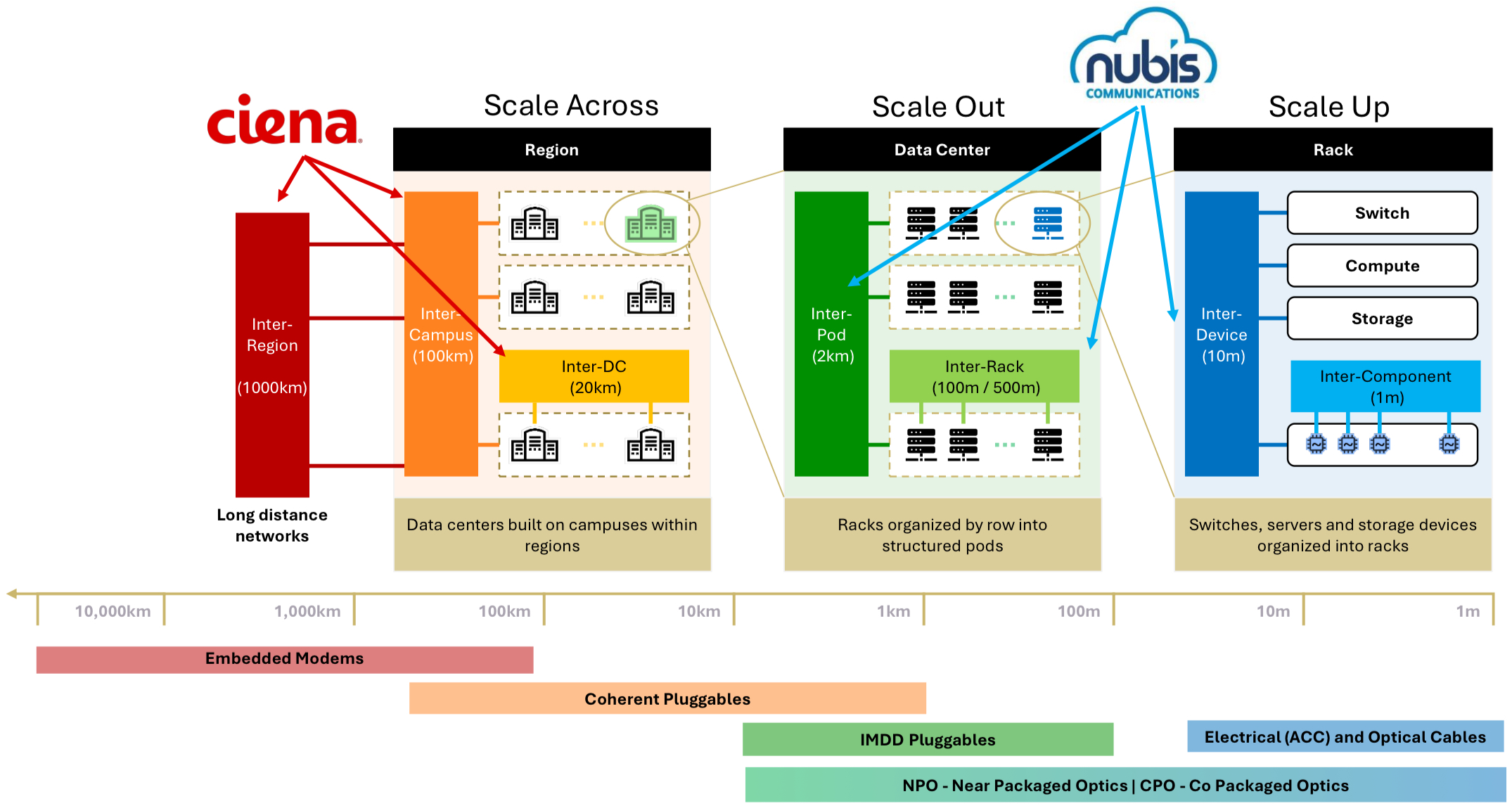
- Ciena is to buy optical interconnect start-up Nubis Communications for $270 million.
- The deal covers optical and copper interconnect technology for data centres
Ciena has announced its intention to buy optical engine specialist Nubis Communications for $270 million. If the network is the computer, Nubis’ optical engine and copper integrated circuit (IC) expertise will help Ciena better stitch together AI’s massive compute fabric.
Ciena signalled its intention to target the data centre earlier this year at the OFC show when it showcased its high-speed 448-gigabit serialiser-deserialiser IC technology and coherent lite modem. Now, Ciena has made a move for start-up Nubis, which plays at the core of AI data centres.
“Ciena’s expertise in high-speed components is relevant to 400G per lane Ethernet transceivers, but they never sold any products to this market,” says Vladimir Kozlov, CEO of LightCounting. “Nubis offers them an entry point with several designs and customer engagements.”
With the deal, Ciena is extending its traditional markets of wide area networks (WAN), metro, and short-reach dense wavelength division multiplexing (DWDM) to include AI networking opportunities. These opportunities include scale-across networks, where AI workloads are shared across multiple data centres, something Ciena can address, to now scale-out and scale-up networks for AI clusters in the data centre.
Puma optical engine
Nubis has developed two generations of compact optical engines for near-package optics (NPO) and co-package optics (CPO) applications. Its first-generation engine operates at 100 gigabits per second (Gbps), while its second, dubbed Puma, operates at 200 Gbps.
Nubis’s optical engine philosophy is based on escaping the optical channels from the surface of the optical engine, not its edge. The start-up also matches the number of optical channels to the electrical ones. The optical engine can be viewed as a sieve: data from the input channels flow through the chip and emerge in the same number of channels at the output. The engine acts as a two-way gateway, with one side handling electrical signals and the other, optical ones.
The Puma optical engine uses 16 channels in each direction, 16 by 200Gbps electrical signals for a total of 3.2 terabits per second (Tbps), and 16 fibres, each fibre carrying 200Gbps of data in the form of a wavelength. Puma’s total capacity is thus 6.4 terabits per second (Tbps). The engine also needs four external lasers to drive the optics, each laser feeding four channels or four fibres. The total fibre bundle of the device consists of 36 fibres: 32 for data (16 for receive and 16 for transmit), and four for the laser light sources.
Nubis is also a proponent of linear drive technology. Here, the advanced serdes on the adjacent semiconductor chip drives the optical engine, thereby avoiding the need for an on-engine digital signal processor (DSP) that requires power. The start-up has also developed a system-based simulator software tool that it uses to model the channel, from the transmitter to the receiver. The tool models not only the electrical and optical components within the channel but also the endpoints, such as the serdes.
Nitro
Nubis has an analogue IC team that designs its trans-impedance amplifiers (TIAs) and drivers used for the optical engine. The hardware compensates for channel impairments with low noise, high linearity, and at high speed. It is this channel simulator tool that Nubis used to optimise its optical engine, and to develop its second key technology, which Nubis calls Nitro —a chip that extends the reach of copper cabling.
“We use our linear optics learning and apply it to copper straight out of the gate, “said Peter Winzer, founder & CTO at Nubis, earlier this year. By using its end-to-end simulator tool, Nubis developed the Nitro IC, which extends the 1m reach of direct-attached copper to 4m using an active copper cable design. “We don’t optimise the driver chip, we optimise the end-to-end system,” says Winzer.
Nubis was also part of a novel design based on a vertical line card to shorten the trace length between an ASIC and pluggable modules.
Ciena’s gain
The acquisition of Nubis places Ciena at the heart of the electrical-optical transition inside the data centre. Ciena will cover both options: copper and optical interconnect. Ciena will gain direct-drive technology expertise for electrical and optical interfaces, enabling scale-up, as well as optical engine technology for scale-out, adding to its coherent technology expertise.

Ciena’s technologies will span coherent ultra-long-haul links all the way to AI accelerators, the heart of AI clusters. By combining Ciena’s 448-gigabit serdes with Nubis’s optical engine expertise, Ciena has a roadmap to develop 12.8Tbps and faster optical engines.
The acquisition places Ciena among new competitors that have chip and optical expertise and deliver co-packaged optics solutions alongside complex ICs such as Broadcom and Marvell.
The deal adds differentiation from Ciena’s traditional system vendor competitors, such as Cisco/ Acacia and Nokia. Huawei is active in long-haul optical and makes AI clusters. Ciena will also compete with existing high-speed optical players, including co-packaged optics specialists Ayar Labs and Ranovus, microLED player Avicena, and optical/IC fabric companies such as LightMatter and Celestial AI.
“Ciena will be a unique supplier in the co-packaged optics/near-packaged optics/active copper cabling data centre interconnect market,” says Daryl Inniss, Omdia’s thought lead of optical components and advanced fibre. “The other suppliers either have multiple products in the intra data centre market, like Broadcom and Nvidia, or they are interconnect-focused start-ups. These suppliers should all wonder what Ciena will do next inside the data centre.”
Ciena will enhance its overall expertise in chips, optics, and signal processing with the Nubis acquisition. It will also put Ciena in front of key processor players and different hyperscaler engineering teams, which drive next-generation AI systems.
Ciena will also have all the necessary parts for the various technologies, regardless of the evolving timescales associated with the copper-to-optical transition within AI systems. Ciena will add direct-detect technology and copper interconnect. On the optical side, it has coherent optical expertise, now coupled with near-package optics and co-packaged optics.
Nubis’ gain
Nubis’ 50-plus staff get a successful exit. The start-up was founded in 2020. Nubis will become a subsidiary of Ciena.
Nubis will be joining a much bigger corporate entity with deep expertise and pockets. Ciena has a good track record with its mergers. Think Nortel at the system level and Blue Planet, a software acquisition. Now the Nubis deal will bring Ciena firmly inside the data centre.
“This is a great deal for Nubis,” says Kozlov. “Congratulations to their team.”
What next?
The deal is expected to close in the fourth quarter of this year. Ciena expects the deal to start adding to its revenues from 2028, requiring Ciena and Nubis to develop products and deliver design wins in the data centre.
“Given the breadth of Ciena’s capabilities, its deep pockets, and products like its data centre out-of-band (DCOM) measurement product, router, and coherent transceivers, one can imagine that Ciena would offer more than co-packaged optics/ near-packaged optics/ active copper cabling inside the data centre,” says Inniss.


OFC 2025 industry reflections - Final Part

Gazettabyte has been asking industry figures for their thoughts after attending the OFC conference held in San Francisco.
In the final part, Arista’s Vijay Vusirikala and Andy Bechtolsheim, Chris Doerr of Aloe Semiconductor, Adtran’s Jörg-Peter Elbers, and Omdia’s Daryl Inniss share their learnings. Vusirikala, Doerr, and Elbers all participated in OFC’s excellent Rump Session.
Vijay Vusirikala, Distinguished Lead, AI Systems and Networks, and Andy Bechtolsheim, Chief Architect, at Arista Networks.
OFC 2025 wasn’t just another conference. The event felt like a significant momentum-gaining inflexion point, buzzing with an energy reminiscent of the Dot.com era optical boom.
This palpable excitement, reflected in record attendance and exhibitor numbers, was accentuated for the broader community by the context set at Nvidia’s GTC event held two weeks before OFC, highlighting the critical role optical technologies play in enabling next-generation AI infrastructure.
This year’s OFC moved beyond incremental updates, showcasing a convergence of foundational technologies and establishing optics not just as a supporting player but a core driver in the AI era. The scale of innovation directed towards AI-centric solutions – tackling power consumption, bandwidth density, and latency – was striking.
Key trends that stood out were as follows:
Lower Power Interconnect technologies
The overarching topic was the need for more power-efficient optics for high-bandwidth AI fabrics. Legacy data centre optics are impacting the number of GPUs that fit into a given data centre’s power envelope.
Three main strategies were presented to address the power issue.
First, whenever possible, use copper cables, which are far more reliable and cost less than optics. The limitation, of course, is copper’s reach, which at 200 gigabit-per-lane is about 1-2m for passive copper cables and 3-4m for active redriven copper cables.
Second, eliminate the traditional digital signal processor (DSP) and use linear interface optics, including Linear Pluggable Optics (LPO), Near Package Optics (NPO), and Co-Packaged Optics (CPO), all of which offer substantial (60%) power savings, lower latency, and higher reliability compared to traditional DSP solutions.
The biggest difference between linear pluggable optics and co-packaged optics is that linear pluggable optics retains the well-known operational advantages of pluggable modules: configurability, multi-vendor support, and easy field serviceability (hot-swapping at module level), compared to fixed optics like co-packaged optics, which require chassis-level RMAs (return materials authorisation). It remains to be seen whether co-packaged optics can overcome the serviceability issues.
Third, developments in a host of new technologies – advances in copper interconnects, microLED-based interconnects, and THz-RF-over-waveguides – promise even lower power consumption than current silicon photonics-based interconnect technologies.
We look forward to hearing more about these new technologies next year.
Transition from 200 gigabit-per-lambda to 400 gigabit-per-lambda
With the 200 gigabit-per-lambda optical generation just moving into volume production in 2025-26, attention has already turned to the advancement and challenges of 400 gigabit-per-lambda optical technologies for future high-speed data transmission, aiming towards 3,200 gigabit (8×400 gigabit) modules.
Several technical approaches for achieving 400 gigabit-per-lambda were discussed, including PAM-4 intensity modulation direct detection (IMDD), PAM-4 dual-polarisation, and optical time division multiplexing (OTDM). The technology choices here include indium phosphide, thin-film lithium niobate (TFLN), and silicon photonics, which are compared based on RF (radio frequency) loss, integration, cost, and high-volume readiness.
For 400 gigabit lambda optics, indium phosphide and thin-film lithium niobate are strong candidates, as silicon photonics will struggle with the high bandwidth.
At this point, it is impossible to predict which platform will emerge as the high-volume winner. Delivering power and cost-effective 400-gigabit lambda optics will require a concerted industry effort from optical component suppliers, connector suppliers, and test and measurement vendors.
Multi-core fibre
A new pain point in large AI data centres is the sheer number of fibre cables and their associated volume and weight. One way to solve this problem is to combine multiple fibre cores in a single fibre, starting initially with four cores, which would offer a 4:1 reduction in fibre count, bulk, and weight.
Hollow-core fibre
Innovation continues in the foundational fibre itself. Hollow-core fibre generated significant buzz, with its potential for lower latency and wider bandwidth attracting intense interest.
The maturing hollow-core fibre ecosystem, including cabling and interconnection progress, suggests deployments beyond niche applications like high-frequency trading may be approaching, reaching areas like distributed AI processing.
AI-driven network evolution
AI isn’t just driving network demand, it is increasingly becoming a network management tool.
Numerous demonstrations showcased AI/machine learning applications for network automation, traffic prediction, anomaly detection, predictive maintenance – e.g., analysing optical time-domain reflectometer (OTDR) traces, configuration management, and resource optimisation. This represents a fundamental shift towards more efficient, reliable, self-configuring, self-healing, and self-optimising networks.
Along with the many technical talks and tutorials, show floor demos, and customer and supplier meetings, OFC attendees also had a chance to combine technology with some light-hearted fun at the rump session.
This year’s topic was rebuilding global communication infrastructure after an alien invasion, and three teams came up with thought-provoking ideas for this theme.
Chris Doerr, CEO of Aloe Semiconductor
The best way to describe OFC 2025 is a giant Mars dust storm that raged for days. The swirling sand made it difficult to see anything clearly, and the sound was so loud you couldn’t think.
Acronyms ending in “O” were hitting you from all sides: LPO, LRO, NPO, CPO, OIO. The wind blew away sand that had buried old technologies, such as lithium niobate, electro-optic polymer, and indium-phosphide modulators, and they joined the fray.
Only now that the storm has somewhat subsided can we start piecing together what the future holds.
The main driver of the storm was, of course, artificial intelligence (AI) systems. AI requires a vast number of communication interconnects. Most interconnects, at least within a rack, are still copper. While copper keeps making incredible strides in density and reach, a fibre-optic interconnect takeover seems more and more inevitable.
The Nvidia announcements of co-packaged optics (CPO), which go beyond co-packaged optics and deserve a new name, such as optical input-output (OIO) or system-on-chip (SOC), created a great deal of excitement and rethinking. Nvidia employs a silicon interposer that significantly increases the electrical escape density and shortens the electrical links. This is important for the long-term evolution of AI computing.
The CPO/OIO/SOC doesn’t mean the end of pluggables. Pluggables still bring tremendous value with attributes such as time-to-market, ecosystem, replaceability, etc.
Most pluggables will still be fully retimed, but 100 gigabit-per-lane seems comfortable with linear pluggable optics (LPO), and 200 gigabit-per-lane is starting to accept linear receive optics (LRO).
For 200 gigabit per lane, electro-absorption modulated lasers (EMLs) and silicon photonics have comfortably taken the lead. However, for 400 gigabit per lane, which had two main demos on the show floor by Ciena and Marvell, many technologies are jockeying for position, mostly EMLs, thin-film lithium niobate (TFLN), indium phosphide, and silicon photonics.
Many companies are abandoning silicon photonics, but this author feels this is premature. There were demos at OFC of silicon photonics attaining near 400 gigabit-per-lane, and the technology is capable of it.
An important thing to remember is that the new OIO/SOC technology is silicon photonics and comes from a CMOS foundry. Putting non-CMOS materials such as thin-film lithium niobate or indium phosphide in such a platform could take years of expensive development and is thus unlikely.
In summary, OFC 2025 was very active and exciting. Significant technology improvements and innovations are needed.
The dust is far from settled, so we must continue wading into the storm and trying to understand it all.
Jörg-Peter Elbers, Senior Vice President, Advanced Technology, Standards and IPR, Adtran
OFC 2025 marked its largest attendance since 2003 with nearly 17,000 visitors, as it celebrated its 50th anniversary.
Discussions in 1975 centred around advances in fibre technology for telecommunications. This year’s hottest topic was undoubtedly optical interconnects for large-scale AI clusters.
Following an insightful plenary talk by Pradeep Sindhu from Microsoft on AI data centre architecture, sessions were packed in which co-packaged optics (CPO) and associated technologies were discussed. The excitement had been fueled by Nvidia’s earlier announcement of using co-packaged optics in its next generation of Ethernet and Infiniband switches.
The show floor featured 800 gigabit-per-second (Gbps), 1.6 terabit-per-second (Tbps), and the first 3.2Tbps interconnect demonstrations using different interface standards and technologies.
For access, 50G-PON was showcased in triple PON coexistence mode, while interest in next-generation very high-speed PON spurred the technical sessions.
Other standout topics included numerous papers on fibre sensing, stimulating discussions on optical satellite communications, and a post-deadline paper demonstrating unrepeated hollow-core fibre transmission over more than 200km.
OFC 2025 was fun too. When else do you get to reimagine communications after an alien attack, as in this year’s rump session?
No visit to San Francisco is complete without trying one of Waymo’s self-driving taxis. Having been proud of Dmitri Dolgov, Waymo’s CEO, for his plenary talk at OFC 2019, it was thrilling to see autonomous driving in action. I love technology!
Daryl Inniss, Omdia Consultant, Optical Components and Fibre Technologies
I worked on commercialising fibre technology for emerging applications at OFS – now Lightera – from 2016 to 2023. I spent the prior 15 years researching and analysing the optical components market.
Today, I see a market on the cusp of a transition due to the unabated bandwidth demand and the rise of computing architectures to support high-performance computing (HPC) and artificial intelligence (AI).
Even optical fibre, the fundamental optical communications building block, is under intense scrutiny to deliver performance suitable for the next 30 to 50 years. Options include hollow-core and multi-core fibre, two of the three fibre technologies that caught my attention at OFC 2025.
The third, polarisation-maintaining fibre arrays for co-package optics, is one part of the conference’s biggest story. OFC 2025 provided a status update on these technologies.
Hollow-core fibre
OFC’s first day hollow-core fibre workshop (S2A) illustrated its niche status and its potential to remain in this state until the fibre is standardised. The industry ecosystem was well represented at the session.
Not surprisingly, challenges highlighted and summarised by Russ Ellis, Microsoft’s Principal Cloud Network Engineer, included manufacturing, field installation, field splicing, cabling, and termination inside the data centre. These are all expected topics and well understood.
I was surprised to hear Microsoft report that the lack of an established ecosystem was a challenge, and I’ll explain why below.
Coming into OFC, the biggest market question was fibre manufacturing scalability, as most reported draws are 5km or less. Supplier YOFC put this concern to rest by showcasing a +20 km spool from a single fibre draw on the show floor. And Yingying Wang, CEO of Linfiber, reported that 50 to 100km preforms will be available this year.
In short, suppliers can scale hollow-core fibre production.
From a field performance perspective, Microsoft highlighted numerous deployments illustrating successful fibre manufacturing, cabling, splicing, termination, installation, and testing. The company also reported no field failures or outages for cables installed over five years ago.
However, to my knowledge, the hollow-core fibre ecosystem challenge is a consequence of a lack of standardisation and discussion about standardisation.
Each fibre vendor has a different fibre design and a different glass outer diameter. Microsoft’s lack-of-an-ecosystem comment mentioned above is therefore unsurprising. Only when the fibre is standardised can an ecosystem emerge, generating volumes and reducing costs,
Today, only vertically integrated players benefit from hollow-core fibre. Until the fibre is standardised, technology development and adoption will be stunted.
Multi-core fibre
I was pleasantly surprised to find multiple transceiver vendors showcasing modules with integrated fan-in/fan-out (FIFO). This is a good idea as it supports multi-core fibre adoption.
One vendor is targeting FR4 (TeraHop for 2x400G), while another is targeting DR8 (Hyper Photonix for 8x100G). There is a need to increase core density, and it is good to see these developments.
However, we are still very far from multi-core fibre commercialisation as numerous operational factors, for example, are impacted. The good news is that multi-core fibre standardisation is progressing.
Polarisation-maintaining fibre
According to Nick Psaila, Intel’s principal engineer and technology development manager, polarisation-maintaining fibre arrays remain expensive.
The comment was made at Optica’s February online Industry Meeting and verified in my follow-up conversation with Psaila.
Using an external laser source is the leading approach to deliver light for co-packaged optics, highlighting an opportunity for high-volume, low-cost polarisation-maintaining fibre arrays.
Co-packaged optics were undoubtedly the most significant topic of the show.
Coherent showcased a 3Tbps concept product of VCSELs to be used in co-packaged optics. Given that multimode fibre is used in the shortest optical connections in data centres and that VCSELs have very low power consumption, I’m surprised I’ve not heard more about their use for this application.
Testing of emerging photonic solutions for HPC and AI devices has been identified as a bottleneck. Quantifi Photonics has taken on this challenge. The company introduced an oscilloscope that provided quality results comparable to industry-leading ones and is designed for parallel measurements. It targets photonic devices being designed for co-packaged optics applications.
Multiple channels, each with wavelength-division multiplexing lasers, must be tested in addition to all the electrical channels. This is time-consuming, expensive process, particularly using existing equipment.
Polymer modulators continue to be interesting because they have high bandwidth and the potential to be inexpensive. However, reliability is their challenge. Another vendor, NLM Photonics, is targeting this application.
The many vendors offering optical circuit switches was a surprising development. I wonder if this opportunity is sufficiently large to justify the number of vendors. I’m told that numerous internet content providers are interested in the technology. Moreover, these switches may be adopted in telecom networks. This is a topic that needs continual attention, specifically regarding the requirements based on the application.
Lastly, Lightmatter provided a clear description of its technology. An important factor is the optical interposer that removes input-output connectivity from the chip’s edge, thereby overcoming bandwidth limitations.
I was surprised to learn that the laser is the company’s design, although Lightmatter has yet to reveal more.

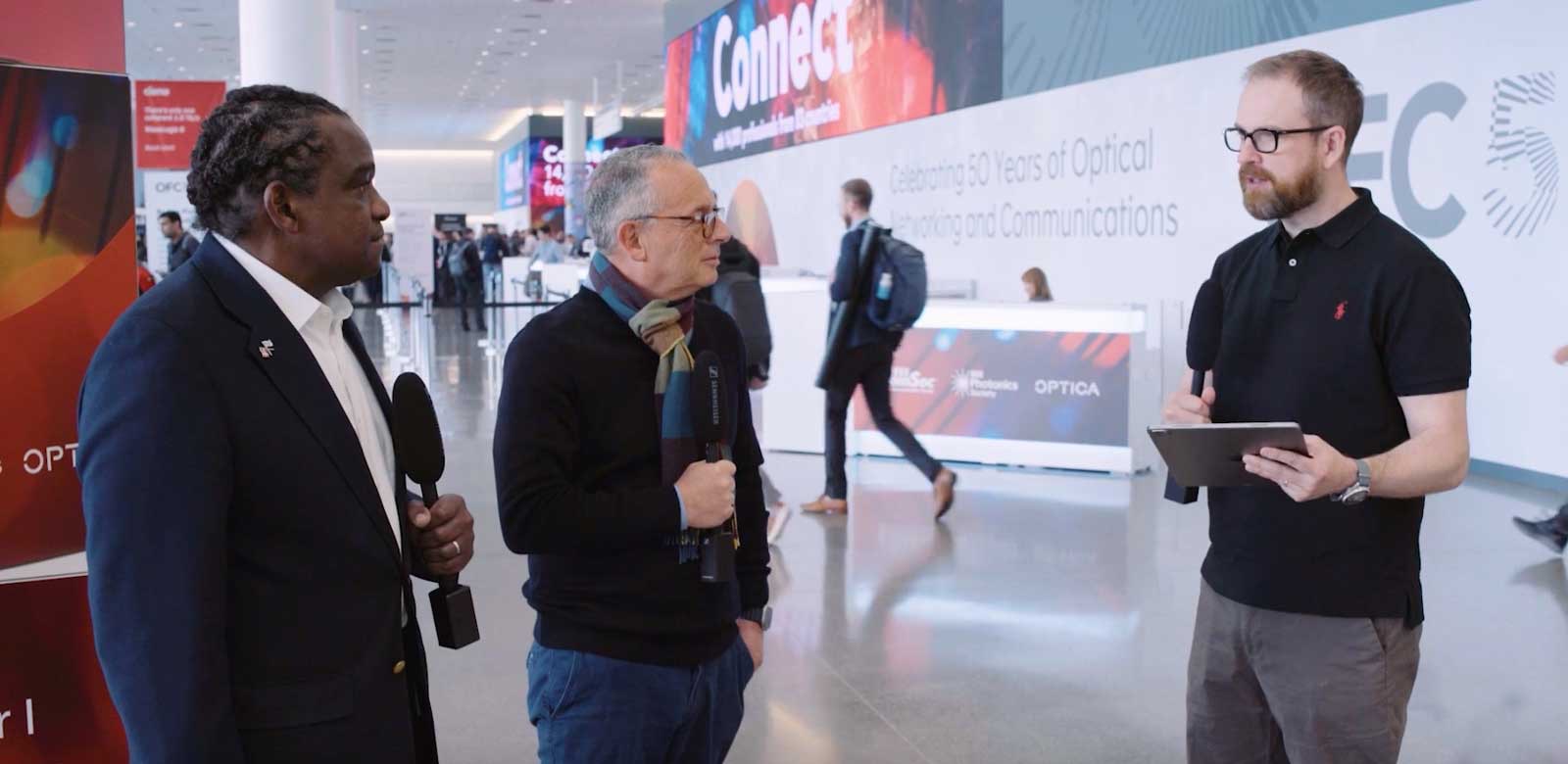
OFC 2025: reflecting on the busiest optics show in years
The discussion covers the hot topics of the show and where the industry is headed next. Click here.

Podcast: Is AI driving a new wave of photonic innovation?

AI is still in its infancy, but it’s already pushing the photonics and computing industries to rethink product roadmaps and drive new levels of innovation.
Adtran’s Gareth Spence talks with authors and analysts Daryl Inniss and the editor of Gazettabyte about the fast pace of AI development and the changes needed to unlock its full potential. They also discuss the upcoming sequel to their book on silicon photonics and its focus on AI.
To listen to the podcast, click here.

AI and optics: An OFC conversation

An OFC conversation with Adtran's Gareth Spence and consultant Daryl Inniss about the AI opportunity for photonics, click here.

The status of silicon photonics - an ECOC interview
Daryl Inniss and I being interviewed at ECOC by Adtran’s Gareth Spence about the state of silicon photonics.
Click here for the interview.

Books read in 2021: Final Part

In the final favoured reads during 2021, the contributors are Daryl Inniss of OFS, Vladimir Kozlov of LightCounting Market Research, and Gazettabyte’s editor.
Daryl Inniss, Director, Business Development at OFS
Four thousand weeks is the average human lifetime.
A book by Oliver Burkeman: Four Thousand Weeks: Time Management For Mortals is a guide to using the finite duration of our lives.
Burkeman argues that by ignoring the reality of our limited lifetime, we fill our lives with busyness and distractions and fail to achieve the very fullness that we seek.
While sobering, Burkeman presents thought-provoking and amusing examples and stories while transitioning them into positive action.
An example is his argument that our lives are insignificant and that, regardless of our accomplishments, the universe continues unperturbed. Setting unrealistic goals is one consequence of our attempt to achieve greatness.
On the other hand, recognising our inability to transform the world should give us enormous freedom to focus on the things we can accomplish.
We can jettison that meaningless job, be fearless in the face of pandemics given that they come and go throughout history, and lower our stresses on financial concerns given they are transitory. What is then left is the freedom to spend time on things that do matter to us.
Defining what’s important is an individual thing. It need not be curing cancer or solving world peace – two of my favourites. It can be something as simple as making a most delicious cookie that your kids enjoy.
It is up to each of us to find those items that make us feel good and make a difference. Burkeman guides us to pursue a level of discomfort as we seek these goals.
I found this book profound and valuable as I enter the final stage of my life.
I continue to search for ways to fulfil my life. This book helps me to reflect and consider how to use my finite time.
Vladimir Kozlov, CEO and Founder of LightCounting Market Research
Intelligence is a fascinating topic. The artificial kind is making all the headlines but alien minds created by nature have yet to be explored.
One of the most bizarre among these is the distributed mind of the octopus. “Other Minds: The Octopus, the Sea and the Deep Origins of Consciousness, by Peter Godfery-Smith, is a perfect introduction to the subject.
The Overstory: A Novel, by Richard Powers takes the concept of alien minds to a new, more emotional level. It is a heavy read. The number of characters rivals that of War and Peace while the density matches the style of Dostoevsky. Yet, it is impossible not to finish the book, even if it takes several months.
It concerns the conflict of “alien minds”. The majority of the aliens are humans, cast from the distant fringes of our world. The trees emerge as a unifying force that keeps the book and the planet together. It is an unforgettable drama.
I have not cut a live tree since reading the book. I can not stop thinking about just how shallow our understanding of the world is.
The intelligence created by nature is more puzzling than dark matter yet it is shuffled into the ‘Does-not-matter’ drawer of our alien minds.
Roy Rubenstein, Gazettabyte’s editor
Ten per cent of my contacts changed jobs in 2021, according to LinkedIn.
Of these, how many quit their careers after 32 years at one firm? And deliberately downgraded their salaries?
That is what Kate Kellaway did. The celebrated Financial Times journalist quit her job to become a school teacher.
Kellaway is also a co-founder of Now Teach, a non-profit organisation that helps turn experienced workers in such professions as banking and the law into teachers.
In her book, Re-educated: How I Changed My Job, My Home and My Hair, Kellaway reflects on her career as a journalist and on her life. She notes how privileged she has been in the support she received that helped her correct for mistakes and fulfill her career; something that isn’t available to many of her students.
She also highlights the many challenges of teaching. In one chapter she describes a class and the exchanges with her students that captures this magnificently.

A book I reread after many years was Arthur Miller’s autobiography, Timebends: A Life.
In the mid-1980s on a trip to the UK to promote his book, Miller visited the Royal Exchange Theatre in Manchester. There, I got a signed copy of his book which I prize.
The book starts with his early years in New York, surrounded by eccentric Jewish relatives.
Miller also discusses the political atmosphere during the 1950s, resulting in his being summoned before the House Un-American Activities Committee. The first time I read this, that turbulent period seemed very much a part of history. This time, the reading felt less alien.
Miller is fascinating when explaining the origins of his plays. He also had an acute understanding of human nature, as you would expect of a playwright.
The book I most enjoyed in 2021 is The Power of Strangers: The Benefits of Connecting in a Suspicious World, by Joe Keohane.
The book explores talking to strangers and highlights a variety of people going about it in original ways.
Keohane describes his many interactions that include an immersive 3-day course on how to talk to strangers, held in London, and a train journey between Chicago and Los Angeles; the thinking being that, during a 42-hour trip, what else would you do but interact with strangers.
Keohane learns that, as he improves, there is something infectious about the skill: people start to strike up conversations with him.
The book conveys how interacting with strangers can be life-enriching and can dismantle long-seated fears and preconceptions.
He describes an organisation that gets Republican and Democrat supporters to talk. At the end of one event, an attendee says: “We’re all relieved that we can actually talk to each other. And we can actually convince the other side to look at something a different way on some subjects.”
If reading novels can be viewed as broadening one’s experiences through the stories of others, then talking to strangers is the non-fiction equivalent.
I loved the book.


Silicon photonics webinar
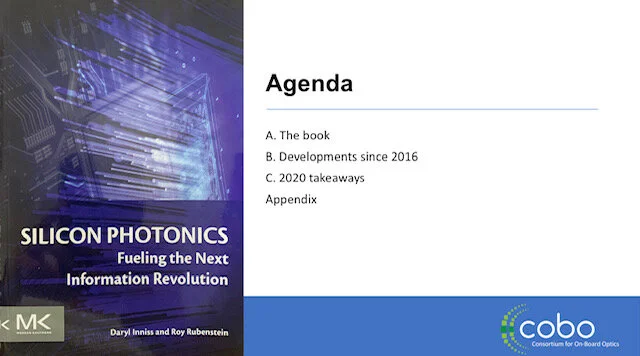
Daryl Inniss and I assess how the technology and marketplace has changed since we published our silicon photonics book at the end of 2016. Click here to view the webinar. Ours is the first of a series of webinars that COBO, the Consortium of On-Board Optics, is hosting.
OFC interview regarding silicon photonics and our book
ADVA Optical Networking's Gareth Spence interviewed Daryl Inniss, director, new business development at OFS, and me at the OFC conference and exhibition held earlier this month in San Diego, California. We were interviewed regarding the status of silicon photonics and our book on the topic.

Click here for the interview.

Presentation slides of the book
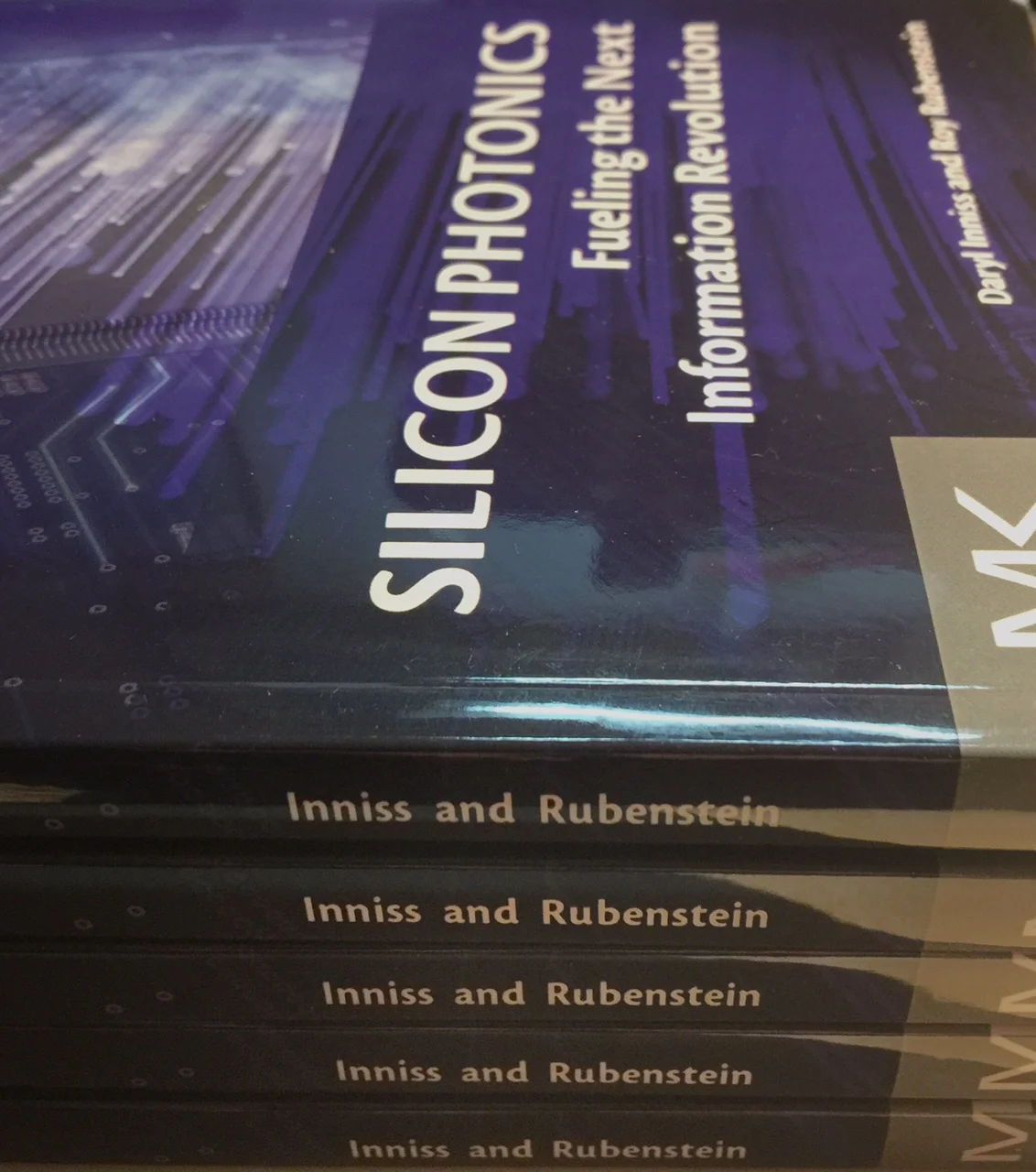 A set of slides summarising the book, Silicon Photonics: Fueling the Next Information Revolution.
To download the slides, please click here.