

Books read in 2021: Part 3

In Part III, two more industry figures pick their reads of the year: Dana Cooperson of Blue Heliotrope Research and ADVA’s Gareth Spence.
My reading traverses different ground from that of other invited analysts to this yearly section. In addition, my ‘avoid new releases’ approach means my picks are not from 2021. And before jumping straight into recommendations, I’ll preface my comments with an homage to communal aspects of reading that have meant so much to me, especially during these two Covid years.
My two book groups managed to meet steadily during the pandemic, sometimes while sitting outside in the snow, covered with blankets and sipping hot tea.
Beyond ensuring a steady stream of titles to read and discuss, the ladies in my book clubs have supported and encouraged each other through births and deaths and all the highs and lows in between. I tried a third, online alumni book club, this year, but meh: what it provided was not even close to the tight-knit book club experience I treasure.
I have also appreciated the annual August in-person ad hoc book club and reading recommendations sessions that grew out of my college experience, and which have been going strong for 40 years now. My daughters and I also exchanged books and discussed them this last year.
The books I most appreciated of the 20 or so I read in 2021 were those that offered interesting, deep, and well-written windows into people, places, cultures, and identities I didn’t know I needed to know more about. Here are my top picks:
My favourite 2021 read was the 2019 Booker Prize winner Girl, Woman, Other, by Bernadine Evaristo. This funny and touching novel spans space and time to weave the stories of twelve mostly female, mostly Black, and mostly British characters and their ancestors. The characters’ narratives intersect in surprising ways that don’t feel at all artificial or manipulative. The book’s unique style and structure add to the storytelling.
A Tree Grows in Brooklyn, by Betty Smith, is a fantastic autobiographical novel published in 1943. It details the hard yet full life of Frances Nolan, who grows up impoverished in Williamsburg to first-generation parents from immigrant families (one Irish, one Austrian) in the early 20th century. The descriptions are so vivid, and the main character so tenacious, determined, and smart, that the book is positive and affirming despite its often tough subject matter (alcoholism, abuse, poverty).
My daughter, who had taken an Asian-American literature class in college, suggested The Sympathizer, a 2016 Pulitzer winner by Viet Thanh Nguyen. Like “A Tree Grows in Brooklyn,” the subject matter (the fall of Saigon, spying, torture, betrayal, being a stranger in a strange land) is not a simple read. But the characters are again so vivid, the narrative so darkly comic and satirical, and the historic subject matter so relevant to today that I found the book riveting. (Note: Nguyen published a sequel in 2021 that I’ve yet to read.)
American Dirt, by Jeanine Cummins, tells the harrowing tale of a group of desperate migrants trying to complete the dangerous trip from Latin America to the US. As I started reading it, a friend who hadn’t read it noted the controversies swirling around the author (she’s not Latinx enough for some) and the plot (lambasted by some as ‘immigrant porn’). Whatever: I read the book and loved it. This gripping novel made the plight of desperate migrants more real to me than any news story had done.
Other book recommendations:
• The Vanishing Half: A Novel by Britt Bennett, regards two African American sisters from the US South who make very different choices (one passes as white) and how their futures and families are affected by their choices.
• Afterlife, by Julia Alvarez, concerns a retired English professor who is suddenly widowed and trying to figure out how to live her life and deal with her three sister
• The Great Believers, by Rebecca Makkai, is about the AIDS crisis in Chicago. It bounces between 1985 and 2015 as it follows a group of gay men and their born and made families. I found the plot (who lives, who dies) a tad manipulative, but the book shined a light on a pandemic and its victims that we should never forget.
• The Miniaturist, by Jessie Burton, which is set in 17th century Amsterdam, is an atmospheric, magical, and suspenseful novel that made the era of the Dutch East India Company come alive for me. You did not want to be poor, female, Black, or gay in 1686 in the Netherlands, so this book is dark.
• Midnight in the Garden of Good and Evil: A Savannah Story, a non-fiction novel by journalist John Berendt, describes a 1980s murder and trial in Savannah, Georgia. Readers will not easily forget the town’s many characters, especially The Lady Chablis.
It seems fitting to end my 2021 recommendations with a recent read, Oscar Wilde’s The Picture of Dorian Gray, about a young man whose moral decay and debauchery is recorded by his painted portrait even while his body retains its unsullied youth and beauty.
Wilde sure had a way with words: his descriptions of 19th century London high society are as sharp as any knife. For example, Lord Fermor was “a genial if somewhat rough-mannered old bachelor, whom the outside world called selfish because it derived no particular benefit from him, but who was considered generous by Society as he fed the people who amused him.”
I’ll close with Wilde’s musing on art from the last epigram in the novel’s preface: “We can forgive a man for making a useful thing as long as he does not admire it. The only excuse for making a useless thing is that one admires it intensely. All art is quite useless.”
Gareth Spence, Senior Director of Digital Marketing and Public Relations at ADVA.
It’s been a grey and wet holiday season in the UK. Ideal conditions for hunkering down in front of the fire and building a reading list for 2022. If you’re doing the same, here are two suggestions for your book pile.
Both recommendations can loosely be filed under the topic of the American Dream. The first one stretches the rules as it’s only available as an audiobook. It’s Miracle and Wonder: Conversations with Paul Simon, by Malcolm Gladwell and Bruce Headlam.
I was reluctant to listen to this book. I’ve grown tired of Gladwell’s writing style and his tendency to reduce human nature to a digestible catchphrase. Still, the opportunity to hear Simon talk about his career proved too compelling.
As a child, I was an avid listener of Simon. His work shaped my early notions of America and the American Dream. In the book, Simon talks extensively about his anthemic tunes. Where the ideas came from, how the songs were shaped and how his relationship with his music has changed during his long career.
It’s fascinating to hear Simon talk openly about his past. If you have any interest in his songs or the musical process, you’ll enjoy this book. Just try your best to overcome Gladwell’s gushing praise of Simon. The man could rob a bank and Gladwell would find artistic merit in it.
My second recommendation is Nomadland: Surviving America in the Twenty-First Century, by Jessica Bruder. This book is a powerful exploration of the flipside of the American Dream. It follows the lives of a growing community of people who have been cast aside by society and forced to find ways to live outside mainstream America.
Many of the people detailed are over 60 and have lost their homes and livelihoods. They now live in recreational vehicles, vans and even cars and spend their time in laborious, menial jobs. When they’re not working, they’re travelling the country, finding ways to embrace freedoms they never had before.
It’s sobering to read Bruder’s book as she spends over a year exploring this nomadic community. It’s hard to imagine that this group won’t continue to expand as life in America becomes ever more challenging.
But as difficult as it is to read, there’s also hope. The people show resourcefulness and resiliency in how they discover a new way to live and rediscover their country.


Books in 2019 - Final Part

Gazettabyte asks industry figures each year to cite the memorable books they have read. These include fiction, non-fiction and work-related titles.
In the second and final part, the recommendations during 2019 of Analysys Mason’s Dana Cooperson and Tom Williams from Acacia Communications are included.
Dana Cooperson, Research Director, Analysys Mason
I’ll cheat somewhat and go back several years when picking favourite books and then I’ll focus on titles read in 2019.
I’ve spent a lot of time over the past five years thinking about, helping my kids apply for, and paying for university education, so education-related books have been a focus.
My first recommendation is Excellent Sheep: The Miseducation of the American Elite and the Way to a Meaningful Life, by William Deresiewicz, an ex-professor and admissions counsellor at Yale.
I recommend it for its insight into the college admissions process, the business of US higher education, and how far some parents, prospective students, and colleges stray from what should be the goal: a good education. The recent “Varsity Blues” admissions scandal is a case in point.
The book, read after my first daughter’s run through the admissions obstacle course, validated my cynicism, but also left me and my younger daughter, who read it, empowered for our second attempt.
Three other education-related books offer different accounts of disadvantaged yet determined individuals who overcome challenging circumstances to become well-educated. And how friends and relatives can work to undermine those who strive for more. They also recount how difficult navigating the system can be for the disadvantaged and the crucial role of mentors.
Educated: A Memoir, by Tara Westover and Hillbilly Elegy: A Memoir of a Family and Culture in Crisis, by J. D. Vance, are well-known. These memoirs are insightful about the ‘anti-elite’, anti-education subcultures in the US (in Appalachia and survivalist Idaho, respectively).
Less well-known is A Hope in the Unseen: an American Odyssey from the Inner City to the Ivy League, by journalist Ron Suskind; by far my favourite of the three.
It traces the path of Cedric Jennings, a bright and determined African American boy from a poor, dangerous section of Washington, D.C., in the 1990s as he faces setback after setback in his quest for an education and a better life. It is a wonderfully written and deep book.
Other books gave me engrossing peeks into other eras, cultures, and species.
My 2019 reading started with Homegoing, by Yaa Gyasi, a story of two 18th century Ghanaian half-sisters, one of whom ends up enslaved in Mississippi. This epic novel spans eight generations of the sisters’ families and sheds light on the dark corners of the international slave trade and its legacy.
The central character of Eleanor Oliphant is Completely Fine, by Gail Honeyman, is smart, funny, and cringingly, endearingly quirky. The novel, set in present-day Scotland, has elements of a mystery as we slowly learn the roots of Eleanor’s trauma and just how twisted her psyche has become in her effort to outrun childhood tragedy.
I ended 2019 with A Gentleman in Moscow: A Novel, by Amor Towles. This novel’s plot spans Russian/ Soviet history from the Bolshevik revolution to the Cold War, and yet it unfolds almost entirely in a hotel.
Count Alexander Rostov, the titular protagonist, is an aristocrat whom the Bolsheviks deem a “former person” and sentenced to house arrest in Moscow’s Metropol Hotel. The Count, abetted by various friends and dogged by his chief antagonist, creates a life well-lived despite being a prisoner of the state. Here’s looking at you, Count!
Lastly, the book you didn’t know you needed to read about the species you didn’t know was so fascinating: The Soul of an Octopus: A Surprising Exploration into the Wonder of Consciousness, by journalist Sy Montgomery.
I’m never going to eat octopus again but that is a small price to pay for such an illuminating exposé on the physiology, lifecycle, and intelligence of the octopus; their personalities; and what we can learn about consciousness from a species alien to us.
Tom Williams, Vice President of marketing at Acacia Communications.
It may be a depressing story but the book that most impacted me in 2019 is entitled: What Made Maddy Run, by Kate Fagan.
It is a tragic story about a freshman, Madison Hollaran, at the University of Pennsylvania, who struggled with the pressures of freshman year as a scholarship athlete at an Ivy League school and committed suicide in her second semester.
Maddy seemed to have a perfect life as a star high-school athlete in soccer and track. She had a strong network of high-school friends and a supportive family, but she found herself lost at Penn and couldn’t find her way back to peace in her life.
Her family and close friends knew she was struggling but I don’t think anyone ever imagines events taking such a turn.
Maddy’s family provided the author with full access to her phone, computer and accounts. Stories from family and friends are interspersed with email and text discussions to provide a real sense of the pain she was struggling to communicate. Stitching these different strands together and the benefit of hindsight provide a fuller perspective.
As she approached her final act of desperation, several interactions presented themselves to offer her a different path out of the valley that she found herself in, but somehow she couldn’t recognise these opportunities. She had lost hope.
The book explores the pressures of freshman year, especially at an Ivy League school where students face a level of academic competitiveness never experienced before. Everyone there was at the top of their class in high-school.
In addition, athletes often feel the burden of living up to expectations to “earn” their scholarship. Their sport can become a responsibility or burden and no longer a source of enjoyment.
The book also explores how social media posts can disguise what someone like Maddie is feeling, making it even harder to recognise when a concerning situation has become a crisis.
As a parent of teenage daughters, I felt for her parents who knew she was struggling but didn’t know how to help. As parents, we want to fix our children’s problems, but as they approach adulthood, it is more difficult to have all the answers.
You know from the start how the book will end, but the chapter where she takes her life is as powerful as anything I’ve read. I can’t imagine how difficult it was for her family to provide the access to enable this book to be written, but I respect their strength and I hope it helps others in similar situations.
The book made a lasting impression on me.
Roy Rubenstein, Editor of Gazettabyte
I read some terrific titles in 2019 but none came close to the book What Dementia Teaches Us about Love, by Nicci Gerrard. (In the US, the title is The Last Ocean: A Journey Through Memory and Forgetting)
Gerrard is a journalist and novelist. She is also a co-founder of a campaign in the UK, named after her father, John, to allow carers to accompany dementia patients in hospitals. This follows her experience with her father who was left alone for days without visitors due to a virus outbreak.
Gerrard describes how, “… away from the home he loved, stripped of familiar routines and surrounded by strangers and machines, he swiftly lost his bearings and his fragile hold on himself. There is a great chasm between care and ‘care’, and my father fell into it.”
The book explores the disease – the gradual fragmentation of a person as they lose memory, language, recognition of their surroundings and, inevitability, their health.
But the book is more than that: it is a treatise on what it is to be human. What makes you, you? The grounding of memory and what it means to start forgetting. What is home? And the conflicting demands of caring: preserving the self while being endlessly drawn to caring for a loved one that is slowly losing and being lost.
The book is part memoir and part study. It is also sprinkled with moving human-interest stories. It may be hard to read at times but the book is uplifting.
Gerrard has written an original work on a topic that is not short of literature. Her writing also causes you to pause and reflect on what you’ve read.
For example, she starts the book with a story of how her father, after a decade of dementia, joins the family on a holiday in Sweden and visits a lake.
“My father, old and frail, swam out a few yards and then he started to sing. It is a song I’d never heard before, and never heard since …
“His self – bashed about by the years, picked apart by his dementia – was, in this moment of kindness, beyond language, consciousness and fear, lost and contained in the multiplicity of things and at home in the vast wonder of life.”


Infinera introduces flexible grid 500G super-channel ROADM
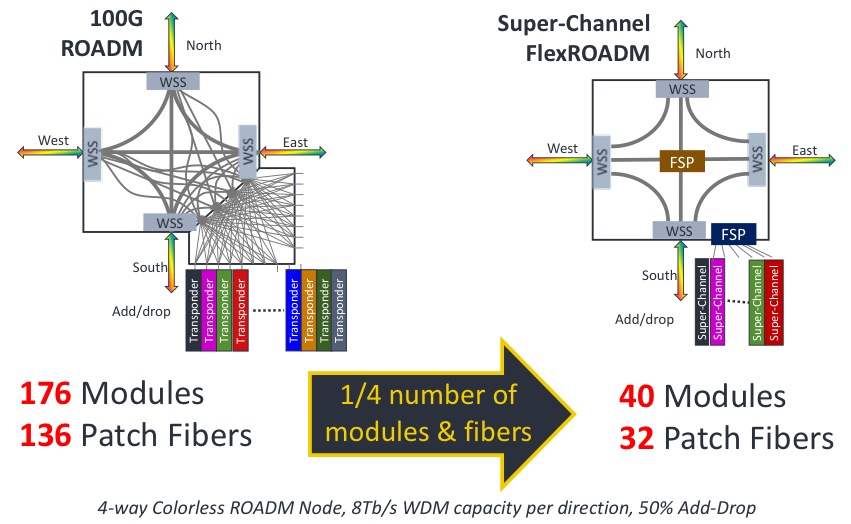 An example showing the impact of a 500G super-channel ROADM node. Source: Infinera
"The FlexROADM will open up the Tier-1 operators in a way Infinera has not been able to do before," says Dana Cooperson, vice president, network infrastructure at market research firm, Ovum. "The DTN-X was necessary but not sufficient; the ROADM is the last piece."
The FlexROADM is claimed to deliver two industry firsts: it can add and drop flexible-grid-based 500 Gig super-channels, and uses the Internet Engineering Task Force’s (IETF) spectrum switched optical networks (SSON).
"SSON is the next generation of WSON [Wavelength Switched Optical Network control plane], except it manages spectrum," says Ron Kline, principal analyst, network infrastructure also at Ovum.
The DTN-X platform combines Infinera's 500 Gig photonic integrated circuits and OTN (Optical Transport Network) switching. With the FlexROADM, Infinera has added switching at the optical layer in 500 Gig increments. Infinera can now offer enhanced multi-layer network optimisation with the combination of electrical and optical switching.
"Optical bypass before was manual using patch cords, now operators can reconfigure with the FlexROADM," says Kline. "It also provides new optical restoration capabilities that Infinera did not have."
The FlexROADM supports up to nine degrees, and is available in colourless, colourless and directionless, and full colourless, directionless and contentionless (CDC) versions.
"The debate about contentionless continues," says Kline. "It is safe to assume that for the majority of applications flexible grid, colourless and directionless will be the high runner." Contentionless will be used by the big carriers, he says, but in certain locations only.
Infinera says the line system announced will support up to 24 Terabit-per-second (Tbps) when it ships in September. The maximum long-haul capacity using its current PM-QPSK super-channels is 9.5Tbps per fibre pair.
"In the future when we enable metro-reach super-channels using PM-16-QAM, they will support 24 Terabit-per-second per fibre pair using the line system we are announcing," says Geoff Bennett, director, solutions and technology at Infinera.
Bennett says the data rate and the spectral efficiency for a given sub-carrier can be varied depending on the reach required. The spacing between sub-carriers that make up a super-channel also can be varied depending on reach. Many different transmission possibilities exist, says Bennett, but to explain the concept, he cites two examples.
The 24Tbps capacity with PM-16-QAM modulation uses pulse shaping at the transmitter to achieve 'Nyquist DWDM' channel spacing, the spacing between channels that approximates the baud rate, says Bennett.
"At this time we are not disclosing the details of the channel spacing, or the number of sub-carriers used by our future line modules," says Bennett. "But the total super-channel spectral width is the equivalent of 200GHz if you are transmitting a one Terabit super-channel, for example." This equates to a spectral efficiency of 5b/s/Hz, and using 16-QAM, the reach achieved will be 600-700km.
"The system we have just launched is designed to operate in long-haul networks and uses PM-QPSK," says Bennett. "For an ultra long-haul reach requirement of 4,500km, the super-channel comprises ten sub-carriers; a total of 500 Gbps over a spectral width of 250 GHz." These line cards are available now, he says.
Infinera continues to make steady market progress, according to Ovum. The company is in the top 10 system vendors globally, while in backbone and 100 Gigabit, Infinera is fourth.

Ovum on Infinera's Intelligent Transport Network strategy
Infinera announced that TeliaSonera International Carrier (TSIC) is extending the use of its DTN-X to its European network, having already adopted the platform in the US. Infinera has also outlined the next evolution in its networking strategy, dubbed the Intelligent Transport Network.
 Dana Cooperson
Gazettabyte asked Dana Cooperson, vice president and practice leader, and Ron Kline, principal analyst, both in the network infrastructure group at market research firm, Ovum, about the announcement and Infinera's outlined strategy.
What has been announced
TSIC is adding Infinera's DTN-X to boost network capacity in Europe and accommodate its own growing IP traffic. TSIC already has deployed 100 Gig technology in its European network, using a Coriant product. The wholesale operator will sell 100 Gig services, activating capacity using the DTN-X's 'instant bandwidth' feature based on already-lit 100 Gig light paths that make up its 500 Gigabit super-channels.
Meanwhile, Infinera has detailed its Intelligent Transport Network strategy that extends its digital optical network that performs optical-electrical-optical (OEO) conversion using its 500 Gig photonic integrated circuits (PICs) coupled with OTN (Optical Transport Network) switching to include additional features. These include multi-layer switching – reconfigurable optical add/drop multiplexers (ROADMs) and MPLS (Multi-Protocol Label Switching) – and PICs with terabit capacity
Q&A with Dana Cooperson and Ron Kline
Q. What is significant about Infinera's Intelligent Transport Network strategy?
Dana C: Infinera is being more public about its longer-term strategy - to 2020 - which includes evolving from its digital optical network messaging to a network that includes multiple layers and types of switching, and more automation. Infinera is not announcing more functionality availability now.
Infinera makes much play about its 500 Gig super-channels. More recently it has detailed such platform features as instant bandwidth and Fast Shared Mesh Protection supported in hardware. Are these features giving operators something new and is Infinera gaining market share as a result?
Dana C: Instant Bandwidth provides a way for Infinera’s operator customers to have their cake and eat it. They can install 500 Gig super-channels ahead of demand, and not pay for each 100 Gig sub-channel until they have a need for that bandwidth. It is a simple process at that point to 'turn on' the next 100 Gig worth of bandwidth within the super-channel.
By installing all five 100 Gig channels at once, the operator can simplify operations - lower opex - and allow quicker time-to-revenue without having to take the capex hit until the bandwidth needs materialise. This is an improvement over the DTN platform, which gave customers the 10x10 Gig architecture to let them pre-position bandwidth before the need for it materialised and save on opex, but at the cost of higher up-front capex than was ideal.
Talking to TSIC confirm that this added flexibility the DTN-X provides has allowed them to win wholesale business from competitors while tying capex more directly to revenue.
Ron K: Although pay-as-you go capability is available, analysis of 100 Gig shipments to date indicate most customers are paying for all five up front.
Dana C: I have not directly talked with an Infinera customer that has confirmed the benefit of Fast Shared Mesh Protection, but the feature certainly seems to be of value to customers and prospects. Our research indicates the continued search for better, more efficient mesh protection. Hardware-enabled protection should provide better latency (higher speed).
Ron K: Resiliency and mesh protection are critical requirements if you want to participate in the market. Shared mesh assumes that you have idle protection capacity available in case there is a failure. That is expensive. However, with Infinera’s technology - the PIC and Instant Bandwidth - it is not as difficult.
Restoration is all about speed – how fast can you get the network back up. It is not always milliseconds, sometimes it is half a minute. But during catastrophic failure events such as an earthquake, where a user can loose entire nodes, 30 seconds may not be so bad. Infinera has implemented the switch in hardware, based on a pre-planned map, so it is quicker.
Dana C: As for what impact these capabilities are having on market share, Infinera has climbed to the No.3 player in 100 Gig DWDM in three quarters since the DTN-X has become available.
They’ve jumped back up to No.4 globally in backbone WDM/CPO-T (converged packet optical transport) after sinking to sixth when they were losing share because they were without a viable 40 Gig solution. They made the right call at that time to focus on 100 Gig systems based on the 500 Gig PIC rather than chase 40 Gig. They are both keeping and expanding with existing DTN customers, TSIC being one, and picking up new customers.
 Ron Kline
Ron K:They are definitely picking up share. However, I’m not sure if they can sustain it. The reason for the share jump is they are selling 100 Gig, five at a time. Remember, most customers elect to pay for all five. That means future sales will lag because customers have pre-positioned the bandwidth.
Looking at the customers is probably a better indicator: Infinera has some 27 customers, maybe 30 by now, which provide a good embedded base. Still, 27 customers is low compared to Ciena, Alcatel-Lucent, Huawei and even Cisco.
When Infinera first announced the DTN-X in 2011 it talked about how it would add MPLS support. Now outlining its Intelligent Transport Network strategy it has still to announce MPLS support. Do operators not need this network feature yet in such platforms and if not, why?
Dana C: The market is still sorting out exactly what is needed for sub-wavelength switching and where it is needed. Cisco’s and Juniper’s approaches are very different in the routing world —essentially, a lower-cost MPLS blade for the CRS versus a whole new box in the PTX; there is no right way there.
Within packet-aware optical products, the same is true: What is the right level of integration of OTN versus MPLS? It depends on where you are in the network, what that carrier’s service mix is, and how fast the mix is changing.
Many carriers are still struggling with their rigid organisational structures, and how best to manage products that are optical and packet in equal measure. So I don’t think Infinera is late, they are just reacting to their customers’ priorities and doing other things first.
Ron K: This is the $64,000 question: MPLS versus OTN. I’m not sure how it will eventually play out. I am asking service providers now.
OTN is a carrier protocol developed for carriers by carriers (the replacement for SONET/SDH). They will be the ones to use it because they have multi-service networks and need the transparency OTN provides. Google types and cable operators will not use OTN switching - they will lean towards the label-switched path (LSP) route. Even Tier-1 operators who have both types of networks will most likely maintain separation.
"The trick is to optimise around the requirements that net you the biggest total available market and which maximise your strengths and minimise your weaknesses. You can’t be all things to all carriers."
If Infinera has its digital optical network, why is it now also talking about ROADMs? And does having both benefit operators?
Dana C: Yes, having both benefits operators. From discussions with Infinera's customers, it is true that the digital nodes give them flexibility, but they do introduce added cost. For those nodes where customers have little need to add/ drop traffic, a ROADM would provide a more cost-efficient option to a node that performs OEO for all the traffic. So, with a ROADM option customers would have more control over node design.
Infinera talks about its next-gen PICs that will support a Terabit and more. After nearly a decade of making PICs, how does Ovum view the significance of the technology?
Dana C: While more vendors are doing photonic integration R&D, and some - Huawei comes to mind - have released some PIC-based products, no one has come close to Infinera in what it can do with photonic integration. Speaking with quite a few of Infinera’s customers, they are very happy with the technology, the system, and the support.
Each generation of PIC requires a significant R&D effort, but it does provide differentiation. Infinera has managed to stay focused and implement on time and on spec. I see them as the epitome of a “specialist” vendor. They are of similar size to Coriant and Tellabs, which have seen their fortunes wane, and ADVA Optical Networking. So I would say they are a very good example of what focus and differentiation can do.
Now, is the PIC the only way to approach system architecture? No. As noted before, some Infinera clients have told me that the lack of a ROADM has hurt them in competitive situations, as did the need to pay for all the pre-positioned bandwidth up front (true for the DTN, not the DTN-X).
From my days in product development, I know you have to optimise around a set of requirements, and the trick is to optimise around the requirements that net you the biggest total available market and which maximise your strengths and minimise your weaknesses. You can’t be all things to all carriers.
What is significant about the latest TeliaSonera network win and what does it mean for Coriant?
Dana C: Infinera is announcing an extension of its deployments at TSIC from North America to now include Europe as well. When you ask what this means to Coriant, their incumbent supplier in Europe, the answer is not clear cut. This gives Infinera an expanded hunting licence and it gives Coriant some cause for worry.
TSIC values both vendors and both will have their place in the European network. TSIC plans to use the vendors in different regions.
I am sure TSIC will try and play each off against the other to get the best price. It is looking for more flexibility and some healthy competition.
Optical networking market in rude health
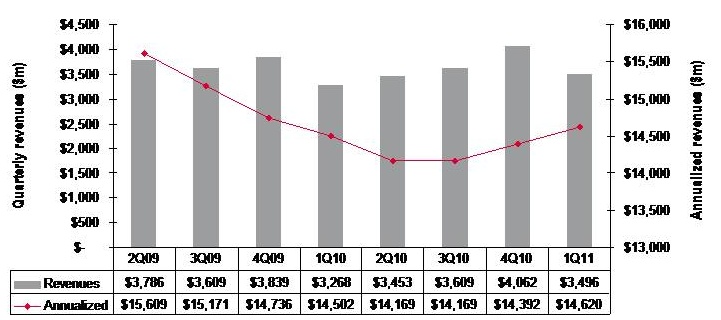 Quarterly market revenues, global optical networking (1Q 2011). Source: Ovum
Despite recent falls in optical equipment makers’ stock, the optical networking market remains in good health with analysts predicting 6-7% growth in 2011.
For Andrew Schmitt, directing analyst for optical at Infonetics Research, unfulfilled expectations are nothing new. Optical networking is a market of single-digit yearly growth yet in the last year certain market segments have grown above average: spending on ROADM-based wavelength division multiplexing (WDM) optical network equipment, for example, has grown 20% since the first quarter of 2010.
“Every few years people get this expectation that there is going to be this hockey stick [growth] and it is not,” says Schmitt. “There has been a lot of Wall Street money moving into this sector in the latter part of 2010 and first part of this year and they have just had their expectations reset, but operationally the industry is very healthy.”

“Nothing in this business changes quickly but the pace of change is starting to accelerate”
Andrew Schmitt, Infonetics Research
But Schmitt acknowledges that there is industry concern about the market outlook. “There have been lots of client calls in the first half of the year wanting to talk numbers,” says Schmitt. “When the market is growing rapidly there is no need for such calls but when it is uncertain, customers put more time into understanding what is going on.”
Both Infonetics and market research firm Ovum say the optical networking market grew 7% globally in the last year (2Q10 to 1Q11).
Ovum says the market reached US $3.5bn in the first quarter of 2011 and it expects 6% growth this year. “Most of the growth will come from North America—general recovery, stimulus-related spending, and LTE (Long Term Evolution)-inspired spending; and from South and Central America mostly mobile and fixed broadband-related,” says Dana Cooperson, network infrastructure practice leader at Ovum.
Ovum also notes that optical networking annualised spending for the last four quarters (2Q10-1Q11) finally went into the black with 1% growth, to reach $14.6bn. Annualised share figures are a strong indicator of longer-term market trends, says Ovum.
Market growth
Factors accounting for the growth include optical equipment demand for mobile and broadband backhaul. Carriers are also embarking on a multi-year optical upgrade to 40 and 100 Gigabit transmission over Optical Transport Network (OTN) and ROADM-based networks. Infonetics notes that ROADM spending in particular set a new high in the first quarter, rising 4% sequentially.
Ovum expects overall growth to come from metro and backbone WDM markets and from LTE. “For metro it is a combination of new builds, as DWDM continues to take over the metro core from SONET/SDH, and expansions of ROADM and 40 Gigabit,” says Cooperson. “For backbone it is a combination of retrofits for 40 and 100 Gigabit and overbuilds with 40 and 100 Gigabit coherent-optimised systems.”
Many operators are also looking at OTN switching and how it can help with network efficiency and manageability, she says, while mobile backhaul continues to be a hot spot as well at the access end of the network.
The Americas are the regions accounting for market growth whereas in Asia-Pacific and Europe, Middle East and Africa the spending remains flat.
“We’re not as bullish on Europe as I’ve heard some others are,” says Cooperson. “We expected China to slow down as capital intensities in the 34-35% seen in 2008 and 2009 were unsustainable. We saw the cooling down a bit earlier in 2010 than we had expected, but it did cool down and will continue to.”
Ovum expects Asia-Pacific as a whole to be moribund. But at least the pullbacks in China will be countered by slow growth in Japan and a big upsurge in India after a huge decline last year due to delayed 3G-related builds among other issues.
Outlook
Ovum is optimistic about the optical networking market due to continued competitive pressures and traffic growth. “We don’t think traffic growth can just continue without attention to the underlying issues related to revenue pressure, regardless of competitive pressures,” says Cooperson. “But newer optical and packet systems offer significant improvements over the old in terms of power efficiency, manageability, and of course 40 and 100 Gigabit coherent and ROADM features.”
“Most of the growth will come from North America"
Dana Cooperson, Ovum.
Many networks worldwide are also due for a core infrastructure update to benefit capacity and efficiency while many other operators are upgrading their access networks for mobile backhaul and enterprise Ethernet services.
Schmitt stresses that while it is right to talk about a 'core reboot', there are all sorts of operators that make up the market: the established carriers, those focussed on Layer 2 and Layer 3 transport, dark fibre companies and cable companies.
“Everyone has a different business so there is not a whole lot of group-think in this industry,” says Schmitt. “So when you talk about a transition to 40 and 100 Gigabit, some carriers will make that transition earlier than others because the nature of their business demands it.”
However, there are developments in equipment costs that are leading to change. “Once you get out to 2013-14, 100 Gigabit [transport] looks really good relative to 40 Gigabit and tunable XFPs at 10 Gigabit look really, really good,” says Schmitt, who believes these are going to be two dominating technologies. “People are going to use 100 Gigabit and when they can afford to throw more 10 Gigabit at the [capacity] problem, in shorter metro and regional spans, they will use tunable XFPs,” he says. “That is a whole new level in terms of driving down cost at 10 Gigabit that people haven’t factored in yet.”
Pacier change
The move to 100 Gigabit will not lead to increased spending, stresses Schmitt. Rather its significance is as a ‘mix shift’: The adoption of 100 Gigabit will shift spending from older systems to newer ones so that the technology is interesting in terms of market share shift rather than by growing overall revenues.
That said, there are areas of optical spending where capital expenditure (capex) is growing faster than the single-digit trend. These include certain competitive telco providers and dark fibre providers like AboveNet, TimeWarner Telecom and Colt. “You look at their capex year-over-year and it is increasing in some cases more over 20% a year,” says Schmitt.
He also notes that while the likes of Google, Yahoo, Microsoft and Apple do not spend on optical equipment as much as established operators such as Verizon or AT&T, their growth rate is higher. “There are sectors of the market that are growing quickly, and competition that are positioned to service those sectors successfully are going to see above-trend growth,” says Schmitt.
He highlights three areas of innovations - ‘big vectors’- that are going to change the business.
One is optical transport's move away from simple on-off keying signalling that opens up all kinds of innovation. Another is the shift in the players buying optical equipment. “A lot more of the R&D is driven by the AboveNets, Time Warners, Comcasts and the Googles and less by the old time PTTs,” says Schmitt. “That is going to change the way R&D is done.”
The third is photonic integration which Schmitt equates to the very early state of the electronics business. While Infinera has done some interesting things with integration, its latest 500 Gigabit PIC (photonic integrated circuit) is a big leap in density, he says: “It will be interesting if that sort of technology crosses over into other applications such as short- and intermediate-reach applications.”
“Nothing in this business changes quickly but the pace of change is starting to accelerate,” says Schmitt. “These three things, when you throw them together in a pot, are going to result in some unpredictable outcomes.”