

ONF advances its vision for the network edge
The Open Networking Foundation’s (ONF) goal to create software-driven architectures for the network edge has advanced with the announcement of its first reference designs.
In March, eight leading service providers within the ONF - AT&T, Comcast, China Unicom, Deutsche Telekom, Google, NTT Group, Telefonica and Turk Telekom - published their strategic plan whereby they would take a hands-on approach to the design of their networks after becoming frustrated with what they perceived as foot-dragging by the systems vendors.
 Timon SloaneThree months on, the service providers have initial drafts of the the first four reference designs: a broadband access architecture, a spine-leaf switch for network functions virtualisation (NFV), a more general networking fabric that uses the P4 packet forwarding programming language, and the open disaggregated transport network (ODTN).
The ONF also announced four system vendors - Adtran, Dell EMC, Edgecore Networks, and Juniper Networks - have joined to work with the operators on the reference design programmes.
“We are disaggregating the supply chain as well as disaggregating the technology,” says Timon Sloane, the ONF’s vice president of marketing and ecosystem. “It used to be that you’d buy a complete solution from one vendor. Now operators want to buy individual pieces and put them together, or pay somebody to do it for them.”
We are disaggregating the supply chain as well as disaggregating the technology
CORD and Exemplars
The ONF is known for various open-source initiatives such as its ONOS software-defined networking (SDN) controller and CORD. CORD is the ONF’s cloud optimised remote data centre work, also known as the central office re-architected as a data centre. That said, the ONF points out that CORD can be used in places other than the central office.
“CORD is a hardware architecture but it is really about software,” says Sloane. “It is a landscape of all our different software projects.”
However, the ONF received feedback last year that service providers were putting the CORD elements together slightly differently. “Vendors were using that as an excuse to say that CORD was too complicated and that there was no critical mass: ‘We don’t know how every operator is going to do this and so we are not going to do anything’,” says Sloane.
It led to the ONF’s service providers agreeing to define the assemblies of common components for various network platforms so that vendors would know what the operators want and intend to deploy. The result is the reference designs.
The reference designs offer operators some flexibility in terms of the components they can use. The components may be from the ONF but need not be; they can also be open-source or a vendor’s own solution.
 Source: ONF
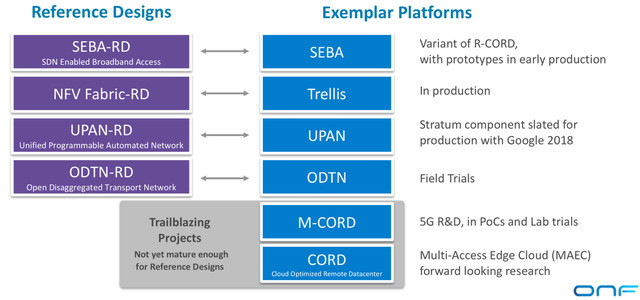
The ONF has also announced the exemplar platforms aligned with the reference designs (see diagram). An exemplar platform is an assembly of open-source components that builds an example platform based on a reference design. “The exemplar platforms are the open source projects that pull all the pieces together,” says Sloane. “They are easy to download, trial and deploy.”
The ONF admits that it is much more experienced with open source projects and exemplar platforms that it is with reference designs. The operators are adopting an iterative process involving all three - open source components, exemplar designs and reference designs - before settling on the solutions that will lead to deployments.
Two of the ONF exemplar platforms announced are new: the SDN-enabled broadband access (SEBA) and the universal programmable automated network (UPAN).
Reference designs
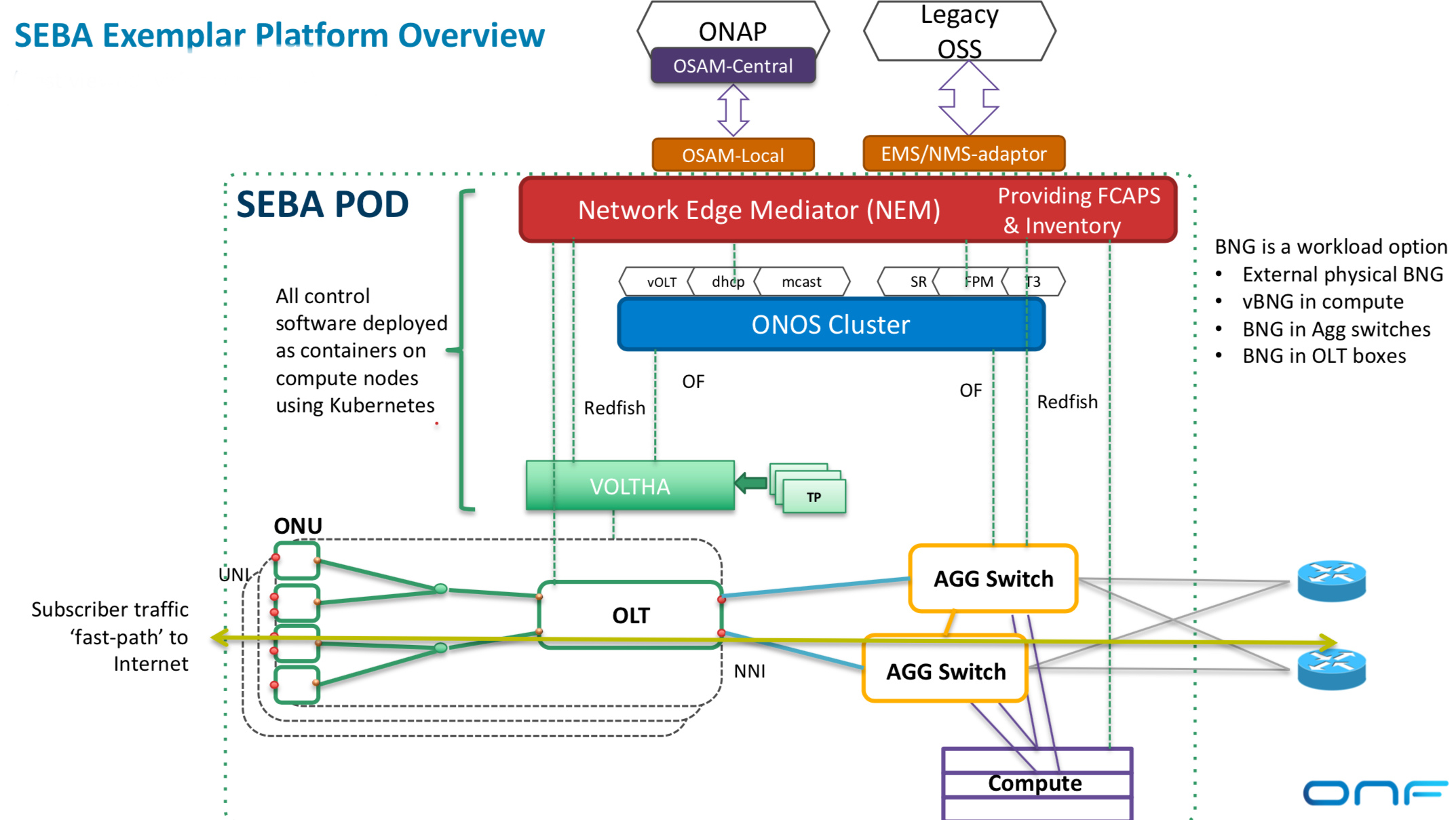
The SEBA reference design is a broadband variant of the ONF’s CORD work and addresses residential and backhauling applications. The design uses Kubernetes, the cloud-native orchestration system that automates the deployment, scaling and management of container-based applications, while the use of the OpenStack platform is optional. “OpenStack is only used if you want to support a virtual machine-based virtual network function,” says Sloane.
 Source: ONF
SEBA uses VOLTHA, the open-source virtual passive optical networking (PON) optical line terminal (OLT) developed by AT&T and contributed to the ONF, and provides interfaces to both legacy operational support systems (OSS) and the Linux Foundation’s Open Networking Automation Platform (ONAP).
SEBA also features FCAPS and mediation. FCAPS is an established telecom capability for network management that can identify faults while the mediation presents information from FCAPS in a way the OSS understands.
“In its slimmest implementation, SEBA doesn’t need CORD switches, just a pair of aggregation switches,” says Sloane. The architecture can place sophisticated forwarding rules onto the optical line terminal and the aggregation switches such that servers and OpenStack are not required. “That has tremendous performance and scale implications,” says Sloane. “No other NFV architecture does this kind of thing.”
The second reference design - the NFV Fabric - ties together two ONF projects - Trellis and ONOS - to create a spine-leaf data centre fabric for edge services and applications.
The two remaining reference designs are UPAN and ODTN.
UPAN can be viewed as an extension of the NFV fabric that adds the P4 data plane programming language. P4 brings programmability to the data plane while the SDN controller enables developers to specify particular forwarding behaviour. “The controller can pull in P4 programs and do intelligent things with them,” says Sloane. “This is a new world where you can write custom apps that will push intelligence into the switch.”
Meanwhile, the ODTN reference design is used to add optical capabilities including reconfigurable optical add-drop multiplexers (ROADMs) and wide-area-network support.
There are also what the ONF calls two trailblazer projects - Mobile CORD (M-CORD) and CORD - that are not ready to become reference designs as they depend on 5G developments that are still taking place.
CORD represents the ONF’s unifying project that brings all the various elements together to address multi-access edge cloud. Also included as part of CORD is an edge cloud services platform. “This is the ultimate vision: what is the app store for edge applications?” says Sloane. “If you write a latency-sensitive application for eyeglasses, for example, how does that get deployed across multiple operators and multiple geographies?”
The ONF says it has already achieved a ‘critical mass’ of vendors to work on the development of the reference designs three months after announcing its strategic plan. The supply chain for each of the reference designs is shown in the table.
 Source: ONF
“We boldly stated that we were going to reconstitute the supply chain as part of this work and bring in partners more aligned to embrace enthusiastically open source and help this ecosystem form and thrive,” says Sloane. “It is a whole new approach and to be able to rally the ecosystem in a short timeframe is notable.”
Our expectation is that at least two of these reference designs will go through this transition this year. This is not a multi-year process.
Next steps
It is the partner operators that are involved in the development of the reference designs. For example, the partners working on ODTN are China Unicom, Comcast and NTT. Once the reference designs are ready, they will be released to ONF members and then publicly.
However, the ONF has yet to give timescales as to when that will happen. “Our expectation is that at least two of these reference designs will go through this transition this year,” says Sloane. “This is not a multi-year process.”

ONF’s operators seize control of their networking needs
- The eight ONF service providers will develop reference designs addressing the network edge.
- The service providers want to spur the deployment of open-source designs after becoming frustrated with the systems vendors failing to deliver what they need.
- The reference designs will be up and running before year-end.
- New partners have committed to join since the consortium announced its strategic plan
The service providers leading the Open Networking Foundation (ONF) will publish open designs to address next-generation networking needs.
Timon SloaneThe ONF service providers - NTT Group, AT&T, Telefonica, Deutsche Telekom, Comcast, China Unicom, Turk Telekom and Google - are taking a hands-on approach to the design of their networks after becoming frustrated with what they perceive as foot-dragging by the systems vendors.
“All eight [operators] have come together to say in unison that they are going to work inside the ONF to craft explicit plans - blueprints - for the industry for how to deploy open-source-based solutions,” says Timon Sloane, vice president of marketing and ecosystem at the ONF.
The open-source organisation will develop ‘reference designs’ based on open-source components for the network edge. The reference designs will address developments such as 5G and multi-access edge and will be implemented using cloud, white box, network functions virtualisation (NFV) and software-defined networking (SDN) technologies.
By issuing the designs and committing to deploy them, the operators want to attract select systems vendors that will work with them to fulfil their networking needs.
Remit
The ONF is known for such open-source projects as the Central Office Rearchitected as a Datacenter (CORD) and the Open Networking Operating System (ONOS) SDN controller.
The ONF’s scope has broadened over the years, reflecting the evolving needs of its operator members. The organisation’s remit is to reinvent the network edge. “To apply the best of SDN, NFV and cloud technologies to enable not just raw connectivity but also the delivery of services and applications at the edge,” says Sloane.
The network edge spans from the central office to the cellular tower and includes the emerging edge cloud that extends the ‘edge’ to such developments as the connected car and drones.
The operators have been hopeful the whole vendor community would step up and start building solutions and embracing this approach but it is not happening at the speed operators want, demand and need
“The edge cloud is called a lot of different things right now: multi-access edge computing, fog computing, far edge and distributed cloud,” says Sloane. “It hasn’t solidified yet.”
One ONF open-source project is the Open and Disaggregated Transport Network (ODTN), led by NTT. “ODTN is edge related but not exclusively so,” says Sloane. “It is starting off with a data centre interconnect focus but you should think of it as CORD-to-WAN connectivity.”
The ONF’s operators spent months formulated the initiative, dubbed the Strategic Plan, after growing frustrated with a supply chain that has failed to deliver the open-source solutions they need. “The operators have been hopeful the whole vendor community would step up and start building solutions and embracing this approach but it is not happening at the speed operators want, demand and need,” says Sloane.
The ONF’s initiative signals to the industry that the operators are shifting their spending to open-source solutions and basing their procurement decisions on the reference designs they produce.
“It is a clear sign to the industry that things are shifting,” says Sloane. “The longer you sit on the sidelines and wait and see what happens, the more likely you are to lose your position in the industry.”
If operators adopt open-source software and use white boxes based on merchant silicon, how will systems vendors produce differentiated solutions?
“All this goes to show why this is disruptive and creating turbulence in the industry,” says Sloane.
Open-source design equates to industry collaboration to develop shared, non-differentiated infrastructure, he says. That means system vendors can focus their R&D tackling new issues such as running and automating networks, developing applications and solving challenges such as next-generation radio access and radio spectrum management.
“We want people to move with the mark,” says Sloane. “It is not just building a legacy business based on what used to be unique and expecting to build that into the future.”
Reference designs
The operators have identified five reference designs: fixed and mobile broadband, multi-access edge, leaf-and-spine architectures, 5G at the edge, and next-generation SDN.
The ONF has already done much work in fixed and mobile broadband with its residential and mobile CORD projects. Multi-access edge refers to developing one network to serve all types of customers simultaneously, using cloud techniques to shift networking resources dynamically as needed.
At first glance, it is unclear what the ONF can contribute to leaf-and-spine architectures. But the ONF is developing SDN-controlled switch fabric that can perform advanced packet processing, not just packet forwarding.
The ONF’s initiative signals to the industry that the operators are shifting their spending to open-source solutions and basing their procurement decisions on the reference designs they produce.
Sloane says that many virtualised tasks today are run on server blades using processors based on the x86 instruction set. But offloading packet processing tasks to programmable switch chips - referred to as networking fabric - can significantly benefit the price-performance achieved.
“We can leverage [the] P4 [programming language for data forwarding] and start to do things people never envisaged being done in a fabric,” says Sloane, adding that the organisation overseeing P4 is going to merge with the ONF.
The 5G reference design is one application where such a switch fabric will play a role. The ONF is working on implementing 5G network core functions and features such as network slicing, using the P4 language to run core tasks on intelligent fabric.
The ONF has already done work separating the radio access network (RAN) controller from radio frequency equipment and aims to use SDN to control a pool of resources and make intelligent decisions about the placement of subscribers, workloads and how the available radio spectrum can best be used.
The ONF’s fifth reference design addresses next-generation SDN and will use work that Google has developed and is contributing to the ONF.
The ONF manages the OpenFlow protocol, used to define the separation between the control and data forwarding planes. But the ONF is the first to admit that OpenFlow overlooked such issues as equipment configuration and operational issues.
The ONF is now engaged in a next-generation SDN initiative. “We are taking a step back and looking at the whole problem, to address all the pieces that didn’t get resolved in the past,” says Sloane.
Google has also contributed two interfaces that allow device management and the ONF has started its Stratum project that will develop an open-source solution for white boxes to expose these interfaces. This software residing on the white box has no control intelligence and does not make any packet-forwarding decisions. That will be done by the SDN controller that talks to the white box via these interfaces. Accordingly, the ONF is updating its ONOS controller to use these new interfaces.
 Source: ONF
From reference designs to deployment
The ONF has a clear process to transition its reference designs to solutions ready for network deployment.
The reference designs will be produced by the eight operators working with other ONF partners. “The reference design is to help others in the industry to understand where you might choose to swap in another open source piece or put in a commercial piece,” says Sloane.
This explains how the components are linked to the reference design (see diagram above). The ONF also includes the concept of the exemplar platform, the specific implementation of the reference design. “We have seen that there is tremendous value in having an open platform, something like Residential CORD,” says Sloane. “That really is what the exemplar platform is.”
The ONF says there will be one exemplar platform for each reference design but operators will be able to pick particular components for their implementations. The exemplar platform will inevitably also need to interface to a network management and orchestration platform such as the Linux Foundation’s Open Network Automation Platform (ONAP) or ETSI’s Open Source MANO (OSM).
The process of refining the reference design and honing the exemplar platform built using specific components is inevitably iterative but once completed, the operators will have a solution to test, trial and, ultimately, deploy.
The ONF says that since announcing the strategic plan a month ago, several new partners - as yet unannounced - have committed to join.
“The intention is to have the reference designs up and running before the end of the year,” says Sloane.
What the cable operators are planning for NFV and SDN
Cable operators are working on adding wireless to their fixed access networks using NFV and SDN technologies.
 Don Clarke“Cable operators are now every bit as informed about NFV and SDN as the telcos are, but they are not out there talking too much about it,” says Don Clarke, principal architect for network technologies at CableLabs, the R&D organisation serving the cable operators.
Clarke is well placed to comment. While at BT, he initiated the industry collaboration on NFV and edited the original white paper which introduced the NFV concept and outlined the operators’ vision for NFV.
NFV plans
The cable operators are planning developments by exploiting the Central Office Re-architected as a Datacenter (CORD) initiative being pursued by the wider telecom community. Comcast is one cable operator that has already joined the Open Networking Lab’s (ON.Lab) CORD initiative. The aim is to add a data centre capability to the cable operators’ access network onto which wireless will be added.
CableLabs is investigating adding high-bandwidth wireless to the cable network using small cells, and the role 5G will play. The cable operators use DOCSIS as their broadband access network technology and it is ideally suited for small cells once these become mainstream, says Clarke: “How you overlay wireless on top of that network is probably where there is going to be some significant opportunities in the next few years.”
One project CableLabs is working on is helping cable operators provision services more efficiently. At present, operators deliver services over several networks: DOCSIS, EPON and in some cases, wireless. CableLabs has been working for a couple of years on simplifying the provisioning process so that the system is agnostic to the underlying networks. “The easiest way to do that is to abstract and virtualize the lower-level functionality; we call that virtual provisioning,” says Clarke.
CableLabs recently published its Virtual Provisioning Interfaces Technical Report on this topic and is developing data models and information models for the various access technologies so that they can be abstracted. The result will be more efficient provisioning of services irrespective of the underlying access technology, says Clarke.
How you overlay wireless on top of that network is probably where there is going to be some significant opportunities in the next few years
SNAPS
CableLabs is also looking at how to virtualise functionality cable operators may deploy near the edge of their networks.
“As the cable network evolves to do different things and adds more capabilities, CableLabs is looking at the technology platform that would do that,” says Clarke.
To this aim, CableLabs has created the SDN-NFV Application development Platform and Stack - SNAPS - which it has contributed to the Open Platform for NFV (OPNFV) group, part of the open source management organisation, The Linux Foundation.
SNAPS is a reference platform to be located near the network edge, and possibly at the cable head-end where cable operators deliver video over their networks. The reference platform makes use of the cloud-based operating system, OpenStack, and other open source components such as OpenDaylight, and is being used to instantiate virtual network functions (VNFs) in a real-time dynamic way. “The classic NFV vision,” says Clarke.
CableLabs' Randy Levensalor says one challenge facing cable operators is that, like telcos, they have separate cloud infrastructures for their services and that impacts their bottom line.
Cable operators are now every bit as informed about NFV and SDN as the telcos are, but they are not out there talking too much about it
“You have one [cloud infrastructure] for business services, one for video delivery and one for IT, and you are operationally less efficient when you have those different stacks,” says Levensalor, lead software architect at CableLabs. “With SNAPS, you bring together all the capabilities that are needed in a reference configuration that can be replicated.”
This platform can support local compute with low latency. "We are not able to say much but there is a longer-term vision for that capability that we’ll develop new applications around,” says Clarke.
Challenges and opportunities
The challenges facing cable operators concerning NFV and SDN are the same as those facing the telcos, such as how to orchestrate and manage virtual networks and do it in a way that avoids vendor lock-in.
“The whole industry wants an open ecosystem where we can buy virtual network functions from one vendor and connect them to virtual network functions and other components from different vendors to create an end-to-end platform with the best capabilities at any given time,” says Clarke.
He also believes that cable operators can move more quickly than telcos because of how they collaborate via CableLabs, their research hub. However, the cable operators' progress is inevitably linked to that of the telcos given they want to use the same SDN and NFV technologies to achieve economies of scale. “So we can’t diverge in the areas that need to be common, but we can move more quickly in areas where the cable network has an inherent advantage, for example in the access network,” says Clarke.