

Is silicon photonics an industry game-changer?
Briefing: Silicon Photonics
Part 3: Merits, challenges and applications
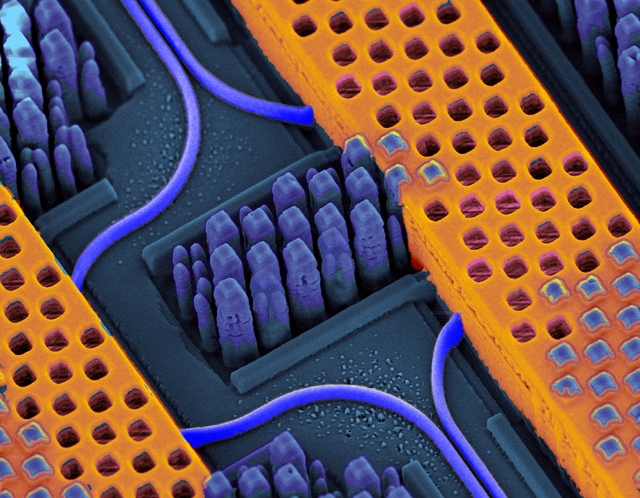 Shown in blue are the optical waveguides (and bend radius) while the copper wires carrying high-speed electrical signals are shown in orange. Source: IBM
System vendors have been on a silicon-photonics spending spree.
Cisco Systems started the ball rolling in 2012 when it acquired silicon photonics start-up, LightWire, for $272M. Mellanox Technologies more recently bought Kotura for $82M. Now Huawei has acquired Caliopa, a four-year-old Belgium-based start-up, for an undisclosed fee. The Chinese system vendor has said it is looking to further bolster its European R&D, and highlighted silicon photonics in particular.
Given that it was only just over a decade ago when systems companies were shedding their optical component units, the trend to acquire silicon photonics highlights the growing importance of the fledgling technology.
These system vendors view silicon photonics as a strategic technology. The equipment makers want to develop expertise and experience as they plan to incorporate the technology in upcoming, hopefully differentiated platforms.
"If I have a Terabit of capacity on the front panel, how am I going to manipulate that across the line card, a fabric or the backplane?" says Adam Carter, general manager and senior director of the transceiver modules group at Cisco Systems. "We saw silicon photonics as a technology that could potentially enable us to get there."
System vendors are already using embedded optics - mounted on boards close to the ICs instead of pluggable modules on the front panel - to create platforms with denser interfaces.
"Photonics doesn't need the latest and greatest lithography"
Arista Networks' 7500E switch has a line card with board-mounted optics rather than pluggable transceivers to increase 100 Gigabit port density. The company offers several line cards using pluggable modules but it has designed one card with board-mounted optics that offers flexible interfaces - 10 Gig, 40 Gig and 100 Gig - and a higher port density. When developing the design, the multi-source agreement (MSA) CFP2 pluggable module was not ready, says Arista.
Compass-EOS, a core IP router start-up, has developed chip-mounted optics based on 168 lasers and 168 detectors. The novel Terabit-plus optical interface removes the need for a switch fabric and the mid-plane to interconnect the router card within the platform. The interface also enables linking of platforms to scale the IP core router.
Both companies are using VCSELs, an established laser technology that silicon photonics competes with. Yet the two designs highlight how moving optics closer to chips enables system innovation, a development that plays to silicon photonics' strength.
 "I characterise silicon photonics as a technology that will compete in the right applications but won’t displace indium phosphide" Ed Murphy, JDSU
Silicon photonics promises cost savings by enabling vendors to piggyback on the huge investments made by the semiconductor industry. Vendors making their own products, such as optical transceivers, also promises to shake up the existing optical component supply chain.
Cisco Systems' first silicon photonics product is the proprietary 100 Gigabit optical CPAK transceiver that is undergoing qualification. By making its own optical module, Cisco avoids paying the optical module makers' margins. Cisco claims the CPAK's smaller size improves the faceplate density compared to the CFP2.
Pros and cons
Silicon photonics may be able to exploit the huge investment already made in the semiconductor industry, but it does differ from standard CMOS integrated circuits (ICs).
First, optics does not have the equivalent of Moore's Law. Whereas chip economics improve with greater integration, only a few optical functions can be cascaded due to the accumulated signal loss as light travels through the photonic circuit. This is true for optical integration in general, not just silicon photonics.
Another issue is that the size of an optical component - a laser or a modulator - is dictated by the laws of physics rather than lithography. "Photonics doesn't need the latest and greatest lithography," says Martin Zirngibl, domain leader for enabling physical technologies at Alcatel-Lucent's Bell Labs. "You can live with 100nm, 120nm [CMOS] components whereas for electronics you want to have 45nm."
This can lead to the interesting situation when integrating electronics with photonics. "You either don't use the latest technology for electronics or you waste a lot of real estate with very expensive lithography for photonics," says Zirngibl.
Another disadvantage of silicon is that the material does not lase. As a result, either a III-V material needs to be bonded to the silicon wafer or an external laser must be coupled to the silicon photonics circuit.
Silicon also has relatively small waveguides which make it tricky to couple light in and out of a chip.
The advantages of silicon photonics, however, are significant.
The technology benefits from advanced 8- and 12-inch wafers and mature manufacturing processes developed by the semiconductor industry. Using such CMOS processes promises high yields, manufacturing scale, and automation and testing associated with large scale IC manufacturing.
"This is probably the only advantage but it is very significant," says Valery Tolstikhin, founder and former CTO of indium phosphide specialist, OneChip Photonics, and now an independent consultant. "It takes silicon totally off the scale compared to any other photonics materials."
"We can build the single-die optical engine in the same CMOS line where processors are built, where billions [of dollars] of investment has been done"
IBM's high-density silicon photonics optical engine is made using a 90nm CMOS process. "We can build the single-die optical engine in the same CMOS line where processors are built, where billions [of dollars] of investment has been done," says Yurii Vlasov, manager of the silicon nanophotonics department at IBM Research. "We are riding on top of that investment."
Extra processing may be introduced for the photonics, says IBM, but the point is that there is no additional capital investment. "It is the same tooling, the same process conditions; we are changing the way this tooling is used," says Vlasov. "We are changing the process a little bit; the capital investment is in place."
 "We believe that even for shorter distance, silicon photonics does compete in terms of cost with VCSELs." Yurii Vlasov, IBM
Stephen Krasulick, CEO of silicon photonics start-up, Skorpios Technologies, makes a similar point. "The real magic with our approach is the ability to integrate it with standard, commercial fabs," he says.
Skorpios is a proponent of heterogeneous integration, or what the company refers to as 'silicon photonics 2.0'. Here silicon and III-V are wafer-bonded and the optical components are created by etching the two materials. This avoids the need to couple external lasers and to use active alignment.
"We do it in a manner such that the CMOS foundry is comfortable letting the wafer back into the CMOS line," says Krasulick, who adds that Skorpios has been working with CMOS partners from the start to ensure that its approach suits their manufacturing flow.
Applications
The first applications adopting silicon photonics span datacom and telecom: from short-reach interconnect in the data centre to 100 Gigabit-per-second (Gbps) long-distance coherent transmission.
Intel is developing silicon photonics technology to help spur sales of its microprocessors. The chip giant is a member of Facebook's Open Compute Project based on a disaggregated system design that separates storage, computing and networking. "When I upgrade the microprocessors on the motherboard, I don't have to throw away the NICs [network interface controllers] and disc drives," says Victor Krutul, director business development and marketing for silicon photonics at Intel. The disaggregation can be within a rack or span rows of equipment.
"Optical modules do not require state-of-the-art lithography or large scale photonic integration, but they do need to be coupled in and out of fibre and they need lasers - none of that silicon photonics has a good solution for"
Intel has developed the Rack Scale Architecture (RSA) which implements a disaggregated design. One RSA implementation for Facebook uses three 100Gbps silicon photonics modules per tray. Each module comprises four transmit and four receive fibres, each at 25Gbps. Each tray uses a Corning-developed MXC connector and its ClearCurve fibre that support data rates up to 1.6Tbps. “Different versions of RSA will have more or less modules depending on requirements," says Krutul.
Luxtera, whose silicon photonics technology has been used for active optical cables, and Mellanox's Kotura, are each developing 100Gbps silicon photonics-based QSFPs to increase data centre reach and equipment face plate density.
One data centre requirement is the need for longer reach links. VCSEL technology is an established solution but at 100Gbps its reach is limited to 100m only. Intel's 100Gbps module, operating at 1310nm and combined with Corning's MXC connector and ClearCurve multi-mode fibre, enables up to 300m links. But for greater distances - 500m to 2,000m - a second technology is required. Data centre managers would like one technology that spans the data centre yet is cost competitive with VCSELs.
"Silicon photonics lends itself to that," says Cisco's Carter. "If we drive the cost lower, can we start looking at replacing or future proofing your network by going to single mode fibre?"
 "There are places where silicon photonics will definitely win, such as chip-to-chip optical interconnects, and there are places where there is still a question mark, like fibre-optics interconnects." Valery Tolstikhin
IBM's 25Gbps-per-channel optical engine has been designed for use within data centre equipment. "We are claiming we have density based on optical scaling which is the highest in the industry, and we have done it using monolithic integration: optical devices are built side-by-side with CMOS," says Vlasov.
What is important, says Vlasov, is not so much the size of the silicon waveguide but how sharp its bend radius is. The bend radius dictates how sharply the light can be guided while remaining confined within the integrated circuit. The higher the light confinement, the smaller the bend radius and hence the overall circuit area.
Much progress has been made in improving light confinement over the past two decades, resulting in the bend ratio coming down from 1cm to a micron. IBM claims that with its technology, it can build systems comprising hundreds of devices occupying a millimeter. "That is a major difference in the density of optical integration," says Vlasov.
IBM does not use heterogeneous integration but couples lasers externally."It is not complicated, it is a technical problem we are solving; we believe that is the way to go," says Vlasov. "The reason why we have gone down this path is very simple: we believe in monolithic integration where electrical circuitry sits side by side with optical components."
Such monolithic integration of the optics with the electronics, such as modulator drivers and clock recovery circuitry, reduces significantly the cost of packaging and testing. "We believe that even for shorter distances, silicon photonics does compete in terms of cost with VCSELs if all elements of the cost are taken care of: bill of materials, packaging and testing," says Vlasov.
But not everyone believes silicon photonics will replace VCSELs.
For example, Tolstikhin questions the merits of silicon photonics for transceiver designs, such as for 100 Gig modules in the data centre. "There are places where silicon photonics will definitely win, such as chip-to-chip optical interconnects, and there are places where there is still a question mark, like fibre-optics interconnects," he says.
Tolstikhin argues that silicon photonics offers little advantage for such applications: "Optical modules do not require state-of-the-art lithography or large scale photonic integration, but they do need to be coupled in and out of fibre and they need lasers - none of that silicon photonics has a good solution for."
Cisco says it was first attracted to LightWire's technology because of its suitability for optical transceivers. Six years ago 1W, SFP+ modules were limited to 10km. "Customers wanted 40km, 80km, even WDM," says Carter. "They [LightWire] did a 40km SFP+ using their modulator that consumed only 0.5W - a huge differentiator." Two years ago 100 Gig CFP modules were at 24W while LightWire demonstrated a module under 8W, says Carter.
Tolstikhin believes silicon photonics' great promise is for applications still to emerge. One example is chip-to-chip communication that has modest optical light requirements and does not have to be coupled in and out of fibre.
"Here you have very high requirements for density packaging and the tiny [silicon] waveguides are handy whereas indium phosphide is too big and too expensive here," says Tolstikhin. Longer term still, silicon photonics will be used for on-chip communication but that will likely be based on deep sub-wavelength scale optics such as surface plasmonics rather than classical dielectric waveguides.
Tolstikhin also argues that the economics of using indium phosphide compared to silicon photonics need not be all that gloomy.
Indium phosphide is associated with custom small-scale fabs and small volume markets. But indium phosphide can benefit from the economics of larger industries just as silicon photonics promises to do with the semiconductor industry.
Indium phosphide is used in higher volume for wireless ICs such as power amplifiers. "Quite significantly orders of magnitude higher," says Tolstikhin. The issue is that, conventionally, photonic circuits are fabricated by using multiple epitaxial growth steps, whereas the wireless ICs are made in a single-growth process, hence epitaxy and wafer processing are decoupled.
"If you can give up on regrowth and still preserve the desired photonic functionality, then you can go to commercial RF IC fabs," he says. "This is a huge change in the economic model." It is an approach that enables a fabless model for indium phosphide photonics, with the potential advantages not unlike those claimed by silicon photonics with respect to commercial CMOS fabs.
"That suggests indium phosphide - which has all kinds of physical advantages for those applications that require transmitters, receivers and fibre, plus readily available high-speed analogue electronics for trans-impedance amplifiers and laser or modulator drivers - may be quite a competitive contender," says Tolstikhin.
"Silicon photonics has a certain capability but the hype around it has magnified that capability beyond reality"
Customers don't care which technology is used inside a transceiver. "They care only about cost, power and package density," says Tolstikhin. "Indium phosphide can be competitive and on many occasions beat silicon photonics."
JDSU also believes that long-term, a perfect fit for silicon photonics may be relative short reach interconnects – chip-to-chip and board-to-board reaches. “You need to have very high speed and dense interconnects, I can see that as being a very strong value proposition long term," says Ed Murphy, senior director, communications and commercial optical products at JDSU.
Finisar and JDSU are open to the potential benefits of silicon photonics but remain strong proponents of traditional optical materials such as indium phosphide and gallium arsenide.
"We have designed silicon photonic chips here at Finisar and have evaluations that are ongoing. There are many companies that now offer silicon photonics foundry services. You can lay out a chip and they will build it for you," says Jerry Rawls, executive director of Finisar. "The problem is we haven't found a place where it can be as efficient or offer the performance as using traditional lasers and free-space optics."
"Silicon photonics has a certain capability but the hype around it has magnified that capability beyond reality,” says JDSU's Murphy. "Practitioners of silicon photonics would tell you that as well."
According to Murphy, each application, when looked at in detail, has its advantages and disadvantages when using either silicon photonics or indium phosphide. “Even in those applications where one or the other is better, the level of improvement is measured in a few tens of percent, not factors of ten,” he says. "I characterise silicon photonics as a technology that will compete in the right applications but won’t displace indium phosphide."
Silicon photonics for telecom
At the other extreme of the optical performance spectrum, silicon photonics is being developed for long-distance optical transmission. The technology promises to help shrink coherent designs to fit within the CFP2 module, albeit at the expense of reach. A CFP2 coherent module has extremely challenging cost, size and power requirements.
Teraxion is developing a coherent receiver for CFP2. "We believe silicon photonics is the material of choice to fulfill CFP2 requirements while allowing even smaller size reduction for future modules such as the CFP4," said Martin Guy, Teraxion's vice president of product management and technology.
u2t Photonics and Finisar recently licensed indium phosphide modulator technology to help shrink coherent designs into smaller form factor pluggables. So what benefit does silicon photonics offer here?
"In terms of size there will not be much difference between indium phosphide and silicon photonics technology," says Guy. "However, being on each side on the fence, we know that process repeatability and therefore yield is better with silicon photonics." Silicon photonics thus promises a lower chip cost.
"We have projects spanning everything from access all the way to long haul, and covering some datacom as well," says Rob Stone, vice president of marketing and program management at Skorpios. The start-up has developed a CMOS-based tunable laser with a narrow line width that is suitable for coherent applications.
"If you develop a library of macrocells, you can apply them to do different applications in a straightforward manner, provided all the individual macrocells are validated," says Stone. This is different to the traditional design approach.
Adding a local oscillator to a coherent receiver requires a redesign and a new gold box. "What we've got, we can plug things together, lay it out differently and put it on a mask," says Stone. "This enables us to do a lot of tailoring of designs really quite quickly - and a quick time-to-market is important."
Perhaps the real change silicon photonics brings is a disruption of the supply chain, says Zirngibl.
An optical component maker typically sells its device to a packaging company that puts it in a transmitter or receiver optical sub-assembly (TOSA/ ROSA). In turn, the sub-assemblies are sold to a module company which then sells the optical transceiver to an equipment vendor. Each player in the supply chain adds its own profit.
Silicon photonics promises to break the model. A system company can design its own chip using design tools and libraries and go to a silicon foundry. It could then go to a packaging company to make the module or package the device directly on a card, bypassing the module maker altogether.
Yet the ASIC model can also benefit module makers.
IBM has developed its 25Gbps-per-channel silicon photonics technology for its platforms, for chip-to-chip and backplanes, less for data centre interconnect. But it is open to selling the engine to interested optical module players. "If this technology can be extended to 2km for big data centres, others can come in, the usual providers of transceivers," says Vlasov.
"There are companies with the potential to offer a [silicon photonics] design service or foundry service to others that would like to access this technology," says Cisco's Carter. "Five years ago there wasn't such an ecosystem but it is developing very fast."
The article is an extended version of one that appeared in the exhibition magazine published at ECOC 2013.
Part 1: Optical interconnect, click here
Part 2: Bell Labs on silicon photonics, click here

u2t Photonics pushes balanced detectors to 70GHz
- u2t's 70GHz balanced detector supports 64Gbaud for test and measurement and R&D
- The company's gallium arsenide modulator and next-generation receiver will enable 100 Gigabit long-haul in a CFP2

"The performance [of gallium arsenide] is very similar to the lithium niobate modulator"
Jens Fiedler, u2t Photonics
u2t Photonics has announced a balanced detector that operates at 70GHz. Such a bandwidth supports 64 Gigabaud (Gbaud), twice the symbol rate of existing 100 Gigabit coherent optical transmission systems.
The German company announced a coherent photo-detector capable of 64Gbaud in 2012 but that had an operating bandwidth of 40GHz. The latest product uses two 70GHz photo-detectors and different packaging to meet the higher bandwidth requirements.
"The achieved performance is a result of R&D work using our experience with 100GHz single photo-detectors and balanced detector technology at a lower speed,” says Jens Fiedler, executive vice president sales and marketing at u2t Photonics.
The monolithically-integrated balanced detector has been sampling since March. The markets for the device are test and measurement systems and research and development (R&D). "It will enable engineers to work on higher-speed interface rates for system development," says Fiedler.
The balanced detector could be used in next-generation transmission systems operating at 64 Gbaud, doubling the current 100 Gigabit-per-second (Gbps) data rate while using the same dual-polarisation, quadrature phase-shift keying (DP-QPSK) architecture.
A 64Gbaud DP-QPSK coherent system would halve the number of super-channels needed for 400Gbps and 1 Terabit transmissions. In turn, using 16-QAM instead of QPSK would further halve the channel count - a single dual-polarisation, 16-QAM at 64Gbaud would deliver 400Gbps, while three channels would deliver 1.2Tbps.
However, for such a system to be deployed commercially the remaining components - the modulator, device drivers and the DSP-ASIC - would need to be able to operate at twice the 32Gbaud rate; something that is still several years out. That said, Fiedler points out that the industry is also investigating baud rates in between 32 Gig and 64 Gig.
Gallium arsenide modulator
u2t acquired gallium arsenide modulator technology in June 2009, enabling the company to offer coherent transmitter as well as receiver components.
At OFC/NFOEC 2013, u2t Photonics published a paper on its high-speed gallium arsenide coherent modulator. The company's design is based on the Mach-Zehnder modulator specification of the Optical Internetworking Forum (OIF) for 100 Gigabit DP-QPSK applications.
The DP-QPSK optical modulation includes a rotator on one arm and a polarisation beam combiner at the output. u2t has decided to support an OIF compatible design with a passive polarisation rotator and combiner which could also be integrated on chip. The resulting coherent modulator is now being tested before being integrated with the free space optics to create a working design.
"The performance [of gallium arsenide] is very similar to the lithium niobate modulator," says Fiedler. "Major system vendors have considered the technology for their use and that is still ongoing."
The gallium arsenide modulator is considerably smaller than the equivalent lithium niobate design. Indeed u2t expects the technology's power and size requirements, along with the company's coherent receiver, to fit within the CFP2 optical module. Such a pluggable 100 Gigabit coherent module would meet long-haul requirements, says Fiedler.
The gallium arsenide modulator can also be used within the existing line-side 100 Gigabit 5x7-inch MSA coherent transponder. Fiedler points out that by meeting the OIF specification, there is no space saving benefit using gallium arsenide since both modulator technologies fit within the same dimensioned package. However, the more integrated gallium arsenide modulator may deliver a cost advantage, he says.
Another benefit of using a gallium arsenide modulator is its optical performance stability with temperature. "It requires some [temperature] control but it is stable," says Fiedler.
Coherent receiver
u2t's current 100Gbps coherent receiver product uses two chips, each comprising the 90-degree hybrid and a balanced detector. "That is our current design and it is selling in volume," says Fiedler. "We are now working on the next version, according to the OIF specification, which is size-reduced."
The resulting single-chip design will cost less and fit within a CFP2 pluggable module.
The receiver might be small enough to fit within the even smaller CFP4 module, concludes Fiedler.
Teraxion embraces silicon photonics for its products
Teraxion has become a silicon photonics player with the launch of its compact 40 and 100 Gigabit coherent receivers.
The Canadian optical component company has long been known for its fibre Bragg gratings and tunable dispersion compensation products. But for the last three years it has been developing expertise in silicon photonics and at the recent European Conference on Optical Communications (ECOC) exhibition it announced its first products based on the technology.

"You don't have this [fabless] model for indium phosphide or silica, while an ecosystem is developing around silicon photonics"
Martin Guy, Teraxion
"We are playing mainly in the telecom business, which accounts for 80% of our revenues," says Martin Guy, vice president, product management & technology at Teraxion. "It is clear that our customers are going to more integration and smaller form-factors so we need to follow our customers' requirements."
Teraxion assessed several technologies but chose silicon photonics and the fabless model it supports. "We are using all our optical expertise that we can apply to this material but use a process already developed for the CMOS industry, with the [silicon] wafer made externally," says Guy. "You don't have this [fabless] model for indium phosphide or silica, while an ecosystem is developing around silicon photonics."
The company uses hybrid integration for its coherent receiver products, with silicon implementing the passive optical functions to which the active components are coupled. Teraxion is using externally-supplied photo-detectors which are flip-chipped onto the silicon for its coherent receiver.
"We need to use the best material for the function for this high-end product," says Guy. "Our initial goal is not to have everything integrated in silicon."
Coherent receiver
A coherent receiver comprises two inputs - the received optical signal and the local oscillator - and four balanced receiver outputs. Also included in the design are two polarisation beam splitters and two 90-degree hybrid mixers.
Several companies have launched coherent receiver products. These include CyOpyics, Enablence, NEL, NeoPhotonics, Oclaro and u2t Photonics. Silicon photonics player Kotura has also developed the optical functions for a coherent receiver but has not launched a product.
One benefit of using silicon photonics, says Teraxion, is the compact optical designs it enables.
The Optical Internetworking Forum (OIF) has specified a form factor for the 100 Gigabit-per-second (Gbps) coherent receiver. Teraxion has developed a silicon photonics-based product that matches the OIF's form factor sized 40mmx32mm. This is for technology evaluation purposes rather than a commercial product. "If customers want to evaluate our technology, they need to have a compatible footprint with their design," explains Guy. This is available in prototype form and Teraxion has customers ready to evaluate the product.
Teraxion will come to market with a second 100 Gigabit coherent receiver design that is a third of the size of the OIF's form factor, measuring 23mmx18mm (0.32x the area of the OIF specification). The compact coherent receivers for 40 and 100Gbps will be available in sample form in the first quarter of 2013.
 Teraxion's OIF-specification 100 Gig coherent receiver (left) for test purposes and its compact coherent receiver product. Source: Teraxion
"We match the OIF's performance with this design but there are also other key requirements from customers that are not necessarily in the OIF specification," says Guy.
The compact 100Gbps design is of interest to optical module and system vendors but there is no one view in terms of requirements or the desired line-side form-factor that follows the 5x7-inch MSA. Indeed there are some that are interested in developing a 100 Gigabit CFP module for metro applications, says Guy.
Roadmap
Teraxion's roadmap includes further integration of the coherent receiver's design. "We are using hybrid integration but eventually we will look at having the photo-detectors integrated within the material,” says Guy.
The small size of the coherent design means there is scope for additional functionality to be included. Teraxion says that customers are interested in integrating variable optical attenuators (VOAs). The local oscillator is another optical function that can be integrated within the coherent receiver.
In 2005 Teraxion acquired Dicos Technologies, a narrow line-width laser specialist. Teraxion's tunable narrow line-width laser product - a few kiloHertz wide - is available in the lab. "The purpose of this product is not to be deployed on the line card - right now," says Guy. "We believe this type of performance will be required for next-generation 100 Gig, 400 Gig, 1 Terabit coherent communication systems where you will need a very 'clean' local oscillator."
Teraxion is also working on developing a silicon-photonics-based modulator. The company has been exploring integrating Bragg gratings within silicon waveguides for which it has applied for patents. This is several years out, says Guy, but has the potential to enable high-speed modulators suited for short-reach datacom applications.
Cisco Systems' 100 Gigabit spans metro to ultra long-haul
Cisco Systems has demonstrated 100 Gigabit transmission over a 3,000km span. The coherent-based system uses a single carrier in a 50GHz channel to transmit at 100 Gigabit-per-second (Gbps). According to Cisco, no Raman amplification or signal regeneration is needed to achieve the 3,000km reach.
Feature: Beyond 100G - Part 2

"The days of a single modulation scheme on a part are probably going to come to an end in the next two to three years"
Greg Nehib, Cisco
The 100Gbps design is also suited to metro networks. Cisco's design is compact to meet the more stringent price and power requirements of metro. The company says it can fit 42, 100Gbps transponders in its ONS 15454 Multi-service Transport Platform (MSTP), which is a 7-foot rack. "We think that is double the density of our nearest competitor today," claims Greg Nehib, product manager, marketing at Cisco Systems.
Also shown as part of the Cisco demonstration was the use of super-channels, multiple carriers that are combined to achieve 400 Gigabit or 1 Terabit signals.
Single-carrier 100 Gigabit
Several of the first-generation 100Gbps systems from equipment makers use two carriers (each carrying 50Gbps) in a 50GHz channel, and while such equipment requires lower-speed electronics, twice as many coherent transmitters and receivers are needed overall.
Alcatel-Lucent is one vendor that has a single-carrier 50GHz system and so has Huawei. Ciena via its Nortel acquisition offers a dual-carrier 100Gbps system, as does Infinera. With Ciena's announcement of its WaveLogic 3 chipset, it is now moving to a single-carrier solution. Now Cisco is entering the market with a single-carrier system.
"When you have a single carrier, you can get upwards of 96 channels of 100Gbps in the C-band," says Nehib. "The equation here is about price, performance, density and power."
What has been done
Cisco's 100Gbps design fits on a 1RU (rack unit) card and uses the first 100Gbps coherent receiver ASIC designed by the CoreOptics team acquired by Cisco in May 2010.
The demonstrated 3,000km reach was made using low-loss fibre. "This is to some degree a hero experiment," says Nehib. "We have achieved 3,000km with SMF ULL fibre from Corning; the LL is low loss." Normal fibre has a loss of 0.20-0.25dB/km while for ULL fibre it is in the 0.17dB/km range.
"You can do the maths and calculate the loss we are overcoming over 3,000km. We just want to signal that we have very good performance for ultra long-haul," says Nehib, who admits that results will vary in networks, depending on the fibre.
Nehib says Cisco's coherent receiver achieves a chromatic dispersion tolerance of 70,000 ps/nm and 100ps differential group delay. Differential group delay is a non-linear effect, says Nehib, that is overcome using the DSP-ASIC. The greater the group delay tolerance, the better the distance performance. These metrics, claims Cisco, are currently unmatched in the industry.
The company has not said what CMOS process it is using for its ASIC design. But this is not the main issue, says Nehib: "We are trying to develop a part that is small so that it fits in many different platforms, and we can now use a single part number to go from metro performance all the way to ultra long-haul."
Another factor that impacts span performance is the number of lit channels. Cisco, in the test performed by independent test lab EANTC, the European Advanced Network Test Center, used 70 wavelengths. "With 70 channels the performance would have been very close to what we would have achieved with [a full complement of] 80 channels," says Nehib.
Super-channels
A super-channel refers to a signal made up of several wavelengths. Infinera, with its DTN-X, uses a 500Gbps super-channel, comprising five 100Gbps wavelengths.
Using a super-channel, an operator can turn up multiple 100Gbps channels at once. If an operator wants to add a 100Gbps wavelength, a client interface is simply added to a spare 100Gbps wavelength making up the super-channel. In contrast turning up a 100Gbps wavelength in current systems usually requires several days of testing to ensure it can carry live traffic alongside existing links.
Another benefit of super-channels is scale by turning up multiple wavelengths simultaneously. As traffic grows so does the work load on operators' engineering teams. Super-channels aid efficiency.
"There is one other point that we hear quite often," says Nehib. "One other attraction of super-channels is overall spectral efficiency." The carriers that make up the signal can be packed more closely, expanding overall fibre capacity.
"Just like with 10 Gig, we think at some point in the future the 100 Gig network will be depleted, especially in the largest networks, and operators will be interested in 400 Gig and Terabit interfaces," says Nehib. "If that wavelength can further benefit from advanced modulation schemes and super-channels through flex[ible] spectrum deployment then you can get more total bandwidth on the fibre and better utilisation of your amplifiers."
Cisco's 100Gbps lab demonstration also showed 400 Gigabit and 1 Terabit super-channels, part of its research work with the Politechnico di Torino. "We are going to move on to other advanced modulation techniques and deliver 400 Gigabit and Terabit interfaces in future," says Nehib.
Existing 100Gbps systems use dual-polarisation, quadrature phase-shift keying (DP-QPSK). Using 16-QAM (quadrature amplitude modulation) at the same baud rate doubles the data rate. Using 16-QAM also benefits spectral utilisation. If the more intelligent modulation format is used in a super-channel format, and the signal is fitted in the most appropriate channel spacing using flexible spectrum ROADMs, overall capacity is increased. However, the spectral efficiency of 16-QAM comes at the expense of overall reach.
"You are able to best match the rate to the reach to the spectrum," says Nehib. "The days of a single modulation scheme on a part are probably going to come to an end in the next two to three years."
Cisco has yet to discuss the addition of a coherent transmitter DSP which through spectral shaping can bunch wavelengths. Such an approach has just been detailed by Ciena with its WaveLogic 3 and Alcatel-Lucent with its 400 Gig photonic service engine.
For the Terabit super-channel demonstration, Cisco used 16-QAM and a flexible spectrum multiplexer. "The demo that we showed is not necessarily indicative of the part we will bring to market," says Nehib, pointing out that it is still early in the development cycle. "We are looking at the spectral efficiency of super-channels, different modulation schemes, flex-spectrum multiplexer, availability, quality, loss etc.," says Nehib. "We have not made firm technology choices yet."
Cisco's 100Gbps system is in trials with some 40 customers and can be ordered now. The product will be generally available in the near future, it says.
Further reading:
Light Reading: EANTC's independent test of Cisco's CloudVerse architecture. Part 4: Long-haul optical transport
ECOC 2011: Products and market trends
There were several noteworthy announcements at the European Conference on Optical Communications (ECOC) held in Geneva in September. Gazettabyte spoke to Finisar, Oclaro and Opnext about their ECOC announcements and the associated market trends.
100 Gig module
Opnext announced the first 100 Gigabit-per-second (Gbps) transponder at ECOC, a much anticipated industry development.
 "Quite a few system vendors .... are looking at 'make-versus-buy' for the next-generation [of 100 Gig]."
Ross Saunders, Opnext
The OTM-100 is a dual-polarisation, quadrature phase-shift keying (DP-QPSK) coherent design that fits into a 5x7-inch module and meets the Optical Internetworking Forum's (OIF) multi-source agreement (MSA). The module's coherent receiver uses a digital signal processor (DSP) developed by NTT Electronics.
"At the moment we are going through the bring-up in the lab," says Ross Saunders, general manager, next-gen transport for Opnext Subsystems.
According to Opnext, system vendors that have their own 100Gbps coherent designs are also interested in the 100Gbps module.
"There are a few developing in-house [100Gbps designs] that are not interested in going for the module solution," says Saunders. "But there is another camp - quite a few system vendors - who have their first-generation solution that are looking at 'make-versus-buy' for the next-generation."
System vendors' first-generation 100Gbps designs use hard-decision forward error correction (FEC). But customers want a 100Gbps design with a reach that gets close to matching that of 10Gbps, 40Gbps DPSK and 40Gbps coherent designs, says Opnext.
"There is demand to go to the next-generation with its higher overhead and soft-decision FEC," says Saunders. "That [soft-decision FEC] buys another 2-3dB of performance so you don't need as many regeneration stages." Translated into distances, the reach using soft-decision FEC is 1500-1600km rather than 800-900km, says Saunders.
Opnext expects to deliver samples to lead customers before the year end.
Meanwhile, Oclaro is also developing a 100Gbps coherent module. "It is on track and we expect to ship in early 2012," says Per Hansen, vice president of product marketing, optical networks solutions at Oclaro.
100 Gig receiver
Oclaro announced an integrated 100Gbps coherent receiver at ECOC.
The company claims the device takes less than half the board area as defined by the OIF. "Board space is at a premium on line cards," says Robert Blum, director of product marketing for Oclaro's photonic components. "If you can increase functionality, that translates to lower cost."
 100 Gig indium phosphide integrated receiver Source: OclaroThe device has two inputs and four outputs. The inputs are the received 100Gbps optical signal and the local oscillator and the outputs are from the four balanced detectors.
"The entire 90-degree hybrid mixing and the photo detection are all done in an indium phosphide single chip," says Blum.
40 Gig modules
Oclaro also announced it is shipping in volume its 40Gbps coherent transponder.
"There is a lot of interest from equipment vendors and service providers to use coherent in their networks," says Hansen "Coherent has advantages in the way it can overcome impairments."
Hansen says coherent will be used in the majority of new network deployments in future: "If you are deploying a network that is geared to 40Gbps and above, people will most likely deploy an all-coherent solution."
One reason why coherent is favoured is that the same technology can be scaled to 100Gbps, 400Gbps and even a Terabit.
Coherent technology, whose DSP is used for dispersion compensation, is also suited for mesh networks where switching wavelengths occurs. The coherent technology can compensate when it encounters new dispersion conditions following the switching.
In contrast 40Gbps direct-detection modules interest vendors for use in existing networks alongside 2.5Gbps and 10Gbps wavelengths, says Oclaro.

For networks geared to 40Gbps and above, people will most likely deploy an all-coherent solution
Per Hansen, Oclaro
"They can have very high power which can make it difficult for a new [high-speed] channel to live next to them but direct-detection modules are robust for those types of applications," says Hansen. "Where you will see people upgrading their existing networks, they will use DPSK or DQPSK transponders."
But Oclaro says that the split is not that clear-cut: 40Gbps coherent for new builds and direct-detection schemes when used alongside existing 10Gbps wavelengths. "There is a lot of variability in both of these approaches such that you can tailor them to different applications," says Hansen. "In the end, what it will come down to is what the customer is happy with and the price points, more than fundamental technology capabilities."
40G client-side interfaces
Finisar demonstrated at ECOC a serial 40Gbps CFP module that meets the 2km 40GBASE-FR standard.
"This will be the first 40 Gig serial module that is in a pluggable form factor," says Rafik Ward, vice president of marketing at Finisar. Indeed Finisar's CFP is a tri-rate design that also supports the ITU-T OC-768 SONET/SDH very short reach (VSR) and OTU3 standards.
The FR interface is the IEEE's 40 Gigabit Ethernet equivalent of the existing OC-768 VSR interface. The original 300pin VSR interface has a 16-channel electrical interface, each operating at 2.5Gbps, while the CFP module uses 10Gbps electrical channels.
IP routers can now be connected to DWDM platforms using the pluggable module, says Finisar. The pluggable will also enable system vendors to design denser line cards with two or even four CFP interfaces, as well as the option of changing the CFP to support other standards as required.
The tri-rate FR pluggable module's power consumption will be below 8W, says Finisar, which is shipping samples to customers.
Meanwhile, Opnext has announced it is sampling its 40GBASE-LR4, the 10km 40 Gigabit Ethernet interface, in a QSFP module. "It will be readily available by the end of the year," says Jon Anderson, director of technology programme at Opnext.
 "The 40GBASE-LR4 [QSFP] will be readily available by the end of the year"
Jon Anderson, Opnext
Tunable laser XFP
Opnext and Oclaro have both announced 10Gbps tunable XFPs at ECOC. Having two new suppliers of tunable XFPs joining JDS Uniphase will increase market competition and reduce the price of the tunable pluggable.
"It really is a replacement for 300-pin transponders," says Blum. "You can now migrate 10Gbps links to a pluggable form factor."
Oclaro's tunable XFP is released for production. Opnext says its tunable XFP will be in volume production by early 2012.
ROADMs get 1x20 WSS
Finisar announced a 1x20 high-port count wavelength selective switch (WSS). The WSS supports a flexible spectrum grid that allows the channel width to be varied in increments of 12.5GHz, enabling future line rates above 100Gbps to be supported.
"This [1x20 WSS] has the possibility to enable some pretty interesting applications for next generation - colourless, directionless, contentionless networks," says Ward.

"This [40GBASE-FR] will be the first 40 Gig serial module that is in a pluggable form factor"
Rafik Ward, Finisar.
One common application of the 1x20 WSS is implementing a multi-degree node. The degree refers to the number of points that node branches out to in a mesh network, says Finisar. "The fundamental question is how many ports do you have in that node?" explains Ward.
For example, an 8-degree node communicates with eight other points in the mesh. With a 1x20 WSS, the architecture uses eight of the 20 as express ports - those 8 ports interfacing with other WSSs in the node - while the remaining 12 ports on that 1x20 WSS are used as add and drop ports.
"The advantage of a 1x20 WSS in this case is enabling a large number of express ports and a large number of add ports," says Ward.
A second application is for colourless or tunable multiplexing.
"One of the problems today enabling colourless ROADM operation is that typically the muxes and demuxes used are AWGs," says Ward. Having a tunable laser is all well and good but it becomes hardwired to a specific port because of the arrayed waveguide grating (AWG). "That specific port is configured for that particular wavelength," he says.
To make an 80-channel colourless design, that does not require manual intervention, four 1x20 WSSs are placed side-by-side with a 1x4 WSS connecting the four. This is a more elegant and compact than using existing 1x9 WSSs, which requires more than twice as many WSS units.
Pump lasers
Oclaro announced two 980nm pump laser products that enable more compact, lower-power amplifier designs.
 "Board space is at a premium on line cards"
Robert Blum, Oclaro
One is an uncooled 980nm 500mW pump laser and the second is two 600mW pump lasers in a single package. The dual-pump laser product halves the footprint and requires a single thermo-electric cooler only.
"The power consumption is significantly lower than what it would be for two discrete pump lasers," says Blum. "The 300mW uncooled pump laser doesn't go away but for dual-stage or mid-stage optical amplifiers instead of using multiple [300mW] lasers, you can use a single package," says Blum.
GPON-on a-stick
Finisar announced a 'GPON-on-a-stick' SFP module. The result of its acquisition of Broadway Networks in 2010, the SFP-based GPON optical network unit (ONU) enables an Ethernet switch to be connected to a PON. The product is aimed at enterprises as well as large residential premises. The GPON stick complements the company's existing EPON stick.
Further information:
ECOC 2011 Market focus presentations, click here
Rapid progress in optical transport seen at ECOC 2011, Ovum's Karen Liu, click here
Finisar and Capella enter 1×20 WSS market; signals shift, Ovum's Daryl Inniss, click here