

Ribbon offers for trial its 1.2T wavelength 9408 platform
Add Your Into Content Here

Ribbon Communications has started working with operators to trial its latest Apollo 9408 optical transport platform that supports 1.2 terabits per second (Tbps) optical wavelengths.
The company’s modular platform can also send 800 gigabit-per-second (Gbps) wavelengths over 1,000km and 400Gbps wavelengths over ultra-long-haul networks.
“We have conducted trials, including one with a Tier 1 European provider,” says Jonathan Homa, senior director of solutions marketing at Ribbon. “You can get 1.2 terabits within major cities, 800 gigabits covering major states or regions, and 400 gigabits for about as long as you want to go.”
“The Apollo 9408 is Ribbon’s first disaggregated transponder unit or compact modular box using the CIM 8 for up to 1.2Tbps of wavelength speed,” says Jimmy Yu, vice president at market research firm Dell’Oro Group.
Yu believes the product has shipped to a customer this quarter and is likely the first commercial shipment of a 1.2Tbps wavelength system for network deployment.
Acacia’s CIM 8 pluggable coherent modem
The Apollo 9408 uses Acacia’s pluggable Coherent Interconnect Module (CIM 8) coherent modem. The CIM 8 uses Acacia’s 5nm CMOS Jannu digital signal processor (DSP) and its silicon photonics-based coherent optics operating at a symbol rate of up to 140 gigabaud.
“The advantage of this smaller transistor geometry is not only the higher density per die but also lower power and faster processing speed,” says Yu. “All the things needed to help service providers achieve cost and power efficiencies.” This is why the market looks forward to the next generation of coherent DSPs, says Yu.
Acacia started shipping the CIM 8 at the year’s start, and Ribbon says the module’s availability enables the company to leapfrog existing 7nm CMOS-based coherent optical transport solutions.
Before 1.2 Tbps-capable wavelengths, the highest speed was 800Gbps, delivered by Ciena, Huawei, and Infinera, says Yu.
“Ciena was first to market and captured the lion’s share of shipment volumes,” says Yu. “We peg Ciena’s market share of 800 Gbps-capable wavelengths at approximately 70 per cent of the cumulative shipments through 2Q 2023. That is a huge share, benefiting from being first to market.”
Compact modular platform
The compact modular platform format was developed to meet the large-scale data centre operators’ computing needs. The platform is used for data centre interconnect applications while the large communications service providers are become interested in the platform form factor.

Compact modular platforms are 600mm deep and use front-to-back airflow for cooling. In contrast, standard telecom equipment is 300mm deep and uses a left-to-right airflow. The compact modular format thus suits data centres with alternate hot and cold aisles of equipment. The platforms face each other, so the air in a cold aisle is blown through each platform, exiting in the adjacent hot aisles. The efficient cooling scheme enables the equipment to be run hotter.
“With the compact modular platform’s front and back airflow, we can run the CIM 8 to 1.2 terabits,” says Homa. “In our standard [telecom] platform [the Apollo 9600 series], we’re using the same CIM 8 pluggable, but from a power dissipation point of view, we can only run it to 800 gigabits.”
The 9408 supports different channel plans depending on how the platform is used. For a cost-optimised transmission, a 400Gbps wavelength fits in a 75GHz channel, and a performance-optimised 800Gbps or 1.2Tbps wavelength fits in a 150GHz channel.
“With continuous baud rate control from 68-140Gbaud, the CIM 8 can accommodate any channel width such as 112.5GHz with networks that have flexible grid ROADMs [reconfigurable optical add/drop multiplexers],” says Homa. “It also uses probabilistic constellation shaping to maximise the line rate for that channel width.”
Configurations
The Apollo 9408 is a two rack unit (2RU) platform. For high-performance optical transport, it holds four MPJ1200_2 sleds. The sleds slot into the compact modular platform, with each sled hosting two CIM 8 modules. The power consumption of the double CIM 8 sled is 270W or less than 0.12W/gigabit. The total transport capacity is thus 9.6 terabits.
Ribbon plans to double the CIM 8s within the 2RU capacity platform to offer 19.2 terabits of capacity.
Alternatively, the 2RU rack can hold up to four MPQ_8 sleds hosting eight 400-gigabit coherent optical modules for a total capacity of 12.8 terabits. Ribbon uses 64 gigabaud 400-gigabit QSFP-DDs that use a transmit power of 0dBm and are OpenROADM MSA compliant.
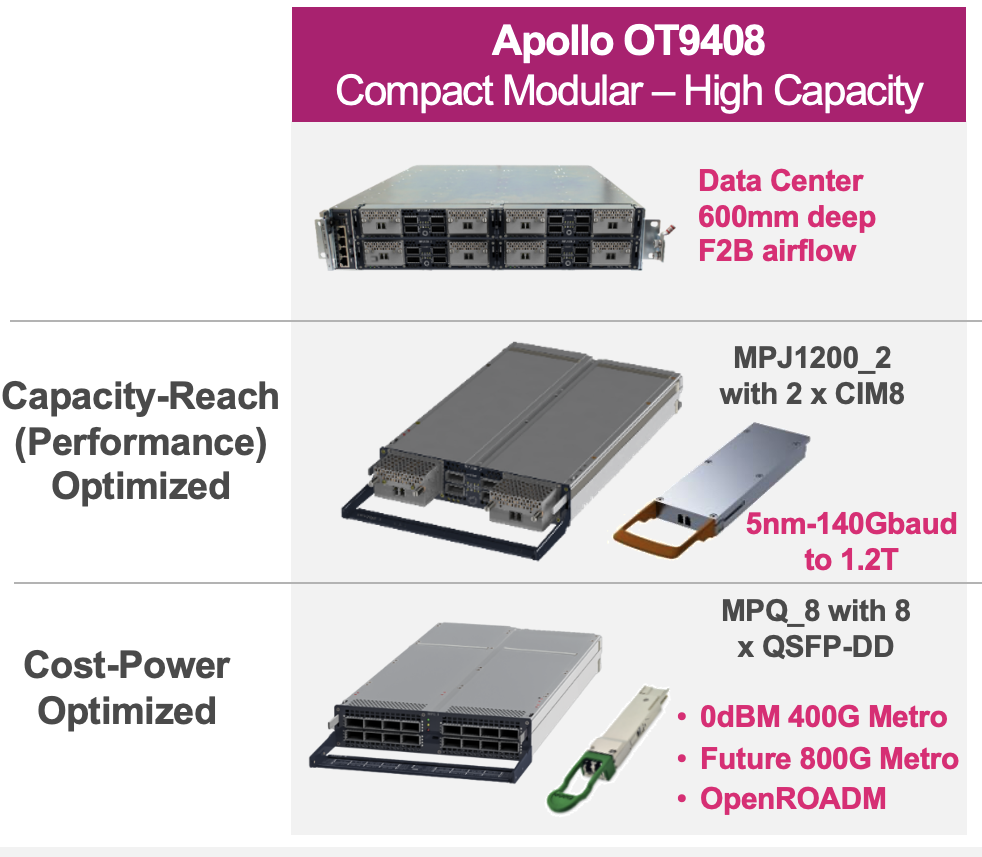
“The MPQ_8 is also designed to accept a new generation of 124Gbaud 800Gbps QSFP-DD pluggables currently in development and expected to be available in early 2025,” says Homa.
Ribbon also offers its standard telecom Apollo 9600 series platforms, from the smallest 2RU 9603 to the 5RU 9608 to the largest 15RU 9624 chassis. The Apollo 9600 modular platforms can use two CIM 8s in the TM800_2 double-slot card for performance-optimised transmission to 800 gigabits, or two CFP2-DCO modules in the TM400_2 single-card slot card for cost-optimised transmission to 400 gigabits.
Industry timing
Optical system vendors that don’t develop their own coherent DSP chips or modems, such as Ribbon, have several supply options. The leading merchant DSP suppliers include Acacia, NEL and Marvell. There are also competitor optical transport providers that source their coherent modem solutions. Ribbon discussed with several coherent modem suppliers but chose Acacia’s CIM 8 for the 9408. Ribbon has worked with Acacia for a decade.
The CIM 8’s 5nm Jannu DSP leapfrogs the 90-100GBd 7nm CMOS generation of coherent DSPs now deployed. This year, 5nm CMOS coherent DSPs have been announced by Nokia and Infinera. Merchant suppliers NEL and Marvell have also detailed their latest coherent DSPs. All these devices operate at symbol rates in the region of 130-150GBd.
Acacia also supplies the CIM 8 to other optical transport vendors such as Cisco, Acacia’s parent company, ZTE, and Adtran. Cisco has announced its Network Convergence System (NCS) 1014 compact modular platform that includes a 2.4Tbps transponder Line using the CIM 8. In March, Adtran reported sending an 800-gigabit signal over 2,200km using the CIM 8 as part of a networking trial. The route included 14 route-and-select flexible-grid ROADMs.
“It will be interesting to see the market dynamics unfold over the next year. There will be more system suppliers of 1.2 Tbps-capable wavelengths,” says Dell’Oro’s Yu. “Many system vendors will use the CIM 8, and some will use NEL’s ExaSpeed GAIA DSP. Some will also develop in-house DSPs such as Huawei and Nokia.”
Every dense wavelength division multiplexing (DWDM) system vendor will have a 1.2 Tbps-capable line card available for sale before the end of 2024, except for Ciena, says Yu: “This is because Ciena will come out with a 1.6 Tbps-capable DSP on a 3nm process node in 2024, one to two years ahead of any other vendors.”
Earlier this year, Ciena announced its WaveLogic 6, the first coherent DSP that operates at 200GBd. Ciena says it will offer its optical transport systems using its 3nm CMOS coherent DSP in the second half of 2024.
Homa believes that the next jump will be 240-plus GBd coherent DSPs, likely implemented using an even smaller 2nm CMOS process node.
The OIF’s 1600ZR 1.6-terabit coherent pluggable module standard will use a 240GBd symbol rate DSP.


WaveLogic 5: Packing a suitcase of ideas in 7nm CMOS
-
Ciena’s WaveLogic 5 coherent digital signal processor family comprises the Extreme and Nano chips
-
The WaveLogic 5 Extreme maximises optical capacity and transmission reach while the WaveLogic 5 Nano is targeted at compact, power-conservative applications

Kim Roberts
Advancing coherent optical transmission performance; targeting the emerging coherent pluggable market; selling modules directly, and the importance of being more vertically integrated. All these aspects were outlined by Cisco to explain why it intends to buy the coherent optical transmission specialist, Acacia Communications; a deal that is set to be completed in the spring of 2020.
But such strategic thinking is being pursued by Ciena with its next-generation WaveLogic 5 family of coherent DSPs.
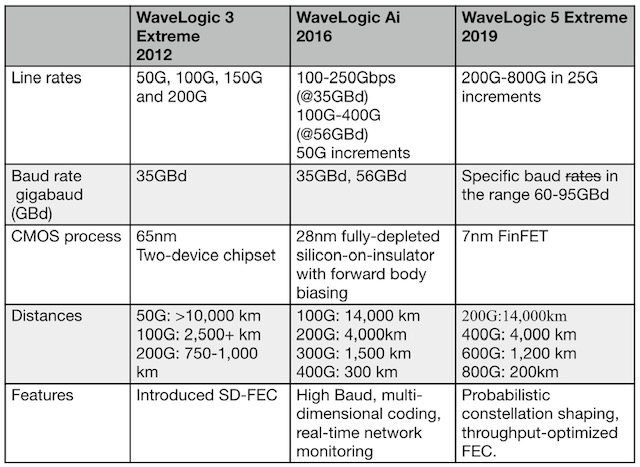
The WaveLogic 5 continues Ciena’s tradition of issuing a coherent digital signal processor (DSP) family approximately every three years: Ciena announced the WaveLogic 3 in 2012 and the WaveLogic Ai in 2016. (Add links).
The company has managed to maintain its three-yearly cadence despite the increasing sophistication of each generation of coherent DSP. For example, the WaveLogic 5 Extreme will support 800 gigabits-per-wavelength, double Ciena’s WaveLogic Ai that has been shipping for nearly two years.
Kim Roberts, vice president of WaveLogic science, says Ciena has managed to deliver its coherent DSPs in a timely manner since much of the algorithmic development work was done 5-6 years ago. The issue has been that certain features developed back then could not be included within the WaveLogic Ai.
WaveLogic 5 is implemented using a 7nm FinFET CMOS process whereas the WaveLogic Ai uses a 28nm specialist CMOS process known as fully-depleted silicon-on-insulator (FD-SOI).
“Seven-nanometer CMOS, due to its density and low heat, allows us to implement things that didn’t make the cut for the WaveLogic Ai,” says Roberts.
The company has a ‘suitcase of ideas’, he says, but not all of the concepts make it into any one generation of chip. “They have to justify performance versus schedule versus heat [generated],” says Roberts. “As we improve the technology, more features make the cut.”
And there are developments that will be included in future designs: “We keep refilling the suitcase,” says Roberts.
NAMING
Ciena first used the Extreme and Nano nomenclature with the WaveLogic 3. In contrast, the WaveLogic Ai, when launched in 2016, was a single-chip targeting the high-end. Ciena chose to change the naming scheme with the Ai since the chip signified a shift with features such as network monitoring.
However, Ciena highlights a key difference between the WaveLogic 3 and WaveLogic 5 families. The WaveLogic 3 Extreme and the WaveLogic 3 Nano could talk to each other on appropriate spans. In contrast, the two WaveLogic 5 chips are distinct. “They are not designed to interwork,” says Roberts.
NETWORKING TRENDS
Telecom service providers are investing in their networks to make them more adaptive. They want their networks to be scalable and programmable, says Ciena.
The operators also want to better understand what is happening in their networks and that requires collecting data, performing analytics and using software to configure their networks in an automated way.
“How do you get there? It is all about coherent technology,” says Helen Xenos, senior director, portfolio marketing at Ciena. “It is a critical element that is helping operators scale their networks.”
By enhancing the traffic-carrying capacity of fibre, coherent technology enables operators to reduce transport costs. “It allows them to be more competitive as they can do more with the hardware they deploy,” says Xenos.

Helen Xenos
Both telcos and cable operators are also applying coherent technology to new applications in their networks such as access.
These transport needs are causing a divergence in requirements.
One is to keep advancing optical performance in terms of the spectral efficiency and the traffic-carrying capacity of links. This is what the WaveLogic 5 Extreme tackles.
The second requirement - producing a compact coherent design for the network edge - is addressed by the WaveLogic 5 Nano.
For access designs, what is important is a compact design where the optics and the DSP can operate over an extended temperature range.
The Nano also addresses the hyperscalers’ need to connect their distributed data centres across a metro. “They need high capacity - 400 gigabits - and short-reach connectivity,” says Xenos. “It really needs to be the smallest footprint to maximise density.”
VERTICAL INTEGRATION
In addition to unveiling the WaveLogic 5 Extreme and Nano ICs, Ciena has outlined how it is more vertically integrated after investing in optics. In 2016, Ciena acquired the high-speed photonics division of Teraxion, gaining expertise in indium phosphide and silicon photonics expertise. {add link}.
Ciena is also now selling coherent optical modules. Gazettabyte revealed last year that Ciena was planning to sell modules using its own optics and WaveLogic technologies. {add link}
The company has no preference regarding indium phosphide and silicon photonics and uses what is best for a particular design.
“Silicon photonics buys you ease-of-manufacturing and cost; indium phosphide is what you need for 800 gigabits,” says Xenos.
Ciena stresses, however, that there is no simple formula as to when each is preferred. In terms of size and heat, silicon photonics has a strong advantage. “In terms of performance, you get better performance in some instances with indium phosphide and then there are overlaps because you bring in cost and other constraints,” says Roberts. “So there is no simple divide.”
“As we move forward, we are going to see an increasing percent of Ciena-custom components in WaveLogic coherent modems,” says Xenos.
Source: Gazettabyte
EXTREME
The WaveLogic 5 Extreme introduces several developments. It operates at specific baud rates ranging from 60 to 95 gigabaud. The baud rates are chosen so that both fixed-grid 100GHz channels and flexible grid ones are supported.
“For the best performance, you have flexible grid when 95 gigabaud is the primary baud rate,” says Roberts.
It is also Ciena’s first coherent DSP that uses probabilistic constellation shaping, a coding scheme used to achieve granular capacity increments. {add link}
“From 200 gigabits to 800 gigabits [in 25-gigabit increments], optimised over any path or the available margin,” says Roberts. “But what is unique about this is that it is optimised for non-linear propagation.”
Initially, the products using the WaveLogic 5 Extreme will use 50-gigabit increments. “This is what is required to service customers’ client requirements today: ten gigabits and multiples of 100-gigabit clients,” says Xenos.
>
“With 25-gigabit steps in client rate, the customer can choose to spend the margin on sending more bits”
The DSP uses four-wave frequency-division multiplexing to mitigate non-linear impairments, particularly beneficial for sub-sea systems.
Ciena says the four-wave frequency-division multiplexing is achieved electrically, reducing the optics to a minimum. “One laser and one modulator are used, so all the [cost-saving] economics of a single optical wavelength,” says Roberts. “But it has the non-linear performance of four tightly-coupled electrical systems.”
Ciena has also added an improved forward-error correction (FEC) scheme - a ‘throughput-optimised FEC’ - that uses variable overhead bits depending on the client rate.
“It will handle 8.6 percent errors compared to what we used in the WaveLogic Ai which handles 3.5 percent errors,” says Roberts. “So it is a decibel better.”
The Extreme chip also has improved link-monitoring capabilities. It monitors the signal-to-noise per channel as well as quantifies the non-linear contributions. “It helps people to understand what is happening in the network and create algorithms to optimise the capacity across the network,” says Xenos.
PROBABILISTIC CONSTELLATION SHAPING
Probabilistic shaping is used to improve the optical performance by lowering the signal energy by not using all the constellation points. Unless, that is, the full data rate is used and then all the constellation points are needed.
The degree of probabilistic shaping used is determined for each link. The parameters used to determine the probabilistic shaping are the amount of dispersion on the link, the span’s reach, and the transmitted client rate.
“The modem will measure what is going on in the link and the customer or some higher-level software will say what the client rate is,” says Roberts. “The modem will then figure out how to do the best non-linear probabilistic shaping to support that rate on the link.”
Roberts says other firms’ probabilistic shaping use one symbol at a time whereas Ciena use blocks, each comprising 128 symbols. “A bigger number would be better but I'm limited by my hardware,” says Roberts.
The 128 symbols equate to 1024 bits: four magnitude bits using 64-ary quadrature amplitude modulation (64-QAM) multiplied by two, one for each polarisation.
This means there are a total of 2^1024 combinations of 1024-bit sequences that could be sent. However, when sending a 400 Gigabit Ethernet (GbE) client signaland, for the benefit of explanation, assuming that 555 bits are needed to carry the data payload and the overhead, the number of possible bit sequences is trimmed to 2^555.
This is still a fantastically huge number but the DSP can work out which are the best 555-bit sequences to send based on them having the most tolerance to linear and non-linear interference.
“The ones that play nicely with their neighbours such that they cause the minimum non-linear degradation on the neighbouring wavelengths and on the other symbols,” explains Roberts.
Ciena is not forthcoming as to how it calculates the best sequences. “Ciena’s algorithms decide which ones are best,” says Xenos. “This is one of our key differentiators.”
The result is that, depending on the fibre type, a 1.5dB performance improvement is achieved for the non-linear characteristics.
“It allows more capacity to be chosen by the customer on that same link,” says Roberts. “With 25-gigabit steps in client rate, the customer can choose to spend the margin on sending more bits.”
Operating the Extreme at 95GBd, a reach of 4,000 km is possible at 400 gigabits and at 600 gigabits, the reach is 1,000 km (see table).
WAVELOGIC 5 NANO
The WaveLogic Nano supports 100-gigabit to 400-gigabit wavelengths and is aimed at applications that need compact designs that generate the least heat.
One application is to enable cable operators to move optics closer to the user and that must operate over an extended temperature range. Here, a packet platform is used that will support line interworking as equipment from different vendors may be at each end of the link.
Another requirement is operating over multiple spans in a metro. Here, compact equipment and low power are more important than spectral efficiency but it is still a challenging environment, says Ciena. Hundreds of nodes may be talking to each other and there may be cascaded reconfigurable optical add-drop multiplexers (ROADMs) with different fibre types making up the network.
A third application is single-span data centre interconnect where achieving the highest density on routers is key. This is the application the 400-gigabit, at least 80km 400ZR specification developed by the Open Internetworking Forum will address.
“The design that we are doing for the WaveLogic 5 Nano for 400ZR is to fit into a QSFP-DD,” says Xenos. “If there is a need for an OSFP [pluggable module], we will offer OSFP.”
Ciena also expects to offer a Nano-based CFP2-DCO module, which will outperform the ZR in terms of reach and features, for more demanding metro applications.
Another new segment requiring coherent optics is 4G and 5G access. “It is to be determined what type of platform is the winning solution in this environment,” says Xenos.
MAKING MODULES
Ciena first made its coherent DSP available to third parties in 2017 when it signed an agreement with Lumentum, NeoPhotonics and at the time Oclaro (since acquired by Lumentum) to use its WaveLogic Ai in their modules.
Now Ciena is selling directly the full coherent modem: the DSP and the optics. This is why Ciena created its Optical Microsystems unit in late 2017.
CMOS PROCESS
Moving to a 7nm FinFET CMOS process delivers several benefits.
It generates much lower heat than the WaveLogic Ai’s 28nm FD-SOI process. It also has a lower quiescent current, the current dissipated independent of whether the chip’s logic is active or not. And 7nm CMOS delivers much greater circuit density: the functionality that can be crammed into a square micrometre of silicon.
“So, a low power [consumption] on features you are not using, and we can include features that if you can't afford the heat, you can turn them off,” says Roberts.
It will offer its Nano in the form of pluggable modules, the WaveLogic Ai as a 5x7-inch module, and the WaveLogic 5 Extreme in another module form factor that will have its own interface. “These would all be viable optics,” says Xenos.
Availability
The first Wave Logic 5 Nano products will appear in the second half of this year while the first Extreme-based products will be available at the end of this year. The 400ZR coherent pluggable module is expected to be available in the first half of 2020.