

Cisco Systems' coherent power move
Cisco Systems announced its intent to acquire the optical transmission specialist CoreOptics back in May. CoreOptics has digital signal processing expertise used to enhance high-speed long-haul dense wavelength division multiplexing (DWDM) optical transmission. Cisco’s acquisition values the German company at US $99m.

"Let me be clear, we don’t believe 100Gbps serial will dominate the market for a long time, or 40Gbps for that matter"
Mark Lutkowitz, Telecom Pragmatics
“It has become clear that Cisco, with a few exceptions, has cornered the coherent market for 40 Gig and 100 Gig,” says Mark Lutkowitz, principal at market research firm, Telecom Pragmatics, which has published a report on Cisco's move.
Prior to Cisco’s move, several system vendors were working with CoreOptics for coherent transmission technology at 40 and 100 Gigabit-per-second (Gbps). Nokia Siemens Networks (NSN) was one and had invested in the company, another was Fujitsu Network Communications. Telecom Pragmatics believes other firms were also working with CoreOptics including Xtera and Ericsson (CoreOptics had worked with Marconi before it was acquired by Ericsson).
ACG Research in its May report Cisco/ CoreOptics Acquisition: What Does It Mean for the Packet Optical Transport Space? also claimed that the Cisco acquisition would set back NSN and Ericsson and listed other system vendors such as ADVA Optical Networking and Transmode that may have been considering using CoreOptics’ 100Gbps multi-source agreement (MSA) design.
“The mere fact that you have all these companies working with CoreOptics - and we don’t know all of them – says it all,” says Lutkowitz. “This was the company they were initially going to be depending on and Cisco made a power move that was brilliant.”
With Cisco bringing CoreOptics in-house, these system vendors will need to find a new coherent technology partner. “The next chance would be with a company like Opnext coming out with a sub-system,” says Lutkowitz. “There is no doubt about it – this was a major coup for Cisco.”
For Cisco, the deal is important for its router business more than its optical transmission business. “In terms of transceivers that go into routers and switches it was absolutely essential that Cisco comes up with coherent technology,” says Lutkowitz. Cisco views transport as a low-margin business unlike IP core routers. “This [acquisition] is about protecting Cisco’s bread and butter – the router business,” he says.
The acquisition also has consequences among the router vendors. Alcatel-Lucent has its own 100Gbps coherent technology which it could add to its router platforms. In contrast, the other main router player, Juniper Networks, must develop the technology internally or partner. Telecom Pragmatics claims Juniper has an internal coherent technology development programme.
40 and 100 Gig markets
Cisco kick-started the 40Gbps market when it added the high-speed interface on its IP core router and Lutkowitz expects Cisco to do the same at 100Gbps. “But let me be clear, we don’t believe 100Gbps serial will dominate the market for a long time, or 40Gbps for that matter.”
In Telecom Pragmatics’ view, multiple channels of 10Gbps will be the predominant approach. First, 10Gbps DWDM systems are widely deployed and their cost continues to come down. And while Alcatel-Lucent and Ciena already have 100Gbps systems, they remain expensive given the infancy of the technology.
But with business with large US operators to be won, systems vendors must have a 100Gbps optical transport offering. Verizon has an ultra-long haul request for proposal (RFP), AT&T has named Ciena as its first domain supplier for its optical and transport equipment but a second partner is still to be announced. And according to ACG Research, Google also has DWDM business.
What next?
Besides Alcatel-Lucent, Ciena, Infinera, Huawei, and now Cisco developing coherent technology, several optical module players are also developing 100Gbps line-side optics. These include Opnext, Oclaro and JDS Uniphase. There are also players such as Finisar that has yet to detail their plans. Lutkowitz believes that if Finisar is holding off developing 100Gbps coherent modules, it may prove a wise move given the continuing strength of the 10Gbps DWDM market.
Opnext acquired subsystem vendor StrataLight Communications in January 2009 and one benefit was gaining StrataLight’s systems expertise and its direct access to operators. Oclaro made its own subsystem move in July, acquiring Mintera. Oclaro has also partnered with Clariphy, which is developing coherent receiver ASICs.
But Telecom Pragmatics questions the long-term prospects of high-end line-side module/ subsystem vendors. “This [technology] is the guts of systems and where the money is made,” says Lutkowitz. “Ultimately all the system vendors will look to develop their own subsystems.”
Lutkowitz highlights other challenges facing module firms. Since they are foremost optical component makers it is challenging for them to make significant investment in subsystems. He also questions when the market 100Gbps will take off. “Some of our [market research] competitors talk about 2014 but they don’t know,” says Lutkowitz.
But is not the trend that over time, 40Gbps and 100Gbps modules will gain increasing share of the line side systems optics, as has happened at 10Gbps?
That is certainly LightCounting’s view that sees Cisco’s move as good news for component and transceiver vendors developing 40 and 100Gbps products. LightCounting argues that with Cisco’s commitment to the technology, other system vendors will have to follow suit, boosting demand for the higher-margin products.
“There will be all types of module vendors but it is possible that going higher in the food chain will not work out,” says Lutkowitz. “There will be more module and component vendors than we have now but all I question is: where are the examples of companies that have gone into subsystems that have done relatively well?”
Opnext is likely to be the next vendor with 100Gbps product, says Lutkowitz, and Oclaro could easily come out with its own offering. “All I’m saying is that there is a possibility that, in the final analysis, systems vendors take the technology and do it themselves.”

Wireless backhaul: The many routes to packet
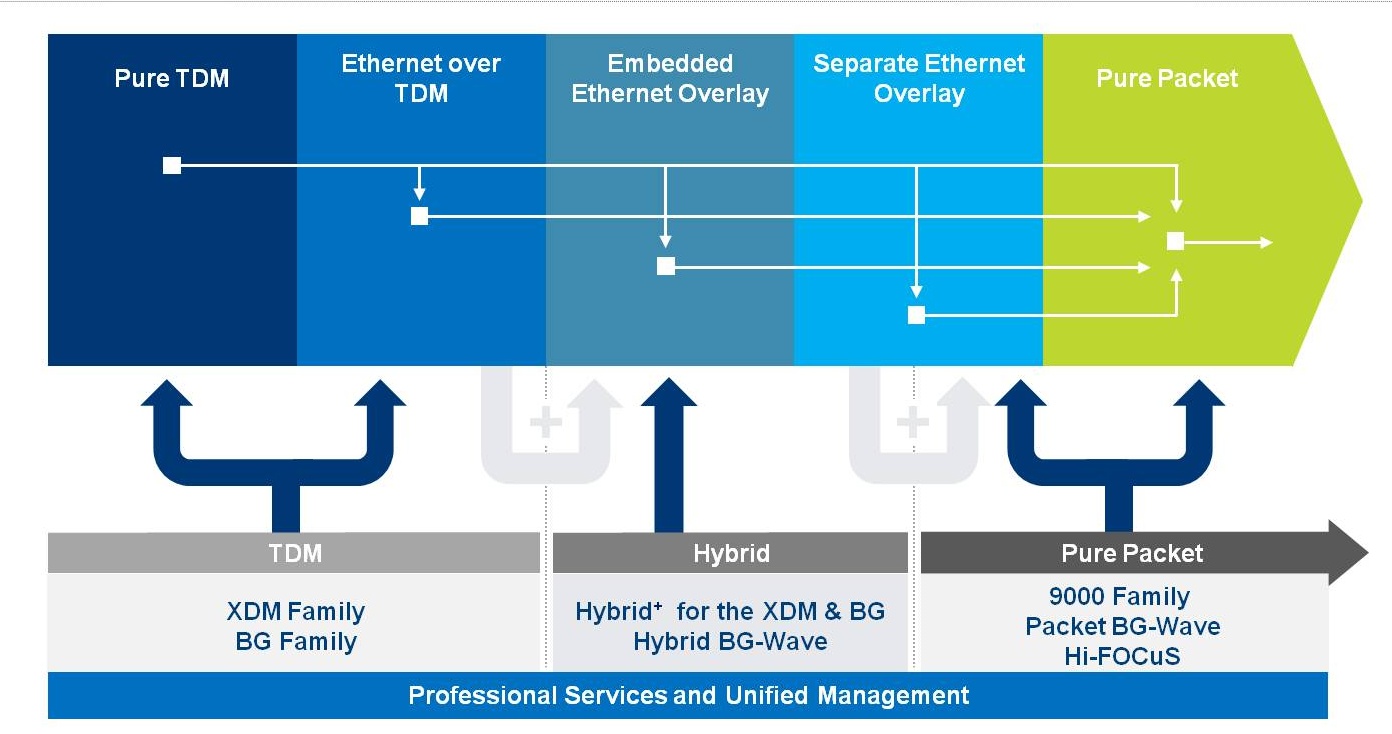
ECI Telecom has detailed its wireless backhaul offering that spans the cell tower to the metro network. The 1Net wireless backhaul architecture supports traditional Sonet/SDH to full packet transport, with hybrid options in between, across various physical media.
“We can support any migration scheme an operator may have over any type of technology and physical medium, be it copper, fibre or microwave,” says Gil Epshtein, senior product marketing manager, network solutions division at ECI Telecom.
Why is this important?
Operators are experiencing unprecedented growth in wireless data due to the rise of smart phones and notebooks with 3G dongles for mobile broadband.
Mobile data surpassed voice traffic for the first time in December 2009, according to Ericsson, with the crossover occurring at approximately 140,000 terabytes per month in both voice and data traffic. According to Infonetics Research, mobile broadband subscribers surpassed digital subscriber line (DSL) subscribers in 2009, and will grow to 1.5 billion worldwide in 2014. By then, there will be 3.6 exabytes (3.6 billion gigabytes) per month of mobile data traffic, with two thirds being wireless video, forecasts Cisco Systems.
“The challenge is that almost all the growth is packet internet traffic, and that is not well suited to sit on the classic TDM backhaul network originally designed for voice,” says Michael Howard, principal analyst, carrier and data center networks at Infonetics Research. TDM refers to time division multiplexing based on Sonet/SDH where for wireless backhaul T1/E1lines are used.

“There is a gap between the technology hype and real life”
Gil Epshtein, ECI Telecom
The fast growth also implies an issue of scale, with the larger mobile operators having many cell sites to backhaul. E1/TI lines are also expensive even if prices are coming down, says Howard: “It is much cheaper to use Ethernet as a transport – the cost per bit is enormously better.”
This is why operators are keen to upgrade their wireless backhaul networks from Sonet/SDH to packet-based Ethernet transport. “But there is a gap between the technology hype and real life,” says Epshtein. Operators have already invested heavily in existing backhaul infrastructure and upgrading to packet will be costly. The operators also know that projected revenues from data services will not keep pace with traffic growth.
“Operators are faced with how to build out their backhaul infrastructures to meet service demands at cost points that provide an adequate return on investment,” says Glen Hunt, principal analyst, carrier transport and routing at Current Analysis. Such costs are multi-faceted, he says, on the capital side and the operational side. “Carriers do not want to buy an inexpensive device that adds complexity to network operations which then offsets any capital savings.”
“It is much cheaper to use Ethernet as a transport –the cost per bit is enormously better.”
Michael Howard, Infonetics Research
To this aim, ECI offers operators a choice of migration schemes to packet-based backhaul. Its solution supports T1/E1lines and Ethernet frame encapsulation over TDM, Ethernet overlay networks, and packet-only networks (see chart above).
With Ethernet overlay, an Ethernet network runs alongside the TDM network. The two can co-exist within a common network element, what ECI calls embedded Ethernet overlay, or separately using distinct TDM and packet switch platforms. And when an operator adopts all-packet, legacy TDM traffic can be carried over packets using circuit emulation pseudo-wire technology.
“ECI’s offering is significant since it includes all the components and systems necessary to handle nearly any type of backhaul requirement,” says Hunt. The same is true for most of the larger system vendors, he says. However, many vendors integrate third party devices to complete their solutions – ECI itself has done this with microwave. But with 1NET for wireless backhaul, ECI will now offer its own microwave backhaul systems.
According to Infonetics, between 55% and 60% of all backhaul links are microwave outside of North America. And 80% of all microwave sales are for mobile backhaul. Moreover, Infonetics estimates that 70 to 80% of operator spending on mobile backhaul through 2012 will be on microwave. “Those are the figures that explain why ECI has decided to go it alone,” says Howard. Until now ECI has used products from its microwave specialist partner, Ceragon Networks.
“ECI has all the essential features that the other big players have like Ericsson, Alcatel-Lucent, Nokia Siemens Networks and Huawei,” says Howard. What is different is that ECI does not supply radio access network (RAN) equipment such as basestations. “It is ok, though, because almost all of the [operator] backhaul tenders separate between RAN and backhaul,” says Howard.
ECI argues that by adopting a technology-agnostic approach, it can address operators’ requirements without forcing them down a particular path. “Operators are looking for guidance as to which path is best from this transition,” says Epshtein. There is no one-model fits all. “We have so many exceptions you really need to look on a case-by-case basis.”
In developed markets, for example, the building of packet overlay is generally happening faster. Some operators with fixed line networks have already moved to packet and that, in theory, simplifies upgrading the backhaul to packet. But organisational issues across an operator’s business units can complicate and delay matters, he says.
And Epshtein cites one European operator that will use its existing network to accommodate growth in data services over the coming years: “It is putting aside the technology hype and looking at the bottom line."
In emerging markets, moving to packet is happening more slowly as mobile users’ income is limited. But on closer inspection this too varies. In Africa, certain operators are moving straight to all-IP, says Ephstein, whereas others are taking a gradual approach.
What’s been done?
ECI has launched new products as well as upgraded existing ones as part of its 1NET wireless backhaul offering.
The company has announced its BG-Wave microwave systems. There are two offerings: an all-packet microwave system and a hybrid one that supports both TDM and Ethernet traffic. ECI says that having its own microwave products will allow it to gain a foothold with operators it has not had design wins before.
“ECI will need to prove the value of its microwave products with actual field deployments”
Glen Hunt, Current Analysis
ECI has announced two additional 9000 carrier Ethernet switch routers (CESR) families: the 9300 and 9600. These have switching capacities and a product size more suited to backhaul. The switches support Layer 3 IP-MPLS and Layer 2 MPLS-TP, as well as the SyncE and IEEE 1588 Version 2 synchronisation protocols.
ECI has also upgraded its XDM multi-service provisioning platform (MSPP) to enable an embedded overlay with Ethernet and TDM traffic supported within the platform.
“When an operator is choosing to add packet backhaul to existing TDM backhaul, typically it is a separate network – they keep voice on TDM and add a second network for packet,” says Howard. This hybrid approach involves adding another set of equipment. “ECI has added functions to existing equipment, which operators may already have, that allows two networks to run over a single set of products.”
Also included in the solution are ECI’s BroadGate and its Hi-FOCuS multi-service access node (MSAN). This is not for operators to deploy the platform for wireless backhaul but rather those operators that have the MSAN can now use it for backhauling traffic, says Ephstein. This is useful in dense urban areas and for operators offering wholesale services to other operators.
All the network elements are controlled using ECI’s LightSoft management system.
“ECI’s solution has the advantage that all the systems use the same operating system and support the same features,” says Hunt. He cites the example of MPLS-TP which is implemented on ECI’s carrier Ethernet and optical platforms.
“ECI has a full range of platforms that all work together to meet the needs of mobile as well as fixed operator,” says Hunt. “ECI will need to prove the value of its microwave products with actual field deployments.”
Operator interest
ECI has secured general telecom wins with large incumbent operators in Western Europe and has been winning business in Eastern Europe, Russia, India and parts of Asia.
ECI’s sweet spot has been its relationship with Tier 2 and Tier 3 operators, says Hunt, and since the company offers broadband access, optical transport, and carrier Ethernet, it can use these successes to help expand into areas such as wireless backhaul.
But wireless backhaul is already a key part of the company’s business, accounting for over 30% of revenues, says Ephstein. Late last year ECI estimated that it was carrying between 30% and 40% of the mobile backbone traffic in India, a rapidly growing market.
As for 1NET wireless backhaul, ECI has announced one win so far - Israeli mobile operator Cellcom which has selected the 9000 CESR family. “Cellcom shows that ECI can continue to expand its presence in the network - in this case leveraging business Ethernet services to add backhaul,” says Hunt.
In addition one European operator, as yet unnamed, has selected ECI’s embedded overlay. “Several other operators are in various stages of selecting the right option for them,” says Ephstein.
- For some ECI wireless backhaul papers and case studies, click here
Still some way to go
Part 1: The vision .... back in 2000
I came across this article (below) on the intelligent all-optical network. I wrote it in 2000 while working at the EMAP magazine, Communications Week International, later to become Total Telecom.
What is striking is just how much of the vision of a dynamic photonic layer is still to be realised. Back then it had also been discussed for over a decade. And bandwidth management, like in 2000, is still largely at the electrical layer.
And yet much progress has been made in networking technology. But the way the network has evolved means that a more flexible photonic layer, while wanted by operators, is only one aspect of the network optimisation they seek to reduce the cost of transporting bits.
The second and third parts of the dynamic optical networking briefing will discuss how often operators reconfigure their networks and what is required, as well as developments in reconfigurable optical add-drop multiplexer (ROADM) and control plane technologies that promise to increase the flexibility of the photonic layer.
--+++--
Seeing the light (April 17th, 2000)
The next generation of networks is coming, with abundant bandwidth and flexible services available on-demand, and intelligent management and provisioning at the optical layer. Roy Rubenstein finds out what's in store and who's set fair in this optical future.
For all its air of novelty, all-optical networking is actually a mature idea. Discussed for the best part of a decade, all-optical networks have perennially promised to deliver the next generation of “intelligent” services, yet besides the stir caused by the arrival of dense wavelength division multiplexing (DWDM), forcing greater capacity over fiber networks, there has been little in the way of tangible development.
Now, with limited ceremony, optical networking is reasserting itself, and the signs are that you could reap the benefits sooner than you think.
What excites operators most is the prospect of bandwidth on demand: high-speed links set up with little more than a few mouse clicks. But the technology is creating dilemmas as well as opportunities. On the one hand, the newer operators can enter the market with a sleeker network - fewer layers and fewer nodes - accompanied by the latest billing and management software. On the other hand, incumbent operators are facing the dilemma of when to embrace the technology and how to integrate it with their legacy equipment.
“Most of the network planners agree this is the way to go,” says Barry Flanigan, senior consultant at Ovum Ltd., of London. "The question is the precise technology and timing."
Flexible bandwidth
Flexible bandwidth provisioning will enable a range of services that have not been practicable until now. For example, network planners in corporations will no longer have to guess - and live with the consequences - each time they budget their capacity requirements and agree horribly rigid contract terms.
In fact all manner of on-tap services become possible when bandwidth is set up and collapsed on an hourly or minute-by-minute basis. One example is bandwidth trading between carriers, enabling operators with their own networks to grab business such as voice services while demand is there, and off load capacity when it is not.
A further example is the broadcasting of sporting events. Instead of satellite coverage, a TV company could set up a cheaper terrestrial network link to each sporting venue, but provision capacity only for the duration of the event. And content providers can offer services locally. Opening pipes, a provider can download and store video on demand on a country-by-country basis ready for delivery, before closing the links.
“That way the service seems a lot quicker,” says Andy Wood, chief technology officer at Storm Telecommunications Ltd., based in London.
Adding intelligence
The key to this flexible bandwidth provisioning is optical switches, which introduce “intelligence” to the optical layer. An optical switch-whether electrically based or all-optical-routes complete wavelengths of light packed with up to 10 megabits of data.
“The scenario today is that bandwidth management is at the electrical layer,” says Richard Dade, director for industry liaison, optical networking group, at Lucent Technologies Inc., Murray Hill, New Jersey. “By the end of this year-2001 it will transition into the optical layer.”
This is also the view of Nick Critchell, product marketing manager for core optical internetworking products at San Jose, California-based Cisco Systems Inc. “Looking forward two years to the core routing, it will provide intelligent switching and intelligent restoration,” he says.
But others question the impact such technologies are having on the awareness of the underlying optical network. “Intelligence may be too strong a word for it,” says Dr. David Huber, chief executive of Corvis Corp., the Columbia, Maryland-based optical networking technology start-up.
What interests him is the sheer data traffic-handling capabilities--transporting terabits of data--and network efficiencies that all-optical switches promise. For example Huber predicts network utilization will exceed 80% using all optical switches. Current network utilization figures are below 50%.
When it comes to the operators, it seems the newer breed is keenest to embrace the technology. For them, adopting intelligent optical switching provides a simpler network, removing the need for Sonet/Synchronous Digital Hierarchy (SDH) transmission equipment. They also gain in reduced operating costs and system efficiencies through the use of the latest network operating system, billing and management systems.
Established operators, in contrast, have an enormous legacy of network equipment. “Different telecoms operators have different levels of awareness [in adopting intelligent optical networks],” is the view of Margaret Hopkins, principal analyst at Cambridge, England-based consultancy Analysys Ltd.
And Hopkins is quick to stress that whatever the merits of the latest optical switching, it will not cause more established technologies to disappear any time soon. “Sonet gives you very fast reconfiguration [if a fiber is cut],” says Hopkins, pointing out that optical networks have some way to go before assuming this role. “For other users, SDH performs functions such as mixing different types of traffic - pulse coded modulated voice and IP - on the one wavelength. This is important, because a wavelength is an awful lot of capacity."
Some way to go
The future of Sonet/SDH is also secure while voice-over-Internet protocol (VoIP) traffic remains low, particularly as a proportion of all voice traffic. “With voice on packet networks, growth has been modest from a European perspective,” says Eric Owen, London-based senior director for European telecommunications at International Data Corp., Framingham, Massachusetts. “When asked about VoIP - medium-to-large enterprises across Europe - only 4% to 5% are doing it,” he says.
But operators are aware that they cannot afford to ignore intelligent optical switches, and several are already trialing the technology including MCI WorldCom Inc. and Williams Communications Inc.
One next-generation carrier has been bolder still. “The first indication of an optical switching network is the announcement from Storm,” says Chris Lewis, managing director of research and consulting at the Yankee Group Europe, of Watford, England. “Storm is basing its case on being able to switch in bandwidth pretty quickly,” he adds.
Storm, a carriers’ carrier, announced last month that it has acquired $100 million-worth of dark fiber to which it will connect optical equipment from Chelmsford, Massachusetts-based Sycamore Networks Inc. “It's the first example we've come across of concrete plans,” says Lewis.
The significance of Storm's announcement is the promise of bandwidth on demand. Mark Stewart, Storm Telecom's business development director, says its network users - carriers, large corporations and Internet service providers - can have the bandwidth they require, with costs based on usage. “A customer may need five STM-1, 155-megabit-persecond links one week and nine the next,” says Stewart.
Currently, an STM-16 (2.5 gigabits per second) link must be leased long-term to guarantee capacity, but through Storm users can buy the bandwidth they need in increments as small as 45 megabits per second, available for lease for “a short period,” according to the company. Storm has yet to finalize its service details, but claims 75% of its network will be up and running by the end of the summer.
The budding pan-European carrier is an example of what Analysys’ Hopkins refers to as a newer operator “configuring more interesting services more quickly.”
For “older” operators, meanwhile, expanding capacity involves adding overlays to their networks. Investing in the latest networking technology is seen as a strategic move, which needs to be taken, but which cannot be implemented in one fell swoop. “They have a share price - they don’t want to be seen to be a dinosaur,” says Hopkins.
And when they do add the latest IP technologies to their infrastructure, they “don’t get the simplification benefits,” she says.
Key stage
Equipment vendors, meanwhile, share the view that flexible switching is a key stage in the evolution of an all-optical layer. “All vendors are working on this: not just to get capacity but to exploit these wavelengths,” says Ovum's Flanigan.
At present the bulk of the public network is still based on Sonet/SDH transmission technology, to which DWDM has been added to meet the demand for IP traffic. “[U.S. long-distance operator] Sprint now has 80% of their routes on WDM,” says Bill Anderson, director of optical networking research at Morristown, New Jersey-based Telcordia Technologies Inc.
Yet while it has fulfilled a need in addressing the steep demand for capacity in recent years, DWDM is some way from being the solution to flexible, “intelligent” bandwidth provisioning. “DWDM can be seen as large, relatively dumb pipes,” says Anderson.
The issue, according to Rick Dodd, director of marketing strategy at optical networking specialist Ciena Corp., of Linthicum, Maryland, stems from the nature of Sonet/SDH technology.
“A lot of human intervention has been traded for intelligence,” he says, referring to the economic realities when SDH technology was first introduced around 10 years ago. Then, the manual setting up of links made sense, but with a decade of improvement in the performance/cost of microprocessors and memory, this is no longer the case.
Economical touch
“It’s very economical to add software and application-specific integrated circuits to the optical infrastructure to deliver a whole new type of network,” says Dodd.
Sycamore Networks is one vendor seeking to exploit this shift. It describes itself as a developer of hardware and software for next-generation optical networks. “What we call intelligent optical networks,” says Jeff Kiel, Sycamore's vice president of product marketing.
Kiel points out that currently Sonet/SDH equipment converts the data into optical form and manages traffic across the network. Sycamore Networks, for one, argues that with intelligent switch technology operators no longer even have to buy SDH equipment.
“You can provide the SDH framing - the same functionality - but subsume it into the optical layer,” says Kiel. Instead of having an IP device connecting to SDH equipment, which in turn connects to DWDM and ultimately fiber, the number of layers in the network can now be limited to three: the IP device linking directly to the intelligent optical network, which in turn connects to the fiber.
Lucent's Dade agrees that SDH can be bypassed, but believes, like Analysys’ Hopkins, that its course has not been run just yet.
“Our projections are that there is still a long life for Sonet/SDH services,” he says. “There will be strong growth for Sonet/SDH and stronger growth for intelligent optical network equipment.”
Carriers and manufacturers alike are looking to collapse telecoms networks into two layers. At the upper, switched layer, asynchronous transfer mode (ATM) and IP are being consolidated and are pulling in certain core SDH functions. The challenge is to ensure that the reconfiguration at the optical layer matches the tried-and-tested reliability of the SDH layer.
Having intelligent switching devices at the optical level is a precondition of this, and raises the prospect of a network with the intelligence to adapt itself--what Dennis Jennings, Telcordia Technologies’ vice president for next-generation networks, calls a dynamic reconfigurable network.
The Optical Domain Service Interconnect (ODSI) initiative [the ODSI merged with the OIF’s signaling workgroup], set up in January [2000] by 50 vendors and service providers, is working to develop a signaling scheme to ensure better communication between the two layers. “In the next year or two carriers will replace networks with two layers,” predicts Jennings.
One consequence of the increasing awareness at the optical layer is that assigning bandwidth may no longer be the preserve of operators. If the ODSI initiative proves successful, an IP router will be able to request an extra wavelength from the optical layer whenever it detects congestion, and relinquish it once the data surge passes.
“Optical networking will enable the provisioning of bandwidth to be instantaneously available,” says Alan Taylor, consulting engineer for Europe at backbone router company Juniper Networks Inc., of Mountain View, California.
“The ODSI is focused on a very simple problem,” says Rick Thompson, senior product marketing manager at Sycamore Networks, one of the co-founders of the initiative. “[The problem] has been deliberately scaled down with the aim of a quick deployment.”
Current routers can view the bandwidth between points, but no signaling scheme is available to enable an extra wavelength to be requested. ODSI intends to extend the signaling of the Multiprotocol Label Switching protocol (MPLS), which is used by routers to establish a path through the network for a given packet stream.
“This signaling between the data and the optical layers promises dynamic self-reconfiguring networks rather than ones needing human intervention,” claims Telcordia's Jennings.
A framework document has been completed and was discussed at an ODSI meeting held in Chicago on 6 April. Completion of the signaling extension is expected within the next three months.
ODSI is not developing a standard, but rather an open framework which the initiative’s members will adopt. Interoperability testing will then ensue.
“You can expect large scale deployment in 2001,” says Thompson.
The equipment vendors
The latest optical switch from Sycamore Networks Inc., the SN 16000, illustrates how optical nodes are gaining in awareness. Switching wavelengths - a necessary requirement if bandwidth is to be provisioned ‘in Seconds’ - is just one of its attributes. The node can also discover a network’s topology, so that should a fiber linking two cities be cut, the traffic can be rerouted on a different path.
This “intelligence” can even take into account the dispersion characteristics of the fiber. Thus if the original path is based on a Sonet OC-192 link, the switch redistributes the data accounting for the fiber’s nature.
Williams Communications Inc., a carrier based in Tulsa, Oklahoma, is trialing an intelligent optical switch from Ciena Corp. in addition to adopting Sycamore’s equipment. Dubbed Multiwave Coredirector, Ciena’s switch is also network-aware, and through the use of the optical signaling and routing protocol (OSRP) can communicate with other Ciena optical switches to determine the network’s status as well as planning the best path for traffic.
“We are enabling optical carriers to deliver optical bandwidth very quickly. In a variety of sizes--wavelengths and fractions of wavelengths - and employed with a variety of priorities,” says Ciena's Dodd. According to the vendors this flexibility can boost carriers’ revenues and have an impact on the implementation cost. “If you look at where service providers are spending their money, for every $1 spent on equipment, $2 to $4 is spent making it run,” says Dodd.
Williams’ appetite for trialing technology is not confined to Ciena and Sycamore's electrical-based optical switches. It is also trialing an all-optical cross-connect switch from Corvis Corp.
According to the carrier not only will an all-optical switch ease the huge increase in expected traffic, it will also help meet the variable demand in bandwidth as traffic becomes increasingly unpredictable, with applications such as video broadcast across the Internet becoming commonplace.
Andy Wright, chief technologist for optical networking at Williams describes Corvis’ technology as suited to “ultra long-haul networking,” removing the need for regenerators as the wavelengths are routed from one end of the optical layer to the other.
Regeneration equipment for a channel can cost between $60,000 and $70,000, says Wright. For a typical 100-channel site the cost is $7 million. By eliminating regeneration, what is required is a $100,000 optical amplifier, “a scale change in prices.”
Qwest Communications Corp., meanwhile, believes all-optical networking will drive down its operating costs by as much as 70%.
Lucent Technologies Inc. is another vendor developing an all-optical switch. “In our view the optical-electrical-optical conversion when routing a wavelength should not happen,” says Dade. Having an all-optical implementation is not only intrinsically cheaper, he says, but extraordinarily flexible. Lucent's Lambdarouter switch is currently being trialled by a U.S. long-distance operator and will be in production by year end.
But the view of Cisco Systems' Nick Critchell is that all-optical switching has still to prove it is reliable enough to be deployed across optical networks. That said, he is in no doubt about the technology’s merit. “We are moving [to develop an all-optical switch] and will be in that space,” he says.
Other sections of this briefing:
Part 2: ROADMS: reconfigurable but still not agile
Part 3: To efficiency and beyond
ROADMs: Set for double-digit growth

Summary
The wavelength-division multiplexing (WDM) reconfigurable optical add-drop multiplexer (ROADM) equipment market will be the fastest growing optical segment over the next few years, according to Infonetics Research. The market research firm in its ROADM Components Market Outlook report predicts that the segment will grow at a compound annual growth rate (CAGR) of 13% from 2008 to 2013.
Q&A
Q. Can you please help by defining some terms? What is the difference between a wavelength-selective switch (WSS) and a ROADM?
AS: A WSS is a component that can direct individual wavelengths among multiple fibers. They are typically built in asymmetrical configurations, such as a 1x9 or a 9x1 and are used in quantity to build logical larger switches, effectively allowing multiple wavelengths to be switched among several incoming and outgoing fibers.
ROADMs are subsystems composed of these WSS modules but also include EDFA amplifiers, splitters, sometimes arrayed waveguide gratings (AWGs), and control electronics that include power balancing.
Q. A ROADM can also be colourless and directionless. What do these terms mean?
AS: For a ROADM to be colourless, it must be capable of dropping wavelengths of the same colour entering the node from both the West and East directions on individual drop ports. Directionless requires that wavelengths added at that node have non-blocking behavior and be capable of being routed either in the West or East direction. Removing these restrictions typically requires more WSSs to be used in the ROADM in place of AWGs, representing a classic flexibility/ cost tradeoff.
Q. In the report you split the WSS into two categories: those with up to four ports and those greater than four ports. Why?
AS: That’s really the breaking point of the market according to carriers I spoke with. Originally, four ports was a high end number but since then larger WSS modules have become available. The market has divided into small, which is 1x2 to 1x4 ports, and large, which at this point are 1x9’s.
 "It is probably the only thing the circuit-loving Bell-heads and the counter-culture IP-bigots can agree on – everybody loves ROADMs."
Andrew Schmitt
Q. You say that ROADMs will be the faster growing optical equipment segment. What is motivating operators to deploy?
AS: ROADMs save money, plain and simple. When you use a ROADM, you eliminate the need to do an electrical-optical conversion and the electronics required to support it. It is particularly attractive for IP over WDM configurations, where expensive layer three router ports can be bypassed. Electrical-optical conversion is where the cost is in networks and ROADMs allow any given node to only touch the traffic required at that node. It’s probably the only thing the circuit-loving bell-heads and the counter-culture IP-bigots can agree on – everybody loves ROADMs.
Q. Are there regional differences in how ROADMs are being embraced? If so, why?
AS: North America, Japan and Europe have seen the bulk of deployments. But that has started to change with smaller carriers in developing countries adopting ROADM, particularly in Asia Pacific.
Q. Did you learn anything that surprised you as part of this research?
I assembled historical estimates of the WSS market back to 2005 through conversations with WSS vendors and equipment makers. Most people were very co-operative. When I was writing the final report, I overlayed historical WSS component revenue with the Infonetics’ ROADM optical equipment revenue we have tracked over the past years, and there was an extremely tight correlation. Where there wasn’t a correlation there was a logical reason behind it – adding more ROADM degrees to existing nodes.
Covering the component market and the equipment market makes the research much better than if I did each market individually. I’ve done a lot of research in the past few years in both technical and financial domains but this was the second most interesting – it was really refreshing to find a big double-digit growth market in optical.
Cisco System’s CEO, John Chambers, has been very public in his goal to grow the company at 15% annually, and I don’t think it is an accident that the Cisco optical group makes ROADM solutions a number one priority. They’ve silently moved up to second in market share for North American WDM, and their ROADM expertise played a big role in this.
The wavelength-division multiplexing (WDM) reconfigurable optical add-drop multiplexer (ROADM) equipment market will be the fastest growing optical segment over the next few years, according to Infonetics Research.
The market research firm in its ROADM Components Market Outlook report predicts that the segment will grow at a compound annual growth rate (CAGR) of 13% from 2008 to 2013.
Andrew Schmitt, directing analyst, optical at Infonetics discusses some of the issues regarding ROADMs and his report findings.