

The long game: Acacia's coherent vision
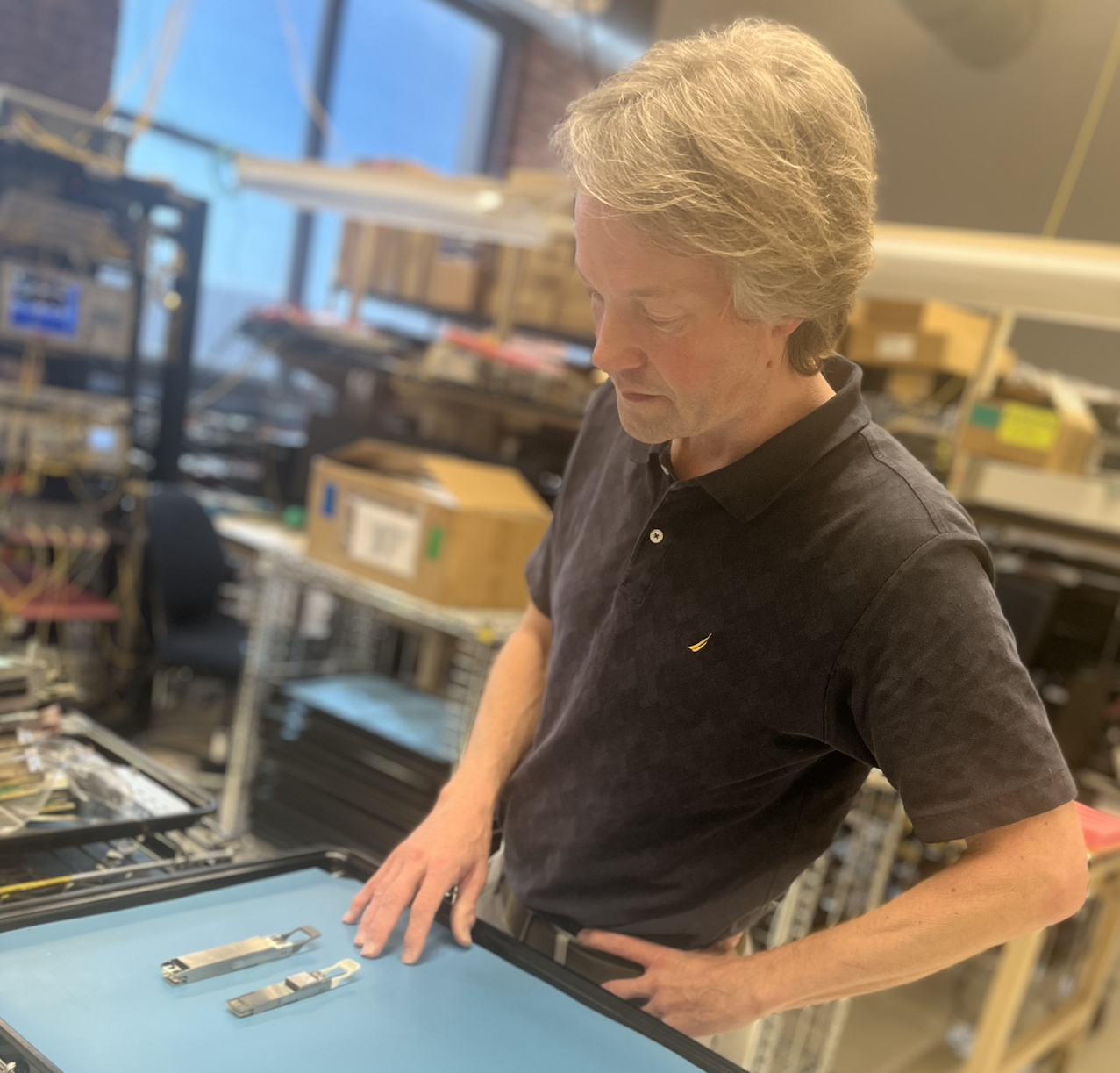
In 2007, Christian Rasmussen made a career-defining gamble. After attending a conference featuring presentations on coherent optical transmission, he returned home, consulted his family, and quit his job at Mintera, then an optical networking equipment maker.
The technology he’d seen discussed promised to solve the transmission impairments associated with direct-detection-based optical transmission – chromatic dispersion and polarisation mode dispersion – that had stymied optical transport to go beyond 40 gigabits-per-second (Gbps).
“We came back and were completely excited that there was a technology that addressed all the problems that we had experienced firsthand,” says Rasmussen, now Chief Technology Officer at Acacia.
His bet paid off. Acacia which he helped co-found in 2009, had a successful IPO in 2016 and would later be acquired by Cisco Systems for $4.5 billion in 2021.
Unfolding coherent optics
Increasing the baud rate has proved spectacularly successful in accommodating traffic growth in the network and reducing transport costs measured in dollar-per-bit.
In 2009, coherent modems operated around 32 gigabaud (GBd) for 100 gigabit-per-second (Gbps) wavelength transmissions. By 2024, the symbol rate has reached 200GBd, enabling 1.6 terabit-per-second (Tbps) wavelengths.
Is the priority still to keep upping the symbol rate of a single carrier when designing next-generation coherent modems?
“We are not just saying that increasing baud rate is right,” says Rasmussen. The fundamental goal is reducing optical transport’s cost and power consumption. “Increasing the baud rate is generally the right approach to achieve that goal but it’s always to a certain degree.”
Acacia’s focus from the beginning has been on integrating the components that make up the coherent modem. The resulting modem need not be expensive and can deliver higher speed and extra bandwidth economically while meeting the power consumption target, he says.
“Until now, we feel that increasing the baud rate has been the right approach,” says Rasmussen. “The question will be how frequently you can go up in baud rate, now that developments are expensive.”
Given the rising cost of developing coherent modems, upping the baud rate only makes sense if designers can double it with each new design, he says. Increasing the baud rate by 30 or 40 percent is too small a return, given the development effort and the costs involved.
That implies Acacia’s follow-on high-end coherent modem will have a symbol rate of around 280GBd.
Acacia’s coherent modules
Acacia’s Coherent Interconnect Module 8 (CIM 8), launched in 2021, was the industry’s first single-carrier 1.2Tbps pluggable module. The module operates at a 140GBd symbol rate.
At ECOC 2024, the company showcased its 800 gigabit ZR+ OSFP pluggable modules, featuring the Delphi coherent DSP implemented in 4nm CMOS process.
The module supports up to 131GBd and implements interoperable probabilistic constellation shaping. The Acacia module has C-band and L-band variants and supports ultra-long-haul distances when sending 400Gbps over a single carrier (see Table).

Challenges and opportunities
The path forward presents challenges and opportunities. There are several design considerations when developing a coherent DSP ASIC.
One is choosing what CMOS process to use. Considerations include cost – the smaller the geometry the more expensive the design, the transistors’ switching speed, whether the chip’s resulting power consumption is acceptable, and the CMOS process’s maturity. If the process is under development, what confidence is there that it will deliver the promised performance once the ASIC design is completed and ready for manufacturing?
The state-of-the-art CMOS process used for coherent DSPs is 3nm. Ciena’s 200GBd WaveLogic 6e is the first coherent DSP to ship using a 3nm CMOS process. Rasmussen is confident that a 3nm CMOS process can achieve at least a 250GBd symbol rate.
Another consideration is to ensure that the DSP’s analogue-to-digital converters (ADCs) and digital-to-analogue converters (DACs) can achieve the required sampling speed and quality. Typically, the ADC sample at 1.1x-1.2x the baud rate, which, for a 250GBd symbol rate, equates to the order of 300 giga-samples a second (GS/s). Achieving such speeds is exceptionally challenging.
Some research is exploring other ways to keep boosting converter sampling speed. One idea is to split the converter’s design between the DSP and a higher-bandwidth III-V material used for the driver or receiver circuitry.
Rasmussen stresses that the key is to keep the ADCs and DACs in CMOS as a part of the DSP. “Once you start going there [splitting the DAC and ADC designs], you start risking your cost and power advantage of the single-carrier approach,” he says.
Acacia timeline
- 2007: Rasmussen attends pivotal conference on coherent transmission
- 2009: Acacia founded; 32GBd coherent modems achieve 100Gbps
- 2014: Acacia is first to ship samples of a coherent pluggable 100G CFP module and announced the industry’s first 100G coherent transceiver in a single silicon photonics integrated circuit package
- 2021: Cisco acquires Acacia for $4.5 billion
- 2021: Launch of CIM 8 (140GBd, 1.2Tbps)
- 2024: Acacia showcases its 800ZR+ OSFP module
Team-oriented approach
As CTO, Rasmussen emphasises the importance of working with colleagues to make decisions. “I’m very passionate about this: team-oriented decision-making,” he says. His role involves extensive conversations with product managers and colleagues that interact with customers to understand market needs, alongside technical discussions and conference attendance to guide technology development.
This collaborative approach has shaped Acacia’s integration strategy as well as the company becoming more vertically integrated. “Owning the whole stack so you always have everything in control,” as Rasmussen puts it, has proven crucial to their success.

From Denmark to Cisco
Rasmussen’s journey began in Denmark, where he completed his electrical engineering degree and doctorate in optical communications before moving to Boston. There, he joined Benny Mikkelsen, now Acacia’s senior vice president and general manager, at Mintera, where they grappled with the limitations of pre-coherent optical systems.
The struggle with 40Gbps direct-detect optical transport systems ultimately led to that pivotal moment in 2007. “It did not make much commercial sense to struggle so much to get to 40 gigabits,” Rasmussen recalls. When coherent transmission emerged as a solution, he and his colleagues seized the opportunity, despite the industry’s post-dot-com bubble and the 2008 financial crisis.
He began working with Mikkelsen and Mehrdad Givehchi on business plans and developing the technology. “Digital signal processing was new to us, so there was a lot of stuff to learn,” he says.
After being turned down by numerous venture capital firms, one – Matrix Parners- backed the Acacia team, which also received corporate funding from OFS, part of Furukawa Electric.
Beyond Technology
Outside the lab, Rasmussen finds balance in gardening, appreciating its immediate rewards compared to the years-long cycle of DSP design. “It’s nice to do something where you can see the immediate result of your work,” he says.
His interests also extend to reading. He recommends “Right Hand, Left Hand” by Chris McManus, praising its exploration of symmetry in nature, and “The Magic of Silence” by Florian Illies, which examines the enduring relevance of painter Caspar David Friedrich.
Looking ahead, Rasmussen remains optimistic about the industry’s innovative capacity.
He says that semiconductor foundries do not tend to publicise their CMOS transistors’ switching frequency, but it is already above 500GHz and approaching 1,000GHz. This suggests that a DSP supporting a baud rate of 400GBd will be possible. And four to five years hence, two more generations of CMOS after 3nm are likely. This all suggests that a further doubling of baud rate to 500GBd is feasible.
“Just look at the record of innovation at Acacia and other companies in the industry; people keep coming up with solutions,” says Rasmussen.


Ribbon offers for trial its 1.2T wavelength 9408 platform
Add Your Into Content Here

Ribbon Communications has started working with operators to trial its latest Apollo 9408 optical transport platform that supports 1.2 terabits per second (Tbps) optical wavelengths.
The company’s modular platform can also send 800 gigabit-per-second (Gbps) wavelengths over 1,000km and 400Gbps wavelengths over ultra-long-haul networks.
“We have conducted trials, including one with a Tier 1 European provider,” says Jonathan Homa, senior director of solutions marketing at Ribbon. “You can get 1.2 terabits within major cities, 800 gigabits covering major states or regions, and 400 gigabits for about as long as you want to go.”
“The Apollo 9408 is Ribbon’s first disaggregated transponder unit or compact modular box using the CIM 8 for up to 1.2Tbps of wavelength speed,” says Jimmy Yu, vice president at market research firm Dell’Oro Group.
Yu believes the product has shipped to a customer this quarter and is likely the first commercial shipment of a 1.2Tbps wavelength system for network deployment.
Acacia’s CIM 8 pluggable coherent modem
The Apollo 9408 uses Acacia’s pluggable Coherent Interconnect Module (CIM 8) coherent modem. The CIM 8 uses Acacia’s 5nm CMOS Jannu digital signal processor (DSP) and its silicon photonics-based coherent optics operating at a symbol rate of up to 140 gigabaud.
“The advantage of this smaller transistor geometry is not only the higher density per die but also lower power and faster processing speed,” says Yu. “All the things needed to help service providers achieve cost and power efficiencies.” This is why the market looks forward to the next generation of coherent DSPs, says Yu.
Acacia started shipping the CIM 8 at the year’s start, and Ribbon says the module’s availability enables the company to leapfrog existing 7nm CMOS-based coherent optical transport solutions.
Before 1.2 Tbps-capable wavelengths, the highest speed was 800Gbps, delivered by Ciena, Huawei, and Infinera, says Yu.
“Ciena was first to market and captured the lion’s share of shipment volumes,” says Yu. “We peg Ciena’s market share of 800 Gbps-capable wavelengths at approximately 70 per cent of the cumulative shipments through 2Q 2023. That is a huge share, benefiting from being first to market.”
Compact modular platform
The compact modular platform format was developed to meet the large-scale data centre operators’ computing needs. The platform is used for data centre interconnect applications while the large communications service providers are become interested in the platform form factor.

Compact modular platforms are 600mm deep and use front-to-back airflow for cooling. In contrast, standard telecom equipment is 300mm deep and uses a left-to-right airflow. The compact modular format thus suits data centres with alternate hot and cold aisles of equipment. The platforms face each other, so the air in a cold aisle is blown through each platform, exiting in the adjacent hot aisles. The efficient cooling scheme enables the equipment to be run hotter.
“With the compact modular platform’s front and back airflow, we can run the CIM 8 to 1.2 terabits,” says Homa. “In our standard [telecom] platform [the Apollo 9600 series], we’re using the same CIM 8 pluggable, but from a power dissipation point of view, we can only run it to 800 gigabits.”
The 9408 supports different channel plans depending on how the platform is used. For a cost-optimised transmission, a 400Gbps wavelength fits in a 75GHz channel, and a performance-optimised 800Gbps or 1.2Tbps wavelength fits in a 150GHz channel.
“With continuous baud rate control from 68-140Gbaud, the CIM 8 can accommodate any channel width such as 112.5GHz with networks that have flexible grid ROADMs [reconfigurable optical add/drop multiplexers],” says Homa. “It also uses probabilistic constellation shaping to maximise the line rate for that channel width.”
Configurations
The Apollo 9408 is a two rack unit (2RU) platform. For high-performance optical transport, it holds four MPJ1200_2 sleds. The sleds slot into the compact modular platform, with each sled hosting two CIM 8 modules. The power consumption of the double CIM 8 sled is 270W or less than 0.12W/gigabit. The total transport capacity is thus 9.6 terabits.
Ribbon plans to double the CIM 8s within the 2RU capacity platform to offer 19.2 terabits of capacity.
Alternatively, the 2RU rack can hold up to four MPQ_8 sleds hosting eight 400-gigabit coherent optical modules for a total capacity of 12.8 terabits. Ribbon uses 64 gigabaud 400-gigabit QSFP-DDs that use a transmit power of 0dBm and are OpenROADM MSA compliant.
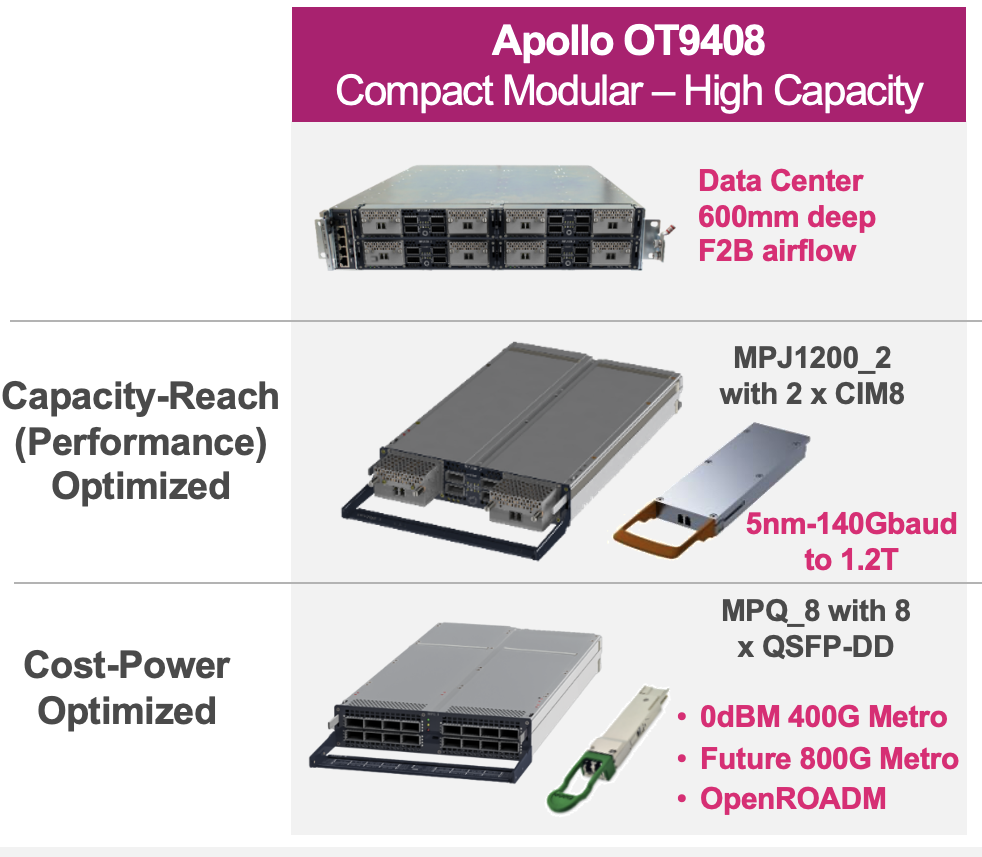
“The MPQ_8 is also designed to accept a new generation of 124Gbaud 800Gbps QSFP-DD pluggables currently in development and expected to be available in early 2025,” says Homa.
Ribbon also offers its standard telecom Apollo 9600 series platforms, from the smallest 2RU 9603 to the 5RU 9608 to the largest 15RU 9624 chassis. The Apollo 9600 modular platforms can use two CIM 8s in the TM800_2 double-slot card for performance-optimised transmission to 800 gigabits, or two CFP2-DCO modules in the TM400_2 single-card slot card for cost-optimised transmission to 400 gigabits.
Industry timing
Optical system vendors that don’t develop their own coherent DSP chips or modems, such as Ribbon, have several supply options. The leading merchant DSP suppliers include Acacia, NEL and Marvell. There are also competitor optical transport providers that source their coherent modem solutions. Ribbon discussed with several coherent modem suppliers but chose Acacia’s CIM 8 for the 9408. Ribbon has worked with Acacia for a decade.
The CIM 8’s 5nm Jannu DSP leapfrogs the 90-100GBd 7nm CMOS generation of coherent DSPs now deployed. This year, 5nm CMOS coherent DSPs have been announced by Nokia and Infinera. Merchant suppliers NEL and Marvell have also detailed their latest coherent DSPs. All these devices operate at symbol rates in the region of 130-150GBd.
Acacia also supplies the CIM 8 to other optical transport vendors such as Cisco, Acacia’s parent company, ZTE, and Adtran. Cisco has announced its Network Convergence System (NCS) 1014 compact modular platform that includes a 2.4Tbps transponder Line using the CIM 8. In March, Adtran reported sending an 800-gigabit signal over 2,200km using the CIM 8 as part of a networking trial. The route included 14 route-and-select flexible-grid ROADMs.
“It will be interesting to see the market dynamics unfold over the next year. There will be more system suppliers of 1.2 Tbps-capable wavelengths,” says Dell’Oro’s Yu. “Many system vendors will use the CIM 8, and some will use NEL’s ExaSpeed GAIA DSP. Some will also develop in-house DSPs such as Huawei and Nokia.”
Every dense wavelength division multiplexing (DWDM) system vendor will have a 1.2 Tbps-capable line card available for sale before the end of 2024, except for Ciena, says Yu: “This is because Ciena will come out with a 1.6 Tbps-capable DSP on a 3nm process node in 2024, one to two years ahead of any other vendors.”
Earlier this year, Ciena announced its WaveLogic 6, the first coherent DSP that operates at 200GBd. Ciena says it will offer its optical transport systems using its 3nm CMOS coherent DSP in the second half of 2024.
Homa believes that the next jump will be 240-plus GBd coherent DSPs, likely implemented using an even smaller 2nm CMOS process node.
The OIF’s 1600ZR 1.6-terabit coherent pluggable module standard will use a 240GBd symbol rate DSP.

OFC highlights a burgeoning coherent pluggable market

A trend evident at the OFC show earlier this month was the growing variety of coherent pluggable modules on display.
Whereas a coherent module maker would offer a product based on a coherent digital signal processor (DSP) and a basic design and then add a few minor tweaks, now the variety of modules offered reflects the growing needs of the network operators.
Acacia, part of Cisco, announced two coherent pluggable to coincide with OFC. The Bright 400ZR+ QSFP-DD pluggable form factor is based on Acacia’s existing 400ZR+ offering. It has a higher transmit power of up to 5dBm and includes a tunable filter to improve the optical signal-to-noise ratio (OSNR) performance.
Acacia’s second coherent module is the fixed wavelength 400-gigabit 400G ER1 module designed for point-to-point applications.
“I can understand it being a little bit confusing,” says Tom Williams, vice president of marketing at Acacia. “We have maybe five or six configurations of modules based on the same underlying DSP and optical technology.”
Bright 400ZR+
The Bright 400ZR+ pluggable addresses a range of network architectures using the high-density QSFP-DD form factor, says Williams.
“Before you had to use the [larger] CFP2-DCO module, now we are bringing some of the functionality into the -DD,” he says. “The Bright 400ZR+ doesn’t replace the CFP2-DCO but it does move us closer to that.” As such, the module also supports OTN framing.
The Bright 400ZR+ has a higher launch power than the optical specification of the OpenZR+ standard but supports the same protocol so it can operate with OpenZR+ compliant pluggables.
The module uses internal optical amplification to achieve the 5dB launch power. The higher launch power is designed for various architectures and ROADM configurations.
“It is not that it allows a certain greater reach so much as the module can address a wider range of applications,” says Williams. “When you talk about colourless, directionless or colourless-directionless-contentionless (CDC-) reconfigurable optical add-drop multiplexing (ROADM) architectures, these are the types of applications this opens up.”
The integrated tunable filter tackles noise. In colourless ROADM-based networks, because the optical multiplexing occurs without filtering, the broadband out-of-band noise can raise the overall noise floor. This then decreases the overall OSNR. Amplification also increases the noise floor.
The tunable filter is used to knock down the overall noise floor, thereby improving the transmit OSNR.
The output power of the Bright 400ZR+ is configurable. The 5dBm launch power is used for ROADMs with array-waveguide gratings while for colourless multiplexing the tunable filter is used, reducing the output power to just above 1dBm.
“You are seeing an anchoring of interoperability that operators can use and then you are seeing people build on top of that with enhancements that add value and expand the use cases,” says Williams.
400 gigabits over 40km
As part of the OIF industry organisation’s work that defined the 400ZR specification, a 40km point-to-point unamplified link was also included. Acacia’s 400G ER1 is such an implementation with the ‘ER’ referring to extended reach, which IEEE defines as 40km.
“At every data rate there has always been an application for these ER reaches in access and enterprise,” says Williams. “The link is just a fibre, it’s like the 10km LR specification, but this goes over 40km.”
The ER1 has been designed to reduce cost and uses a fixed laser. ”We are not doing OSNR testing, it is based on a power-limited 40km link,” says Williams.
The OIF standard uses concatenated forward-error correction (CFEC) while Acacia employs its openFEC (oFEC) that enhances the reach somewhat.
Shipment updates
Acacia also reported a significant ramp in the shipment of its pluggables that use its Greylock coherent DSP.
It has shipped over 50,000 such pluggables, 20,000 alone shipped in Cisco’s last (second) fiscal quarter. “This is being driven by the expected early adopters of 400ZR, as well as a range of other applications,” says Williams.
Acacia says it has also shipped over 100,000 Pico DSP ports. Each AC1200 multi-haul module has two such ports.
The AC1200 sends up to 1.2 terabits over two wavelengths using Acacia’s 7nm CMOS Pico DSP. The multi-haul module is being used in over 100 networks while three of the four largest hyperscalers use the technology.
Acacia also demonstrated at OFC its latest multi-haul module announced last year, a 1.2 terabits single-wavelength design that uses its latest 5nm CMOS Jannu DSP and which operates at a symbol rate of up to 140 gigabaud.
Acacia says samples of its latest multi-haul module that uses its own Coherent Interconnect Module 8 (CIM 8) form factor will be available this year while general availability will be in 2023.
Post-deadline
Williams also presented a post-deadline paper at OFC.
The work outlined was the demonstration of the optical transmission of 400 Gigabit Ethernet flows over a 927km link. The trial comprised transmission through several networks and showed the interoperability of 400-gigabit QSFP-DD and CFP2 modules.
The work involved Orange Labs, Lumentum, Neophotonics, EXFO and Acacia.