

WaveLogic 5: Packing a suitcase of ideas in 7nm CMOS
-
Ciena’s WaveLogic 5 coherent digital signal processor family comprises the Extreme and Nano chips
-
The WaveLogic 5 Extreme maximises optical capacity and transmission reach while the WaveLogic 5 Nano is targeted at compact, power-conservative applications

Kim Roberts
Advancing coherent optical transmission performance; targeting the emerging coherent pluggable market; selling modules directly, and the importance of being more vertically integrated. All these aspects were outlined by Cisco to explain why it intends to buy the coherent optical transmission specialist, Acacia Communications; a deal that is set to be completed in the spring of 2020.
But such strategic thinking is being pursued by Ciena with its next-generation WaveLogic 5 family of coherent DSPs.
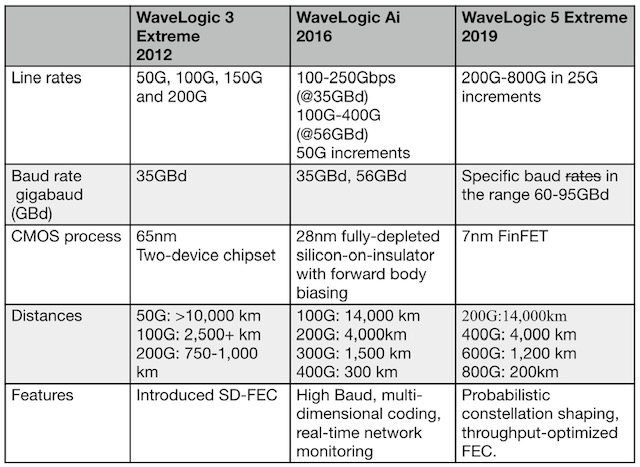
The WaveLogic 5 continues Ciena’s tradition of issuing a coherent digital signal processor (DSP) family approximately every three years: Ciena announced the WaveLogic 3 in 2012 and the WaveLogic Ai in 2016. (Add links).
The company has managed to maintain its three-yearly cadence despite the increasing sophistication of each generation of coherent DSP. For example, the WaveLogic 5 Extreme will support 800 gigabits-per-wavelength, double Ciena’s WaveLogic Ai that has been shipping for nearly two years.
Kim Roberts, vice president of WaveLogic science, says Ciena has managed to deliver its coherent DSPs in a timely manner since much of the algorithmic development work was done 5-6 years ago. The issue has been that certain features developed back then could not be included within the WaveLogic Ai.
WaveLogic 5 is implemented using a 7nm FinFET CMOS process whereas the WaveLogic Ai uses a 28nm specialist CMOS process known as fully-depleted silicon-on-insulator (FD-SOI).
“Seven-nanometer CMOS, due to its density and low heat, allows us to implement things that didn’t make the cut for the WaveLogic Ai,” says Roberts.
The company has a ‘suitcase of ideas’, he says, but not all of the concepts make it into any one generation of chip. “They have to justify performance versus schedule versus heat [generated],” says Roberts. “As we improve the technology, more features make the cut.”
And there are developments that will be included in future designs: “We keep refilling the suitcase,” says Roberts.
NAMING
Ciena first used the Extreme and Nano nomenclature with the WaveLogic 3. In contrast, the WaveLogic Ai, when launched in 2016, was a single-chip targeting the high-end. Ciena chose to change the naming scheme with the Ai since the chip signified a shift with features such as network monitoring.
However, Ciena highlights a key difference between the WaveLogic 3 and WaveLogic 5 families. The WaveLogic 3 Extreme and the WaveLogic 3 Nano could talk to each other on appropriate spans. In contrast, the two WaveLogic 5 chips are distinct. “They are not designed to interwork,” says Roberts.
NETWORKING TRENDS
Telecom service providers are investing in their networks to make them more adaptive. They want their networks to be scalable and programmable, says Ciena.
The operators also want to better understand what is happening in their networks and that requires collecting data, performing analytics and using software to configure their networks in an automated way.
“How do you get there? It is all about coherent technology,” says Helen Xenos, senior director, portfolio marketing at Ciena. “It is a critical element that is helping operators scale their networks.”
By enhancing the traffic-carrying capacity of fibre, coherent technology enables operators to reduce transport costs. “It allows them to be more competitive as they can do more with the hardware they deploy,” says Xenos.

Helen Xenos
Both telcos and cable operators are also applying coherent technology to new applications in their networks such as access.
These transport needs are causing a divergence in requirements.
One is to keep advancing optical performance in terms of the spectral efficiency and the traffic-carrying capacity of links. This is what the WaveLogic 5 Extreme tackles.
The second requirement - producing a compact coherent design for the network edge - is addressed by the WaveLogic 5 Nano.
For access designs, what is important is a compact design where the optics and the DSP can operate over an extended temperature range.
The Nano also addresses the hyperscalers’ need to connect their distributed data centres across a metro. “They need high capacity - 400 gigabits - and short-reach connectivity,” says Xenos. “It really needs to be the smallest footprint to maximise density.”
VERTICAL INTEGRATION
In addition to unveiling the WaveLogic 5 Extreme and Nano ICs, Ciena has outlined how it is more vertically integrated after investing in optics. In 2016, Ciena acquired the high-speed photonics division of Teraxion, gaining expertise in indium phosphide and silicon photonics expertise. {add link}.
Ciena is also now selling coherent optical modules. Gazettabyte revealed last year that Ciena was planning to sell modules using its own optics and WaveLogic technologies. {add link}
The company has no preference regarding indium phosphide and silicon photonics and uses what is best for a particular design.
“Silicon photonics buys you ease-of-manufacturing and cost; indium phosphide is what you need for 800 gigabits,” says Xenos.
Ciena stresses, however, that there is no simple formula as to when each is preferred. In terms of size and heat, silicon photonics has a strong advantage. “In terms of performance, you get better performance in some instances with indium phosphide and then there are overlaps because you bring in cost and other constraints,” says Roberts. “So there is no simple divide.”
“As we move forward, we are going to see an increasing percent of Ciena-custom components in WaveLogic coherent modems,” says Xenos.
Source: Gazettabyte
EXTREME
The WaveLogic 5 Extreme introduces several developments. It operates at specific baud rates ranging from 60 to 95 gigabaud. The baud rates are chosen so that both fixed-grid 100GHz channels and flexible grid ones are supported.
“For the best performance, you have flexible grid when 95 gigabaud is the primary baud rate,” says Roberts.
It is also Ciena’s first coherent DSP that uses probabilistic constellation shaping, a coding scheme used to achieve granular capacity increments. {add link}
“From 200 gigabits to 800 gigabits [in 25-gigabit increments], optimised over any path or the available margin,” says Roberts. “But what is unique about this is that it is optimised for non-linear propagation.”
Initially, the products using the WaveLogic 5 Extreme will use 50-gigabit increments. “This is what is required to service customers’ client requirements today: ten gigabits and multiples of 100-gigabit clients,” says Xenos.
>
“With 25-gigabit steps in client rate, the customer can choose to spend the margin on sending more bits”
The DSP uses four-wave frequency-division multiplexing to mitigate non-linear impairments, particularly beneficial for sub-sea systems.
Ciena says the four-wave frequency-division multiplexing is achieved electrically, reducing the optics to a minimum. “One laser and one modulator are used, so all the [cost-saving] economics of a single optical wavelength,” says Roberts. “But it has the non-linear performance of four tightly-coupled electrical systems.”
Ciena has also added an improved forward-error correction (FEC) scheme - a ‘throughput-optimised FEC’ - that uses variable overhead bits depending on the client rate.
“It will handle 8.6 percent errors compared to what we used in the WaveLogic Ai which handles 3.5 percent errors,” says Roberts. “So it is a decibel better.”
The Extreme chip also has improved link-monitoring capabilities. It monitors the signal-to-noise per channel as well as quantifies the non-linear contributions. “It helps people to understand what is happening in the network and create algorithms to optimise the capacity across the network,” says Xenos.
PROBABILISTIC CONSTELLATION SHAPING
Probabilistic shaping is used to improve the optical performance by lowering the signal energy by not using all the constellation points. Unless, that is, the full data rate is used and then all the constellation points are needed.
The degree of probabilistic shaping used is determined for each link. The parameters used to determine the probabilistic shaping are the amount of dispersion on the link, the span’s reach, and the transmitted client rate.
“The modem will measure what is going on in the link and the customer or some higher-level software will say what the client rate is,” says Roberts. “The modem will then figure out how to do the best non-linear probabilistic shaping to support that rate on the link.”
Roberts says other firms’ probabilistic shaping use one symbol at a time whereas Ciena use blocks, each comprising 128 symbols. “A bigger number would be better but I'm limited by my hardware,” says Roberts.
The 128 symbols equate to 1024 bits: four magnitude bits using 64-ary quadrature amplitude modulation (64-QAM) multiplied by two, one for each polarisation.
This means there are a total of 2^1024 combinations of 1024-bit sequences that could be sent. However, when sending a 400 Gigabit Ethernet (GbE) client signaland, for the benefit of explanation, assuming that 555 bits are needed to carry the data payload and the overhead, the number of possible bit sequences is trimmed to 2^555.
This is still a fantastically huge number but the DSP can work out which are the best 555-bit sequences to send based on them having the most tolerance to linear and non-linear interference.
“The ones that play nicely with their neighbours such that they cause the minimum non-linear degradation on the neighbouring wavelengths and on the other symbols,” explains Roberts.
Ciena is not forthcoming as to how it calculates the best sequences. “Ciena’s algorithms decide which ones are best,” says Xenos. “This is one of our key differentiators.”
The result is that, depending on the fibre type, a 1.5dB performance improvement is achieved for the non-linear characteristics.
“It allows more capacity to be chosen by the customer on that same link,” says Roberts. “With 25-gigabit steps in client rate, the customer can choose to spend the margin on sending more bits.”
Operating the Extreme at 95GBd, a reach of 4,000 km is possible at 400 gigabits and at 600 gigabits, the reach is 1,000 km (see table).
WAVELOGIC 5 NANO
The WaveLogic Nano supports 100-gigabit to 400-gigabit wavelengths and is aimed at applications that need compact designs that generate the least heat.
One application is to enable cable operators to move optics closer to the user and that must operate over an extended temperature range. Here, a packet platform is used that will support line interworking as equipment from different vendors may be at each end of the link.
Another requirement is operating over multiple spans in a metro. Here, compact equipment and low power are more important than spectral efficiency but it is still a challenging environment, says Ciena. Hundreds of nodes may be talking to each other and there may be cascaded reconfigurable optical add-drop multiplexers (ROADMs) with different fibre types making up the network.
A third application is single-span data centre interconnect where achieving the highest density on routers is key. This is the application the 400-gigabit, at least 80km 400ZR specification developed by the Open Internetworking Forum will address.
“The design that we are doing for the WaveLogic 5 Nano for 400ZR is to fit into a QSFP-DD,” says Xenos. “If there is a need for an OSFP [pluggable module], we will offer OSFP.”
Ciena also expects to offer a Nano-based CFP2-DCO module, which will outperform the ZR in terms of reach and features, for more demanding metro applications.
Another new segment requiring coherent optics is 4G and 5G access. “It is to be determined what type of platform is the winning solution in this environment,” says Xenos.
MAKING MODULES
Ciena first made its coherent DSP available to third parties in 2017 when it signed an agreement with Lumentum, NeoPhotonics and at the time Oclaro (since acquired by Lumentum) to use its WaveLogic Ai in their modules.
Now Ciena is selling directly the full coherent modem: the DSP and the optics. This is why Ciena created its Optical Microsystems unit in late 2017.
CMOS PROCESS
Moving to a 7nm FinFET CMOS process delivers several benefits.
It generates much lower heat than the WaveLogic Ai’s 28nm FD-SOI process. It also has a lower quiescent current, the current dissipated independent of whether the chip’s logic is active or not. And 7nm CMOS delivers much greater circuit density: the functionality that can be crammed into a square micrometre of silicon.
“So, a low power [consumption] on features you are not using, and we can include features that if you can't afford the heat, you can turn them off,” says Roberts.
It will offer its Nano in the form of pluggable modules, the WaveLogic Ai as a 5x7-inch module, and the WaveLogic 5 Extreme in another module form factor that will have its own interface. “These would all be viable optics,” says Xenos.
Availability
The first Wave Logic 5 Nano products will appear in the second half of this year while the first Extreme-based products will be available at the end of this year. The 400ZR coherent pluggable module is expected to be available in the first half of 2020.


Books in 2018 - Part 3
More books read in 2018, as recommended by Steve Alexander and Yves LeMaitre.
Steve Alexander, senior vice president and CTO, Ciena
I was standing in line at a Starbucks and was chatting with another person who asked what all these engineers were doing talking about networks of submarines. In fact, it was a nearby conference on submarine cables. The person said: “I thought that’s what satellites were for”.
I wanted to find a book I could point people to who think that satellites carry most of the international traffic when, in fact, it is the fibre-optic submarine cables that carry the vast majority of the world’s communications. I came up with The Undersea Network by Nicole Starosielski.
Our industry does such a good job at this that most people don’t even know such networks exist. It is like air; it is there and it works.
My youngest son read The Martian by Andy Weir after seeing the movie and he thought it was pretty good. I’ve always been a Sci-Fi fan but haven’t read much lately so it was nice to get back into it.
Yves LeMaitre, chief strategy officer at Lumentum
I am afraid I am guilty of spending far too much time streaming shows and sports to my laptop. The good thing is my TV stays off. However, I did manage to read several books this year. The three I would highlight - all non-fiction - have a focus on US history.
The first, Destiny of the Republic: A Tale of Madness, Medicine and the Murder of a President by Candice Millard, is about the presidency and assassination of James Garfield intertwined with several of the scientific inventions of the times.
Another title by Candice Millard that I recommend is The River of Doubt: Theodore Roosevelt’s Darkest Journey that details his exploration of the Amazon.
My third recommendation, The Devil in the White City: A Saga of Magic and Murder at the Fair that Changed America by Erik Larson, tells the story of the Chicago’s World Fair of 1893 combined with a serial killer story.
Reading about what are still relatively recent events highlights how much the world has changed in the last century while people’s aspirations and desires have not.
The life stories and achievements of Theodore Roosevelt, James Garfield and Daniel Burnham, the architect of the Chicago World’s Fair, should challenge us to expect more from our leadership, whether in the political, business or social arenas. We have become complacent in accepting mediocrity and lowering our standards.
Reading these stories should remind us that true leadership exists and is a rare quality that should be appreciated and recognised.
Acacia eyes pluggables as it demos its AC1200 module
The emerging market opportunity for pluggable coherent modules is causing companies to change their strategies.
Ciena is developing and plans to sell its own coherent modules. And now Acacia Communications, the coherent technology specialist, says it is considering changing its near-term coherent digital signal processor (DSP) roadmap to focus on coherent pluggables for data centre interconnect and metro applications.

Source: Gazettabyte
DSP roadmap
Acacia’s coherent DSP roadmap in recent years has alternated between an ASIC for low-power, shorter-reach applications followed by a DSP to address more demanding, long-haul applications.
In 2014, Acacia announced its Sky 100-gigabit DSP for metro applications that was followed in 2015 by its Denali dual-core DSP that powers its 400-gigabit AC-400 5x7-inch module. Then, in 2016, Acacia unveiled its low-power Meru, used within its pluggable CFP2-DCO modules. The high-end 1.2-terabit dual-core Pico DSP used for Acacia’s board-mounted AC1200 coherent module was unveiled in 2017.
“The 400ZR is our next focus,” says Tom Williams, senior director of marketing at Acacia.
The 400ZR standard, promoted by the large internet content providers, is being developed to link switches in separate data centres up to 80km apart. Acacia’s subsequent coherent DSP that follows the 400ZR may also target pluggable applications such as 400-gigabit CFP2-DCO modules that will span metro and metro-regional distances.
“There is a trend to pluggable, not just the 400ZR but the CFP2-DCO [400-gigabit] for metro,” says Williams. “We are still evaluating whether that causes a shift in our overall cadence and DSP development.”
AC1200 trials
Meanwhile, Acacia has announced the results of two transatlantic trials involving its AC1200 module whose production is now ramping.
>
“There is a trend to pluggable, not just the 400ZR but the CFP2-DCO [400-gigabit] for metro”
In the first trial, Acacia, working with ADVA, transmitted a 300-gigabit signal over a 6,800km submarine cable. The 300-gigabit wavelength occupied a 70GHz channel and used ADVA’s Teraflex technology, part of ADVA’s FSP 3000 CloudConnect platform. Teraflex is a one-rack-unit (1RU) stackable chassis that supports three hot-pluggable 1.2-terabit sleds, each sled incorporating an Acacia AC1200 module.
In a separate trial, the AC1200 was used to send a 400-gigabit signal over 6,600km using the Marea submarine cable. Marea is a joint project between Microsoft, Facebook and Telxius that links the US and Spain. The cable is designed for performance and uses an open line system, says Williams: “It is not tailored to a particular company’s [transport] solution”.
The AC1200 module - 40 percent smaller than the 5x7-inch AC400 module - uses Acacia’s patented Fractional QAM (quadrature amplitude modulation) technology. The technology uses probabilistic constellation shaping that allows for non-integer constellations. “Instead of 3 or 4 bits-per-symbol, you can have 3.56 bits-per-symbol,” says Williams.
Acacia’s Fractional QAM also uses an adaptive baud rate. For the trial, the 400-gigabit wavelength was sent using the maximum baud rate of just under 70 gigabaud. Using the baud rate to the full allows a lower constellation to be used for the 400-gigabit wavelength thereby achieving the best optical signal-to-noise ratio (OSNR) and hence reach.
In a second demonstration using the Marea cable, Acacia demonstrated a smaller-width channel in order to maximise the overall capacity sent down the fibre. Here, a lower baud rate/ higher constellation combination was used to achieve a spectral efficiency of 6.41 bits-per-second-per-Hertz (b/s/Hz). “If you built out all the channels [on the fibre], you achieve of the order of 27 terabits,” says Williams.
Pluggable coherent
The 400ZR will be implemented using the same OSFP and QSFP-DD pluggable modules used for 400-gigabit client-side interfaces. This is why an advanced 7nm CMOS process is needed to implement the 400ZR DSP so that its power consumption will be sufficiently low to meet the modules’ power envelopes when integrated with Acacia’s silicon-photonics optics.
There is also industry talk of a ZR+, a pluggable module with a reach exceeding80km. “At ECOC, there was more talk about the ZR+,” says Williams. “We will see if it becomes standardised or just additional proprietary performance.”
Another development is the 400-gigabit CFP2-DCO. At present, the CFP2-DCO delivers up to 200-gigabitwavelengths but the standard, as defined by the Optical Internetworking Forum (OIF), also supports 400 gigabits.
Williams says that there a greater urgency to develop the 400ZR than the 400-gigabit CFP2-DCO. “People would like to ramp the ZR pretty close to the timing of the 400-gigabit client-side interfaces,” says Williams. And that is likely to be from mid-2019.
In contrast, the 400-gigabit CFP2-DCO pluggable while wanted by carriers for metro applications, is not locked to any other infrastructure build-out, says Williams.

Ciena to sell its own coherent modules
The systems vendor is expanding its offerings to include WaveLogic modem chips and coherent optical modules.
Ciena is developing its own coherent modules to sell to the telecom and datacom markets.
The system vendor has set up the Optical Microsystems Division business unit to promote its WaveLogic coherent modem technology to the marketplace. Until now it has licensed its WaveLogic Ai digital signal processor (DSP) to module makers Lumentum, NeoPhotonics and Oclaro. But now it is planning to sell its own coherent modules.
In a job advert for a head of sales channel development, Ciena says the Optical Microsystems Division's goal is ‘to develop and productize electro-optic components and modules for sale to global systems integrator customers to be incorporated in their products for sale to telecom and data network customers’.
And at the recent European Conference on Optical Communication (ECOC) held in Rome, a network equipment manufacturer said it was approached by Ciena enquiring if it was interested in buying coherent modules from the company.
Ciena would not comment when asked if it will sell its own coherent modules. Instead, the company pointed to statements it made during its fourth quarter 2017 earnings call that outlined the creation of the Optical Microsystems Division with the stated goal of generating $50 million annual revenues by year-end 2020.
[At ECOC], a network equipment manufacturer said it was approached by Ciena enquiring if it was interested in buying coherent modules from the company
Optical Microsystems Division
Until Ciena announced in early 2017 the licensing of its 400-gigabit WaveLogic Ai to Lumentum, NeoPhotonics and Oclaro, systems vendors kept their coherent DSPs in-house. And with good reason. These are the chips that power their leading optical platforms and enable product differentiation.
Ciena’s announcement at the time showed a willingness to pursue a different business model. By licensing its DSP to optical module makers, Ciena could break into important new markets such as China even though the move would benefit its competitors using its advanced DSP for their platforms.
But the market has changed since Ciena made the announcement and now the company is deciding how best to proceed, says Mike Genovese, managing director and senior equity research analyst at MKM Partners.
“At the time of the announcement it seemed there was a big opportunity selling the [coherent] modem into Chinese OEMs,” says Genovese. “But that seems less likely now because Chinese OEMs want to assemble their own modules out of components they buy and make.”
The result is that the opportunity has shifted to data centre interconnect. “But there are decisions that need to be made,” says Genovese. “For example, does Ciena want to make its modem product a [pluggable] 400ZR solution?”
It is a view shared by Sterling Perrin, principal analyst, optical networking and transport at Heavy Reading.
“It [the licensing of its DSP] was originally built around breaking into the China market. That strategy now looks must riskier than it did originally, so I’m certain they are looking at every alternative,” says Perrin. ”The main goal is to get the most return-on-investment on the money they put into building a WaveLogic generation, and using that money to fund the next generation of DSP investment.”
At the time of the announcement it seemed there was a big opportunity selling the [coherent] modem into Chinese OEMs. But that seems less likely now.
Pluggables are going to become an important opportunity for coherent technology, says Andrew Schmitt, founder and directing analyst at Cignal AI. Schmitt says the next stage of coherent’s development - what he calls the fourth generation of coherent - will be pluggable from the start and more standards-based than any wavelength-division multiplexing (WDM) pluggable that has preceded it.
“It will address a large portion of the overall market - not just cloud operator data centreinterconnect,” says Schmitt. “Equipment vendors will need to adjust their strategies as many standalone optical hardware applications will be displaced by pluggable coherent.”
Ciena also has all the required technologies. As well as its WaveLogic modem technology, it has high-speed optical component expertise that it gained with the 2016 acquisition of Teraxion’s photonics division. The Teraxion group had indium phosphide and silicon photonics technologies.
All change
The agreement between Ciena and the three optical module makers also included an option where future WaveLogic DSPs would be made available to the three for applications such as 400-gigabit pluggables.
NeoPhotonics says that Ciena’s general strategy of bringing its WaveLogic Ai technology to a larger market and application space has not changed.
Equipment vendors will need to adjust their strategies as many standalone optical hardware applications will be displaced by pluggable coherent
Is Ciena going straight to market with future WaveLogic-based modules?
“How the modules are marketed may follow different models in the future; there is always an evolution in business models as the market shifts,” says Ferris Lipscomb, NeoPhotonics’ vice president of marketing. “Our intention is to continue to be a partner and bring value to the Ciena Microsystems business wherever possible.”
Lumentum would not comment on what the status was regarding using future coherent DSPs, nor would it say whether Ciena is to sell its own modules. Lumentum did say that it has a close relationship with Ciena and that it continues to support partnership opportunities.
But the possibility of Ciena selling modules to the marketplace is not ruled out by Ciena’s third optical module partner, Oclaro.
Yves LeMaitre, chief strategy officer at Oclaro says that Ciena’s recent announcements could point to a new strategic direction. “At this point, it is unclear how they are going to do this,” he says. Oclaro also does not know yet if it will gain access to new WaveLogic designs.
LeMaitre views the options with Ciena’s coherent technology as part of a broader debate as to how systems vendors should adapt their business models in an environment of change brought about by software-defined networks and open design frameworks.
The fact that internet content providers purchase optics directly, as do certain service providers, creates a dilemma for the systems vendors. “How are they going to go to the market to address this?” says LeMaitre. “Are they going to rely on a partnership with module makers or are they going to address the market on their own?”
Oclaro says it remains ‘very interested’ in working with Ciena if it is willing to give the module maker access to future DSP designs for pluggables.
Ciena picks ONAP’s policy code to enhance Blue Planet
Operators want to use automation to help tackle the growing complexity and cost of operating their networks.
 Kevin Wade“Policy plays a key role in this goal by enabling the creation and administration of rules that automatically modify the network’s behaviour,” says Kevin Wade, senior director of solutions, Ciena’s Blue Planet.
Incorporating ONAP code to enhance Blue Planet’s policy engine also advances Ciena’s own vision of the adaptive network.
Automation platforms
ONAP and Ciena’s Blue Planet are examples of network automation platforms.
ONAP is an open software initiative created by merging a large portion of AT&T’s original Enhanced Control, Orchestration, Management and Policy (ECOMP) software developed to power its own software-defined network and the OPEN-Orchestrator (OPEN-O) project, set up by several companies including China Mobile, China Telecom and Huawei.
ONAP’s goal is to become the default automation platform for service providers as they move to a software-driven network using such technologies as network functions virtualisation (NFV) and software-defined networking (SDN).
Blue Planet is Ciena’s own open automation platform for SDN and NFV-based networks. The platform can be used to manage Ciena’s own platforms and has open interfaces to manage software-defined networks and third-party equipment.
Ciena gained the Blue Planet platform with the acquisition of Cyan in 2015. Since then Ciena has added two main elements.
One is the Manage, Control and Plan (MCP) component that oversees Ciena's own telecom equipment. Ciena’s Liquid Spectrum that adds intelligence to its optical layer is part of MCP.
The second platform component added is analytics software to collect and process telemetry data to detect trends and patterns in the network to enable optimisation.
“We have 20-plus [Blue Planet] customers primarily on the orchestration side,” says Wade. These include Windstream, Centurylink and Dark Fibre Africa of South Africa. Out of these 20 or so customers, one fifth do not use Ciena’s equipment in their networks. One such operator is Orange, another Blue Planet user Ciena has named.
A further five service providers are trialing an upgraded version of MCP, says Wade, while two operators are using Blue Planet’s analytics software.
In a closed-loop automation process, the policy subsystem guides the orchestration or the SDN controller, or both, to take actions
Policy
Ciena has been a member of the ONAP open source initiative for one year. By integrating ONAP’s policy components into Blue Planet, the platform will support more advanced closed-loop network automation use cases, enabling smarter adaptation.
“In a closed-loop automation process, the policy subsystem guides the orchestration or the SDN controller, or both, to take actions,” says Wade. Such actions include scaling capacity, restoring the network following failure, and automatic placement of a virtual network function to meet changing service requirements.
In return for using the code, Ciena will contribute bug fixes back to the open source venture and will continue the development of the policy engine.
The enhanced policy subsystem’s functionalities will be incorporated over several Blue Planet releases, with the first release being made available later this year. “Support for the ONAP virtual network function descriptors and packaging specifications are available now,” says Wade.
The adaptive network
Software control and automation, in which policy plays an important role, is one key component of Ciena's envisaged adaptive network.
A second component is network analytics and intelligence. Here, real-time data collected from the network is fed to intelligent systems to uncover the required network actions.
The final element needed for an adaptive network is a programmable infrastructure. This enables network tuning in response to changing demands.
What operators want, says Wade, is automation, guided by analytics and intent-based policies, to scale, configure, and optimise the network based on a continual reading to detect changing demands.
Verizon, Ciena and Juniper trial 400 Gigabit Ethernet
Verizon has sent a 400 Gigabit Ethernet signal over its network, carried using a 400-gigabit optical wavelength.
The trial’s goal was to demonstrate multi-vendor interoperability and in particular the interoperability of standardised 400 Gigabit Ethernet (GbE) client signals.
 Glenn Wellbrock“[400GbE] Interoperability with the client side has been the long pole in the tent - and continues to be,” says Glenn Wellbrock, director, optical transport network - architecture, design and planning at Verizon. “This was trial equipment, not generally-available equipment.”
It is only the emergence of standardised modules - in this case, an IEEE 400GbE client-side interface specification - that allows multi-vendor interoperability, he says.
By trialing a 400-gigabit lightpath, Verizon also demonstrated the working of a dense wavelength-division multiplexing (DWDM) flexible grid, and a baud rate nearly double the 32-35Gbaud in wide use for 100-gigabit and 200-gigabit wavelengths.
“It shows we can take advantage of the entire system; we don’t have to stick to 50GHz channel spacing anymore,” says Wellbrock.
[400GbE] Interoperability with the client side has been the long pole in the tent - and continues to be
Trial set-up
The trial used Juniper Networks’ PTX5000 packet transport router and Ciena’s 6500 packet-optical platform, equipment already deployed in Verizon’s network.
The Verizon demonstration was not testing optical transmission reach. Indeed the equipment was located in two buildings in Richardson, within the Dallas area. Testing the reach of 400-gigabit wavelengths will come in future trials, says Wellbrock.
The PTX5000 core router has a traffic capacity of up to 24 terabits and supports 10-gigabit, 40-gigabit and 100-gigabit client-side interfaces as well as 100-gigabit coherent interfaces for IP-over-DWDM applications. The PTX5000 uses a mother card on which sits one or more daughter cards hosting the interfaces, what Juniper calls a flexible PIC concentrator (FPC) and physical interface cards (PICs), respectively.
Juniper created a PIC with a 400GbE CFP8 pluggable module implementing the IEEE’s 10km 400GBASE-LR8 standard.
“For us, it was simply creating a demo 400-gigabit pluggable line card to go into the line card Verizon has already deployed,” says Donyel Jones-Williams, director of product marketing management at Juniper Networks.
 Donyel Jones-WilliamsThe CFP8 400GbE interface connected the router to Ciena’s 6500 packet-optical platform.
Ciena also used demonstration hardware developed for 400-gigabit trials. “We expect to develop other hardware for general deployment,” says Helen Xenos, senior director, portfolio marketing at Ciena. “We are looking at smaller form-factor pluggables to carry 400 Gigabit Ethernet.”
400-gigabit deployments and trials
Ciena started shipping its WaveLogic Ai coherent modem that implements 400-gigabit wavelengths in the third quarter of 2017. Since then, the company has announced several 400-gigabit deployments and trials.
Vodafone New Zealand deployed 400 gigabits in its national transport network last September, a world first, claims Ciena. German cable operator, Unitymedia, has also deployed Ciena’s WaveLogic Ai coherent modem to deliver a flexible grid and 400-gigabit wavelengths to support growing content delivered via its data centres. And JISC, which runs the UK’s national research and education network, has deployed the 6500 platform and is using 400-gigabit wavelengths.
 Helen Xenos
Last September, AT&T conducted its own 400-gigabit trial with Ciena. With AT&T’s trial, the 400-gigabit signal was generated using a test bed. “An SDN controller was used to provision the circuit and the [400-gigabit] signal traversed an OpenROADM line system,” says Xenos.
Using the WaveLogic Ai coherent modem and its support for a 56Gbaud rate means that tunable capacity can now be doubled across applications, says Xenos. The wavelength capacity used for long-haul distances can now be 200 gigabits instead of 100 gigabits, while metro-regional networks spanning 1,000km can use 300-gigabit wavelengths. Meanwhile, 400-gigabit lightpaths suit distances of several hundred kilometres.
It is the large data centre operators that are driving the majority of 400 gigabit deployments, says Ciena. The reason the 400-gigabit announcements relate to telecom operators is because the data centre players have not gone public with their deployments, says Xenos.
Juniper Networks’ PTX5000 core router with 400GbE interfaces will primarily be used by the telecom operators. “We are in trials with other providers on 400 gigabits,” says Jones-Williams. “Nothing is public as yet.”
Has coherent optical transmission run its course?
Feature: Coherent's future
Three optical systems vendors share their thoughts about coherent technology and the scope for further improvement as they look two generations ahead to symbol rates approaching 100 gigabaud
Optical transmission using coherent detection has made huge strides in the last decade. The latest coherent technology with transmitter-based digital signal processing delivers 25x the capacity-reach of 10-gigabit wavelengths using direct-detection, according to Infinera.
Since early 2016, the optical systems vendors Infinera, Ciena and Nokia have all announced new coherent digital signal processor (DSP) designs. Each new generation of coherent DSP improves the capacity that can be transmitted over an optical link. But given the effectiveness of the latest coherent systems, has most of the benefits already been achieved?
 Source: Infinera
“It is getting harder and harder,” admits Kim Roberts, vice president, WaveLogic science at Ciena. “Unlike 10 years ago, there are no factors of 10 available for improvement.”
Non-linear Shannon limit
It is the non-linear Shannon limit that defines how much information can be sent across a fibre, a function of the optical signal-to-noise ratio.
 Kim Roberts of CienaThe limit is based on the work of famed mathematician and information theorist, Claude Shannon. Shannon's work was based on a linear communication channel with added Gaussian noise. Optical transport over a fibre is a more complex channel but the same Shannon bound applies, although assumptions for the non-linearities in the fibre must be made.
Roberts stresses that despite much work, the industry still hasn't figured out just what the upper limit is over a fibre for a given optical signal-to-noise ratio.
It is getting harder and harder. Unlike 10 years ago, there are no factors of 10 available for improvement.
"There are papers that show that with this method and this method, you can do this much," says Roberts. "And there are other papers that show that as the power goes up, there is no theoretical limit until you melt the fibre."
These are theoretical things, he says, but the key is that the headroom available remains unknown. What is known is that the theoretical limit remains well ahead of practical systems. Accordingly, systems performance can be improved using a combination of techniques and protocols coupled with advances in electro-optics.
Design goals
A key goal when designing a new optical transmission system is to increase the data sent for a given cost i.e. decrease the cost-per-bit. This is an ongoing requirement as the service providers contend with ever growing network traffic.
Another challenge facing engineers is meeting the demanding power, density and thermal constraints of their next-generation optical transport system designs.
One way to reduce the cost-per-bit is to up the symbol rate to increase the data sent over a wavelength. Traditional 100-gigabit and 200-gigabit dense wavelength-division multiplexing (DWDM) systems use 32-35 gigabaud (GBaud). The latest coherent DSPs already support more than one baud rate: Nokia’s PSE-2s coherent DSP supports 33Gbaud or 45Gbaud while Ciena’s WaveLogic Ai chipset supports 35Gbaud or 56Gbaud.
Having a choice of baud rates coupled with the various modulation scheme options means the same number of bits can be sent over a range of optical reaches. The more complex the modulation scheme, the closer the points are in a constellation and the harder it is to correctly detect the data at the receiver in the presence of noise. Accordingly, using the combination of a simpler modulation scheme and a higher baud rate allows the same data to be sent further.
Capacity-reach is what matters: how much capacity you can extract for a given reach
Nokia's 1.4-billion transistor PSE-2s supports two 200 gigabit-per-second (Gbps) formats: polarisation-multiplexing, 16-ary quadrature amplitude modulation (PM-16QAM) at 33Gbaud, or using PM-8QAM at 45Gbaud. The 200-gigabit wavelength has an optical reach of some 800km using 16-QAM at 33Gbaud but this rises to 1,600km when PM-8QAM at 45Gbaud is used. Alternatively, using 45Gbaud and PM-16QAM, more data can be sent: 250 gigabits-per-wavelength over 800km.
 Nokia's Randy EisenachCoherent systems designers are not stopping there. “The next higher baud rate the industry is targeting is 61-68 Gbaud,” says Randy Eisenach, senior product marketing manager, optical networks at Nokia.
Operating at the higher gigabaud range - Infinera talks of 65-70Gbaud - a single transmitter-receiver pair sends twice the amount of data of traditional 32-35Gbaud systems using the same modulation format. But the higher-baud rates require the electro-optics to operate twice as fast. The analogue-to-digital and digital-to-analogue converters of the coherent DSP must sample at twice the baud rate - at least 130 billion samples-per-second. A 65-70Gbaud rate also requires silicon implemented using a more advanced and expensive CMOS process mode - 16nm instead of 28nm. In turn, the optical modulator and drivers need to work well at these higher rates.
“The optical networking industry is well on its way to solving these engineering and component issues in the next year or so,” says Eisenach.
The capacity-per-wavelength also goes up with baud rate. For shorter reach links, 400-600 gigabits-per-wavelength are possible at 65-70Gbaud and, according to Pravin Mahajan, Infinera’s director of product and corporate marketing, power consumption in terms of watts-per-gigabit will improve by some 2.5x.
 Pravin Mahajan of InfineraAnd the system vendors are not stopping there: the next baud rate hike after 65-70Gbaud will be in the region of 80-100 Gbaud. The coherent DSPs that will support such data rates will need to be implemented using 7nm CMOS process (see table).
“Capacity-reach is what matters: how much capacity you can extract for a given reach,” says Mahajan. “These successive generations [of faster baud rates] all keep moving that curve upwards.”
DSP features
In addition to the particular baud rates chosen by the vendors for their DSP designs, each includes unique features.
Instead of modulating the data onto a single carrier, Infinera’s FlexCoherent DSP uses multiple Nyquist sub-carriers spread across a channel. The number of subs-carriers varies depending on the link. The benefit of the approach, says Infinera, is that it allows a lowering of the baud rate used which increases the tolerance to non-linear channel impairments experienced during optical transmission.
The FlexCoherent DSP also supports enhanced soft-decision forward-error correction (SD-FEC) including the processing of two channels that need not be contiguous. This is possible as the FlexCoherent DSP is dual-channel which particularly benefits long-haul and subsea applications, claims Infinera. By pairing two channels, the FEC codes can be shared. Pairing a strong channel with a weak one and sharing the codes allows some of the strength of the strong signal to be used to bolster the weaker one, extending its reach or even allowing a more advanced modulation scheme to be used.
Infinera has just announced that by using Nyquist sub-carriers and the FEC gain sharing technologies, its customer, Seaborn Networks, is able delivering 11.8 terabits of capacity over a 10,600km submarine link.
Nokia’s PSE-2s DSP has sufficient processing performance to support two coherent channels. Each channel can implement a different modulation format if desired, or the two can be tightly coupled to form a super-channel. Using 45Gbaud and PM-16QAM, two 250-gigabit channels can be implemented to enable a 500-gigabit muxponder card. The PSE-2s can also implement 400-gigabit wavelength but that is the only format where only one channel can be supported by the PSE-2s.
Ciena’s WaveLogic Ai, meanwhile, uses advanced coding schemes such that it no longer mentions particular modulation schemes but rather a range of line rates in 50-gigabit increments.
Coding schemes with names such as set-partition QPSK, matrix-enhanced PM-BPSK, and 8D-2QAM, have already started to appear in the vendors’ coherent DSPs.
“Vendors use a lot of different terms essentially for the same thing: applying some type of coding to symbols to improve performance,” says Eisenach.
There are two main coding approaches: constellation shaping, also known as probabilistic shaping, and multi-dimensional coding. Combining the two - probabilistic shaping and multi-dimensional coding - promises enhanced performance in the presence of linear and non-linear transmission impairments. These are now detailed.
Probabilistic shaping
The four constellation points of QPSK modulation are equidistant from the origin. With more advanced modulation schemes such as 16-QAM, the constellation points differ in their distance from the origin and hence have different energies. Points in the corners of the constellation, furthest from the origin, have the most energy since a point’s power is the square of the distance from the origin.
 Here the origin is at the centre of the square 64-QAM constellation. With probabilistic shaping, more of the points closer to the origin are chosen with the resulting data rate going down. Source: Nokia
Probabilistic shaping uses the inner constellation points more than the outer points, thereby reducing the overall average energy and this improves the signal-to-noise ratio. To understand why, Ciena points out that the symbol error rate at the receiver is dominated by the distance between neighbouring points of the constellation. Reduced the average energy still keeps the distance between the points the same, but when gain is applied to restore the signal’s power levels, the effect is to increase the distance between points. “It means we have better separation between the points, we’ve expanded everything,” says Roberts.
Using probabilistic shaping delivers a maximum 1.53dB of improvement in a linear transmission channel. “That is the theoretical limit,” says Roberts. “In a non-linear world, we get a greater benefit from shaping beyond just shaping the noise.”
Probabilistic shaping also has another benefit: it allows the number of bits sent per symbol to be defined.
Using standard modulation schemes such as 64-QAM with no constellation shaping, 6 bits-per-symbol are sent. Using shaping and being selective in what points are used, fewer bits are sent and they don’t need to be integer values. “I can send 5.7, 5.6, 5.3, even 5.14 bits-per symbol,” says Roberts. “Until I get to 5 bits, and then I have a choice: do I use more shaping or do I start with 32-QAM, which is 5 bits-per-symbol.”
 Technology A shows today's coherent DSPs: operating at 30-35Gbaud and delivering 100, 150 and 200Gbps capacities per wavelength. Technology B is Ciena's WaveLogic A. Operating at 56Gbaud, it delivers up to 400Gbps per wavelength in 50Gbps. Technology C will continue this trend. Operating around 70Gbaud, up to 600Gbps per wavelength will be possible in even finer speed increments of 25Gbps. Is this Ciena's next WaveLogic? Source: Ciena
This is very useful as it allows fine control of the data sent such that operators can squeeze just enough data to suit the margins available on a particular fibre link. “You don't have to choose between 100-gigabit and 200-gigabit wavelengths,” says Roberts. "You can use smaller jumps and that sometimes means sending more capacity.”
Three things are needed to fine-tune a link in this way. One is a coherent DSP that can deliver such variable increments on a wavelength using probabilistic shaping. Also needed is a flexible client signalling scheme such as the OIF’s Flexible Ethernet (FlexE) protocol, a protocol mechanism to vary the Ethernet payload for transmission. Lastly, intelligent networking software is required to determine what is happening in the network and the margins available to assess how much data can be squeezed down a link.
Ciena says it has not implemented probabilistic shaping in its latest WaveLogic Ai coherent DSP. But given the Ai will be a family of devices, the technique will feature in upcoming coherent DSPs.
Nokia published a paper at the OFC event held earlier this year showing the use of probabilistic shaping over a transatlantic link. Using probabilistic-shaped 64-QAM (PS-64QAM), a spectral efficiency of 7.46b/s/Hz was achieved over the 5,523km link. This equates to 32 terabits of capacity over the fibre, more than 2.5x the 12 terabits of the existing DWDM system that uses 100Gbps PM-QPSK.
Advanced coding
Multi-dimensional coding is another technique used to improve optical transmission. A 16-QAM constellation is a two-dimensional (2D) representation in one polarisation, says Roberts. But if both polarisations of light are considered as one signal then it becomes a 4D, 256-point (16x16) symbol. This can be further extended by including the symbols in adjacent time slots. This forms an 8D representation.
Non-linear compensation has been an interesting research topic. Nokia continues to investigate the topic and implementation methods but the benefits appear small for most real-world applications
The main two benefits of multi-dimensional coding are better noise performance and significantly better performance in the presence of non-linear impairments.
Nokia’s PSE-2s uses coding for its set-partition QPSK (SP-QPSK). Standard PM-QPSK uses amplitude and phase modulation, resulting in a 4-point constellation. With SP-QPSK, only three of the four constellation points are used for each symbol. A third fewer constellation points means less data is transported but the benefit of SP-QPSK is extended reach due to the greater Euclidean distance between the symbol points created by carefully mapping the sequence of symbols. This results in 2.5dB of extra gain compared to PM-QPSK, for a reach beyond 5,000km.
Using the PSE-2’s 45Gbaud symbol rate, the fewer constellation points of SP-QPSK can be compensated for to achieve the same overall 100Gbps capacity as PM-QPSK at 33Gbaud.
Infinera’s FlexCoherent uses what it calls matrix-enhanced PM-BPSK, a form of averaging that adds 1dB of gain. “Any innovation that adds gain to a link, the margin that you give to operators, is always welcome,” says Mahajan.
Ciena’s WaveLogic 3 Extreme coherent DSP supports the multi-dimension coding scheme 8D-2QAM to improve reach or capacity of long-reach spans.
Such techniques mean vendors have a wealth of available choices available. It is also why Ciena has stopped referring to modulation schemes and talks about its WaveLogic Ai at 35Gbaud supporting 100-250Gbps data rates in 50-gigabit increments while at 56Gbaud, the WaveLogic Ai delivers 100-400Gbps optical channels in 50-gigabit steps.
Probabilistic shaping and multi-dimensional coding are distinct techniques but combining the two means the shaping can be done across dimensions.
Design engineers thus have various techniques to keep improving performance and there are other directions too.
Forward-error correction is about 2dB from the theoretical limit and with improved design Ciena’s Roberts expects 1dB can be reclaimed.
In turn, signal processing techniques could be applied at the transmitter to compensate for expected non-linear effects. “Non-linear compensation has been an interesting research topic,” says Eisenach. “Nokia continues to investigate the topic and implementation methods but the benefits appear small for most real-world applications.”
So is there much scope for further overall improvement?
“There is still a lot more juice left," says Mahajan.
“It [coherent transmission improvement] is getting harder and harder,” adds Roberts. “It is taking more mathematics and more and more CMOS gates, but Moore’s law is providing lots of CMOS gates.”
This is an updated and extended version of an article that first appeared in Optical Connections magazine earlier this year.
Real-time visibility makes optical networking smarter
Systems vendors are making optical networks smarter. Their latest equipment, combining intelligent silicon and software, can measure the status of the network and enable dynamic network management.
Ciena recently announced its Liquid Spectrum networking product while Infinera has launched its Instant Network. Both vendors exploit the capabilities of their latest generation coherent DSPs to allow greater network automation and efficiency. The vendors even talk about their products being an important step towards autonomous or cognitive networks.
"Operators need to do things more efficiently," says Helen Xenos, director, portfolio solutions marketing at Ciena. "There is a lot of unpredictability in how traffic needs to be connected over the network." Moreover, demands on the network are set to increase with 5G and the billions of devices to be connected with the advent of Internet of Things.
Existing optical networks are designed to meet worse-case conditions. Margins are built into links based on the fibre used and assumptions are made about the equipment's end-of-life performance and the traffic to be carried. Now, with Ciena's latest WaveLogic Ai coherent DSP-ASIC, not only is the performance of the network measured but the coherent DSP can be used to exploit the network's state rather than use the worse-case end-of-life conditions. "With Liquid Spectrum, you now don't need to operate the network in a static mode," says Xenos.
We are at the beginning of this new world of operating networks
Software applications
Ciena has announced the first four software applications as part of Liquid Spectrum. The first, Performance Meter, uses measured signal-to-noise ratio data from the coherent DSP-ASICs to gauge the network's state to determine how efficiently the network is operating.
Bandwidth Optimiser acts on the network planner's request for bandwidth. The app recommends the optimum capacity that can be run on the link, based on exploiting baud rate and the reach, and also where to place the wavelengths within the C-band spectrum. Moreover, if service demands change, the network engineer can decide to reduce the built-in margins. "I may decide I don't need to reserve a 3dB margin right now and drop it down to 1dB," says Xenos. Bandwidth Optimiser can then be rerun to see how the new service demand can be met.
This approach contrasts with the existing way end points are connected, where all the wavelengths used are at the same capacity, a user decides their wavelengths and no changes are made once the wavelengths are deployed. "It is much simpler, it [the app] takes away complexity from the user," says Xenos.
 The Liquid Restoration app ensuring alternative capacity in response to the loss of a 300-gigabit route due to a fault. Source: Ciena
The two remaining apps launched are Liquid Restoration and Wave-Line Synchroniser. Liquid Restoration looks at all the available options if a particular path fails. "It will borrow against margin to get as much capacity as possible," says Xenos. Wave-Line Synchroniser is a tool that helps with settings so that Ciena's optics can work with another vendor's line system or optics from another vendor work with Ciena's line system.
Liquid Spectrum will be offered as a bundle as part of Ciena's latest BluePlanet Manage, Control and Plan tool that combines service and network management, resource control and planning.
Xenos says Liquid Spectrum represents the latest, significant remaining piece towards the industry's goal of developing an agile optical infrastructure. Sophisticated reconfigurable optical add-drop multiplexers (ROADMs) and flexible coherent DSPs have existed for a while but how such flexible technology has been employed has been limited because of the lack of knowledge of the real-time state of the network. Moreover, with these latest Liquid Spectrum software tools, much of the manual link engineering and complexity regarding what capacity can be supported and where in the spectrum it should be placed, says Xenos.
"We are at the beginning of this new world of operating networks," says Xenos. "Going forward, there will be an increasingly level of sophistication that will be built into the software."
Ciena demonstrated Liquid Spectrum at the OFC show held in Los Angeles last month.
Part 2: Infinera's Instant Network, click here
Books of the year 2016 - Part 2
Simon Poole, director, new business ventures, Finisar Australia
The highlight of the year in fiction was reading The Shepherds’ Crown, the last of the Discworld novels from the wonderful Terry Pratchett. He, along with his cast of extraordinary characters, including the marvellous Tiffany Aching – a fabulous role model for teenage girls, held up a mirror to the foibles and strengths of our humanity, and will be sorely missed.
Farewell also to the fearless Christoph Hitchens; re-reading God is not Great reminded me of the strengths of his analysis and the importance of ethics and morals in our dealings with each other.
From a work perspective, The Other Side of Innovation: Solving the Execution Challenge by Vijay Govindarajan and Chris Trimble is one of the few books about innovation that tries to address the real issues which are, to my mind, around the implementation of the ideas rather than their generation. Recommended for anyone who has to manage innovation within an existing organisation with all its strengths and weaknesses.
Loudon Blair, senior director, corporate strategy office, Ciena
Three books read this year caused me to innocently stumble upon a recurring theme of how we are responding to rapid advances in communications technology.
As an adult, reading the 19th century classic, Alice’s Adventures in Wonderland by Lewis Carroll, provided a fascinating insight into Carroll’s creative mind. I was especially intrigued by how he plays with the reader’s interpretation of the English language - how we can say one thing and be understood to have said something else. It is a reminder in these days of email misinterpretation and text shorthand to be clear about what we intend to communicate.
The Alchemist by Paulo Coelho is a story of a shepherd boy seeking his personal legend and has multiple layers of interpretation. Coelho talks about how your personal legend is something that you have always wanted to accomplish. You know what it is when you are young because, at that age, everything is possible. But as you get older, you can lose track of your goal as some “mysterious force” convinces you that it is impossible to realize. However, Coelho says that when you really want something, “the universe conspires in helping you achieve it”.
I think there is a lot to be said for this idea that there is a universe of help out there to steer us towards our goals. As a society, we have never been more connected. Through the Internet and social networks, we have created a highly interactive and diverse networking universe which helps us attain our goals on a daily basis.
Drive: The Surprising Truth About What Motivates Us by Daniel H. Pink explores the issue of motivation in the workplace. Pink discusses how, as society evolves, traditional motivational techniques that may have been useful in the past, can be counter-productive in the future.
His discussion on how our workplace is evolving from routine rule-based tasks to non-routine conceptual tasks sidetracked me on to a commonly explored concern today about how artificial intelligence and robotics may replace many of today’s jobs.
As an engineer working to develop the next generation of the Internet, this caused me to reflect on the responsibility and implications of the future we will create as technical innovators.
Ciena brings data analytics to optical networking
- Ciena's WaveLogic Ai coherent DSP-ASIC makes real-time measurements, enabling operators to analyse and adapt their networks.
- The DSP-ASIC supports 100-gigabit to 400-gigabit wavelengths in 50-gigabit increments.
- The WaveLogic Ai will be used in Ciena’s systems from 2Q 2017.
Ciena has unveiled its latest generation coherent DSP-ASIC. The device, dubbed WaveLogic Ai, follows Ciena’s WaveLogic 3 family of coherent chips which was first announced in 2012. The Ai naming scheme reflects the company's belief that its latest chipset represents a significant advancement in coherent DSP-ASIC functionality.
 Helen XenosThe WaveLogic Ai is Ciena's first DSP-ASIC to support two baud rates, 35 gigabaud for fixed-grid optical networks and 56 gigabaud for flexible-grid ones. The design also uses advanced modulation schemes to optimise the data transmission over a given link.
Perhaps the most significant development, however, is the real-time network monitoring offered by the coherent DSP-ASIC. The data will allow operators to fine-tune transmissions to adapt to changing networking conditions.
“We do believe we are taking that first step towards a more automated network and even laying the foundation for the vision of a self-driving network,” says Helen Xenos, director, portfolio solutions marketing at Ciena.
All those assumptions of the past [based on static traffic] aren't holding true anymore
Network Analytics
Conservative margins are used when designing links due to a lack of accurate data regarding the optical network's status. This curtails the transmission capacity that can be sent since a relatively large link margin is used. In turn, cloud services and new applications mean networks are being exercised in increasingly dynamic ways. “The business environment has changed a little bit,” says Joe Cumello, vice president, portfolio marketing at Ciena. “All those assumptions of the past [based on static traffic] aren't holding true anymore.”
Ciena is being asked by more and more operators to provide information as to what is happening within their networks. Operators want real-time data that they can feed to analytics software to make network optimisation decisions. "Imagine a network where, instead of those rigid assumptions in place, run on manual spreadsheets, the network is making decisions on its own," says Cumello.
WaveLogic Ai performs real-time analysis, making available network measurements data every 10ms. The data can be fed through application programming interfaces to analytics software whose output is used by operators to adapt their networks.
 Joe Cumello
The network parameters collected include the transmitter and receiver optical power, polarisation channel and chromatic dispersion conditions, error rates and transmission latency. In addition, the DSP-ASIC separates the linear and non-linear noise components of the signal-to-noise ratio. An operator will thus see what the network margin is and allow links to operate more closely to the limit, improving transmissions by exploiting the WaveLogic Ai's 50-gigabit transmission increments.
"Maybe there are only a few wavelengths in the network such that the capacity can be cranked up to 300 gigabits. But as more and more wavelengths are added, if you have the tools, you can tell the operator to adjust,” says Xenos. “This helps them get to the next level; something that has not been available before.”
WaveLogic Ai
The WaveLogic Ai's lower baud rate - 35 gigabaud - is a common symbol rate used by optical transmission systems today. The baud rate is suited to existing fixed-grid networks based on 50GHz-wide channels. At 35 gigabaud, the WaveLogic Ai supports data rates from 100 to 250 gigabits-per-second (Gbps).
The second, higher 56 gigabaud rate enables 400Gbps single-wavelength transmissions and supports data rates of 100 to 400Gbps in increments of 50Gbps.
Using 35 gigabaud and polarisation multiplexing, 16-ary quadrature amplitude modulation (PM-16QAM), a 200-gigabit wavelength has a reach is 1,000km.
With 35-gigabaud and 16-QAM, effectively 8 bits per symbol are sent.
In contrast, 5 bits per symbol are used with the faster 56 gigabaud symbol rate. Here, a more complex modulation scheme is used based on multi-dimensional coding. Multi-dimensional formats add additional dimensions to the four commonly used based on real and imaginary signal components and the two polarisations of light. The higher dimension formats may use more than one time slot, or sub-carriers in the frequency domain, or even use both techniques.
For the WaveLogic Ai, the 200-gigabit wavelength at 56 gigabaud achieves a reach of 3,000km, a threefold improvement compared to using a 35 gigabaud symbol rate. The additional reach occurs because fewer constellation points are required at 56 gigabaud compared to 16-QAM at 35 gigabaud, resulting in a greater Euclidean distance between the constellation points. "That means there is a higher signal-to-noise ratio and you can go a farther distance," says Xenos. "The way of getting to these different types of constellations is using a higher complexity modulation and multi-dimensional coding."
We do believe we are taking that first step towards a more automated network and even laying the foundation for the vision of a self-driving network
The increasingly sophisticated schemes used at 56 gigabaud also marks a new development whereby Ciena no longer spells out the particular modulation scheme used for a given optical channel rate. At 56 gigabaud, the symbol rate varies between 4 and 10 bits per symbol, says Ciena.
The optical channel widths at 56 gigabaud are wider than the fixed grid 50GHz. "Any time you go over 35 gigabaud, you will not fit [a wavelength] in a 50GHz band," says Xenos.
The particular channel width at 56 gigabaud depends on whether a super-channel is being sent or a mesh architecture is used whereby channels of differing widths are added and dropped at network nodes. Since wavelengths making up a super-channel go to a single destination, the channels can be packed more closely, with each channel occupying 60GHz. For the mesh architecture, guard bands are required either side of the wavelength such that a 75GHz optical channel width is used.
The WaveLogic Ai enables submarine links of 14,000km at 100Gbps, 3,000km links at 200Gbps (as detailed), 1,000km at 300Gbps and 300km at 400Gbps.
Hardware details
The WaveLogic Ai is implemented using a 28nm semiconductor process known as fully-depleted silicon-on-insulator (FD-SOI). "This has much lower power than a 16nm or 18nm FinFET CMOS process," says Xenos. (See Fully-depleted SOI vs FinFET)

Using FD-SOI more than halves the power consumption compared to Ciena’s existing WaveLogic 3 coherent devices. "We did some network modelling using either the WaveLogic 3 Extreme or the WaveLogic 3 Nano, depending on what the network requirements were," says Xenos. "Overall, it [the WaveLogic Ai] was driving down [power consumption] more than 50 percent." The WaveLogic 3 Extreme is Ciena's current flagship coherent DSP-ASIC while the Nano is tailored for 100-gigabit metro rates.
Other Ai features include support for 400 Gigabit Ethernet and Flexible Ethernet formats. Flexible Ethernet is designed to support Ethernet MAC rates independent of the Ethernet physical layer rate being used. Flexible Ethernet will enable Ciena to match the client signals as required to fill up the variable line rates.
Further information:
SOI Industry Consortium, click here
STMicroelectronics White Paper on FD-SOI, click here
Other coherent DSP-ASIC announcements in 2016
Infinera's Infinite Capacity Engine, click here
Nokia's PSE-2, click here