
How DSP smarts continue to improve optical transport
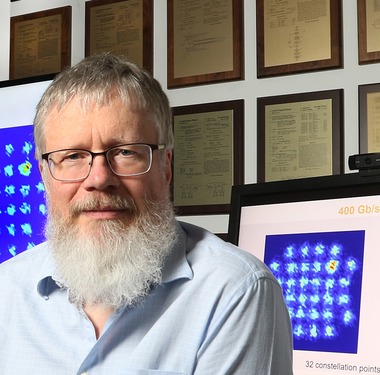
- Kim Roberts explains the signal processing techniques Ciena is using for its WaveLogic 6 coherent DSP.
- Roberts explains how the techniques squeeze, on average, a 15 per cent improvement in spectral efficiency.
- The WaveLogic 6 Extreme chip can execute 1,600 trillion (1.6 x 10¹⁵) operations per second and uses the equivalent of 4km of on-chip copper interconnect.
Part 2: WaveLogic 6’s digital signal processing toolkit
Bumping into Kim Roberts on the way to the conference centre at OFC, held in San Diego in March, I told him how, on the Ciena briefing about its latest WaveLogic 6 coherent digital signal processor (DSP), there had been insufficient time to dive deeply into the signal processing techniques used.
“What are you doing now?” said Roberts.
“I’m off to the plenary session to catch the keynotes.”
Chatting some more, I realised I was turning down a golden opportunity to sit down with a leading DSP and coherent modem architect.
“Is that offer still open?” I asked.
He nodded.
We grabbed a table at a nearby cafe and started what would prove to be an hour-long conversation.
High-end coherent DSPs
Many leading coherent modem vendors unveiled their latest designs in the run-up to the OFC show. It is rare for so many announcements to be aligned, providing a valuable glimpse of the state of high-performance optical transport.
Nokia announced its PSE-6s, which has a symbol rate of up to 130 gigabaud (GBd) and supports 1.2 terabit wavelengths. Infinera announced its 1.2-terabit ICE-7, which has a baud rate of up to 148GBd, while Fujitsu detailed it is using its 135GBd 1.2-terabit wavelength coherent DSP for its 1FINITY Ultra optical platform.
Meanwhile, Acacia, a Cisco company, revealed its 140GBd Jannu 1.2-terabit DSP has been shipping since late 2022. Acacia announced the Jannu DSP in March 2022.
All these coherent DSPs are implemented using 5nm CMOS and are shipping or about to.
And Ciena became the first company to detail a coherent DSP fabricated using a 3nm CMOS process. The WaveLogic 6 Extreme supports 1.6-terabit wavelengths and has a symbol rate of up to 200GBd.
Ciena’s WaveLogic 6 Extreme improves spectral efficiency by, on average, 15 per cent. WaveLogic 6 Extreme-based coherent modems will be available from the first half of 2024.
Customer considerations
Kim Roberts begins by discussing what customers want.
“With terrestrial systems, it is cost-per-bit [that matters], and if you’re not going very far, it is cost-per-modem,” says Roberts.
For the shortest reaches (tens of km), 100 gigabit may be enough while 200 gigabit or more is overkill. Here, a coherent pluggable module does the job.
“What matters is the cost per modem to get the flexibility of coherent connectivity so that you can plug it in and it works,” says Roberts.
With medium and long-haul terrestrial routes, cost-per-bit and heat-per-bit are the vital issues. With heat, area and volume of the coherent design are important. “I need volume to get the heat out of the chip on the card and into the air,” says Roberts.
Another use case is where spectral efficiency is key, for networks where fibre is scarce. An operator could be leasing dark fibre, or it could be a submarine network.
Ciena’s WaveLogic 6 Extreme’s 15 per cent improvement in spectral efficiency improves capacity over the same link. “Equivalently, you can go a dB (decibel) further or have a dB more signal margin,” says Roberts.
A common refrain heard is that spectral efficiency is no longer improving due to the Shannon limit being approached. Shannon’s limit is being approached because of the considerable progress already made by the industry in coherent optics.
“There is no 6dB to be had like in the old days,” says Roberts. “WaveLogic 3 was 2.5dB better than WaveLogic 2, but those multiple dBs are no longer there.”
The returns are diminishing, but striving for improvements remains worthwhile. “If you’re an operator that cares about spectral efficiency, that’s important,” he says.
Nonlinearity mitigation
Roberts returns to the issue of Shannon’s limit, based on the work of famed mathematician and information theorist, Claude Shannon.
“Shannon defines a theoretical limit for the capacity of a channel having linear propagation with additive Gaussian noise,” says Roberts.
This defines a strict mathematical limit, and it is pointless to go beyond that; he says: “In terms of linear performance, modems are getting close to the limit, within a couple of dB.”
Shannon’s limit doesn’t wholly define fibre since the channel is nonlinear.
Roberts says there is a whole research area addressing the bounds given such nonlinearities.
“We’re a long way from those theoretical nonlinear limits, but what matters is what’s the practical limit, and it’s getting hard,” he says
Increasing transmit power improves the optical signal-to-noise ratio (OSNR) and strengthens nonlinearities. Indeed, the nonlinearities grow faster with increased transmit power until, eventually, they dominate.
Because tackling nonlinearities is so complicated, Ciena’s approach is to approximate the problem as a linear Gaussian noise channel and do everything possible to mitigate the effects of nonlinearity rather than embrace it.
This is done by compensating at the transmitter the nonlinearities expected to happen along the fibre. The receiver performs measurements on a second-by-second basis and sends the results back. These are used as estimates of the anticipated nonlinearity about to be encountered and subtracted from the symbols to be sent.
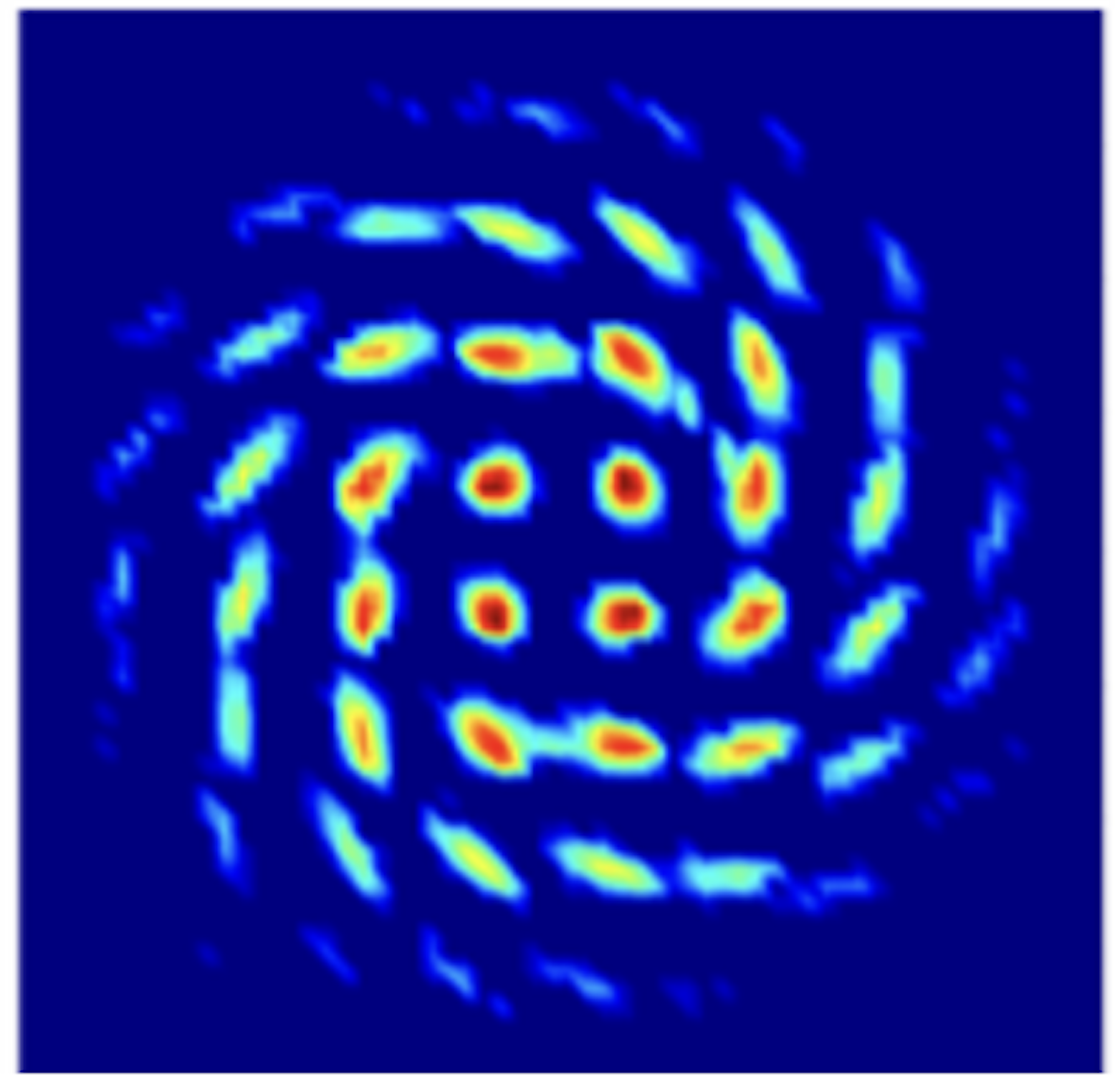
Even though the exact nonlinearity is unknown, this is still a valid approximation. “It gives a quarter to one dB of performance improvement,” says Roberts
Edgeless clock recovery
Robert explains other clever signal processing techniques that buy a 6 per cent spectral efficiency improvement.
With wavelength division multiplexing (WDM), the laser-generated signals are placed next to each other across the fibre’s spectrum.
For WaveLogic 6, when running at its maximum symbol rate of 200 gigabaud, the spectrum occupies a 200GHz-wide channel.
Usually, the signal in the frequency domain is not perfectly square-shaped; the signal rolls off in the frequency domain so that in the time domain there is no inter-symbol interference. “But [as a result] you’re wasting spectrum; you are not fully using that spectrum,” says Roberts.
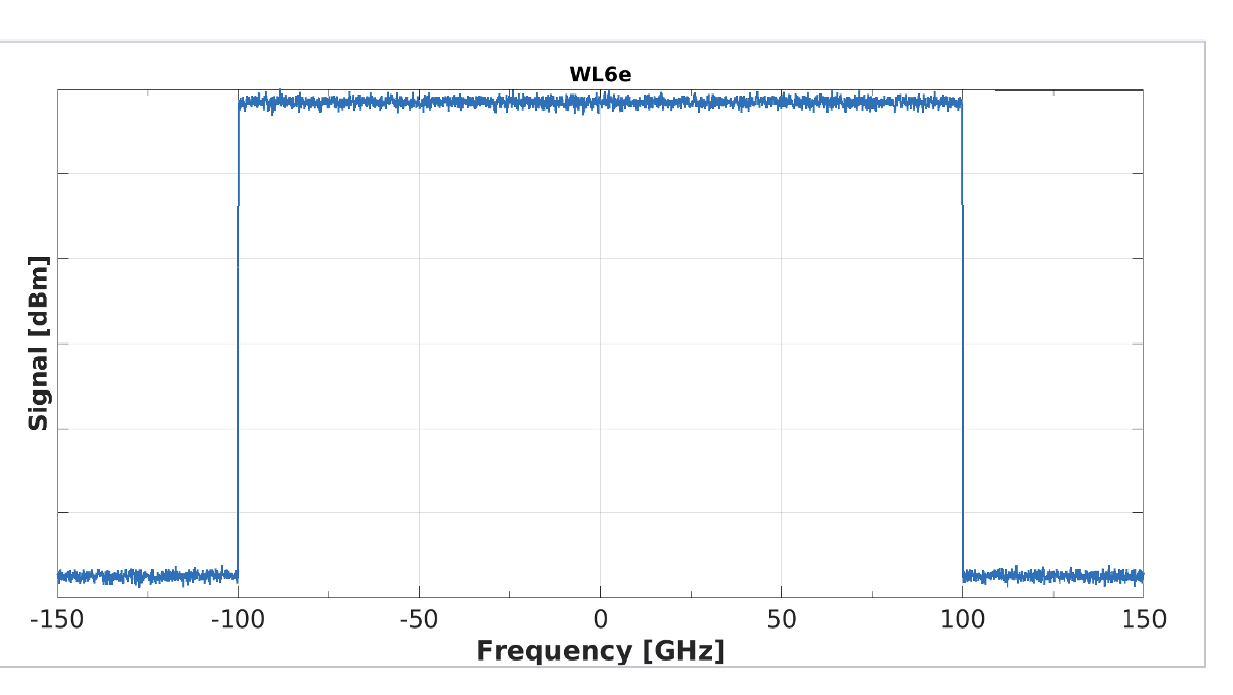
With WaveLogic 6, Ciena has created an idealised flat-topped, vertically edged signal spectra allowing the signals to be crammed side by side thereby making best use of the fibre’s spectrum (see diagram).
The challenge is that the clocking information used for data recovery at the receiver resided in this roll-off region. Now, that is no longer there so Cienahas developed another method to recover clock information.
A second challenge with signal recovery is that the transmit laser and the receive laser are not rigidly fixed in frequency. Being so close together, care is needed to recover only the wavelength – signal – of interest.
Yet another complication is how a rectangle in the frequency domain causes the signal in the time domain to ‘ring’ and go on forever.
“There are several signal processing methods that we had to develop to make this possible,” says Roberts.
Frequency-division multiplexing
Ciena also uses frequency division multiplexing (FDM), a technique it first introduced with the WaveLogic 5 Extreme.
The difference between WDM and FDM, explains Roberts, is that WDM uses different lasers to generate the wavelengths while FDM is generated by applying digital techniques to the same laser. “You are digitally combining different streams,” he says.
This is useful because it turns out that each fibre route has an optimum baud rate because of nonlinearities.
“If I’m using the full symbol rate of 200GBd, I can divide that into parallel streams, which behave as if they were independent circuits as far as nonlinearity is concerned,” says Roberts. “The optimum number of FDM in your spectrum is proportional to the square root of the total amount of dispersion, so high dispersion, more FDMs, low dispersion, just one.”
Ciena first added the option of four FDM with the WaveLogic 5. Now, WaveLogic 6 implements 1,2,4, and 8 FDM channels.

“For short distances, you want to go one signal at 200 gigabaud, or smaller if you’re reducing baud rate, but if you’re going very long distances, lots of dispersion, you go at eight parallel streams being sent at 25 gigabaud each,” he says.
But introducing FDM causes notches in the near-idealised rectangular spectrum mentioned earlier. Ciena has had to tackle that too.
“If you measure the spectrum, it’s completely flat, there are no notches between the FDMs, there is no wasted spectrum,” says Roberts.
Multi-dimensional coding
Multi-dimensional coding is a further technique used by Ciena to improve optical transmission, especially in troublesome cables where there are much nonlinearity and noise. It is challenging to get information through.
To understand multi-dimensional constellations, Roberts uses the example of a 16-QAM constellation, which he describes as a two-dimensional (2D) representation in one polarisation.
But if both polarisations of light are considered one signal, it becomes a 4D, 256-point (16×16) symbol. This can be further extended by including the symbols in adjacent time slots to form an 8D representation.
Ciena introduced this technique with its WaveLogic 3 Extreme coherent DSP, which supported the multi-dimension coding scheme 8D-2QAM to improve the reach or capacity of long-reach spans.
Now Ciena has introduced a family of such multi-dimensional schemes with WaveLogic 6 Extreme, executing in regions of very high nonlinearity and noise. These include 4, 8, and 16-dimensional constellations.
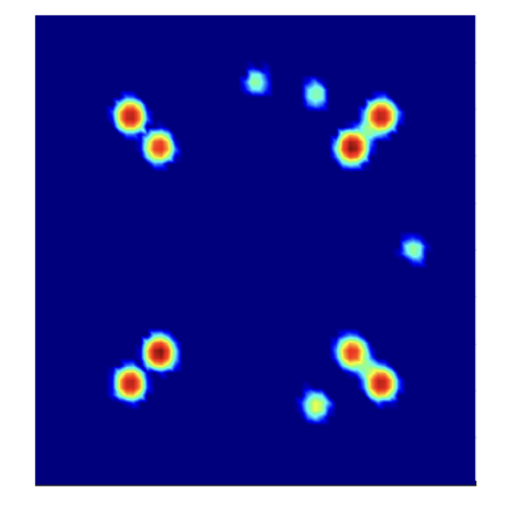
An example where the technique is used includes cases where there is twice as much noise as there is signal. “So the signal-to-noise ratio is -3dB,” says Roberts. Yet even here, 100 gigabits can still get through.
WaveLogic 6 Nano
Ciena also announced its 3nm CMOS WaveLogic 6 Nano DSP aimed at pluggable coherent modules. Is the Nano’s role to implement a subset of the signal processing capabilities of the Extreme?
Here, the customer’s requirements are different: heat, space and footprint are the dominant concerns. The Nano has to fit the heat envelope of the different sizes of pluggables, says Roberts. The optical performance is chosen based on fitting that heat requirement.
One of the merits of 3nm FinFET transistor technology is that if you don’t clock a circuit, only 1 per cent of the heat is generated compared to when it’s clocked, notes Roberts: “So, for different features, I can turn off the clock.”
A suitcase still full of tools?
At the time of the WaveLogic 5 launch, Roberts mentioned that there were still many tools left in the suitcase of ideas. Is this still true with the WaveLogic 6?
For Roberts, the question is: will it be economically viable to put in new capabilities based on the heat and performance and in terms of the size, schedule, and the amount of work involved?
Then, with a broad smile, he says: “There is room to occupy us as to how to get the next 10 to 20 per cent of spectral efficiency.”
And with that, we each set off for a day of meetings.
Roberts headed off to his hotel before his 10am meeting. I set off for the OFC exhibition hall and a meeting with the OIF.
As I walked to the convention centre, I kept thinking about the impromptu briefing and how I so nearly passed up on Roberts’ expertise and generosity.


Do optical DACs have a role in future coherent modems?
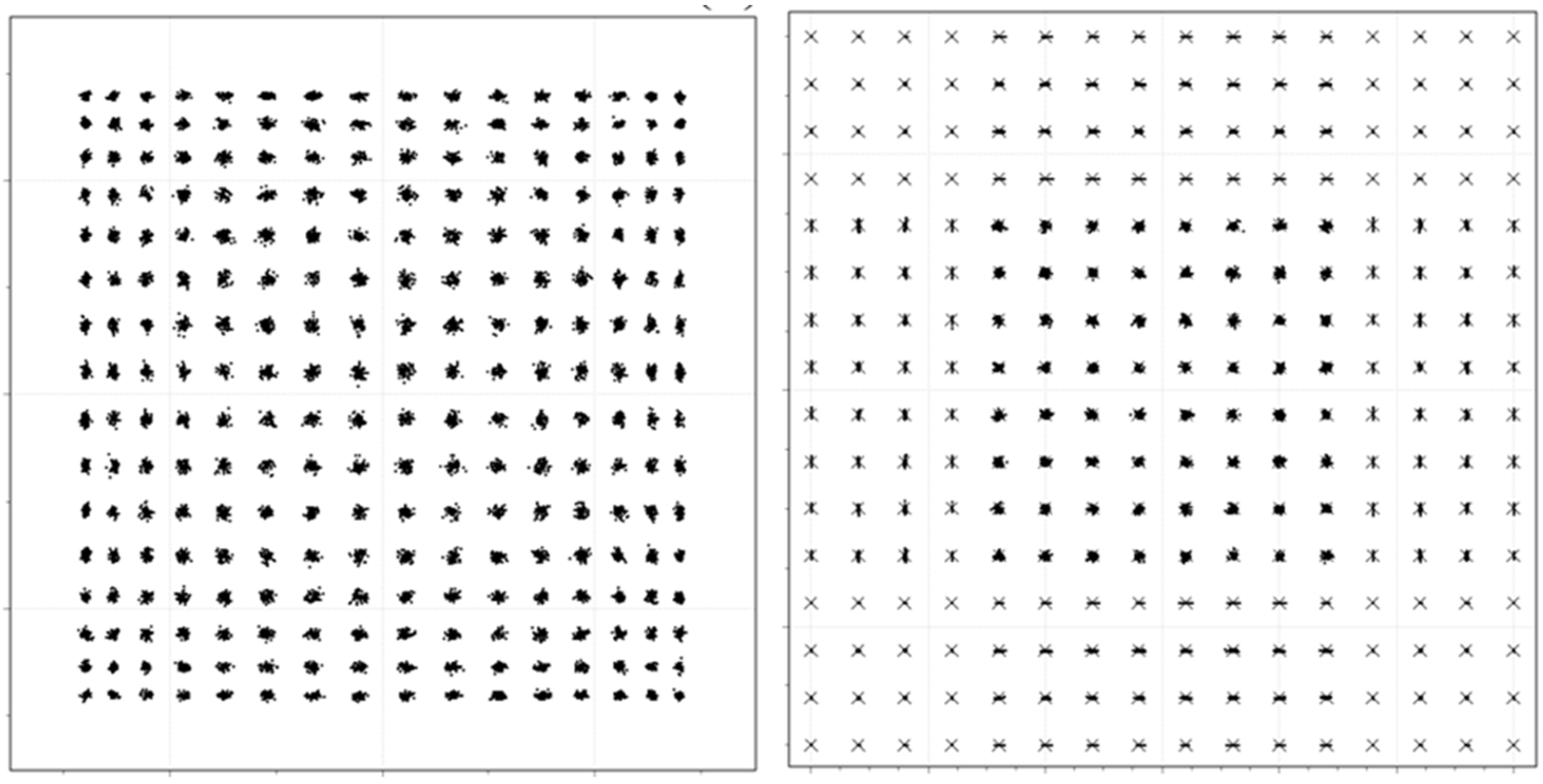
- A proposed optical digital-to-analogue converter (oDAC) concept offers several system benefits, including better signal performance, higher bit rates and lower power consumption.
- The oDAC design benefits coherent optics but can also be used in direct-detect designs. This article focusses on coherent optics.
- Coherent system vendors are aware of oDAC technology but it is not part of their current roadmaps.
Systems vendors continue to advance the performance of optical transmission systems. But they are the first to admit the task is getting more complex.
Long-distance transmission is challenging due to the channel impairments introduced by the optical fibre, such as noise, chromatic dispersion, and non-linearities.
Coherent modems have become the established technology that use a powerful digital signal processor (DSP) and optics to counter channel impairments.
In recent years the industry has progressed coherent technology to such a degree that it is now difficult to keep improving optical performance.
One critical component of the coherent DSP is the analogue front end: the transmitter’s digital-to-analogue converters (DACs) and the receiver’s analogue-to-digital converters (ADCs).
The DACs take the digital signal input and produce the analogue drive signal for the coherent optics’ Mach-Zehnder modulators. In turm, the DSP’s ADCs sample the signal at the receiver’s optics before recovering the transmitted data payload.
The challenge facing coherent DSP designers is to keep scaling the bandwidth of the DACs and ADCs while maintaining high resolution and high energy efficiency.
This growing challenge has led some researchers to propose alternatives.
One such proposal is an optical digital-to-analogue converter or oDAC.
The status of coherent DSPs
Recent announcements from leading coherent optic vendors, including Cisco’s Acacia, Ciena, Infinera, NEL, and Nokia, show the continual progress in hiking the symbol rate of coherent DSPs.

Vendors want to keep increasing the symbol rate – the frequency of the symbols where each symbol carries one or more bits, depending on the modulation scheme used – since it remains the best way to reduce the cost of sending network traffic.
First-generation coherent systems used a symbol of 32 gigabaud (GBd). Now, Acacia’s currently shipping 5nm CMOS Jannu DSP operates at up to 140GBd. Ciena, meanwhile, has detailed its WaveLogic 6 Extreme, the first coherent DSP implemented in 3nm CMOS that will work at up to 200GBd.
To scale the baud rate, all the sub-systems making up the coherent modem must scale.
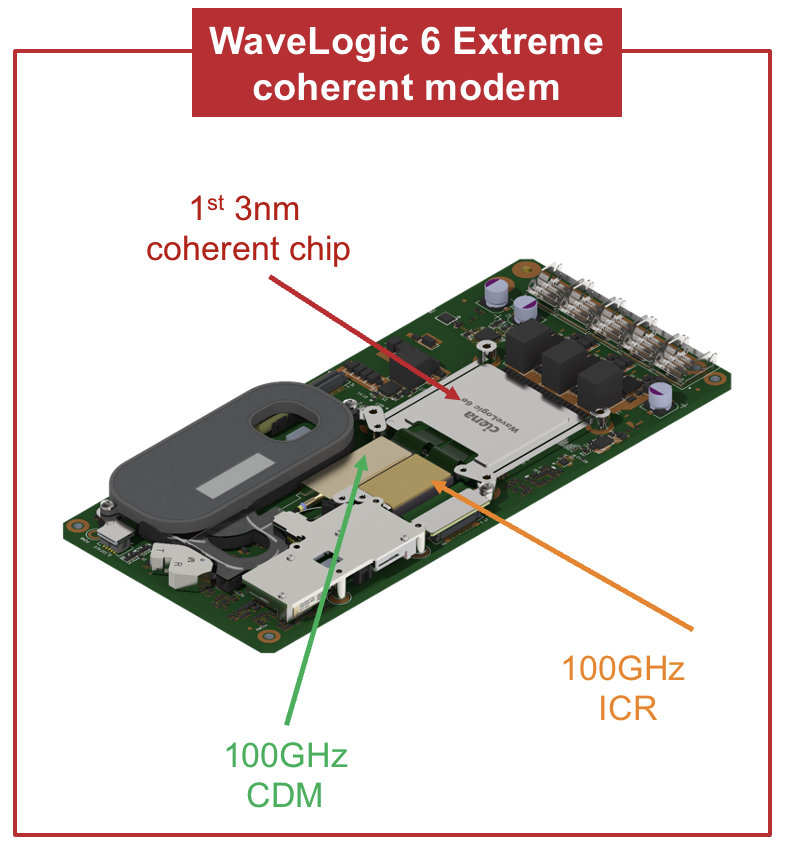
The sub-systems include the DSP’s DACs and ADCs, the modulator drivers, and the trans-impedance amplifiers. The coherent optics – the coherent driver modulator (CDM) transmitter and the integrated coherent receiver (ICR) – must also scale.
For a 200GBd symbol rate, the bandwidth of all these components must reach 100GHz.
Looking ahead
The industry consensus is that coherent modems will reach 280-300GBd before the decade’s end. But to do so will require considerable engineering effort.
The industry offers less visibility after 300+GBd.
System vendors say that at some future point, it will not make economic sense to keep increasing the baud rate. It will be too costly to make the coherent modem and reducing the cost-per-bit will stop.
Already each new generation CMOS node is more costly while new materials are needed to scale the optics. Ciena says it is using silicon photonics for the integrated coherent receiver, while indium phosphide is being used for the transmitter’s modulators. Ciena is also looking at thin-film lithium niobate as a modulator technology.
As for DACs and ADCs, circuit designers face considerable challenges in achieving a 100GHz bandwidth.
Moreover, the DACs and ADCs sample faster than the baud rate, typically 1.2x. At OFC, imec, the Belgium technology research centre, outlined its work on 3nm coherent DSPs showing a sample rate of 250 giga-samples/s.

Such huge sampling rates explain the interest in optical DACs which can process a high-baud rate signal to generate, using optical parallelism, an ultra-high bit-rate signal based on either multi-level Pulse Amplitude Modulation (PAM) or Quadradure Amplitude Modulation (QAM) signals.
Two prominent professors promoting an optical DAC design are Ioannis Tomkos of the department of electrical and computer engineering at the University of Patras, Greece, and Moshe Nazarathy at the faculty of electrical engineering at the Technion University, Israel.
Limitations of DACs
Tomkos starts by highlighting the shortcomings of conventional DACs.
DACs not only have to operate sampling rates at least as high as the baud rate but they also have a finite resolution. Typically, 6-8 bits are used for coherent designs.
The effective number of bits (ENOB) available are even lower due to the clock jitter when operating the electrical circuits at such high speeds.
The finite effective number of bits limit the use of higher-order modulation schemes. Today, coherent systems use up to 16-ary quadrature amplitude modulation (16-QAM), except for the highest capacity, shortest-distance links.
A second issue is the non-linear nature of the optical modulator’s transfer function. “It’s a sine non-linearity type of response in Mach-Zehnder modulators due to the nature of interference,” says Tomkos.
This requires operating the modulator over a reduced range, the linear region of its transfer function around its biasing voltage.
Such curtailing of the driver saves power but results in ‘modulator loss’; the area occupied by the modulator’s constellation points is less than the ideal available (see top left diagram).
“You not driving the modulator to the limit,” says Tomkos. “Modulation loss can be as high as 9-12dB which impacts signal recovery at the receiver.”
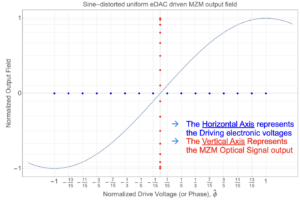
The relation between the driving DAC inputs and the discrete optical outputs is generally nonlinear (see diagram above). This means the constellation points look warped and are not spaced equally apart causing signal distortion.
Such optical distortion can be tackled using various specialised DAC architectures but the cost is either higher power, limited speed or extra modulation loss.
“Ideally, we would like to have equal distances between the symbols so we can robustly separate each symbol from the others since we also have electronic errors coming from the DACs that impact the quality of the symbols and shift them from their optimal points,” says Tomkos.
The impact of modulation loss and optical distortion also worsen when higher modulation schemes above 16-QAM are used.
The oDAC
Mention the term optical DAC, and specific thoughts come to mind. Is the optical signal sampled? Is the DAC electrical in its input and output, but its inner workings are photonic?
The optical DAC, as proposed by Nazarathy and Tomkos, is neither of the above. Moreover, it uses existing driver electronics based on the simplest traditional lowest-order DACs.
Indeed, the oDAC looks similar to a conventional coherent optics transmitter in terms of components, but the differences in operation and achieved performance are significant.
The oDAC can also be implemented in several ways bringing critical benefits for various system requirements.
Architecture
A conventional coherent optical transmitter splits the incoming laser source and feeds the light equally to the in-phase and quadrature Mach-Zehnder modulators (one arm of which includes a 90-degree phase shifter).

The two Mach-Zehnder modulators are driven, as shown. In this example, two drivers implement a bipolar 4-level pulse amplitude modulation (PAM-4) signal such that the coherent transmitter produces a 16-QAM output signal.
The oDAC architecture is subtly different.
The oDAC’s main two components are a variable splitter and combiner at the input and output and the Mach-Zehnder modulator pair. Here, both modulators are identical; there is no 90o phase shifter but the differential phase is maintained at 0o degrees and the modulators are operated at full-scale resulting in zero modulation loss (see diagram at the article’s start).

Each modulator arm is driven by an electrical PAM-4 signal, and the variable splitter-combiner produces the bipolar PAM-16 optical output.
For 16-PAM, 4/5 of the laser signal is fed to one arm and the remaining 1/5 to the other. The PAM-4 DAC drivers for both Mach-Zehnder modulators are identical.
“In the first case, we had 16 symbols in two dimensions (i.e. QAM16); here we have 16 symbols, but in one dimension (i.e. PAM16), the other dimension is missing due to the absence of the 90-degree phase shifter,” says Tomkos.
According to Tomkos, the sine nonlinearity of the optical modulators here is an advantage. “The generated signal does not suffer from modulation loss and optical distortion due to electronic driver mismatch errors, as the noise coming from the electronic DACs gets squelched,” he says.
Higher-order modulation
As mentioned, the oDACs can be implemented and arranged in several ways.
For example, two oDACs can be used, one orthogonal in phase to the other, in a conventional coherent transmitter structure to generate a higher modulation signal. For example, two optical DAC arms, each 16-PAM, used as I and Q, will produce a 256-QAM signal.
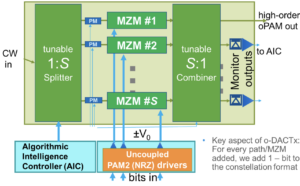
But even more strikingly, more than two parallel modulation paths (by stacking-up more modulators in parallel, see diagram) can be used as an alternative approach to generating higher-order modulation schemes and higher bit rates, and at reduced power consumption per bit.
“The ratio between the bit rate and the baud rate is exactly the number of parallel paths,” says Nazarathy. “Another name for it is spectral efficiency: how many bits each symbol carries.”
The oDAC uses straightforward drivers. The professors say only PAM-2 or PAM-4 drivers are used. This way, power savings are maximised.
“The big picture is that we offload the electronics burden by going parallel optically,” says Nazarathy, adding that what is being traded is electronic DAC complexity and the associated performance limitations of the drivers for optical parallelism of replicated blocks of Mach-Zehnder modulators.
“You don’t want to stack things [photonic componentry] serially as if you keep stacking that way, you incur an optical loss because the loss is compounded,” says Nazarathy. Here, the modulators are stacked in parallel, the preferred integration approach.
Moreover, the more paths used, the higher-order the generated optical constellation is. “Eventually, only PAM-2 (Non-return-to-zero) drivers are used and that’s the minimum power consumption you can get,” says Tomkos.
“So we have parallelism (at the same laser power) that generates for the same baud rate, double or triple the bit rate [depending on whether 2 or 3 paths are used],” says Nazarathy. And the resulting constellations are near ideal: there is no modulation loss, nor is there optical distortion.
Nazarathy explains such benefits as the result of a ‘divide-and-conquer’ approach.
“If you keep the modulation paths simple, you have more freedom to optimise the drive point of the modulators,” he says. “The modulators benefit you more because they are more simply driven.” Then, by adding more modulator paths, the system performance improves overall.”
He also notes how the optical implementation is robust to imperfections generated by the electronic circuitry.
Optical DAC: A definition
- Two or more optical modulator units and some static or slowly-tuned ‘glue’ optics.
- The electrical drivers feeding the optical modulators are simple for lowest-power, either PAM2 (NRZ) or PAM4 drivers. Electronic DACs generating higher-order PAM are not needed.
- No high-speed power-hungry digital encoder (mapper) is used. The number of Mach-Zehnder modulators is B where the constellation size is C=2B. This is referred to as Direct Digital Drive. This last condition ensures the lowest power consumption.
Status
The oDAC work is currently at the research stage.
The working of the oDAC has been simulated and verified, and several papers have been published. Patents have also been filed.
At the recent OFC event in San Diago in March, Professor Tomkos met with hyperscalers, systems and components vendors to explain the oDAC technology and its benefits.
The two academics are focused on the oDAC in the optical transmitter, but Nazarathy says they also plan to surprise at the optical receiver end.
Tomkos says the optical DAC is an ideal fit for future coherent transmitters that will be used in 6G networks and datacenter networks, which will carry significant amounts of traffic at ultra-high rates.
The oDAC approach also bodes well for the trend of using linear drive optics. Indeed, the implementation of the oDAC hardware is carried out within the framework of a major R&D project called FLEX-SCALE that Tomkos is co-ordinating and is funded under the first phase of the 6G Smart Networks and Services (SNS) Partnership.
Tomkos believes that the first use of the optical DAC may likely be for data centre interconnect, a more mature market where higher-order modulation formats can be used and low-power is at a premium.
The professors are looking for partners and exploring options to commercialise the technology.

Ciena advances coherent technology on multiple fronts
- Ciena has unveiled the industry’s first coherent digital signal processor (DSP) to support 1.6-terabit wavelengths
- Ciena announced two WaveLogic 6 coherent DSPs: Extreme and Nano
- WaveLogic 6 Extreme operates at a symbol rate of up to 200 gigabaud (GBd) while the Nano, aimed at coherent pluggables, has a baud rate from 118-140GBd
Part 1: WaveLogic 6 coherent DSPs
Ciena has leapfrogged the competition by announcing the industry’s first coherent DSP operating at up to 200GBd.
The WaveLogic 6 chips are the first announced coherent DSPs implemented using a 3nm CMOS process.
Ciena’s competitors are – or will soon be – shipping 5nm CMOS coherent DSPs. In contrast, Ciena has chosen to skip 5nm and will ship WaveLogic 6 Extreme coherent modems in the first half of 2024.
Using a leading CMOS process enables the cramming of more digital logic and features in silicon. The DSP also operates a faster analogue front-end, i.e. analogue-to-digital converters (ADC) and digital-to-analogue (DAC) converters.
The WaveLogic 6 matches Ciena’s existing WaveLogic 5 family in having two DSPs: Extreme, for the most demanding optical transmission applications, and Nano for pluggable modules.
WaveLogic 6 Extreme is the first announced DSP that supports a 1.6-terabit wavelength; Acacia’s (Cisco) coherent DSP supports 1.2-terabit wavelengths and other 1.2-terabit wavelength DSPs are emerging.
WaveLogic 6 Nano addresses metro-regional networks and data centre interconnect (up to 120km). Here, cost, size, and power consumption are critical. Ciena will offer the WaveLogic 6 in QSFP-DD and OSFP pluggable form factors.
Class 3.5
Network traffic continues to grow exponentially. Ciena notes that the total capacity of its systems shipped between 2010 and 2021 has grown 150x, measured in petabits per second.
Increasing the symbol rate is the coherent engineers’ preferred approach to reduce the cost per bit of optical transport.
Doubling the baud rate doubles the data sent using the same modulation scheme. Alternatively, the data payload can be sent over longer spans.
However, upping the symbol rates increases the optical wavelength’s channel width. Advanced signal processing is needed to achieve further spectral efficiency gains.
One classification scheme of coherent modem symbol rate defines first-generation coherent systems operating at 30-34GBd as Class 1. Class 2 modems double the rate to 60-68GBd. The OIF’s 400ZR standard operating at 64GBd is a Class 2 coherent modem.
Currently-deployed optical transport systems operating at 90-107GBd reside between Class 2 and Class 3 (120-136GBd). Ciena’s WaveLogic 5 Extreme is one example, with its symbol rate ranging from 95-107GBd. Ciena has shipped over 60,000 WaveLogic 5 Extreme DSPs to over 200 customers.
Acacia’s latest CIM-8 coherent modem, now shipping, operates at 140GBd, making it a Class 3 design. Infinera, NEL, and Nokia announced their Class 3 devices before the OFC 2023 conference and exhibition.
Now Ciena, with its 200GBd WaveLogic 6 Extreme, sits alone between Class 3 and Class 4 (240-272GBd).
WaveLogic 6 Extreme
Ciena has extended the performance of all the components of the Extreme-based coherent modem to work at 200GBd.
These components include the DSP’s analogue front-end: the ADCs and DACs, the coherent optics and the modulator drivers and TIAs. All must operate with a 100GHz bandwidth.
To operate at 200GBd, the ADCs and DACs must sample over 200 giga-samples a second. This is pushing ADC and DAC design to the limit.
The coherent modem’s optics and associated electronics must also have a 100GHz operating bandwidth. Ciena developed the optics in-house and is also working with partners to bring the coherent optics to market with a 100GHz bandwidth.
Ciena uses silicon photonics for the Extreme’s integrated coherent receiver (ICR) optics. For the coherent driver modulator (CDM) transmitter, Ciena is using indium phosphide and is also evaluating other technology such as thin-film lithium niobate.
“There are multiple options that are available and being looked at,” says Helen Xenos, senior director of portfolio marketing at Ciena.
Much innovation has been required to achieve the fidelity with 100GHz electro-optics and get the signalling right between the transmitter-receiver and the ASIC, says Xenos.
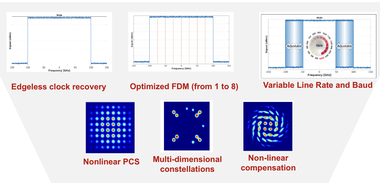
Ciena introduced frequency division multiplexing (FDM) sub-carriers with the WaveLogic 5 Extreme, a technique to help tackle dispersion. With the introduction of edgeless clock recovery, Ciena has created a near-ideal rectangular spectrum with sharp edges.
“First, inside this signal, there are FDM sub-carriers, but you don’t see them because they are right next to each other,” says Xenos. “Getting rid of this dead space between carriers enables more throughput.”
Making the signal’s edges sharper means that wavelengths are packed more tightly, better using precious fibre spectrum. Edgeless clock recovery alone improves spectral efficiency by between 10-13 per cent, says Xenos.
Moving to 3nm allows additional signal processing. As an example, Ciena’s WaveLogic 6 Extreme DSP can select between 1, 2, 4 and 8 sub-carriers based on the dispersion on the link. WaveLogic 5 Extreme supports 4 sub-carrier FDM only.
The baud rate is also adjustable from 67-200GBd, while for the line rate, the WaveLogic 6 supports 200-gigabit to 1.6-terabit wavelengths using probabilistic constellation shaping (PCS).
Another signal processing technique used is multi-dimensional constellation shaping. These are specific modulations that are added to support legacy submarine links.
“For compensated submarine cables that have specific characteristics, they need a specialised type of design also in the DSP,” says Xenos.
Ciena also uses nonlinear compensation techniques to squeeze further performance and allow higher power signals, improving overall link performance.
Ciena can address terrestrial and new and legacy submarine links with the WaveLogic 6 Extreme running these techniques.
Xenos cites performance examples using the enhanced DSP performance of the WaveLogic 6 Extreme.
Using WaveLogic 5, an 800-gigabit wavelength can be sent at 95GBd using a 112.5GHz-wide channel. The 800-gigabit signal can cross several reconfigurable optical add-drop multiplexer (ROADM) hops.
Sending a 1.6-terabit wavelength at 185GBd over a similar link, the signal occupies a 200GHz channel. “And you get better performance because of the extra DSP enhancements,” says Xenos.
The operator Southern Cross has simulated using the WaveLogic 6 Extreme on its network and says the DSP will be able to send one terabit of data over 12,000km.
Optical transport systems benefits
Systems benefits of the Extreme DSP include doubling capacity, transmitting a 1.6-gigabit wavelength, and halving the power consumed per bit.
The WaveLogic 6 Extreme will fit within existing Ciena optical transport kit.
Xenos said the design goal is to get to the next level of cost and power reduction and maximise the network coverage for 800-gigabit wavelengths. This is why Ciena chose to jump to 3nm CMOS for the WaveLogic 6 Extreme, skipping 5nm CMOS.
WaveLogic 6 Nano
The 3nm CMOS WaveLogic 6 Nano addresses pluggable applications for metro and data centre interconnect.
“The opportunity is still largely in front of us [for coherent pluggables],” says Xenos.
The current WaveLogic 5 Nano operating between 31.5-70GBd addresses 100-gigabit to 400-gigabit coherent pluggable applications. These include fixed grid networks using 50GHz channels and interoperable modes such as OpenROADM, 400ZR and 400ZR+. Also supported is the 200-gigabit CableLabs specification.
The WaveLogic 5 Nano is also used in the QSFP-DD module with embedded amplification for high-performance applications.
There is also a new generation of specifications being worked on by standards bodies on client side and line side 800-gigabit and 1.6-terabit interfaces.
Developments mentioned by Xenos include an interoperable probabilistic constellation shaping proposal to be implemented using coherent pluggables.
The advent of 12.8-terabit and 25.6-terabit Ethernet switches gave rise to 400ZR. Now with the start of 51.2-terabit and soon 102.4-terabit switches, the OIF’s 800ZR standard will be needed.

There is also a ‘Beyond 400 Gig’ ITU-T and OpenROADM initiative to combine the interoperable OpenZR+ and the 400-gigabit coherent work of the OpenROADM MSA for a packet-optimised 800-gigabit specification for metro applications.
Another mode is designed to support not just Ethernet but OTN clients.
Lastly, there will also be long-distance modes needed at 400, 600, and 800-gigabit rates.
“With WaveLogic 6 Nano, the intent is to double the capacity within the same footprint,” says Xenos.
In addition to these initiatives, the WaveLogic 6 Nano will address a new application class for much shorter spans – 10km and 20km – at the network edge. The aim is to connect equipment across buildings in a data centre campus, for example.
Some customers want a single channel design and straightforward forward-error correction. Other customers with access to limited capacity will want a wavelength division multiplexed (WDM) solution.
The Nano’s processing and associated optics will be tuned to each application class. “The engineering is done so that we only use the performance and power required for a specific application,” says Xenos.
A Nano-based coherent pluggable connecting campus buildings will differ significantly from a pluggable sending 800 gigabits over 1,000km or across a metro network with multiple ROADM stages, she says.
The WaveLogic 6 Nano will be used with silicon photonics-based coherent optics, but other materials for the coherent driver modulator transmitter may be used.
Availability
Ciena taped out the first 3nm CMOS Extreme and Nano ICs last year.
The WaveLogic 6 Extreme-based coherent modem will be available for trials later this year. Product shipments and network deployments will begin in the first half of 2024.
Meanwhile, shipments of WaveLogic 6 Nano will follow in the second half of 2024.
The Metaverse and the network
CTO interviews part 1: Stephen Alexander
“The inability to precisely predict how we’ll use it [the Metaverse], and how it will change our daily life, is not a flaw. Rather, it is a prerequisite for the Metaverse’s disruptive force.”
The Metaverse: And How it Will Revolutionize Everything by Matthew Ball, 2022.
CTO Interview
Stephen Alexander’s trusty 20-year-old dishwasher finally stopped working during the pandemic.
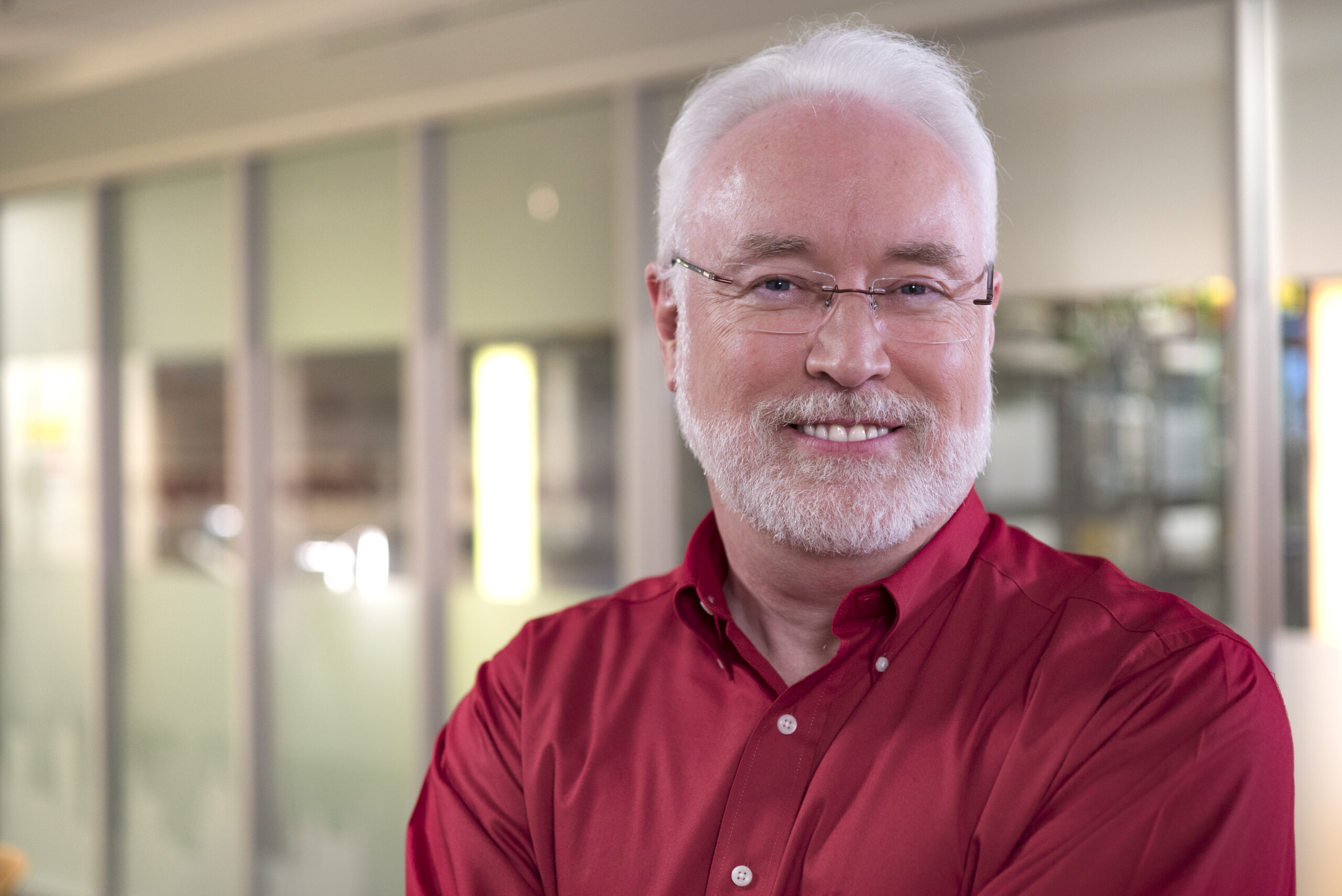
Unfortunately, getting spare parts shipped to the US was impossible, so Alexander, the CTO of Ciena (pictured), resorted to ‘how-to’ YouTube videos and got bits from eBay.
It highlighted the power of the online experience, something set to ramp significantly with the advent of the Metaverse.
The Metaverse refers to immersive virtual worlds where people will meet to socialise, learn, work and play.
During the pandemic, Ciena also experienced how the online experience can benefit work. The company used the network to guide remote data centre staff wearing virtual-reality headsets in operating its equipment.
Ciena also used high-resolution audio-visual equipment to continue development work during the pandemic. A solitary engineer in the lab would conduct measurements, sending the results to engineers working remotely.
“So we had started down this path where it [the Metaverse] is not just gaming but has got some interesting business applications,” says Alexander.
Metaverse survey
Ciena commissioned a recent survey on the Metaverse and its work uses. The systems vendor wanted to know how the customers of its customers view the emerging technology and how they would use it.
“What it [the Metaverse] represents for us is a use case,” says Alexander. “It’s an application space for this [networking] infrastructure we are all building.”
The study surveyed 15,000 people worldwide. Nearly all (96%) see the value of virtual meetings, while more than three-quarters (78%) say they would use more immersive experiences such as the Metaverse. However, two in five (38%) of the respondents said unreliable networking performance was a concern holding their organisations back.
Alexander, like many, spent his days in virtual meetings during the pandemic. In the mornings, he would talk to teams in Europe, in the middle of the day to the Americas, and in the evenings to the Asia Pacific. “It was a very efficient use of time,” he says.
But such tools are less effective for getting to know people. “You don’t have the ability to go to dinner, have coffee, go for a drink, that sort of thing,” he says.
Online meetings of up to 20 people are also limiting. Conversations are one-to-many unlike an in-person meeting where multiple parallel interactions occur.
“With a more immersive Metaverse environment where you have a virtual-reality capability, maybe we can start to do those things,” he says.
Alexander says that with the many areas of interactions, you can ask how many would be improved using augmented reality/ virtual reality.
Healthcare and education
Alexander experienced other benefits of online interactions, such as telemedicine, during the pandemic. But also some shortfalls. “What could have been done to improve the online education experience?” he says.
In a Metaverse-enabled world, education could enable high-school students to experience different types of work before deciding their career path. They could ‘join’ professionals – an airline pilot, a nurse, a doctor – to experience their working day.
“You plop on the headset, or you go into your ‘holodeck’ or advanced zoom environment and spend some hours or a day experiencing what that person’s life is like and what they do,” says Alexander. “That’s a huge educational potential enabled by this augmented reality/ virtual reality-enhanced world.”
Takeaways
One takeaway from Ciena’s commissioned survey is how widespread the acceptance of this future development is, says Alexander. There is also a broad interest in using the Metaverse for business applications.
The survey also highlighted some intriguing ideas.
Alexander says he looks forward to catching up with a former work colleague, but that this rarely happens due to their day-to-day commitments.
“You can imagine this world where his avatar and my avatar run into each other, and they talk about what’s going on in their lives and all the other things,” says Alexander. “And they come back, and we get a download from the evening.”
Network upshot
Alexander says that for some years, he has been saying that the network must get faster, the cloud has to get closer to the network edge, and infrastructure must get more intelligent.
These trends will benefit the Metaverse.
Latency is one crucial networking performance parameter.
Any end-device connected to the cloud has specific requirements regarding how it interacts and the latency it needs. For example, a latency of 100ms is ok when watching streaming video, but for gaming, that is too long; a headset requires a latency in the tens of milliseconds. Controlling an automated forklift truck is even more demanding. Here, tolerable latency is in single-digit milliseconds.
“That tells you, in some sense, where the edge of the cloud has to be,” says Alexander. “It just says that from the device to the cloud and back, it better be a certain physical distance as there is the speed of light issue.”
Network capacity also plays a role if the edge device generates enormous amounts of data – a petabyte, for example – and there is a timeliness to receiving an answer, even if it is a yes or no.
What network endpoints generate such massive amounts of data?
Alexander cites the example of synthesised designer drugs based on a person’s human genome. “If you have cancer, knowing that and getting the drug today, this week, this month is a whole lot different than getting it next year,” he says.
Other examples driving bandwidth he cites include military and agriculture (crops and livestock) applications.
“This is why this kind of a survey is so useful to us because we can go to our customers, whether they be cloud hyper-giants or to service providers and have a conversation about not what they are provisioning today, but what they’re going to provision in two to five years,” says Alexander.
This helps Ciena have better conversations with its customers about what they will need and should consider.
Planning
Staff at Ciena don’t yet have the word ‘Metaverse’ in their job titles.
Instead, staff are developing the next-generation WaveLogic coherent digital signal processor (DSP) family to drive the lowest cost-per-bit, highest capacity for fibre. Other Ciena employees are addressing network intelligence and automation; while others still are tackling routing, switching and the dynamic edge.
All applications require some flavour of these technologies, says Alexander.
The Metaverse is in its infancy in terms of use cases, with gaming being one prominant example.
“But you can imagine this can go for education, healthcare, and normal business interactions,” says Alexander. “It gets people’s juices flowing; look at the potential once we have high-capacity, low-latency connections to the cloud, and cloud is instantiated in enough local data centres that you can process things very quickly.”
Once that happens, people across industries will ask what they can do.
“That’s where you’re going to start to see the kind of the vectors of progress get established,” he says. “But common things that we see – capacity, connectivity, the ability to have a simpler, faster, more dynamic edge – those are key to enabling all this.”


ECOC '22 Reflections - Part 2

Gazettabyte is asking industry and academic figures for their thoughts after attending ECOC 2022, held in Basel, Switzerland. In particular, what developments and trends they noted, what they learned, and what, if anything, surprised them.
In Part 2, Broadcom‘s Rajiv Pancholy, optical communications advisor, Chris Cole, LightCouting’s Vladimir Kozlov, Ciena’s Helen Xenos, and Synopsys’ Twan Korthorst share their thoughts.
Rajiv Pancholy, Director of Hyperscale Strategy and Products Optical Systems Division, Broadcom*
The buzz at the show reminded me of 2017 when we were in Gothenburg pre-pandemic, and that felt nice.
Back then, COBO (Consortium for On-Board Optics) was in full swing, the CWDM8 multi-source agreement (MSA) was just announced, and 400-gigabit optical module developments were the priority.
This year, I was pleased to see the show focused on lower power and see co-packaged optics filter into all things ECOC.
Broadcom has been working on integrating a trans-impedance amplifier (TIA) into our CMOS digital signal processor (DSP), and the 400-gigabit module demonstration on the show floor confirmed the power savings integration can offer.
Integration impacts power and cost but it does not stop there. It’s also about what comes after 2nm [CMOS], what happens when you run out of beach-front area, and what happens when the maximum power in your rack is not enough to get all of its bandwidth out.
It is the idea of fewer things and more efficient things that draws everyone to co-packaged optics.
The OIF booth showcased some of the excitement behind this technology that is no longer a proof-of-concept.
Moving away from networking and quoting some of the ideas presented this year at the AI Hardware Summit by Alexis Bjorlin, our industry needs to understand how we will use AI, how we will develop AI, and how we will enable AI.
These were in the deeper levels of discussions at ECOC, where we as an industry need to continue to innovate, disagree, and collaborate.
Chris Cole, Optical Communications Advisor
I don’t have many substantive comments because my ECOC was filled with presentations and meetings, and I missed most of the technical talks and market focus presentations.
It was great to see a full ECOC conference. This is a good sign for OFC.
Here is an observation of what I didn’t see. There were no great new silicon photonics products, despite continued talk about how great it is and the many impressive research and development results.
Silicon photonics remains a technology of the future. Meanwhile, other material systems continue to dominate in their use in products.
Vladimir Kozlov, CEO of LightCounting
I am surprised by the progress made by thin-film lithium niobate technology. There are five suppliers of these devices now: AFR, Fujitsu, Hyperlight, Liobate, and Ori-chip.
Many vendors also showed transceivers with thin-film lithium niobate modulators inside.
Helen Xenos, senior director of portfolio marketing at Ciena
One key area to watch right now is what technology will win for the next Ethernet rates inside the data centre: intensity-modulation direct detection (IMDD) or coherent.
There is a lot of debate and discussion happening, and several sessions were devoted to this topic during the ECOC Market Focus.
Twan Korthorst, Group Director Photonic Solutions at Synopsys.
My main observations are from the exhibition floor; I didn’t attend the technical conference.
ECOC was well attended, better than previous shows in Dublin and Valencia and, of course, much better than Bordeaux (the first in-person ECOC in the Covid era).
I spent three days talking with partners, customers and potential customers, and I am pleased about that.
I didn’t see the same vibe around co-packaged optics as at OFC; not a lot of new things there.
There is a feeling of what will happen with the semiconductor/ datacom industry. Will we get a downturn? How will it look? In other words, I noticed some concerns.
On the other hand, foundries are excited about the prospects for photonic ICs and continue to invest and set ambitious goals.
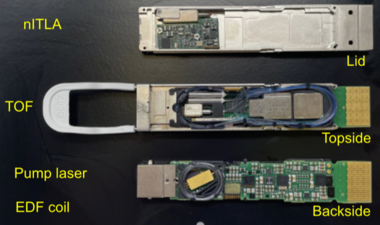
Ciena's multi-format 400G coherent QSFP-DD pluggable
Ciena showcased a working 400-gigabit Universal coherent pluggable module at the ECOC 2022 conference and exhibition in Basel, Switzerland.
Ciena is using its WaveLogic 5 Nano coherent digital signal processor (DSP) for the Universal QSFP-DD coherent pluggable module.
“We call it universal because it supports many transmission modes – interoperable and high performance; the most in the industry,” says Helen Xenos, senior director of portfolio marketing at Ciena.
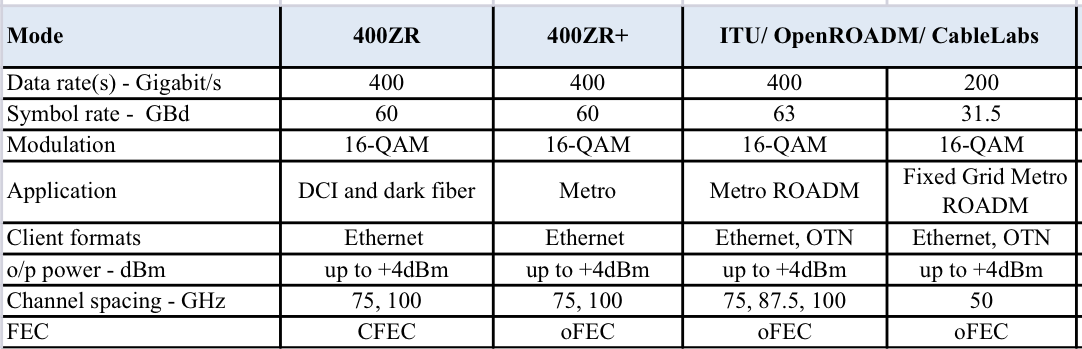
The pluggable has custom extended-performance modes and supports three industry formats: the 400ZR interoperable standard, the 400ZR+ multi-source agreement (MSA), and the OpenROADM MSA. (See tables below).
IP over DWDM
Communications service providers (CSPs) want to add pluggable coherent modules to their IP routers, removing the need for a separate transponder card or box linking the router to the optical line system.
The advent of coherent QSFP-DD pluggables has meant the same form factor can be used for client-side and line-side optics, ensuring efficient use of the router ports.
The CSPs want the coherent QSFP-DD module to have sufficient optical performance to meet their demanding networking requirements. For example, the module’s output signal can pass through the filtering stages of reconfigurable optical add-drop multiplexers (ROADMs) along the optical link.
Optical amplification and filtering
Ciena’s coherent QSFP-DD adds a fibre-based optical amplifier and a tunable optical filter to the coherent photonics and electronic ICs.
The optical amplification enables the high-performance mode and the launching of a 4dBm output signal. In contrast, 400ZR and 400ZR+ have a launch power of -10dBm.
“This is the industry’s highest [QSDP-DD] transmit power,” says Xenos.
The tunable optical filter improves the optical performance of the coherent receiver.
In an optical line system with colourless ROADMs, the Erbium-doped fibre amplifiers (EDFAs) generate out-of-band transmission noise – amplified spontaneous emission (ASE). The noise sources superimpose and become significant, impairing wavelength and system performance dramatically.
The tunable optical filter eliminates this effect and simplifies deployment over any photonics line system. In addition, Ciena says the pluggables can now work alongside high-baud rate transponders in existing ROADM applications.
The QSFP-DD’s tunable optical filter means its optical performance closely matches that of the CFP2-DCO, aiding the two classes of pluggables working together.
Modes of operation
400ZR defines the module’s baseline coherent performance. The OIF developed the 400ZR standard so hyperscalers can link their equipment in two separate data centres up to 120km apart.
The 400ZR specification delivers just enough optical performance to meet the optical link budget. The OIF produced a low-cost, interoperable, pluggable coherent specification.
400ZR supports a single baud rate – 60 gigabaud (GBd), and modulation scheme – dual-polarisation 16-QAM, and carries Ethernet frames.
Google, Meta, Microsoft and Alibaba were all involved in the OIF development, with the 400ZR Implementation Agreement published in early 2020.
400ZR supports two-channel widths: 75GHz and 100GHz, while the forward error correction scheme used is CFEC.
The 400ZR+ MSA enhances the performance by supporting other data rates – 100, 200 and 300 gigabits-per-second (Gbps) – as well as 400Gbps. In addition, it uses several modulation schemes and the enhanced O-FEC error correction scheme that extends reach.
Ciena’s module also meets the OpenROADM MSA, supporting Ethernet and OTN and an enhanced reach at 400Gbps.

Ciena’s Universal module’s extended performance modes up the symbol rate to 65 and 70 gigabaud (GBd) and uses probabilistic constellation shaping (PCS).
PCS maps the bitstream onto the constellation to maximise the data recovery at the coherent receiver, thereby improving overall optical performance. The scheme also allows the fine-tuning of the data rate sent.
At ECOC, Ciena showed the module implementing the high-performance mode at 70GBd and PCS.
ECOC innovation award
The ECOC Exhibition Market Focus Advisory Committee awarded the most innovative product award to Ciena’s WaveLogic 5 Nano 400G Universal QSFP-DD.

Hyperscalers' needs drive a new class of coherent DSP

Coherent digital signal processors (DSPs) companies have supported two families of coherent chips for some time. That’s because no single coherent DSP can meet all the market’s requirements.
The coherent DSP used for highest-performance optical transmissions must include advanced coding techniques, forward error correction, and a high symbol rate to send as much data as possible on a single wavelength and maximise reach.
In contrast, a DSP for coherent pluggable modules needs to be power-efficient and compact to meet the optical module’s power envelope and size constraints; a 400ZR QSFP-DD and a CFP2-DCO 400ZR+ being examples.
According to Ciena, now there is a need for a third category of coherent DSP for 1.6 terabit-per-second (Tbps) and 3.2Tbps transmissions over short distances for next-generation switch routers.
Carrying data centre payloads
The need comes from the hyperscalers, as with most emerging coherent optical applications. The new coherent DSP design is needed since it is the only way to support multi-terabit data rates for this application, says Ciena.
“Data centre switch routers with new 51.2- and 102.4-terabit switch chipsets will need greater than 400 gigabit-per-wavelength connectivity,” said Helen Xenos, senior director, portfolio marketing at Ciena, during a talk at NGON & DCI World, held in Barcelona in June.
The coherent DSP will connect equipment within a data centre and between data centre buildings on campus. A 1-10km reach for the 1.6Tbps or 3.2Tbps wavelength transmissions is needed using an industry-standard pluggable such as a QSFP-DD or a OSFP pluggable form factor.
“It would have to be a specific, very low-cost design,” says Xenos.
Coherent evolution
Applications using coherent optical technology continue to grow.
Subsea, long-haul, metro, and 80-120km data centre interconnect are all well-known markets for coherent optics, said Xenos. Now, coherent is moving to the access network and for unamplified single-channel links.
“There is no one coherent optical design that will be cost-optimal across all of these applications,” said Xenos. “This is why multiple coherent optical modem designs are required.”
Xenos last presented at NGON & DCI World in pre-pandemic 2019. Then, the questions were whether 800-gigabit wavelengths would be needed and what optical performance 400-gigabit coherent pluggables would deliver.
Much has since changed. There has been a broad deployment of optical transport equipment using 800-gigabit wavelengths while the coherent pluggable market has gone from strength to strength.
For the high-end, up to 800 gigabits per wavelength, 7nm CMOS DSPs are used, operating at a symbol rate of 90-110 gigabaud (GBd).
For 400-gigabit coherent pluggables operating, the symbol rate is 60-70GBd, while the optics used is mainly silicon photonics.
800-gigabit market
Ciena started shipping 800-gigabit capable optical modules in April 2020.
Since then, the company has seen strong uptake, with hyperscalers leading the way.

Also, a broad deployment of colourless, flexible grid optical line systems has helped 800-gigabit technology adoption.
Xenos cited, among others, Altibox, which brings high capacity connectivity from Norway to key digital hubs in Europe.
“They turned up the longest 800-gigabit wavelength between Copenhagen and Amsterdam, and that was over 1,100 kilometres,” she said.
400-gigabit pluggables
Xenos points out that there has been a halving of the power-per-bit at 400Gbps.
 Source: Ciena.
In 2017, Ciena offered a 400-gigabit 60GBd modem design in a 5×7-inch package.
“Now we have a pluggable 400-gigabit QSFP-DD at 60GBd pluggable, so the same type of design, the same simple feature set required with a 400ZR,” said Xenos.
Optical performance is also being pushed to 70GBd in the QSFP-DD, with the module having a higher output power.
Near-term designs
Ciena says the next two to three generations of coherent DSPs will use 5nm and 3nm CMOS.
New promising materials for optical modulation are emerging, such as thin-film lithium niobite, and barium titanate, which is compatible with silicon photonics.
“[A] Higher baud [rate] will reduce cost-per-bit and get more capacity using a single wavelength,” says Xenos. “Also, there will be more intelligence and programmability as we move forward to enable more automated networks.”
She says a 160GBd symbol rate is needed to send 800 gigabits over long-distance spans.
The key for all the different modem designs is to develop something better while choosing the right technologies so that new products are available promptly.
“It’s essential to make the right technology choice that will give the right reliability and be commercially available,” says Xenos.
Three nanometre CMOS promises more significant performance benefits for a DSP design, but developing the process technology is challenging for the leading chip fabrication plants. In addition, a 3nm CMOS process will be costly.
Award
Ciena won the optical vendor of the year award, one of the five prizes presented at the NGON & DCI World show.

Books read in 2021: Part 2

In Part II, two more industry figures pick their reads of the year: Sara Gabba of II-VI and Ciena’s Joe Marsella.
Sara Gabba, Strategic Marketing, II-VI
I’ve always read a lot. I cannot fall asleep without the sweet or the exciting company of a good book!
In the last year, I’ve spent many evenings reading fairy tales to my young daughter and, on top of the traditional ones from Andersen or the Grimm brothers, I’ve surprisingly discovered that she really likes the Greek myths (in an adaptation for children), which are the archetypes of most of the ‘modern’ tales. Love, mystery, jealousy, fear, talent, heroism: all the instincts and passions of humankind are there and able to capture every reader.
Coming to the books that I enjoyed most this past year, I’ll mention three, beginning with L’infinito Tra Le Note: Il Mio Viaggio Nella Musica (My Journey into Music) by the famous orchestra director Riccardo Muti.
In simple words, he leads you through the history of music, disclosing the essence of the main composers and the secrets that are hidden among their notes and silences, all filtered by his sensitivity and his long experience as director of the world’s most important orchestras.
Galeotto fu il collier (A Gallehault was the Collier) is an amusing book from the prolific and always brilliant pen of Andrea Vitali, an Italian writer whose novels typically take place in Bellano, a nice village on the eastern shore of the Lake of Como where he was born and worked as a general practitioner. Bellano is indeed a charming village, in addition to the well-known Bellagio.
This book is a choral novel, able to recreate the atmosphere of common life in 1930’s Italy. The comedy lies in the everyday routine of the many simple characters, in the plot full of anecdotes and of said-unsaid words: an amazing and wonderful comedy of errors!
Lastly, I really loved Liar Moon written by the Italian-American writer, Ben Pastor.
This romance is the second of the saga featuring Martin Bora, the Major of the Wehrmacht whose character was inspired by Claus von Stauffenberg, the German colonel who attempted to assassinate Adolf Hitler in 1944 (maybe you remember the Tom Cruise movie Valkyrie, also inspired by von Stauffenberg’s brave acts).
This historical mystery novel takes place in the North-East region of Italy during the German occupation in the Second World War, where the skilled army officer Bora solves a complex murder case. Martin Bora is fighting for the wrong side in the world conflict, so he obviously has all the characteristics to be a villain. However, he is far from being a stereotype and you cannot avoid but to love him for his torn sense of loyalty to his nation and his daring acts of disobedience to the criminal orders received from his commanders.
Joe Marsella, Vice President, Product Line Management, Routing and Switching at Ciena.
As an evolving society, we often tend to look back on the ‘good old days’ and lament how difficult life has become, often forgetting that as a whole we are much better off than we have ever been.
History, for me, is a healthy way of not only reminding oneself of that simple fact but also serving as an opportunity to learn from past experiences to improve the journey ahead.
With that in mind, one book I found extremely interesting in 2021 is One Minute to Midnight: Kennedy, Khrushchev, and Castro on the Brink of Nuclear War by Michael Dobbs, which tells the story of the days leading up to the Cuban Missile Crisis of 1962 and how close the world came to nuclear annihilation.
The story focuses on how quickly a series of decisions can escalate over a 13-day time frame and the ability of two opposing leaders to reach a compromise for the greater good of not only their respective countries but the world.
As business leaders, we are required to make decisions and negotiate constantly, and while our negotiated outcomes rarely reach the magnitude of Kennedy and Khrushchev in the fall of 1962, it’s reassuring to know that even in the most difficult circumstances agreements can be reached with mutually beneficial results.

Infinera’s ICE6 sends 800 gigabits over a 950km link

Infinera has demonstrated the coherent transmission of an 800-gigabit signal across a 950km span of an operational network.
Infinera used its Infinite Capacity Engine 6 (ICE6), comprising an indium-phosphide photonic integrated circuit (PIC) and its FlexCoherent 6 coherent digital signal processor (DSP).
The ICE6 supports 1.6 terabits of traffic: two channels, each supporting up to 800-gigabit of data.
The trial, conducted over an unnamed operator’s network in North America, sent the 800-gigabit signal as an alien wavelength over a third-party line-system carrying live traffic.
“We have proved not only the state of our 800-gigabit with ICE6 but also the distances it can achieve,” says Robert Shore, senior vice president of marketing at Infinera.
800G trials
Several systems vendors have undertaken 800-gigabit optical trials.
Ciena detailed two demonstrations using its WaveLogic 5 Extreme (WL5e). One was an interoperability trial involving Verizon and Juniper Networks while the second connected two data centres belonging to the operator, Southern Cross Cable, to confirm the deployment of the WL5e cards in a live network environment.
Neither Ciena trial was designed to demonstrated WL5e’s limit of optical performance. Accordingly, no distances were quoted although both links were sub-100km, according to Ciena.
Meanwhile, Huawei has trialled its 800-gigabit technology in the networks of operators Turkcell and China Mobile.
The motivation for vendors to increase the speed of line-side optical transceivers is to reduce the cost of data transport. “One laser generating more data,” says Shore. “But it is not just high-speed transmissions, it is high-speed transmissions over distance.”
Infinera’s first 800-gigabit demonstration involved the ICE6 sending the signal over 800km of Corning’s TXF low-loss fibre.
“We did the demo on that fibre and we realised we had a ton of margin left over after completing the 800-gigabit circuit,” says Shore. The company then looked for a suitable network trial using standard optical fibre.
Infinera used a third-party’s optical line system to highlight that the 950km reach wasn’t due to a combination of the ICE6 module and the company’s own line system.
“What we have shown is that you can take any link anywhere, use anyone’s line system, carrying any kind of traffic, drop in the ICE6 and get 800-gigabit connections over 950km,” says Shore.
ICE 6
Infinera attributes the ICE6’s optical performance to its advanced coherent toolkit and the fact that the company has both photonics and coherent DSP technology, enabling their co-design to optimise the system’s performance.
One toolkit technique is Nyquist sub-carriers. Here, data is sent using several Nyquist sub-carriers across the channel instead of modulating the data onto a single carrier. The ICE6 is Infinera’s second-generation design to use sub-carriers, the first being ICE4, that doubles the number from four to eight.
The benefit of using sub-carriers is that high data rates can be achieved while the baud rate used for each one is much lower. And a lower baud rate is more tolerant to non-linear channel impairments during optical transmission.
Sub-carriers also improve spectral efficiency as the channels have sharper edges and can be packed tightly.
Infinera applies probabilistic constellation shaping to each sub-carrier, allowing fine-tuning of the data each carries. As a result, more data can be sent on the inner sub-carriers and less on the outer two outer sub-carrier where signal recovering is harder.
The sweet spot for sub-carriers is a symbol rate of 8-11 gigabaud (GBd). For the Infinera trial, eight sub-carriers were used, each at 12GBd, for an overall symbol rate of 96GBd.
“While it is best to stay as close to 8-11GBd, the coding gain you get as you go from 11GBd to 12GBd per sub-carrier is greater than the increased non-linear penalties,” says Shore.
Another feature of the coherent DSP is its use of soft-decision forward-error correction (SD-FEC) gain sharing. By sharing the FEC codes, processing resources can be shifted to one of the PIC’s two optical channels that needs it the most.
The result is that some of the strength of the stronger signal can be traded to bolster the weaker one, extending its reach or potentially allowing a higher modulation scheme to be used.
Applications
Linking data centres is one application where the ICE6 will be used. Another is sub-sea optical transmission involving spans that can be thousands of kilometres long, requiring lower modulation schemes and lower data rates.
“It’s not just cost-per-bit and power-per-bit, it is also spectral efficiency,” says Shore. “And a higher-performing optical signal can maintain a higher modulation rate over longer distances as well.”
Infinera says that at 600 gigabits-per-second (Gbps), link distances will be “significantly better” than 1,600km. The company is exploring suitable links to quantify ICE6’s reach at 600Gbps.
The ICE6 is packaged in a 5×7-inch optical module. Infinera’s Groove series will first adopt the ICE6 followed by the XTC platforms, part of the DTN-X series. First network deployments will occur in the second half of this year.
Infinera is also selling the ICE6 5×7-inch module to interested parties.
XR Optics
Infinera is not addressing the 400ZR coherent pluggable module market. The 400ZR is the OIF-defined 400-gigabit coherent standard developed to connect equipment in data centres up to 120km apart.
Infinera is, however, eyeing the emerging ZR+ opportunity using XR Optics. ZR+ is not a standard but it extends the features of 400ZR.
XR Optics is the brainchild of Infinera that is based on coherent sub-carriers. All the sub-carriers can be sent to the same destination for point-to-point links, but they can also be sent to different locations to allow for point-to-multipoint communications. Such an arrangement allows for traffic aggregation.
“You can steer all the sub-carriers coming out of an XR transceiver to the same destination to get a 400-gigabit point-to-point link to compete with ZR+,” says Shore. “And because we are using sub-carriers instead of a single carrier, we expect to get significantly better performance.”
Infinera is developing the coherent DSPs for XR Optics and has teamed up with optical module makers, Lumentum and II-VI.
Other unnamed partners have joined Infinera to bring the technology to market. Shore says that the partners include network operators that have contributed to the technology’s development.
Infinera planned to showcase XR Optics at the OFC conference and exhibition held recently in San Diego.
Shore says to expect XR Optics announcements in late summer, from Infinera and perhaps others. These will detail the XR Optics form factors and how they function as well as the products’ schedules.

ECOC 2019 industry reflections II

Gazettabyte requested the thoughts of industry figures after attending the ECOC show, held in Dublin. In particular, what developments and trends they noted, what they learned and what, if anything, surprised them. Input from II-VI, Ciena, Fujitsu Optical Components and Acacia Communications. The second and final part.
State of play for 400 Gigabit Ethernet (GbE). Form factors ‘right-sized’ for faceplate densities
Sanjai Parthasarathi, chief marketing officer at II-VI
One new theme at ECOC is the demand for lower-cost 100-gigabit coherent transceivers for deployment in optical access for wireless access and fibre-deep cable TV. Such demand would significantly expand the market.
It was noteworthy at the show how 5G has become a significant factor influencing the wireless access market, with the potential for wide deployment of dense wavelength-division multiplexing (DWDM) technology with wavelength switching and tuning functions, not only in traditional network architectures but interesting new ones too.
This could drive significant demand for low-cost wavelength-selective switch (WSS) modules, tunable transceivers and 100-gigabit coherent transceivers, which is exciting.
As for surprises at the show, ECOC validated the view that developments in digital signal processor (DSP) technology for transceivers have accelerated to the point of having caught up with the state-of-the-art in photolithography, previously the province of DSPs for consumer electronics, high-performance computing and processors.
DSPs, for next-generation transceivers, are increasingly leveraging 7nm CMOS.
Patricia Bower, senior manager of product marketing at Ciena
A key talking point at ECOC was the state of play for 400 Gigabit Ethernet (GbE). Form factors ‘right-sized’ for faceplate densities – QSFP-DD, for example – and developments in short-range optical signalling supporting 100 gigabit-per-lambda are enablers for this next-generation client rate.
Market projections for 400GbE indicate a faster ramp for 400GbE than for 100GbE in previous years and that 400GbE client-side modules will ship in 2020 with broad, market-wide volumes ramping in 2021.
In parallel, 400-gigabit DWDM is projected to grow very strongly. Starting in early 2020, deployments of 800 gigabit-capacity DWDM systems will enable the industry to efficiently transport 400GbE anywhere in the network, including transoceanic propagation.
Following this, 400ZR will enable 400 gigabits-per-second over short point-to-point, single-span data centre interconnect links using coherent technology in the same compact QSFP-DD mechanical forms which will go hand-in-hand with the volume uptake of 400GbE.
Co-packaged optics
Discussions continued around approaches to package optics and electronics in switch-fabric ICs.
The consensus was that the approach will be mainstream in future 51.2 terabits-per-second (Tbps) switch chips, a couple of iterations from where we are today.
I learned more about the progress supporting wafer-scale manufacturability of co-packaged switch cores and optical input/ outputs, including on-chip laser integration.
Consideration of the relative trade-offs among power dissipation, cost, thermal management, and reliability compared to off-chip lasers are key. Electrical signalling also remains key in this approach. Even moving data off a chip package optically, electrical intra-chip signaling to the switching core is still needed for what effectively is a multi-chip module or modular system-on-chip.
Companies with key design skills in electrical and optical components will be best placed to address such designs.
I wasn’t surprised but pleased to see the progress by the industry for 400ZR demonstrated at the OIF booth. Various companies showed IC-TROSA electro-optic samples which is a contributing element for a 400ZR solution.
Mechanical mock-ups of the intended module packages (QSFP-DD and OSFP) were also shown as well as a mock-up of a switch-router platform to highlight 400ZR integration.
This level of progress is in line with the expected ramp-up of 400ZR in 2021.
Yukiharu Fuse, chief marketing officer, vice president/ general manager, business strategy division, Fujitsu Optical Components Limited
Several items were of interest at ECOC, but two I’d highlight are 400-gigabit coherent pluggable optics and XR Optics.
Vendors demonstrated the progress being made in the development of 400-gigabit coherent pluggable transceivers.
The key is their success is the development of a low-power coherent digital signal processor (DSP) that fits within a QSFP-DD or OSFP module, and this now seems feasible.
With this innovation, data centre operators will be able to install these modules in the slots used for client Ethernet, allowing the operators to support data centre interconnect without the need for transport gear.
The OIF-standardised 400ZR implementation will support linking data centres up to 120km apart using interoperable pluggable modules. The data centre operators also want longer reaches that ZR offers even if the power consumption of the transceiver inevitably goes up.
To address this, NEL and Acacia together with Lumentum and Fujitsu Optical Components introduced OpenZR+ to support longer distance links for data centre interconnect and other applications.
This will act as a potential de-facto standard with multi-source transceivers to support distances beyond ZR.
Such a development will be a big step for the data center operators, enabling wider coverage without the need for transport equipment.
XR Optics
Infinera introduced at ECOC a new concept of point-to-multi-point communications for access and aggregation network, dubbed XR Optics. Using Nyquist subcarriers, XR Optics can distribute up to 16 points according to the bandwidth requirements.
This concept may create a new market for coherent optics that until now has focussed on high-capacity, point-to-point applications.
Infinera introduced at ECOC a technology not a product. It will be interesting to see how the technology evolves into products and the support it gets with the goal of creating a multi-source supply chain.
I’m curious about the concept, though, with the key being how to achieve low-cost coherent optics needed for access and aggregation networks. I will watch this development with interest.
Tom Williams, vice president of marketing, Acacia Communications
We are seeing a trend toward increasing use of silicon photonics in client and transport optics. There are multiple approaches in the industry to address the challenges of power, size and cost, but silicon photonics has become established as an important technology for a variety of applications.
We were also happy to see the positive feedback for the OpenZR+ solution that we, in collaboration with several other companies, defined at the show.
I’ve participated in the 400ZR effort and the CableLabs project to define a coherent interface in access networks, so I was interested to learn more about the Infinera XR optics proposal. I’m still trying to understand the details, but it’s always interesting to see a different approach to solving a technical challenge.
As for unexpected developments at the show, I was surprised how difficult it can be to get a taxi in Dublin when Ariana Grande is in town!