

ADVA targets access with its latest pluggable module
- The 25 gigabit-per-second (Gbps) SFP28 is self-tuning and has a reach of 40km
- ADVA’s CEO, Christoph Glingener, in his plenary talk at ECOC 2022 addressed the unpredictable nature of technology adoption.
ADVA has expanded its portfolio of optical modules with an SFP28 for the access market.
The AccessWave25 is a self-tuning dense wavelength division multiplexing (DWDM) pluggable.
The SFP28 is designed to enable communications service providers to straightforwardly upgrade their access networks from 10Gbps to 25Gbps.
ADVA made the announcement just before ECOC 2022.
Features
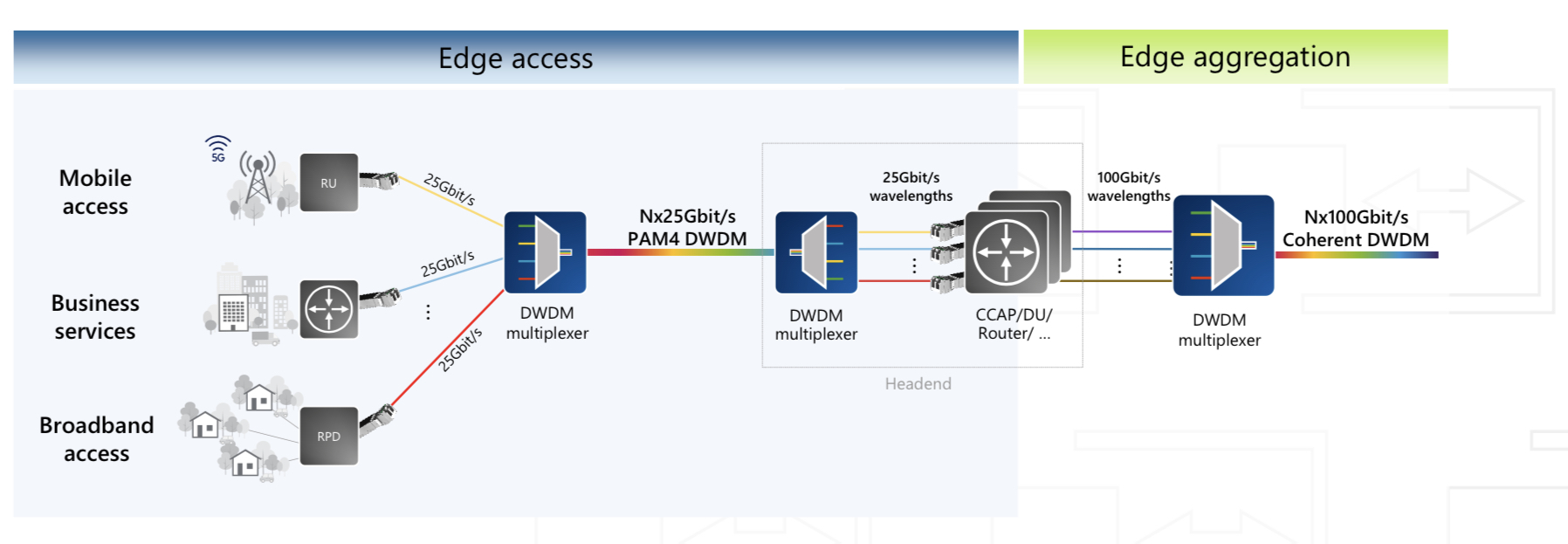
The SFP28 module links switches and routers to DWDM open-line systems (see diagram below).
The 40km-reach pluggable uses 4-level pulse amplitude modulation (PAM-4) and supports 25 gigabit Ethernet and eCPRI traffic.
The module uses the G.metro self-tuning standard to coordinate with the remote-end transceiver a chosen channel in the C-band, simplifying configuration and removing human error.
The G.metro communication channel also enables remote monitoring of the module.
The SFP28 consumes 3W and works over the extended temperature of -40 to 85oC.
Strategy
ADVA says vertical integration is a critical part of its Optical Engine unit’s strategy.
Saeid Aramideh, ADVA’s Optical Engine’s vice president of business development, says the unit focusses on such technology disciplines as silicon photonics, laser technology and digital signal processing.
The digital signal processing includes aggregation as with ADVA‘s MicroMux module products, PAM-4 used by the AccessWave25, and coherent as with its 100ZR module announced in June.
Advanced packaging is another technology area of interest.
“These are the fundamental innovation areas we focus on,” says Aramideh. “We build our product portfolio based on these platforms.”
ADVA also looks at the market to identify product gaps.
“Not so much every MSA module, but what is happening on the aggregation side,” says Aramideh. “What is it that other people are not paying attention to?”
This is what motivated ADVA’s MicroMux products. The MicroMux module family includes a 10-by-10 gigabit going into 100 gigabits, a 10-by-one gigabit into 10 gigabits, and a four-by-100 gigabit going into 400 gigabits.
“The reality is over 10,000 MicroMux modules are carrying traffic with a top tier-one network provider in Europe,“ says Aramideh. “Not on ADVA equipment but on other network equipment maker, which we haven’t made public.”
For access aggregation, ADVA unveiled at OFC its four-by-10 gigabit MicroMux Edge BiDi with a 40km reach.
“This is for Ethernet, backhaul, and services where fibre is limited and symmetric latency is important,” says Aramideh.
ADVA’s 100ZR module uses a coherent digital signal processor (DSP) developed with Coherent. The 100ZR is a QSFP28 module that dissipates 5W and reaches 300km.
Now, ADVA has added the AccessWave25, a tunable SFP28 that uses direct-detect technology and PAM-4, including ADVA’s IP for distance optimisation.
“The AccessWave25 works on legacy, so if you have a 10-gigabit network, you don’t have to change anything on the physical layer,” he says.
ADVA also looks at metro applications and says it will announce lower-power, smaller form factor coherent designs.
ECOC plenary talk
The CEO of ADVA, Christoph Glingener, gave a plenary talk at ECOC.
Entitled Never say never, Glingener reflected on technology adoption and its timing.
He pointed out how technologies that, at first, seem impractical or too difficult to adopt can subsequently become mainstream. He cited coherent optical communication as one example.
Glingener also discussed how such unpredictability impacts business, citing supply-chain issues, the global pandemic, and sovereignty.
Sovereignty and the influx of government capital for fibre rollout and semiconductors confirm that the optical communications industry is in a good place. But Glingener worries how the industry’s practitioners are ageing and stresses more needs to be done to attract graduates.
Tracing optical communications’ progress, he talked about the 15-year cycles of first direct detect and then fibre amplification. Coherent then followed in 2010.
The industry is thus ripe for breakthrough technology.

Reaching limits
Shannon’s limit means spectral efficiency no longer improves while Moore’s law’s demise continues. Near-term trends are clear, he says, parallelism, whether it is multiple spectrum bands, multiple fibres, or multiple fibre cores. This, in turn, will drive new optical amplifier and wavelength-selective switch designs.
Further optimisation will be needed, integration at the device level and the creation of denser systems. Network automation is also essential and that requires much work.
Glingener also argues for optical bypass rather than electrical packet processing. Large core routers overseeing routing at the IP and optical layer will not aid the greening of the internet.
Next wave
So what is the next technology wave?
Possibilities he cited include hollow-core fibre, photonic computing, and quantum entanglement for communications and the quantum internet.
Will they reach a large scale? Glingener is doubtful.
Whatever the technology proves to be, he said, it is likely already being discussed at ECOC 2022.
If he has a message for the audience, it is to apply their own filter whenever they hear people say, ‘it will never come,’ or ‘it is too difficult.’ Never say never, says Glingener.


ADVA and II-VI’s coherent partnership

- ADVA and II-VI have jointly developed a 100-gigabit coherent DSP
- Both companies plan to use the 2.0-2.5W, 7nm CMOS Steelerton DSP for a 100ZR QSFP28 module
- II-VI’s ASIC design team engineered the DSP while ADVA developed the silicon photonics-based optics.
ADVA and II-VI have joined forces to define a tiny coherent digital signal processor (DSP) that fits inside a QSFP28 optical module.
The Steelerton DSP can send a 100-gigabit dense wavelength-division multiplexing (DWDM) transmission over 80-120km, carrying wireless backhaul and access traffic.
“It is backhaul of broadband, it is backhaul of mobile, and it definitely moves outdoors,” says Christoph Glingener, CTO at ADVA.
The module also serves metro networks with its 300km reach using optical amplification.
II-VI and ADVA now join such established coherent players as Ciena, Huawei, Infinera, Nokia as well as Marvell, NEL, and Acacia, now part of Cisco.
Effect Photonics announced at OFC earlier this year its coherent market entry with its acquisition of the Viasat DSP team.
Motivation
ADVA says it entered the coherent DSP market after failing to find a design suited for backhaul, a coherent market that promises highest unit volumes.
Backhaul has become even more important market for ADVA given its merger with broadband equipment maker ADTRAN.
II-VI also notes how access rates are moving from 10 to 100 gigabits.
“We were looking to develop a DSP capable to target a market that is underserved and where we can differentiate. This analysis led us to the 100ZR with a purpose-built DSP solution” says John DeMott, vice president product management, coherent and tunable product lines at II-VI.
The 100-gigabit coherent market for access contrasts with 400-gigabit coherent that uses modules such as 400ZR and 400ZR+ to connect data centres.
ADVA did consider existing suppliers’ coherent DSPs but deemed them too big and power-hungry for this application. This is what led to the II-VI partnership.
“We found a partner in II-VI that was willing to do this, but to get to the required power envelopes, we needed a 7nm DSP,” says Glingener. “And 7nm CMOS technology is not cheap.“
II-VI has a staff of mixed-signal and ASIC engineers in Germany that designed the Steelerton chip.
The two firms now have their own 100-gigabit DSP and can start developing coherent product roadmaps.
Applications
The 100ZR module will be deployed at aggregation sites.
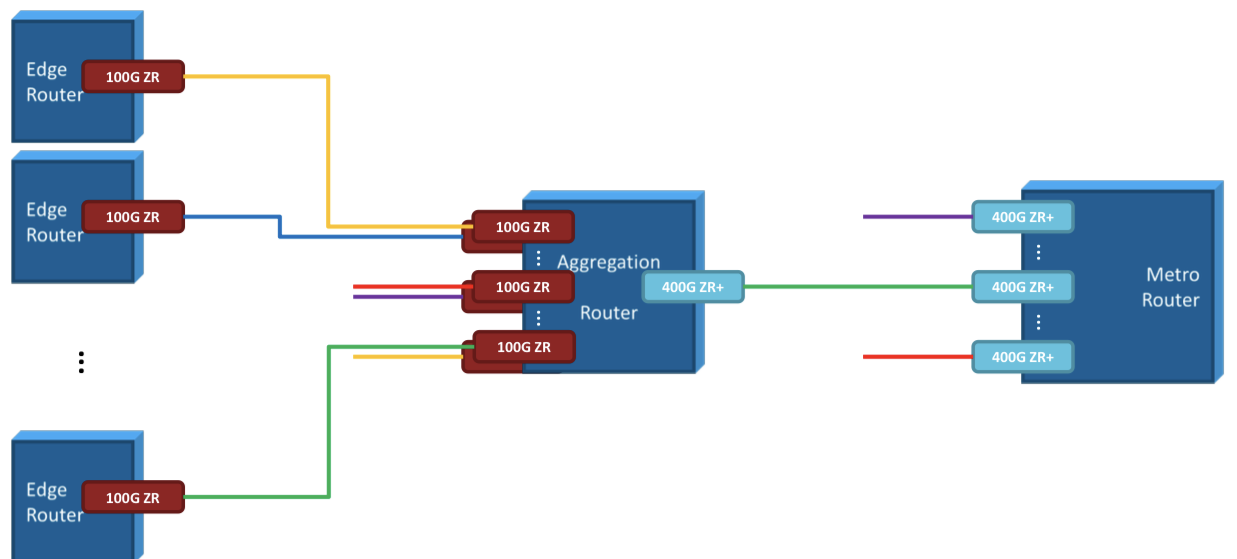
ADVA shows how the 100ZR module is used for edge aggregation (see diagram).


Another application is 100-gigabit data-centre interconnect (DCI) for enterprises; hyperscalers require 400 gigabit and higher rates for DCI.
II-VI says the DSP is suited for access and metro applications. The 100ZR module fits a wavelength in a 50GHz channel to enable 96 DWDM wavelengths across the C-band. The 100ZR module has a maximum reach of 300km when used with amplification.
“The 22dB loss budget supports up to 80km without in-line amplification and up to 300km with in-line amplification, limited by chromatic dispersion,” says DeMott.
II-VI highlights several use-cases for the 100ZR module.
One is IP-over-DWDM, connecting edge routers to an aggregation router (see diagram) or a muxponder. The aggregated 100-gigabit wavelengths are sent to a metro router using a 400-gigabit 400ZR+ coherent module. II-VI also has 400ZR+ modules.
Two factors dictate the 100ZR module design: power consumption and the form factor.
Even a module power consumption of 10W is too high for access. Also, the DSP and optics must fit inside a QSFP28 since this is a common form factor for access equipment uplinks.
The resulting DSP has a power consumption of 2.0-2.5W and the chip is a fifth the size of other 7nm coherent DSPs. The 100ZR QSFP28 module – the DSP and optics – consumes 5.0-5.5W.
The DSP is stripped down to its essential features to achieve the power target. For example, the DSP uses one modulation format only: dual-polarisation, quadrature phase-shift keying (DP-QPSK).
“You de-feature the DSP down to a level that you can meet the power envelope, and it is not that complicated anymore,” says Glingener.
ADVA developed the silicon photonics analogue front end for the module that uses a single laser. To fit the DSP and the optics in a QSFP28 also proved an integration challenge.
The Steelerton DSP is taped out and both companies expect to have 100ZR prototype modules in the second half of this year.
What next
ADVA is planning a 100ZR+ module that will have enhanced optical performance that will be available in prototype form in early 2023.
ADVA’s coherent module interest remains broadband. Possible developments include a 5nm CMOS 200-gigabit DSP or a cheaper, more power-efficient, second-generation 100-gigabit design.
ADVA is also exploring concepts such as a parallel design, a 4x100G implementation.
Meanwhile, II-VI is looking at high-end coherent designs, which may include multiple sources for silicon photonics
“The next obvious steps are 800 gigabits and 1.6 terabits,” says DeMott. “There is a lot of [industry] activity, so those would be directions we’re considering.” II-VI has in-house optics for high-end coherent designs.
There will be a market for 800-gigabit coherent modules, says DeMott, but hyperscalers already are asking for 1.6-terabit designs.
“These are divergent DSPs,” says DeMott. “You can’t do a DSP that does 1.6 terabits, 800 gigabits and 400 gigabits; it’s either a 1.6-terabit or a 400/ 800-gigabit DSP design.”