

Infinera unveils its next-gen packet-optical platforms
 Source: Infinera
Infinera has unveiled its latest metro products that support up to 200-gigabit wavelengths using CFP2-DCO pluggable modules.
The XTM II platform family is designed to support growing metro traffic, low-latency services and the trend to move sophisticated equipment towards the network edge. Placing computing, storage and even switching near the network edge contrasts with the classical approach of backhauling traffic, sometimes deep within the network.
“If you backhaul everything, you really do not know if it belongs in that part of the network,” says Geoff Bennett, director, solutions and technology at Infinera. Backhauling inherently magnifies traffic whereas operators want greater efficiencies in dealing with bandwidth growth, he says: “This is where the more cloud-like architectures towards the network edge come in.”
But locating equipment at the network edge means it must fit within existing premises or in installed prefabricated huts where space and the power supplied are constrained.
“If you are asking service providers to put more complex equipment there, then you need low power utilisation,” says Bennett. “This has been a key piece of feedback from customers we have been asking as to how they want our existing products to evolve in the metro-access.”
Having a distributed switch fabric is a long-term advantage for Infinera
Infinera says its latest XTM II products are eight times denser in terms of tranmission capacity while setting a new power-consumption low of 20W-27W per 100 gigabits depending on the operating temperature (25oC to 55oC). Infinera claims its nearest metro equipment competitor achieves 47W per 100 gigabits.
Sterling Perrin, principal analyst, optical networking and transport at Heavy Reading, says Infinera has achieved the power-efficient design by using a distributed switch architecture rather that a central switch fabric and adopting the CFP2-DCO pluggable module with its low-power coherent DSP.
“If you have a centralised fabric and you put it into an edge application then for some cases it will be a perfect fit but for many applications, it will be overkill in terms of capacity and hence power,” says Perrin. “Infinera is able to do it in a modular fashion in terms of just how much capacity and power is put in an application.”
Having a distributed switch fabric is a long-term advantage for Infinera for these applications, says Perrin, whereas competitor vendors will also benefit from the CFP2-DCO for their next designs.
And even if a competitor uses a distributed design, they will not leapfrog Infinera, says Perrin, although he expects competitors’ designs to come down considerably in power with the adoption of the CFP2-DCO.
Infinera has chosen not to use its photonic integrated circuit (PIC) technology for its latest metro platform given the large installed base of XTM chassis that already use pluggable modules. “It would make sense that customers would give feedback that they want a product that has industry-leading performance but which is also backwards compatible,” says Bennett.
Infinera has said it will evaluate whether its PIC technology will be applied to each new generation of the product line. “So when you get to the XTM III they will have another round looking at it,” says Perrin. “If I were placing bets on the XTM III, I would say they are going to continue down this route [of using pluggables].”
Perrin expects line-side pluggable technology to continue to progress with companies such as Acacia Communications and the collaboration between Ciena with its WaveLogic DSP technology and several optical module makers.
“At what point is the PIC going to be better than what is available with the pluggables?” says Perrin. “For this application, I don’t see it.”
XTM II family
Infinera has already been shipping upgraded XTM chassis for the last 18 months in advance of the launch of its latest metro cards. The upgraded chassis - the one rack unit (1RU) TM-102/II, the 3RU TM-301/II and the 11RU TM-3000/II - all feature enhanced power management and cooling.
What Infinera is unveiling now are three cards that enhance the capacity and features of the enhanced chassis. The new cards will work with the older generation XTM chassis (without the ‘II’ suffix) as long as a vacant card slot is available and the chassis’ total power supply is not exceeded. This is important given over 30,000 XTM chassis have been deployed.
The Infinera cards announced are the 400-flexponder, a 200-gigabit muxponder, and the EMXP440 packet-optical transport switch. The distributed switch architecture is implemented using the EMXP440 card.
Operators will also be offered Infinera’s Instant Bandwidth feature as part of the XTM II whereby they can pay for the line side capacity they use: either 100-gigabit or 200-gigabit wavelengths using the CFP2-DCO. The Instant Bandwidth offered is not the superchannel format available for Infinera’s other platforms that use its PIC but it does offer operators the option of deploying a higher-speed wavelength when needed and paying later.
400G flexponder
The flexponder can operate as a transponder and as a muxponder. For a transponder, the client signal and line-side data rate operate at the same data rate. In contrast, a muxponder aggregates lower data-rate client signals for transport on a single wavelength.
Infinera’s 400-gigabit flexponder card uses four 100 Gigabit Ethernet QSFP28 client interfaces and two 200-gigabit CFP2-DCO pluggable line-side modules. Each CFP2-DCO can transport data at 100 gigabits using polarisation-multiplexing, quadrature phase-shift keying (PM-QPSK) modulation or at 200 gigabits using 16-ary quadrature amplitude modulation (PM-16QAM).
The 400-gigabit card can thus operate as a transponder when the CFP2-DCO transports at 100 gigabits and as a muxponder when it carries two 100-gigabit signals over a 200-gigabit lambda. Given the card has two CFP2 line-side modules, it can even operate as a transponder and muxponder simultaneously.
The flexponder card also supports OTN block encryption using the AES-256 symmetric key protocol.
The flexponder is an upgrade on Infinera’s existing 100-gigabit muxponder card. The eightfold increase in capacity is achieved by using two 200-gigabit ports instead of a single 100-gigabit module and halving the width of the line card.
Using the flexponder card, the TM-102/II chassis has a transport capacity of 400 gigabits, up to 1.6 terabits with the TM-301/II and a total of 4 terabits using the TM-3000/II platform.
We can dial back the FEC if you need low latency and don't need the reach
200G muxponder
The double-width 200G card includes all the electronics needed for multi-service multiplexing. The line-side optics is a single CFP2-DCO module whereas the client side can accommodate two QSFP28s and 12 SFP+ 10-gigabit modules. The card can multiplex a mix of services including 10GbE, 40GbE, and 100GbE; 8-, 16- and 32-gigabit Fibre Channel; OTN and legacy SONET/SDH traffic.
Other features include support for OTN block encryption using the AES-256 symmetric key protocol.
The card’s forward error correction performance can also be traded to reduce the traffic latency. “We can dial back the FEC if you need low latency and don't need the reach,” says Bennett.
OTN add-drop multiplexing can also be implemented by pairing two of the multiplexer cards.
EMXP440 switch and flexible open line system
The EMXP440 packet-optical transport switch card supports layer-two functionality such as Carrier Ethernet 2.0 and MPLS-TP. “Mobile backhaul and residential broadband, these are the cards the operators tend to use,” says Bennett.
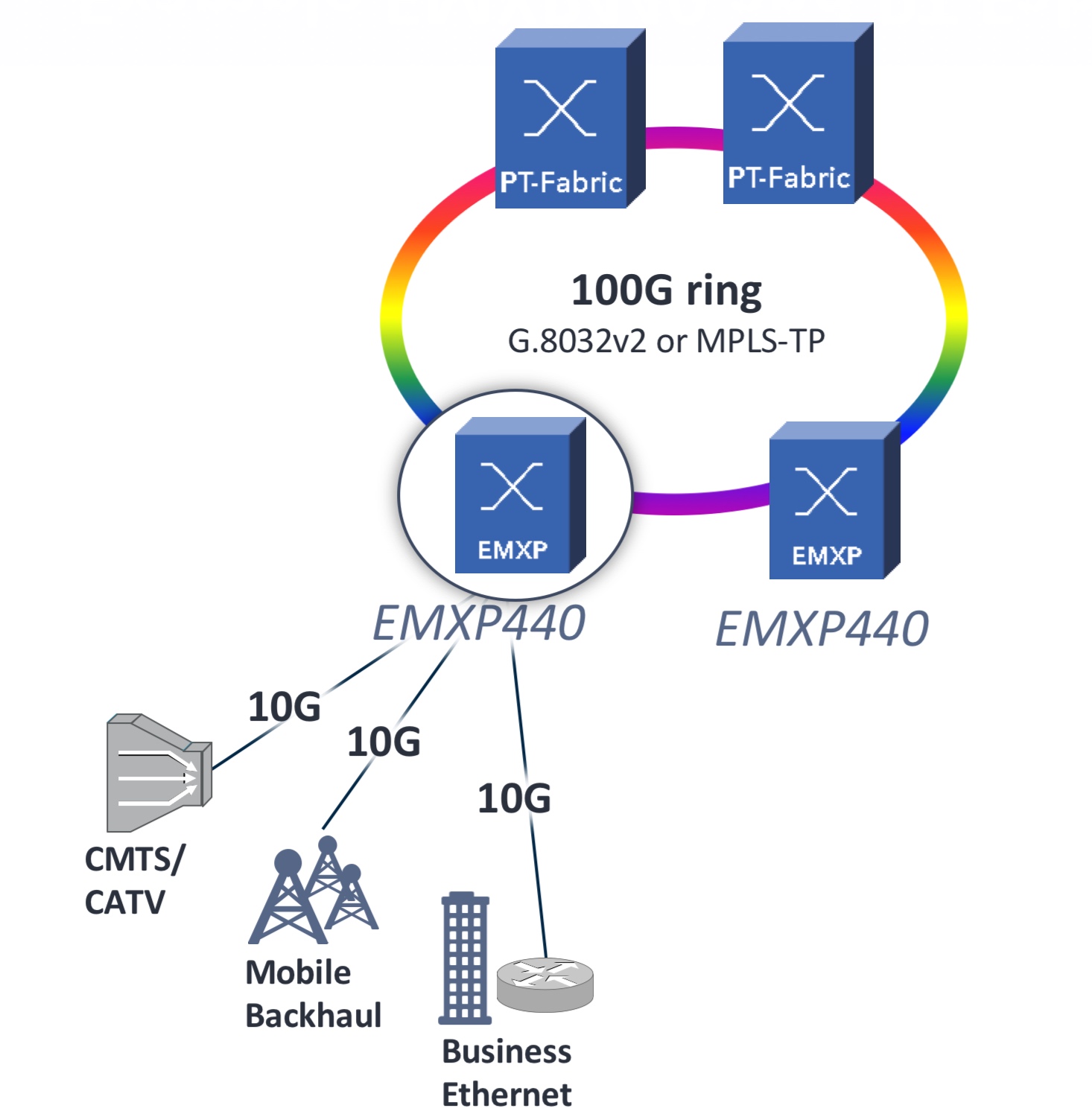
The two-slot EMXP440 card has two CFP2-DCOs and 12 SFP+ client-side interfaces. The reason why the line side and client side interface capacity differ (400 gigabits versus 120 gigabits) is that the card can be used to build simple packet rings (see diagram, top).
The line-side interfaces can be used for ‘East’ and ‘West' traffic while the SFP+ modules can be used to add and drop signals. The EMXP440 card also has an MPO port such that up to 12 SFP+ further ports can be added using Infinera’s PTIO-10G card, part of its PT Fabric products.
A flexible grid open line system is also available for the XTM II. The XTM II’s 100-gigabit and 200-gigabit wavelengths fit within a 50GHz-wide fixed grid channel but Infinera is already anticipating future higher baud rates that will require channels wider than 50GHz. A flexible grid also improves the use of the fibre’s overall capacity. In turn, RAMAN amplification will also be needed to extend the reach using future higher order modulation schemes such as 32- and 64-QAM.
Infinera says the 400-gigabit flexponder card will be available in the next quarter while the 200-gigabit muxponder and the EMXP440 cards will ship in the final quarter of 2017.

Acacia looks to co-package its coherent PIC and DSP-ASIC
- Acacia Communications is working to co-package its coherent DSP and its silicon photonics transceiver chip.
- The company is also developing a digital coherent optics module that will support 400 gigabit.
Acacia Communications is working to co-package its coherent DSP and its silicon photonics transceiver chip. The line-side optical transceiver company is working on a digital coherent optics module that will support 400 gigabits.
Acacia announced last November that it was sampling the industry’s first CFP2 Digital Coherent Optics (CFP2-DCO) that supports 100- and 200-gigabit line rates. The CFP2-DCO integrates the DSP and its silicon photonics chip within a CFP2 module, which is half the size of a CFP module, with each chip packaged separately.
The CFP2-DCO adds to the company’s CFP2-ACO design that was announced a year ago. In the CFP2-ACO, the CFP2 module contains just the optics with the DSP-ASIC chip on the same line card connected to the module via a special high-speed interface connector.
Now, Acacia is working to co-package the two chips, which will not only improve the performance of its CFP2-DCO but also enable new, higher-performance optical modules such as a 400-gigabit DCO. The Optical Internetworking Forum announced a new implementation agreement last December for an interoperable 400-gigabit ZR (80km) coherent interface.
Both [the DSP and silicon photonics chip] are based on CMOS processes. The next step for Acacia is to bring them into a single package.
Portfolio upgrades
Acacia has also upgraded its existing portfolio of coherent transceivers. The company has integrated the enhanced silicon photonics coherent transceiver in its AC100-CFP and its AC-400 5x7-inch modules.
The silicon-photonics transceiver achieves a more efficient coupling of light in and out of the chip and uses an improved modulator driver design that reduces the overall power consumption. The design also supports flexible grid, enabling channel sizes of 37.5GHz in addition to fixed-grid 50GHz channels.
The resulting AC100-CFP module has a greater reach of 2,500km and a lower power consumption than the first generation design announced in 2014. The enhanced PIC has also been integrated within the AC-400. The AC-400, announced in 2015, integrates two silicon photonics chips to support line rates of 200, 300 and 400 gigabits.
CFP2-DCO
Acacia is using the coherent transceiver photonic integrated circuit (PIC), first used in its CFP2-ACO, alongside a new coherent DSP to integrate the optics and DSP within the compact CFP2.
“The third-generation PIC is a mini PIC; in a gold box that is about the size of a dime, which is a third of the size of our original PIC,” says Benny Mikkelsen, founder and CTO of Acacia.
One design challenge with its latest DSP was retaining the reach of the original DSP used in the AC100-CFP while lowering its power consumption. Having an inherently low-power coherent DSP design in the first place is one important factor. Mikkelsen says this is achieved based on several factors such as the DSP algorithms chosen and how they are implemented in hardware, the clock frequencies used within the chip, how the internal busses are implemented, and the choice of bits-per-symbol used for the processing.
The resulting DSP’s power consumption can be further reduced by using an advanced CMOS process. Acacia uses a 16nm CMOS process for its latest DSP.
Other challenges to enable a CFP2-DCO module include reducing the power consumption of the optics and reducing the packaging size. “The modulator driver is the piece part that consumes the most power on the optics side,” says Mikkelsen.
Acacia's CFP2-DCO supports polarisation multiplexing, quadrature phase-shift keying (PM-QPSK) for 100 gigabits, and two modulation schemes: polarisation multiplexing, 8-ary quadrature amplitude multiplexing (PM-8QAM) and 16-ary QAM - for 200-gigabit line rates. In contrast, its -ACO supports just PM-QPSK and PM-16QAM.
At 100 gigabits, the DSP consumes about half the power of the Sky DSP used in the original AC100. Using PM-8QAM for 200 gigabits means the new DSP and optics support a higher baud rate - some 45 gigabaud compared to the traditional 32-35 gigabaud used for 100 and 200-gigabit transmission. However, while this increases the power consumption, the benefit of 8QAM is a 200-gigabit reach beyond 1,000km.
Mikkelsen stresses that a key reason the company can achieve a CFP2-DCO design is having both technologies in-house: “You can co-optimise the DSP and the silicon photonics”.
We think, at least in the near term, that the OSPF module seems to be a good form factor to work on
ACO versus DCO
Since Acacia now offers both the CFP2-ACO and CFP2-DCO modules, it is less concerned about how the relative demand for the two modules develops. “We don’t care too much which one is going to have the majority of the market,” says Mikkelsen. That said, Acacia believes that the CFP2-DCO market will become the larger of the two.
When the CFP2-ACO was first considered several years ago, the systems vendors and optical module makers shared a common interest. Systems vendors wanted to use their custom coherent DSP-ASICs while the -ACO module allowed component makers that didn't have the resources to develop their own DSP to address the market with their optics. It was also necessary to separate the DSP and the optics if the smaller CFP2 form factor was to be used.
But bringing CFP2-ACOs to volume production has proved more difficult than first envisaged. The CFP2-DCO is far easier to use, says Mikkelsen. The module can be plugged straight into equipment whereas the CFP2-ACO must be calibrated by a skilled optical engineer when a wavelength is first turned up.
Future work
Acacia is now looking at new module form factors and new packaging technologies. “Both [the DSP and silicon photonics chip] are based on CMOS processes,” says Mikkelsen. “The next step for Acacia is to bring them into a single package.”
In addition to the smaller size, a single package promises a slightly lower power consumption as well as manufacturing cost advantages. “We also expect to see higher performance once the DSP and optics are sitting next to each other which we believe will improve signal integrity between the two,” says Mikkelsen.
Acacia is not waiting for any industry challenges to be overcome for a single-package design to be achieved. The company points out that its silicon photonics chip is not temperature sensitive, aiding its co-packaging with the DSP.
Acacia is working on a 400-gigabit DCO design and is looking at several potential module types. The company is a member of the OSFP module MSA as well as the Consortium of On-Board Optics (COBO) which has started a coherent working group. “We think, at least in the near term, that the OSPF module seems to be a good form factor to work on,” says Mikkelsen.
NeoPhotonics samples its first CFP-DCO products
 The company has announced two such CFP Digital Coherent Optics (CFP-DCO) modules: a 100 gigabit-per-second (Gbps) module and a dual-rate 100Gbps and 200Gbps one.
“Our rationale [for entering the CFP-DCO market] is we have all the optical components and the [merchant coherent] DSPs are now becoming available,” says Ferris Lipscomb (pictured), vice president of marketing at NeoPhotonics. “It is possible to make this product without developing your own custom DSP, with all the expense that entails.”
-DCO versus -ACO
The pluggable transceiver line-side market is split between Digital Coherent Optics and Analog Coherent Optics (ACO) modules.
Optical module makers are already supplying the more compact CFP2 Analog Coherent Optics (CFP2-ACO) transceivers. The CFP2-ACO integrates the optics only, with the accompanying coherent DSP-ASIC chip residing on the line card. The CFP2-ACO suits system vendors that have their own custom DSP-ASICs and can offer differentiated, higher-transmission performance while choosing the optics in a compact pluggable module from several suppliers.
In contrast, the CFP-DCO suits more standard deployments, and for those end-customers that do not want to be locked into a single vendor and a proprietary DSP. The -DCO is also easier to deploy. In China, currently undertaking large-scale 100-gigabit optical transport deployments, operators want a module that can be deployed in the field by a relatively unskilled technician. Deploying an ACO requires an engineer to perform the calibration due to the analogue interface between the module and the DSP, says NeoPhotonics.
The DCO also suits those systems vendors that do not have their own DSP and do not want to source a merchant coherent DSP and implement the analogue integration on the line card.
Our rationale [for entering the CFP-DCO market] is we have all the optical components and the [merchant coherent] DSPs are now becoming available
One platform, two products
The two announced ClearLight CFP-DCO products are a 100 gigabit-per-second (Gbps) module implemented using polarisation multiplexing, quadrature phase-shift keying modulation (PM-QPSK), and a module that supports both 100Gbps and 200Gbps using PM-QPSK and 16 quadrature amplitude modulation (PM-16QAM), respectively.
The two modules share the same optics and DSP-ASIC. Where they differ is in the software loaded onto the DSP and the host interface used. The lower-speed module has a 4 by 25-gigabit interface whereas the 200-gigabit CFP-DCO uses an 8 by 25-gigabit-wide interface. “The 100-gigabit CFP-DCO plugs into existing client-side slots whereas the 200-gigabit CFPs have to plug into custom designed equipment slots,” says Lipscomb.
The 100-gigabit CFP-DCO has a reach of 1,000km plus and has a power consumption under 24W. Lipscomb points out that the actual specs including the power consumption are negotiated on a customer-by-customer basis. The 200-gigabit CFP-DCO has a reach of 500km.
NeoPhotonics says it is using a latest-generation 16nm CMOS merchant DSP. NTT Electronics (NEL) and Clariphy have both announced 16nm CMOS coherent DSPs.
“We are designing to be able to second-source the DSP,” says Lipscomb. “There are currently only two merchant suppliers but there are others that have developments but are not yet at the point where they would be in the market.”
The CFP-DCO modules also support flexible grid that can fit a carrier within the narrower 37.5GHz channel to increase overall transmission capacity sent across a fibre’s C-band.
NeoPhotonics’s 100Gbps CFP-DCO is already sampling and it expected to be generally available in mid-2017, while the 200Gbps CFP-DCO is expected to be available one-quarter later.
“For 200-gigabit, you need to have customers building slots,” says Lipscomb. “For 100-gigabit, there are lots of slots available that you can plug into; 200-gigabits will take a little bit longer.”
NeoPhotonics’ CFP-DCO delivers the line rate used by the Voyager white box packet optical switch being developed as part of the Telecom Infra Project backed by Facebook and ten operators including Deutsche Telekom and SK Telecom. But the one-rack-unit Voyager packet optical platform uses four 5"x7" modules not pluggable CFP-DCOs to achieve the total line rate of 800Gbps.
Roadmap
NeoPhotonics is developing coherent module designs that will use higher baud rates than the standard 32-35 gigabaud (Gbaud), such as 45Gbaud and 64Gbaud.
The company also plans to develop a CFP2-DCO. Such a module is expected around 2018 once lower-power DSP-ASICs become available that can fit within the 12W power envelope of the CFP2. Such merchant DSP-ASICs will likely be implemented in a more advanced CMOS process such as 12nm or even 7nm.
Acacia Communications is already sampling a CFP2-DCO. Acacia designs its own silicon photonics-based optics and the coherent DSP-ASIC.
NeoPhotonics is also considered future -ACO designs beyond the CFP2 such as the CFP8, the 400-gigabit OSFP form factor and even the CFP4. “We are studying it but we don't know yet which directions things are going to go,” says Lipscomb.
Corrected on Dec 22nd. The Voyager box does not use pluggable CFP-DCO modules.
600-gigabit channels on a fibre by 2017
NeoPhotonics has announced an integrated coherent receiver that will enable 600-gigabit optical transmission using a single wavelength. A transmission capacity of 48 terabits over the fibre’s C-band is then possible using 80 such channels.

NeoPhotonics’ micro integrated coherent receiver operates at 64 gigabaud, twice the symbol rate of deployed 100-gigabit optical transport systems and was detailed at the recent ECOC show.
Current 100 gigabit-per-second (Gbps) coherent systems use polarisation-multiplexing, quadrature phase-shift keying (PM-QPSK) modulation operating at 32 gigabaud. “That is how you get four bits [per symbol],” says Ferris Lipscomb, vice president of marketing at NeoPhotonics.
Optical designers have two approaches to increase the data transmitted on a wavelength: they can use increasingly complex modulation schemes - such as 16 quadrature amplitude modulation (16-QAM) or 64-QAM - and they can increase the baud rate. “You double the baud rate, you double the transmission capacity,” says Lipscomb. “And using 64-QAM and 64 gigabaud, you can go to 600 gigabit per channel; of course when you do that, you reduce the reach.”
The move to the higher 64 gigabaud symbol rate will help Internet content providers increase capacity between their large-scale data centres. Typical transmission distances between sites are relatively short, up to 100km.
Telcos too will benefit from the higher baud rate as it will enable them to use software-defined networking to adapt, on-the-fly, a line card’s data rate and reach depending on the link. Such a flexible rate coherent line card would allow 600Gbps on a single channel over 80km, 400 gigabit (16-QAM) over 400km, or 100 gigabit over thousands of kilometers.
Status
NeoPhotonics says it is now sampling its 64 gigabaud coherent receiver. It is still premature to discuss when the high-speed coherent receiver will be generally available, the company says, as it depends on the availability of other vendors’ components working at 64 gigabaud. These include the modulator, the trans-impedance amplifier and the coherent digital signal processor ASIC (DSP-ASIC).
Lipscomb says that a 64-gigabaud modulator in lithium niobate already exists but not in indium phosphide. The lithium niobate modulator is relatively large and will fit within a CFP module but the smaller CFP2 module will require a 64-gigabaud indium phosphide modulator.
“General availability will be timed based on when our customers are ready to go into production,” says Lipscomb. “Trials will happen in the first half of 2017 with volume shipments only happening in the second half of next year.”
Using 64-QAM and 64 gigabaud, you can go to 600 gigabit per channel
Challenges
A micro integrated coherent receiver has two inputs - the received optical signal and the local oscillator - and four balanced receiver outputs. Also included are two polarisation beam splitters and two 90-degree hybrid mixers.
Lipscomb says Neophotonics worked for over a year to develop its coherent receiver: “It is a complete design from the ground up.”
The slowest element sets the speed at which the receiver can operator such that the design not only involves the detector and trans-impedance amplifier but other elements such as the wirebonds and the packaging. “Everything has to be upgraded,” says Lipscomb. “It is not just a case of plopping in a faster detector and everything works.”
Nano-ICR and the CFP2-DCO
The industry is now working on a successor, smaller coherent detector dubbed the nano integrated coherent receiver (nano-ICR). “It has not all gelled yet but the nano-ICR would be suitable for the CFP2-DCO.”
The CFP2-DCO is a CFP2 Digital Coherent Optics pluggable module that integrates the coherent DSP-ASIC. In contrast, the CFP2 Analog Coherent Optics (CFP2-ACO) modules holds the optics and the DSP-ASIC resides on the line card.
“As the new DSPs come out using the next CMOS [process] nodes, they will be lower power and will be accommodated in the CFP2 form factor,” says Lipscomb. “Then the optics has to shrink yet again to make room for the DSP.”
Lipscomb sees the CFP2-ACO being used by system vendors that have already developed their own DSP-ASICs and will offer differentiated, higher-transmission performance. The CFP2-DCO will be favoured for more standard deployments and by end-customers that do not want to be locked into a single vendor and a proprietary DSP.
There is also the CFP2-DCO’s ease of deployment. In China, currently undertaking large-scale 100-gigabit optical transport deployments, operators want a module that can be deployed in the field by a relatively unskilled technician. “The ACOs with the analogue interface tend to require a lot of calibration,” says Lipscomb. “You can’t just plug it in and it works; you have to run it in, calibrate it and bring it up to get it to work properly.”
The CFP2-DCO module is expected in 2018 as the DSP-ASICs will require an advanced 12nm or even 7nm CMOS process.