

Nokia adds 400G coherent modules across its platforms

Nokia is now shipping its 400-gigabit coherent multi-haul CFP2-DCO. The module exceeds the optical performance of 400ZR and ZR+ coherent pluggables.
Nokia’s CFP2-DCO product follows its acquisition of silicon photonics specialist, Elenion Technologies, in 2020.
Nokia has combined Elenion’s coherent optical modulator and receiver with its low-power 64-gigabaud (GBd) PSE-Vc coherent digital signal processor (DSP).
Nokia is also adding coherent pluggables across its platform portfolio.
“Not just optical transport and transponder platforms but also our IP routing portfolio as well,” says Serge Melle, director of product marketing, IP-optical networking at Nokia.
“This [amplifier and filter] allows for much better optical performance,”
“This [amplifier and filter] allows for much better optical performance,”
Melle is an optical networking industry veteran. He joined Nokia two years ago after a 15-year career at Infinera. Melle started at Pirelli in 1995 when it was developing a 4×2.5-gigabit wavelength-division multiplexing (WDM) system. In between Pirelli and Infinera, Melle was at Nortel Networks during the optical boom.
400ZR, ZR+ and the multi-haul CFP2-DCO
The CFP2-DCO’s optical performance exceeds that of the QSFP-DD and OSFP form factors implementing 400ZR and ZR+ but is inferior to line-card coherent transponders used for the most demanding optical transport applications.
The 400ZR coherent OIF standard transmits a 400-gigabit wavelength up to 120km linking equipment across data centres. Being a standard, 400ZR modules are interoperable.
The ZR+ adds additional transmission speeds – 100, 200 and 300-gigabits – and has a greater reach than ZR. ZR+ is not a standard but there is the OpenZR+ multi-source agreement (MSA).
Implementing 400ZR and ZR+ coherent modules in a QSFP-DD or OSFP module means they can be inserted in client-side optics’ ports on switches and routers.
The OIF did not specify a form factor as part of the 400ZR standard, says Melle, with the industry choosing the QSFP-DD and OSFP. But with the modules’ limited power dissipation, certain modes of the coherent DSP are turned off, curtailing the feature set and the reach compared to a CFP2-DCO module.
The modules also have physical size restrictions.
“You don’t have enough thermal budget to put an optical amplifier inside the QSFP-DD package,” says Melle. “So you are left with whatever power the DWDM laser outputs through the modulator.” This is -7dBm to -10dBm for 400ZR and ZR+ optics, he says.
The CFP2-DCO is larger such that the DSP modes of encryption, OTN client encapsulation, LLDP snooping (used to gather data about attached equipment), and remote network monitoring (RMON) can be enabled.
The CFP2-DCO can also house an optical amplifier and tunable filter. The filter reduces the out-of-band optical signal-to-noise ratio (OSNR) thereby increasing the module’s sensitivity. “This [amplifier and filter] allows for much better optical performance,” says Melle. A 400-gigabit multi-haul module has a 0dBm optical output power, typically.
The different transceiver types are shown in the table.
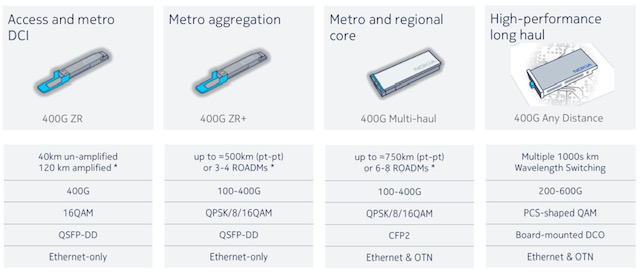
Nokia’s paper at the recent OFC virtual conference and exhibition detailed how its 400-gigabit multi-haul CFP2-DCO achieved a reach of 1,200km.
The paper details the transmission of 52, 400-gigabit signals, each occupying a 75GHz channel, for a total capacity of 20.8 terabits-per-second (Tbps).
Melle stresses that the demonstration was more a lab set-up than a live network where a signal goes through multiple reconfigurable optical add-drop multiplexers (ROADMs) and where amplifier stages may not be equally spaced.
That said, the CFP2-DCO’s reach in such networks is 750km, says Nokia.
IP-optical integration
Having coherent pluggables enables 400 Gigabit Ethernet (400GbE) payloads to be sent between routers over a wide area network, says Nokia.
“Given this convergence in form factor, with the QSFP-DD and ZR/ ZR+, you can now do IP-optical integration, putting coherent optics on the router without sacrificing port density or having locked-in ports,” says Melle.
Nokia is upgrading its IP and optical portfolio with coherent pluggables.
“In the routers, ZR/ ZR+, and in transponders not only the high-performance coherent optics – the [Nokia] PSE-Vs [DSP] – but also the CFP2-DCO multi-haul,” says Melle. “The 400-gigabit multi-haul is also going to be supported in our routers.”
Accordingly, Nokia has developed two sets of input-output (I/O) router cards: one supporting QSFP-DDs suited for metro-access applications, and the second using CFP2-DCO ports for metro and regional networks.
The choice of cards adds flexibility for network operators; they no longer need to have fixed CFP2-DCO slots on their router faceplates, whether they are used or not. But being physically larger, there are fewer CFP2-DCO ports than QSFP-DD ports on the I/O cards.
While the QSFP-DD MSA initially defined the module with a maximum power dissipation of 14.5W, a coherent QSFP-DD module consumes 18-20W. Dissipating the heat generated by the modules is a challenge.
Nokia’s airflow cooling is simplified by placing a module on both sides of the line card rather than stacking two CFP2-DCOs, one on top of the other.
Nokia is adding its CFP2-DCO to its 1830 optical transport portfolio. These include its PSI-M compact modular systems, the PSS transponder systems and also its PSS-x OTN switching systems.
The 400ZR/ZR+ module will be introduced with all its routing platforms this summer – the 7250 IXR, 7750 SR, 7750 SR-s, and the 7950 XRS, whereas the CFP2-DCO will be added to its 7750 and 7950 series later this year.
Nokia will source the 400ZR/ZR+ from third parties as well as from its optical networks division.
Its routers use QSFP-DD form-factor for all 400GbE ports and this is consistent for most router vendors in the industry. “Thus, our use and supply of 400ZR/ZR+ pluggable DCOs will focus on the QSFP-DD form-factor,” says Melle. However, the company says it can offer the OSFP form-factor depending on demand.
Network planning study
Nokia published a paper at OFC on the ideal coherent solution for different applications.
For metro aggregation rings with 4-5 nodes and several ROADM pass-throughs, using ZR+ modules is sufficient. Moreover, using the ZR+ avoids any loss in router port density.
For metro-regional core applications, the ZR+’s optical performance is mostly insufficient. Here, the full 400-gigabit rate can not be used but rather 300 gigabit-per-second (Gbps) or even 200Gbps to meet the reach requirements.
Using a 400-gigabit multi-haul pluggable on a router might not match the density of the QSFP-DD but it enables a full 400-gigabit line rate.
For long-haul, the CFP2-DCO’s performance is “reasonable”, says Nokia, and this is where high-performance transponders are used.
What the OFC paper argues is that there is no one-size-fits-all solution, says Melle.
800-Gigabit coherent pluggables
Traditionally, the IEEE has defined short-reach client-side optics while the OIF defines coherent standards.
“If we want this IP-optical convergence continuing in the next generation of optics, those two worlds are going to have to collaborate more closely,” says Melle.
That’s because when a form-factor MSA will be defined, it will need to accommodate the short-reach requirements and the coherent optics. If this doesn’t happen, says Melle, there is a risk of a new split occuring around the IP and optical worlds.
The next generation of coherent pluggables will also be challenging.
All the vendors got together in 2019 and said that 400ZR was just around the corner yet the modules are only appearing now, says Melle.
The next jump in pluggable coherent optics will use a symbol rate of 90-130GBd.
“That is very much the cutting-edge so it brings back the optics as a critical enabling technology, and not just optics but the packaging,” concludes Melle.


Lumentum ships a 400G CFP2-DCO coherent module

Lumentum has started supplying customers with its CFP2-DCO coherent optical module. Operators use the pluggable to add an optical transport capability to equipment.
The company describes the CFP2-DCO as a workhorse; a multi-purpose pluggable for interface requirements ranging from connecting equipment in separate data centres to long-haul optical transmission. The module works at 100-, 200-, 300- and 400-gigabit line rates.
The pluggable also complies with the OpenROADM multi-source agreement. It thus supports the open Forward Error Correction (oFEC) standard, enabling interoperability with oFEC-compliant coherent modules from other vendors.
“We are encountering a fundamental limit set by mother nature around spectral efficiency,”
“Optical communications is getting more diverse and dynamic with the inclusion of the internet content providers (ICPs) alongside traditional telecom operators,” says Brandon Collings, CTO at Lumentum.
The CFP2-DCO module is being adopted by traditional network equipment makers and by the ICPs who favour more open networking.
CFP2-DCOs modules from vendors support the OIF’s 400ZR standard that links switching and routing equipment in data centres up to 120km apart and more demanding custom optical transmission performance requirements, referred to as ZR+.
So what differentiates Lumentum’s CFP2-DCO from other coherent module makers?
Kevin Affolter, Lumentum’s vice president, strategic marketing for transmission, highlights the company’s experience in making coherent modules using the CFP form factor. Lumentum also makes the indium phosphide optical components used for its modules.
“We are by far the leading vendor of CFP2-ACO modules and that will go on for several years yet,” says Affolter.
Unlike the CFP2-DCO that integrates the optics and the digital signal processor (DSP), the earlier generation CFP2-ACO module includes optics only, with the coherent DSP residing on the line card.
The company also offers a 200-gigabit CFP2-DCO that has been shipping for over 18 months.
As a multi-purpose design, Affolter says some customers want to use the CFP2-DCO primarily at 200 gigabits for its long-haul reach while others want the improved performance of the proprietary 400-gigabit mode and its support of Ethernet and OTN clients.
“Each of the [merchant] DSPs has subtly different features,” says Affolter. “Some of those features are important to protect applications, especially for some of the hyperscalers’ applications.”
Higher baud rates
Lumentum did not make any announcements at the recent OFC virtual conference and show regarding indium phosphide-based coherent components operating at the next symbol rate of 128 gigabaud (GBd). But Collings says work continues in its lab: “This is a direction we are all headed.”
The latest coherent optical components operate at 100GBd, making possible 800-gigabit-per-wavelength transmissions. Moving to a 128GBd symbol rate enables a greater reach for the given transmission speed as well as the prospect of 1.2+ terabit wavelengths.
This means fewer coherent modules are needed to send a given traffic capacity, saving costs. But moving to a higher baud rate does not improve overall spectral density since a higher baud rate signal requires a wider channel.
“We are encountering a fundamental limit set by mother nature around spectral efficiency,” says Collings.
Optical transmission technology continues to follow the familiar formula where the more challenging high-end, high-performance coherent systems start as a line-card technology and then, as it matures, transitions to a more compact pluggable format. This trend will continue, says Collings.
The industry goal remains to scale capacity and reduce the dollars-per-bit cost and that applies to high-end line cards and pluggables. This will be achieved using greater integration and increasing the current baud rate.
“Getting capacity up, driving dollars-per-bit down is now what the game is going to be about for a while,” says Collings.
Whether the industry will go significantly above 128GBd such as 256GBd remains to be seen as this is seen as a technically highly challenging task.
However, the industry continues to demand higher network capacity and lower cost-per-bit. So Collings sees a couple of possible approaches to continue satisfying this demand.
The first is to keep driving down the cost of the 128GBd generations of transceivers, satisfying lower cost-per-bit and expanding capacity by using more and more transceivers.
The second approach is to develop transceivers that integrate multiple optical carriers into a single ‘channel’. A channel here refers to a unit of optical spectrum managed through the ROADM network. This would increase capacity per transceiver and lower the cost-per-bit.
“Both approaches are technical and implementation challenges and it remains to be seen which, or both, will be realised across the industry,” says Collings.
100-gigabit PAM-4 directly modulated laser
At OFC Lumentum announced that its 100-gigabit PAM-4 directly modulated laser (DML), which is being used for 500m applications, now supports the 2km-reach FR single-channel and FR4 four-channel client-side module standards.
This is a normal progression of client-side modules for the data centre where the higher performance externally-modulated laser (EML) for a datacom transceiver is the one paving the way. As the technology matures, the EML is replaced by a DML which is cheaper and has simpler drive and control circuitry.
“We started this [trait] with the -LR4 which was dominated by EMLs,” says Mike Staskus, vice president, product line management, datacom at Lumentum. “The fundamental cost savings of a DML is its smaller chip size, more chips per wafer, and fewer processes, fewer regrowths.”
The company is working on a 200-gigabit EML and a next-generation 100-gigabit DML that promises to be lower cost and possibly uncooled.
Reconfigurable optical add-drop multiplexers (ROADMs)
Lumentum is working to expand its wavelength-selective switches (WSSes) to support the extended C-band, and C- and L-band options as a way to increase transmission capacity.
“We are expanding the overall ROADM portfolio to accommodate extended C-band and more efficient C-band and L-band opportunities to continue to build capacity into ROADM networks,” says Collings. “As spectral efficiency saturation sets in, we are going to need more amplified bandwidth and more fibres, and the C- and L-bands will double fibre capacity.”
The work includes colourless and directionless; colourless, directionless and contentionless, and higher-degree ROADM designs.

WaveLogic 5: Packing a suitcase of ideas in 7nm CMOS
-
Ciena’s WaveLogic 5 coherent digital signal processor family comprises the Extreme and Nano chips
-
The WaveLogic 5 Extreme maximises optical capacity and transmission reach while the WaveLogic 5 Nano is targeted at compact, power-conservative applications

Kim Roberts
Advancing coherent optical transmission performance; targeting the emerging coherent pluggable market; selling modules directly, and the importance of being more vertically integrated. All these aspects were outlined by Cisco to explain why it intends to buy the coherent optical transmission specialist, Acacia Communications; a deal that is set to be completed in the spring of 2020.
But such strategic thinking is being pursued by Ciena with its next-generation WaveLogic 5 family of coherent DSPs.
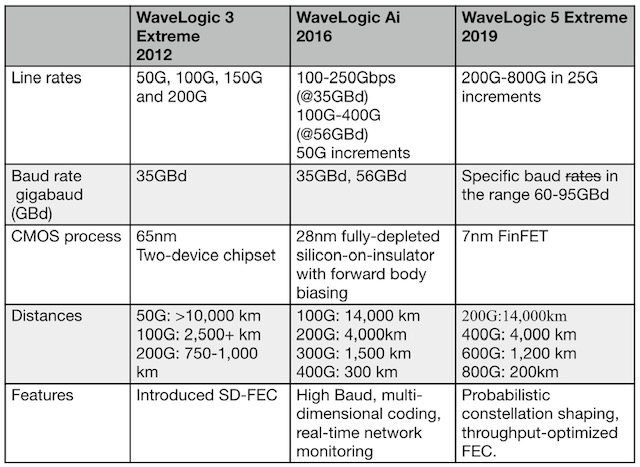
The WaveLogic 5 continues Ciena’s tradition of issuing a coherent digital signal processor (DSP) family approximately every three years: Ciena announced the WaveLogic 3 in 2012 and the WaveLogic Ai in 2016. (Add links).
The company has managed to maintain its three-yearly cadence despite the increasing sophistication of each generation of coherent DSP. For example, the WaveLogic 5 Extreme will support 800 gigabits-per-wavelength, double Ciena’s WaveLogic Ai that has been shipping for nearly two years.
Kim Roberts, vice president of WaveLogic science, says Ciena has managed to deliver its coherent DSPs in a timely manner since much of the algorithmic development work was done 5-6 years ago. The issue has been that certain features developed back then could not be included within the WaveLogic Ai.
WaveLogic 5 is implemented using a 7nm FinFET CMOS process whereas the WaveLogic Ai uses a 28nm specialist CMOS process known as fully-depleted silicon-on-insulator (FD-SOI).
“Seven-nanometer CMOS, due to its density and low heat, allows us to implement things that didn’t make the cut for the WaveLogic Ai,” says Roberts.
The company has a ‘suitcase of ideas’, he says, but not all of the concepts make it into any one generation of chip. “They have to justify performance versus schedule versus heat [generated],” says Roberts. “As we improve the technology, more features make the cut.”
And there are developments that will be included in future designs: “We keep refilling the suitcase,” says Roberts.
NAMING
Ciena first used the Extreme and Nano nomenclature with the WaveLogic 3. In contrast, the WaveLogic Ai, when launched in 2016, was a single-chip targeting the high-end. Ciena chose to change the naming scheme with the Ai since the chip signified a shift with features such as network monitoring.
However, Ciena highlights a key difference between the WaveLogic 3 and WaveLogic 5 families. The WaveLogic 3 Extreme and the WaveLogic 3 Nano could talk to each other on appropriate spans. In contrast, the two WaveLogic 5 chips are distinct. “They are not designed to interwork,” says Roberts.
NETWORKING TRENDS
Telecom service providers are investing in their networks to make them more adaptive. They want their networks to be scalable and programmable, says Ciena.
The operators also want to better understand what is happening in their networks and that requires collecting data, performing analytics and using software to configure their networks in an automated way.
“How do you get there? It is all about coherent technology,” says Helen Xenos, senior director, portfolio marketing at Ciena. “It is a critical element that is helping operators scale their networks.”
By enhancing the traffic-carrying capacity of fibre, coherent technology enables operators to reduce transport costs. “It allows them to be more competitive as they can do more with the hardware they deploy,” says Xenos.

Helen Xenos
Both telcos and cable operators are also applying coherent technology to new applications in their networks such as access.
These transport needs are causing a divergence in requirements.
One is to keep advancing optical performance in terms of the spectral efficiency and the traffic-carrying capacity of links. This is what the WaveLogic 5 Extreme tackles.
The second requirement - producing a compact coherent design for the network edge - is addressed by the WaveLogic 5 Nano.
For access designs, what is important is a compact design where the optics and the DSP can operate over an extended temperature range.
The Nano also addresses the hyperscalers’ need to connect their distributed data centres across a metro. “They need high capacity - 400 gigabits - and short-reach connectivity,” says Xenos. “It really needs to be the smallest footprint to maximise density.”
VERTICAL INTEGRATION
In addition to unveiling the WaveLogic 5 Extreme and Nano ICs, Ciena has outlined how it is more vertically integrated after investing in optics. In 2016, Ciena acquired the high-speed photonics division of Teraxion, gaining expertise in indium phosphide and silicon photonics expertise. {add link}.
Ciena is also now selling coherent optical modules. Gazettabyte revealed last year that Ciena was planning to sell modules using its own optics and WaveLogic technologies. {add link}
The company has no preference regarding indium phosphide and silicon photonics and uses what is best for a particular design.
“Silicon photonics buys you ease-of-manufacturing and cost; indium phosphide is what you need for 800 gigabits,” says Xenos.
Ciena stresses, however, that there is no simple formula as to when each is preferred. In terms of size and heat, silicon photonics has a strong advantage. “In terms of performance, you get better performance in some instances with indium phosphide and then there are overlaps because you bring in cost and other constraints,” says Roberts. “So there is no simple divide.”
“As we move forward, we are going to see an increasing percent of Ciena-custom components in WaveLogic coherent modems,” says Xenos.
Source: Gazettabyte
EXTREME
The WaveLogic 5 Extreme introduces several developments. It operates at specific baud rates ranging from 60 to 95 gigabaud. The baud rates are chosen so that both fixed-grid 100GHz channels and flexible grid ones are supported.
“For the best performance, you have flexible grid when 95 gigabaud is the primary baud rate,” says Roberts.
It is also Ciena’s first coherent DSP that uses probabilistic constellation shaping, a coding scheme used to achieve granular capacity increments. {add link}
“From 200 gigabits to 800 gigabits [in 25-gigabit increments], optimised over any path or the available margin,” says Roberts. “But what is unique about this is that it is optimised for non-linear propagation.”
Initially, the products using the WaveLogic 5 Extreme will use 50-gigabit increments. “This is what is required to service customers’ client requirements today: ten gigabits and multiples of 100-gigabit clients,” says Xenos.
>
“With 25-gigabit steps in client rate, the customer can choose to spend the margin on sending more bits”
The DSP uses four-wave frequency-division multiplexing to mitigate non-linear impairments, particularly beneficial for sub-sea systems.
Ciena says the four-wave frequency-division multiplexing is achieved electrically, reducing the optics to a minimum. “One laser and one modulator are used, so all the [cost-saving] economics of a single optical wavelength,” says Roberts. “But it has the non-linear performance of four tightly-coupled electrical systems.”
Ciena has also added an improved forward-error correction (FEC) scheme - a ‘throughput-optimised FEC’ - that uses variable overhead bits depending on the client rate.
“It will handle 8.6 percent errors compared to what we used in the WaveLogic Ai which handles 3.5 percent errors,” says Roberts. “So it is a decibel better.”
The Extreme chip also has improved link-monitoring capabilities. It monitors the signal-to-noise per channel as well as quantifies the non-linear contributions. “It helps people to understand what is happening in the network and create algorithms to optimise the capacity across the network,” says Xenos.
PROBABILISTIC CONSTELLATION SHAPING
Probabilistic shaping is used to improve the optical performance by lowering the signal energy by not using all the constellation points. Unless, that is, the full data rate is used and then all the constellation points are needed.
The degree of probabilistic shaping used is determined for each link. The parameters used to determine the probabilistic shaping are the amount of dispersion on the link, the span’s reach, and the transmitted client rate.
“The modem will measure what is going on in the link and the customer or some higher-level software will say what the client rate is,” says Roberts. “The modem will then figure out how to do the best non-linear probabilistic shaping to support that rate on the link.”
Roberts says other firms’ probabilistic shaping use one symbol at a time whereas Ciena use blocks, each comprising 128 symbols. “A bigger number would be better but I'm limited by my hardware,” says Roberts.
The 128 symbols equate to 1024 bits: four magnitude bits using 64-ary quadrature amplitude modulation (64-QAM) multiplied by two, one for each polarisation.
This means there are a total of 2^1024 combinations of 1024-bit sequences that could be sent. However, when sending a 400 Gigabit Ethernet (GbE) client signaland, for the benefit of explanation, assuming that 555 bits are needed to carry the data payload and the overhead, the number of possible bit sequences is trimmed to 2^555.
This is still a fantastically huge number but the DSP can work out which are the best 555-bit sequences to send based on them having the most tolerance to linear and non-linear interference.
“The ones that play nicely with their neighbours such that they cause the minimum non-linear degradation on the neighbouring wavelengths and on the other symbols,” explains Roberts.
Ciena is not forthcoming as to how it calculates the best sequences. “Ciena’s algorithms decide which ones are best,” says Xenos. “This is one of our key differentiators.”
The result is that, depending on the fibre type, a 1.5dB performance improvement is achieved for the non-linear characteristics.
“It allows more capacity to be chosen by the customer on that same link,” says Roberts. “With 25-gigabit steps in client rate, the customer can choose to spend the margin on sending more bits.”
Operating the Extreme at 95GBd, a reach of 4,000 km is possible at 400 gigabits and at 600 gigabits, the reach is 1,000 km (see table).
WAVELOGIC 5 NANO
The WaveLogic Nano supports 100-gigabit to 400-gigabit wavelengths and is aimed at applications that need compact designs that generate the least heat.
One application is to enable cable operators to move optics closer to the user and that must operate over an extended temperature range. Here, a packet platform is used that will support line interworking as equipment from different vendors may be at each end of the link.
Another requirement is operating over multiple spans in a metro. Here, compact equipment and low power are more important than spectral efficiency but it is still a challenging environment, says Ciena. Hundreds of nodes may be talking to each other and there may be cascaded reconfigurable optical add-drop multiplexers (ROADMs) with different fibre types making up the network.
A third application is single-span data centre interconnect where achieving the highest density on routers is key. This is the application the 400-gigabit, at least 80km 400ZR specification developed by the Open Internetworking Forum will address.
“The design that we are doing for the WaveLogic 5 Nano for 400ZR is to fit into a QSFP-DD,” says Xenos. “If there is a need for an OSFP [pluggable module], we will offer OSFP.”
Ciena also expects to offer a Nano-based CFP2-DCO module, which will outperform the ZR in terms of reach and features, for more demanding metro applications.
Another new segment requiring coherent optics is 4G and 5G access. “It is to be determined what type of platform is the winning solution in this environment,” says Xenos.
MAKING MODULES
Ciena first made its coherent DSP available to third parties in 2017 when it signed an agreement with Lumentum, NeoPhotonics and at the time Oclaro (since acquired by Lumentum) to use its WaveLogic Ai in their modules.
Now Ciena is selling directly the full coherent modem: the DSP and the optics. This is why Ciena created its Optical Microsystems unit in late 2017.
CMOS PROCESS
Moving to a 7nm FinFET CMOS process delivers several benefits.
It generates much lower heat than the WaveLogic Ai’s 28nm FD-SOI process. It also has a lower quiescent current, the current dissipated independent of whether the chip’s logic is active or not. And 7nm CMOS delivers much greater circuit density: the functionality that can be crammed into a square micrometre of silicon.
“So, a low power [consumption] on features you are not using, and we can include features that if you can't afford the heat, you can turn them off,” says Roberts.
It will offer its Nano in the form of pluggable modules, the WaveLogic Ai as a 5x7-inch module, and the WaveLogic 5 Extreme in another module form factor that will have its own interface. “These would all be viable optics,” says Xenos.
Availability
The first Wave Logic 5 Nano products will appear in the second half of this year while the first Extreme-based products will be available at the end of this year. The 400ZR coherent pluggable module is expected to be available in the first half of 2020.


Acacia bets on silicon as coherent enters its next phase
Gazettabyte interviewed Acacia Communications’ president and CEO, Murugesan ‘Raj’ Shanmugaraj, as the coherent technology company celebrates its 10th anniversary.

Raj Shanmugaraj
Acacia Communications has come a long way since Raj Shanmugaraj (pictured) first joined the company as CEO in early 2010. “It was just a few conference rooms and we didn't have enough chairs,” he says.
The company has since become a major optical coherent player with revenues of $340 million in 2018; revenues that would have been higher but for the four-month trade ban imposed by the US on Chinese equipment maker ZTE, an Acacia customer.
And as the market for coherent technology continues to grow, Acacia and other players are preparing for new opportunities.
“We are still in the early stages of the disruption," says Shanmugaraj. “You will see higher performance [coherent systems] in some parts of the network but there is going to be growth as coherent moves closer to the network edge.”
Here, lower power, flexibility and more integrated coherent solutions will be needed as the technology moves inside the data centre and closer to the network edge with the advent of 5G, higher-speed access and the Internet of Things (IoT).
Competitive landscape
Shanmugaraj prefers to focus on Acacia’s own strengths and products when asked about the growing competition in the coherent marketplace. However, recent developments present challenges for the company.
Systems vendors such as Huawei and Ciena are becoming more vertically integrated, developing not only their own coherent digital signal processor (DSP) ASICs but also optics. Ciena has also made its WaveLogic Ai DSP available to optical module makers Lumentum and NeoPhotonics and will sell its own optical modules using its latest WaveLogic 5 coherent silicon.
>
“You will see higher performance [coherent systems] in some parts of the network but there is going to be growth as coherent moves closer to the network edge ”
New coherent digital signal processor (DSP) players are also expected to enter the marketplace alongside established competitors, NEL and Inphi. The entrance of new players developing coherent DSPs is motivated by the unit volumes promised by 400ZR, the emerging 80km data centre interconnect interface standard.
“We are proponents of the fact that the merchant market will continue to grow, driven by interoperability and standardisation,” says Shanmugaraj. Such growth will lead to multiple markets where coherent technology will play. “There are going to be a few winners, not just one or two,” he says.
Acacia’s revenues were hit in 2018 following the US Department of Commerce’s enforced trade ban imposed on ZTE. However, the company recorded a strong fourth quarter posting revenues of $107 million, up almost a quarter on the revenues a year earlier. This followed strong ZTE orders after the ban was revoked.
Shanmugaraj says diversification has always been a priority for the company, independent of the trade issues between the US and China. The company has also been working to diversify its Chinese customer base. “So we are well positioned as these trade issues get resolved,” he says.
Origins
Acacia was established in mid-2009 by a core team from Mintera, a sub-system supplier that provided 40-gigabit DPSK line cards to network equipment suppliers. But Mintera folded and was eventually sold to Oclaro in July 2010.
Before joining Acacia, Shanmugaraj was at systems vendor Alcatel-Lucent where he learned two lessons.
One is that the long-term success of a company is based on technology leadership. “You want to be driven by technology or you fall behind your competitors,” he says. The second lesson was that the largest systems companies build products internally before an ecosystem becomes established, after which they buy from merchant suppliers.
This matched the vision of Acacia’s founders that sought to exploit their optical expertise gained at Mintera to become a leading merchant supplier of coherent transmission technology.
Stealth years
Acacia remained in secrecy for nearly half its existence, only revealing its technology and products in 2014 with the launch of the AC-100 CFP coherent pluggable module. The AC-100 is aimed at metro networks delivering a transmission reach of 80km to 1,200km. However, Acacia had already been selling 5x7-inch modules for 100-gigabit long-haul and ultra-long-haul applications as well as a 40-gigabit ultra-long-haul module.
“In the early years, there were just a few companies working on coherent,” says Shanmugaraj. “We had to be careful in terms of what products we were developing and what customers we were going after.”
Shanmugaraj says Acacia secured multi-million dollar commitments from customers even before it had a product. “It was the expertise of the founding team as well as the product concepts they were proposing that got them the commitments,” he says.
The backing enabled the company to manage with only $53 million of venture funding prior to its successful initial public offering in 2016.
“This was a pretty significant feat,” says Shanmugaraj. “Hardware start-ups, whether semiconductor or systems companies, use significantly more cash; these are expensive technologies to get off the ground.”
Shanmugaraj describes the early years as intense, with staff working between 60 and 70 hours a week.The then start-up had to be prudent with funding, not growing too quickly yet having sufficient resources to meet orders from systems customers that had their own orders to fulfil.
Coherent technologies
Acacia’s founders chose silicon for its coherent solutions, to replace ‘exotic materials’ such as indium phosphide and lithium niobate used in traditional optical transmission systems.
The company backed silicon photonics for the coherent optics, an industry trailblazing decision. To this aim, Acacia recruited Chris Doerr, the renowned optical integration specialist and Bell Labs Fellow.
The company also decided to develop its own coherent DSPs. By developing the optics and the DSP, Acacia could use a co-design approach when designing the hardware, trading off the performance of the optics and the signal processing to achieve an optimal design.
Shanmugaraj explains that the company chose a silicon-based approach to exploit the huge investment made by the semiconductor industry in chips and their packaging. Basing the components on silicon would not only simplify high-speed networks, he says, but it would also lower their power consumption and enable products to be made more quickly and cheaply.
“The beauty of silicon photonics is that it can be placed right next to a heat source, in this case, the high-power coherent DSP ASIC that generates a lot of heat,” says Shanmugaraj. “This allows for smaller form-factor designs.” In contrast, indium phosphide-based optics need to be temperature controlled when placed next to a hot chip, he says.
“Five or six years ago, people were challenging whether silicon photonics was even going to work at 100 and 200 gigabits,” says Shanmugaraj. Acacia has now used silicon photonics in all its products, including its latest high-end 1.2 terabits AC1200 coherent module.
Shanmugaraj sees Acacia's portfolio of coherent products as the company's biggest achievement: "You see start-ups that come out with one product that is a bestseller but we have continued to innovate and today we have a broad portfolio."
AC1200
The AC1200 module supports two optical wavelengths, each capable of supporting 100 to 600-gigabit transmissions in increments of 50 gigabits.
The AC1200 can be used for data centre interconnect links through to long distance submarine links. Acacia recently demonstrated the AC1200 transmitting a 400-gigabit signal over a 6,600km submarine cable.
“We are seeing strong interest in our AC1200 from network operators and expect our equipment customers to begin deployments this quarter,” says Shanmugaraj.
There are several reasons why network operators are choosing to deploy the AC1200, he says: “High capacity is important in data centre interconnect edge applications where we expect hyperscale operators may use the AC1200 in its full 1.2-terabit mode, but these applications are also sensitive to cost, power and density.”
The AC1200 also provides higher capacity in a smaller footprint than the 5x7-inch form factors currently available, he says, while for longer-reach applications, the AC1200 offers a combination of performance and flexibility that is setting the pace for the competition.
The data centre interconnect market represents a good opportunity for coherent interconnect suppliers because the operators drive and deploy technology at pace, says Shanmugaraj. Hyperscalers are continually looking to add more capacity in the same size and power constraints that exist today. Accordingly, this has been a priority development area for Acacia.
To increase capacity, companies have boosted the symbol rate from 32 gigabaud to 64 gigabaud while systems vendors Ciena and Infinera have recently detailed upcoming systems that support 800-gigabit wavelengths that use a symbol rate approaching 100 gigabaud.
The AC1200, which is due in systems in the coming quarter, demonstrates silicon photonics based modulation operating at up to 70 gigabaud while first indium-phosphide 800-gigabit per wavelength systems are due by the year-end.
“We don’t really see silicon photonics lagging behind indium phosphide,” says Shanmugaraj. “We think there is a path to even higher baud rates with silicon photonics, and 128 gigabaud is the next logical step up because it would double the data rate without needing to increase the modulation order.”
Higher modulation orders are also possible but the benefits must be weighed against increased complexity, he says.
400-gigabit coherent pluggables
Shanmugaraj says that the 400ZR pluggable module standard continues the trend to reduce the size and power consumption of optical transport systems in the data centre.
>
“You want to be driven by technology or you fall behind your competitors”
The current generation of data centre interconnect platforms, ranging from a 1 rack unit pizza box to a several rack-unit-sized chassis, were developed to be more compact than conventional optical transport platforms.
Now, with the advent of 400ZR that fits into a client-side QSFP-DD or OSFP module, data centre operators will be able to do away with such platforms for distances up to 80km by plugging the modules into the switch or router platforms and connecting them to open line systems.
“Costs come down because it [coherent] is getting down to the client-side form factors and that gives the hyperscalers more faceplate density,” says Shanmugaraj. “The hyperscalers also gain multi-vendor interoperability [with 400ZR] which is important as they want standardisation.”
Shanmugaraj admits that with the advent of 400ZR will bring greater competition. But he points out that the 400ZR is a complicated product to built that will challenge companies. Those players that have both the optics and a low-power DSP will have an advantage. “As long as it opens up the market wider, it is good for Acacia as it is in our control how we can win in the market,” says Shanmugaraj.
The industry expectation is that the 400ZR will start to be deployed in the second half of 2020.
There is also industry talk about 400ZR+, an interface that will be able to go beyond 80km that will require more advanced dispersion compensation and forward error correction schemes.
Shanmugaraj says it will be the same DSP ASIC that will support both the 400ZR and 400ZR+. However, a 400ZR+ interface will consume more power and so will likely require a larger module form factor than the ZR.
Meanwhile, the 400-gigabit CFP2-DCO pluggable for metro networks is built along the same lines as the 400ZR, says Shanmugaraj.
“Here you have applications like the Open ROADM MSA where network operators are trying to drive the same interoperability and not be stuck with one vendor,” he says. “This is driving the 400-gigabit evolution in the metro network for some of the largest telcos.”
There is also the open networking packet-optical opportunity, white-box platforms such as the Voyager and Cassini being developed by the Telecom Infra Project (TIP). Shanmugaraj says such white boxes rely on software solutions that are a work-in-progress and that much work is still to be done.
“The first generation showed that there is more work required to standardise the software and how that can be used by the hyperscalers,” he says. “It is an opportunity but we view it as more of a longer-term one.”
Emerging opportunities
The markets that are growing today are the metro, long haul, sub-sea and data centre interconnect, says Shanmugaraj.
The coherent applications that are emerging will result in products within the data centre as well as for 5G, access, the Internet of Things (IoT) and even autonomous vehicles.
Ultimately, what will lead to coherent being adopted within the data centre is the speed of the interfaces. “As you go to higher speeds, direct detection technology gets constrained [due to dispersion and other impairments],” says Shanmugaraj.
But for this to happen certain conditions will need to be met: the speed of interfaces on switches will need to increase, not just to 400 gigabits but 800 gigabits and greater.
“Looking to higher data rates beyond 400 gigabits, it gets more challenging for direct detect to achieve the necessary link budgets cost-effectively,” says Shanmugaraj. “It may be necessary to move from four-lane solutions to eight lanes in order to support the desired reaches. At the same time, we are working to make coherent more cost-effective for these applications.”
The other two conditions are the challenge of what form factors the coherent technology be squeezed into, andcost. Coherent optics is more expensive but its cost is driven by such factors as volumes, the level of automation that can be used to make the module, and the yield.
“There could be inflextion points where coherent becomes cost-competitive for some applications in the data centre,” says Shanmugaraj.
Companies will continue to innovate in both direct detect and coherent technologies and the market will determine the transition points. “But we do believe that coherent can be adopted inside data centres in the future,” he says.
In turn, metro and long-haul networks are already being upgraded in anticipation of 5G and the access requirements. “4G networks have a lot of 1-gigabit and 10-gigabit links but 5G has an order of magnitude higher throughput requirement,” says Shanmugaraj.
That means more capacity is needed for backhaul and that will lead to a proliferation of low-cost 100-gigabit coherent. A similar story is unfolding in access with the likes of the cable operators moving fibre closer to the network edge. This too will need low-cost 100-gigabit coherent interfaces.
IoT is a longer term opportunity and will be dependent on dense deployments of devices before the traffic will require sufficient aggregation to justify coherent.
“I don’t know if your refrigerator will have a coherent interface,” concludes Shanmugaraj. “But as you aggregated these [devices] into aggregation points, that becomes a driver for coherent at the edge.”
Acacia eyes pluggables as it demos its AC1200 module
The emerging market opportunity for pluggable coherent modules is causing companies to change their strategies.
Ciena is developing and plans to sell its own coherent modules. And now Acacia Communications, the coherent technology specialist, says it is considering changing its near-term coherent digital signal processor (DSP) roadmap to focus on coherent pluggables for data centre interconnect and metro applications.

Source: Gazettabyte
DSP roadmap
Acacia’s coherent DSP roadmap in recent years has alternated between an ASIC for low-power, shorter-reach applications followed by a DSP to address more demanding, long-haul applications.
In 2014, Acacia announced its Sky 100-gigabit DSP for metro applications that was followed in 2015 by its Denali dual-core DSP that powers its 400-gigabit AC-400 5x7-inch module. Then, in 2016, Acacia unveiled its low-power Meru, used within its pluggable CFP2-DCO modules. The high-end 1.2-terabit dual-core Pico DSP used for Acacia’s board-mounted AC1200 coherent module was unveiled in 2017.
“The 400ZR is our next focus,” says Tom Williams, senior director of marketing at Acacia.
The 400ZR standard, promoted by the large internet content providers, is being developed to link switches in separate data centres up to 80km apart. Acacia’s subsequent coherent DSP that follows the 400ZR may also target pluggable applications such as 400-gigabit CFP2-DCO modules that will span metro and metro-regional distances.
“There is a trend to pluggable, not just the 400ZR but the CFP2-DCO [400-gigabit] for metro,” says Williams. “We are still evaluating whether that causes a shift in our overall cadence and DSP development.”
AC1200 trials
Meanwhile, Acacia has announced the results of two transatlantic trials involving its AC1200 module whose production is now ramping.
>
“There is a trend to pluggable, not just the 400ZR but the CFP2-DCO [400-gigabit] for metro”
In the first trial, Acacia, working with ADVA, transmitted a 300-gigabit signal over a 6,800km submarine cable. The 300-gigabit wavelength occupied a 70GHz channel and used ADVA’s Teraflex technology, part of ADVA’s FSP 3000 CloudConnect platform. Teraflex is a one-rack-unit (1RU) stackable chassis that supports three hot-pluggable 1.2-terabit sleds, each sled incorporating an Acacia AC1200 module.
In a separate trial, the AC1200 was used to send a 400-gigabit signal over 6,600km using the Marea submarine cable. Marea is a joint project between Microsoft, Facebook and Telxius that links the US and Spain. The cable is designed for performance and uses an open line system, says Williams: “It is not tailored to a particular company’s [transport] solution”.
The AC1200 module - 40 percent smaller than the 5x7-inch AC400 module - uses Acacia’s patented Fractional QAM (quadrature amplitude modulation) technology. The technology uses probabilistic constellation shaping that allows for non-integer constellations. “Instead of 3 or 4 bits-per-symbol, you can have 3.56 bits-per-symbol,” says Williams.
Acacia’s Fractional QAM also uses an adaptive baud rate. For the trial, the 400-gigabit wavelength was sent using the maximum baud rate of just under 70 gigabaud. Using the baud rate to the full allows a lower constellation to be used for the 400-gigabit wavelength thereby achieving the best optical signal-to-noise ratio (OSNR) and hence reach.
In a second demonstration using the Marea cable, Acacia demonstrated a smaller-width channel in order to maximise the overall capacity sent down the fibre. Here, a lower baud rate/ higher constellation combination was used to achieve a spectral efficiency of 6.41 bits-per-second-per-Hertz (b/s/Hz). “If you built out all the channels [on the fibre], you achieve of the order of 27 terabits,” says Williams.
Pluggable coherent
The 400ZR will be implemented using the same OSFP and QSFP-DD pluggable modules used for 400-gigabit client-side interfaces. This is why an advanced 7nm CMOS process is needed to implement the 400ZR DSP so that its power consumption will be sufficiently low to meet the modules’ power envelopes when integrated with Acacia’s silicon-photonics optics.
There is also industry talk of a ZR+, a pluggable module with a reach exceeding80km. “At ECOC, there was more talk about the ZR+,” says Williams. “We will see if it becomes standardised or just additional proprietary performance.”
Another development is the 400-gigabit CFP2-DCO. At present, the CFP2-DCO delivers up to 200-gigabitwavelengths but the standard, as defined by the Optical Internetworking Forum (OIF), also supports 400 gigabits.
Williams says that there a greater urgency to develop the 400ZR than the 400-gigabit CFP2-DCO. “People would like to ramp the ZR pretty close to the timing of the 400-gigabit client-side interfaces,” says Williams. And that is likely to be from mid-2019.
In contrast, the 400-gigabit CFP2-DCO pluggable while wanted by carriers for metro applications, is not locked to any other infrastructure build-out, says Williams.

Oclaro showcases its pluggable CFP2-DCO at ECOC
Multi-sourcing CFP2-DCO modules, coherent digital signal processor (DSP) partnerships, new laser opportunities and the latest on Lumentum’s acquisition of Oclaro. A conversation with Oclaro’s chief strategy officer, Yves LeMaitre.
Oclaro demonstrated its CFP2 Digital Coherent Optics (CFP2-DCO) pluggable module working with Acacia Communications’ own CFP2-DCO at the recent European Conference on Optical Communication (ECOC), held in Rome.
 Yves LeMaitreOclaro announced earlier this year that it would use Acacia’s Meru coherent DSP for a CFP2-DCO product.
The company also announced at ECOC the availability of a portfolio of single-mode lasers that operate over an extended temperature range.
“We see two new laser opportunities for us,” says LeMaitre. “The upgrade of the access networks and, concurrently, the deployment of 5G.”
Coherent pluggables
The CFP2-DCO is a dense wavelength-division multiplexing (DWDM) module that supports 100-gigabit and 200-gigabit data rates. With the CFP2-DCO design, the coherent DSP is integrated within the module, unlike the CFP2 Analog Coherent Optics (CFP2-ACO) where the DSP chip resides on the line card.
“A concern of the market is that there has been essentially only one source of CFP2-DCO for the last few years and it was Acacia,” says LeMaitre. “Now there will be a broader supply for people who want coherent pluggables.”
Oclaro has been selling a CFP2-ACO but the company could not address those systems vendors that do not have their own DSP yet want to use coherent pluggables. “Now we can leverage our optics and combine it with Acacia’s DSP and bring another source of the CFP2-DCO,” says LeMaitre.
Acacia’s Meru is a low-power DSP that supports 200 gigabit-per-second (Gbps) wavelengths using either 8-ary quadrature amplitude modulation (8-QAM) or 16-QAM. Using 8-QAM enhances the optical reach at 200 gigabit. Oclaro’s CFP2-DCO uses its indium phosphide-based optics whereas Acacia’s module uses the company’s silicon photonics technology.
Oclaro sees the deal with Acacia as a first step, given the coming generation of 400-gigabit coherent modules including the 400ZR.
Production of Oclaro’s CFP2-DCO will commence in early 2019.
WaveLogic Ai DSP
Oclaro, along with module makers Lumentum and NeoPhotonics, signed an agreement in 2017 with Ciena to use the equipment maker’s 400-gigabit WaveLogic Ai coherent DSP. Oclaro is now shipping the 400-gigabit optical module that uses the Ciena DSP.
“The market for these types of large 400-gigabit form-factor modules in fairly limited as it is already addressed by many of the network equipment manufacturers,” says LeMaitre. “It [the module] is targeted at a few customers and a few opportunities.”
When the agreement with the three module makers was announced, there was talk of Ciena developing coherent DSPs for emerging applications such as 400-gigabit pluggables. However, Ciena has since decided to bring its own coherent modules to the marketplace and Oclaro does not yet know if it will get access to Ciena’s future coherent DSPs.
“We remain very interested in working with Ciena if they give us access to a DSP that could fit into pluggable coherent solutions but we have no agreement on that,” says LeMaitre.
There is an expectation in terms of dollar-per-bit that 400-gigabit modules are not yet meeting
Access and 5G wireless
At ECOC, Oclaro announced the availability of extended-temperature 10-gigabit and 25-gigabit lasers for access network and 5G deployments. The company also detailed its electro-absorption modulated laser (EML) supporting single-wavelength 100-gigabit transmissions for the data centre.
LeMaitre says the latest laser opportunities stem from the expansion and speed upgrades of the access infrastructure as well as upcoming 5G deployments. “This is resulting in a new lease of life for single-mode lasers because of the faster speeds and increased distances,” he says. These distances range from 10-40km and even 80km.
The environmental conditions required for these applications means the lasers must operate over industrial temperature (I-Temp) ranges, from -40 to 85oC and even higher.
Oclaro’s 25-gigabit directly-modulated laser (DML) for 5G fronthaul and mid-haul applications operates at up to 95oC. This means the laser does not need a thermo-electric cooler, simplifying the module design and reducing its power consumption. The laser has also been operated at 50 gigabit-per-second (Gbps) using 4-level pulse-amplitude modulation (PAM-4).
LeMaitre says the architectures for 5G will vary depending on the density of deployments and the primary application such as broadband or the Internet of Things.
Oclaro also announced an extended temperature range DML for 10-gigabit passive optical networks such as XGS-PON and 10GE-PON. The laser, which operates at the 1270nm wavelength, is used at the optical network unit (ONU) at the premises. Oclaro is also developing new 10-gigabit EMLs for the downstream link, from the PON optical line terminal (OLT) to the ONU. Transmission distances for such PONs can be 20km.
The company recently expanded laser production at its Japan and UK facilities, while the 10- and 25-gigabit lasers are now being mass-produced.
400 Gigabit Ethernet
Oclaro was one of five companies that took part in a 100-gigabit single-wavelength interoperability demonstration organised by the Ethernet Alliance at the show. The other four were Applied Optoelectronics, InnoLight Technology, Source Photonics, and Sumitomo Electric Industries.
The company showed its EML operating at 50 gigabaud with PAM-4 in the 100-Gigabit QSFP28 module. The 50Gbaud EML can operate uncooled such that no thermo-electric cooler is needed.
Oclaro says it will soon start sampling a 400-gigabit QSFP-DD FR4 module. The 2km four-channel FR4 developed by the 100-Gigabit Single Lambda MSA will use four 50Gbaud lasers. Volume production of the FR4 module is expected from the second quarter of 2019.
LeMaitre says 400-gigabit modules for the data centre face two key challenges.
One is meeting the power consumption of the new form factor modules such as the QSFP-DD. The optics for a four-wavelength design consumes 3-4W while the accompanying PAM-4 digital signal processor can consume 7-8W. “A transceiver burning 10-12W might be an issue for large-scale deployments,” says LeMaitre. “There is a power issue here that needs to be fixed.”
The second challenge for 400-gigabit client-side is cost. The price of 100-gigabit modules has now come down considerably. “There is an expectation in terms of dollar-per-bit that 400-gigabit modules are not yet meeting,” says LeMaitre. If the DSPs have yet to meet the power needs while the cost of the new modules is not in line with the dollar-per-bit performance of 100-gigabit modules, then 400-gigabit modules will be delayed, he says.
Acquisition
Lumentum’s acquisition of Oclaro, announced in March, continues to progress.
LeMaitre says two of the main three hurdles have now been overcome: anti-trust clearance in the U.S. and gaining shareholder approval. What remains is achieving Chinese clearance via the State Authority for Market Regulation.
“Until the merger deal is closed, we have to continue to operate as two separate companies,” says LeMaitre. But that doesn't prevent the two firms planning for the day when the deal is completed. Issues being worked through include the new organisation, the geographic locations of the companies’ groups, and how the two firms will work together to build a combined financial model.
The deal is expected to close before the year-end.
Optical module trends: A conversation with Finisar
Finisar demonstrated recently a raft of new products that address emerging optical module developments. These include:
- A compact coherent integrated tunable transmitter and receiver assembly
- 400GBASE-FR8 and -LR8 QSFP-DD pluggable modules and a QSFP-DD active optical cable
- A QSFP28 100-gigabit serial FR interface
- 50-gigabit SFP56 SR and LR modules
Rafik Ward, Finisar’s general manager of optical interconnects, explains the technologies and their uses.
Compact coherent
Finisar is sampling a compact integrated assembly that supports 100-gigabit and 200-gigabit coherent transmission.
The integrated tunable transmitter and receiver assembly (ITTRA), to give it its full title, includes the optics and electronics needed for an analogue coherent optics interface.
The 32-gigabaud ITTRA includes a tunable laser, optical amplifier, modulators, modulator drivers, coherent mixers, a photo-detector array and the accompanying trans-impedance amplifiers, all within a gold box. “An entire analogue coherent module in a footprint that is 70 percent smaller than the size of a CFP2 module,” says Ward. The ITTRA's power consumption is below 7.5W.
 Rafik WardFinisar says the ITTRA is smaller than the equivalent integrated coherent transmitter-receiver optical sub-assembly (IC-TROSA) design being developed by the Optical Internetworking Forum (OIF).
“We potentially could take this device and enable it to work in that [IC-TROSA] footprint,” says Ward.
Using the ITTRA enables higher-density coherent line cards and frees up space within an optical module for the coherent digital signal processor (DSP) for a CFP2 Digital Coherent Optics (CFP2-DCO) design.
Ward says the CFP2 is a candidate for a 400-gigabit coherent pluggable module along with the QSFP-DD and OSFP form factors. “All have their pros and cons based on such fundamental things as the size of the form factor and power dissipation,” says Ward.
But given coherent DSPs implemented in 7nm CMOS required for 400 gigabit are not yet available, the 100 and 200-gigabit CFP2 remains the module of choice for coherent pluggable interfaces.
 The demonstration of the ITTRA implementing a 200-gigabit link using 16-QAM at OFC 2018. Source: Finisar
400 gigabits
Finisar also demonstrated its first 400-gigabit QSFP-DD pluggable module products based on the IEEE standards: the 2km 400GBASE-FR8 and the 10km 400GBASE-LR8. The company also unveiled a QSFP-DD active optical cable to link equipment up to 70m apart.
The two QSFP-DD pluggable modules use eight 50-gigabit PAM-4 electrical signal inputs that are modulated onto eight lasers whose outputs are multiplexed and sent over a single fibre. Finisar chose to implement the IEEE standards as its first QSFP-DD products as they are low-power and lower risk 400-gigabit solutions.
The alternative 2km 400-gigabit design, developed by the 100 Lambda MSA, is the 400G-FR4 that uses four 100-gigabit optical lanes. “This has some risk elements to it such as the [PAM-4] DSP and making 100-gigabit serial lambdas work,” says Ward. “We think the -LR8 and -FR8 are complementary and could enable a fast time-to-market for people looking at these kinds of interfaces.”
The QSFP-DD active optical cable may have a reach of 70m but typical connections are 20m. Finisar uses its VCSEL technology to implement the 400-gigabit interface. At the OFC show in March, Finisar demonstrated the cable working with a Cisco high-density port count 1 rack-unit switch.
I sometimes get asked by customers what is the best way to get to higher-density 100 gigabit. I point to the 400-gigabit DR4.
QSFP28 FR
Finisar also showed it 2km QSFP28 optical module with a single wavelength 100-gigabit PAM-4 output. The QSFP28 FR takes four 25 gigabit-per-second electrical interfaces and passes them through a gearbox chip to form a 50-gigabaud PAM-4 signal that is used to modulate the laser.
The QSFP28 FR is expected to eventually replace the CWDM4 that uses four 25-gigabit wavelengths multiplexed onto a single fibre. “The end-game is to get a 100-gigabit serial module,” says Ward. “This module represents the first generation of that.”
Finisar is also planning a 500m QSFP28 DR. The QSFP28 DR and FR will work with the 500m IEEE 400GBASE-DR4 that has four outputs, each a fibre carrying a 100-gigabit PAM-4 signal, with the -DR4 outputs interfacing with up to four FR or DR modules.
“I sometimes get asked by customers what is the best way to get to higher-density 100 gigabit,” says Ward. “I point to the 400 gigabit DR4, even though we call it a 400-gigabit part, it is also a 4x100-gigabit DR solution.”
Ward says that the 500m reach of the DR is sufficient for the vast majority of links in the data centre.
SFP56 SR and LR
Finisar has also demonstrated two SFP56 modules: a short reach (SR) version that has a reach of 100m over OM4 multi-mode fibre and the 10km LR single-mode interface. The SR is VSCEL-based while the LR uses a directly-modulated distributed feedback laser.
The SFP is deployed widely at speeds up to and including 10 gigabits while the 25-gigabit SFP shipments are starting to ramp. The SFP56 is the next-generation SFP module with a 50-gigabit electrical input and a 50-gigabit PAM-4 optical output.
The SFP56 will be used for several applications, says Finisar. These include linking servers to switches, connecting switches in enterprise applications, and 5G wireless applications.
Finisar says its 50 and 100 gigabit-per-lane products will likely be released throughout 2019, in line with the industry. “The 8-channel devices will likely come out at least a few quarters before the 4-channel devices,” says Ward.
Oclaro uses Acacia’s Meru DSP for its CFP2-DCO
Oclaro will use Acacia Communications’ coherent DSP for its pluggable CFP2 Digital Coherent Optics (CFP2-DCO) module. The module will be compatible with Acacia’s own CFP2-DCO, effectively offering customers a second source.
 Tom Williams This is the first time Acacia is making its coherent DSP technology available to a fellow module maker, says Tom Williams, Acacia’s senior director, marketing.
Acacia benefits from the deal by expanding the market for its technology, while Oclaro gains access to a leading low-power coherent DSP, the Meru, and can bring to market its own CFP2-DCO product.
Williams says the move was encouraged by customers and that having a second source and achieving interoperability will drive CFP2-DCO market adoption. That said, Acacia is not looking for further module partners. “With two strong suppliers, we don’t see a need to add additional ones,” says Williams.
“This agreement is a sign that the market is reaching maturity, with suppliers transitioning from grabbing market share at all costs to more rational strategies,” says Vladimir Kozlov, CEO and founder of LightCounting Market Research.
CFP2-DCO
The CFP2-DCO is a dense wavelength-division multiplexing module that supports 100-gigabit and 200-gigabit data rates.
With the CFP2-DCO design, the coherent DSP sits within the module, unlike the CFP2 Analog Coherent Optics (CFP2-ACO) where the DSP chip is external, residing on the line card.
According to Kevin Affolter, Oclaro’s vice president strategic marketing, the company looked at several merchant and non-merchant coherent DSPs but chose the Meru due to its low power consumption and its support for 200 gigabits using 8-ary quadrature amplitude modulation (8-QAM) as well as the 16-QAM scheme. Using 8-QAM extends the optical reach of 200-gigabit wavelengths.
This agreement is a sign that the market is reaching maturity, with suppliers transitioning from grabbing market share at all costs to more rational strategies
At 100 gigabits the CFP2-DCO achieves long-haul distances of 2,000km whereas at 200 gigabit at 8-QAM, the reach is in excess of 1,000km. The 8-QAM requires a wider passband than the 16-QAM, however, such that in certain metro networks where the signal passes through several ROADM stages, it is better to use the 16-QAM mode, says Acacia.
 Source: Acacia, Gazettabyte
Oclaro’s design will combine the Meru with its indium phosphide-based optics whereas Acacia’s CFP2-DCO uses silicon photonics technology. The power consumption of the CFP2-DCO module is of the order of 20W.
The two companies say their CFP2-DCO modules will be compatible with the multi-source agreement for open reconfigurable add-drop multiplexers (ROADMs). The Open ROADM MSA is backed by 16 companies, eight of which are operators. The standard currently only defines 100-gigabit transmission based on a hard-decision forward-error correction.
“There are several carriers, AT&T being the most prominent, within Open ROADM,” says Affolter. “It makes sense for both companies to make sure the needs of Open ROADM are addressed.”
Coherent shift
In 2017, Oclaro was one of three optical module companies that signed an agreement with Ciena to use the systems vendor’s WaveLogic Ai coherent DSP to develop a 400-gigabit transponder.
 Kevin Affolter
Affolter says the Ciena and Acacia agreements should be seen as distinct; the 400-gigabit design is a large, 5x7-inch non-pluggable module designed for maximum reach and capacity. “The deals are complementary and this announcement has no impact on the Ciena announcement,” says Affolter.
Does the offering of proprietary DSPs to module makers suggest a shift in coherent that has always been seen as a strategic technology that allows for differentiation?
Affolter thinks not. “There are several vertically integrated vendors with their own DSPs that will continue to leverage their investment as much as they can,” he says. “But there is also an evolution of end customers and network equipment manufacturers that are moving to more pluggable solutions and that is where the -DCO really plays.”
Oclaro expects to have first samples of its CFP2-DCO by year-end. Meanwhile, Acacia’s CFP2-DCO has been generally available for over six months.
Elenion's coherent and fibre-to-the-server plans
- Elenion’s coherent chip - an integrated modulator-receiver assembly - is now generally available.
- The company has a silicon photonics design library that includes over 1,000 elements.
- Elenion is also developing an optical engine for client-side interfaces.
Elenion Technologies has given an update on its activities and strategy after announcing itself eight months ago. The silicon photonics-based specialist is backed by private equity firm, Marlin Equity Partners, which also owns systems vendor, Coriant. Elenion had already been active for two and a half years and shipping product when it emerged from its state of secrecy last December.
 Larry SchwerinElenion has since announced it is selling its telecom product, a coherent transceiver PIC, to Coriant and now other companies.
It has also progressed its optical engine design for the data centre that will soon be a product. Elenion has been working with Ethernet switch chip maker, Cavium, and data centre player, Microsoft, as part of its datacom work.
“We have moved forward,” says Larry Schwerin, the CEO of Elenion.
Coherent PIC
Elenion’s integrated modulator-receiver assembly is being used by Coriant for two CFP2 Analogue Coherent Optics (CFP2-ACO) modules as part of its Groove G30 platform.
The first is a short-reach CFP2-ACO for point-to-point 200-gigabit links that has a reach of at least 80km. The second is a high-performance CFP2-ACO that has a reach of up to 4,000km at 100 gigabits and 650km at 200 gigabits.
Schwerin says the company is now selling the coherent PIC to “a lot of people”. In addition to the CFP2-ACO, there is the Digital Coherent Optics (DCO) pluggable market where the PIC and the coherent digital signal processor (DSP) are integrated within the module. Examples include the CFP-DCO and the smaller CFP2-DCO which is now being designed into new systems. ADVA Optical Networking is using the CFP2-DCO for its Teraflex, as is its acquisition target MRV with its 200-gigabit coherent muxponder. Infinera’s latest XTM II platforms also use the CFP2-DCO.
We have got a library that has well over 1,000 elements
Using silicon photonics benefits the cost and performance of the coherent design, says Schwerin. The cost benefit is a result of optical integration. “You can look at it as a highly simplified supply chain,” says Schwerin. Coupling the electronics close to the optics also optimises overall performance.
Elenion is also targeting the line-card market for its coherent PIC. “This is one of the reasons why I wanted to stay out of the pluggable business,” says Schwerin. “There are a lot more customers out there if you stay out of pluggables because now you are selling an [optical] engine.”
The company is also developing a coherent PIC design that will support higher data rates such as 400- and 600-gigabit per lambda. “Without being too specific because we do remain stealthy, we have plans to support these applications,” says Schwerin.
Schwerin stresses that the real strength of the company is its design library used to develop its silicon photonics circuits. Elenion emerged out of a silicon photonics design-for-service company. “We have got a library that has well over 1,000 elements,” he says. Elenion says it can address custom design requests of companies using its design library.
Datacom
Elenion announced at the OFC show held in Los Angeles in March that it is working with Jabil AOC Technologies, a subsidiary of the manufacturing firm, Jabil Circuits. Elenion chose the contract manufacturer due to its ability to address both line-card and pluggable designs, the markets for its optical engines.
The two firms have also been working at the chip level on such issues as fibre attach, coupling the laser and adding the associated electronics. “We are trying to make the interface as elegant and streamlined as possible,” says Schwerin. “We have got initiatives underway so that you don't need these complex arrangements.”
Schwerin highlights the disparity between the unit volumes needed for the telecom and datacom markets. According to forecasts from market research firms, the overall coherent market is expected to grow to 800,000 and 1 million units a year by 2020. In contrast, the interfaces used inside one large-scale data centre can be up to 2 million. “To achieve rapid manufacturing and yield, you have got to simplify the process,” he says.
This is what Elenion is tackling. If 1,000 die can be made on a single silicon wafer, and knowing the interface volumes required and the yields, the total number of wafer runs can be determined. And it is the overall time taken from starting a wafer to the finished transceiver PIC output that Elenion is looking to shorten, says the CEO.
We ran that demo from 7 AM to 2 AM every day of the show
At OFC, Elenion hired a hotel suite near the convention centre to demonstrate its technologies to interested companies. One demonstration used its 25Gbps optical engine directly mounted on a Cavium QLogic network interface card (NIC) connecting a server to a high-capacity Cavium Xpliant Ethernet switch chip. The demo showed how 16 NICs could be connected to the switch chip for a total capacity of 400 gigabits. “No more direct-attached cables or active optical cables, literally fibre-to-the-server,” says Schwerin. “We ran that demo from 7 AM to 2 AM every day of the show.”
Elenion’s on-board optics design was based on the emerging Consortium of On-Board Optics (COBO) standard. “The Microsoft folks, we work with them closely, so obviously what we are doing follows their intent,” says Schwerin.
The optical engine will also support 56Gbps links when used with four-level pulse-amplitude modulation (PAM-4) and the company is even eyeing 100Gbps interfaces. For now, Elenion’s datacom optical engine remains a technical platform but a product will soon follow.
The company’s datacom work is also benefiting its telecom designs. “The platform technology that we use for datacom has now found its way into the coherent programme, especially around the packaging,” says Schwerin.
* The article was changed on July 25th to mention that Elenion's PIC is being used in two Coriant CFP-ACOs.
Coherent optics players target the network edge for growth
Part 1: Coherent developments
The market for optical links for reaches between 10km and 120km is emerging as a fierce battleground between proponents of coherent and direct-detection technologies.
Interest in higher data rates such as 400 gigabits is pushing coherent-based optical transmission from its traditional long-distance berth to shorter-reach applications. “That tends to be where the growth for coherent has come from as it has migrated from long-haul to metro,” says Tom Williams, senior director of marketing at Acacia Communications, a coherent technology supplier.
 Source: Acacia Communications, Gazettabyte
Williams points to the Optical Internetworking Forum’s (OIF) ongoing work to develop a 400-gigabit link for data centre interconnect. Dubbed 400ZR, the project is specifying an interoperable coherent interface that will support dense wavelength-division multiplexing (DWDM) links for distances of at least 80km.
Meanwhile, the IEEE standards group defining 400 Gigabit Ethernet has issued a Call-For-Interest to determine whether to form a Study Group to look at 400-Gigabit applications beyond the currently defined 10km 400GBASE-LR8 interface.
“Coherent moving to higher-volume, shorter-reach solutions shows it is not just a Cadillac product,” says Williams. Higher-volume markets will also be needed to fund coherent chip designs using advanced CMOS process nodes. “Seven nanometer [CMOS] becomes a very expensive prospect,” says Williams. “The traditional business case is not going to be there without finding higher volumes.”
Coherent moving to higher-volume, shorter-reach solutions shows it is not just a Cadillac product
Pico DSP
Acacia detailed its next-generation high-end coherent digital signal processor (DSP) at the OFC show held in Los Angeles in March.
 Tom WilliamsDubbed Pico, the DSP will support transmission speeds of up to 1.2 terabits-per-second using two carriers, each carrying 600 gigabits of data implemented using 64-ary quadrature amplitude modulation (64QAM) and a 64 gigabaud symbol rate. The 16nm CMOS dual-core DSP also features an internal crossbar switch to support a range of 100-gigabit and 400-gigabit client interfaces.
ADVA Optical Networking is using the Pico for its Teraflex data centre interconnect product. The Teraflex design supports 3.6 terabits of line-side capacity in a single rack unit (1RU). Each 1RU houses three “sleds”, each supporting two wavelengths operating at up to 600 gigabits-per-second (Gbps).
But ADVA Optical Networking also detailed at OFC its work with leading direct-detection technology proponents, Inphi and Ranovus. For the data centre interconnect market, there is interest in coherent and direct-detection technologies, says ADVA.
Detailing the Pico coherent DSP before it is launched as a product is a new development for Acacia. “We knew there would be speculation about ADVA’s Teraflex technology and we preferred to be up front about it,” says Williams.
The 16nm Pico chip was also linked to an Acacia post-deadline paper at OFC detailing the company’s progress in packaging its silicon photonics chips using ball grid array (BGA) technology. Williams stresses that process issues remain before its photonic integrated circuit (PIC) products will use BGA packaging, an approach that will simplify and reduce manufacturing costs.
“You are no longer running the board with all the electronics through a surface mount line and then have technicians manually solder on the optics,” says Williams. Moreover, BGA packaging will lead to greater signal integrity, an important consideration as the data rates between the coherent DSP and the PIC increase.
It is an endorsement of our model but I do not think it is the same as ours. You still have to have someone providing the DSP and someone else doing the optics
Coherent competition
Ciena's recent announcement that it is sharing its WaveLogic Ai coherent DSP technology with optical module vendors Lumentum, Oclaro and NeoPhotonics is seen as a response to Acacia’s success as a merchant supplier of coherent modules and coherent DSP technologies.
Williams says Acacia’s strategy remains the same when asked about the impact of the partnership between Ciena and the optical module makers: to continue being first to market with differentiated products.
One factor that has helped Acacia compete with merchant suppliers of coherent DSPs - NEL and ClariPhy, now acquired by Inphi - is that it also designs the silicon photonics-based optics used in its modules. This allows a trade-off between the DSP and the optics to benefit the overall system design.
A challenge facing the three optical module makers working with Ciena is that each one will have to go off and optimise their design, says Williams. “It is an endorsement of our model but I do not think it is the same as ours,” he says. “You still have to have someone providing the DSP and someone else doing the optics.”
Coherent roadmap
Acacia has managed to launch a new coherent DSP product every year since 2011 (see diagram, above). In 2015 it launched its Denali DSP, the first to operate at line rates greater than 100Gbps.
Last year it announced the Meru, a low-power DSP for its CFP2-DCO module. The CFP2-DCO operates at 100Gbps using polarisation multiplexing, quadrature phase-shift keying, (PM-QPSK) and two 200Gbps modes: one using 16-ary quadrature amplitude modulation (PM-16QAM) and a longer reach variant, implemented using a higher baud rate and 8-ary quadrature amplitude modulation (PM-8QAM). The CFP2-DCO is already starting to be designed into platforms.
Since 2014, Acacia has launched a low-power DSP design every even year and a high-end DSP every odd year, with the Pico being the latest example.
Acacia has not said when the Pico coherent DSP will be generally available but ADVA Optical Networking has said it expects to launch the Teraflex in early 2018.