

OIF prepares for virtual network services
The Optical Internetworking Forum has begun specification work for virtual network services (VNS) that will enable customers of telcos to define their own networks. VNS will enable a user to define a multi-layer network (layer-1 and layer-2, for now) more flexibly than existing schemes such as virtual private networks.
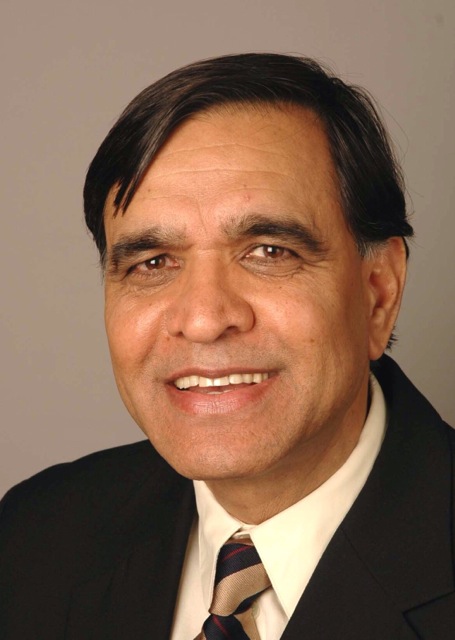 Vishnu Shukla"Here, we are talking about service, and a simple way to describe it [VNS] is network slicing," says OIF president, Vishnu Shukla. "With transport SDN [software-defined networking], such value-added services become available."
The OIF work will identify what carriers and system vendors must do to implement VNS. Shukla says the OIF already has experience working across multiple networking layers, and is undertaking transport SDN work. "VNS is a really valuable extension of the transport SDN work," says Shukla.
The OIF expects to complete its VNS Implementation Agreement work by year-end 2015.
Meanwhile, the OIF's Carrier Working Group has published its recommendations document, entitled OIF Carrier WG Requirements for Intermediate Reach 100G DWDM for Metro Type Applications, that provides input for the OIF's Physical Link Layer (PLL) Working Group.
The PLL Working Group is defining the requirements needed for a compact, low-cost and low-power 100 Gig interface for metro and regional networks. This is similar to the OIF work that successfully defined the first 100 Gig coherent modules in a 5x7-inch MSA.
The Carrier Working Group report highlights key metro issues facing operators. One is the rapid growth of metro traffic which, according to Cisco Systems, will surpass long-haul traffic in 2014. Another is the change metro networks are undergoing. The metro is moving from a traditional ring to a mesh architecture with the increasing use of reconfigurable optical add/drop multiplexers (ROADMs). As a result, optical wavelengths have further to travel, must contend with passing through more ROADMs stages and more fibre-induced signal impairments.
Shukla stresses there are differences among operators as to what is considered a metro network. For example, metro networks in North America span 400-600km typically and can be as much as 1,000km. In Europe such spans are considered regional or even long-haul networks. Metro networks also vary greatly in their characteristics. "Because of these variations, the requirements on optical modules varies so much, from unit to unit and area to area," says Shukla.
Given these challenges, operators want a module with sufficient optical performance to contend with the ROADM stages, and variable distances and network conditions encountered. "Sometimes we feel that the requirements [between metro and long-haul] won't be that much [different]," says Shukla. Indeed, the Carrier Working Group report discusses how the boundaries between metro and long-haul networks are blurring.
Yet operators also want such robust optical module performance at a greatly reduced price. One of the report's listed requirements is the need for the 100 Gig intermediate-reach interfaces to cost 'significantly' less than the cheapest long-haul 100 Gig.
To this aim, the report recommends that the 100 Gig pluggable optical modules such as the CFP or CFP2 be used. Standardising on industry-accepted pluggable MSAs will drive down cost as happened with the introduction of 100 Gig long haul 5x7-inch MSA modules.
Metro and regional coherent interfaces will also allow the specifications to be relaxed in terms of the DSP-ASIC requirements and the modulation schemes used. "When we come to the metro area, chances are that some of the technologies can be done more simply, and the cost will go down," says Shukla. Using pluggables will also increase 100 Gig line card densities, further reducing cost, while the report also favours the DSP-ASIC being integrated into the pluggable module, where possible.
Contributors to the Carrier Working Group report include representatives from China Telecom, Deutsche Telekom, Orange, Telus and Verizon, as well as module maker Acacia.

Arista Networks embeds optics to boost 100 Gig port density
Arista Networks' latest 7500E switch is designed to improve the economics of building large-scale cloud networks.
The platform packs 30 Terabit-per-second (Tbps) of switching capacity in an 11 rack unit (RU) chassis, the same chassis as Arista's existing 7500 switch that, when launched in 2010, was described as capable of supporting several generations of switch design.

"The CFP2 is becoming available such that by the end of this year there might be supply for board vendors to think about releasing them in 2014. That is too far off."
Martin Hull, Arista Networks
The 7500E features new switch fabric and line cards. One of the line cards uses board-mounted optics instead of pluggable transceivers. Each of the line card's ports is 'triple speed', supporting 10, 40 or 100 Gigabit Ethernet (GbE). The 7500E platform can be configured with up to 1,152 10GbE, 288 40GbE or 96 100GbE interfaces.
The switch's Extensible Operating System (EOS) also plays a key role in enabling cloud networks. "The EOS software, run on all Arista's switches, enables customers to build, manage, provision and automate these large scale cloud networks," says Martin Hull, senior product manager at Arista Networks.
Applications
Arista, founded in 2004 and launched in 2008, has established itself as a leading switch player for the high-frequency trading market. Yet this is one market that its latest core switch is not being aimed at.
"With the exception of high-frequency trading, the 7500 is applicable to all data centre markets," says Hull. "That it not to say it couldn't be applicable to high-frequency trading but what you generally find is that their networks are not large, and are focussed purely on speed of execution of their transactions." Latency is a key networking performance parameter for trading.
The 7500E is being aimed at Web 2.0 companies and cloud service providers. The Web 2.0 players include large social networking and on-line search companies. Such players have huge data centres with up to 100,000 servers.
The same network architecture can also be scaled down to meet the requirements of large 'Fortune 500' enterprises. "Such companies are being challenged to deliver private cloud as the same competitive price points as the public cloud," says Hull.
The 7500 switches are typically used in a two-tier architecture. For the largest networks, 16 or 32 switches are used on the same switching tier in an arrangement known as a parallel spine.
A common switch architecture for traditional IT applications such as e-mail and e-commerce uses three tiers of switching. These include core switches linked to distribution switches, typically a pair of switches used in a given area, and top-of-rack or access switches connected to each distribution pair.
For newer data centre applications such as social networking, cloud services and search, the computation requirements result in far greater traffic shared on the same tier of switching, referred to as east-west traffic. "What has happened is that the single pair of distribution switches no longer has the capacity to handle all of the traffic in that distribution area," says Hull.
Customers address east-west traffic by throwing more platforms together. Eight or 16 distribution switches are used instead of a pair. "Every access switch is now connected to each one of those 16 distribution switches - we call them spine switches," says Hull.
The resulting two-tier design, comprising access switches and distribution switches, requires that each access switch has significant bandwidth between itself and any other access switch. As a result, many 7500 switches - 16 or 32 - can be used in parallel at the distribution layer.
 Source: Arista Networks
"If I'm a Fortune 500 company, however, I don't need 16 of those switches," says Hull. "I can scale down, where four or maybe two [switches] are enough." Arista also offers a smaller 4-slot chassis as well as the 8 slot (11 RU) 7500E platform.
7500E specification
The switch has a capacity of 30Tbps. When the switch is fully configured with 1,152 10GbE ports, it equates to 23Tbps of duplex traffic. The system is designed with redundancy in place.
"We have six fabric cards in each chassis," says Hull, "If I lose one, I still have 25 Terabits [of switching fabric]; enough forwarding capacity to support the full line rates on all those ports." Redundancy also applies to the system's four power supplies. Supplies can fail and the switch will continue to work, says Hull.
The switch can process 14.4 billion 64-byte packets a second. This, says Hull, is another way of stating the switch capacity while confirming it is non-blocking.
The 7500E comes with four line card options: three use pluggable optics while the fourth uses embedded optics, as mentioned, based on 12 10Gbps transmit and 12 10Gbps receive channels (see table).

Using line cards supporting pluggable optics provides the customer the flexibility of using transceivers with various reach options, based on requirements. "But at 100 Gigabit, the limiting factor for customers is the size of the pluggable module," says Hull.
Using a CFP optical module, each card supports four 100Gbps ports only. The newer CFP2 modules will double the number to eight. "The CFP2 is becoming available such that by the end of this year there might be supply for board vendors to think about releasing them in 2014," says Hull. "That is too far off."
Arista's board mounted optics delivers 12 100GbE ports per line card.
The board-mounted triple-speed ports adhere to the IEEE 100 Gigabit SR10 standard, with a reach of 150m over OM4 fibre. The channels can be used discretely for 10GbE, grouped in four for 40GbE, while at 100GbE they are combined as a set of 10.
"At 100 Gig, the IEEE spec uses 20 out of 24 lanes (10 transmit and 10 receive); we are using all 24," says Hull. "We can do 12 10GbE, we can do three 40GbE, but we can still only do one 100Gbps because we have a little bit left over but not enough to make another whole 100GbE." In turn, the module can be configured as two 40GbE and four 10GbE ports, or 40GbE and eight 10GbE.
Using board-mounted optics reduces the cost of 100Gbps line card ports. A full 96 100GbE switch configuration achieves a cost of $10k/port while using existing CFP modules the cost is $30k-50k/ port, claims Arista.
Arista quotes 10GbE as costing $550 per line card port not including the pluggable transceiver. At 40GbE this scales to $2,200. For 100GbE the $10k/ port comprises the scaled-up port cost at 100GbE ($2.2k x 2.5) to which is added the cost of the optics. The power consumption is under 4W/ port when the system is fully loaded.
The company uses merchant chips rather than an in-house ASIC for its switch platform. Can't other vendors develop similar performance systems based on the same ICs? "They could, but it is not easy," says Hull.
The company points out that merchant chip switch vendors use a CMOS process node that is typically a generation ahead of state-of-the-art ASICs. "We have high-performance forwarding engines, six per line card, each a discrete system-on-chip solution," says Hull. "These have the technology to do all the Layer 2 and Layer 3 processing." All these devices on one board talk to all the other chips on the other cards through the fabric.
In the last year, equipment makers have decided to bring silicon photonics technology in-house: Cisco Systems has acquired Lightwire while Mellanox Technologies has announced its plan to acquire Kotura.
Arista says it is watching silicon photonics developments with keen interest. "Silicon photonics is very interesting and we are following that," says Hull. "You will see over the next few years that silicon photonics will enable us to continue to add density."
There is a limit to where existing photonics will go, and silicon photonics overcomes some of those limitations, he says.
Extensible Operating System
Arista's highlights several characteristics of its switch operating system. The EOS is standards-compliant, self-healing, and supports network virtualisation and software-defined networking (SDN).
The operating system implements such protocols as Border Gateway Protocol (BGP) and spanning tree. "We don't have proprietary protocols," says Hull. "We support VXLAN [Virtual Extensible LAN] an open standards way of doing Layer 2 overlay of [Layer] 3."
EOS is also described as self-healing. The modular operating system is composed of multiple software processes, each process described as an agent. "If you are running a software process and it is killed because it is misbehaving, when it comes back typically its work is lost," says Hull. EOS is self-healing in that should an agent need to be restarted, it can continue with its previous data.
"We have software logic in the system that monitors all the agents to make sure none are misbehaving," says Hull. "If it finds an agent doing stuff that it should not, it stops it, restarts it and the process comes back running with the same data." The data is not packet related, says Hull, rather the state of the network.
The operating system also supports network virtualisation, one aspect being VXLAN. VXLAN is one of the technologies that allows cloud providers to provide a customer with server resources over a logical network when the server hardware can be distributed over several physical networks, says Hull. "Even a VLAN can be considered as network virtualisation but VXLAN is the most topical."
Support for SDN is an inherent part of EOS from its inception, says Hull. “EOS is open - the customers can write scripts, they can write their own C-code, or they can install Linux packages; all can run on our switches." These agents can talk back to the customer's management systems. "They are able to automate the interactions between their systems and our switches using extensions to EOS," he says.
"We encompass most aspects of SDN," says Hull. "We will write new features and new extensions but we do not have to re-architect our OS to provide an SDN feature."
Arista is terse about its switch roadmap.
"Any future product would improve performance - capacity, table sizes, price-per-port and density," says Hull. "And there will be innovation in the platform's software.
Effdon Networks extends the 10x10 MSA to 80km
Effdon Networks has demonstrated a 100 Gigabit CFP module with an 80km reach; a claimed industry first. The company has also developed the Qbox, a 1 rack unit (1RU) extended reach platform capable of 400-800 Gigabit-per-second (Gbps) with a reach of 80-200km.
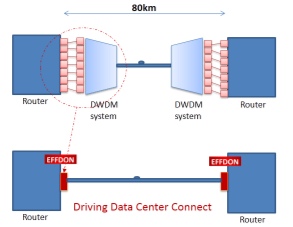 Effdon's CFP does not require the use of external DWDM multiplexing/ demultiplexing and can be added directly onto a router. Source: Effdon Networks
Available 100 Gigabit CFP modules have so far achieved 10km. Now with the Effdon module a 80km reach has been demonstrated that uses 10Gbps optics and no specialist silicon.
Effdon's design is based on the 10x10 MSA (multi-source agreement). "We have managed to resolve the technology barriers - using several techniques - to get to 80km," says Eitan Efron, CEO of Effdon Networks.
There is no 100 Gigabit standard for 80km. The IEEE has two 100 Gigabit standards: the 10km long reach 100GBASE-LR4 and the 40km extended reach 100GBASE-ER4.
Meanwhile, the 100 Gigabit 10x10 MSA based on arrays of 10, 10 Gigabit lasers and detectors, has three defined reaches: 2km, 10km and 40km. At the recent OFC/NFOEC exhibition, Oplink Communication and hybrid integration specialist, Kaiam, showed the 10x10 MSA CFP achieving 40km.
Effdon has not detailed how it has achieved 80km but says its designers have a systems background. "All the software that you need for managing wavelength-division multiplexing (WDM) systems is in our device," says Efron. "Basically we have built a system in a module."
These system elements include component expertise and algorithmic know-how. "Algorithms and software; this is the main IP of the company," says Efron. "We are using 40km components and we are getting 80km."
100 Gigabit landscape
Efron says that while there are alternative designs for 100 Gigabit transmission at 80km or more, each has challenges.
A 100Gbps coherent design achieves far greater reaches but is costly and requires a digital signal processor (DSP) receiver ASIC that consumes tens of watts. No coherent design has yet been implemented using a pluggable module.
Alternative CFP-based 100Gbps direct-detection designs based on a 4x28Gbps architecture exist. But their 28Gbps lanes experience greater dispersion that make achieving 80km a challenge.
MultiPhy's MP1100Q DSP chip counters dispersion. The chip used in a CFP module achieves a 55km point-to-point reach using on-off keying and 800km for dense WDM metro networks using duo-binary modulation.
Finisar and Oclaro also offer 100Gbps direct detection CFP modules for metro dense WDM using duo-binary modulation but without a receiver DSP. ADVA Optical Networking is one system vendor that has adopted such 100Gbps direct-detect modules. Another company developing a 4x28Gbps direct detect module is Oplink Communications.
But Effdon points out that its point-to-point CFP achieves 80km without using an external DWDM multiplexer and demultiplexer - the multiplexing/demultiplexing of the wavelengths is done within the CFP - or external amplification and dispersion compensation. As a result, the CFP plugs straight into IP routers and data centre switches.
"What they [data centre managers] want is what they have today at 10 Gig: ZR [80km] optical transceivers," says Efron

Market demand
"We see a lot of demand for this [80km] solution," says Efron. The design, based on 10 Gigabit optics, has the advantage of using mature high volume components while 25Gbps component technology is newer and available in far lower volumes.
"This [cost reduction associated with volume] will continue; we see 10 Gig lasers going into servers, base stations, data centre switches and next generation PON," says Efron. "Ten Gigabit optical components will remain in higher volume than 25 Gig in the coming years."
The 10x10 MSA CFP design can also be used to aggregate multiple 10 Gig signals in data centre and access networks. This is an emerging application and is not straightforward for the more compact, 4x25Gbps modules as they require a gearbox lane-translation IC.
Reach extension
Effdon Networks' Qbox platform provides data centre managers with 400-800Gbps capacity while offering a reach up to 200km. The box is used with data centre equipment that support CXP or QSFP modules but not the CFP. The 1RU box thus takes interfaces with a reach of several tens of meters to deliver extended transmission.
Qbox supports eight client-side ports - either 40 or 100 Gbps - and four line-facing ports at speeds of 100Gbps or 200Gbps for a reach of 80 to 200km. In future, the platform will deliver 400Gbps line speeds, says Efron.
Samples of the 80km CFP and Qbox are available for selected customers, says Effdon, while general availability of the products will start in the fourth quarter of 2013.

OFC/NFOEC 2013 product round-up - Part 2
Second and final part
- Custom add/drop integrated platform and a dual 1x20 WSS module
- Coherent receiver with integrated variable optical attenuator
- 100/200 Gigabit coherent CFP and 100 Gigabit CFP2 roadmaps
- Mid-board parallel optics - from 150 to over 600 Gigabit.
- 10 Gigabit EPON triplexer
Add/drop platform and wavelength-selective switches
Oclaro announced an add/drop routing platform for next-generation reconfigurable optical add/drop multiplexers (ROADMs). The platform, which supports colourless, directionless, contentionless (CDC) and flexible grid ROADMs, can be tailored to a system vendor's requirements and includes such functions as cross-connect switching, arrayed amplifiers and optical channel monitors.
 "If we make the whole thing [add/drop platform], we can integrate in a much better way"
Per Hansen, Oclaro
After working with system vendors on various line card designs, Oclaro realised there are significant benefits to engineering the complete design.
"You end up with a controller controlling other controllers, and boxes that get bolted on top of each other; a fairly unattractive solution," says Per Hansen, vice president of product marketing, optical networks solutions at Oclaro. "If we make the whole thing, we can integrate in a much better way."
The increasingly complex nature of the add/drop card is due to the dynamic features now required. "You have support for CDC and even flexible grid," says Hansen. "You want to have many more features so that you can control it remotely in software."
A consequence of the add/drop's complexity and automation is a need for more amplifiers. "It is a sign that the optics is getting mature; you are integrating more functionality within your equipment and as you do that, you have losses and you need to put amplifiers into your circuits," says Hansen.
Oclaro continues to expand its amplifier component portfolio. At OFC/NFOEC, the company announced dual-chip uncooled pump lasers in the 10-pin butterfly package multi-source agreement (MSA) it announced at ECOC 2012.
"We have two 500mW uncooled pumps in a single package with two fibres, each pump being independently controlled," says Robert Blum, director of product marketing for Oclaro's photonic components unit.
The package occupies half the space and consumes less than half the power compared to two standard discrete thermo-electrically cooled pumps. The dual-chip pump lasers will be available as samples in July 2013.
Oclaro gets requests to design 4- and 8-degree nodes; with four- and eight-degree signifying the number of fibre pairs emanating from a node.
"Depending on what features customers want in terms of amplifiers and optical channel monitors, we can design these all the way down to single-slot cards," says Hansen. Vendors can then upgrade their platforms with enhanced switching and flexibility while using the same form factor card.
Meanwhile, Finisar demonstrated at OFC/NFOEC a module containing two 1x20 liquid-crystal-on-silicon-based wavelength-selective switches (WSSes). The module supports CDC and flexible grid ROADMs. "This two-port module supports the next-generation route-and-select [ROADM] architecture; one [WSS] on the add side and one on the drop side," says Rafik Ward, vice president of marketing at Finisar.
100Gbps line side components
NeoPhotonics has added two products to its 100 Gigabit-per-second (Gbps) coherent transport product line.
The first is an coherent receiver that integrates a variable optical attenuator (VOA). The VOA sits in front of the receiver to screen the dynamic range of the incoming signal. "This is even more important in coherent systems as coherent is different to direct detection in that you do not have to optically filter the channels coming in," says Ferris Lipscomb, vice president of marketing at NeoPhotonics.
 "That is the power of photonic integration: you do a new chip with an extra feature and it goes in the same package."
Ferris Lipscomb, NeoPhotonics
In a traditional system, he says, a drop port goes through an arrayed waveguide grating which filters out the other channels. "But with coherent you can tune it like a heterodyne radio," says Lipscomb. "You have a local oscillator that you 'beat' against the signal so that the beat frequency for the channel you are tuned to will be within the bandwidth of the receiver but the beat frequency of the adjacent channel will be outside the bandwidth of the receiver."
It is possible to do colourless ROADM drops where many channels are dropped, and using the local oscillator, the channel of interest is selected. "This means that the power coming in can be more varied than in a traditional case," says Lipscomb, depending on how many other channels are present. Since there can be up to 80 channels falling on the detector, the VOA is needed to control the dynamic range of the signal to protect the receiver.
"Because we use photonic integration to make our integrated coherent receiver, we can put the VOA directly on the chip," says Lipscomb. "That is the power of photonic integration: you do a new chip with an extra feature and it goes in the same package."
The VOA integrated coherent receiver is sampling and will be generally available in the third quarter of 2013.
NeoPhotonics also announced a narrow linewidth tunable laser for coherent systems in a micro integrated tunable laser assembly (micro-ITLA). This is the follow-on, more compact version of the Optical Internetworking Forum's (OIF) ITLA form factor for coherent designs.
While the device is sampling now, Lipscomb points out that is it for next-generation designs such that it is too early for any great demand.
Sumitomo Electric Industries and ClariPhy Communications demonstrated 100Gbps coherent CFP technology at OFC/NFOEC.
ClariPhy has implemented system-on-chip (SoC) analogue-to-digital (ADC) and digital-to-analogue (DAC) converter blocks in 28nm CMOS while Sumitomo has indium phosphide modulator and driver technology as well as an integrated coherent receiver, and an ITLA.
The SoC technology is able to support 100Gbps and 200Gbps using QPSK and 16-QAM formats. The companies say that their collaboration will result in a pluggable CFP module for 100Gbps coherent being available this year.
Market research firm, Ovum, points out that the announcement marks a change in strategy for Sumitomo as it enters the long-distance transmission business.
In another development, Oclaro detailed integrated tunable transmitter and coherent receiver components that promise to enable 100 Gigabit coherent modules in the CFP2 form factor.
The company has combined three functions within the transmitter. It has developed a monolithic tunable laser that does not require an external cavity. "The tunable laser has a high-enough output power that you can tap off a portion of the signal and use it as the local oscillator [for the receiver]," says Blum. Oclaro has also developed a discrete indium-phosphide modulator co-packaged with the laser.
The CFP2 100Gbps coherent pluggable module is likely to have a reach of 80-1,000km, suited to metro and metro regional networks. It will also be used alongside next-generation digital signal processing (DSP) ASICs that will use a more advanced CMOS process resulting in a much lower power consumption .
To be able to meet the 12W power consumption upper limit of the CFP2, the DSP-ASIC will reside on the line card, external to the module. A CFP, however, with its upper power limit of 32W will be able to integrate the DSP-ASIC.
Oclaro expects such an CFP2 module to be available from mid-2014 but there are several hurdles to be overcome.
One is that the next-generation DSP-ASICs will not be available till next year. Another is getting the optics and associated electronics ready. "One challenge is the analogue connector to interface the optics and the DSP," says Blum.
Achieving the CFP2 12W power consumption limit is non-trivial too. "We have data that the transmitter already has a low enough power dissipation," says Blum.
Board-mounted optics
Finisar demonstrated its board-mounted optical assembly (BOA) running at 28Gbps-per-channel. When Finisar first detailed the VCSEL-based parallel optics engine, it operated at 10Gbps.
The mid-board optics, being aimed at linking chassis and board-to-board interconnect, can be used in several configurations: 24 transmit channels, 24 receive channels or as a transceiver - 12 transmit and 12 receive. When operated at full rate, the resulting data rate is 672Gbps (24x28Gbps) simplex.
The BOA is protocol-agnostic operating at several speeds ranging from 10Gbps to 28Gbps. For example 25Gbps supports Ethernet lanes for 100Gbps while 28Gbps is used for Optical Transport Network (OTN) and Fibre Channel. Overall the mid-board optics supports Ethernet, PCI Express, Serial Attached SCSI (SAS), Infiniband, Fibre Channel and proprietary protocols. Finisar has started shipping BOA samples.
Avago detailed samples of higher-speed Atlas optical engine devices based on its 12-channel MicroPod and MiniPod designs. The company has extended the channel speed from 10Gbps to 12.5Gbps and to 14Gbps, giving a total bandwidth of 150Gbps and 168Gbps, respectively.
"There is enough of a market demand for applications up to 12.5Gbps that justifies a separate part number," says Sharon Hall, product line manager for embedded optics at Avago Technologies.
The 12x12.5Gbps optical engines can be used for 100GBASE-SR10 (10x10Gbps) as well as quad data rate (QDR) Infiniband. The extra capacity supports Optical Transport Network (OTN) with its associated overhead bits for telecom. There are also ASIC designs that require 12.5Gbps interfaces to maximise system bandwidth.
The 12x14Gbps supports the Fourteen Data Rate (FDR) Infiniband standard and addresses system vendors that want yet more bandwidth.
The Atlas optical engines support channel data rates from 1Gbps. The 12x12.5Gbps devices have a reach of 100m while for the 12x14Gbps devices it is 50m.
Hall points out that while there is much interest in 25Gbps channel rates, the total system cost can be expensive due to the immaturity of the ICs: "It is going to take a little bit of time." Offering a 14Gbps-per-channel rate can keep the overall system cost lower while meeting bandwidth requirements, she says.
10 Gig EPON
Operators want to increase the split ratio - the number of end users supported by a passive optical network - to lower the overall cost.
A PON reach of 20km is another important requirement to operators, to make best use of their central offices housing the optical line terminal (OLT) that serves PON subscribers.
To meet both requirements, the 10G-EPON has a PRX40 specification standard which has a sufficiently high optical link budget. Finisar has announced a 10G-EPON OLT triplexer optical sub-assembly (OSA) that can be used within an XFP module among others that meets the PRX40 specification.
The OSA triplexer supports 10Gbps and 1G downstream (to the user) and 1Gbps upstream. The two downstream rates are needed as not all subscribers on a PON will transition to a 10G-EPON optical network unit (ONU).
To meet the standard, a triplexer design typically uses an externally modulated laser. Finisar has met the specification using a less complex directly modulated laser. The result is a 10G-EPON triplexer supporting a split ratio of 1:64 and higher, and that meets the 20km reach requirement.
Finisar will sell the OSA to PON transceiver makers with production starting first quarter, 2014. Up till now the company has used its designs for its own PON transceivers.
See also:
OFC/NFOEC 2013 product round-up - Part 1, click here
OFC/NFOEC 2013 product round-up - Part 1
Part 1: Client-side transceivers
- First CFP2 single-mode and multi-mode transceiver announcements
- Cisco Systems unveils its CPAK module
- 100 Gigabit QSFPs from Kotura and Luxtera
- CFP2 and 40km CFP 10x10 MSA modules
- Infiniband FDR and 'LR4 superset' QSFPs
The recent OFC/NFOEC exhibition and conference held in Anaheim, California, saw a slew of optical transceiver announcements. The first CFP2 client-side products for single-mode and multi-mode fibre were unveiled by several companies, as was Cisco Systems' in-house CPAK transceiver.
The CFP2 is the pluggable form factor that follows the first generation CFP. The CFP MSA announced the completion of the CFP2 specification at the show, while several vendors including Avago Technologies, Finisar, Fujitsu Optical Components, NeoPhotonics, Oclaro and Oplink Communications detailed their first CFP2 products.
The 40 and 100 Gigabit CFP2 is half the size of the CFP, enabling at least a doubling of the CFP2 transceivers on a faceplate compared to four CFPs (see table below). The CFP2 is also future-proofed to support 200 and 400Gbps (See first comment at bottom of CFP2 story).
Another difference between the CFP and the CFP2 is that the CFP2 uses a 4x25Gbps electrical interface. Accordingly, the CFP2 does not need the 'gearbox' IC that translates between ten, 10 Gigabit-per-second (Gbps) lanes to four, 25Gbps electrical lanes that interface to the 4x25/28Gbps optics. Removing the gearbox IC saves space and reduces the power consumption by several watts.
The industry has long settled on the SFP+ at 10Gbps while the QSFP has become the 40Gbps form factor of choice. With 100Gbps still in its infancy, transceiver vendors are pursuing several client-side interfaces. Much work will be needed to reduce the size, power consumption and cost of 100Gbps interfaces before the industry settles on a single pluggable form factor for the single-mode and multi-mode standards.
CFP2 announcements
Finisar demonstrated two CFP2 modules, one implementing the IEEE 100GBASE-LR4 10km standard and the other, the IEEE 100GBASE-SR10 100m multi-mode standard. The company is using directly-modulated, distributed feedback (DFB) lasers for its CFP2 LR4. In contrast, the CFP module uses more expensive, electro-absorption modulator lasers (EMLs). Finisar demonstrated interoperability between the two LR4 modules, an EML-based CFP and a DFB-based CFP2, at the show.
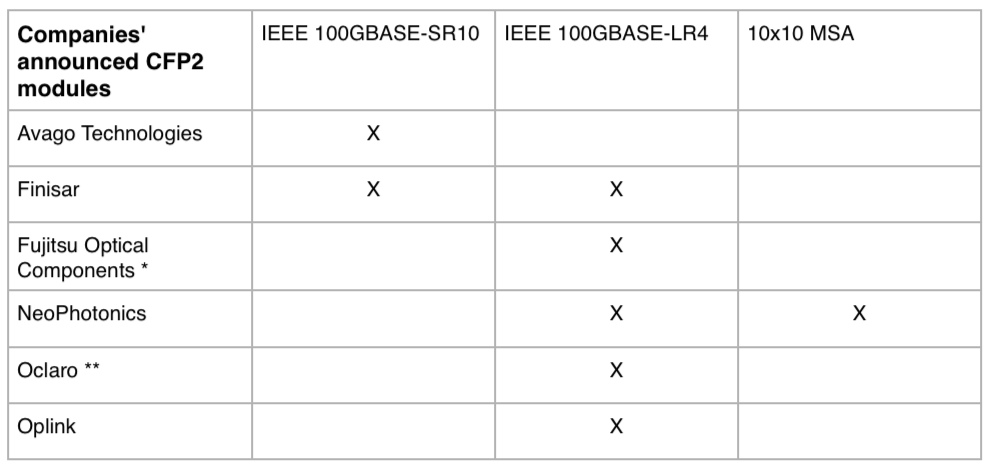
* An ER4 CFP2 is under development
** Oclaro disclosed indium phosphide components for a future CFP2 line side pluggable
Using directly modulated lasers also reduces the power consumption, says Finisar. Overall, the CFP2 LR4 consumes 7W compared to a 24W first-generation CFP-based LR4.
"We can migrate these [directly modulated laser] designs to a single quad 28 Gig photonic integrated circuit TOSA," says Rafik Ward, Finisar's vice president of marketing. "Likewise on the receive [path], there will be a quad 28 Gig ROSA." The TOSA refers to a transmitter optical sub-assembly while the ROSA is the receiver equivalent. Ward says the CFP2s will be in production this year.
Several module and chip makers took part in the Optical Internetworking Forum's (OIF) multi-vendor demonstration of its 4x25 Gigabit chip-to-module electrical interface, the CEI-28G-VSR. The demonstration included CFP2 LR4s from Finisar and from Oclaro as well as Luxtera's 100Gbps shorter reach module in a QSFP28. Oclaro's CFP2 is expected to be in production in the third quarter of 2013.
Another standard implemented in the CFP2 is the 100GBASE-SR10 multi-mode standard. Avago Technologies and Finisar both detailed CFP2 SR10 modules. The SR10 uses 10 VCSELs, each operating at 10Gbps. The SR10 can be used as a 100Gbps interface or as 10 independent 10Gbps channels.
The CFP2 SR10 can be interfaced to 10 Gigabit Ethernet (GbE) SFP+ modules or combinations of 10GbE SFP+ and 40GbE QSFPs. "What people are looking for using the CFP2 multi-mode module is not only for the 100 Gig Ethernet application but interoperability with 40 Gig Ethernet as well as 10 Gig Ethernet modules," says I Hsing Tan, Ethernet segment marketing manager in the fibre optics product division at Avago.
The SR10 electrical interface specification supports retiming and non-retiming options. The Avago CFP2 module includes clock data recovery ICs that can be used for retiming if needed or bypassed. The result is that Avago's CFP2 SR10 consumes 4-6W, depending on whether the clock data recovery chips are bypassed or used.
Meanwhile, NeoPhotonics became the first company to announce the 10x10 MSA in a CFP2.
NeoPhotonics has not detailed the power consumption but says the 10x10Gbps CFP2 is lower than the CFP since all of the chips - photonic and electrical - are a newer generation and much work has gone into reducing the power consumption.
"Demand is quite strong for the 10x10 solution," says Ferris Lipscomb, vice president of marketing at NeoPhotonics. "The CFP2 version is being developed, and we expect strong demand there as well."
The key advantage of the 10x10-based solution over a 4x25Gbps design is cost, according to NeoPhotonics. "10x10 enjoys the volume and maturity of 10 Gig, and thus the cost advantage," says Lipscomb. "We believe the 10x10 CFP2 will follow the trend of the 10x10 MSA CFP and will offer a significant cost advantage over CFP2 LR4-based solutions."
Cisco's CPAK
Cisco finally showed its in-house silicon photonics-based CPAK transceiver at OFC/NFOEC. The CPAK is the first product to be announced following Cisco's acquisition of silicon photonics player, LightWire.

Cisco says the CPAK is more compact than the CFP2 transceiver with the company claiming that 12 or more transceivers will fit on a faceplate. "While the industry is leapfrogging the CFP with the CFP2, our CPAK leapfrogs the CFP2 because it is much more efficient from a size and power consumption perspective," says Sultan Dawood, a marketing manager at Cisco.
Vendors backing the CFP2 stress that the CPAK is only slighter smaller than the MSA module. "The CFP2 and the CPAK are both interim form factors pending when the CFP4 becomes available." says Avago's Tan. "Any product [like the CFP2] governed by an MSA is going to see strong market adoption."
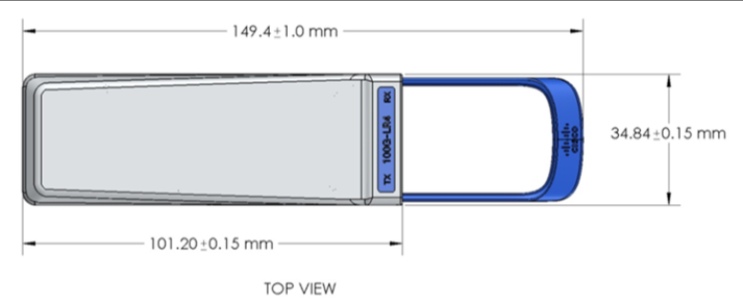 Cisco's CPAK transceiver Source: Cisco
The CFP4 specification is still being worked on but 16 CFP4s will fit on a faceplate and the transceiver is scheduled for the second half of 2014.
At OFC, Cisco demonstrated the CPAK implementing the 100GBASE-LR4 and -SR10 standards. The CPAK transceiver will be generally available in the summer of 2013, says Cisco.
CFP
Oplink Communication and hybrid integration specialist, Kaiam, showed a 100Gbps 10x10 MSA CFP implementing a 40km extended reach.
The 10x10 40km CFP is for connecting data centres and for broadband backhaul applications. The CFP electro-absorption modulator lasers coupled to a wavelength multiplexer make up the TOSA while the ROSA comprises avalanche photodiode receivers and a demultiplexer. Samples will be available in the second quarter of 2013, with production starting in the third quarter.
Source Photonics announced a second-generation 100GBASE-LR4 CFP with a power consumption of 12-14W.
Meanwhile, Effdon Networks detailed its first 100Gbps product, a CFP with a reach of 80km. Until now 100Gbps CFPs have been limited largely to 10km LR4 while the first 100Gbps CFPs with a reach of 80km or greater being 4x25Gbps direct-detection designs that can include specialist ICs.
100 Gig QSFP
Luxtera and Kotura, both detailed 100 Gigabit QSFPs that use their respective silicon photonics technology. The Kotura design uses two chips, has a reach of 2km and is a four-channel wavelength-division multiplexing (WDM) design while the Luxtera design is a four-channel integrated transceiver that uses a single laser and is tailored for 500m although Luxtera says it can achieve a 2km reach.
40 Gigabit Ethernet and Infiniband FDR
Avago Technologies announced that its eSR4 40 Gigabit Ethernet (GbE) QSFP+ has a reach of up to 550m, beyond the reach specified by the IEEE 40GBASE-SR4 standard. The eSR4 supports 40GbE or four independent 10GbE channels. When used as a multi-channel 10GbE interface, the QSFP+ interfaces to various 10GbE form factors such as X2, XFP and SFP+, It can also interface to a 100GbE CFP2, as mentioned.
Avago first announced the eSR4 QSFP+ with a reach of 300m over OM3 multi-mode fibre and 400m over OM4 fibre. The eSR4 now extends the reach to a guaranteed 550m when used with specific OM4 fibre from fibre makers Corning, Commscope and Panduit.
The extended reach is needed to address larger data centres now being build, as well as support flatter switch architectures that use two rather than three tiers of switches, and that have greater traffic flowing between switches on the same tier.
Avago says data centre managers are moving to deploy OM4 fibre. "The end user is going to move from OM3 to OM4 fibre for future-proofing purposes," says Tan. "The next-generation 32 Gig Fibre Channel and 100 Gigabit Ethernet are focussing on OM4 fibre."
Meanwhile, ColorChip showed its 56Gbps QSFP+ implementing the FDR (Fourteen Data Rate) 4x Infiniband standard as part of a Mellanox MetroX long-haul system demonstration at the show.
Finisar also demonstrated a 40Gbps QSFP using four 1310nm VCSELs. The result is a QSFP with a 10km reach that supports a 40Gbps link or four, 10Gbps links when used in a 'breakout' mode. The existing 40GBASE-LR4 standard supports a 40Gbps link only. Finisar's non-standard implementation adds a point-to-multipoint configuration.
"A single form factor port can be used not only for 40 Gig but also can enable higher density 10 Gig applications than what you can do with SFP+," says Ward.
Kaiam detailed a 40Gbps QSFP+ ER4 transceiver having a 40km reach. The QSFP+ transceiver has the equivalent functionality of four DML-based SFP+s fixed on a coarse WDM grid, and includes a wavelength multiplexer and de-multiplexer.
For OFC/NFOEC 2013 - Part 2, click here
Further reading
LightCounting: OFC/NFOEC review: news from the show floor, click here
Ovum: Cisco hits both show hot buttons with silicon photonics for 100G, click here
ECI Telecom demos 100 Gigabit over 4,600km
- 4,600km optical transmission over submarine cable
- The Tera Santa Consortium, chaired by ECI, will show a 400 Gigabit/ 1 Terabit transceiver prototype in the summer
- 100 Gigabit direct-detection module on hold as the company eyes new technology developments
 "When we started the project it was not clear whether the market would go for 400 Gig or 1 Terabit. Now it seems that the market will start with 400 Gig."
Jimmy Mizrahi, ECI Telecom
ECI Telecom has transmitted a 100 Gigabit signal over 4,600km without signal regeneration. Using Bezeq International's submarine cable between Israel and Italy, ECI sent the 100 Gigabit-per-second (Gbps) signal alongside live traffic. The Apollo optimised multi-layer transport (OMLT) platform was used, featuring a 5x7-inch MSA 100Gbps coherent module with soft-decision, forward error correction (SD-FEC).
"We set a target for the expected [optical] performance with our [module] partner and it was developed accordingly," says Jimmy Mizrahi, head of the optical networking line of business at ECI Telecom. "The [100Gbps] transceiver has superior performance; we have heard that from operators that have tested the module's capabilities and performance."
One geography that ECI serves is the former Soviet Union which has large-span networks and regions of older fibre.
Tera Santa Consortium
ECI used the Bezeq trial to also perform tests as part of the Tera Santa Consortium project involving Israeli optical companies and universities. The project is developing a transponder capable of 400 Gigabit and 1 Terabit rates. The project is funded by seven participating firms and the Israeli Government.
"When we started the project it was not clear whether the market would go for 400 Gig or 1 Terabit,” says Mizrahi. “Now it seems that the market will start with 400 Gig."
The Tera Santa Consortium expects to demonstrate a 1 Terabit prototype in August and is looking to extend the project a further three years.
100 Gigabit direct detection
In 2012 ECI announced it was working with chip company, MultiPhy, to develop a 100 Gigabit direct-detection module. The 100 Gigabit direct detection technology uses 4x28Gbps wavelengths and is a cheaper solution than 100Gbps coherent. The technology is aimed at short reach (up to 80km) links used to connect data centres, for example, and for metro applications.
“We have changed our priorities to speed up the [100Gbps] coherent solution,” says Mizrahi. “It [100Gbps direct detection] is still planned but has a lower priority.”
ECI says it is monitoring alternative technologies coming to market in the next year. “We are taking it slowly because we might jump to new technologies,” says Mizrahi. “The line cards will be ready, the decision will be whether to go for new technologies or for direct detection."
Mizrahi would not list the technologies but hinted they may enable cheaper coherent solutions. Such coherent modules would not need SD-FEC to meet the shorter reach, metro requirements. Such a module could also be pluggable, such as the CFP or even the CFP2, and use indium phosphide-based modulators.
“For certain customers pricing will always be the major issue,” says Mizrahi. “If you have a solution at half the price, they will take it.”
Teraxion embraces silicon photonics for its products
Teraxion has become a silicon photonics player with the launch of its compact 40 and 100 Gigabit coherent receivers.
The Canadian optical component company has long been known for its fibre Bragg gratings and tunable dispersion compensation products. But for the last three years it has been developing expertise in silicon photonics and at the recent European Conference on Optical Communications (ECOC) exhibition it announced its first products based on the technology.

"You don't have this [fabless] model for indium phosphide or silica, while an ecosystem is developing around silicon photonics"
Martin Guy, Teraxion
"We are playing mainly in the telecom business, which accounts for 80% of our revenues," says Martin Guy, vice president, product management & technology at Teraxion. "It is clear that our customers are going to more integration and smaller form-factors so we need to follow our customers' requirements."
Teraxion assessed several technologies but chose silicon photonics and the fabless model it supports. "We are using all our optical expertise that we can apply to this material but use a process already developed for the CMOS industry, with the [silicon] wafer made externally," says Guy. "You don't have this [fabless] model for indium phosphide or silica, while an ecosystem is developing around silicon photonics."
The company uses hybrid integration for its coherent receiver products, with silicon implementing the passive optical functions to which the active components are coupled. Teraxion is using externally-supplied photo-detectors which are flip-chipped onto the silicon for its coherent receiver.
"We need to use the best material for the function for this high-end product," says Guy. "Our initial goal is not to have everything integrated in silicon."
Coherent receiver
A coherent receiver comprises two inputs - the received optical signal and the local oscillator - and four balanced receiver outputs. Also included in the design are two polarisation beam splitters and two 90-degree hybrid mixers.
Several companies have launched coherent receiver products. These include CyOpyics, Enablence, NEL, NeoPhotonics, Oclaro and u2t Photonics. Silicon photonics player Kotura has also developed the optical functions for a coherent receiver but has not launched a product.
One benefit of using silicon photonics, says Teraxion, is the compact optical designs it enables.
The Optical Internetworking Forum (OIF) has specified a form factor for the 100 Gigabit-per-second (Gbps) coherent receiver. Teraxion has developed a silicon photonics-based product that matches the OIF's form factor sized 40mmx32mm. This is for technology evaluation purposes rather than a commercial product. "If customers want to evaluate our technology, they need to have a compatible footprint with their design," explains Guy. This is available in prototype form and Teraxion has customers ready to evaluate the product.
Teraxion will come to market with a second 100 Gigabit coherent receiver design that is a third of the size of the OIF's form factor, measuring 23mmx18mm (0.32x the area of the OIF specification). The compact coherent receivers for 40 and 100Gbps will be available in sample form in the first quarter of 2013.
 Teraxion's OIF-specification 100 Gig coherent receiver (left) for test purposes and its compact coherent receiver product. Source: Teraxion
"We match the OIF's performance with this design but there are also other key requirements from customers that are not necessarily in the OIF specification," says Guy.
The compact 100Gbps design is of interest to optical module and system vendors but there is no one view in terms of requirements or the desired line-side form-factor that follows the 5x7-inch MSA. Indeed there are some that are interested in developing a 100 Gigabit CFP module for metro applications, says Guy.
Roadmap
Teraxion's roadmap includes further integration of the coherent receiver's design. "We are using hybrid integration but eventually we will look at having the photo-detectors integrated within the material,” says Guy.
The small size of the coherent design means there is scope for additional functionality to be included. Teraxion says that customers are interested in integrating variable optical attenuators (VOAs). The local oscillator is another optical function that can be integrated within the coherent receiver.
In 2005 Teraxion acquired Dicos Technologies, a narrow line-width laser specialist. Teraxion's tunable narrow line-width laser product - a few kiloHertz wide - is available in the lab. "The purpose of this product is not to be deployed on the line card - right now," says Guy. "We believe this type of performance will be required for next-generation 100 Gig, 400 Gig, 1 Terabit coherent communication systems where you will need a very 'clean' local oscillator."
Teraxion is also working on developing a silicon-photonics-based modulator. The company has been exploring integrating Bragg gratings within silicon waveguides for which it has applied for patents. This is several years out, says Guy, but has the potential to enable high-speed modulators suited for short-reach datacom applications.
AppliedMicro samples 100Gbps CMOS multiplexer
AppliedMicro has announced the first CMOS merchant multiplexer chip for 100Gbps coherent optical transmission. The S28032 device supports dual polarisation, quadrature phase-shift keying (DP-QPSK) and has a power consumption of 4W, half that of current multiplexer chip designs implemented in BiCMOS.
 The S28032 100 Gig multiplexer IC. Source: AppliedMicro
"CMOS has a very low gain-bandwidth product, typically 100GHz," says Tim Warland, product marketing manager, connectivity solutions at AppliedMicro. “Running at 32GHz, we have been able to achieve a very high bandwidth with CMOS."
Significance
The availability of a CMOS merchant device will be welcome news for optical transport suppliers and 100Gbps coherent module makers. CMOS has better economics than BiCMOS due to the larger silicon wafers used and the chip yields achieved. The reduced power consumption also promotes the move to smaller-sized optical modules than the current 5x7-inch multi-source agreement (MSA).
"By reducing the power and the size, we can get to a 4x6-inch next-generation module,” says Warland. “And perhaps if we go for a shorter [optical transmission] reach - 400-600km - we could get into a CFP; then you can get four modules on a card.”
"Coherent ultimately is the solution people want to go to [in the metro] but optical duo-binary will do just fine for now"
Tim Warland, AppliedMicro
Chip details
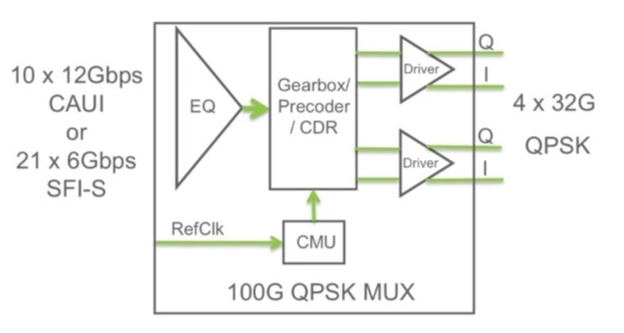
The S28032 has a CAUI interface: 10x12Gbps input lanes that are multiplexed into four lanes at 28Gbps to 32Gbps. The particular data rate depends on the forward error correction (FEC) scheme used. The four lanes are DQPSK-precoded before being fed to the polarisation multiplexer to create the DP-QPSK waveforms.
The device also supports the SFI-S interface - 21 input channels, each at 6Gbps. This is significant as it enables the S28032 to be interfaced to NTT Electronics' (NEL) DSP-ASIC coherent receiver chip that has been adopted by 100Gbps module makers Oclaro and Opnext (now merged) as well as system vendors including Fujitsu Optical Systems and NEC.
 The mux IC within a 100Gbps coherent 5x7-inch optical module. Source: AppliedMicro
The AppliedMicro multiplexer IC, which is on the transmit path, interfaces with NEL's DSP-ASIC that is on the receiver path, because the FEC needs to be a closed loop to achieve the best efficiency, says Warland. "If you know what you are transmitting and receiving, you can improve the gain and modify the coherent receiver sampling points if you know what the transmit path looks like," he says.
The DSP-ASIC creates the transmission payloads and uses the S28032 to multiplex those into 28Gbps or greater speed signals.
The SFI-S interface is also suited to interface to FPGAs, for those system vendors that have their own custom FPGA-based FEC designs.
"Packet optical transport systems is more a potential growth engine as the OTN network evolves to become a real network like SONET used to be"
Francesco Caggioni. AppliedMicro
The multiplexer chip's particular lane rate is set by the strength of the FEC code used and its associated overhead. Using OTU4 frames with its 7% overhead FEC, the resulting data rate is 27.95Gbps. With a stronger 15% hard-decision FEC, each of the 4 channel's data rate is 30Gbps while it is 31.79Gbps with soft-decision FEC.
"It [the chip] has got sufficient headroom to accommodate everything that is available today and that we are considering in the OIF [Optical Internetworking Forum],” says Warland. The multiplexer is expected to be suitable for coherent designs that achieve a reach of up to 2,000-2,500km but the sweet spot is likely to be for metro networks with a reach of up to 1,000km, he says.
But while the CMOS device can achieve 32Gbps, it has its limitations. "For ultra long haul, we can't support a FEC rate higher than 20%," says Warland. "For that, a 25% to 30% FEC is needed."
AppliedMicro is sampling the device to lead customers and will start production in 1Q 2013.
What next
The S28032 joins AppliedMicro's existing S28010 IC suited for the 10km 100 Gigabit Ethernet 100GBASE-LR4 standard, and for optical duo-binary 100Gbps direct detection that has a reach of 200-1,000km.
"Our next step is to try and get a receiver to match this chip," says Warland. But it will be different to NEL's coherent receiver: "NEL's is long haul." Instead, AppliedMicro is eyeing the metro market where a smaller, less power-hungry chip is needed.
"Coherent ultimately is the solution people want to go to [in the metro] but optical duo-binary will do just fine for now," says Warland.
Two million 10Gbps OTN ports
AppliedMicro has also announced that it has shipped 2M 10Gbps OTN silicon ports. This comes 18 months after it announced that it had shipped its first million.
"OTN is showing similar growth to the 10 Gigabit Ethernet market but with a four-year lag," says Francesco Caggioni, strategic marketing director, connectivity solutions at AppliedMicro.
The company sees OTN growth in the IP edge router market and for transponder and muxponder designs, while packet optical transport systems (P-OTS) is an emerging market.
"Packet optical transport systems is more a potential growth engine as the OTN network evolves to become a real network like SONET used to be," says Caggioni. "We are seeing development but not a lot of deployment."
Further reading:
Transport processors now at 100 Gigabit
Cortina Systems has detailed its CS605x family of transport processors that support 100 Gigabit Ethernet and Optical Transport Network (OTN).
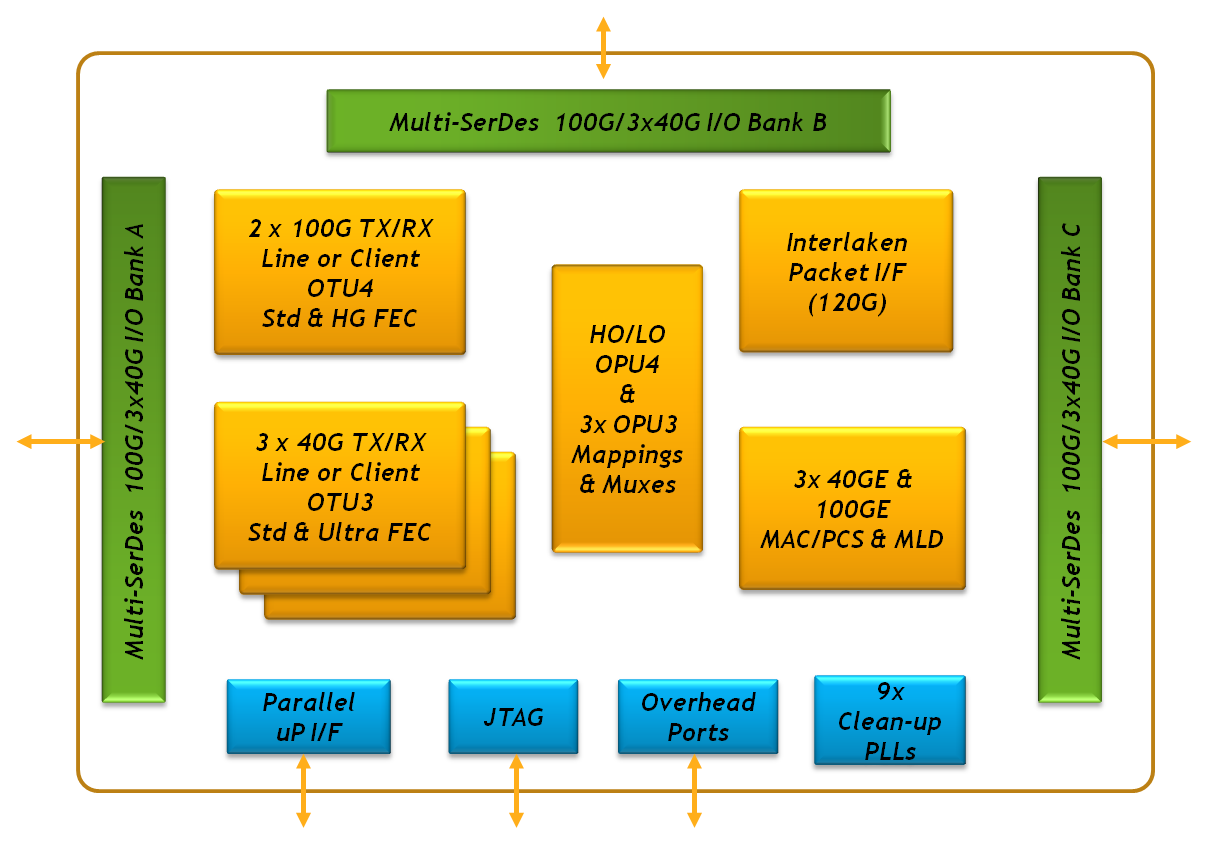 The CS6051 transport processor architecture. Source: Cortina Systems
The application-specific standard product (ASSP) family from Cortina Systems is aimed at dense wavelength division multiplexing (DWDM) platforms, packet optical transport systems, carrier Ethernet switch routers and Internet Protocol edge and core routers. The chip family can also be used in data centre top-of-rack Ethernet aggregation switches.
"Our traditional business in OTN has been in the WDM market," says Alex Afshar, product line manager, transport products at Cortina Systems. "What we see now is demand across all those platforms."
ASSP versus FPGA
Until now, equipment makers have used field programmable gate arrays (FPGAs) to implement 100 Gigabit-per-second (Gbps) designs. This is an important sector for FPGA vendors, with Altera and Xilinx making several company acquisitions to bolster their IP offerings to address the high end sector. System vendors have also used FPGA board-based designs from specialist firm TPACK, acquired by Applied Micro in 2010.
The advantage of an FPGA design is that it allows faster entry to market, while supporting relevant standards as they mature. FPGAs also enable equipment makers to use their proprietary intellectual property (IP); for example, advanced forward error correction (FEC) codes, to distinguish their designs.
However, once a market reaches a certain maturity, ASSPs become available. "ASSPs are more efficient in terms of cost, power and integration," says Afshar.
But industry analysts point out that ASSP vendors have a battle on their hands. "In this class of product, there is a lot of customisation and proprietary design and FPGAs are well suited for that," says Jag Bolaria, senior analyst at The Linley Group.
CS605x family
The CS605x extends Cortina's existing CS604x 40Gbps OTN transport processors launched in April 2011. The CS605x devices aggregate 40 Gigabit Ethernet or OTN streams into 100Gbps or map between 100 Gigabit Ethernet and OTN frames. Combining devices from the two families enables 10 and 40 Gigabit OTN/ Ethernet traffic to be aggregated into 100 Gigabit streams.
The CS6051 is the 100 Gigabit family's flagship device. The CS6051 can interface directly to three 40Gbps optical modules, a 100 Gigabit CFP or a 12x10Gbit/s CXP module. The device also supports the Interlaken interface to 120 Gigabit (10x12.5Gbps) to interface to devices such as network processors, traffic managers and FPGAs.
The CS6051 supports several forward error correction (FEC) codes including the standard G.709, a 9.4dB coding gain FEC with only a 7% overhead, and an 'ultra-FEC' whose strength can be varied with overhead, from 7% to 20%.
The CS6053 is similar to the CS6051 but uses a standard G.709 FEC only, aimed at system vendors with their own powerful FECs such as the latest soft-decision FEC. The CS6052 supports Ethernet and OTN mapping but not aggregation while the CS6054 supports Ethernet only. It is the C6054 which is used for top-of-rack switches in the data centre.
The devices consume between 10-12W. Samples of the CS605x family have been available since October 2011 and will be in volume production in the first half of this year.
Further reading:
For a more detailed discussion of the C605x family, click on the article featured in New Electronics
The CFP4 optical module to enable Terabit blades
 Source: Gazettabyte, Xilinx
The CFP2 is about half the size of the CFP while the CFP4 is half the size of the CFP2. The CFP4 is slightly wider and longer than the QSFP.
The two CFP modules will use a 4x25Gbps electrical interface, doing away with the need for a 10x10Gbps to 4x25Gbps gearbox IC used for current CFP 100GBASE-LR4 and -ER4 interfaces. The CFP2 and CFP4 are also defined for 40 Gigabit Ethernet use.
The CFP's maximum power rating is 32W, the CFP2 12W and the CFP4 5W. But vendors that put eight CFP2 or 16 CFP4s on a blade still want to meet the 60W total power budget.
 Getting close: Four CFP modules deliver slightly less bandwidth than 48 SFP+ modules: 4x100Gbps versus 480Gbps. The four also consume more power - 60w versus 48W. Moving to the CFP2 module will double the blade's bandwidth without consuming more power while the CFP4 will do the same again. a blade with 16 CFP4 modules promises 1.6Tbps while requiring 60W. Source: Xilinx
The first CFP2 modules are expected this year - there could be vendor announcements as early as the upcoming OFC/NFOEC 2012 show to be held in LA in the first week in March. The first CFP4 products are expected in 2013.
Further reading
The CFP MSA presentation: CFP MSA 100G roadmap and applications