

Apps over packet-optical: Ciena boosts 6500's packet handling
 Source: Ciena
Ciena has enhanced its packet-optical equipment portfolio by adding packet support to its flagship 6500 platform.
Cards and software from Ciena's established Carrier Ethernet packet platforms have been added to the 6500, a packet-optical platform that features reconfigurable optical add-drop multiplexing (ROADM), WaveLogic3 coherent transponders, Optical Transport Network (OTN) switching and SONET/SDH aggregation. The system vendor has also developed packet aggregation and switch fabric cards for the 6500.
"You can now use the 6500 for 100 percent packet switching, 100 percent OTN switching, or any mix in between," says Michael Adams, vice president of product and technical marketing at Ciena.
The development is part of a general trend to combine optical and packet to create scalable, manageable networks. It also addresses the operators' growing need for programmable networks to deliver cloud-based services and dynamic bandwidth.
Applications
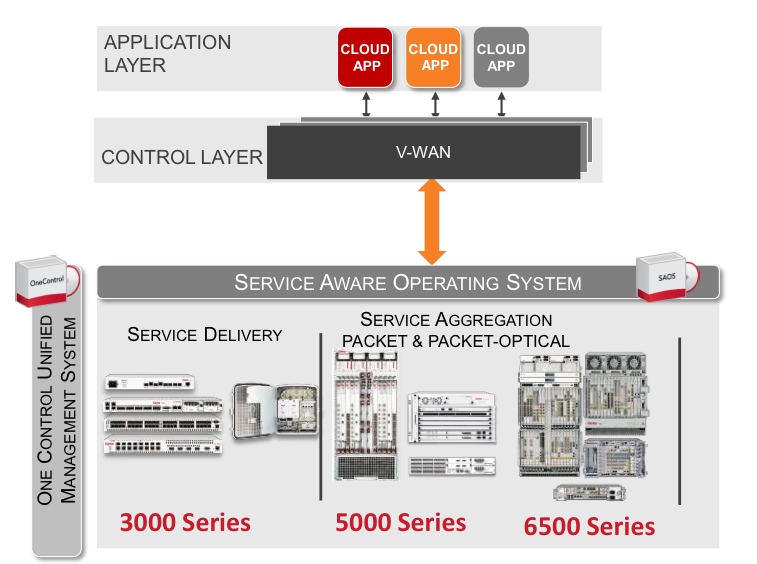
Ciena has a virtual wide-area network (VWAN) control layer that resides above the networking layer that abstracts the hardware and through which software applications can be executed (see chart).
"We have a scheduler 'app' through the control layer VWAN that allows bandwidth to change between sites, for example," says Adams. "Every night I want to do a backup between these times and I want this much bandwidth as I do it."
Another application is machine-to-machine communication that can be used to link data centres. "If you can virtualise within a data centre, why not virtualise across data centres?" says Adams.
As [servers'] virtual machines move between data centres, the performance of the network becomes key. Ciena has an application programming interface (API) that links to the server's hypervisor that allows machine-to-machine communication to be intercepted to benefit the bandwidth made available for the virtual machine traffic. "We are not doing it today but we have the software to link between two data centres," says Adams.
6500 enhancements
Until now it has been difficult to combine packet with packet optical, requiring different platforms, each with their own management system, says Adams. "It has been hard to take a base station that needs only packet, put the Carrier Ethernet traffic onto a ring [network] and then onto a 100 Gigabit wavelength," he says. "You either built pure packet or used a form of packet optical but it was hard to mix."
Ciena has added hardware and software to the 6500 from its existing packet platforms. The packet platforms are used to deliver Ethernet services and infrastructure and are a $40 million-a-quarter business for Ciena, with over 300,000 network elements deployed.
The service-aware operating system (SAOS), developed for the Ethernet packet platforms, has also been ported onto the 6500's new packet and fabric cards.
With the 6500 running the same software as its packet platforms, service management across the network becomes simpler. "Now, one system can deploy services, and look at performance visualisation between the layers," says Adams.
Ciena's latest hardware cards include blades with 1 and 10 Gigabit-per-second (Gbps) aggregation that operate independently of the 6500's switch fabric. "You don't touch the fabric, just run [them] over a WDM wavelength," says Adams. The stackable blades support 120Gbps to 300Gbps of packet traffic.
Meanwhile, the 6500 switch fabric cards add 600 Gigbit or 1.2 Terabit packet switching capacity that will be increased further in future.
"We have got these blades that can be stacked besides each other for resiliency or scale," says Adams. "And if you want to scale those up, there is a [switch] fabric solution."
Further reading:
100 Gigabit and packet optical loom large in the metro
P-OTS 2.0: 60-second interview with Heavy Reading's Sterling Perrin

Carrier Ethernet switch chip for wireless small cells
- 6-port low power 12 Gigabit Carrier Ethernet switch chip
- Used for intra and inter-board comms, and back-hauling
- Supports MPLS and MPLS-TP

"Multi-carrier OA&M performance monitoring allows you to manage your network for your users through another carrier’s network”
Uday Mudoi, Vitesse Semiconductor
Vitesse Semiconductor has launched an Ethernet switch chip for Long Term Evolution (LTE) small cells.
Small cells are being adopted by mobile operators as a complement to their existing macrocells to boost signal coverage and network capacity. The small cells include microcells and picocells as well as femtocells for the enterprise.
The Serval Lite chip, the VSC7416, from Vitesse will be used to aggregate and switch traffic and will reside at the interface between the access and the pre-aggregation segments of the mobile network.
According to Uday Mudoi, director of product marketing at Vitesse, two units make up a carrier’s small cell: the base station and the back-hauling. The base station itself comprises baseband and general purpose processing. “What we are seeing on a base station – whether it is a macro or a small cell – is the use of multi-core processors, and you may need more than one such device on the baseband card,” says Mudoi. The Serval Lite IC can be used as an interface between the baseband and general purpose processors, and to other hardware on the card.
 The basestation features baseband (BB) and general purpose processing (GPP) cards. Source: Vitesse
The backhaul unit also features the Serval Lite IC. “The backhaul is more interesting from a switch perspective,” says Mudoi. The switch takes traffic from the base stations and places it on the outgoing interface, typically a microwave or fibre link, says Mudoi.
The switch also supports Carrier Ethernet for the traffic back-hauling. Such features include hierarchical quality of service (QoS), performance monitoring and operations, administration and management (OA&M). "Multi-carrier OA&M performance monitoring allows you to manage your network for your users through another carrier’s network,” says Mudoi.
Switch characteristics
The Serval Lite is implemented using a 65nm CMOS process. The IC has six ports: four at 1 Gigabit Ethernet (GbE) and two that run at 1GbE or 2.5GbE. There is also a choice of NPI and PCI Express interfaces to connect to processors.
The chip has a full line rate switching capacity of 12 Gigabit. “It is a standard switching device, from any port to any port, that is standards compliant,” says Mudoi.
The switch supports the IEEE1588v2 timing protocol needed to synchronise between cell sites. The device also supports MPLS (Multiprotocol Label Switching) and MPLS-TP (Multiprotocol Label Switching Transport Profile).
“The 1588 timing issue is more complex when you are dealing with small cells,” says Mudoi. The back-hauling happens over millimeter wave or microwave links which adds extra timing constraints. This requires additional hardware to support the timing standard.
The device has been designed to achieve a low power consumption of typically 1.5W with the maximum being 3W. Vitesse has stripped out a T1/E1 processor used for back-hauling, with the chip supporting Ethernet only. The device also adheres to the IEEE 802.3az (Energy Efficient Ethernet), powering down the ports when inactive.
The switch features a single core 416 MHz MIPS processor used for overall management of the small cell. Samples of the VSC7416 are now available.