

Brandon Collings
There are certain news items on media sites that nothing can prepare you for.
A post by Lumentum on LinkedIn paid tribute to the passing of chief technology officer (CTO) Brandon Collings, aged 51; the unfolding words revealing the magnitude of the company’s loss.
Brandon Collings was a wonderful person and a joy to know. He had that rarest gift of being able to explain complex technologies and make sense of trends with answers of extraordinary clarity.
Who else could explain the intricacies of a colourless, directionless, contentionless, flexible, reconfigurable optical add-drop multiplexer (ROADM) while describing the ROADM market as “glacially slow”?
It was a joy to meet him at shows and interview him by phone.
Early in my interviews with him, I misspelt his name in a printed article. This was a rookie mistake. His response was generous, as if to say it was a most straightforward error.
I once asked Brandon to discuss recent books he had read and rated. He didn’t have much time to read, he said, but he loved reading to his children.
One favourite book in his household was “ish” by Peter Reynolds.
It is about a young boy who loves to draw everywhere. His elder brother sees his work and mocks it.
The boy continues, striving to draw better, but the results are ‘ish’ pictures – for example, a ‘vase-ish’ drawing rather than a vase. Frustrated, he stops.
But his sister loves his ‘ish’-like sketches, giving him the confidence to return to drawing and develop his unique style, which he then extends to his life.
Brandon’s summary: “A cute story about viewing the one’s self and the world through one’s own eyes rather than through others.”
After interviewing the CTO of Ciena late last year, I decided to make it the opening of a series of CTO interviews. Brandon Collings was first on the list.
I last met with him at the OFC show in March. After meeting with him, I was to meet Verizon’s Glenn Wellbrock, and we decided Glenn would come to the Lumentum stand as a meeting place.
After finishing the interview with Brandon, I went looking for Glenn only to spot he was already with Brandon. I watched how the two warmly embraced, talked animatedly and were delighted to share a moment.
The last time I saw Brandon was on the evening of OFC’s penultimate day.
I was in a restaurant, and we spotted Brandon and his Lumentum colleagues at a nearby table. At some point, Brandon got up, went round the table and said goodbye to his colleagues.
My impulse was to try and catch his eye and say goodbye. But he was getting a red-eye flight; he grabbed his backpack and was gone.
It is hard to imagine the void felt among his colleagues at Lumentum or by his beloved family.
The optical industry has many great, kind, and wonderful people. But this is a loss, an industry subtraction.
For me, his passing marks the industry into a before and an after.

Lumentum’s CTO discusses photonic trends
CTO interviews part 2: Brandon Collings
- The importance of moving to parallel channels will only increase given the continual growth in bandwidth.
- Lumentum’s integration of NeoPhotonics’ engineers and products has been completed.
- The use of coherent techniques continues to grow, which is why Lumentum acquired the telecom transmission product lines and staff of IPG Photonics.
“It has changed quite significantly given what Lumentum is engaging in,” he says. “My role spans the entire company; I’m engaged in a lot of areas well beyond communications.”
A decade ago, the main focus was telecom and datacom. Now Lumentum also addresses commercial lasers, 3D sensing, and, increasingly, automotive lidar.
Acquisitions
Lumentum was busy acquiring in 2022. The deal to buy NeoPhotonics closed last August. The month of August was also when Lumentum acquired IPG Photonics’ telecom transmission product lines, including its coherent digital signal processing (DSP) team.
NeoPhotonics’ narrow-linewidth tunable lasers complement Lumentum’s modulators and access tunable modules. Meanwhile, the two companies’ engineering teams and portfolios have now been merged.
NeoPhotonics was active in automotive lidar, but Lumentum stresses it has been tackling the market for several years.
“It’s an area with lots of nuances as to how it is going to be adopted: where, how fast and the cost dependences,” says Collings. “We have been supplying illuminators, VCSELs, narrow-linewidth lasers and other technologies into lidar solutions for several different companies.”
Lumentum gained a series of technological capabilities and some products with the IPG acquisition. “The big part was the DSP capability,” says Collings.
ROADMs
Telecom operators have been assessing IP-over-DWDM anew with the advent of coherent optical modules that plug directly into an IP router.
Cisco’s routed optical networking approach argues the economics of using routers and the IP layer for traffic steering rather than at the optical layer using reconfigurable optical add-drop multiplexers (ROADMs).
Is Lumentum, a leading ROADM technology supplier, seeing such a change?
“I don’t think there is a sea change on the horizon of moving from optical to electrical switching,” says Collings. “The reason is still the same: transceivers are still more expensive than optical switches.”
That balance of when to switch traffic optically or electrically remains at play. Since IP traffic continues to grow, forcing a corresponding increase in signalling speed, savings remain using the optical domain.
“There will, of course, be IP routers in networks but will they take over ROADMs?” says Collings. “It doesn’t seem to be on the horizon because of this growth.”
Meanwhile, the transition to more flexible optical networking using colourless, directionless, contentionless (CDC) ROADMs, is essentially complete.
Lumentum undertook four generations of switch platform design in the last decade to enable CDC-ROADM architectures that are now dominant, says Collings.
Lumentum moved from a simple add-drop to a route-and-select and a colourless, contentionless architecture.
A significant development was Lumentum’s adoption of liquid-crystal-on-silicon (LCOS) technology that enabled twin wavelength-selective switches (WSSes) per node that adds flexibility. LCOS also has enabled a flexible grid which Lumentum knew would be needed.
“We’re increasingly using MEMS technology alongside LCOS to do more complex switching functions embedded in colourless, directionless and contentionless networks today,” says Collings.
Shannon’s limit
If the last decade has been about enabling multiplexing and demultiplexing flexibility, the next challenge will be dealing with Shannon’s limit.
“We can’t stuff much more information into a single optical fibre – or that bit of the amplified spectrum of the optical fibre – and go the same distance,” says Collings. “We’ve sort of tapped out or reached that capacity.”
Adding more capacity requires amplified fibre bandwidth, such as using the L-band alongside the C-band or adding a second fibre.
Enabling such expansion in a cost- and power-efficient way will be fundamental, says Collings, and will define the next generation of optical networks.
Moreover, he expects consumer demand for bandwidth growth to continue. More sensing and more up-hauling of data to the cloud for processing will occur.
Accordingly, optical transceivers will continue to develop over the next decade.
“They are the complement requirement for scaling bandwidth, cost and power effectively,” he says.
Parallelism
Continual growth of bandwidth over the next decade will cause the industry to experience technological ceilings that will drive more parallelism in communications.
“If you look in data centres and datacom interconnects, they have long moved to parallel interface implementations because they felt that bandwidth ceiling from a technological, power dissipation or economic reason.”
Coherent systems have a symbol rate of 128 gigabaud (GBd), and the industry is working on 256GBd systems. Sooner or later, the consensus will be that the symbol rate is fast enough, and it is time to move to a parallel regime.
“In large-scale networks, parallelism is going to be the new thing over the next ten years,” says Collings.
Coherent technology
Collings segments the coherent optical market into three.
There are high-end coherent designs for long-haul transport developed by optical transport vendors such as Ciena, Cisco, Huawei, Infinera and Nokia.
Then there are designs such as 400ZR developed for data centre interconnect. Here a ‘pretty aggressive’ capability is needed but not full-scale performance.
At the lower end, there are application areas where direct-detect optics is reaching its limit. For example, inside the data centre, campus networks and access networks. Here the right solution is coherent or a ‘coherent-light’ technology that is a compromise between direct detection and full-scale coherence used for the long haul.
“So there is emerging this wide continuum of applications that need an equal continuum of coherent technology,” says Collings.
Now that Lumentum has a DSP capability with the IPG acquisition, it can engage with those applications that need solutions that use coherent but may not need the highest-end performance.
800 gigabits and 1.6 terabits
There is also an ongoing debate about the role of coherent for 800-gigabit and 1.6-terabit transceivers, and Collings says the issues remain unclear.
There’s a range of application requirements: 500m, 2km, and 10km. A direct-detect design may meet the 500m application but struggle at 2k and break down at 10km. “There’s a grey area, just in this simple example,” he says.
Also, the introduction of coherent should be nuanced; what is not needed is a long-haul 5,000km DSP. It is more a coherent-light solution or a borrowing from coherent technologies, says Collings: “You’re still trying to solve a problem that you can almost do with direct detect but not quite.”
The aim is to use the minimum needed to accomplish the goal because the design must avoid paying the cost and power to implement the full complement coherent long-haul.
“So that’s the other part of the grey area: how much you borrow?” he says. “And how much do you need to borrow if you’re dealing with 10km versus 2km, or 800 gigabits versus 1.6 terabits.”
Data centres are already using parallel solutions, so there is always the option to double a design through parallelism.
“Eight hundred gigabit could be the baseline with twice as many lanes as whatever we’re doing at 400 gigabits,” he says. “There is always this brute force approach that you need to best if you’re going to bring in new technologies.”
Optical interconnect
Another area Lumentum is active is addressing the issues of artificial intelligence machine-learning clusters. The machine-learning architectures used must scale at an unprecedented rate and use parallelism in processors, multiple such processors per cluster, and multiple clusters.
Scaling processors requires the scaling of their interconnect. This is driving a shift from copper to optics due to the bandwidth growth involved and the distances: 100, 200 and 400 gigabits and lengths of 30-50 meters, respectively.
The transition to an integrated optical interconnect capability will include VCSELs, co-packaged optics, and much denser optical connectivity to connect the graphic processing units (GPUs) rather than architectures based on pluggables that the industry is so familiar with, says Collings.
Co-packaged optics address a power dissipation interconnect challenge and will likely first be used for proprietary interconnect in very high density GPU artificial intelligence clusters.
Meanwhile, pluggable optics will continue to be used with Ethernet switches. The technology is mature and addresses the needs for at least two more generations.
“There’s an expectation that it’s not if but when the switchover happens to co-packaged optics and the Ethernet switch,” says Collings.
Material systems
Lumentum has expertise in several material systems, including indium phosphide, silicon photonics and gallium arsenide.
All these materials have strengths and weaknesses, he says.
Indium phosphide has bandwidth advantages and is best for light generation. Silicon is largely athermal, highly parallelisable and scalable. Staff joining from NeoPhotonics and IPG have strengthened Lumentum’s silicon photonics expertise.
“The question isn’t silicon photonics or indium phosphide. It’s how you get the best out of both material systems, sometimes in the same device,” says Collings. “Sticking in one sandbox is not going to be as competitive as being agile and having the ability to bring those sandboxes together.”

Lumentum ships a 400G CFP2-DCO coherent module

Lumentum has started supplying customers with its CFP2-DCO coherent optical module. Operators use the pluggable to add an optical transport capability to equipment.
The company describes the CFP2-DCO as a workhorse; a multi-purpose pluggable for interface requirements ranging from connecting equipment in separate data centres to long-haul optical transmission. The module works at 100-, 200-, 300- and 400-gigabit line rates.
The pluggable also complies with the OpenROADM multi-source agreement. It thus supports the open Forward Error Correction (oFEC) standard, enabling interoperability with oFEC-compliant coherent modules from other vendors.
“We are encountering a fundamental limit set by mother nature around spectral efficiency,”
“Optical communications is getting more diverse and dynamic with the inclusion of the internet content providers (ICPs) alongside traditional telecom operators,” says Brandon Collings, CTO at Lumentum.
The CFP2-DCO module is being adopted by traditional network equipment makers and by the ICPs who favour more open networking.
CFP2-DCOs modules from vendors support the OIF’s 400ZR standard that links switching and routing equipment in data centres up to 120km apart and more demanding custom optical transmission performance requirements, referred to as ZR+.
So what differentiates Lumentum’s CFP2-DCO from other coherent module makers?
Kevin Affolter, Lumentum’s vice president, strategic marketing for transmission, highlights the company’s experience in making coherent modules using the CFP form factor. Lumentum also makes the indium phosphide optical components used for its modules.
“We are by far the leading vendor of CFP2-ACO modules and that will go on for several years yet,” says Affolter.
Unlike the CFP2-DCO that integrates the optics and the digital signal processor (DSP), the earlier generation CFP2-ACO module includes optics only, with the coherent DSP residing on the line card.
The company also offers a 200-gigabit CFP2-DCO that has been shipping for over 18 months.
As a multi-purpose design, Affolter says some customers want to use the CFP2-DCO primarily at 200 gigabits for its long-haul reach while others want the improved performance of the proprietary 400-gigabit mode and its support of Ethernet and OTN clients.
“Each of the [merchant] DSPs has subtly different features,” says Affolter. “Some of those features are important to protect applications, especially for some of the hyperscalers’ applications.”
Higher baud rates
Lumentum did not make any announcements at the recent OFC virtual conference and show regarding indium phosphide-based coherent components operating at the next symbol rate of 128 gigabaud (GBd). But Collings says work continues in its lab: “This is a direction we are all headed.”
The latest coherent optical components operate at 100GBd, making possible 800-gigabit-per-wavelength transmissions. Moving to a 128GBd symbol rate enables a greater reach for the given transmission speed as well as the prospect of 1.2+ terabit wavelengths.
This means fewer coherent modules are needed to send a given traffic capacity, saving costs. But moving to a higher baud rate does not improve overall spectral density since a higher baud rate signal requires a wider channel.
“We are encountering a fundamental limit set by mother nature around spectral efficiency,” says Collings.
Optical transmission technology continues to follow the familiar formula where the more challenging high-end, high-performance coherent systems start as a line-card technology and then, as it matures, transitions to a more compact pluggable format. This trend will continue, says Collings.
The industry goal remains to scale capacity and reduce the dollars-per-bit cost and that applies to high-end line cards and pluggables. This will be achieved using greater integration and increasing the current baud rate.
“Getting capacity up, driving dollars-per-bit down is now what the game is going to be about for a while,” says Collings.
Whether the industry will go significantly above 128GBd such as 256GBd remains to be seen as this is seen as a technically highly challenging task.
However, the industry continues to demand higher network capacity and lower cost-per-bit. So Collings sees a couple of possible approaches to continue satisfying this demand.
The first is to keep driving down the cost of the 128GBd generations of transceivers, satisfying lower cost-per-bit and expanding capacity by using more and more transceivers.
The second approach is to develop transceivers that integrate multiple optical carriers into a single ‘channel’. A channel here refers to a unit of optical spectrum managed through the ROADM network. This would increase capacity per transceiver and lower the cost-per-bit.
“Both approaches are technical and implementation challenges and it remains to be seen which, or both, will be realised across the industry,” says Collings.
100-gigabit PAM-4 directly modulated laser
At OFC Lumentum announced that its 100-gigabit PAM-4 directly modulated laser (DML), which is being used for 500m applications, now supports the 2km-reach FR single-channel and FR4 four-channel client-side module standards.
This is a normal progression of client-side modules for the data centre where the higher performance externally-modulated laser (EML) for a datacom transceiver is the one paving the way. As the technology matures, the EML is replaced by a DML which is cheaper and has simpler drive and control circuitry.
“We started this [trait] with the -LR4 which was dominated by EMLs,” says Mike Staskus, vice president, product line management, datacom at Lumentum. “The fundamental cost savings of a DML is its smaller chip size, more chips per wafer, and fewer processes, fewer regrowths.”
The company is working on a 200-gigabit EML and a next-generation 100-gigabit DML that promises to be lower cost and possibly uncooled.
Reconfigurable optical add-drop multiplexers (ROADMs)
Lumentum is working to expand its wavelength-selective switches (WSSes) to support the extended C-band, and C- and L-band options as a way to increase transmission capacity.
“We are expanding the overall ROADM portfolio to accommodate extended C-band and more efficient C-band and L-band opportunities to continue to build capacity into ROADM networks,” says Collings. “As spectral efficiency saturation sets in, we are going to need more amplified bandwidth and more fibres, and the C- and L-bands will double fibre capacity.”
The work includes colourless and directionless; colourless, directionless and contentionless, and higher-degree ROADM designs.

Lumentum on ROADM growth, ZR+, and 800G
CTO interview: Brandon Collings
- The ROADM market is experiencing a period of sustained growth
- The Open ROADM MSA continues to advance and expand its scope
- ZR+ coherent modules will support some interoperability to avoid becoming siloed but optical performance differentiation remains key
Lumentum reckons the ROADM growth started some 18-24 months ago.
Brandon Collings gave a Market Focus talk at the recent ECOC show in Dublin, where he explained why it is a good time to be in the reconfigurable optical add-drop multiplexer (ROADM) business.
“Quantities are growing substantially and it is not one reason but a multitude of reasons,” says Collings. The CTO of Lumentum reckons the growth started some 18-24 months ago.
ROADM markets
Lumentum highlights three factors fuelling the demand for ROADM components.
The first is the emergence of markets such as China and India that previously did not use ROADMs.
“China has pretty universally adopted ROADMs going forward,” says Collings. Previously, Optical Transport Network (OTN) point-to-point links and large OTN switches have been used. But ongoing traffic growth means this solution alone is not sustainable, both in terms of the switch capacity and the number of optical transceivers required.
“The bandwidth needed for these OTN switches is scaling beyond the rational use of optical-electrical-optical (OEO) node configuration,” says Collings. “You need 50 to 300 terabits of OTN [switch capacity] surrounded by the equivalent amount of optical transceivers, and that is not economical.”
The Chinese service providers have adopted a hybrid ROADM and OTN network architecture. The ROADMs perform optical bypass – passing on lightpaths destined for other nodes in the network – to reduce the optical transceivers and OTN switch capacity needed.
The network operators in India, in contrast, are using ROADMs to cope with the many fibre cuts they experience. The ROADMs are used to restore the network by rerouting traffic around the faults.
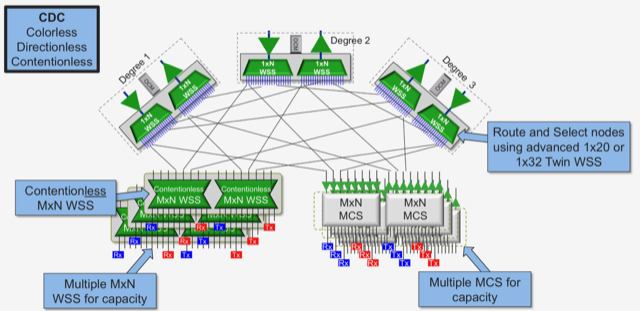
A second market magnifier is how modern ROADM networks use more wavelength-selective switches (WSSes). Both colourless and directionless (CD) ROADMs, and colourless, directionless and contentionless (CDC) ROADMs use more WSSes per node (see diagram above).
Such ROADMs also use more advanced WSS designs. Using an MxN WSS for the multicast switch in a route-and-select CDC ROADM, for example, delivers system benefits especially when adding and dropping wider optical channels that are starting to be used. Collings says Lumentum’s own MxN WSS is now close to volume manufacturing.
The third factor fuelling ROADM growth is the ongoing demand for more capacity. “Every time you fill a fibre, you typically use another degree in your [ROADM] node and light up a second fibre to grow capacity,” says Collings.
Operators with limited fibre are exploiting the fibre’s spectrum by using the C-band and L-band to grow capacity. This, too, requires more WSSes per node.
“All of these growth factors are happening simultaneously,” says Collings.
Open ROADM MSA
Lumentum is also a member of the Open ROADM multi-source agreement (MSA) that has created a disaggregated design to enable interoperability between systems vendors’ ROADMs.
AT&T is deploying Open ROADM systems in its metro networks while the MSA members have begun work on Revision 6.0 of the standard.
“Open ROADM is maturing and increasing its span of interest,” says Collings.
At first glance, Lumentum’s membership is surprising given it supplies ROADM building-blocks to vendors that make the ROADM systems. Moreover, the Open ROADM standard views a ROADM as an enclosed system.
“The Open ROADM has set certain boundaries where it defines interfaces so that vendor A can talk to vendor B,” says Collings. “And it has set that boundary pretty much at the complete ROADM node.”
Yet Lumentum is an MSA member because part of the software involved in controlling the ROADM is within the node. “It is not just a hardware solution, it is hardware and a significant software solution to supply into that,” says Collings.
Pluggable optics is also a part of the Open ROADM MSA, another reason for Lumentum’s interest. “There is a general discussion about potentially making a boundary condition around pluggable optics as well,” he says.
Collings says the MSA continues to build the ecosystem and the management system to help others use Open ROADM, not just AT&T.
400ZR, OpenZR+ and ZR+
As a supplier of coherent optics and line-side modules, Lumentum is interested in the OIF’s 400ZR standard and what is referred to as ZR+.
ZR+ offers an extended set of features and enhance optical performance. Both 400ZR and ZR+ will be implemented using QSFP-DD and OSFP pluggable modules.
The 400ZR specification has been developed for a specific purpose: to deliver 400 Gigabit Ethernet for distances of at least 80km for data centre interconnect applications. But 400ZR is not suited for more demanding metro mesh and longer-distance metro-regional applications.
This is what ZR+ aims to address. However, ZR+, unlike 400ZR, is not a standard and is a broad term.
At ECOC, Acacia Communications and NTT Electronics detailed interoperability between their coherent DSPs using what they call ‘OpenZR+’. OpenZR+ uses Ethernet traffic like 400ZR but also supports the additional data rates of 100, 200 and 300 Gigabit Ethernet. OpenZR+ also borrows from the OpenROADM specification to enable module interoperability between vendors for data centre interconnect applications with reaches beyond 120km.
But ZR+ encompasses differentiated coherent designs that support 400 gigabits in a compact pluggable but also lower transmission rates that trade capacity for reach.
“So, yes, both classes of ‘ZR+’ are emerging,” says Collings.
OpenZR+ seeks interoperability in compact pluggables, as well as higher power, higher performance modes less focused on interoperability, while ZR+ includes proprietary, higher-power solutions. “That [ZR+] is an area where distance and capacity equal money, in terms of savings and value,” says Collings. “That is going to be an area of differentiation, as it has always been for coherent interfaces.”
Collings favours some standardisation around ZR+, to enable interchangeability among module vendors and avoid the creation of a siloed market.
“But I don’t think we are going to find ZR+ interfaces defined for interoperability because you will find yourself walking back on that differentiation in terms of value that the network operators are looking to extract,” says Collings. “They need every bit of distance they can get.”
Network operators want compact, cost-effective solutions that do ‘even more stuff’ than they are used to. “400ZR checks that box but for bigger, broader networks, operators want the same thing,” says Collings.
There is a continuum of possibilities here, he says: “It is high value from a network operator point of view and it’s a technology challenge for the likes of us and the [DSP] chip vendors.”
800G Pluggable MSA
Lumentum also recently joined the 800G Pluggable MSA that was announced at the CIOE show, held in Shenzhen in September.
“Like any client interface where Lumentum is a supplier of the underlying [laser] chips – whether DMLs, EMLs or VCSELs – we feel it is pretty important for us to be in the definition setting of the interface,” says Collings. “We want the interface to be aligned optimally to what the chip can do.”
Lumentum announced last year that it is exiting the client-side module business and therefore will be less involved in the module aspects of the interface work.
“Having moved out of the [client-side] module business, we’re finding an awful lot of customers interested in engaging with us on the chip level, much more than before,” says Collings.
Further information
For an Optical Connections article about OpenZR+, co-authored by Acacia, NTT Electronics, Lumentum, Juniper Networks and Fujitsu Optical Components, click here

Lumentum completes sale of certain datacom lines to CIG
Brandon Collings, CTO of Lumentum, talks CIG, 400ZR and 400ZR+, COBO, co-packaged optics and why silicon photonics is not going to change the world.
Lumentum has completed the sale of part of its datacom product lines to design and manufacturing company, Cambridge Industries Group.

The sale will lower the company's quarterly revenues by between $20 million to $25 million. Lumentum also said that it will stop selling datacom transceivers in the next year to 18 months.
The move highlights how fierce competition and diminishing margins from the sale of client-side modules is causing optical component companies to rethink their strategies.
Lumentum’s focus is now to supply its photonic chips to the module makers, including CIG. “From a value-add point of view, there is a lot more value in selling those chips than the modules,” says Brandon Collings, CTO of Lumentum.
400ZR and ZR+
Lumentum will continue to design and sell line-side coherent optical modules, however.
“With coherent, there is a lot of complexity and challenge in the module’s design and manufacture,” says Collings. “We believe we can extract the value we need to continue in that business.”
The emerging 400ZR and 400ZR+ are examples of such challenging coherent interfaces.
The 400ZR specification, developed by the Optical Internetworking Forum (OIF), is a 400-gigabit coherent interface with an 80km reach. The 400 gigabit-per-second (Gbps) line rate will be achieved using a 64-gigabaud symbol rate and a 16-QAM modulation scheme.
>
“[400ZR] is not client-side. Sixty-four gigabaud is very hard to do in such an extremely compact form factor.
”
Module makers will implement the 400ZR interface using client-side pluggable modules such as the QSFP-DD and the OSFP to enable data centre operators to add coherent interfaces directly to their switches.
But implementing 400ZR will be a challenge. “This is not client-side,” says Collings. “Sixty-four gigabaud is very hard to do in such an extremely compact form factor.”
First samples of 400ZR modules are expected by year-end.
The 400ZR+ interface, while not a specification, is a catch-all for a 400-gigabit coherent that exceeds the 400ZR specification. The 400ZR+ will be a multi-rate design that will support additional line rates of 300, 200 and 100Gbps. Such rates coupled with more advanced forward-error correction (FEC) schemes will enable the 400ZR+ to span much greater distances than 80km.
The 400ZR+ interface helps the developers of next-generation coherent DSP chips to recoup their investment by boosting the overall market their devices can address. “It is basically a way of saying I’m going to spend $50 million developing a coherent DSP, and the 400ZR market alone is not big enough for that investment,” says Collings.
Lumentum says there will be some additional functionality that will be possible to fit into a QSFP-DD such that at least one of the ZR+ modes will be supported. But given the QSFP-DD module’s compactness and power constraints, the ZR+ will also be implemented in the CFP2 form factor that has the headroom needed to fully exploit the coherent DSP’s capabilities to also address metro and regional networks.
400ZR+ modules are expected in volume by the end of 2020 or early 2021.
DSP economics
Lumentum will need to source a coherent DSP for its 400ZR/ ZR+ designs as it does not have its own coherent chip. At the recent OFC show held in San Diego, the talk was of new coherent DSP players entering the marketplace to take advantage of the 400ZR/ZR+ opportunity. Collings says he is aware of five DSP players but did not cite names.
NEL and Inphi are the two established suppliers of merchant coherent DSPs. Lumentum (Oclaro) has partnered with Acacia Communications to use its Meru DSP for Lumentum’s CFP2-DCO design, although it is questionable whether Acacia will license its DSP for 400ZR/ ZR+, at least initially.
>
“God forbid if 10 or more players are doing this as no matter how you slice it, people will be losing [money]”
Lumentum and Oclaro also partnered with Ciena to use its WaveLogic Ai for a long-haul module. That leaves room for at least one more provider of a coherent DSP that could be a new entrant or an established system vendor that will license an internal design.
Collings points out that it makes no sense economically to have more than five players. If it takes $50 million to tape out a 7nm CMOS coherent DSP, the five players will invest a total of $250 million. And if the investment cost for the module, photonics and everything else is a comparable amount, that equates to $500 million being spent on the 400-gigabit coherent generation.
As for the opportunity, Collings talks of about a total of up to 500,000 ports a year by 2020. That equates to an investment return in the first year of $1,000 per device sold. “God forbid if 10 or more players are doing this as no matter how you slice it, people will be losing [money].”
Beyond Pluggables
The evolution of optics beyond pluggables was another topic under discussion at OFC.
The Consortium of On-Board Optics (COBO), the developerof an interoperable optical solution that embeds optics on the line card, had a stand at the show and a demonstration of its technology. In turn, co-packaged optics, the stage after COBO in the evolution of optical interfaces that will integrate the optics with the silicon in one package, is also now also on companies' agenda.
Collings explains that COBO came about because the industry thought on-board optics would be needed given the challenge of 400-gigabit pluggables meeting the interface density needed for 12.8-terabit switches . “I shared that opinion four to five years ago,” he says, adding that Lumentum is a member of COBO.
>
“That problem is real. It is a matter of how far the current engineering can go before it becomes too painful.”
But 400-gigabit optics has been engineered to meet the required faceplate density, including ZR for coherent. As a result, COBO is less applicable. “That need to break the paradigm is a lot less,” he says.
That said, Collings says COBO has driven valuable industry discussion given that the data centre is heading in a direction where 32 ports of 800-gigabit interfaces will be needed to get data in and out of next-generation, 25-terabit switches.
“That problem is real,” says Collings. “It is a matter of how far the current engineering can go before it becomes too painful.” Scaling indefinitely what is done today is not an option, he says.
It is possible with the next generation of switch chip to simply use a two-rack-unit box with twice as many 400-gigabit modules. “That has already been done at the 100-gigabit generation that lasted longer because it doubled up the 100-gigabit port count,” he says.
“In the generation after that, you are now asking for stuff that looks very challenging with today’s technology,” he says. “And that is where co-packaging is focused, the 50-terabit switch generation.” Switches using such capacity silicon are expected in the next four years.
But this is where it gets tricky, as co-packaging not only presents significant technical challenges but also will change the supply chain and business models.
Collings points out that hyperscalars do not like making big pioneering investments in new technology, rather they favour buying commodity hardware. “They don’t like risk, they love competition, and they like a healthy ecosystem,” he says.
“There is a lot of talk from the technology direction of how we can solve this problem [using co-packaged optics] but I think on the business side, the riskside, the investment side is putting a lot of pressure on that actually happening,” says Collings. “Where it ends up I don’t honestly know.”
Silicon photonics
One trend evident at OFC was the growing adoption of silicon photonics by optical component companies.
Indeed, the market research firm, LightCounting, in a research note summarising OFC 2019, sees silicon photonics as a must-have technology given co-packaged optics is now clearly on the industry’s roadmap.
However, Collings stresses that Lumentum’s perspective remains unchanged regarding the technology.
“It’s a fabless exercise so we can participate in silicon photonics and, quite frankly, that is why a lot of other companies are participating because the barrier to entry is quite low,” says Collings. “Nevertheless, we look at silicon photonics as another tool in the toolbox: it has advantages in some areas, some significant disadvantages in others, and in some places, it is simply comparable.”
When looking at a design from a system perspective such as a module, other considerations come into play besides the cost of the silicon photonics chip itself. Collings cites the CFP2 coherent module. While the performance of its receiver is good using silicon photonics, the modulator is questionable. You also need a laser and a semiconductor optical amplifier to compensate for silicon photonics higher loss, he says,
The alternative is to use an indium phosphide-based design and that has its own design issues. “What we are finding when you look at the right level is that the two are the same or indium phosphide has the advantage,” says Collings. “And as we go faster, we are finding silicon is not really keeping up in bandwidth and performance.”
As a result, Lumentum is backing indium phosphide for coherent operating at 64 gigabaud.
“A lot of people are talking about silicon photonics because they can talk about it,” says Collings. “It’s not worthless, don’t get me wrong, but its success outside of Acacia has been niche, and Acacia is top notch at doing this stuff.”

Relentless traffic growth leads to a ROADM rethink
Technology briefing: ROADMs
Lumentum has developed an optical switch to enable reconfigurable optical add-drop multiplexers (ROADMs) to cope with the traffic growth expected over the next decade.
The company’s MxN wavelength-selective switch (WSS) will replace the existing multicast switch used in colourless, directionless and contentionless ROADMs. The Lumentum TrueFlex 8x24 twin switch will enable networking nodes of 400-terabit capacity.
“This second-generation switch is what will take us into the 100 gigabaud and super-channel era of network scalability,” says Brandon Collings, CTO of Lumentum.
ROADMs
ROADMs sit at the mesh nodes in an optical network. Their function is to pass lightpaths destined for other nodes in the network - referred to as optical bypass - and enable the adding and dropping of wavelengths at the node. Such add/drops may be rerouted traffic or provisioned new services.
As network traffic continues to grow, so do the degrees of a ROADM and the ports of its sub-systems. The degree of a ROADM is defined to the number of connections or fibre pairs it can support. In the diagram, a ROADM of degree three is shown.
 A multicast switch-based 3-degree CDC ROADM. Source Lumentum.
It is rare to encounter more than five or six fibre routes leaving any given mesh node in a network, says Lumentum. “But in those fibre routes there is typically a large number of fibres - 64 or 128,” says Collings. “Operators deploy a conduit of fibre between cities.”
When the C-band fills up, an operator will light another fibre pair, taking up another of the ROADM’s degrees. ROADMs built today have 16 degrees. And since a fibre’s C-band can occupy some 30 terabits of data, this is how 400-terabit mesh nodes will be achieved.
“That is a pretty big node but that is the end [of life] capacity,” says Collings. “I don’t think you will find a 400-terabit node today but we build our networks so that they get there, five to eight years from when they are deployed.”
This raises another issue: the length of time it takes for any generational change of a ROADM design to take hold in the network.
“When a new approach comes along, it takes a couple of years for everyone to figure out how they will use it,” says Collings. Then, once a decision is made, it takes another two years to deploy followed by five to eight years before the ROADM node is filled.
“Nothing happens quickly in this business,” says Collings. “But the upside, from a business point of view, is that as things are designed in, they have a long deployment cycle.”
Lumentum illustrates the point with its own products.
The company is seeing growing demand for its dual TrueFlex WSS deployed in route-and-select ROADM architectures. “But we are still seeing growth on the older broadcast-and-select architectures underpinned by singe 1x9 WSSes,” says James Goodchild, director, product line management for wavelength management products at Lumentum.
CDC ROADMs
A colourless, directionless and contentionless (CDC) ROADM uses a twin multicast switch for the wavelength add and drop functions. The input fibre to each degree’s WSS is connected to the output path WSS of each of the ROADM’s other degrees. The input WSS also connects to the drop multicast switch (see diagram above).
Using a WSS on the input path means that only wavelengths of interest are routed to the WSS’ output ports. Hence the ROADM’s reference as a route-and-select architecture.
Using a 1xN splitter array instead of a WSS for the input path results in a broadcast-and-select ROADM. Here, the input fibre’s wavelengths are broadcast to all the N output ports. The high optical loss associated with the splitters is the main reason why CDC ROADM designs have transitioned to the WSS-based route-and-select architecture.
This second-generation switch is what will take us into the 100 gigabaud and super-channel era of network scalability
However, there is still an optical loss issue to be contended with, introduced by the add or drop multicast switch. Accordingly, along with the twin multicast switch are two arrays of erbium-doped fibre amplifiers (EDFAs). One EDFA array is on the drop ports to the MxN multicast switch and the second amplifier array boosts the outputs of the add-path multicast switch before their transmission into the network.
The MxN multicast switch comprises 1xN splitter arrays, N being the number of add-drop ports, and Mx1 selection switches where M is the number of directions the ROADM supports. A typical multicast switch is 8x16: eight being the ROADM’s number of directions and 16 the drop-port count.
Each of the N splitter arrays sends the signals on a drop port to all the Mx1 selection switches where each one pulls off the channel to be dropped. Having a selection switch at each of the multicast switch’s N drop ports is what enables contentionless operation, the avoidance of a collision when the same wavelength is droppedat a node from different degree directions.
MxN switch
Lumentum’s decision to develop the MxN switch to replace the multicast switch follows its study to understand how optical transmission networks will evolve with continual traffic growth.
One development is the adoption of higher-baud-rate, higher-capacity coherent transmissions that require wider channel widths. A 400-gigabit wavelength requires a 75GHz channel compared to the standard 50GHz fixed grid used for 100- and 200-gigabit transmissions. Future transmission speeds of 800 gigabits will use two such channels or 150GHz of spectrum, while a 1 terabit signal is expected to occupy 300GHz of fibre spectrum. “This is how we anticipate coherent transmission evolving,” says Collings.
Moving to wider channels also benefits the ROADM’s cost. If operators continued to use 50GHz channels, the channel count would grow exponentially with the growth in traffic. In contrast, adopting wider channels means the add-drop port count grows only linearly with traffic. “Using wider channels, the advantage is you don't have to support 600 ports of add-drop in your ROADM networks,” says Collings.
But wider channels means greater amplification demands on the EDFA arrays, an issue that will only worsen over time.
Multicast switch-based designs don’t support the wider channels we know are coming
Losing the amp
Because the power spectral density is constant, the power in a channel increases proportionally with its width. For example, a 75GHz channel has 2dB more power compared to a 50GHz channel spacing, a 150GHz channel 5dB more while a 300GHz channel has an extra 8dB.
The EDFA array is engineered to handle the worst case power requirement that occurs when all 16 optical transceivers into the multicast switch go to the same ROADM degree. Here the EDFA must be able to boost all 16 channels.
For a multicast switch with 16 ports, 22dBm amplification is needed for a 150GHz channel which requires going from an uncooled pump design to a cooled pump one. Equally, 25dBm amplification is needed for 300GHz channels. And as the number of degrees grows, so do the demands on the amplification until no practical amplifier design is possible (see diagram).
 The EDFA requirements to compensate for the optical loss of the multicast switch. The complexity of the EDFA design grows with the multicast switch's port count until it becomes insupportable. Source: Lumentum.
“This is not an issue today because we use very modest-sized channels and we engineer our systems to accommodate them,” says Collings. “But if you look forward, you realise they [multicast switch-based designs] don’t support the wider channels we know are coming.”
Using a WSS-based MxN switch solves this issue because, as with the input port WSS of a route-and-select architecture, the switch has a lower optical loss - under 8dB - compared to the 17dB of the splitter-based multicast switch.
The sub-8dB loss is below the threshold where amplification is needed: the optical signal is sufficiently strong at the drop port to be received, as are the added signals for transmission into the network. The resulting removal of the EDFAs simplifies greatly the complexity, size and cost of the CDC ROADM.
“The MxN is a WSS - it’s a router - so it sends all of the light in the direction it is supposed to go,” says Collings. “You can push through the MxN switch channels of any width and of any power because there is no amplifier that needs to be there and be designed appropriately."
The resulting second-generation CDC ROADM design is shown below.
 Source: Lumentum
Lumentum's Goodchild says the 8x24 twin implementation of the MxN switch will be available in the first quarter of 2019.
“Certain systems vendors already have access to samples,” says Goodchild.
Further reading
2D WSSes, click here
ROADMs and their evolving amplification needs, click here
ON2020 rallies industry to address networking concerns
 Source: ON2020
The slide shows how router-blade client interfaces are scaling at 40% annually compared to the 20% growth rate of general single-wavelength interfaces (see chart).
Extrapolating the trend to 2024, router blades will support 20 terabits while client interfaces will only be at one terabit. Each blade will thus require 20 one-terabit Ethernet interfaces. “That is science fiction if you go off today’s technology,” says Winzer, director of optical transmission subsystems research at Nokia Bell Labs and a member of the ON2020 steering committee.
This is where ON2020 comes in, he says, to flag up such disparities and focus industry efforts so they are addressed.
ON2020
Established in 2016, the companies driving ON2020 are Fujitsu, Huawei, Nokia, Finisar, and Lumentum.
The reference to 2020 signifies how the group looks ahead four to five years, while the name is also a play on 20/20 vision, says Brandon Collings, CTO of Lumentum and also a member of the steering committee.
 Brandon CollingsON2020 addresses a void in the industry, says Collings. The Optical Internetworking Forum (OIF) organisation may have a similar conceptual mission but it is more hands-on, focussing on components and near-term implementations. ON2020 looks further out.
“Maybe you could argue it is a two-step process,” says Collings. “First, ON2020 is longer term followed by the OIF’s definition in the near term.”
To build a longer-term view, ON2020 surveyed network operators worldwide including the largest internet content providers players and leading communications service providers.
ON2020 reported its findings at the recent ECOC show under three broad headings: traffic growth and the impact on fibre capacity and interfaces, interconnect requirements, and network management and operations.
Things will have to get cheaper; that is the way things are.
Network management
One key survey finding is the importance network operators attach to software-defined networking (SDN) although the operators are frustrated with the lack of SDN solutions available, forcing them to work with vendors to address their needs.
 Peter WinzerThe network operators also see value in white boxes and disaggregation, to lower hardware costs and avoid vendor lock-in. But as with SDN, there are challenges with white boxes and disaggregation.
“Let’s not forget that SDN comes from the big webscales,” says Winzer, companies with abundant software and control experience. Telecom companies don’t have such sophisticated resources.
“This produces a big conundrum for the telecom operators: they want to get the benefits without spending what the webscales are spending,” says Winzer. The telcos also need higher network reliability such that their job is even harder.
Responding to ON2020’s anonymous survey, the telecom players stress how SDN, disaggregation and the adoption of white boxes will require a change in practices and internal organisation and even the employment of system integrators.
“They are really honest. They say, nice, but we are just overwhelmed,” says Winzer. “It highlights the very important organisational challenges operators are facing.”
Operators are frustrated with the lack of SDN solutions available.
Capacity and connectivity
The webscales and telecom operators were also surveyed about capacity and connectivity issues.
Both classes of operator use 10-terabit links or more and this will soon rise to 40 terabits. The consensus is that the C-band alone is insufficient given their capacity needs.
Those operators with limited fibre want to grow capacity by also using the L-band with the C-band, while operators with plenty of fibre want to combine fibre pairs - a form of spatial division multiplexing - and using the C and L bands. The implication here is that there is an opportunity for hardware integration, says ON2020.
Network operators use backbone wavelengths at 100, 200 and 400 gigabits. As for service feeds - what ON2020 refers to as granularity - webscale players favour 25 gigabit-per-second (Gbps) whereas telecom operators continue to deal with much slower feeds - 10Mbps, 100Mbps, and 1Gbps.
What can ON2020 do to address the demanding client-interface requirements of IP router blades, referred to in the chart?
Xiang Liu, distinguished scientist, transmission product line at Huawei and a key instigator in the creation of ON2020, says photonic integration and a tighter coupling between photonics and CMOS will be essential to reduce the cost-per-bit and power-per-bit of future client interfaces.
 Xiang Liu
“As the investment for developing routers with such throughputs could be unprecedentedly high, it makes sense for our industry to collectively define the specifications and interfaces,” says Liu. “ON2020 can facilitate such an industry-wide effort.”
Another survey finding is that network operators favour super-channels once client interfaces reach 400 gigabits and higher rates. Super-channels are more efficient in their use of the fibre’s spectrum while also delivering operations, administration, and management (OAM) benefits.
The network operators were also asked about their node connectivity needs. While they welcome the features of advanced reconfigurable optical add-drop multiplexers (ROADMs), they don’t necessarily need them all. A typical response being they will adopt such features if they are practically for free.
This, says Winzer, is typical of carriers. “Things will have to get cheaper; that is the way things are.”
Photonic integration and a tighter coupling between photonics and CMOS will be essential to reduce the cost-per-bit and power-per-bit of future client interfaces
Future plans
ON2020 is still seeking feedback from additional network operators, the survey questionnaire being availability for download on its website. “The more anonymous input we get, the better the results will be,” says Winzer.
Huawei’s Liu says the published findings are just the start of the group’s activities.
ON2020 will conduct in-depth studies on such topics as next-generation ROADM and optical cross-connects; transport SDN for resource optimisation and multi-vendor interoperability; 5G-oriented optical networking that delivers low latency, accurate synchronisation and network slicing; new wavelength-division multiplexing line rates beyond 200 gigabit; and optical link technologies beyond just the C-band and new fibre types.
ON2020 will publish a series of white papers to stimulate and guide the industry, says Liu.
The group also plans to provide input to standardisation organisations to enhance existing standards and start new ones, create proof-of-concept technology demonstrators, and enable multi-vendor interoperable tests and field trials.
Discussions have started for ON2020 to become an IEEE Industry Connections programme. “We don’t want this to be an exclusive club of five [companies],” says Winzer. “We want broad participation.”
The white box concept gets embraced at the optical layer
 Brandon Collings
White boxes have arisen to satisfy the data centre operators’ need for simple building-block functions in large number that they can direct themselves.
“They [data centre operators] started using very simple white boxes - rather simple functionality, much simpler than the large router companies were providing - which they controlled themselves using software-defined networking orchestrators,” says Brandon Collings, CTO of Lumentum.
Such platforms have since evolved to deliver high-performance switching, controlled by third-party SDN orchestrators, and optimised for the simple needs of the data centre, he says. Now this trend is moving to the optical layer where the same flexibility of function is desired. Operators would like to better pair the functionality that they are going to buy with the exact functionality they need for their network, says Collings.
“There is no plan to build networks with different architectures to what is built today,” he says. “It is really about how do we disaggregate conventional platforms to something more flexible to deploy, to control, and which you can integrate with control planes that also manage higher layers of the network, like OTN and the packet layer.”
White box products
Lumentum has a background in integrating optical functions such as reconfigurable optical add/drop multiplexers (ROADMs) and amplifiers onto line cards, known as its TrueFlex products. “That same general element is now the element being demanded by these white box strategies, so we are putting them in pizza boxes,” says Collings.
At OFC, Lumentum announced several white box designs for linking data centres and for metro applications. Such designs are for large-scale data centre operators that use data centre interconnect platforms. But several such operators also have more complex, metro-like optical networking requirements. Traditional telcos such as AT&T are also interested in pursuing the approach.
The first Lumentum white box products include terminal and line amplifiers, a dense WDM multiplexer/ demultiplexer and a ROADM. These hardware boxes come with open interfaces so that they can be controlled by an SDN orchestrator and are being made available to interested parties.
OpenFlow, which is used for electrical switches in the data centre, could be use with such optical white boxes. Other more likely software are the Restconf and Netconf protocols. “They are just protocols that are being defined to interface the orchestrator with a collection of white boxes,” says Collings.
Lumentum’s mux-demux is defined as a white box even though it is passive and has no power or monitoring requirements. That is because the mux-demux is a distinct element that is not part of a platform.
AT&T is exploring the concept of a disaggregated ROADM. Collings says a disaggregated ROADM has two defining characteristics. One is that the hardware isn’t required to come with a full network control management system. “You can buy it and operate it without buying that same vendor’s control system,” he says. The second characteristic is that the ROADM is physically disaggregated - it comes in a pizza box rather than a custom, proprietary chassis.
There remains a large amount of value between encompassing optical hardware in a pizza box to delivering an operating network
Lumentum: a systems vendor?
The optical layer white box ecosystem continues to develop, says Collings, with many players having different approaches and different levels of ‘aggressiveness’ in pursuing the concept. There is also the issue of the orchestrators and who will provide them. Such a network control system could be written by the hyper-scale data centre operators or be developed by the classical network equipment manufacturers, says Collings.
Collings says selling pizza boxes does not make Lumentum a systems vendor. “There is a lot of value-add that has to happen between us delivering a piece of hardware with simple open northbound control interfaces and a complete deployed, qualified, engineered system.”
Control software is needed as is network engineering; value that traditional system vendors have been adding. “That is not our expertise; we are not trying to step into that space,” says Collings. There remains a large amount of value between encompassing optical hardware in a pizza box to delivering an operating network, he says.
This value and how it is going to be provided is also at the core of an ongoing industry debate. “Is it the network provider or the people that are very good at it: the network equipment makers, and how that plays out.”
Lumentum’s white box ROADM was part of an Open Networking Lab proof-of-concept demonstration at OFC.
JDSU's Brandon Collings on silicon photonics, optical transport & the tunable SFP+
JDSU's CTO for communications and commercial optical products, Brandon Collings, discusses reconfigurable optical add/drop multiplexers (ROADMs), 100 Gigabit, silicon photonics, and the status of JDSU's tunable SFP+.

"We have been continually monitoring to find ways to use the technology [silicon photonics] for telecom but we are not really seeing that happen”
Brandon Collings, JDSU
Brandon Collings highlights two developments that summarise the state of the optical transport industry.
The industry is now aligned on the next-generation ROADM architecture of choice, while experiencing a ’heavy component ramp’ in high-speed optical components to meet demand for 100 Gigabit optical transmission.
The industry has converged on the twin wavelength-selective switch (WSS) route-and-select ROADM architecture for optical transport. "This is in large networks and looking forward, even in smaller sized networks," says Collings.
In a route-and-select architecture, a pair of WSSes reside at each degree of the ROADM. The second WSS is used in place of splitters and improves the overall optical performance by better suppressing possible interference paths.
JDSU showcased its TrueFlex portfolio of components and subsystems for next-generation ROADMs at the recent European Conference on Optical Communications (ECOC) show. The company first discussed the TrueFlex products a year ago. "We are now in the final process of completing those developments," says Collings.
Meanwhile, the 100 Gigabit-per-second (Gbps) component market is progressing well, says Collings. The issues that interest him include next-generation designs such as a pluggable 100Gbps transmission form factor.
Direct detection and coherent
JDSU remains uncertain about the market opportunities for 100Gbps direct-detection solutions for point-to-point and metro applications. "That area remains murky," says Collings. "It is clearly an easy way into 100 Gig - you don't have to have a huge ASIC developed - but its long-term prospects are unclear."
The price point of 100Gbps direct-detection, while attractive, is competing against coherent transmission solutions which Collings describes as volatile. "As coherent becomes comparable [in cost], the situation will change for the 4x25 Gig [direct detection] quite quickly," he says. "Coherent seems to be the long-term, robust cost-effective way to go, capturing most of the market."
At present, coherent solutions are for long-haul that require a large, power-consuming ASIC. Equally the accompanying optical components - the lasers and modulators - are also relatively large. For the coherent metro market, the optics must become cheaper and smaller as must the coherent ASIC.
"If you are looking to put that [coherent ASIC and optics] into a CFP or CFP2, the problem is based on power; cost is important but power is the black-and-white issue," says Collings. Engineers are investigating what features can be removed from the long-haul solution to achieve the target 15-20W power consumption. "That is pretty challenging from an ASIC perspective and leaves little-to-no headroom in a pluggable," says Collings.
The same applies to the optics. "Is there a lesser set of photonics that can sit on a board that is much lower cost and perhaps has some weaker performance versus today's high-performance long-haul?" says Collings. These are the issues designers are grappling with.
Silicon photonics
Another area in flux is the silicon photonics marketplace. "It is a very fluid and active area," says Collings. "We are not highly active in the area but we are very active with outside organisations to keep track of its progress, its capabilities and its overall evolution in terms of what the technology is capable of."
The silicon photonics industry has shifted towards datacom and interconnect technology in the last year, says Collings. The performance levels silicon photonics achieves are better suited to datacom than telecom's more demanding requirements. "We have been continually monitoring to find ways to use the technology for telecom but we are not really seeing that happen,” says Collings.
Tunable SFP+
JDSU demonstrated its tunable laser in an SFP+ pluggable optical module at the ECOC exhibition.
The company was first to market with the tunable XFP, claiming it secured JDSU an almost two-year lead in the marketplace. "We are aiming to repeat that with the SFP+," says Collings.
The SFP+ doubles a line card's interface density compared to the XFP module. The SFP+ supports both 10Gbps client-side and wavelength-division multiplexing (WDM) interfaces. "Most of the cards have transitioned from supporting the XFP to the SFP+," says Collings. This [having a tunable SFP+] completes that portfolio of capability."
JDSU has provided samples of the tunable pluggable to customers. "We are working with a handful of leading customers and they typically have a preference on chirp or no-chirp [lasers], APD [avalanche photo-diode] or no APD, that sort of thing," says Collings.
JDSU has not said when it will start production of the tunable SFP+. "It won't be long," says Collings, who points out that JDSU has been demonstrating the pluggable for over six months.
The company plans a two-stage rollout. JDSU will launch a slightly higher power-dissipating tunable SFP+ "a handful of months" before the standard-complaint device. "The SFP+ standard calls for 1.5W but for some customers that want to hit the market earlier, we can discuss other options," says Collings.
Further reading
Rational and innovative times: JDSU's CTO Q&A Part II

"What happens after 100 Gig is going to be very interesting"
Brandon Collings (right), JDSU
How has JDS Uniphase (JDSU) adapted its R&D following the changes in the optical component industry over the last decade?
JDSU has been a public company for both periods [the optical boom of 1999-2000 and now]. The challenge JDSU faced in those times, when there was a lot of venture capital (VC) money flowing into the system, was that the money was sort of free money for these companies. It created an imbalance in that the money was not tied to revenue which was a challenge for companies like JDSU that ties R&D spend to revenue. You also have much more flexibility [as a start-up] in setting different price points if you are operating on VC terms.
The situation now is very straightforward, rational and predictable.
There is not a huge army of R&D going on. That lack of R&D does not speed up the industry but what it does do is allow those companies doing R&D - and there is still a significant number - a lot of focus and clarity. It also requires a lot of partnership between us, our customers [equipment makers] and operators. The people above us can't just sit back and pick and choose what they like today from myriad start-ups doing all sorts of crazy things.
We very much appreciate this rational time. Visions can be more easily discussed, things are more predictable and everyone is playing from a similar set of rules.
Given the changes at the research labs of system vendor and operators, is there a risk that insufficient R&D is being done, impeding optical networking's progress?
It is hard to say absolutely not as less people doing things can slow things down. But the work those labs did, covered a wide space including outside of telecom.
There is still a sufficient critical mass of research at placed like Alcatel-Lucent Bell Labs, AT&T and BT; there is increasingly work going on in new regions like Asia Pacific, and a lot more in and across Europe. It is also much more focussed - the volume of workers may have decreased but the task still remains in hand.
"There are now design tradeoffs [at speeds higher than 100Gbps] whereas before we went faster for the same distance"
How does JDSU foster innovation and ensure it is focussing on the right areas?
I can't say that we have at JDSU a process that ensures innovation. Innovation is fleeting and mysterious.
We stay very connected to our key customers who are more on the cutting edge. We have very good personal and professional relationships with their key people. We have the same type of relationship with the operators.
I and my team very regularly canvass and have open discussions about what is coming. What does JDSU see? What do you see? What technologies are blossoming? We talk through those sort of things.
That isn't where innovation comes from. But what that can do is sow the seeds for the opportunity for innovation to happen.
We take that information and cycle it through all our technology teams. The guys in the trenches - the material scientists, the free-space optics design guys - we try to educate them with as much of an understanding of the higher-level problems that ultimately their products, or the products they design into, will address.
What we find is that these guys are pretty smart. If you arm them with a wider understanding, you get a much more succinct and powerful innovation than if you try to dictate to a material scientist here is what we need, come back when you are done.
It is a loose approach, there isn't a process, but we have found that the more we educate our keys [key guys] to the wider set of problems and the wider scope of their product segments, the more they understand and the more they can connect their sphere of influence from a technology point of view to a new capability. We grab that and run with it when it makes sense.
It is all about communicating with our customers and understanding the environment and the problem, then spreading that as wide as we can so that the opportunity for innovation is always there. We then nurse it back into our customers.
Turning to technology, you recently announced the integration of a tunable laser into an SFP+, a product you expect to ship in a year. What platforms will want a tunable laser in this smallest pluggable form factor?
The XFP has been on routers and OTN (Optical Transport Network) boxes - anything that has 10 Gig - and those interfaces have been migrated over to SFP+ for compactness and face plate space. There are already packet and OTN devices that use SFP+, and DWDM formats of the SFP+, to do backhaul and metro ring application. The expectation is that while there are more XFP ports today, the next round of equipment will move to SFP+.
Certainly the Ciscos, Junipers and the packet guys are using tunable XFPs in great volume for IP over DWDM and access networks, but the more telecom-centric players riding OTN links or maybe native Ethernet links over their metro rings are probably the larger volume.
What distance can the tunable SFP+ achieve?
The distances will be pretty much the same as the tunable XFP. We produce that in a number of flavours, whether it is metro and long-haul. The initial SFP+ will like be the metro reaches, 80km and things like that.
What is the upper limit of the tunable XFP?
We produce a negative chirp version which can do 80km of uncompensated dispersion, and then we produce a zero chirp which is more indicative of long-haul devices.
In that case the upper limit is more defined by the link engineering and the optical signal-to-noise ratio (OSNR), the extent of the dispersion compensation accuracy and the fibre type. It starts to look and smell like a long-haul lithium niobate transceiver where the distances are limited by link design as much as by the transceiver itself. As for the upper limit, you can push 1000km.
An XFP module can accommodate 3.5W while an SFP+ is about 1.5W. How have you reduced the power to fit the design into an SFP+?
It may be a generation before we get to that MSA level so we are working with our customers to see what level they can tolerate. We'll have to hit a lot less that 3.5W but it is not clear that we have to hit the SFP+ MSA specification. We are already closer now to 1.5W than 3.5W.
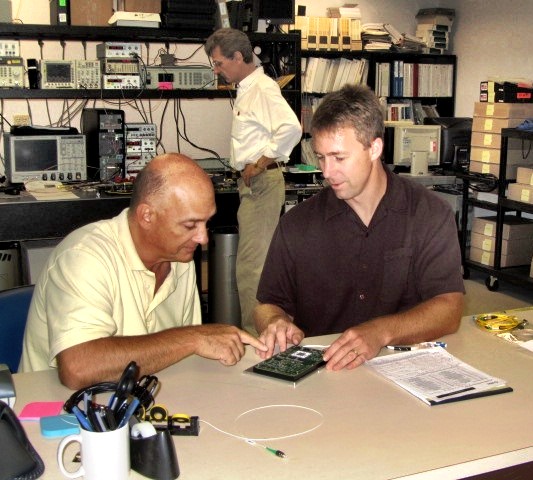
"I can't say that we have at JDSU a process that ensures innovation. Innovation is fleeting and mysterious."
Semiconductors now play a key role in high-speed optical transmission. Will semiconductors take over more roles and become a bigger part of what you do?
Coherent transmission [that uses an ASIC incorporating a digital signal processor (DSP)] is not going away. There is a lot of differentiation at the moment in what happens in that DSP, but I think overall it is going to be a tool the system houses use to get the job done.
If you look at 10 Gig, the big advancement there was FEC [forward error correction] and advanced FEC. In 2003 the situation was a lot like it is today: who has the best FEC was something that was touted.
If you look at coherent technology, it is certainly a different animal but it is a similar situation: that is, the big enabler for 40 and 100 Gig. Coherent is advanced technology, enhanced FEC was advanced technology back then, and over time it turned into a standardised, commoditised piece that is central and ubiquitously used for network links.
Coherent has more diversity in what it can do but you'll see some convergence and commoditisation of the technology. It is not going to replace or overtake the importance of photonics. In my mind they play together intimately; you can't replace the functions of photonics with electronics any time soon.
From a JDSU perspective, we have a lot of work to do because the bulk of the cost, the power and the size is still in the photonics components. The ASIC will come down in power, it will follow Moore's Law, but we will still need to work on all that photonics stuff because it is a significant portion of the power consumption and it is still the highest portion of the cost.
JDSU has made acquisitions in the area of parallel optics. Given there is now more industry activity here, why isn't JDSU more involved in this area?
We have been intermittently active in the parallel optics market.
The reality is that it is a fairly fragmented market: there are a lot of applications, each one with its own requirements and customer base. It is tough to spread one platform product around these applications. That said, parallel optics is now a mainstay for 40 and 100 Gig client [interfaces] and we are extremely active in that area: the 4x10, 4x25 and 12x10G [interfaces]. So that other parallel optics capability is finding its way into the telecom transceivers.
We do stay active in the interconnect space but we are more selective in what we get engaged in. Some of the rules there are very different: the critical characteristics for chip interconnect are very different to transceivers, for example. It may be much better to have on-chip optics versus off-chip optics. Obviously that drives completely different technologies so it is a much more cloudy, fragmented space at the moment.
We are very tied into it and are looking for those proper opportunities where we do have the technologies to fit into the application.
How does JDSU view the issues of 200, 400 Gigs and 1 Terabit optical transmission?
What happens after 100 Gig is going to be very interesting.
Several things have happened. We have used up the 50GHz [DWDM] channel, we can't go faster in the 50GHz channel - that is the first barrier we are bumping into.
Second, we're finding there is a challenge to do electronics well beyond 40 Gigabit. You start to get into electronics that have to operate at much higher rates - analogue-to-digital converters, modulator drivers - you get into a whole different class of devices.
Third, we have used all of our tools: we have used FEC, we are using soft-decision FEC and coherent detection. We are bumping into the OSNR problem and we don't have any more tools to run lines rates that have less power to noise yet somehow recover that with some magic technology like FEC at 10 Gig, and soft decision FEC and coherent at 40 and 100 Gig.
This is driving us into a new space where we have to do multi-carrier and bigger channels. It is opening up a lot of flexibility because, well, how wide is that channel? How many carriers do you use? What type of modulation format do you use?
What format you use may dictate the distance you go and inversely the width of the channel. We have all these new knobs to play with and they are all tradeoffs: distance versus spectral efficiency in the C-band. The number of carriers will drive potentially the cost because you have to build parallel devices. There are now design tradeoffs whereas before we went faster for the same distance.
We will be seeing a lot of devices and approaches from us and our customers that provide those tradeoffs flexibly so the carriers can do the best they can with what mother nature will allow at this point.
That means transponders that do four carriers: two of them do 200 Gig nicely packed together but they only achieve a few hundred kilometers, but a couple of other carriers right next door go a lot further but they are a little bit wider so that density versus reach tradeoff is in play. That is what is going to be necessary to get the best of what we can do with the technology.
That is the transmission side, the transport side - the ROADMS and amplifiers - they have to accommodate this quirky new formats and reach requirements.
We need to get amplifiers to get the noise down. So this is introducing new concepts like Raman and flex[ible] spectrum to get the best we can do with these really challenging requirements like trying to get the most reach with the greatest spectral efficiency.
How do you keep abreast of all these subject areas besides conversations with customers?
It is a challenge, there aren't many companies in this space that are broader than JDSU's optical comms portfolio.
We do have a team and the team has its area of focus, whether it is ROADMs, modulators, transmission gear or optical amplifiers. We segment it that way but it is a loose segmentation so we don't lose ideas crossing boundaries. We try to deal with the breadth that way.
Beyond that, it is about staying connected with the right people at the customer level, having personal relationships so that you can have open discussions.
And then it is knowing your own organisation, knowing who to pull into a nebulous situation that can engage the customer, think on their feet and whiteboard there and then rather than [bringing in] intelligent people that tend to require more of a recipe to do what they are doing.
It is all about how to get the most from each team member and creating those situations where the right things can happen.
For Part I of the Q&A, click here