

Books of 2023 - Final part
Gazettabyte has been asking industry figures to pick their reads of the year. In the final part, contributions are from Larry Dennison, Tim Doiron, Catherine White and Neil McRae.
Larry Dennison, Network Research Group, Nvidia
At this point in my life, book reading is to unwind and is mostly fiction. I get nearly everything else from reading selected technical papers, the daily news and Real Clear Politics. There is just so much cognitive dissonance in the news and editorials that I retreat into fantasy for some down-time.
The best books for me this year are the Beware of Chicken series. This is a light-hearted, martial arts/ cultivation world. Most of the world believes that ‘one strives for the heavens alone’. The main protagonist believes that ‘everything is connected’ and that relationships and doing the right thing are most important. This creates a central set of likeable characters who prevail and grow when challenges arise.
The other series is The Wandering Inn, a truly massive work with a multitude of likable and unlikable characters. Very rich world building, the main character is Erin who was transported from Earth and becomes an inn keeper. Erin sees the good in nearly everyone, including goblins, which results in her finding ways of dispelling prejudice. It isn’t always happy but there is always a sense of noble conduct.
Tim Doiron, Vice President, Solution Marketing, Infinera
In recent years, my reading has leaned toward technology, leadership, marketing, and history. However, with a son who recently completed his master’s degree in psychology, I found myself in 2023 developing an interest in topics related to human behavior and how people are wired.
In parallel with my newfound interest in psychology, I was asked to give a presentation at one of our recent leadership events. In that presentation, I referenced four books that had an impact on me and my thinking in 2023.
Three of these books were written in the past few years and the fourth is an older one that I revisited to prepare for my presentation. I’ll explain.
The first book is Think Again: The Power of Knowing What You Don’t Know, by Adam Grant, an organisational psychologist and well-known author. In Think Again, Grant identifies four styles commonly used to approach problems: preacher, prosecutor, politician, and scientist. While each of these approaches might be useful under certain situations, Grant argues that we should spend more time thinking like a scientist. We need to remain curious, challenging our own positions and assumptions and inviting others around us to do the same.
The world is changing fast, and positions that were accurate yesterday may not hold for today or tomorrow. For most of us in the technology industry, thinking like a scientist might come naturally, but we may not always apply it when making tradeoffs or debating strategies with colleagues. The second book is Dare to Lead: Bare Work. Tough Conversations. Whole Hearts. by Brenee Brown.
Brown is a research professor and storyteller in areas of shame, empathy, courage, and vulnerability. Brown has worked with all types of companies and organisations. To be courageous, you must be vulnerable. And vulnerability involves fear, uncertainty, and risk. If you find yourself thinking about effective leadership, this is a great book.
If we are going to think like a scientist and be courageous leaders, how do we solidify and anchor change in our organizations and our companies? That’s where John P. Kotter’s Leading Change comes in. I read this book 20 years ago and revisited it in preparation for my leadership presentation. We need to anchor change in the company culture if it’s going to stick. While this book isn’t new, the eight steps Kotter outlines for helping transform any organisation remain relevant.
Finally, as a marketeer I am always thinking about effective communications. Earlier this year, one of my colleagues at Infinera shared Smart Brevity: The Power of Saying More with Less by Jim VandeHei, Mike Allen and Roy Schwartz.
In our digital and social-media infused life, the ability to deliver relevant, concise, and impactful information has never been more important. This book provided some useful tips and scenarios and was a fast read. Maybe I don’t need to write all those white papers after all. Nice!
Catherine White, Researcher, Optical and Quantum technology, BT.
One book I read is Wasteland: The Dirty Truth About What We Throw Away, Where It Goes, and Why It Matters by Oliver Franklin-Wallis.
Technology has contributed to creating more waste than providing good solutions to solving the harm waste creates. There is also much work to be done to reclaim valuable materials.
At BT, there are programmes to reclaim and recycle materials from technical waste, among other initiatives for sustainability. For example, BT Group looks to circular networks in sustainability drive.
Wasteland is well written and brings home – in great detail – what we all basically know and must not ignore. It is also a fascinating, and sometimes horrifying journey waste takes once we say goodbye to it.
Another book I read is Novacene: The Coming Age of Hyperintelligence by James Lovelock. I am a great admirer of Lovelock and his early work on ecology. He was a brilliant, multi-talented engineer, and his Gaia theory, though it has a New Age association to some people, was based on computer simulations.
Lovelock lived for over a century, and his final book was published a few years ago, providing a startling vision of the future in which the predominant new intelligent life forms of the galaxy will be artificial, and the first of them (at least on this planet) created by us.
I am not sure he is right. I hope he is not because the thought is unsettling (though he has been proved to be prescient about many things). But his ideas are thought-provoking, even as a strawman to criticise, and it is the final work of a great individual.
During a break in Devon, I picked up a secondhand copy of a book of short stories The Rest of the Robots by the classic sci-fi author, Isaac Asimov.
It’s not his best robot book but I found an interesting story within this book in which the robotic proof-reader makes changes to the meaning of the text it is correcting, to match hard coded AI ethical rules that subsume other rules, with unintended effects.
Asimov had remarkable perception of the future but reading his work makes it clear he did not go far enough in predicting the sophistication with which AI would be able to reason. However, he was right about the unpredictability, and that is the key message for me. We finally need a robot psychologist like Asimov’s Susan Calman!
Neil McRae, Chief Network Strategist, Juniper Networks
The first book I read earlier this year was I May Be Wrong: And Other Wisdoms from Life as a Forest Monk, by Björn Natthiko Lindeblad.
I was recommended to read this by a friend. He recommended the book to help me with a big change in my life that I was going through, having left the company I worked for 12 years and sensing it was going to be more difficult than I might like to admit.
The book is the story of the author, a monk in Thailand. What I liked about this book is how closely the author seemed to mirror my thinking but from a totally different vantage point and wildly different life choices. He illustrates the struggle of being a monk and the realities of life, but it also teaches that the simplest things will make a difference in the world.
I found this approach inspiring, and the ending, well, I’m not going to give it away, but in a world where mental health is increasingly important, this energised me and got me moving on my next journey much quicker.
Through the Glass Ceiling to the Stars: The Story of the First American Woman to Command a Space Mission by Eileen Collins and Jonathan Ward is the amazing life story of Eileen Collins, the first female Space Shuttle Command and Pilot.
I have been fortunate to meet Eileen on many occasions, and the book surprised me in the way that Eileen had to deal with some brutal highs and lows, with immense mental strength during difficult times for her and for NASA and the Space Shuttle programme, and then the pressure of being the public face of the return to flight programme.
She is known for being the first female space shuttle pilot and commander, but Eileen was also the first woman to fly the F-15 fighter jet.
The book tells me that if you are determined enough and hungry enough, the sky is not the limit.

Books of 2023 - Part 3
Gazettabyte has been asking industry figures to pick their reads of the year. In Part 3, Noam Mizrahi, Katharine Schmidtke, Steve Suarez, and Vladimir Kozlov share their readings of the year.
Noam Mizrahi, EVP, corporate CTO at Marvell.
Start with Why: How Great Leaders Inspire Everyone to Take Action, by Simon Sinek is a book about the obvious. It is so obvious, in fact, that it is very hard to do. We all want our message to get through so that people understand, see things through our eyes and share our vision.
When we start a journey, we know very well why we do it. This is also when we inspire and motivate the most, ourselves and others. But, as we develop our company, products and careers, intuitively, routine makes us focus on what we do and how we do it, and in some (or many) cases, we forget why we do it.
Once we forget the why, it is harder for us to experience a sense of accomplishment and, in most cases, will make it harder for us to inspire others to follow our vision.
Focus on the why as a means for inspiration and motivation. I find this simple advice something I always try to remember and in everything I do.
This book did not necessarily tell me what to do or how to do it, but I sure know why it was vital for me to read it.
Katharine Schmidtke, Ph.D., Eribel Systems LLC
Integrated Photonics for Data Communications Applications, Edited by Madeleine Glick, Ling Liao, and Katharine Schmidtke (2023), is the book I definitely read most in 2023!
This book, the inaugural volume in a series on integrated photonics, is a testament to the collaborative expertise inspired by Prof. Kimerling at MIT. It is the culmination of a three-year collaboration between co-editors Madeleine, Ling and me. We are incredibly grateful to the over ninety authors, each a leader in the field, whose technical expertise shines through and makes the content enriching and inspiring.
Diving into the world of advanced photonic devices and integrated photonic circuits, the book explores key concepts, design principles, performance metrics, and manufacturing processes. It goes beyond the theoretical, offering a comprehensive view of the practical aspects crucial for understanding and advancing this field.
One of the book’s strengths is its examination of the current trends and commercial requirements in data communication for data centres and high-performance computing. The inclusion of contributions from end users sharing key performance indicators adds a valuable real-world perspective.
At its core, the book dissects the fundamental building blocks of integrated photonics, unravelling the complexities of lasers, modulators, photodetectors, and passive devices. It’s a holistic journey through the individual elements that collectively form the intricate web of photonic integrated circuits.
Over the summer, I was back in England clearing out old bookshelves and discovered the series of spy novels by the British writer, John le Carré. I picked up The Little Drummer Girl, published in 1983. The story follows the manipulations of Martin Kurtz, an Israeli spymaster who intends to kill Khalil – a Palestinian terrorist who is bombing Jewish-related targets in Europe, particularly Germany – and Charlie, an English actress and double agent working on behalf of the Israelis.
It’s a thrilling and complex plot with many unexpected twists and turns, but this story has no heroes. Everyone loses something, including Charlie, who loses her mind. Reading it forty years after its writing, I experienced déjà vu during the events which started on October 7th, 2023.
I’ve had the book Narrative and Numbers: The Value of Stories in Business, by Aswath Damodaran on my reading list since its publication in 2017, and it certainly lived up to the anticipation.
The author delves into the intricacies of valuing companies, offering a profound analysis beyond the numbers. What sets this book apart is its exploration of the transformative power of storytelling in the business world.
As engineers, we often underestimate the impact of a well-crafted narrative. The author argues that a logical and rational story, when presented effectively, can breathe life into facts and figures.
The book emphasizes the importance of storytelling in making data understandable and unforgettable. The art of storytelling is revealed to be a compelling force that captivates audiences, making it challenging to dismiss even seemingly improbable valuations.
What struck me was the insight into how companies, seemingly without substantial revenue, can achieve remarkably high valuations.
By reading this book, you gain a deeper understanding of the alchemy that occurs when a compelling story intertwines with the cold, hard metrics of business. It’s a valuable read, shedding light on the often-underestimated influence of narrative in shaping perceptions and valuations.
Von der Nutzlosigkeit Erwachsen zu Werden, by Georg Heinzen and Uwe Koch (1994) can be translated as ‘Growing up from Uselessness’ or, because it’s a double entendre, ‘About the Uselessness of Growing up’.
The book is a farce about a tragic victim of the German education crisis of the 1970s and the job market of the 1990s. At thirty, still unemployed and living at home, this hopeless character discovers that having graduated high school, his education is helpful for everything but not needed for anything.
I wasn’t educated in Germany, but this mood was contagious throughout the rest of Europe, and I, too, struggled to get my first job during the recession of the 1990s.
Reading it now, with two teenagers preparing to launch themselves into the workforce in a few years, I’m sure they feel the same way. This might seem to be a depressing topic for me to dwell on, but the book is a fun read filled with ironic humour and many relevant topics for today.
Steve Suarez, Founder & CEO of HorizonX
This year marked a significant milestone for me. I took the courageous step of pursuing my lifelong aspiration of entrepreneurship. My goal is to empower organisations to innovate effectively and at scale. In a world where innovation is consistent and a requisite, there is a demand for skilled professionals who can excel in this realm across all industries and geographies.
To equip myself, I recognised the necessity to acquire new competencies, particularly in sales and the fundamentals of operating a thriving consulting business. To this end, I started listening to The Consulting Bible: How to Launch and Grow a Seven-Figure Consulting Business, by Alan Weiss, 2nd Edition in audiobook format, which I listened to during my commutes to London.
The insights have been invaluable. It has sharpened my focus on what drives business success and has influenced my approach to consulting. The lessons learned have been instrumental in shaping my entrepreneurial journey, allowing me to concentrate on strategies that make an impact.
I am eager to share more about how these learnings have transformed my business practices and the innovative solutions I can offer clients.
Vlad Kozlov, CEO and founder of LightCounting Market Research
An Immense World: How Animal Senses Reveal the Hidden Realms Around Us, by Ed Yong, reads like poetry, but it offers the depth of a Ph.D thesis, or several, with its range of topics.
You may already know that bats navigate the world using echolocation. Still, it works and it is fascinating, an incredible level of complexity chiselled by evolution over millennia, one mutation at a time. Even a recovering communist may wonder if evolution can do such a feat.
The book is dense and you have to take it in slowly. I’m almost finished now, and the most incredible chapter so far was on electric fields. Not about hundreds of volts that stingrays use but weak electric fields that many fish use to navigate murky waters. Unbelievable.
I am saving the next chapter on magnetic fields for the holidays.
A must read for anyone interested in high-tech innovation. Yes, this is a cutting edge technology. It is also a journey into a parallel world, or worlds, of creatures around us. What drives them remains a mystery, but all of them are caused by something in their lives. And it is more than just hunger.

Books of 2023 - Part 2
Gazettabyte asks industry figures to pick their reads of the year. In Part 2, Alan Liu, Yves LeMaitre, and, in this case, the editor of Gazettabyte list their recommended reads.
Alan Liu, CEO & Co-Founder at Quintessent Inc.
One book that left a deep impression on me is Man’s Search for Meaning by Viktor Frankl, a recounting and reflection by the author of his time as a prisoner in various concentration camps during WWII.
I listened to the audiobook mostly during commutes to work at the beginning of the year. Whatever challenges awaited me for the day, no matter how big, they seemed less daunting when reframed against the book’s stories.
The extreme deprivation and suffering described also gave me a deeper appreciation for the basic creature comforts of modern life that we enjoy (such as food, shelter, and coffee), which are easy to take for granted due to their constancy.
Yves LeMaitre, CEO of AstroBeam
Let me start with my favourite spy novel writer, John Le Carre. Pick any of his books. I just read his first small novel from 1961: Call for the Dead.
I recommend starting with his first major success, The Spy Who Came In from the Cold and if you like it, work your way to more recent books relevant to today’s tumultuous world: The Little Drummer Girl and A Most Wanted Man. Hopefully, it will bring you with an alternative viewpoint on some of today’s geopolitical hotspots
As the world continues to accept more diversity, if you want to glimpse Native American culture, try the easy path of the Tony Hillerman mystery books.
Then follow up with a trip to the Navajo and Hopi reservations in the Southwest. I promise it will change completely your views of the US history and Indian land ownership and occupation.
My favourite is A Thief of Time: A Leaphorn and Chee Novel but you can safely pick any of his books.
If you want to have the best Native guides in the Southwest, call my friend, Louis Williams, at Ancient Wayves River and Hiking Adventures: Guided Tours. He will make you discover the world of Diné and the incredible mystery of the lost Anasazi people.
Last summer, we had the best rafting trip on the San Juan River with his team, with incredible hikes in hidden canyons discovering ruins and artefacts left behind by the Ancient People.
Roy Rubenstein, Editor, Gazettabyte
One reading topic of continual interest is Israel. I have also listened to more podcasts this year and am a big fan of long-read articles.
I’m reading Isabel Kershner’s book: The Land of Hope and Fear: Israel’s Battle for Its Inner Soul. Kershner is the New York Times’s veteran correspondent in Israel. There is no shortage of books by journalists impacted by covering Israel. This is a timely primer for anyone wanting to understand the complexities of Israel.
Kai Bird is known for co-authoring the book on Robert Oppenheimer that was the basis of this year’s blockbuster film. But years ago he wrote a biography about CIA intelligence officer, Robert Aimes. Aimes was an outstanding character who served in the Middle East and died in the truck bomb assault on the US embassy in Beirut in 1983. Aimes got the Americans to talk to the PLO, ultimately leading to the Oslo Peace Accords.
Simon Baron-Cohen’s book, The Science of Evil: On Empathy and the Origins of Cruelty is another revisited book. The author is a psychologist and a leading authority on autism. Early in the book, he explains that he has an issue with the word ‘Evil’. In it, he explores why certain people cannot read, or don’t care, how others feel. He discusses the brain and structures such as the empathy circuit function. Empathy is absent when the circuit doesn’t work. However, the effects can vary significantly: people with autism differ from psychopaths. Why the circuit may malfunction is complex. It involves genetics, social, and environmental issues. The book, published in 2011, gives a different view on how to think about and treat cruelty.
In 2014, Prof Baron-Cohen co-signed a letter to The Times (of London) addressed to the leaders in Israel and Gaza that ends with the word empathy: “So, we say to the leaders of Israel and Hamas, please sit down, talk without table thumping, listen to each other and start a new politics based on the principles of respect, dignity, and empathy.”
One of my best reads is the book Two Roads Home: Hitler, Stalin, and the Miraculous Survival of My Family, by Daniel Finkelstein. It combines a period of upheaval in Europe and the Soviet Union with the survival of the author’s parents – who eventually meet and settle in Hendon, North London.
The book describes the history happening around two individuals who spent the rest of their lives bringing up their children in a loving home. The tale is remarkable and moving, including an early chapter where the author pays tribute to his father.
I met Finkelstein’s parents in the early 1990s but knew nothing of their story. I was also at Daniel’s sister’s wedding and remember being incredibly moved by the father’s speech.
Jonathan Raban is an author I lost track of only for him to resurface in the obituary columns, sadly. I realise he had moved to the US two decades ago.
His last book, Father and Son: A Memoir, is just out: about his recovery from a stroke coupled with the story of his parents and their love letters while separated during WWII.
Raban is a beautiful writer. “A nurse had assisted me into the wheelchair, and I was dozing there when Julia (his daughter) arrived to visit. The oddity of the situation made us both shy. We were deferential newcomers to the conventions of the hospital, like tourists with lowered voices tiptoeing around a foreign cathedral.
Lastly, The Atlantic and The New Yorker magazines published some great articles on AI this year:
- Talk to Me: Can artificial intelligence allow us to speak to another species?
- Geoffrey Hinton: It’s far too late to stop AI
- Does Sam Altman Know What he is Creating?
- How Jensen Huang’s Nvidia is powering the AI revolution
- The Inside Story of Microsoft’s Partnership with OpenAI
Books in 2023
Gazettabyte asks industry figures to pick their reads of the year. William Koss, Dean Bubley and Scott Wilkinson kick off this year’s recommended reads.
William R Koss, CEO at Drut Technologies
My 2023 reading list is less than normal as the year has been full of technical reading and presentation materials for work. I enjoy history books as well as business history that tell the rise and fall of some company, industry or person.
In Progress
Target Tokyo: The Story of the Sorge Spy Ring by Gordon W. Prange: I picked this book out of Amazon’s recommendation list. Gordon Prange being the author of At Dawn We Slept and Tora, Tora, Tora. Currently plowing through this book that was unfinished at the time of his death.
The Crusades: The War for the Holy Land by Thomas Asbridge. My knowledge of the Crusades was thin and I was looking for a book that provided a grand overview. So far it has not disappointed, but I have had to familiarize myself with many new names.
Completed Reads
Band of Brothers: E Company, 506th Regiment, 101st Airborne, from Normandy to Hitler’s Eagle’s Nest by Stephen E. Ambrose. A second read for me as I watched the series on Netflix over the summer and the thought occurred to read the book and compare and contrast the series to the book. Ambrose is a wonderful writer.
Going Infinite: The Rise and Fall of a New Tycoon by Michael Lewis. I was raising venture capital during the crypto craze from the same firms SBF raised capital and I admit that reading this book is part schadenfreude.
Circle of Treason: CIA Traitor Aldrich Ames and the Men He Betrayed by Sandra Grimes and Jeanne Vertefeuille.A second read for me. Something triggered the thought of Aldrich Ames and I read the book in two days.
The Wager: A Tale of Shipwreck, Mutiny and Murder by David Grann. A very fun read and puts into perspective the speed of news and information that we enjoy today. People thought along the time scale of years in the 1700s
This Kind of War: The Classic Korean War History by T.R. Fehrenbach. My father was in the Korean War and I have read many a book on the subject. It was a new read for me.
Duel in the Sun: Alberto Salazar, Dick Beardsley, and America’s Greatest Marathon by John Brant. My hobby is road cycling, but I have a colleague who has run the Boston Marathon a few times. The Boston Marathon route is within walking distance of my house and my colleague recommended this book as the best book written on marathon racing. I finished it on a couple of airplane rides.
Unscripted: The Epic Battle for a Media Empire and the Redstone Family Legacy by James B. Stewart and Rachel Abrams. A complete disappointment. The book was recommended by a former colleague and I just did not find all the personal details that interesting. I think I was hoping for a better read along the lines of the series Succession which had just ended and that was the reason for my reading.
Castles of Steel: Britain, Germany, and the Winning of the Great War at Sea by Robert K. Massie. Robert Massie is a master historian. One of the greats of our time. I have read Dreadnaught and Castles of Steel a few times. This book is master level history telling. Magnificent in all regards. Sections of the book can be read as short books. The story of Von Spee’s journey from the Pacific to Atlantic could be a single book. I am about to start his book Nicholas and Alexandra about the fall of the Romanov Dynasty.
Dean Bubley, technology industry analyst & futurist at Disruptive Analysis
A recent stand-out for me is Material World: The Six Raw Materials That Shape Modern Civilization by Ed Conway.
I found the book fascinating. It helped me gain a new angle on a lot of the issues faced in the economy and society overall, as well as specific bits of the tech sector.
It tells the stories of the production, processing, transport and use of some of the core minerals we use throughout society and technology. The book covers:
- sand/silicon used for concrete and also semiconductors and optical fibre
- lithium for batteries
- copper for cables, generators and motors
- oil & gas and why they’re still necessary at least for creating products rather than combustion (such as carbon anodes in batteries)
- salt(s) for multiple purposes
- iron & steel
One of the things I often realise is that it is easy to get wrapped up in technology including telecoms. We talk about virtualisation, AI, cloud, orchestration and software all the time.
There’s also a lot of physics. I often talk about radio spectrum and wireless propagation, including 5G and WiFi indoors and through walls. But I don’t pay much attention to the chemistry and materials involved.
This book poses some hard questions, such as where we get enough lithium (and also cobalt and other metals) for decarbonisation, or enough copper for new generators and grid capacity.
My takeout is that the next 20-30 years involve a tightrope walk, buffeted by the winds of physical materials, economics, geopolitics and hidden dependencies. It’s all very well saying ‘just stop doing X’, but sometimes (at least some) of X is essential in order to continue making Y or doing Z.
We also must be careful not just about “supplier diversity” for complex systems like radio access network equipment, or even the components and chips, but all the way down to the raw materials, which may be mined or refined in only a few places around the world.
Worth a read or a listen. I’m an audiobook devotee & this is narrated well enough to listen at 3x speed.
Scott Wilkinson, lead analyst, networking components, Cignal AI
There have been several books this year that I recommended to friends and colleagues. The Cartel by Don Winslow provides unique insights (for fiction) into the crisis at the southern US border.
My son, a Biomechanical Engineering Master’s student at Virginia Tech, and I both read Andy Weir’s Project Hail Mary. It’s like candy to engineers and I enjoyed discussing it with him as he made his way through the chapters.
I recently finished Rod Chernow’s massive biography, Grant, which was fascinating on every page, especially to those who were erroneously taught that he was a mediocre general who won the Civil War due only to attrition and not due to his strategic genius.
But the one book that I recommend the most to my engineering colleagues and history fans is The Great Bridge: The Epic Story of the Building of the Brooklyn Bridge by David McCullough. I’ve read several of McCullough’s histories, but never got around to reading this, his first. The Great Bridge tells the story of the building of the Brooklyn Bridge. It was an engineering feat that is hard to comprehend today.
Anyone driving or taking a subway train across the East River nay have difficulty imagining a time when Brooklyn and Manhattan were separate cities. The only way to get from one to the other was by ferry, and the residents in Brooklyn were worried that any more permanent connection might bring NYC corruption across the river. Washington Roebling took over the project when his father unexpectedly died early in the planning stages. With only his mind and his pencil, he designed every aspect of the bridge from the caissons sunk deep into the river to the cables spanning the towers. Plagued by an unknown disease he contracted after repeatedly descending into the pressurized caissons (what we now know as the bends), Roebling – and his very underappreciated wife, Emily – nevertheless managed a feat that boggles the mind, especially for engineers who let computers do the heavy lifting today.
The book describes challenges ranging from river currents to corruption to political interference, and parallels to modern times are not hard to make. Yet, almost 100 years later, when the bridge was inspected, the only recommendation was to add a coat of paint. The engineering is breathtaking, but the ability of the Chief Engineer to accomplish it with the tools of his time and with all of the roadblocks thrown up is awe-inspiring.
On a recent visit to New York to visit my daughter during her internship at the AMNH, I tried to convince the family to all travel down to the Brooklyn Bridge, just to look at it again in person. I was overruled, but that’s ok. It’ll still be there the next time, and for a long time after.
Books read in 2021: Final Part

In the final favoured reads during 2021, the contributors are Daryl Inniss of OFS, Vladimir Kozlov of LightCounting Market Research, and Gazettabyte’s editor.
Daryl Inniss, Director, Business Development at OFS
Four thousand weeks is the average human lifetime.
A book by Oliver Burkeman: Four Thousand Weeks: Time Management For Mortals is a guide to using the finite duration of our lives.
Burkeman argues that by ignoring the reality of our limited lifetime, we fill our lives with busyness and distractions and fail to achieve the very fullness that we seek.
While sobering, Burkeman presents thought-provoking and amusing examples and stories while transitioning them into positive action.
An example is his argument that our lives are insignificant and that, regardless of our accomplishments, the universe continues unperturbed. Setting unrealistic goals is one consequence of our attempt to achieve greatness.
On the other hand, recognising our inability to transform the world should give us enormous freedom to focus on the things we can accomplish.
We can jettison that meaningless job, be fearless in the face of pandemics given that they come and go throughout history, and lower our stresses on financial concerns given they are transitory. What is then left is the freedom to spend time on things that do matter to us.
Defining what’s important is an individual thing. It need not be curing cancer or solving world peace – two of my favourites. It can be something as simple as making a most delicious cookie that your kids enjoy.
It is up to each of us to find those items that make us feel good and make a difference. Burkeman guides us to pursue a level of discomfort as we seek these goals.
I found this book profound and valuable as I enter the final stage of my life.
I continue to search for ways to fulfil my life. This book helps me to reflect and consider how to use my finite time.
Vladimir Kozlov, CEO and Founder of LightCounting Market Research
Intelligence is a fascinating topic. The artificial kind is making all the headlines but alien minds created by nature have yet to be explored.
One of the most bizarre among these is the distributed mind of the octopus. “Other Minds: The Octopus, the Sea and the Deep Origins of Consciousness, by Peter Godfery-Smith, is a perfect introduction to the subject.
The Overstory: A Novel, by Richard Powers takes the concept of alien minds to a new, more emotional level. It is a heavy read. The number of characters rivals that of War and Peace while the density matches the style of Dostoevsky. Yet, it is impossible not to finish the book, even if it takes several months.
It concerns the conflict of “alien minds”. The majority of the aliens are humans, cast from the distant fringes of our world. The trees emerge as a unifying force that keeps the book and the planet together. It is an unforgettable drama.
I have not cut a live tree since reading the book. I can not stop thinking about just how shallow our understanding of the world is.
The intelligence created by nature is more puzzling than dark matter yet it is shuffled into the ‘Does-not-matter’ drawer of our alien minds.
Roy Rubenstein, Gazettabyte’s editor
Ten per cent of my contacts changed jobs in 2021, according to LinkedIn.
Of these, how many quit their careers after 32 years at one firm? And deliberately downgraded their salaries?
That is what Kate Kellaway did. The celebrated Financial Times journalist quit her job to become a school teacher.
Kellaway is also a co-founder of Now Teach, a non-profit organisation that helps turn experienced workers in such professions as banking and the law into teachers.
In her book, Re-educated: How I Changed My Job, My Home and My Hair, Kellaway reflects on her career as a journalist and on her life. She notes how privileged she has been in the support she received that helped her correct for mistakes and fulfill her career; something that isn’t available to many of her students.
She also highlights the many challenges of teaching. In one chapter she describes a class and the exchanges with her students that captures this magnificently.

A book I reread after many years was Arthur Miller’s autobiography, Timebends: A Life.
In the mid-1980s on a trip to the UK to promote his book, Miller visited the Royal Exchange Theatre in Manchester. There, I got a signed copy of his book which I prize.
The book starts with his early years in New York, surrounded by eccentric Jewish relatives.
Miller also discusses the political atmosphere during the 1950s, resulting in his being summoned before the House Un-American Activities Committee. The first time I read this, that turbulent period seemed very much a part of history. This time, the reading felt less alien.
Miller is fascinating when explaining the origins of his plays. He also had an acute understanding of human nature, as you would expect of a playwright.
The book I most enjoyed in 2021 is The Power of Strangers: The Benefits of Connecting in a Suspicious World, by Joe Keohane.
The book explores talking to strangers and highlights a variety of people going about it in original ways.
Keohane describes his many interactions that include an immersive 3-day course on how to talk to strangers, held in London, and a train journey between Chicago and Los Angeles; the thinking being that, during a 42-hour trip, what else would you do but interact with strangers.
Keohane learns that, as he improves, there is something infectious about the skill: people start to strike up conversations with him.
The book conveys how interacting with strangers can be life-enriching and can dismantle long-seated fears and preconceptions.
He describes an organisation that gets Republican and Democrat supporters to talk. At the end of one event, an attendee says: “We’re all relieved that we can actually talk to each other. And we can actually convince the other side to look at something a different way on some subjects.”
If reading novels can be viewed as broadening one’s experiences through the stories of others, then talking to strangers is the non-fiction equivalent.
I loved the book.

Books read in 2021: Part 4
In Part IV, two more industry figures pick their reads.
Michael Hochberg, a silicon photonics expert and currently at a start-up in stealth mode, discusses classical Greek history, while Professor Laura Lechuga, a biosensor luminary highlights Michael Lewis’s excellent book about the pandemic, among others.
Michael Hochberg, President of a stealth-mode start-up
One of the primary ways that I mis-spent my youth was by crawling through my father’s library of social science and history books. This activity generally occurred when I was supposed to be asleep, resting up for a full day of stark and abject boredom in school. This resulted in some perverse outcomes, like my tendency to fall asleep in class at an unusually young age.
It’s accepted practice for college students; certainly, many of the students in my classes during my time as an academic got in some excellent naps. I was always sad to see them leave the comfort of their warm beds to nap in a hard, wooden chair while I lectured; I feel like they would have slept better at home.
Of course, the true masters of napping were the faculty, for whom it was a key technique in committee meetings. But this sort of advanced napping is considerably less common in elementary and middle school, and I suspect that some of my teachers took it personally.
Perhaps the most compelling thing I read during those years was Thucydides’ History of the Peloponnesian War. It’s the history (arguably the first historical volume ever written) of the great conflict between Athens and Sparta. If you’ve never read Pericles’ Funeral Oration, I highly recommend it for anyone who has an interest in leadership; it’s quite possibly the greatest political speech ever given. And there’s a new-ish edition that includes necessary maps, references and explanations, which makes reading and understanding the context dramatically easier. This material makes the text accessible to people who aren’t experts and aren’t reading it as part of a course. It’s even out in paperback!
It’s a volume that I’ve returned to twice, because one of the things that amazes me every time I look at it is how little things have changed in the last 2,500 years. I found myself re-reading it this year and thinking about how much more I got out of it than I did ten years ago; the benefit of experience.
The motivations, actions, and behaviors of the people in Thucydides are instantly and intensely familiar. Given all the changes to technology, government, religion, our knowledge of the universe, access to information, communications, our ideas about ourselves, the triumphs of empiricism and the scientific method, et cetera, it’s amazing to see that the bones of how people behave, both as individuals and as groups, really haven’t changed.
People are still motivated by their desire for security, their interests, and their values (including that sometimes-forgotten motive: honour.) Despite the panoply of innovations, we seem to be basically the same. As a technologist, it’s a thought that gives me both pause and comfort.
Thucydides’ History is told primarily from an Athenian perspective. As I dug deeper, I encountered several books over the years that were truly fascinating, and that gave great insight into the leadership and motivations of the Athenians; I’ve developed a keen interest, starting with this reading, in the circumstances under which democratic regimes can emerge and thrive, both historically and in the present day.
Here are a couple of my favorite further readings on the history of Athens:
- Donald Kagan’s biography of Pericles (Pericles of Athens and the Birth of Democracy); Kagan’s other works are also fascinating reading, as are his lectures from his Yale University history course on the history of Ancient Greece, which are on the web.
- John Hale’s biography of Themistocles and his history of the Athenian navy, The Lords of the Sea.
Because this history of Athens is the story of the rise and fall of a great maritime power, it provides only a limited treatment of Sparta, the foremost territorial power of Ancient Greece.
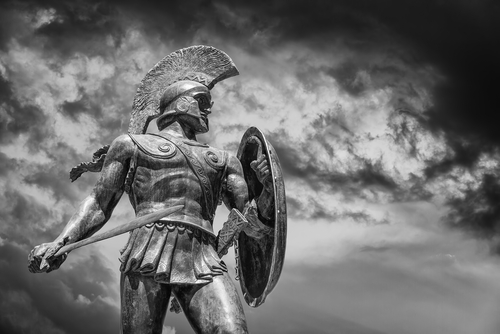
So, what of the Spartans? The world remembers Leonidas and the 300 at Thermopylae. Students of history remember Plataea, and the later alliance between the Spartans and the Persian Empire directed against Athens. But the Spartans, as a people, remained enigmatic after reading Thucydides, at least to me. What motivated them to create their peculiar society? What were the pressures that shaped their thinking? How did they come to be what they were? Why did they make the decisions that they did?
As Thucydides observed: The Athenians built and left behind immense public works. Temples that still stand today. An extensive literature: comedies, tragedies, and philosophies. Art and sculpture. All the trappings of a commercial, vibrant, creative society. They get to explain themselves to us in their own words. But what of the Spartans, who left behind almost nothing of the sort? We remember their military achievements. But they left behind very little that would allow us to understand them.
To quote Thucydides directly, courtesy of Lapham’s Quarterly (possibly my favourite periodical):
“Suppose that the city of Sparta were to become deserted and that only the temples and foundations of buildings remained: I think that future generations would, as time passed, find it very difficult to believe that the place had really been as powerful as it was represented to be. Yet the Spartans occupy two-fifths of the Peloponnese and stand at the head not only of the whole Peloponnese itself but also of numerous allies beyond its frontiers. Since, however, the city is not regularly planned and contains no temples or monuments of great magnificence, but is simply a collection of villages, in the ancient Hellenic way, its appearance would not come up to expectation. If, on the other hand, the same thing were to happen to Athens, one would conjecture from what met the eye that the city had been twice as powerful as in fact it is.
To address the mystery of the Spartans, Paul Rahe, of Hillsdale College, has written four volumes (thus far) on the history of Spartan strategic thought, and the fifth one will go to press soon.
- The Grand Strategy of Classical Sparta
- The Spartan Regime
- Sparta’s First Attic War
- Sparta’s Second Attic War
These volumes are among the finest books I’ve read. They make the strategic dilemmas and choices of the Spartans as clear as the historical record seems to allow, and where the record is silent, Rahe fills in the blanks with speculation informed by a nuanced understanding of the politics and practices of the day. Rahe has filled in the blank spaces in a way that is remarkable. These books are also utterly readable even to someone like me, who is most decidedly a non-expert in the field.
One of my key takeaways from reading Rahe’s work was the importance of understanding, in detail, the capabilities, motivations, aspirations, and commitments of adversaries, and of having a grand strategy that is simple to articulate, understand and implement.
Only then can a wide range of individuals and organizations coordinate their actions in service of such a grand strategy, which is generally what is required for success, in both business and warfare. The conflict between Athens and Sparta was between a maritime society and a territorial power, and this finds echoes in the current conflicts between the United States and the People’s Republic of China.
In that vein, I’ve been reading Elbridge Colby’s fascinating book (I’m about a third through) on the Strategy of Denial, which I recommend as a thought-provoking work to anyone with an interest in US-China relations. My next reading in this area is Thucydides on Strategy: Grand Strategies in the Peloponnesian War and their Relevance Today.
In recent years, with the revolution in machine learning, we’ve started to develop tools that can do super-human things in areas where humans previously had an absolute monopoly. These tools will allow us to do amazing things that we can barely imagine today, and they will have world-changing economic, military, and social impacts. It’s an incredibly exciting time to be a technologist and to have a chance to participate in this revolution.
Many people believe that these tools will produce fundamental changes in how individual humans behave, in how we organise ourselves into polities, and in how we strategise to enhance our security. Perhaps they’re right. But I don’t think so. The community of technologists have believed that our innovations will change human nature before, and we’ve been wrong before.
I believe that the same motivations that Thucydides articulated so well – Fear, Honor, and Interest – will continue to dominate the landscape. I expect that reading Thucydides will still give deep insight into human nature 500 years from now (assuming of course that anyone is still around to read his work). And 2,500 years of western history seem to suggest, at least to me, that new technology doesn’t fundamentally change human nature, and that to think otherwise is arrogance.
Professor Laura Lechuga, Group Leader NanoBiosensors and Bioanalytical Applications Group, Catalan Institute of Nanoscience and Nanotechnology (ICN2), CSIC, BIST and CIBER-BBN.
I used to read a lot but with our frantic way of living before the pandemic – travelling and working, it was hard to find the time. The pandemic has given me back this habit and I am enjoying it very much.
Here are my best readings of 2021:
The Premonition: A Pandemic Story, by Michael Lewis is an excellent description of the chaotic US public health system and how fighting for political power have corrupted the organisations that should help society in any emergency. The result: the United States has had been one of the countries in pandemic management. A must-read book.
Reina Roja, by Juan Gómez-Jurado, a renowned Spanish author. This is a thriller about the world’s smartest woman on the hunt for a serial killer. I especially like how the protagonist interprets, with a female scientific mind, the actions of the murderer and the staging of the crimes. The book grabs your attention from the first page and continues with a frenetic pace that ends up taking your breath away. I´m not going to disclose the identity of the serial killer …
Acoso by Angela Bernardo is the first book that reveals sexual harassment in Spanish science. The book includes testimonies, interviews with specialists in sexual harassment and compiles the scarce data available in Spain regarding this problem.
The author unravels how the structure of Spanish universities and research centres make its very difficult for female scientists to report and find support when they are victims of sexual harassment or harassment due to gender discrimination.
The Man Who Counted: A Collection of Mathematical Adventures, by Melba Tahan (a pen name), is a well known and classic book in maths by Brazilian writer, Júlio César de Mello e Souz. The book describes curious word problems, mathematics puzzles and curiosities. The protagonist is a thirteenth-century Persian scholar of the Islamic Empire. A must-read book!
My last recommendation is Nosotros, los actogésimos (una novela de mundoochenta), by Jesús Zamora Bonilla. This is a Spanish science fiction book describing “Mundochenta”, a planet 140,000 light years from Earth and its inhabitants, the “eightieths”.
A police and scientific thriller, the book takes place in a very distant future but in a society not yet as technologically advanced as ours. “Mundoachenta” is dominated by the Empire and the Church, which face the challenge of assimilating the increasing scientific advances.
The book is a parody of how power and religion have always tried to stop scientific advances to maintain its dominance.

Books read in 2021: Part 3

In Part III, two more industry figures pick their reads of the year: Dana Cooperson of Blue Heliotrope Research and ADVA’s Gareth Spence.
My reading traverses different ground from that of other invited analysts to this yearly section. In addition, my ‘avoid new releases’ approach means my picks are not from 2021. And before jumping straight into recommendations, I’ll preface my comments with an homage to communal aspects of reading that have meant so much to me, especially during these two Covid years.
My two book groups managed to meet steadily during the pandemic, sometimes while sitting outside in the snow, covered with blankets and sipping hot tea.
Beyond ensuring a steady stream of titles to read and discuss, the ladies in my book clubs have supported and encouraged each other through births and deaths and all the highs and lows in between. I tried a third, online alumni book club, this year, but meh: what it provided was not even close to the tight-knit book club experience I treasure.
I have also appreciated the annual August in-person ad hoc book club and reading recommendations sessions that grew out of my college experience, and which have been going strong for 40 years now. My daughters and I also exchanged books and discussed them this last year.
The books I most appreciated of the 20 or so I read in 2021 were those that offered interesting, deep, and well-written windows into people, places, cultures, and identities I didn’t know I needed to know more about. Here are my top picks:
My favourite 2021 read was the 2019 Booker Prize winner Girl, Woman, Other, by Bernadine Evaristo. This funny and touching novel spans space and time to weave the stories of twelve mostly female, mostly Black, and mostly British characters and their ancestors. The characters’ narratives intersect in surprising ways that don’t feel at all artificial or manipulative. The book’s unique style and structure add to the storytelling.
A Tree Grows in Brooklyn, by Betty Smith, is a fantastic autobiographical novel published in 1943. It details the hard yet full life of Frances Nolan, who grows up impoverished in Williamsburg to first-generation parents from immigrant families (one Irish, one Austrian) in the early 20th century. The descriptions are so vivid, and the main character so tenacious, determined, and smart, that the book is positive and affirming despite its often tough subject matter (alcoholism, abuse, poverty).
My daughter, who had taken an Asian-American literature class in college, suggested The Sympathizer, a 2016 Pulitzer winner by Viet Thanh Nguyen. Like “A Tree Grows in Brooklyn,” the subject matter (the fall of Saigon, spying, torture, betrayal, being a stranger in a strange land) is not a simple read. But the characters are again so vivid, the narrative so darkly comic and satirical, and the historic subject matter so relevant to today that I found the book riveting. (Note: Nguyen published a sequel in 2021 that I’ve yet to read.)
American Dirt, by Jeanine Cummins, tells the harrowing tale of a group of desperate migrants trying to complete the dangerous trip from Latin America to the US. As I started reading it, a friend who hadn’t read it noted the controversies swirling around the author (she’s not Latinx enough for some) and the plot (lambasted by some as ‘immigrant porn’). Whatever: I read the book and loved it. This gripping novel made the plight of desperate migrants more real to me than any news story had done.
Other book recommendations:
• The Vanishing Half: A Novel by Britt Bennett, regards two African American sisters from the US South who make very different choices (one passes as white) and how their futures and families are affected by their choices.
• Afterlife, by Julia Alvarez, concerns a retired English professor who is suddenly widowed and trying to figure out how to live her life and deal with her three sister
• The Great Believers, by Rebecca Makkai, is about the AIDS crisis in Chicago. It bounces between 1985 and 2015 as it follows a group of gay men and their born and made families. I found the plot (who lives, who dies) a tad manipulative, but the book shined a light on a pandemic and its victims that we should never forget.
• The Miniaturist, by Jessie Burton, which is set in 17th century Amsterdam, is an atmospheric, magical, and suspenseful novel that made the era of the Dutch East India Company come alive for me. You did not want to be poor, female, Black, or gay in 1686 in the Netherlands, so this book is dark.
• Midnight in the Garden of Good and Evil: A Savannah Story, a non-fiction novel by journalist John Berendt, describes a 1980s murder and trial in Savannah, Georgia. Readers will not easily forget the town’s many characters, especially The Lady Chablis.
It seems fitting to end my 2021 recommendations with a recent read, Oscar Wilde’s The Picture of Dorian Gray, about a young man whose moral decay and debauchery is recorded by his painted portrait even while his body retains its unsullied youth and beauty.
Wilde sure had a way with words: his descriptions of 19th century London high society are as sharp as any knife. For example, Lord Fermor was “a genial if somewhat rough-mannered old bachelor, whom the outside world called selfish because it derived no particular benefit from him, but who was considered generous by Society as he fed the people who amused him.”
I’ll close with Wilde’s musing on art from the last epigram in the novel’s preface: “We can forgive a man for making a useful thing as long as he does not admire it. The only excuse for making a useless thing is that one admires it intensely. All art is quite useless.”
Gareth Spence, Senior Director of Digital Marketing and Public Relations at ADVA.
It’s been a grey and wet holiday season in the UK. Ideal conditions for hunkering down in front of the fire and building a reading list for 2022. If you’re doing the same, here are two suggestions for your book pile.
Both recommendations can loosely be filed under the topic of the American Dream. The first one stretches the rules as it’s only available as an audiobook. It’s Miracle and Wonder: Conversations with Paul Simon, by Malcolm Gladwell and Bruce Headlam.
I was reluctant to listen to this book. I’ve grown tired of Gladwell’s writing style and his tendency to reduce human nature to a digestible catchphrase. Still, the opportunity to hear Simon talk about his career proved too compelling.
As a child, I was an avid listener of Simon. His work shaped my early notions of America and the American Dream. In the book, Simon talks extensively about his anthemic tunes. Where the ideas came from, how the songs were shaped and how his relationship with his music has changed during his long career.
It’s fascinating to hear Simon talk openly about his past. If you have any interest in his songs or the musical process, you’ll enjoy this book. Just try your best to overcome Gladwell’s gushing praise of Simon. The man could rob a bank and Gladwell would find artistic merit in it.
My second recommendation is Nomadland: Surviving America in the Twenty-First Century, by Jessica Bruder. This book is a powerful exploration of the flipside of the American Dream. It follows the lives of a growing community of people who have been cast aside by society and forced to find ways to live outside mainstream America.
Many of the people detailed are over 60 and have lost their homes and livelihoods. They now live in recreational vehicles, vans and even cars and spend their time in laborious, menial jobs. When they’re not working, they’re travelling the country, finding ways to embrace freedoms they never had before.
It’s sobering to read Bruder’s book as she spends over a year exploring this nomadic community. It’s hard to imagine that this group won’t continue to expand as life in America becomes ever more challenging.
But as difficult as it is to read, there’s also hope. The people show resourcefulness and resiliency in how they discover a new way to live and rediscover their country.

Books read in 2021: Part 2
In Part II, two more industry figures pick their reads of the year: Sara Gabba of II-VI and Ciena’s Joe Marsella.
Sara Gabba, Strategic Marketing, II-VI
I’ve always read a lot. I cannot fall asleep without the sweet or the exciting company of a good book!
In the last year, I’ve spent many evenings reading fairy tales to my young daughter and, on top of the traditional ones from Andersen or the Grimm brothers, I’ve surprisingly discovered that she really likes the Greek myths (in an adaptation for children), which are the archetypes of most of the ‘modern’ tales. Love, mystery, jealousy, fear, talent, heroism: all the instincts and passions of humankind are there and able to capture every reader.
Coming to the books that I enjoyed most this past year, I’ll mention three, beginning with L’infinito Tra Le Note: Il Mio Viaggio Nella Musica (My Journey into Music) by the famous orchestra director Riccardo Muti.
In simple words, he leads you through the history of music, disclosing the essence of the main composers and the secrets that are hidden among their notes and silences, all filtered by his sensitivity and his long experience as director of the world’s most important orchestras.
Galeotto fu il collier (A Gallehault was the Collier) is an amusing book from the prolific and always brilliant pen of Andrea Vitali, an Italian writer whose novels typically take place in Bellano, a nice village on the eastern shore of the Lake of Como where he was born and worked as a general practitioner. Bellano is indeed a charming village, in addition to the well-known Bellagio.
This book is a choral novel, able to recreate the atmosphere of common life in 1930’s Italy. The comedy lies in the everyday routine of the many simple characters, in the plot full of anecdotes and of said-unsaid words: an amazing and wonderful comedy of errors!
Lastly, I really loved Liar Moon written by the Italian-American writer, Ben Pastor.
This romance is the second of the saga featuring Martin Bora, the Major of the Wehrmacht whose character was inspired by Claus von Stauffenberg, the German colonel who attempted to assassinate Adolf Hitler in 1944 (maybe you remember the Tom Cruise movie Valkyrie, also inspired by von Stauffenberg’s brave acts).
This historical mystery novel takes place in the North-East region of Italy during the German occupation in the Second World War, where the skilled army officer Bora solves a complex murder case. Martin Bora is fighting for the wrong side in the world conflict, so he obviously has all the characteristics to be a villain. However, he is far from being a stereotype and you cannot avoid but to love him for his torn sense of loyalty to his nation and his daring acts of disobedience to the criminal orders received from his commanders.
Joe Marsella, Vice President, Product Line Management, Routing and Switching at Ciena.
As an evolving society, we often tend to look back on the ‘good old days’ and lament how difficult life has become, often forgetting that as a whole we are much better off than we have ever been.
History, for me, is a healthy way of not only reminding oneself of that simple fact but also serving as an opportunity to learn from past experiences to improve the journey ahead.
With that in mind, one book I found extremely interesting in 2021 is One Minute to Midnight: Kennedy, Khrushchev, and Castro on the Brink of Nuclear War by Michael Dobbs, which tells the story of the days leading up to the Cuban Missile Crisis of 1962 and how close the world came to nuclear annihilation.
The story focuses on how quickly a series of decisions can escalate over a 13-day time frame and the ability of two opposing leaders to reach a compromise for the greater good of not only their respective countries but the world.
As business leaders, we are required to make decisions and negotiate constantly, and while our negotiated outcomes rarely reach the magnitude of Kennedy and Khrushchev in the fall of 1962, it’s reassuring to know that even in the most difficult circumstances agreements can be reached with mutually beneficial results.

Books read in 2021: Part 1

Each year Gazettabyte asks industry figures to pick their reads of the year. Paul Brooks and Maxim Kuschnerov kick off this year’s recommended reads.
Dr. Paul Brooks, Optical Transport Director, VIAVI Solutions
Having spent a very happy time serving in the Royal Navy, I am always reading about all things connected with its history.
As a young midshipman, I managed to sleep through many of the history lessons at BRNC Dartmouth so I am using my spare time to catch up on the lessons I missed all those years ago.
One book which I have very much enjoyed this year has been Stephen Taylor’s Sons of the Waves: The Common Seaman in the Heroic Age of Sail.
While many books are written about major figures such as Nelson and Blake, the ordinary sailor with his robustness, loyalty and sense of duty was the key element in the success of the Royal Navy.
This well-researched book is a joy to read as it brings to life the heroic men. I must confess I did hum ‘Heart of Oak’ as I reached for my tot of rum as I read about the jolly Jack Tar on the Victory at Trafalgar!
For any student of history, and indeed anyone interested in social history, this is one for your Christmas list.
Dr. Maxim Kuschnerov, Director of the Optical & Quantum Communications Laboratory
No Rules Rules: Netflix and the Culture of Reinvention, by Reed Hastings and Erin Meyer, got good press last year, so when I saw it at the airport, it was a no brainer to get it.
The book offers a radical approach to management, focusing on totally open feedback and the removal of most controls, whether it’s the lack of vacation policy (take as much as you want) or the absence of higher approvals for most business dealings. Salary adjustments are governed by external market references and not internal processes, which is generally not a bad thing.
Naturally, looking at this corporate culture through the glasses of a German dependency of a Chinese company makes for a big contrast and it would be hard to imagine a German company functioning without any kind of rules. But what the book achieves is to shift the normal operational bias towards a more modern view of team management and it helped me to make adjustments in everyday work, changing the way that I interpreted my role within my team.
This brings me straight to another, older, book by Erin Meyer, The Culture Map: Breaking Through the Invisible Boundaries of Global Business. It reads like a compressed tutorial of inter-cultural communication and decision making, although I have to admit it was almost more fun to naively learn all of this in the field than to have all the findings confirmed at a later point by the conclusions in this book.
I found it particularly interesting to see the historical context for some present cultural behaviour, by which I don’t mean the obvious teaching of Confucius for Chinese people but also current social traits in Europe dating back to the Roman Empire.
So when a Chinese colleague, who recently moved to Germany, described the German personality as a coconut after the first weeks of adjusting to life in Munich, it made me think that we should be providing this book as a compulsory read within the company, just to soften the blow.
Lastly, looking at how big data and analytics started to change our lives in many domains and found their way into sport in the classic Moneyball book, I believe that no other sport has been changed as drastically by a statistical approach to analytics as basketball.
Kirk Goldberry’s Sprawlball: A Visual Tour of the New Era of the NBA explains the dramatic change in the game by findings that, in hindsight, are so obvious that one can only wonder how we all didn’t see it coming in the 1990s when the GOAT Michael Jordan redefined the art of playing ball.
Goldberry explains the historical context for modern-day greats like LeBron James, James Harden and Steph Curry, while also giving a shout-out to my other personal favourite, Dirk Nowitzki, whose 2011 finals run will stay at the top of my sporting moments.
I just wish I could have told my 14-year-old self to stop practising baby hooks and post ups and go straight to 3-point drills.
AI: “It is an astonishing time to be a technologist.”
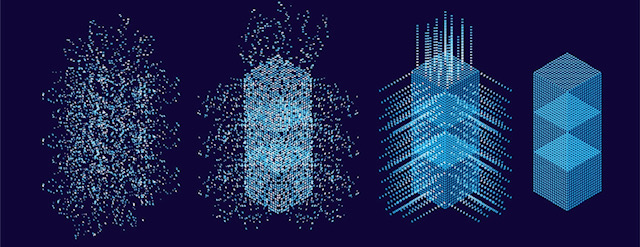
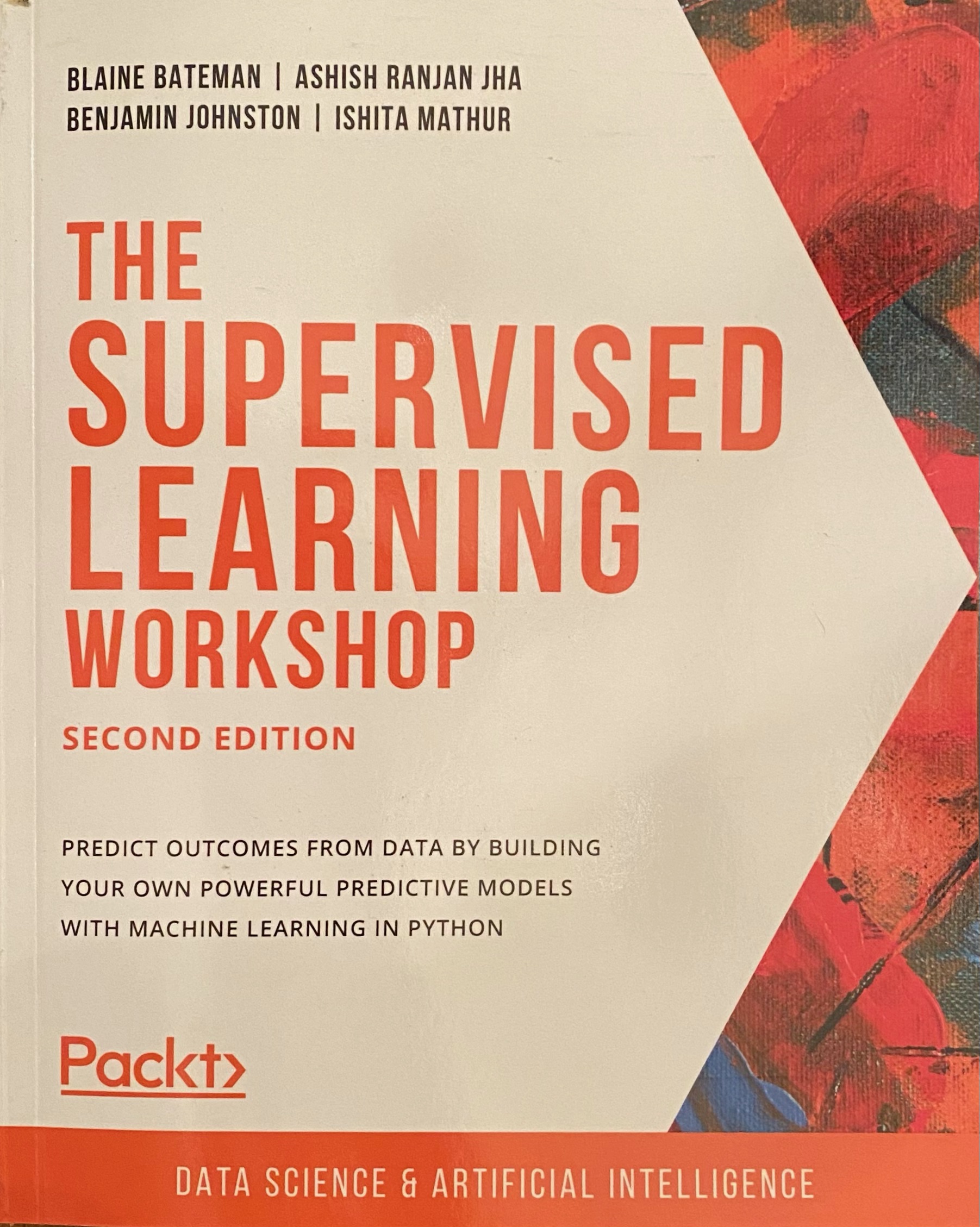
Want to master artificial intelligence (AI) techniques? A new book, The Supervised Learning Workshop, teaches you how to create machine-learning models using the Python programming language. A conversation with the co-author, Blaine Bateman.
Blaine Bateman is a business strategy consultant, helping companies identify growth strategies and opportunities.
Several years ago he decided to focus on data analysis or, more accurately, predictive analytics using machine learning.
“I started to see that clients had lots of data, frequently they didn’t know anything about it and they weren’t using it,” he says. “At the same time, I started to see that AI and machine learning were really on the uptick.”
Machine learning work is also rewarding, he says: “You build stuff and when you get it to work, you do something that helps someone.”
But it is not all fun: there is a lot of “data wrangling”, preparatory work to get the data ready for modelling.
First, the data may need to be integrated if it comes from several sources, and it may need to be scaled. It also pays to study the data, to discover as much as possible about it before modelling. All this takes time.
“Everyone likes the idea that you shovel data into a machine-learning black box and insights come out, but it is not that simple,” says Bateman.
Coming of age
AI and machine learning are terms commonly always mentioned together although machine learning is, in fact, a subset of AI.
There is also no real intelligence here, says Bateman. Machine learning, or what he calls predictive analytics, is the application of tools, algorithms and methodologies to train models.
“That is the learning part and it is using machine – a computer,” he says. “AI sounds a lot cooler but the vast majority of times you see the two, it is one and the same thing.”
AI is also not a new topic: neural networks, genetic algorithms and fuzzy logic were the subjects of much attention in the 1980s and ’90s. But developments in recent years has caused AI to finally hit its stride.
One factor is the maturity of silicon for AI, another is the advent of cloud computing. Bateman also highlights how the AI and machine-learning community embraced the open-source software movement. “It means there is a tremendous amount of commercial-scale work being done using open-source software,” he says.
Google’s TensorFlow, an example of open-source software, is one of the most used libraries for neural networks, while Keras is a software layer that sits on top, simplifying the use of TensorFlow in a Python environment.
“Coding languages such as Python and R have been around a long time and, with the open-source movement, these have grown and been extended into incredibly capable platforms,” says Bateman.
Another important catalyst for AI has been the development of e-learning, or massively open online courses (MOOC).
People used to go to college, learn a skill, enter industry and learn on the job before developing a career. “Now, people are jump-starting that,” he says.
There is an entire industry of people using online courses to learn as fast as possible. “Which is the reason for the books like the one I’ve participated on,” says Bateman.
Supervised learning
Supervised learning refers to data which has a characteristic or property that is known in advance, also referred to as labelled data.
Examples of such data could be numerous images of car registration plates to train an automated road-tolling system, or labelled images of lung abnormalities to train a medical scanning tool.
“We train a model by giving it a picture and telling it the answer,” says Bateman. “Then, once the model is built, you can translate a new picture into an answer.”
There is also unsupervised learning which refers to another aspect of machine learning. Here, data is applied to a clustering algorithm, for example, the MNIST handwritten digits database used to train algorithms to recognise ZIP or postcodes.
The MNIST database can be used for supervised learning, training a model to recognise each of the digits. But in unsupervised learning, the algorithm segregates the digits into clusters without being told what they are.
There are sophisticated clustering methods such as the uniform manifold approximation and projection (UMAP) approach that can reduce complex data sets into smaller dimensions. “It can take up to 80 dimensions and project them onto three and oftentimes find meaningful patterns,” he says.
Yet so far unsupervised learning is not used that much whereas supervised learning accounts for over 80 per cent of all machine learning applications used today, says Bateman.
Book
Packt Publishing wanted to issue a new edition of its machine learning book that included the latest supervised-learning practices. The publisher approached Bateman after seeing his work in the open-source community.
The resulting book – The Supervised Learning Workshop – is aimed at undergraduates and engineers. “Since it jumps into supervised learning, the expectation is that you have some coding skills and know enough Python to work through the exercises,” says Bateman.
The book uses Jupyter Notebooks, an open-source web application for developing Python code. “A lot of people use it to do small projects,” he says.
The topics addressed in the book can all be run using a decent laptop. “A huge amount of people working in AI are working on laptops; it is definitely doable with today’s technology,” he says.
And for larger data sets and bigger problems, there is always the cloud service providers such as Amazon Web Services, Google, Microsoft and others.
After a short introduction covering supervised and unsupervised learning, the book starts with linear regression, which remains an extremely important tool in machine learning.
His advice to students is to build a linear model first and see how well it performs. “That gives you a baseline,” says Bateman.
The topic of gradient-descent is then introduced, a technique used to train more sophisticated algorithms such as neural networks. Further into the book, more sophisticated techniques are introduced.
“The most sophisticated thing we talk about is ways to combine these algorithms into ensembles,” says Bateman.
Ensembling refers to using several less powerful models – what Bateman calls ‘weak learners’ – that are combined in some way, their results may be averaged or their outputs voted on.
Ensembling provides superior results compared with using a single model, even a sophisticated one
Bateman feels lucky to be working in the field of machine learning.
“We have this explosion of freely-available technology that you can use on a laptop to solve amazing problems,” he says. “It is an astonishing time to be a technologist.”