

SiDx's use of silicon photonics for blood testing
Part 4: Biosensor start-up, SiDx
A blood sample reveals much about a person’s health. But analysing the sample is complicated given its many constituents.
Identifying a user’s blood type is also non-trivial.
If a patient arriving at hospital needs a blood transfusion, the universal donor blood type, O negative, is administered. That’s because it takes too long – 45 minutes typically – to identify the patient’s blood type. This also explains the huge demand for O negative blood.
Identifying blood type promptly is what start-up SiDx set out to address with a platform based on a silicon photonics sensor. The resulting platform does more than just blood-type identification.
SiDx
The Seattle-based start-up was founded in 2017. By then, SiDx had a decade of research behind it, in silicon-photonics biosensors and the associated biochemistry.
SiDx had also started working with a blood centre in Seattle. Such centres source and sell blood to US hospitals.
“We were looking for an application that justified starting the company,” says Jonas Flueckiger, vice president of engineering at SiDx.
Flueckiger notes that silicon photonics is one of several ways to analyse biological materials. “It has advantages but there are alternatives,” he says. “You have to find an application where the advantages of silicon photonics can shine.”
Marketplace and challenges
Flueckiger splits the biosensor marketplace into three: centralised lab equipment, bedside and portable equipment, and home testing.
For centralised labs, what matters is the scale and the ability to perform parallel testing. Here, trained staff are required for sample preparation and operating the equipment.
The second category, bedside and portable systems, are compact and rugged platforms designed to deliver results quickly; SiDx’s testing system takes 12 minutes. Such platforms are newer and are the focus of SiDx and other silicon photonics biosensor start-ups.
“As for home tests, you don’t need a doctor’s office, you can do it yourself,” says Flueckiger.
But medical diagnostics is a challenging market to enter. “The biggest challenge is that it is very, very hard to bring something new into the medical space,” says Flueckiger.
Hospitals are conservative establishments with rigid protocols that have test systems that doctors trust.
“Even though you show your system will be better, more efficient, faster, and the patient will be better served, it is still very hard to make a case to replace existing technology in a hospital,” says Flueckiger.
A new biosensor system must show it saves money, almost as important as demonstrating improved performance. “If your device is better but it costs more, that is not enough,” says Flueckiger.
Even if a start-up develops a system comparable in price, it must displace existing processes. And that raises a series of questions. Who does the testing? Where do the test results go? And who delivers the news to the patient?
“It is a complex picture and it is not just about technology,” says Flueckiger.

Ring resonators
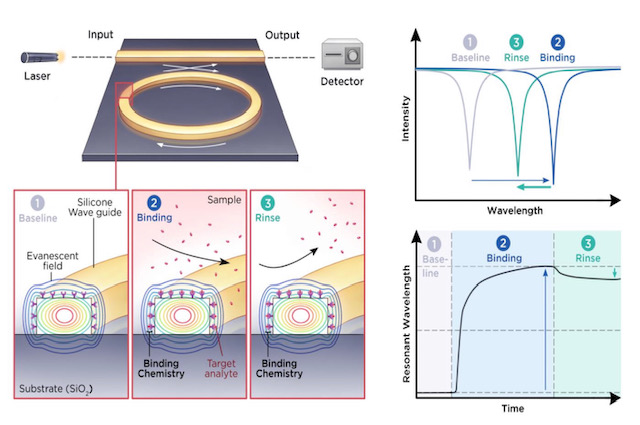
SiDx’s silicon photonics platform measures refractive index changes in light caused by blood sample components attaching to ‘receptors’ placed on the sensor’s surface.
Biochemistry is required to design the receptors for blood analysis and is a core expertise of SiDx.
SiDx uses a laser coupled to a ring resonator. When blood sample constituents attach to the receptors on the ring resonator’s surface, the wavelength at which the sensor resonates changes. This shift in refractive index is used to identify the constituents. (See diagram above.)
A key benefit of the ring resonator approach is its tiny size. Multiple sensors can be integrated into a compact area allowing tests to be performed in parallel. Or as Flueckiger puts it, there is an ability to ask more than one question.
SiDx says it uses ring resonators but it is not detailing its design.
Most emerging integrated-photonics biosensing companies use a laser and ring resonator to read refractive index changes.
One way of get readings is using a tunable laser but alternative designs are possible such as using a fixed laser and tuning the resonator.
That is possible, says Flueckiger, but in a multiplexed design where multiple ring resonators are used, the electrical input-output for all the resonators gets tricky.
“Even for a single test, a single marker, you will have a negative control, a positive control, usually one or two more to make sure you have what you think you have,” says Flueckiger. “With bodily fluids like blood, it is complex and includes stuff that can interfere.”
Silicon photonics also enables label-free detection.
Here, only receptors are used to catch a blood constituent of interest. There is no need for labels with fluorescent attachments designed to link to the constituent.
But labelling improves the probability of identifying what is being looked for. Blood is so complex a sample that doctors may not want label-free testing for just this reason, the risk that another biomarker gives a similar response to what is being sought.
SiDx says sample preparation is key here. Rather than simply squirting the blood sample into the device, additional steps are used such as dilution or separating red blood cells from the serum with testing performed on either. Reagents can also be added to remove all the cells’ membranes.
Such sample preparation steps before label-free testing are important and non-trivial. “Photonics, that is the easy part,” says Flueckiger.
The resulting biosensor comprises optics and biology. Yet it requires a shelf life of 6-12 months. Another reason why medical biosensor design – and the biochemistry in particular – is challenging.
Blood testing and disease screening
Most people understand major blood types such as A, B, AB or O negative, says Flueckiger. But it is more complicated than that in that there are many subgroups. If they are assessed wrongly, it can prove harmful to a patient.
SiDx’s platform can perform blood typing and also Rhesus tests during pregnancy. Rhesus disease is caused by a certain mix of blood types between a pregnant mother and the unborn child.
SiDx sees blood typing as an entry to the market: to prove its technology before branching out. “Once you have blood typing and a sample, you can expand the test portfolio,” says Flueckiger.
The aim is to group tests in an offering that make sense. For example, testing for covid-19 but also testing for the common flu. Or, if a patient tests negative for covid-19, what else could it be? Testing that way and getting an answer avoids the need for a second test.
There are multiple ways to test for covid-19.
A PCR test looks for the DNA of the virus. Analysing a blood sample determines if a body’s immune response has developed antibodies to the virus. If so, it means the person has, or has had, covid-19. SiDx’s biosensor will also be able to test a person’s immune system after a vaccine and determine if a booster jab is needed.
SiDx’s system can detect DNA, but an issue is that DNA needs ‘amplification’; its levels are too small otherwise.
Using integrated photonics coupled with the right capture molecules on the surface allows what is captured to be detected. A DNA molecule is much smaller so other tricks are needed to measure it. As a result, antibodies are more commonly tested for because it is much easier, says Flueckiger.
Prospects
SiDx along with other silicon photonics biosensor companies such as Genalyte, SiPhox, Rockley Photonics and Antelope DX, all received recent funding rounds. SiDx has raised a total of $3 million in funding and $2 million in research funding.
Is this not a vote of confidence in what is a tough market to crack?
There is venture money but it is hard to come by, says Flueckiger. Developing a medical device takes time, a minimum of five years before getting somewhere. If a company starts from scratch, the development time is longer than what venture capitalists are happy with.
Companies pursuing blood testing also can expect greater scrutiny given the story of private company, Theranos, whose claims about developing a breakthrough blood analysis system proved false.
Venture capitalists recognise the potential of benchtop devices but their concern is making money and how quickly a start-up can multiply their investment.
“Unless you can show hockey-stick growth, it’s a tough sell,” says Flueckiger. “These are long-term investments, not like a software company.”
That said, the covid-19 pandemic has helped. People now understand the important role such diagnostic equipment can play. They recognise how long it takes and that if money is thrown at the problem, device development can be accelerated.
Despite the challenges, Flueckiger is upbeat. “We have made lots of progress,” he says. “We have proven to ourselves that our technology works.” SiDx says there are developments that bring its platform closer to market that it cannot disclose at present.
The coronavirus pandemic also provided the company with a motivational boost to launch a product that is far easier to use.
SiDx did consider shifting its focus to address covid-19 testing but the pandemic occurred a year too early. “If it happened now, we would be in a lot better position to turn around very quickly with limited money and have a test ready,” says Flueckiger.
SiDx says that its conversations with investors generate excitement but they want proof of a return.
“You go into this knowing you have a long runway – the next five years will be hard – and then there is the question of whether you will be successful or not,” says Flueckiger.

imec’s research work to advance biosensors

Part 3: Biosensor developments
- Pol Van Dorpe discusses the institute’s use of photonics and silicon to develop new designs for medical diagnostics.
- imec has designed a breathalyser that detects the coronavirus with the accuracy of a polymerase chain reaction (PCR) test, a claimed world first.
Optics and photonics are advancing medical diagnostics in two notable ways.
The technologies are helping to shrink diagnostic systems to create new types of medical devices.
“Going from big lab equipment to something much smaller is a clear trend,” says Pol Van Dorpe, a Fellow at imec, the Belgium R&D nanoelectronics and nanotechnology institute.
Photonics and silicon also benefit central labs by creating more powerful test instruments. More functionality and detectors can be integrated in a given area enabling multiple tests in parallel, a technique dubbed multiplexing.
imec’s biosensor work and espertise
imec began its biosensor research in the 1990s, investigating electrical and surface plasmon-based devices. In more recent years, it has added the development of custom biosensor chips for companies.
As examples, imec worked with Panasonic to develop a chip for PCR, a testing technique now known to the public due to covid-19. The R&D institute also worked with Genalyte, a pioneering silicon photonics medical diagnostics company that uses optical waveguides, ring resonators, and a tunable laser for its multiplexing biosensor product.
imec has also developed in-house expertise across several disciplines needed for biosensor development.
Several groups at imec cover photonics, with Van Dorpe heading the group addressing biophotonics and single-molecule electrical devices.
Another group addresses biochemistry and surface chemistry used to coat and activate a sensor’s surface so that receptors can be attached. Receptors are biochemical materials that enable the sensor to trap and detect materials.
A further team covers microfluidics used to deliver liquid samples to the sensor or to mix solutions precisely.
Semiconductor process steps are used to create high-aspect-ratio structures that implement microfluidic structures. Such structures can also be used to sort cells, known as cytometry.
“There are many sensor types, and each has its own fluidic needs,” says Van Dorpe.
Spin-offs
imec has also spun off several biosensor companies.
One, miDiagnostics, raised $16.5 million in funding in 2020. miDiagnostics has a nanofluidic processor (nFP) that performs diagnostic tests on fluids guided through the system using capillary forces. The liquids can be redirected and can even have their flow reversed.
The nFP is configurable depending on the application. It combines nanofluidic processing and PCR for processing biomarkers: from cells and proteins to nucleic acids and small molecules.
Indigo is another spin-off that is developing a glucose monitoring system. A photonics sensor is embedded under the skin and communicates the user’s blood sugar level to a smartphone.
Market trends
The biosensor market is complex. Many actors – labs, doctors and users – in healthcare must be convinced before adopting a biosensor device. For a device to be successful, it must add value compared to existing equipment. Cost is also key as is the use-case and ease of use.
Portable equipment that delivers results promptly so that medical staff can make quick decisions is one example. Others include identifying if a patient has suffered a heart attack or bacterial infections such as sepsis, or enabling a doctor’s office to determine if a patient has a bacterial or viral infection. But no doctor will have 20 devices in their office, each performing a specific test, he says.
Such biosensor devices could also have played a key role during the current coronavirus pandemic.
“I can tell you we were working with companies and if they were several years ahead in their roadmaps, much of this would have been a lot easier,” says Van Dorpe.
Antigen-based quick tests for covid exist but people don’t trust them completely due to their limited sensitivity. It is also still not known when people become contagious. “If you take a nasal swab but are already recovering then you may not be as contagious,” says Van Dorpe.
imec has developed a coronavirus breathalyser. Blowing into a filter, aerosols and small droplets from a person’s lungs are collected. A 5-minute PCR analysis unit delivers a result, informing the person if their breath is infectious.
The goal is to use such systems at airports and large events, but it doesn’t guarantee that a person won’t get sick. “You could have been infected the previous day,” says Van Dorpe.
In clinical trials with UZ Leuven, the university hospital of Leuven, the system has tested viral RNA in exhaled air with high sensitivity.
“Our chip technology can detect quickly the virus particles with the same accuracy as classical PCR tests,” says Van Dorpe. “We are the first in the world to demonstrate this.”
imec is undertaking more clinical trials while improving the test’s robustness and ease of use. “We are discussing the commercialisation of our technology with different parties,” he says.
Biosensor technologies
imec’s toolbox of technologies include silicon nitride optical waveguides, beam splitters, filters, spectrometers, and in-plane and out-of-plane lenses.
imec can deposit waveguides on CMOS and has exploited the technique with CMOS image sensors that have many detectors. “We can use commercial image-sensor wafers and deposit the waveguide technology and use those pixels as detectors,” says Van Dorpe.
Established diagnostic techniques used in medical labs include ELISA, a reference technique to detect proteins, and PCR that tests for nucleic acid detection (DNA/ RNA).
The importance of both lab techniques will not change anytime soon, says Van Dorpe.
One reason why ELISA and PCR are so established is that they use ‘amplification’ to detect minute amounts of the material being tested for – the analyte – in complex samples.
For amplification, another label is used in addition to the receptors. The analyte is attached to an antibody within the label, and it is this second label that provides greater testing sensitivity. This, however, requires sample preparation by trained staff.
In contrast, newer biosensors technologies such as surface plasmon resonance (SPR) and silicon photonics use a label-free approach that does away with the second analyte-label stage.
But the label-free sensor is less sensitive; the technique measures when something attaches to the receptors but it can’t distinguish what it measures.
Van Dorpe stresses that amplification is chemistry-related and so it can be used with silicon photonics or SPR.
It is the overall diagnostic system that determines sensitivity, the combination of the transduction process and the chemistry, says Van Dorpe.
SPR and silicon photonics
SPR and silicon photonics biosensors work by measuring changes in light caused by passing a sample over the sensor which causes molecules to attach to the surface.
An SPR system comprises a laser, a prism attached to a gold surface, and a detector. Light is shone through the prism and is reflected from the gold layer before being detected. At a certain incident angle, the light causes electron resonance on the gold surface causing the reflected light intensity to dip.
Attaching biochemical receptors to the gold surface tailored to the analyte causes a shift in resonance angle and the angle change is a measure of the analyte’s presence.
In contrast, silicon photonic designs measure refractive index changes in the light caused by analytes attached to receptors on the sensor’s surface. Two sensor designs are used: a laser with either a Mach-Zehnder interferometer (MZI) or a ring resonator.
“Everything that changes the refractive index causes a signal,” says Van Dorpe.
imec’s biosensor developments
imec’s work with Genalyte a decade ago involved a biosensor that used a tunable laser and ring-resonator sensors.
More recently, the R&D institute has developed technologies not reflected in the silicon photonics designs used by biosensor start-ups such as Genalyte, SiDx, Antelope DX and SiPhox.
imec’s biosensor technologies have been developed to be less sensitive to non-specific binding. What is measured is fluorescence that occurs with the binding to the analyte.
“In blood or more complicated samples, there is a lot of stuff [besides what is being tested for],” says Van Dorpe.
One technology imec has developed performs rapid ELISA-style testing without needing the repeated wash stages required with ELISA systems.

ELISA uses an antibody receptor to detect the tested-for material while a second antibody uses an enzyme that produces colour. And it is the colour that is measured. In effect, both antibodies detect the analyte but the second, with its fluorescent label, helps determine how much analyte has bound.
With standard ELISA testing, repeated wash steps are required to remove what has not bound to the receptors and labels. These wash stages lengthen the testing time.
imec’s sensor is sensitive in the region very close to the surface. Measuring the fluorescence near the surface determines its build-up over time (see diagram).
The cleverness of the sensor is that the larger the concentration, the faster the surface fills up, reflected in the rate of change of fluorescence over time.
“You don’t need to wait until everything has stabilised to determine the concentration,” says Van Dorpe. “You can wait, say 2 minutes, measure the slope of the signal and that gives you a direct measure of the concentration.”
The design can be used with blood samples, to measure protein production or proteins that shouldn’t be there.
The sensor allows the real-time measurement of biomarkers, and no wash stages are needed. It also enables a controlled process for the biological production of vaccines or cancer therapy.
The key here is that using waveguides and integrated photonics allows localised sensing.
“Also with waveguide technology, because you route light on a chip, you can address a lot of [sensing] sites at the same time,” says Van Dorpe. “That allows you to measure a lot of spots, what is called multiplexing.”
These are the advantages of integrated photonics: the ability to test in parallel and the precise quantification of concentrations, he says.
imec has developed a second fluorescence technique – called super-critical angled fluorescence – closely related to the first but that does away with the waveguide.
As with the first technique, two antibodies are used, one with a fluorescent label.
By exciting the fluorescent label, light is produced in all directions. If a high-angle beam is used, the light at the surface interface refracts within a critical angle.
A fluorescent molecule close to the surface – less than a wavelength away – emits light into a silicon-oxide material. This helps distinguish molecules far from the surface compared to closer ones.
imec’s compact system filters out fluorescence from labels floating further away while measuring those nearby. This is like what happens with the waveguide of the first technique, where it is routed to the detector. But here the detector is situated underneath to measure the fluorescence. The technique delivers rapid results.
The two imec techniques deliver selective sensing that doesn’t rely on refractive index changes or mass. With the latter techniques, all the signals are picked up: everything that binds, wanted and unwanted materials.
The imec techniques are not perfect. There is some degree of auto-fluorescence but it is low. Also, some antibodies with the label will bind to the surface but that is much smaller than the proteins, says Van Dorpe.
Cytometry
imec is working with Sarcura, a cell therapy firm, on a high-throughput cytometry solution for cell separation. Here photonic integration is used along with a microfluidic solution to measure the cells.
A standard cytometer has a flow of cells and a bank of lasers at multiple wavelengths typically. As the cells pass, they scatter the focused light from the lasers. The scattering is measured while the cells also fluoresce since they are labelled. This allows for cell categorisation.
With cell therapy for cancer treatment, immune cells are grown and need analysing. Another use is identifying tumour cells in the blood.
“There are lots of applications where you want to pick out specific cells, label them, look at their properties and classify,” he says.
Traditional equipment used for these tasks is large and complex, requiring skilled staff.
What silicon photonics and microfluidics allow is the bringing of cells to the channel and, with waveguides, illuminate them and detect them.
The result, says Van Dorpe, is a high-throughput design with many adjacent channels.

Silicon Photonics spills over into new markets
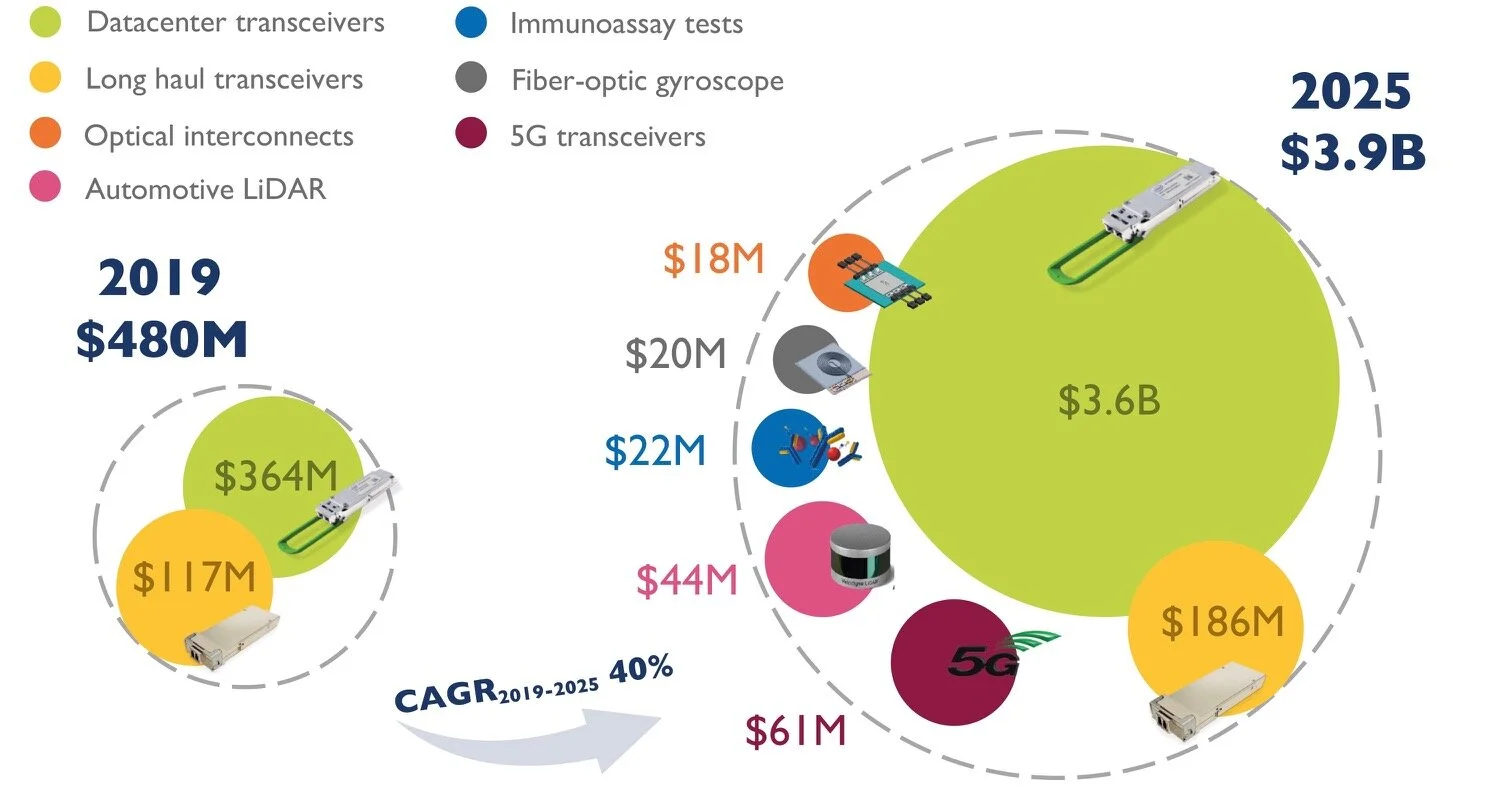
The market for silicon photonics is set to grow eightfold by 2025. So claims market research firm, Yole Développement, in its latest report on silicon photonics, a technology that enables optical components to be made on a silicon substrate.
Silicon photonics is also being used in new markets although optical transceivers will still account for the bulk of the revenues in 2025.
Source: Yole
Market forecast
“We are entering a phase where we are beyond the tipping point [for silicon photonics],” says Eric Mounier, fellow analyst at Yole. “There is no doubt silicon photonics will grow and will be used beyond the data centre.”
Yole sized the 2019 global silicon photonics market at US $480 million, dominated by sales of optical transceivers for the data centre. In 2025 the forecast is for a $3.9 billion market, with data centre transceivers accounting for over 90 per cent of the market.
Eric Mounier
Revenues from new markets such as 5G optical transceivers, automotive, co-packaged optics, fibre-optic gyroscopes, and biochemical sensors will generate $165 million revenues in 2025.
The Yole report also highlights a maturing supply chain, advances in co-packaged optics, and more silicon photonics start-up announcements in the last year.
“It seems the big data centre operators, telecom players and sensor companies are convinced silicon photonics is a key technology for integration, lower cost and smaller components for interconnect and sensing applications,” says Mounier.
Optical transceivers
Data centre optical transceivers account for the bulk of silicon photonics’ market value and unit volumes.
Three-quarters of revenues in 2019 were for data centre transceivers for reaches ranging from several hundred meters to 2km and 10km. This market for silicon photonics is dominated by two players: Intel and Cisco with its Luxtera acquisition.
“For 100-gigabit transceivers, silicon photonics is probably the most used technology compared to legacy optics,” says Mounier.
The remaining 2019 revenues were from long-haul coherent transceiver sales, a market dominated by Acacia that is being acquired by Cisco.
Other companies involved in the transceiver supply chain include Innolight, Juniper Networks, and Alibaba with its work with Elenion Technologies (Elenion was recently acquired by Nokia). HP is working with several firms to develop its silicon photonics supply chain, from device design to final products.
The rollout of 5G is generating a need for 10-gigabit and 25-gigabit transceivers for distances up to 100m, linking remote radio heads and the baseband unit, part of the 5G radio access network.
Yole forecasts a $61 million 5G transceiver market in 2025.
Co-packaged optics
The packaging of optical input-output with a digital chip, known as co-packaged optics, has made notable progress in the last year.
“We are pretty convinced that co-packaged optics is the next big application for silicon photonics,” says Mounier.
Intel has demonstrated its optics packaged with the Tofino 2 Ethernet switch chip it gained with the Barefoot Networks acquisition. “Talking to Intel, I believe in two to three years from now, there will be the first product,” he says.
Other firms pursuing co-packaged optics include Ranovus, Rockley Photonics, Ayar Labs and Sicoya.
The doubling in Ethernet switch-chip capacity every two years is a key driver for co-packaged optics. Switch chips with 25.6-terabit capacity exist and 51.2-terabit switches will be shipping by 2025.
There will also be eight-hundred-gigabit pluggable transceivers in 2025 but Yole says co-packaged optics offers a systems approach to increasing channel counts to keep pace with growing switch capacities.
Foundries and design houses
More than 10 foundries exist worldwide offering silicon photonics services.
“Foundries are interested in silicon photonics because they see a future opportunity for them to fill their fabs,” says Mounier.
Yole cites how GlobalFoundries is working with Ayar Labs, HP with TSMC, Sicoya with IHP Microelectronics, and Rockley Photonics with VTT Memsfab. TSMC also works with Cisco through its Luxtera acquisition.
Swedish MEMS foundry, Silex Microsystems, is developing a portfolio of silicon photonics technology. “They are working with many players developing telecom photonic platforms,” says Mounier.
There are also several design houses offering photonic design services to companies that want to bring products to market. Examples include VLC Photonics, Luceda, Photon Design and Effect Photonics.
Optical design requires know-how that not all firms have, says Mounier. Such silicon photonics design services recall the ASIC design houses that provided a similar service to the electronics industry some two decades ago.
Sensors
Lidar used for autonomous cars and biochemical chips are two emerging sensor markets embracing silicon photonics. Lidar (light detection and ranging) uses light to sense a vehicle’s surroundings.
“Lidar systems are bulky and expensive and a car needs several, at the front, rear and sides,” says Mounier. “Silicon photonics is an emerging platform for the integration of such devices.”
Two Lidar approaches are using silicon photonics: frequency modulation continuous wave (FMCW) Lidar, also known as coherent Lidar, and an optical phased array.
For coherent Lidar, the transmitted frequency of the laser - represented by the local oscillator - and the reflected signal are mixed coherently. This enables phase and amplitude information to be recovered to determine an object’s position and velocity.
SiLC Technologies has developed a FMCW Lidar chip. Working with Varroc Lighting Systems, the two firms have demonstrated Lidar integrated into a car headlamp.
The second approach - an optical phased array - steers the beam of light without using any moving parts.
Lidar is complex and can be implemented using other technologies besides silicon photonics, says Mounier: “Silicon photonics for Lidar has several advantages but it is not clear why the technology will be used in the car or for robotic vehicles.”
In turn, the emerging economic crisis worldwide will likely delay the development of the autonomous car, he says.
Other sensor developments include silicon photonics-based biosensors from Genalyte that use lasers, micro-ring resonators and detectors to produce fast biological test results. The US company has raised over $90 million in three rounds of funding.
French firm Aryballe produces a tiny photonic IC that acts as an electronic nose (digital olfaction). “Using silicon photonics, you can integrate everything on a chip,” says Mounier. “It needs less packaging and assembly and you get a tiny chip at the end.”
COVID-19
Silicon photonics shipments have been delayed in the first half of 2020 due to the COVID-19 pandemic, says Yole. But the market for silicon photonics will still grow this year albeit not at the originally forecasted 10 per cent.
“Everyone is working from home and there is a need for more networking bandwidth,” says Mounier. There will continued demand for transceivers for the data centre and telecom services.
“Market growth will be positive for telecoms, and markets such as defence and medical will not be much impacted,” he says.
