

Avago to acquire CyOptics
- Avago to become the second largest optical component player
- Company gains laser and photonic integration technologies
- The goal is to grow data centre and enterprise market share
- CyOptics achieved revenues of $210M in 2012
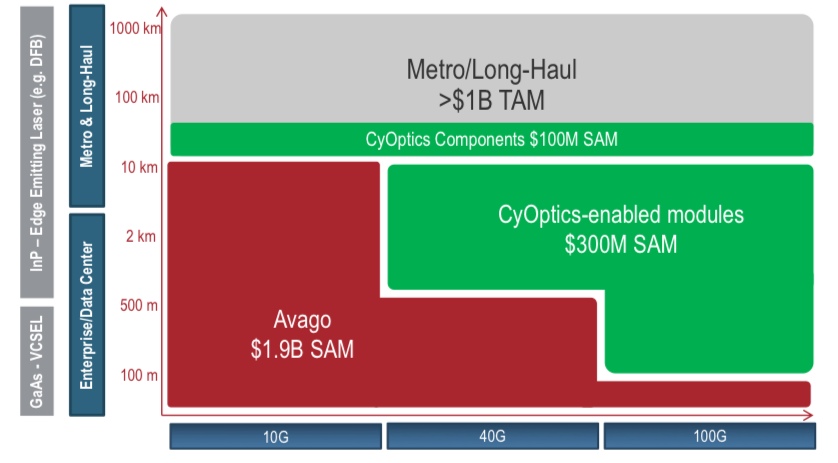 How the acquisition of CyOptics will expand Avago's market opportunities. SAM is the serviceable addressable market and TAM is the total addressable market. Source: Avago
Avago Technologies has announced its plan to acquire optical component player, CyOptics. The value of the acquisition, at US $400M, is double CyOptics' revenues in 2012.
CyOptics' sales were $210M last year, up 21 percent from the previous year. Avago's acquisition will make it the optical component industry's second largest company, behind Finisar, according to market research firm, Ovum. The deal is expected to be completed in the third quarter of the year.
The deal will add indium phosphide and planar lightwave circuit (PLC) technologies to Avago's vertical-cavity surface-emitting laser (VCSEL) and optical transceiver products. In particular, Avago will gain edge laser technology and photonic integration expertise. It will also inherit an advanced automated manufacturing site as well as entry into new markets such as passive optical networking (PON).
Avago stresses its interest in acquiring CyOptics is to bolster its data centre offerings - in particular 40 and 100 Gigabit data centre and enterprise applications - as well as benefit from the growing PON market.
The company has no plans to enter the longer distance optical transmission market beyond supplying optical components.

Significance
Ovum views the acquisition as a shift in strategy. Avago is known as a short distance interconnect supplier based on its VCSEL technology.
"Avago has seen that there are challenges being solely a short-distance supplier, and there are opportunities expanding its portfolio and strategy," says Daryl Inniss, Ovum's vice president and practice leader components.
Such opportunities include larger data centres now being built and their greater use of single-mode fibre that is becoming an attractive alternative to multi-mode as data rates and reach requirements increase.
"Avago's revenues can be lumpy partly because they have a few really large customers," says Inniss.
Another factor motivating the acquisition is that short-distance interconnect is being challenged by silicon photonics. "In the long run silicon photonics is going to win," he says.
What Avago will gain, says Inniss, is one of the best laser suppliers around. And its acquisition will impact adversely other optical module players. "CyOptics is a supplier to several transceiver vendors," says Inniss. "The outlook, two or three years' hence, is decreased business as a merchant supplier."
Inniss points out that CyOptics will represent the second laser manufacturer acquisition this year, following NeoPhotonics's acquisition of Lapis Semiconductor which has 40 Gigabit-per-second (Gbps) electro-absorption modulator lasers (EMLs).
These acquisitions will remove two merchant EML suppliers, given that CyOptics is a strong 10Gbps EML player, and lasers are a key technological asset.
See also:
For a 2011 interview with CyOptics' CEO, click here

Avago's latest optical engine targets active optical cables
Avago Technologies has unveiled its first family of active optical cables for use in the data centre and for high performance computing.
The company has developed an optical engine for use in the active optical cables (AOCs). Known as the Atlas 75x, the optical engine reduces the power consumption and cost of the AOC to better compete with direct-attach copper cables.

“Some 99 percent of [active optical cable] applications are 20m or less”
Sharon Hall, Avago
"This is a price-elastic market," says Sharon Hall, product line manager for embedded optics at Avago Technologies. "A 20 percent price premium over a copper solution, then it starts to get interesting."
The AOC family comprises a 10 Gigabit-per-second (Gbps) single channel SFP+ and two QSFP+ cables - a 4x10Gbps QSFP+ and a QSFP+-to-four SFP+. The SFP+ AOC is used for 10 Gigabit Ethernet, 8 Gigabit Fibre Channel and Infiniband applications. The QSFP+ is used for 4-channel Infiniband, serial-attached SCSI (SAS) storage while the QSFP-to-four-SFP+ is required for server applications.
There are also three 12-channel CXP AOC products: 10-channel and 12-channel cables with each channel at 10Gbps; and a 12-channel CXP, each at 12.5Gbps. The devices supports the 100GBASE-SR10 100 Gigabit Ethernet and 12-channel Infiniband standards.
The 12-channel 12.5Gbps CXP product is used typically for proprietary applications such as chassis-to-chassis links where greater bandwidth is required, says Avago.
The SFP+ and QSFP+ products have a reach of 20m whereas competing AOC products achieve 100m. “Some 99 percent of applications are 20m or less,” says Hall.
The SFP+ and QSFP+ AOC products use the Atlas 75x optical engine. The CXP cable uses Avago’s existing Atlas 77x MicroPod engine and has a reach of 100m.
The Atlas 75x duplex 10Gbps engine reduces the power consumption by adopting a CMOS-based VCSEL driver instead of a silicon germanium one. “With CMOS you do not get the same level of performance as silicon germanium and that impacts the reach,” says Hall. “This is why the MicroPod is more geared for the high-end solutions.”
The result of using the Atlas 75x is an SFP+ AOC with a power consumption of 270mW compared to 200mW of a passive direct-attach copper cable. However, the SFP+ AOC has a lower bit error rate (1x10-15 vs. 1x10-12), a reach of up to 20m compared to the copper cable’s 7m and is only a quarter of the weight.
The SFP+ AOC does have a lower power consumption compared to active direct-attach cable, which consumes 400-800mW and has a reach of 15m.
Avago says that up to a 30m reach is possible using the Atlas 75x optical engine. Meanwhile, samples of the AOCs are available now.
40 Gigabit Ethernet QSFPs boost port density and reach
 "For the larger data centres being built today, reach is becoming more and more important"
I Hsing Tan, Avago
Avago’s eSR4 QSFP+ transceiver extends the reach of 40GbE over multimode fibre beyond the IEEE 40GBASE-SR4 specification, to 300m over OM3 and 400m over OM4 multimode fibre.
Reflex Photonics’ 40GbE QSFP also achieves 300m over OM3 fibre and while it has not tested the transceiver over OM4 fibre, the company is using the same optics that it uses for its CFP which meets 450m over OM4.
“This [QSFP] is aimed at large data centres operated by the likes of a Google or a Facebook,” says Robert Coenen, vice president, sales and marketing at Reflex Photonics. Such data centres can have link requirements of 1000m. “The more reach you can give over multimode fibre, the more money they [data centre operators] can save.”
The eSR4, like Avago's already announced iSR4 (interoperable SR4) 40GbE QSFP+ transceiver, supports either 40GbE or four independent 10GbE channels. When used as a multichannel 10GbE interface, the QSFP+ can interface to various 10GbE form factors such as X2, XFP and SFP+, says Avago.
The iSR4 also increases the faceplate port density of equipment from 48, 10 Gigabit Ethernet (GbE) SFP+ ports to up to 44 QSFP+ 40GbE ports. Avago says that one equipment vendor has already announced a card with 36 QSFP+ ports. The iSR4 QSFP+ also reduces the overall Gigabit/Watt power consumption to 37.5mW/Gbps compared to 100mW /Gbps for the SFP+. The eSR4 has half the power consumption, which puts it around 50mW/Gbps.
But the iSR4 matches the reach of the IEEE 40GBASE-SR4 40GbE standard: 100m for OM3 and 150m for OM4-based fibre. "This [reduced reach at 40GbE] creates an issue for data centre operations," says I Hsing Tan, Ethernet segment marketing manager in the fiber optics product division at Avago. "They require additional investment to redo all the wiring in current 10GbE infrastructure to support a shorter reach."
With the extended reach 40GbE QSFPs the reach associated with 10GbE interfaces on OM3 and OM4 multimode fibre is now restored.
The iSR4 module is available now, says Avago, while the eSR4 will be available from mid-2012. Reflex’s Coenen says it will have samples of its 40GbE QSFP, which also supports 40GbE and 4x10GbE, by May 2012.
What has been done
For Avago's iSR4 QSFP+ to operate as four, 10GbE channels, it has to comply with the 10GBASE-SR optical standard. That is because 10GBASE-SR supports a maximum receive power of -1dBm whereas the 40GBASE-SR4 has a maximum output power of 2.4dBm. The transmitter power of the iSR4 has thus been reduced. "We force the output of the transmitter down to -1dBm," says Tan.
To achieve the greater reach, the eSR4 uses a VCSEL design with a tighter spectral width. Other parameters include the optical modulation amplitude power and the wavelength. These affect the resulting fibre dispersion. “Once you control the spectral width, you can design the other two to meet the specs," says Tan.
The Avago 40GbE QSFP+ modules use an integrated 4- channel VCSEL array and a 4-channel photo-detector array.
Significance
The 40GbE short reach interfaces play an important role in the data centre. As servers move from using 1GbE to 10GbE interfaces, the uplink from aggregation 'top-of-rack' switches must also scale from 10GbE to higher speeds of 40GbE or 100GbE.
However existing 100GbE interfaces make use of the CFP module which is relatively large and expensive. And although the 100GbE standard has a clear roadmap leading to CFP2 and CFP4 modules, half and a quarter of the size of the CFP, respectively, these are not yet available.
40GbE QSFP+ transceivers do exist and offer the equipment faceplate density improvement vendors want.
The QSFP+ also benefits existing 10GbE designs by supporting nearly 4x the number of 10GbE on a card. Thus a new blade supporting up to 44, 40GbE QSFP+ transceivers can interface to up to 176 10GbE transceivers, a near fourfold capacity increase.
According to Avago, between 10% and 20% of interface requirements in the data centre are beyond 150m. Without the advent of extended reach 40GbE modules, data centre operators would need to deploy single mode fibre and a 40GBASE-LR4 module, it says. And while that can be fitted inside a QSFP, its power consumption is up to 3.5W, compared to the 1.5W of the QSFP+ eSR4. "The cost of the LR4 is also increased by at least a factor of three," says Tan.
Avago says that some 95% of all fibre in the data centre is multimode fibre. As for OM3 and OM4 deployments the ratio is 80% to 20%, respectively.
Altera unveils its optical FPGA prototype
Altera has been showcasing a field-programmable gate array (FPGA) chip with optical interfaces. The 'optical FPGA' prototype makes use of parallel optical interfaces from Avago Technologies.
Combining the FPGA with optics extends the reach of the chip's transceivers to up to 100m. Such a device, once commercially available, will be used to connect high-speed electronics on a line card without requiring exotic printed circuit board (PCB) materials. An optical FPGA will also be used to link equipment such as Ethernet switches in the data centre.
"It is solving a problem the industry is going to face," says Craig Davis, product marketing manager at Altera. "As you go to faster bit-rate transceivers, the losses on the PCB become huge."
What has been done
Altera's optical FPGA technology demonstrator combines a large FPGA - a Stratix IV EP4S100G5 - to two Avago 'MicroPod' 12x10.3 Gigabit-per-second (Gbps) optical engines.
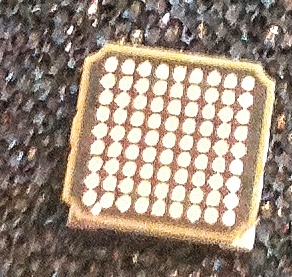 Avago's MicroPod 12x10Gbps optical engine deviceThe FPGA used has 28, 11.3Gbps electrical transceivers and in the optical FPGA implementation, 12 of the interfaces connect to the two MicroPods, a transmitter optical sub-assembly (TOSA) and a receiver optical sub-assembly (ROSA).
The MicroPod measures 8x8mm and uses 850nm VCSELs. The two optical engines interface to a MTP connector and consume 2-3W. Each MicroPod sits in a housing - a land grid array compression socket - that is integrated as part of the FPGA package.
"The reason we are doing it [the demonstrator] with a 10 Gig FPGA and 10 Gig transceivers is that they are known, good technologies," says Davis. "It is a production GT part and known Avago optics."
Why it matters
FPGAs, with their huge digital logic resources and multiple high-speed electrical interfaces, are playing an increasingly important role in telecom and datacom equipment as the cost to develop application-specific standard product (ASSP) devices continues to rise.
The 40nm-CMOS Stratix IV FPGA family have up to 32, 11.3Gbps transceivers, while Altera's latest 28nm Stratix V FPGAs support up to 66x14.1Gbps transceivers, or 4x28Gbps and 32x12.5Gbps electrical transceivers on-chip.
Altera's FPGAs can implement the 10GBASE-KR backplane standard at spans of up to 40 inches. "You have got the distances on the line card, the two end connectors and whatever the distances are across a 19-inch rack," says Davis. Moving to 28Gbps transceivers, the distance is reduced significantly to several inches only. To counter such losses expensive PCBs must be used.
One way to solve this problem is to go optical, says Davis. Adding 12-channel 10Gbps optical engines means that the reach of the FPGAs is up to 100m, simplifying PCB design and reducing cost while enabling racks and systems to be linked.
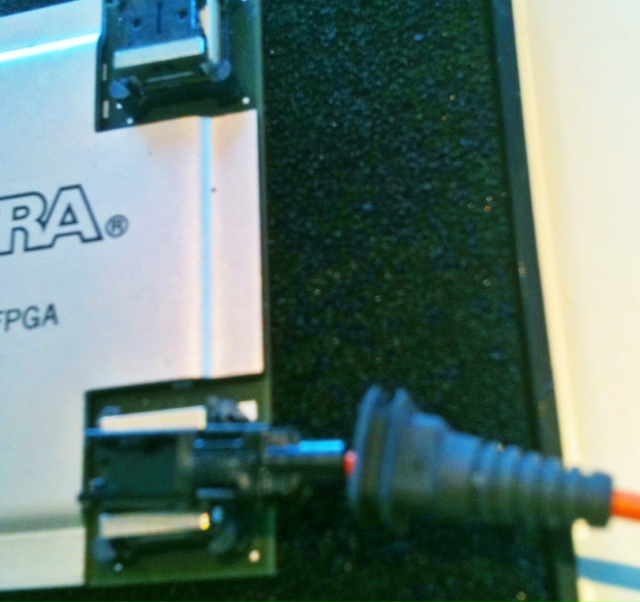 The multimode fibre connector to the MicroPod
Developing an optical FPGA prototype highlights that chip vendors already recognise the role optical interfaces will play.
It is also good news for optical component players as the chip market promises a future with orders of magnitude greater volumes than the traditional telecom market.
The optical FPGA is one target market for silicon photonics players. One, Luxtera, has already demonstrated its technology operating at 28Gbps.
What next
Altera stresses that this is a technology demonstrator only.
The company has not made any announcements regarding when its first optical FPGA product will be launched, and whether the optical technology will enter the market interfacing to its FPGAs' 11.3Gbps, 14.1Gbps or highest-speed 28Gbps transceivers.
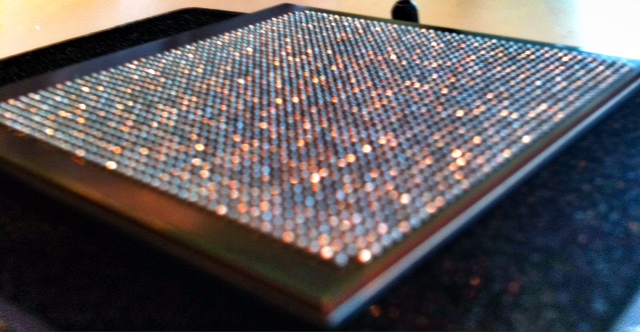 The undersideof the FPGA, showing the 1,932-pin ball grid array
Fibre-to-the-FPGA
Part 1: FPGAs
Programmable logic chip vendor Altera is developing FPGAs with optical interfaces. But is there a need for such technology and how difficult will it be to develop?
FPGAs with optical interfaces promise to simplify high-speed interfacing between and within telecom and datacom systems. Such fibre-based FPGAs, once available, could also trigger novel system architectures. But not all FPGA vendors believe optical-enabled FPGAs’ time has come, arguing that cost and reliability hurdles must be overcome for system vendors to embrace the technology

“One of the advantages of using optics is that you haven’t got to throw your backplanes away as [interface] speeds increase.”
Craig Davis, Altera
Altera announced in March that it is developing FPGAs with optical interfaces. The FPGA vendor has yet to detail its technology demonstrator but says it will do so later this year. Altera describes the advent of optically-enabled FPGAs as a turning point, driven by the speed-reach tradeoff of electrical interfaces coupled with the rising cost of elaborate printed circuit board (PCB) materials needed for the highest speed interfaces.
Interface speeds continue to rise. The Interlaken interface has a channel rate of up to 6.375 Gigabit-per-second (Gbps) while the Gen 3.0 PCI Express standard uses 8.0 Gbps lanes. Meanwhile 16 Gigabit Fibre Channel standard operates at 14.1 Gbps while 100 Gigabit interfaces for Ethernet and line-side optical transport are moving to a four-channel electrical interface that almost doubles the lane rates to 25-28 Gbps. The CFP2 optical module for 100 Gigabit, to be introduced in 2012, will use the four-channel electrical interface.
Copper interfaces such channel speeds but at the expense of reach. Craig Davis, senior product marketing engineer at Altera, cites the 10GBASE-KR 10Gbps backplane standard as an example of the bandwidth-reach the latest FPGAs can achieve: 40 inches including the losses introduced by the two connectors at each end.

“Our interactions with our customers are primarily for products that are not going to see the light of day for several years”
Panch Chandrasekaran, Xilinx
Work is being undertaken to development very short reach electrical interfaces at 28Gbps for line cards and electrical backplanes. “You are talking 4 to 6 inches of trace to a CFP2 module or a chip-to-chip interface,” says Panch Chandrasekaran, Xilinx’s senior product marketing manager, high-speed serial I/O. “Honestly, this is going to be a challenge but we usually figure out a way how to do things.”
The faster the link, the more energy has to be put into the signals and the more losses you have on the board, says Davis: “Signal integrity aspects also get more difficult, the costs go up as does the power consumption.”
According to Altera, signal losses increase 3.5x going from 10 to 30Gbps. To match the losses at 10Gbps when operating at these higher speeds, complex PCB materials such as N4000-13 EP SI and Megtron 6 are needed rather than the traditional FR4 design. However, the cost of designing and manufacturing such PCBs can rise by five-fold.
In contrast, using an optically-enabled FPGA simplifies PCB design. “For traditional chip-to-chip on a line card, optics does have a benefit because you can trade off the number of layers on a PCB,” says Davis. Such an optical-based design also offers future-proofing. “A lot of the applications we’ll be looking to support are across backplanes and between shelves,” says Davis. “One of the advantages of using optics is that you haven’t got to throw your backplanes away as [interface] speeds increase.”
FPGAs with optical interfaces also promise new ways to design systems. Normally when one line card talks to another on different shelves it is via a switch card on each shelf. Using an FPGA with an optical interface, the cards can talk directly. “People are looking at this,” says Davis. “You could take that to the extreme and go to the next cabinet which makes a much easier system design.”
Altera says vendors are interested in optical-enabled FPGAs for storage systems. Here interlinked disk drives require multiple connectors between boards. “There is an argument that it becomes a simpler system design with one FPGA taking directly to another or one chip directly to another,” says Davis “The more advanced R&D groups within certain companies are investigating the best route forward.”
But while FPGA companies agree that optical interfaces will be needed, there is no consensus on timing. “Xilinx has been looking at this technology for a while now,” says Chandrasekaran. “There is a reason why we haven’t announced it: we have a little while to go before key ecosystem and technology questions are answered.”
The mechanical and reliability issues of systems are stringent and the optical option must prove that it can deliver what is needed, says Chandrasekaran. “It is possible to do at the moment but the cost and reliability equation hasn’t been fully solved.”
Xilinx also says that while it is discussing the technology with customers, the requirement for such FPGA-based optical interfaces is some way off. “Our interactions with our customers are primarily for products that are not going to see the light of day for several years,” says Chandrasekaran
“Customers are always excited to hear about integration play,” says Gilles Garcia, director, wired communications business unit at Xilinx. But ultimately end customers care less about the technology as long as the price, power and board real-estate requirements are met. “What we are seeing with this [optical-enabled FPGA] technology is that it is not answering the requirements we are seeing from our large customers that are looking for their next-generation systems,” says Garcia
FPGA vendor Tabula also questions the near-term need for such technology. Alain Bismuth, vice president of marketing at Tabula, says nearly all the ports shipped today are at speeds of 10Gbps and below. Even in 2014, the number of 40Gbps ports forecast will only number 650,000, he says.
For Bismuth, two things must happen before optically-enabled FPGAs become commonplace. “You can build them in high volumes reliably and with good yields without incurring higher costs than a separate, discrete [FPGA and optical module] solution,” says Bismuth. “Second, the emergence in interesting volume of networks at 100 Gig and beyond to justify the integration effort.” Such networks are emerging at a “fairly slow pace”, he says.
Meanwhile Altera’s development work continues apace. “We are working with partners to develop the system and we will be demonstrating the optics-on-a-chip in Q4,” says Bob Blake, corporate and product marketing manager, Altera Europe. Altera says its packaged FPGA and optical interface will support short reach links up to 100m and be based on multimode fibre. “All we have announced is that the optical interface will be on the package and it will connect into the FPGA,” says Davis.
The technology will also use 10Gbps optical interface yet the company has detailed that its Stratix V FPGA family supports electrical transceivers at 28Gbps. “The optical interface can go higher than that [10Gbps] so in future we can target 28Gbps and beyond,” says Davis.
Optical partners
Optical component and transceiver firms such as Avago Technologies, Finisar and Reflex Photonics all have parallel optical devices - optical engines - that support up to 12 channels at 10Gbps. Avago’s MicroPod 12x10Gbit/s optical engine measures 8x8mm, for example.
None of the optical vendors would comment on its involvement with Altera’s optical-enabled FPGA.
Avago Technologies says that as FPGA interface speeds move to 10 Gbps and beyond, its customers are finding they need to move from copper to optical interfaces to maintain bandwidth for board, chassis, and system-level interconnect. “In line with this announcement from Altera, we are investing the time to verify Avago optical modules with FPGA SERDES blocks to ensure that FPGA users can design optical interfaces with confidence,” says Victor Krutul, director of marketing for fibre optic products at Avago.
Finisar too only talks about general trends. “We are seeing many technology leaders moving optics further onto the board and deeper into the system,” says Katharine Schmidtke, director of strategic marketing for Finisar. “This approach offers a number of advantages including improving signal integrity and reducing power consumption on copper traces at higher bandwidths.”
Reflex Photonics says that it has the technology and products to realise optically-enabled IC packages. “We are working with more than one IC company to bring optically-enabled IC packages to market,” says Robert Coenen, vice president, sales and marketing at Reflex.
For Coenen, FPGAs represent the first step in bringing optics to the IC package: “Due to their penetration into niche markets, FPGAs make the most sense to create what will ultimately be a huge market in optically-enabled IC packages.”
Coenen stresses that optics to the IC package is a significant shift in how optical links are used and so it will take time for this application to take hold. However, as the cost per bit decreases, optics will start being used in additional applications including switch ASICs, microprocessors and graphics processors.
“The beauty of an MT-terminated ribbon fiber optical connection at the edge of the package is that this solution allows designers to use the additional high-speed optical connectivity without having to drastically change their design practices,” says Coenen. This is not the case with technologies such as PCB optical waveguides or free-space optical communication.
“I believe the Altera announcement is just the first in what will be many announcements of optical-to-the-IC-package technology in the coming year or two,” says Coenen.
Further reading
- Briefing Part 2: Boosting high performance computing with optics
- Altera White Paper: Overcome Copper Limits with Optical Interfaces
- Xilinx's 400 Gigabit Ethernet FPGA
- The InfiniBand roadmap gets redrawn
Optical engines bring Terabit bandwidth on a card
Such a parallel optics design offer several advantages when used on a motherboard. It offer greater flexibility when cooling since traditional optics are normally in pluggable slots at the card edge, furthest away from the fans. Such optical engines also simplify high-speed signal routing and electromagnetic interference issues since fibre is used rather than copper traces.
 Figure 1: Fourteen 120Gbps MiniPods on a board. Source: Avago Technologies
Avago has two designs – the 8x8mm MicroPod and the 22x18mm MiniPod. The 12x10.3125 Gigabit-per-second (Gbps) MicroPods are being used in IBM’s Blue Gene computer and Avago says it is already shipping tens of thousands of the devices a month.
“The [MicroPod’s] signal pins have a very tight pitch and some of our customers find that difficult to do,” says Victor Krutul, director of marketing for the fibre optics division at Avago Technologies. The MiniPod design tackles this by using the MicroPod optical engine but a more relaxed pitch. The MiniPod uses a 9x9 electrical MegArray connector and is now sampling, says Avago.
Figure 1 shows 14 MiniPod optical engines on a board, each operating at 12x10Gbps. “If you were trying to route all those signals electrically on the board, it would be impossible,” says Krutul. All 14 MiniPods go to one connector, equating to a 1.68Tbps interface.
 Figure 2: Sixteen MicroPods in a 4x4 array. Source: Avago Technologies
Figure 2 shows 16 MicroPods in a 4x4 array. “Those [MicroPods] can get even closer,” says Krutul. Also shown are the connectors to the MicroPod array. Avago has worked with US Conec to design connectors whereby the flat ribbon fibres linking the MicroPods can stack on top of each other. In this example, there are four connections for each row of MicroPods.
OFC announcements and market trends
More compact transceiver designs at 10, 40 and 100 Gigabit, advancements in reconfigurable optical add-drop multiplexer (ROADM) technology and parallel optical engine developments were all in evidence at this year’s OFC/NFOEC show held in Los Angeles in March.
 “MSAs are designed by committee, and when you have a committee you throw away innovation and you throw away time-to-market”
Victor Krutul, Avago Technologies
Finisar said that the show was one of the busiest in recent years. “There was an increasing system-vendor presence at OFC, and there was a lot more interest from investor analysts,” says Rafik Ward, vice president of marketing at Finisar.
Ethernet interfaces
Opnext demonstrated an IEEE 100GBASE-ER4 module design at the show, the 100 Gigabit Ethernet (GbE) standard with a 40km reach. Based on the company’s CFP-based 100GBASE-LR4 10km module, the design uses a semiconductor optical amplifier (SOA) on the receive path to achieve the extended reach. The IEEE standard calls for an SOA in front of the photo-detectors for the 100GBASE-ER4 interface.
“We don’t have that [SOA] integrated yet, we are just showing the [design] feasibility,” says Jon Anderson, director of technology programme at Opnext. The extended reach interface will be used to connect IP core routers to transport system when the two platforms reside in separate facilities. Such a 40km requirement for a 100GbE interface is not common but is an important one to meet, says Anderson.
Opnext’s first-generation LR4, currently shipping, is a discrete design comprising four discrete transmitter optical sub-assemblies (TOSAs) and four receiver optical sub-assemblies (ROSAs) and an optical multiplexer and demultiplexer. The company’s next-generation design will integrate the four lasers and the optical multiplexer into a package and will be used in future more compact CFP2 and CFP4 modules.
The CFP2 module is half the size of the CFP module and the CFP4 is a quarter. In terms of maximum power, the CFP module is rated at 32W, the CFP2 12W and the CFP4 5W. “The CFP4 is a little bit wider and longer than the QSFP,” says Anderson. The first CFP2 modules are expected to become available in 2012 and the CFP4 in 2013.
System vendors are interested in the CFP4 as they want to support over one terabit of capacity on a 15-inch faceplate. Up to 16 ports can be supported –1.6Tbps – on a faceplate using the CFP4, and using a “belly-to-belly” configuration two rows of 16 ports will be possible, says Anderson.
Finisar demonstrated a distributed feedback laser (DFB) laser-based CFP module at OFC that implements the 10km 100GBASE-LR4 standard. The adoption of DFB lasers promises significant advantages compared to existing first-generation -LR4 modules that use electro-absorption modulated lasers (EMLs). “If you look at current designs, ours included, not only do they use EMLs which are significantly more expensive, but each is in its own package and has its own thermo-electric cooler,” says Ward.
Finisar’s use of DFBs means an integrated array of the lasers can be packaged and cooled using a single thermo-electric cooler, significantly reducing cost and nearly halving the power to 12W. “Now that the power [of the DFB-based] LR4 is 12W, we can place it within a CFP2 with its 25-28 Gigabit-per-second (Gbps) electrical I/O,” says Ward.
Moving to the faster input/output (I/O) compared to the CFP’s 10Gbps I/O means that that serialiser/ deserialiser (serdes) chipset can be replaced with simpler clock data recovery (CDR) circuitry. “By the time we move to the CFP4, we remove the CDRs completely,” says Ward. “It’s an un-retimed interface.” Finisar’s existing -LR4 design already uses an integrated four-photodetector array.
An early application of the 100GbE -LR4, as with the -ER4, is linking core routers with optical transport systems in operators’ central offices. Many Ethernet switch vendors have chosen to focus their early high-data efforts at 40GbE but Finisar says the move to 100GbE has started.
Finisar argues that the adoption of DFBs will ultimately prove the cost-benefits of a 4-channel 100GbE design which faces competition from the emerging 10x10 multi-source agreement (MSA). “Everything we have heard about the 10x10 [MSA] has been around cost,” says Ward. “The simple view inside Finisar is that by the time the Gen2 100GbE module that we showed at OFC gets to market, this argument [4x25Gig vs. 10x10Gig] will be a moot point.”
 “40Gig is definitely still strong and healthy”
Jon Anderson, Opnext
By then the second-generation -LR4 module design will be cost competitive if not even lower cost than the 10x10 MSA. “If you look at optoelectronic components, at the end of the day what really drives cost is yield,” says Ward. “If we can get our yields of 25Gig DFBs down to a level that is similar to 10Gig DFB yields- it doesn’t have to match, just in the ballpark - then we have a solution where the 4x25Gig looks like a 4x10Gig solution and then I believe everyone will agree that 4x25Gig is a less expensive architecture.” Finisar expects the Gen2 CFP -LR4 in production by the first half of 2012.
Opnext demonstrated a 40GBASE- LR4 (40Gbps, up to 10km) standard in a QSFP+ module at OFC. Anderson says it is seeing demand for such a design from data centre operators and from switch and transport vendors.
Avago Technologies announced a 40Gbps QSFP+ module at OFC that implements the 100m IEEE 40GBASE-SR4. “It will interoperate with Avago’s SFP+ modules,” says Victor Krutul, director of marketing for the fibre optics division at Avago Technologies. The QSFP+ can interface to another QSFP+ module or to four 10Gbps SFP+ modules.
Avago also announced a proprietary mini-SFP+ design, 30% smaller than the standard SFP+ but which is electrically compatible. According to Krutul, the design came about following a request from one of its customers: “What it allows is the ability to have 64 ports on the front [panel] rather than 48.”
Did Avago consider making the mini-SFP+ design an MSA? “What we found with MSAs is that they are designed by committee, and when you have a committee you throw away innovation and you throw away time-to-market,” says Krutul.
Krutul was previously a marketing manager for Intel’s LightPeak before joining Avago over half a year ago.
 “There was an increasing system-vendor presence at OFC, and there was a lot more interest from investor analysts”
Rafik Ward, Finisar.
Line-side interfaces
Opnext will be providing select customers with its 100Gbps DP-QPSK coherent module for trialling this quarter. The module has a 5-inch by 7-inch footprint and uses a 168-pin connector. “We are working to try and meet the OIF spec [with regard power consumption] which is 80W.” says Anderson. “It is challenging and it may not be met in the first generation [design].”
The company is also moving its 40Gbps 2km very short reach (VSR) transponder to support the IEEE 40GBASE-FR standard within a CFP module, dubbed the “tri-rate” design. “The 40BASE-FR has been approved, with the specification building on the ITU’s 40Gig VSR,” says Anderson. “It continues to support the [OC-768] SONET/SDH rate, it will support the new OTN ODU3 40Gbps and the intermediate 40 Gigabit Ethernet.”
Opnext and Finisar are both watching with interest the emerging 100Gbps direct detection market, an alternative to 100 Gigabit coherent aimed shorter reach metro applications.
“We certainly are watching this segment and do have an interest, but we don’t have any product plans to share at this point,” says Anderson.
“The [100Gbps] direct-detection market is very interesting,” says Ward. Coherent is not going to be the only way people will deploy 100Gbps light paths. “There will be a market for shorter reach, lower performance 100 Gigabit DWDM that will be used primarily in datacentre-to-datacentre,” he says. Tier 2 and tier 3 carriers will also be interested in the technology for use in shorter metro reaches. “There is definitely a market for that,” says Ward.
Opnext also announced its small form-factor – 3.5-inch by 4.5-inch - 40Gbps DPSK module. “With a smaller form factor, the next generation could move to a CFP type pluggable,” says Anderson. “But that is if our customers are interested in migrating to a pluggable design for DPSK and DQPSK.”
Are there signs that the advent of 100 Gigabit is affecting 40Gbps uptake? “We definitely not seeing that,” says Anderson. “We are continuing to see good solid demand for both 40G line side – DPSK and DQPSK – and a lot of pull to being this tri-rate VSR.”
Such demand is not just from China but also North Ametican carriers. “40 Gig is definitely still strong and healthy,” says Anderson “But there are some operators that are waiting to see how 100G does and approved in for major build-outs.”
At 10Gbps, Opnext also had on show a tunable TOSA for use in an XFP module, while Finisar announced an 80km, 10Gbps SFP+ module. “SFP+ has become a very successful form factor at 10Gbps,” says Ward. “All the market data I see show SFP+ leads in overall volumes deployed by a significant margin.” Its success has been achieved despite being a form factor was not designed to achieve all the 10Gbps reaches required initially. This is some achievement, says Ward, since the XFP+ form factor used for 80km has a power rating of 3.5W while the 80km SFP+ has to work within a less than 2W upper limit.
Parallel Optics
Avago detailed its main parallel optic designs: the CXP module and its two optical engine designs.
The company claims it seeing much interested from high-performance computing vendors such as IBM and Fujitsu for its CXP 120 Gigabit (12x10Gbps) parallel transceiver module. Avago is sampling the module and it will start shipping in the summer.
The company also announced the status of its embedded parallel optics devices (PODs). Such parallel optic designs offer several advantages, says Krutul. Embedding the optics on the motherboard offers greater flexibility in cooling since the traditional optics is normally at the edge of the card, furthest away from the fans. Such optics also simplify high-speed signal routing on the printed circuit board since fibre is used.
Avago offers two designs – the 8x8mm MicroPod and the 22x18mm MiniPod. The 12x10Gbps MicroPods are being used in IBM’s Blue Gene computer and Avago says it is already shipping tens of thousands of the devices a month. “The [MicroPod’s] signal pins have a very tight pitch and some of our customers find that difficult to do,” says Krutul. The MiniPod design tackles this by using the MicroPod optical engine but a more relaxed pitch. At OFC, Avago said that the MiniPod is now sampling.
Gridless ROADMs
Finisar demonstrated what it claims is the first gridless wavelength-selective switch (WSS) module at the show. A gridless ROADM supports variable channel widths beyond the fixed International Telecommunication Union's (ITU) defined spacings. Such a capability enables ROADMs to support variable channel spacings that may be required for transmission rates beyond 100Gbps: 400Gbps, 1Tbps and beyond.
“We have an increasing amount of customer interest in this [FlexGrid], and from what we can tell, there is also an increasing amount of carrier interest as well,” says Ward, adding that the company is already shipping FlexGrid WSSs to customers.
Finisar is a contributing to the ongoing ITU work to define what the grid spacings and the central channels should be for future ROADM deployments. Finisar demonstrated its FlexGrid design implementing integer increments of 12.5GHz spacing. “We could probably go down to 1GHz or even lower than that,” says Ward. “But the network management system required to manage such [fine] granularity would become incredibly complicated.” What is required for gridless is a balance between making good use of the fibre’s spectrum while ensuring the system in manageable, says Ward.
Do multi-source agreements benefit the optical industry?
System vendors may adore optical transceivers but there is a concern about how multi-source agreements originate.
Optical transceiver form factors, defined through multi-source agreements (MSAs), benefit equipment vendors by ensuring there are several suppliers to choose from. No longer must a system vendor develop its own or be locked in with a supplier.
 “Personally, the MSA is the worst thing that has happened to the optical industry”
Marek Tlaka, Luxtera
Pluggables also decouple optics from the line card. A line card can address several applications simply by replacing the module. In contrast, with fixed optics the investment is tied to the line card. A system can also be upgraded by swapping the module with an enhanced specification version once it is available.
But given the variety of modules that datacom and telecom system vendors must support, there are those that argue the MSA process should be streamlined to benefit the industry.
Traditionally, several transceiver vendors collaborate before announcing an MSA. The CFP MSA announced in March 2009, for example, was defined by Finisar, Opnext and Sumitomo Electric Device Innovations. Since then Avago Technologies has become a member.
“The industry has an interesting model,” says Niall Robinson, vice president of product marketing at Mintera. “A couple of companies can get together, work behind closed doors and announce suddenly an MSA and try to make it defacto in the market.”
Robinson contrasts the MSA process with the Optical Interconnecting Forum’s (OIF) 100Gbps line side work that defined guidelines for integrated transmitter and receiver modules. Here service providers and system vendors also contributed. “It was a much more effective and fair process, allowing for industry collaboration,” says Robinson
Matt Traverso, senior manager, technical marketing at Opnext, and involved in the CFP MSA, also favours an open process. “But the view that the way MSAs are run is not open is a bit of a fallacy,” he says.
“Any MSA that is well run requires iteration with suppliers,” says Traverso. The opposite is also true: poorly run MSAs have short lives, he says. Having too open a forum also runs the risk of creating a one-size-fits-all: “One vendor may want to use the MSA as a copper interface while a carrier will want it for long-haul dense WDM.”
Optical transceiver vendors benefit in another way if they are the ones developing MSAs. “Transceiver vendors will not make life tough for themselves,” says Padraig OMathuna, product marketing director at optical device maker, GigOptix. “If MSAs are defined by system vendors, [transceiver] designs would be a lot more challenging.”
Avago Technologies argues for standards bodies to play a role especially as industry resources become more thinly spread.
“MSAs are not standards; there are items left unwritten and not enough double checking is done,” says Sami Nassar, director of marketing, fiber optic products division at Avago Technologies. There are always holes in the specifications, requiring patches and fixes. “If they [transceivers] were driven by standards bodies that would be better,” says Nassar.
Organisations such as the IEEE don’t address packaging and connectors as part of their standards work. But this may have to change. “The real challenge, as the industry thins out, is ensuring the [MSA] work is thorough,” says Dan Rausch, Avago’s senior technical marketing manager, fiber optic products division. “The challenge for the industry going forward is ensuring good engineering and more robust solutions.”
Marek Tlalka, vice president of marketing at Luxtera, goes further, questioning the very merits of the MSA: “Personally, the MSA is the worst thing that has happened to the optical industry.”
Unlike the semiconductor industry where a framer chip once on a line card delivers revenue for years, a transceiver company may design the best product yet six months later be replaced by a cheaper competitor. “The return on investment is lost; all that work for nothing,” says Tlalka.
“Is it a good development or not? MSAs are out there,” says Vladimir Kozlov, CEO of optical transceiver market research firm, LightCounting. “It helps system vendors, giving them a freedom to buy.”
But MSAs have squeezed transceiver makers, says Kozlov, and he worries that it is hindering innovation as companies cut costs to maximize their return on investment.
“There is continual pressure to reduce the price of optics,” adds Daryl Inniss, Ovum’s practice leader components. If operators are to provide video and high definition TV services and grow revenues then bandwidth needs to become dirt cheap. “Even today optics is not cheap,” says Inniss. Certainly MSAs play an important role in reducing costs.
“The transceiver vendors’ challenge is our benefit,” admits Oren Marmur, vice president, optical networking line of business, network solutions division at system vendor, ECI Telecom. “But we have our own challenges at the system level.”