

100 Gigabit 'unstoppable'
A Q&A with Andrew Schmitt (@aschmitt), directing analyst for optical at Infonetics Research.

"40Gbps has even less value in the metro than in the core"
Andrew Schmitt, Infonetics Research
A study from market research firm, Infonetics Research, has found that operators have a strong preference for deploying 100 Gigabit-per-second (Gbps) technology as they upgrade their networks.
Infonetics interviewed 21 incumbent service providers, competitive operators and mobile operators that have either 40Gbps, 100Gbps or both wavelength types installed in their networks, or that plan to install by next year (2013).
The operators surveyed, from all the major regions, account for over a quarter (28%) of worldwide telecom carrier revenue and capital expenditure.
The study's findings include:
- A strong preference by the carriers for 100Gbps transport in both Brownfield and Greenfield installations. Carriers will use 40 and 100Gbps to the same degree in existing Brownfield networks while favouring 100Gbps for new, Greenfield builds.
- The reasons to deploy 40Gbps and 100Gbps optical transport equipment include lowering the cost per bit, taking advantage of the superior dispersion performance of coherent optics, and lowering incremental common equipment costs due to the increased spectral efficiency.
- Most respondents indicate 40Gbps is only a short-term solution and will move the majority of installations to 100Gbps once those products become widely available.
- Non-coherent 100Gbps is not yet viewed as an important technology.
- Colourless and directionless ROADMs and Optical Transport Network (OTN) switching are important components of Greenfield builds; gridless and contentionless ROADMs are much less so.
Q&A with Andrew Schmitt
Q. A key finding is that 40Gbps and 100Gbps are equally favoured for Brownfield routes. And is it correct that Brownfield refers to existing routes carrying 10Gbps and maybe 40Gbps wavelengths while Greenfield involves new 100Gbps wavelengths? What is it about Brownfield that 40Gbps and 100Gbps have equal footing? Equally, for Greenfield, is the thinking: "If we are deploying a new lit fibre, we might as well start with the newest and fastest"?
A: The assumptions on Brownfield versus Greenfield are correct, the definitions in the survey and the report are more detailed but that is right.
It is more an issue that they [carriers] are building with 40Gbps now but will transition to 100Gbps where it can be used. Where it can't be used they stick with 40Gbps. There are many reasons why 100Gbps may not work in existing networks.
Q: Another finding is that 40Gbps is seen as a short-term solution. What is short term? And will that also be true for the metro or does metro have its own dynamic?
A: We didn't test timing explicitly for Greenfield versus Brownfield networks. It [40Gbps] doesn't necessarily peak, it is just not growing at the same rate as 100Gbps. And 40Gbps has even less value in the metro than in the core, particularly in Greenfield builds. With Greenfield 100Gbps combined with soft-decision forward error correction (SD-FEC), it is almost as good as 40Gbps.
Q: The study found that non-coherent 100Gbps isn't yet viewed as an important technology. Why do you think that is so? And what is your take on the non-coherent 100Gbps opportunity?
A: The jury is still out.
The large customers I spoke with haven't looked at it and therefore can't form an opinion. A lot of promises and marketing at this point but that doesn't mean it won't work. Module vendors are pretty excited about it and they aren't stupid.
Q: You say colourless and directionless is seen as important ROADM attributes, gridless and contentionless much less so. If operators are building 100Gbps Greenfield overlays, is not gridless a must to future-proof the network investment?
A: The gridless requirement is completely overblown and folks positioning it as a requirement today haven't done the work to understand the issues trying to use it today. This survey was even more negative than I expected.

Optical networking market in rude health
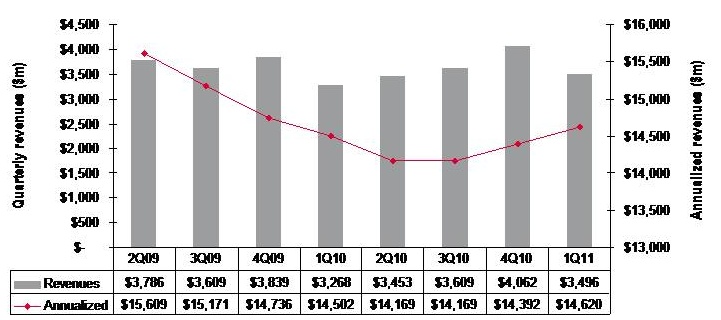 Quarterly market revenues, global optical networking (1Q 2011). Source: Ovum
Despite recent falls in optical equipment makers’ stock, the optical networking market remains in good health with analysts predicting 6-7% growth in 2011.
For Andrew Schmitt, directing analyst for optical at Infonetics Research, unfulfilled expectations are nothing new. Optical networking is a market of single-digit yearly growth yet in the last year certain market segments have grown above average: spending on ROADM-based wavelength division multiplexing (WDM) optical network equipment, for example, has grown 20% since the first quarter of 2010.
“Every few years people get this expectation that there is going to be this hockey stick [growth] and it is not,” says Schmitt. “There has been a lot of Wall Street money moving into this sector in the latter part of 2010 and first part of this year and they have just had their expectations reset, but operationally the industry is very healthy.”
“Nothing in this business changes quickly but the pace of change is starting to accelerate”
Andrew Schmitt, Infonetics Research
But Schmitt acknowledges that there is industry concern about the market outlook. “There have been lots of client calls in the first half of the year wanting to talk numbers,” says Schmitt. “When the market is growing rapidly there is no need for such calls but when it is uncertain, customers put more time into understanding what is going on.”
Both Infonetics and market research firm Ovum say the optical networking market grew 7% globally in the last year (2Q10 to 1Q11).
Ovum says the market reached US $3.5bn in the first quarter of 2011 and it expects 6% growth this year. “Most of the growth will come from North America—general recovery, stimulus-related spending, and LTE (Long Term Evolution)-inspired spending; and from South and Central America mostly mobile and fixed broadband-related,” says Dana Cooperson, network infrastructure practice leader at Ovum.
Ovum also notes that optical networking annualised spending for the last four quarters (2Q10-1Q11) finally went into the black with 1% growth, to reach $14.6bn. Annualised share figures are a strong indicator of longer-term market trends, says Ovum.
Market growth
Factors accounting for the growth include optical equipment demand for mobile and broadband backhaul. Carriers are also embarking on a multi-year optical upgrade to 40 and 100 Gigabit transmission over Optical Transport Network (OTN) and ROADM-based networks. Infonetics notes that ROADM spending in particular set a new high in the first quarter, rising 4% sequentially.
Ovum expects overall growth to come from metro and backbone WDM markets and from LTE. “For metro it is a combination of new builds, as DWDM continues to take over the metro core from SONET/SDH, and expansions of ROADM and 40 Gigabit,” says Cooperson. “For backbone it is a combination of retrofits for 40 and 100 Gigabit and overbuilds with 40 and 100 Gigabit coherent-optimised systems.”
Many operators are also looking at OTN switching and how it can help with network efficiency and manageability, she says, while mobile backhaul continues to be a hot spot as well at the access end of the network.
The Americas are the regions accounting for market growth whereas in Asia-Pacific and Europe, Middle East and Africa the spending remains flat.
“We’re not as bullish on Europe as I’ve heard some others are,” says Cooperson. “We expected China to slow down as capital intensities in the 34-35% seen in 2008 and 2009 were unsustainable. We saw the cooling down a bit earlier in 2010 than we had expected, but it did cool down and will continue to.”
Ovum expects Asia-Pacific as a whole to be moribund. But at least the pullbacks in China will be countered by slow growth in Japan and a big upsurge in India after a huge decline last year due to delayed 3G-related builds among other issues.
Outlook
Ovum is optimistic about the optical networking market due to continued competitive pressures and traffic growth. “We don’t think traffic growth can just continue without attention to the underlying issues related to revenue pressure, regardless of competitive pressures,” says Cooperson. “But newer optical and packet systems offer significant improvements over the old in terms of power efficiency, manageability, and of course 40 and 100 Gigabit coherent and ROADM features.”
“Most of the growth will come from North America"
Dana Cooperson, Ovum.
Many networks worldwide are also due for a core infrastructure update to benefit capacity and efficiency while many other operators are upgrading their access networks for mobile backhaul and enterprise Ethernet services.
Schmitt stresses that while it is right to talk about a 'core reboot', there are all sorts of operators that make up the market: the established carriers, those focussed on Layer 2 and Layer 3 transport, dark fibre companies and cable companies.
“Everyone has a different business so there is not a whole lot of group-think in this industry,” says Schmitt. “So when you talk about a transition to 40 and 100 Gigabit, some carriers will make that transition earlier than others because the nature of their business demands it.”
However, there are developments in equipment costs that are leading to change. “Once you get out to 2013-14, 100 Gigabit [transport] looks really good relative to 40 Gigabit and tunable XFPs at 10 Gigabit look really, really good,” says Schmitt, who believes these are going to be two dominating technologies. “People are going to use 100 Gigabit and when they can afford to throw more 10 Gigabit at the [capacity] problem, in shorter metro and regional spans, they will use tunable XFPs,” he says. “That is a whole new level in terms of driving down cost at 10 Gigabit that people haven’t factored in yet.”
Pacier change
The move to 100 Gigabit will not lead to increased spending, stresses Schmitt. Rather its significance is as a ‘mix shift’: The adoption of 100 Gigabit will shift spending from older systems to newer ones so that the technology is interesting in terms of market share shift rather than by growing overall revenues.
That said, there are areas of optical spending where capital expenditure (capex) is growing faster than the single-digit trend. These include certain competitive telco providers and dark fibre providers like AboveNet, TimeWarner Telecom and Colt. “You look at their capex year-over-year and it is increasing in some cases more over 20% a year,” says Schmitt.
He also notes that while the likes of Google, Yahoo, Microsoft and Apple do not spend on optical equipment as much as established operators such as Verizon or AT&T, their growth rate is higher. “There are sectors of the market that are growing quickly, and competition that are positioned to service those sectors successfully are going to see above-trend growth,” says Schmitt.
He highlights three areas of innovations - ‘big vectors’- that are going to change the business.
One is optical transport's move away from simple on-off keying signalling that opens up all kinds of innovation. Another is the shift in the players buying optical equipment. “A lot more of the R&D is driven by the AboveNets, Time Warners, Comcasts and the Googles and less by the old time PTTs,” says Schmitt. “That is going to change the way R&D is done.”
The third is photonic integration which Schmitt equates to the very early state of the electronics business. While Infinera has done some interesting things with integration, its latest 500 Gigabit PIC (photonic integrated circuit) is a big leap in density, he says: “It will be interesting if that sort of technology crosses over into other applications such as short- and intermediate-reach applications.”
“Nothing in this business changes quickly but the pace of change is starting to accelerate,” says Schmitt. “These three things, when you throw them together in a pot, are going to result in some unpredictable outcomes.”
ROADMs: Set for double-digit growth

Summary
The wavelength-division multiplexing (WDM) reconfigurable optical add-drop multiplexer (ROADM) equipment market will be the fastest growing optical segment over the next few years, according to Infonetics Research. The market research firm in its ROADM Components Market Outlook report predicts that the segment will grow at a compound annual growth rate (CAGR) of 13% from 2008 to 2013.
Q&A
Q. Can you please help by defining some terms? What is the difference between a wavelength-selective switch (WSS) and a ROADM?
AS: A WSS is a component that can direct individual wavelengths among multiple fibers. They are typically built in asymmetrical configurations, such as a 1x9 or a 9x1 and are used in quantity to build logical larger switches, effectively allowing multiple wavelengths to be switched among several incoming and outgoing fibers.
ROADMs are subsystems composed of these WSS modules but also include EDFA amplifiers, splitters, sometimes arrayed waveguide gratings (AWGs), and control electronics that include power balancing.
Q. A ROADM can also be colourless and directionless. What do these terms mean?
AS: For a ROADM to be colourless, it must be capable of dropping wavelengths of the same colour entering the node from both the West and East directions on individual drop ports. Directionless requires that wavelengths added at that node have non-blocking behavior and be capable of being routed either in the West or East direction. Removing these restrictions typically requires more WSSs to be used in the ROADM in place of AWGs, representing a classic flexibility/ cost tradeoff.
Q. In the report you split the WSS into two categories: those with up to four ports and those greater than four ports. Why?
AS: That’s really the breaking point of the market according to carriers I spoke with. Originally, four ports was a high end number but since then larger WSS modules have become available. The market has divided into small, which is 1x2 to 1x4 ports, and large, which at this point are 1x9’s.
 "It is probably the only thing the circuit-loving Bell-heads and the counter-culture IP-bigots can agree on – everybody loves ROADMs."
Andrew Schmitt
Q. You say that ROADMs will be the faster growing optical equipment segment. What is motivating operators to deploy?
AS: ROADMs save money, plain and simple. When you use a ROADM, you eliminate the need to do an electrical-optical conversion and the electronics required to support it. It is particularly attractive for IP over WDM configurations, where expensive layer three router ports can be bypassed. Electrical-optical conversion is where the cost is in networks and ROADMs allow any given node to only touch the traffic required at that node. It’s probably the only thing the circuit-loving bell-heads and the counter-culture IP-bigots can agree on – everybody loves ROADMs.
Q. Are there regional differences in how ROADMs are being embraced? If so, why?
AS: North America, Japan and Europe have seen the bulk of deployments. But that has started to change with smaller carriers in developing countries adopting ROADM, particularly in Asia Pacific.
Q. Did you learn anything that surprised you as part of this research?
I assembled historical estimates of the WSS market back to 2005 through conversations with WSS vendors and equipment makers. Most people were very co-operative. When I was writing the final report, I overlayed historical WSS component revenue with the Infonetics’ ROADM optical equipment revenue we have tracked over the past years, and there was an extremely tight correlation. Where there wasn’t a correlation there was a logical reason behind it – adding more ROADM degrees to existing nodes.
Covering the component market and the equipment market makes the research much better than if I did each market individually. I’ve done a lot of research in the past few years in both technical and financial domains but this was the second most interesting – it was really refreshing to find a big double-digit growth market in optical.
Cisco System’s CEO, John Chambers, has been very public in his goal to grow the company at 15% annually, and I don’t think it is an accident that the Cisco optical group makes ROADM solutions a number one priority. They’ve silently moved up to second in market share for North American WDM, and their ROADM expertise played a big role in this.
The wavelength-division multiplexing (WDM) reconfigurable optical add-drop multiplexer (ROADM) equipment market will be the fastest growing optical segment over the next few years, according to Infonetics Research.
The market research firm in its ROADM Components Market Outlook report predicts that the segment will grow at a compound annual growth rate (CAGR) of 13% from 2008 to 2013.
Andrew Schmitt, directing analyst, optical at Infonetics discusses some of the issues regarding ROADMs and his report findings.