

ECOC 2023 industry reflections - Final Part
Gazettabyte has been asking industry figures to reflect on the recent ECOC show in Glasgow. The final instalment emphasises coherent technology with contributions from Adtran, Cignal AI, Infinera, Ciena, and Acacia.
Jörg-Peter Elbers, head of advanced technology at Adtran
The ECOC 2023 conference and show was a great event. The exhibition floor was busy and offered ample networking opportunities. In turn, the conference and the Market Focus sessions provided information on the latest technologies, products, and developments.
One hot topic was coherent 800ZR modems. Several vendors demonstrated coherent 800ZR modules and related components. Importantly, these modules also boast new and improved 400 gigabit-per-second (Gbps) modes. The 120 gigabaud (GBd) symbol rate enables 400-gigabit dual-polarisation quadrature phase shift keying (DP-QPSK) transmission over demanding links and long-haul routes. In turn, the advent of 5nm CMOS digital signal processor (DSP) technology enables lower power DP-16QAM than 400ZR modules.
There is broad agreement that the next step in coherent transmission is a 240GBd symbol rate, paving the way to single-wavelength 1.6 terabit-per-second (Tbps) optical transport.
Meanwhile, the use of coherent optical technology closer to the network edge continues. Several players announced plans to follow Adtran and Coherent and jump on the low-power 100 gigabit-per-second ZR (100ZR) ‘coherent lite’ bandwagon. Whether passive optical networking (PON) systems will adopt coherent technology after 50G-PON sparked lively debate but no definitive conclusions.
The OIF 400ZR+ demonstration showed interoperability between a dozen optical module vendors over metro-regional distances. It also highlighted the crucial role of an intelligent optical line system such as Adtran’s FSP3000 OLS in automating operation and optimising transmission performance.
The post-deadline papers detailed fibre capacity records by combining multiple spectral bands and multiple fibre cores. The line-system discussions on the show floor focused on the practical implications of supporting C-, L-, extended, and combined band solutions for customers and markets.
From workshops to the regular sessions, the application of artificial intelligence (AI) was another prominent theme, with network automation a focus area. Examples show not only how discriminative AI can detect anomalies or analyse failures but also how generative AI can improve the interpretation of textual information and simplify human-machine and intent interfaces. For network engineers, ‘Copilot’-like AI assistance is close.
After ECOC is also before ECOC, so please mark in your calendars September 22-26, 2024. ECOC will celebrate its 50th anniversary next year and will take place in Frankfurt, Germany. As one of the General Chairs of the ECOC 2024 event, and on behalf of the entire organising committee, I look forward to welcoming you!
Andrew Schmitt, founder and directing analyst, Cignal AI
ECOC is a great show, it’s like OFC (the annual optical communications and networking event held in the US) but refined to only the critical elements. Here are my key takeaways.
The most impressive demonstration was 800ZR test boards and modules from Marvell and its partners Coherent and Lumentum. Within eight weeks of the first silicon, Marvell has demos up and running in-house and at its partners. The company has at least a 6-month lead in the 800ZR market, making intelligent tradeoffs to achieve this.
Lumentum showed an 8-QAM mode of operation that allows 800 gigabit transmission within a 100GHz channel spacing, which should be interesting. After the massive success of 400ZR, it’s natural to extrapolate the same success for 800ZR, but the use cases for this technology are substantially different. We also heard updates and broader support for 100ZR.
Linear drive pluggable optics (LPO) was a hot topic, although it was our impression that, while optimism ruled public discussion, scepticism was widely expressed in private. There was more agreement than disagreement with our recent report (see the Active Insight: The Linear Drive Market Opportunity). No one is more confident about LPO than the companies who view this as another opportunity to bid for business at hyperscale operators they don’t currently have.
The 200 gigabit per lane silicon/ physical media device (PMD)/ optics development continues, and it is on track to enable 1.6-terabit optics by 2024. Marvell had a more advanced and mature demo of what they showed behind closed doors at OFC. The advancements here are the real threat to adopting LPO, and people need to realise that LPO is competing with the power specs of 200 gigabits per lane, not 100 gigabits per lane solutions.
Also impressive was the comprehensive engineering effort by Eoptolink to show products that covered 100 gigabit and 200 gigabit per lane solutions, both retimed and linear. The company’s actions show that if you have the engineering resources and capital, rather than pick the winning technology, do everything and let the market decide. Also impressive is the CEO, who understood the demos and the seasoned application engineers. Kudos to keeping engaged with the products!
System vendors had a more significant presence at the show, particularly Ciena and Infinera. It’s unsurprising to see more system vendors since they are increasing investments in pluggables, particularly coherent pluggables.
We had many discussions about our forecasts for IPoDWDM deployment growth. This disruption is something that component vendors are excited about, and hardware OEMs view it as an opportunity to adjust how they deliver value to operators (see the Active Insight: Assessing the Impact of IP-over DWDM).
Lastly, the OIF coordinated 400ZR+ and OpenROADM interoperability testing despite the organisation not being directly involved in those industry agreements. The OIF is a fantastic organisation that gets valuable things done that its members need.
Paul Momtahan, director, solutions marketing, Infinera
ECOC 2023 provided an excellent opportunity to catch the latest trends regarding transponder innovation, coherent pluggables and optical line systems. A bonus was getting to the show without needing a passport.
Transponder innovation topics included coherent digital signal processor (DSP) evolution, novel modulators, and the maximum possible baud rate. DSP sessions included the possibility of offloading DSP functions into the photonic domain to reduce power consumption and latency.
There were also multiple presentations on constellation shaping, including enhanced nonlinear performance, reduced power consumption for probabilistic constellation shaping, and potential uses for geometric shaping.
Novel modulators with very high baud rates, including thin-film lithium niobate, barium titanate, plasmonic, and silicon-organic hybrid, were covered. The need for such modulators is the limited bandwidth potential of silicon photonics modulators, though each face challenges such as integration with silicon photonics and manufacturability.
From the baud rate session, the consensus was that 400GBd symbol rates are probable, up to 500GBd might be possible, but higher rates are unlikely. The critical challenges are the radio frequency (RF) interconnects and the digital-to-analogue and analogue-to-digital converters. However, several presenters wondered whether a multi-wavelength transponder might be more sensible for symbol rates above 200 to 250GBd.
Coherent pluggables were another topic, especially at 800 gigabit. However, one controversial topic was the longevity of coherent pluggables in routers (IPoDWDM). Several presenters argued the current period would pass once router port speeds and coherent port speeds no longer align.
As the coherent optical engines approach the Shannon limit, innovation is shifting towards optical line systems and fibres as alternative way to scale capacity.
Several presentations covered ROADM evolution to 64 degrees and even 128 degrees. A contrasting view is that ROADMs’ days are numbered to be replaced by fibre switches and full spectrum transponders, at least in core networks.
Additional options for scaling capacity included increasing the spectrum of existing bands with super-C and super-L. Lighting different bands, such as the S-band (in addition to C+L bands), is seen as the best candidate, with commercial solutions three to five years away.
Overall, it was a great event, and I look forward to seeing how things evolve by the time of next year’s ECOC show in Frankfurt. (For more, click here)
Helen Xenos, senior director, portfolio marketing, Ciena
This was my third year attending ECOC, and the show never disappoints. I always leave this event excited and energised about what we’ve accomplished as an industry.
Every year seems to bring new applications and considerations for coherent optical technology. This year, ECOC showcased the ever-growing multi-vendor ecosystem for 400-gigabit coherent pluggable transceivers, considerations in the evolution to 800-gigabit pluggables, evolution to coherent PON, quantum-secure coherent networking, and the evolution to 200 gigabaud and beyond. When will coherent technology make it into the data centre? A question still open for debate.
Ciena’s optical engineer wizards were on hand to share specifics about our recently announced 3nm CMOS-based WaveLogic 6 technology, which includes the industry’s first performance-optimised 1.6 teraburs-per-second (Tbps) optics as well as 800-gigabit pluggables.
It was exciting for me to introduce customers, suppliers and research graduates to their first view of 3nm chip performance results and show how these enable the next generation of products. And, of course, Ciena was thrilled that WaveLogic 6 was awarded the Most Innovative Coherent Module Product at the event.
Tom Williams, director of technical marketing at Acacia
From my perspective, while there weren’t as many major product announcements as OFC, several trends and technologies continued to progress, including OIF interoperability, 800ZR/ZR+, linear pluggable optics (LPO) and terabit optics.
The OIF interop demonstration was once again a highlight of the show. The booth was at the entrance to the exhibition and seemed to be packed with people each time I passed by.
OIF has expanded the scope of these demonstrations with each show, and this year was the largest ever. In addition to having the participation of 12 module vendors (with 34 modules), the focus was on the ZR+ operation. What was successfully demonstrated was a single-span 400ZR network and a multi-span network.
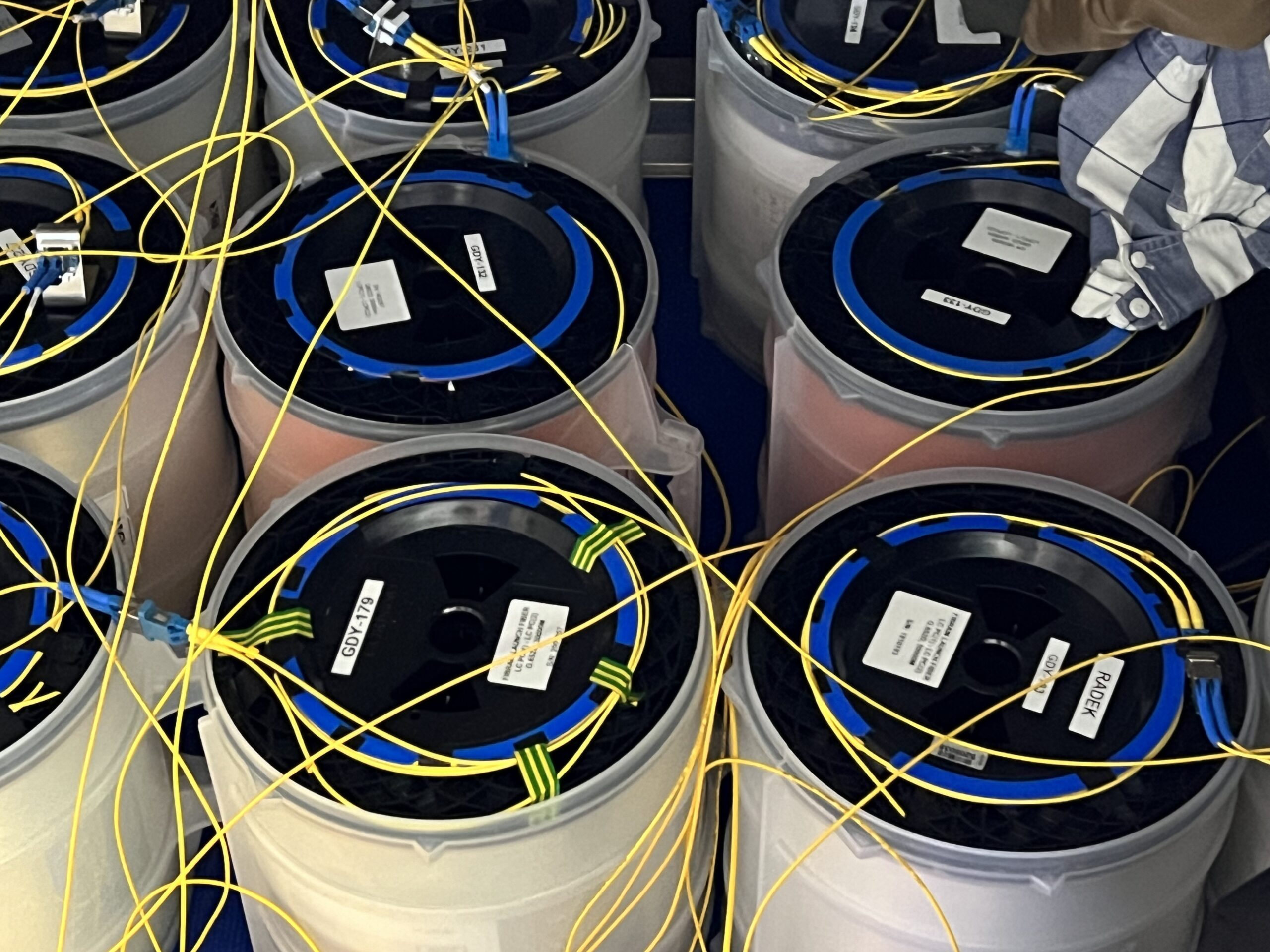
As co-chair of the OpenZR+ MSA, I was excited by the great collaboration with OIF. These efforts help to drive the industry forward. Karl Gass is not only the most creatively dressed person at every trade show; he is exceptional at coordinating these activities.
It is clear that linear drive pluggable optics (LPO) works in some situations, but views differ about how widespread its adoption will be and how standardisation should be addressed. I lived through the analogue coherent optics (ACO) experience. ACO was essentially a linear interface for a coherent module where the digital processing happened outside the module. For ACO, it was a DSP on the host board and for LPO it is the switch ASIC. The parameters that need to be specified are similar. There is a precedent for this kind of effort. Hopefully, lessons learned there will be helpful for those driving LPO. I am interested to see how this discussion progresses in the industry as some of the challenges are discussed, such as its current limited interoperability and support for 200 gigabits per lane.
There have been announcements from several companies about performance-optimised coherent optics in what we call Class 3 (symbol rates around 140 gigabaud), which support up to 1.2 terabits on a wavelength. Our CIM 8 module has been used in multiple field trials, demonstrating the performance benefits of these solutions.
Our CIM 8 (Coherent Interconnect Module 8) achieves this performance in a pluggable form factor. The CIM 8 uses the same 3D siliconisation technology we introduced for our 400-gigabit pluggables and enables operators to scale their network capacity in a cost- and power-efficient way.


Books in 2019
Gazettabyte asks industry figures each year to cite the memorable books they have read. These include fiction, non-fiction and work-related titles.
Here are the choices of Cisco’s Bill Gartner, Sylvie Menezo of silicon photonics start-up, Scintil Photonics, and Andrew Schmitt, directing analyst at Cignal AI.
Bill Gartner, Senior Vice President and General Manager, Cisco Optical Systems and Optics.
At the top of my list is The Gene: An Intimate History, by Siddhartha Mukherjee. Mukherjee does an amazing job of telling the story of the gene, providing historical context dating back to pre-Darwin times through to modern advances in gene therapy. The material is complex but he is great at describing the evolution of thinking about genes and progress in the genome project in layman’s terms.
The book leaves me in awe of how much has been accomplished, especially in the past 20 years, and yet how much more we have to learn about this fascinating topic, how progress in this area might be applied to solve some of medicine’s most challenging problems, and the moral dilemma that we confront as we think about altering nature’s work.
The Billionaire Who Wasn’t: How Chuck Feeney Secretly Made and Gave Away a Fortune by Conor O’Clery is an amazing story of a man who went from rags to riches, built one of the most profitable private businesses in history (Duty-Free Shops), and earned billions. He then gave it all away and did so anonymously. He lived frugally and was adamant that his contributions be kept secret. It is an inspiring story of an American hero who touched the lives of millions who will never know.
Longitude: The True Story of a Lone Genius Who Solved the Greatest Scientific Problem of His Time by Dava Sobel includes a foreword by Neil Armstrong. I am fascinated by stories that highlight how one individual persists in a vision and has a major impact on the world. In the 18th century, it was common for entire fleets of ships to run aground or get lost as navigation techniques were primitive.
Latitude was relatively straightforward, based on the angle of the sun relative to the horizon (and the date), but determining longitudinal position was often guesswork. After several disasters, including one where over 200 sailors were killed, the British government established a prize for the solution.
This is a fantastic story of a relatively unknown watchmaker who single-handedly solved the problem and then persuaded the sceptics that his chronometer was superior to any available method.
Lastly, I read Franklin and Winston: An Intimate Portrait of an Epic Friendship by Jon Meacham. This is a fantastic story of the intimate and at times stormy relationship between FDR and Winston Churchill. The story, unlike many WWII narratives, is told from the perspective of their interactions. FDR and Churchill were magnificent leaders, each of whom took a principled stand against Nazism and Fascism. It is also frightening to contemplate the course history may have taken had lesser leaders been in place.
Sylvie Menezo, CEO and CTO of Scintil Photonics.
The book I recommend is a novel I read this summer, La Tresse (The Braid) by Laetitia Colombani. It is a tale of three women, each from a different continent and experiencing different living conditions, yet their lives happen to be connected by something at the end of the book. To me, all three are very beautiful and strong women figures, moved by a ‘different something’ deep inside them, and that is what makes them beautiful!
Andrew Schmitt, founder and directing analyst at Cignal AI
It was a good reading year for me. Starting with fiction, my overall pick of the year is the Three-Body Problem series by Cixin Liu, a science fiction story of epic scale that stretches from the Cultural Revolution in China into the distant future.
It was written in Chinese and as a result, the style, prose and cultural perspective are different in a refreshing way. This series is right up there with Dune, Asimov and all the sci-fi greats. It is a must-read if that is your thing.
Martha Wells turned out more short novels to conclude the Murderbot Diaries, a series that I reviewed in 2018. I also read Neal Stephenson’s FALL; or, Dodge in Hell: A Novel this year. He’s maintained a steady production of books but I don’t think his latest books are as good as his archive (Snow Crash, Cryptonomicon, others). FALL was very disappointing, particularly the second half – I don’t recommend it. Read the archive instead.
It was an intense non-fiction year, so I’ll hit the good stuff that I strongly recommend.
I picked up Nobody Wants to Read Your Sh*t: And Other Tough-Love Truths to Make You a Better Writer by Steven Pressfield on a twitter recommendation and it resonated with me. So much written market research lacks respect and appreciation of the client’s time and Pressfield shares simple, useful tips to make your reader care about what you are writing. Anyone who writes for others should read this, and it is quick.
This book leads me to one of Pressfield’s big hits, Gates of Fire: An Epic Novel of the Battle of Thermopylae, a narrative history of the Spartans and the battle. As an engineer, I never had the time – and frankly, the interest – to study Ancient Greece. Pressfield vividly brings Sparta and Greece to life and recounts the events leading up to the battle of the famous “300”. A fantastic book.
My son had to read Midnight in Chernobyl: The Untold Story of the World’s Greatest Nuclear Disaster by Adam Higginbotham over the summer for High School.
We read it together; a highly recommended thing to do with your teenagers. Better yet, after the book, we were treated with the excellent “Chernobyl” drama on HBO. If you liked the HBO series, definitely read the book as it tells the story in a comprehensive and detailed way without an artistic license. The size, scale, and sacrifices endured by the Soviets to contain the disaster are incredible. The organisational ineptitude before and right after the event are horrifying. The same top-down decision hierarchy that caused the problem was paradoxically the only way to get it cleaned up.
My last recommendation is Shoe Dog: A Memoir – by the Creator of Nike, by Phil Knight. It recounts the genesis of the company as a supplier of track shoes made in Japan following WWII as the country rapidly emerged as an export powerhouse. It is a book about post-war Japan, raw entrepreneurship, and building what at the time was a new sales and marketing model combining athletics and fashion. One of the better business books I’ve read.
Books in 2019 – Final part, click here


Books in 2018 - Part 2
Some more books consumed in 2018, as recommended by Maxim Kuschnerov and Andrew Schmitt.
Maxim Kuschnerov, senior R&D manager at Huawei.
It is hard to believe the book Fire and Fury: Inside the Trump White House by Michael Wolff was published in 2018. Judging by what has happened since Trump’s inauguration, this recollection of his first days in the White House seems outdated. But it was fun to read while the memory of the election was still fresh. It is hard to judge whether all the book’s sources are truthful but the main message is certainly not too far off.

John Carreyrou’s Bad Blood: Secrets and Lies in a Silicon Valley Startup deals with the rise and fall of Elizabeth Holmes and her infamous blood testing start-up, Theranos. If it wasn’t for the fact that Holmes endangered the lives of thousands of people with her erroneous tests, one could be almost amazed on how she secured $1 billion from investors based on absolutely no technology whatsoever. It is also hard to believe how big chains could go along deploying Theranos tests without qualification of the products or the necessary Food and Drug Administration (FDA) approval.
As a westerner working for Huawei, Henry Kissinger’s On China was an important read to understand better how China sees itself and the world. There is no other nation capable of looking decades ahead like it is the fourth quarter of the next financial year. This is a worthwhile book for anyone wanting to make sense of the world.
Being a huge poker fan, buying the book Poker Brat: Phil Hellmuth’s Autobiography was a no-brainer. Hellmuth has his place in poker history, being one of the youngest World Series of Poker (WSOP) main event winners and the record holder with 15 bracelets. However, the book offers little insight on poker strategy. Or maybe it is the lack of strategy which makes Hellmuth who he is. If someone is really interested in learning from a great poker player, I’d recommend Every Hand Revealed by Gus Hansen. Hansen may have lost more than $20 million in online playing, but his book offers a better view on poker strategy back in the day of the big poker boom, before German maths wizards and game theory optimal strategy rewrote poker rules once again.
If a book has already been turned into a movie starring Brad Pitt, it means I am very late to the party with Michael Lewis’s Moneyball: The Art of Winning an Unfair Game. But being an artificial intelligence and machine-learning aficionado, everything is about recognising the underlying patterns, whether it is in images, optical signals or in such a beautiful and simple game like baseball. Most likely baseball strategists already apply machine learning to further optimise their strategy.
Andrew Schmitt, Founder and directing analyst at Cignal AI
The Winter Fortress: The Epic Mission to Sabotage Hitler's Atomic Bomb by Neal Bascomb is my pick of the year. I can’t believe this story isn't already a movie. It is about the Allies’ attempt to destroy the heavy-water plant in German-occupied Norway that was critical to the development of a German Atomic Weapon. Norwegians in exile in the UK, working with locals, pulled off a stunning attack that crippled the plant and set back the German effort. But the book is mostly about the events leading up to the mission, as well as the escape afterwards. The men who pulled it off were as hardcore as they come, and the sacrifices and impossible decisions they faced need to be shared. It is a story I imagine most Norwegians know, and it is a story that should be told to the world.
Hillbilly Elegy: A Memoir of a Family and Culture in Crisis by J.D. Vance is a good autobiography of someone who managed to escape people and situations that could easily have misdirected him. I am not going to join the chorus of folks who point to this book as reasoning for Trump getting elected; I avoid political discussions at all costs in a work environment. But reading this makes you appreciate the positive advantages you may have had growing up. The author, on the surface, had none but he highlights the people and situations that were formative for him and how they guided him on the right path. The best part about the book is that it isn’t preachy and Vance goes out of his way to explain that the problems he avoided have no easy or clear solutions.
Ray Dalio’s whitepapers, essays and explainer videos have always impressed me with concise formats and clear ideas. However, his book, Principles: Life and Work, is a big meal that I didn’t finish. I would recommend his YouTube videos and whitepapers and unless you are a hardcore self-help reader, which I’m not, then skip this.
My son had to read War by Sebastian Junger over the summer for High School. We read it together; a highly recommended thing to do with your teenagers. Junger was embedded in the Korengal Valley in Afghanistan with the US Army and was in the thick of some of the worst fighting. He also wrote The Perfect Storm which was a great book (and a terrible movie). In this book, he brings you right in the midst of events. If you want to know what being at the sharp end in Afghanistan is like, and the physical and mental sacrifices soldiers are making, then read this.
Michael Lewis is one of my favourite authors so I had to read his latest book, The Fifth Risk. It is well-written but it is about politics. I’m tired of politics. I don't think we need more of it so I won't recommend it.
I ripped through two volumes of Martha Wells’s The Murderbot Diaries on the way back from China. It’s about a security robot that figures out how to disable its governor software and become self-aware. A killing machine with a conscience, struggling with the details of being human. Some of the best Sci-Fi I’ve read in a long time. Netflix or Amazon need to give their money to this author right now and turn it into a series.

Books in 2017
Andrew Schmitt, founder and lead analyst of Cignal AI
I didn’t have a good year with books. I bought more than these and either didn’t read them or I lost interest. Hopefully, 2018 will be better.
A Mind at Play: How Claude Shannon Invented the Information Age by Jimmy Soni and Rob Goodman was a big disappointment. It is a well-researched book and has tons of great history on Claude Shannon but there was something about the writing style that made it turgid. I struggled to finish it but learned a lot about Claude Shannon, including that his home in Boston wasn’t far from mine.
The Hard Thing about Hard Things: Building a Business When There are No Easy Answers by Ben Horowitz was the year’s winner. Ben Horowitz started the VC firm A16Z with Marc Andreessen, and both worked at Netscape and later founded Loudcloud. This is easily one of my favourite management books. Each chapter of the book covers an operational topic via a narrative of experiences from the author. Examples include how to build culture and how to scale a sales organisation. The book is highly readable and enjoyable, rare for a title about management advice. Horowitz talks about another book, High Output Management by Andy Grove, which I am reading now.
I reread Cryptonomicon by Neal Stephenson this year for fun. Entertaining book, particularly in light of all the crypto-currency mania. It was written 18 years ago and was way ahead of its time. As William Gibson said, the future is already here, it’s just not evenly distributed. Seveneves was good too (from 2015), but I sure hope that isn’t our future.
The King and Queen of Malibu: The True Story of the Battle for Paradise by David Randall is a history of the large parcel of land now known as Malibu in Southern California. One person owned it after the Spanish American war, and the book is the story of how a rapidly encroaching Los Angeles, spurred on by the automobile, led to its eventual taking by eminent domain. If you know the area and are interested in the history, it is a great book. Otherwise, it is probably of little interest.
I also read a few other sci-fi fiction books while on the road that came highly recommended (Ready Player One, Fortress at the End of Time, Blindsight) but I thought they were not that great.
Vladimir Kozlov, founder and CEO of LightCounting Market Research
I read two books in 2017 that I would highlight.
The first is War and Peace by Leo Tolstoy.
The second is Makers and Takers: The Rise of Finance and the Fall of American Business by Rana Foroohar. The book offers a sobering outlook on modern economic developments and questions the sustainability of growth.
Juniper Networks opens up the optical line system
Juniper Networks has responded to the demands of the large-scale data centre players with an open optical line system architecture.
 Donyel Jones-WilliamsThe system vendor has created software external to its switch, IP router and optical transport platforms that centrally controls the optical layer.
Juniper has also announced a reconfigurable optical add-drop multiplexer (ROADM) - the TCX1000 - that is Lumentum’s own white box ROADM design. Juniper will offer the Lumentum white box as its own, part of its optical product portfolio.
The open line system architecture, including the TCX1000, is also being pitched to communications service providers that want an optical line system and prefer to deal with a single vendor.
“Juniper plans to address the optical layer with a combination of software and open hardware in the common optical layer,” says Andrew Schmitt, founder and lead analyst at Cignal AI. “This is the solution it will bring to customers rather than partnering with an optical vendor, which Juniper has tried several times without great success.”
Open line systems
An optical line system comprises terminal and transmission equipment and network management software. The terminal equipment refers to coherent optics hosted on platforms, while line elements such as filters, optical amplifiers and ROADMs make up the transmission equipment. Traditionally, a single vendor has provided all these elements with the network management software embedded within the vendor’s platforms.
An open optical line system refers to line equipment and the network management system from a vendor such as Nokia, Infinera or Ciena that allows the attachment of independent terminal equipment. An example would be the Telecom Infra Project’s Voyager box linked to a Nokia line system, says Schmitt.
The open line system can also be implemented as a disaggregated design. Here, says Schmitt, the control software would be acquired from a vendor such as Juniper, Fujitsu, or Ciena with the customer buying open ROADMs, amplifiers and filters from various vendors before connecting them. Open software interfaces are used to communicate with these components. And true to an open line system, any terminal equipment can be connected.
The advantage of an open disaggregated optical line system is that elements can be bought from various sources to avoid vendor lock-in. It also allows the best components to be acquired and upgraded as needed.
Meanwhile, disaggregating the management and control software from the optical line system and equipment appeals to the way the internet content providers architect and manage their large-scale data centres. This is what Juniper’s proNX Optical Director platform enables, the second part of its open line system announcement.
Juniper believes its design is an industry first in how it separates the control plane from the optical hardware.
“We have taken the concept of disaggregation and software-defined networking to separate the control plane out of the hardware,” says Donyel Jones-Williams, director of product marketing management at Juniper Networks. “Our control plane is no longer tied to physical hardware.”
Having an open line system supplied by one vendor gets you 90% of the way there
Disaggregated control benefits the optimisation of the open line system, and enables flexible updates without disrupting the service.
Cignal AI’s Schmitt says that the cloud and co-location players are already using open line systems just not disaggregated ones.
“Having an open line system supplied by one vendor gets you 90% of the way there,” says Schmitt. For him, a key question is what problem is being solved by taking this one step further and disaggregating the hardware.
Schmitt’s view is that an operator introduces a lot of complexity into the network for the marginal benefit of picking hardware suppliers independently. “And realistically they are still single-sourcing the software from a vendor like Juniper or Ciena,” says Schmitt.
Juniper now can offer an open line system, and if a customer wants a disaggregated one, it can build it. “I don’t think users will choose to do that,” says Schmitt. “But Juniper is in a great position to sell the right open line system technology to its customer base and this announcement is interesting and important because Juniper is clearly stating this is the path it plans to take.”
TCX1000 and proNX
Juniper’s open optical line system announcement is the latest development in its optical strategy since it acquired optical transport firm, BTI Systems, in 2016.
BTI’s acquisition provided Juniper with a line system for 100-gigabit transport. “The filters and ROADMs didn’t allow the system to scale to 200-gigabit and 400-gigabit line rates and to support super-channels and flexgrid,” says Jones-Williams.
With the TCX1000, Juniper now has a one-rack-unit 20-degree ROADM that is colourless, directionless and which supports flexgrid to enable 400-gigabit, 600-gigabit and even higher capacity optical channels in future. The TCX1000 supports up to 25.6 terabits-per-second per line.
A customer can also buy the white box ROADM from Lumentum directly, says Juniper. “It gives our customers freedom as to how they want to source their product,” says Jones-Williams.
Competition between vendors is now in the software domain. We no longer believe that there is differentiation in the optical line system hardware
Juniper’s management and control software, the ProNX Optical Director, has been architected using microservices. Microservices offers a way to architect applications using virtualisation technology. Each application is run in isolation based on the service they provide. This allows a service to run and scale independently while application programming interfaces (APIs) enable communication with other services.
Container technology is used to implement microservices. Containers use fewer hardware resources than virtual machines, an alternative approach to server virtualisation.
 Source: Juniper Networks.
“It is built for data centre operators,” says Don Frey, principal analyst, routers and transport at the market research firm, Ovum. “Microservices makes the product more modular.”
Juniper believes the competition between vendors is now in the software domain. “We no longer believe that there is differentiation in the optical line system hardware,” says Jones-Williams.
Data centre operators are not concerned about line system interoperability, they are just trying to remove the blade lock-in so they can get the latest technology.
Market demands
Most links between data centres are point-to-point networks yet despite that, the internet content providers are interested in ROADMs, says Juniper. What they want is to simplify network design using the ROADM’s colourless and flexible grid attributes. A directionless ROADM is only needed for complex hub sites that require flexibility in moving wavelengths through a mesh network.
The strategy of the large-scale data centre operators is to split the optical system between an open line system and purpose-built blades. The split allows them to upgrade to the best blades or pluggable optics while leaving the core untouched. “The concept is similar to the open submarine cables as the speed of innovation in core systems is not the same as the line optics,” says Frey. “Data centre operators are not concerned about line system interoperability, they are just trying to remove the blade lock-in so they can get the latest technology.”
Juniper says there is also interest from communications service providers in the ROADM as part of their embrace of open initiatives such as the Open ROADM MSA. Frey says AT&T will make its first deployment of the Open ROADM before the year-end or in early 2018.
“There are a lot of synergies in terms of what we have announced and things like Open ROADM,” says Jones-Williams. “But we know that there are customers out there that just want a line system and they do not care if it is open or not.”
Juniper is already working with customers with its open line system as part of the development of its proNX software.
The branded ROADM and the proNX Optical Director will be generally available in early 2018.
Books of the year 2016 - Part 1
Each year Gazettabyte asks industry figures to comment on books that they recommend. Here are BT's Andrew Lord's and Cignal's Andrew Schmitt's recommendations to kick off this year's reviews.
Andrew Lord, Head of Optical Research at BT.
Quantum technologies are flavour of the month, with huge government investments from around the world. The title and cover of Bananaworld: Quantum Mechanics for Primates by Jeffrey Bub, suggest a book that will ‘unpeel’ a tough but increasingly important subject for general readers.
The book itself is, however, far deeper than its cover suggests, going way beyond the basics, and attempting to forge a link between quantum mechanics and the structure of information.
Imagining a strange world in which bananas exhibit quantum effects might just confuse rather than aid the general reader, but those wishing to probe the deeper information theory questions will find much here to ‘chew on’.
Andrew Schmitt, founder of Cignal AI
Starting a company with a wide customer base requires a lot of ‘infrastructure’ that I didn’t realise would consume so much time. I like to build things so it has been a real thrill but also a lot of work. I think I gravitated towards fun things to read as a result of having my hands full. All of them were outstanding.
A Fire Upon The Deep by Vernor Vinge, and Seveneves by Neal Stephenson require a great deal of mental fortitude but unfold on such a grand scale that they are very appealing. Stephenson is a favourite of mine, ever since reading Snow Crash in college. He’s like William Gibson except with a sense of humour.
I also reread Fahrenheit 451 by Ray Bradbury. Let’s just say it felt a lot less sci-fi the second time around. If you look at the monoculture of ideas in politics, education, even business – it’s a dangerous situation. A big reason populism is emerging in the West is because people are sick of getting told what to think by “smart” people, and the perceived loss of control. It is a healthy rebellion despite a lot of the downside because the alternative – everyone thinking in lockstep – is far more dangerous.
I had greater ambitions for non-fiction and have several unread Kindle books on my iPhone. I wanted to read The Hard Thing about Hard Things from Ben Horowitz but have not. Other titles include The Comeback: How Larry Ellison's Team Won the America's Cup by G. Bruce Knecht and American Sniper: The Autobiography of the Most Lethal Sniper in U.S. Military History by Chris Kyle.
The book Elon Musk: Tesla, SpaceX, and the Quest for a Fantastic Future by Ashlee Vance is a great read. There are a lot of haters out there who don’t like Tesla for various reasons – his government funding, climate-change skeptics who don’t like his views, and who knows what else? Fine by me. But after reading this book you have to acknowledge the massive, ridiculous undertaking of starting both a rocket company and an electric car company. It is insane. Yet this guy has managed to keep the wheels from coming off so far. He has burned through people, capital, and relationships but the results are impressive.
He may not be everyone's idea of a nice guy – whatever - but he is a walking, breathing, living image of the American ethos of invention and capitalism. Whatever money it costs the US government is more than offset by the example he sets for others that anything is possible provided you have enough time, money, and guts.
Books in 2015 - Part 1
Andrew Schmitt, founder and CEO at Cignal AI
I didn’t read that much this year but I did read The Wright Brothers by David McCullough. That was outstanding. McCullough is a great historical author and wrote a book that was both a biography of the Wrights as well as a narrative of their efforts to build the first powered airplane.
I didn't know of all of the other simultaneous, better-financed efforts that fell far short of the efforts of two brothers from Dayton, Ohio. I also was unaware of how the effort transfixed the world when they did complete it.
There is so much chattering today about Lean Development and Devops (how many people use that word and really know what it means?) as if these are new developments. But the Wrights are a case study in lean development and simultaneous development and deployment. Read this and see Devops in action over 100 years ago and I'm sure there are lots more examples.
Rupert Baines, CEO at UltraSoC
This year has been rather frantic: starting a new role and being very full on has meant I've read less than I usually do. Perhaps that's wrong: a friend and mentor advises this precisely is the time to read more, for sanity and perspective. But she is wiser than I, or perhaps more self-disciplined.
Inevitably, reading less does not mean buying less! The Japanese have a term which is not yet a loanword but ought to be: Tsundoku.
Many of the books I have read have been non-taxing but fun (Trigger Mortis: the new James Bond; The Martian; Robert Harris' Cicero trilogy etc.) but I have read a few brilliant books worth recommending.
The Narrow Road To The Deep North by Richard Flanagan deservedly won the Booker prize last year and is a lovely, haunting, tragic novel. It describes an Australian surgeon who is captured and becomes a war hero as commander of a Japanese PoW camp - and the consequences for him and others after the war. It is not an easy read, harrowing and sad. But brilliant scenes, astonishingly vivid characters and insights on what it means to be "a good man" and the effect of war make the hard work worthwhile. A brilliant book.
A Place of Greater Safety by Hilary Mantel. I loved Wolf Hall (if you haven't read it, then do so) so read her earlier historic novel. Thank God for e-books because this is huge - and if I had realised how hefty it was I might not have read it. Set in the French Revolution, this describes in feverish intensity and hyper-real vividness the run-up to revolution, the Bastille and then the Terror. Robespierre, St. Just, Danton, and many, many more feature in utterly fascinating, compelling detail. There is a lot of information, and a LOT of pages but fascinating and enjoyable.
I really enjoy David Mitchell's novels. A clever, complex, interwoven set of stories (within the books and between them). The Bone Clocks was a fun novel: flitting through characters and decades (1984-2043) in a gripping science fiction/ adventure romp. Slade House is a shorter Halloween horror-ride of a creepy page-turner.
In non-fiction, it is interesting I haven't read much this year.
I finally read Thinking, Fast and Slow by Daniel Kahneman. To be honest, it is a fascinating insight but suffers the fault of so many business books: it has one great idea, but that isn't enough to support a whole book. Reading it late and being aware of that idea I found myself turning pages rather fast as a familiar concept was explained and repeated. That is perhaps ironic in a book about modes of thinking and contrasting quick impressions with deeper reflection.
A slight cheat as I haven't read them yet (remember what I said about book piles?), are SuperForecasting: The Art and Science of Forecasting by Philip Tetlock and Dan Gardner and Act Like a Leader, Think Like a Leader by Herminia Ibarra.
Both were highly recommended by several people independently. Both have travelled the world on my Kindle without being started yet. Maybe over the holidays.
For Part 2, click here
60-second interview with Infonetics' Andrew Schmitt
 Andrew Schmitt
Q: Infonetics claims the global WDM market grew 6% in 2014, to total US $10 billion. What accounted for such impressive growth in 2014?
AS: Primarily North American strength from data centre-related spending and growth in China.
Q: In North America, the optical vendors' fortunes were mixed: ADVA Optical Networking, Infinera and Ciena had strong results, balanced by major weakness at Alcatel-Lucent, Fujitsu and Coriant. You say those companies whose fortunes are tied to traditional carriers under-performed. What are the other markets that caused those vendors' strong results?
These three vendors are leading the charge into the data centre market. ADVA had flat revenue, North America saved their bacon in 2014. Ciena is also there because they are the ones who have suffered the least with the ongoing changes at AT&T and Verizon. And Infinera has just been killing it as they haven’t been exposed to legacy tier-1 spending and, despite the naysayers, has the platform the new customers want.
"People don’t take big risks and do interesting things to attack flat or contracting markets"
Q: Is this mainly a North American phenomenon, because many of the leading internet content providers are US firms?
Yes, but spending from Baidu, Alibaba, and Tencent in China is starting to scale. They are running the same playbook as the western data centre guys, with some interesting twists.
Q. You say the press and investors are unduly fascinated with AT&T's and Verizon's spending. Yet they are the two largest US operators, their sum capex was $39 billion in 2014, and their revenues grew. Are these other markets becoming so significant that this focus is misplaced?
Growth is what matters.
People don’t take big risks and do interesting things to attack flat or contracting markets. Sure, it is a lot of spend, but the decisions are made and that data is seen - incorporated into people’s thought-process and market opinion. What matters is what changes. And all signs are that these incumbents are trying to become more like the data centre folks.
Q. What will be the most significant optical networking trend in 2015?
Cheaper 100 gigabit, which lights up the metro 100 gigabit market for real in 2016.
WDM and 100G: A Q&A with Infonetics' Andrew Schmitt
The WDM optical networking market grew 8 percent year-on-year, with spending on 100 Gigabit now accounting for a fifth of the WDM market. So claims the first quarter 2014 optical networking report from market research firm, Infonetics Research. Overall, the optical networking market was down 2 percent, due to the continuing decline of legacy SONET/SDH.
In a Q&A with Gazettabyte, Andrew Schmitt, principal analyst for optical at Infonetics Research, talks about the report's findings.
Q: Overall WDM optical spending was up 8% year-on-year: Is that in line with expectations?
Andrew Schmitt: It is roughly in line with the figures I use for trend growth but what is surprising is how there is no longer a fourth quarter capital expenditure flush in North America followed by a down year in the first quarter. This still happens in EMEA but spending in North America, particularly by the Tier-1 operators, is now less tied to calendar spending and more towards specific project timelines.
This has always been the case at the more competitive carriers. A good example of this was the big order Infinera got in Q1, 2014.
You refer to the growth in 100G in 2013 as breathtaking. Is this growth not to be expected as a new market hits its stride? Or does the growth signify something else?
I got a lot of pushback for aggressive 100G forecasts in 2010 and 2011 when everyone was talking about, and investing in, 40G. You can read a White Paper I wrote in early 2011 which turned out to be pretty accurate.
My call was based on the fact that, fundamentally, coherent 100G shouldn’t cost more than 40G, and that service providers would move rapidly to 100G. This is exactly what has happened, outside AT&T, NTT and China which did go big with 40G. But even my aggressive 100G forecasts in 2012 and 2013 were too conservative.
I have just raised my 2014 100G forecast after meeting with Chinese carriers and understanding their plans. 100G will essentially take over almost all of the new installations in the core by 2016, worldwide, and that is when metro 100G will start. But there is too much hype on metro 100G right now given the cost, but within two years the price will be right for volume deployment by service providers.
There is so much 'blah blah blah' about video but 90 percent is cacheable. Cloud storage is not
You say the lion's share of 100G revenue is going to five companies: Alcatel-Lucent, Ciena, Cisco, Huawei, and Infinera. Most of the companies are North American. Is the growth mainly due to the US market (besides Huawei, of course). And if so, is it due to Verizon, AT&T and Sprint preparing for growing LTE traffic? Or is the picture more complex with cable operators, internet exchanges and large data centre players also a significant part of the 100G story, as Infinera claims.
It’s a lot more complex than the typical smartphone plus video-bandwidth-tsunami narrative. Many people like to attach the wireless metaphor to any possible trend because it is the only area perceived as having revenue and profitability growth, and it has a really high growth rate. But something big growing at 35 percent adds more in a year than something small growing at 70 percent.
The reality is that wireless bandwidth, as a percentage of all traffic, is still small. 100G is being used for the long lines of the network today as a more efficient replacement for 10G and while good quantitative measures don’t exist, my gut tells me it is inter-data-centre traffic and consumer/ business to data centre traffic driving most of the network growth today.
I use cloud storage for my files. I’m a die-hard Quicken user with 15 years of data in my file. Every time I save that file, it is uploaded to the cloud – 100MB each time. The cloud provider probably shifts that around afterwards too. Apply this to a single enterprise user - think about how much data that is for just one person. There is so much 'blah blah blah' about video but 90 percent is cacheable. Cloud storage is not.
Each morning a hardware specialist must wake up and prove to the world that they still need to exist
Cisco is in this list yet does not seek much media attention about its 100G. Why is it doing well in the growing 100G market?
Cisco has a slice of customers that are fibre-poor who are always seeking more spectral efficiency. I also believe Cisco won a contract with Amazon in Q4, 2013, but hey, it’s not Google or Facebook so it doesn’t get the big press. But no one will dispute Amazon is the real king of public cloud computing right now.
You’ve got to do hard stuff that others can’t easily do or you are just a commodity provider
In the data centre world, there is a sense that the value of specialist hardware is diminishing as commodity platforms - servers and switches - take hold. The same trend is starting in telecoms with the advent of Network Functions Virtualisation (NFV) and software-defined networking (SDN). WDM is specialist hardware and will remain so. Can WDM vendors therefore expect healthy annual growth rates to continue for the rest of the decade?
I am not sure I agree.
There is no reason transport systems couldn’t be white-boxed just like other parts of the network. There is an over-reaction to the impact SDN will have on hardware but there have always been constant threats to the specialist.
Each morning a hardware specialist must wake up and prove to the world that they still need to exist. This is why you see continued hardware vertical integration by some optical companies; good examples are what Ciena has done with partners on intelligent Raman amplification or what Infinera has done building a tightly integrated offering around photonic-integrated circuits for cheap regeneration. Or Transmode which takes a hacker’s approach to optics to offer customers better solutions for specific category-killer applications like mobile backhaul. Or you swing to the other side of the barbell, and focus on software, which appears to be Cyan’s strategy.
You’ve got to do hard stuff that others can’t easily do or you are just a commodity provider. This is why Cisco and Intel are investing in silicon photonics – they can use this as an edge against commodity white-box assemblers and bare-metal suppliers.
The OTN transport and switching market
 Source: Infonetics Research
The OTN transport and switching market is forecast to grow at a 17% compound annual growth rate (CAGR) from 2011 to 2016, outpacing the 5.5% CAGR of the optical equipment market (WDM, SONET/SDH). So claims a recent study on the OTN equipment marketplace by Infonetics Research.
A Q&A with report author, Andrew Schmitt, principal analyst for optical at Infonetics.
How should OTN (Optical Transport Network) be viewed? As an intermediate technology bridging the legacy SONET/SDH and the packet world? Or is OTN performing another, more fundamental networking role?
There is a deep misconception that once the voyage to an all-packet nirvana is complete, there is no need for SONET/SDH or an equivalent technology. This isn’t true. Networks that are 100% packet still need an OSI layer 1 mechanism, and to date this is mostly SDH and increasingly OTN.
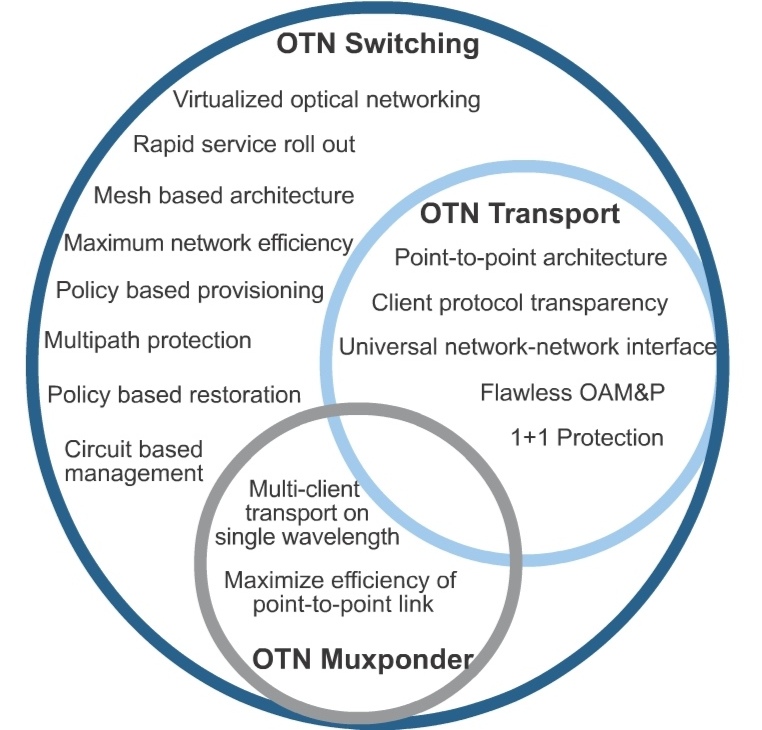
OTN should be viewed as the carrier transport protocol for the foreseeable future. For many carriers, OTN will be used not just for carrying a single packet client, but for interleaving multiple clients onto the same wavelength. This is OTN switching, and it is a superset of OTN transport functionality.
Most people talk about the OTN market but they fail to distinguish between whether OTN is used as a point-to-point technology or as a switching technology that allows the creation of an electronic mesh network.
What is OTN doing within operators' networks that accounts for their strong investment in the technology?
OTN is the new physical layer protocol carrying out the OSI [Open Systems Interconnection] layer 1 functions. Carriers are investing in OTN as part of their continuing investments in WDM [wavelength division multiplexing] equipment, most of which supports OTN transport, a maturing market. The new market is that of OTN switching, which resembles the SONET/SDH multiplexing scheme, but with much better features and management.
OTN switching deployments are directly related to large scale deployments of 40G and 100G transport networks as part of what I like to call The Optical Reboot. As these new wavelength speeds are rolled out, often on unused fibre, other technologies are being introduced at the same time – things like OTN switching and new control plane methods.
"People are underestimating how hard it is to build this [OTN] hardware and combine it with control plane software"
Please explain the difference between the main platforms - OTN transport, OTN switching and P-OTS. And will they have the same relative importance by 2016?
OTN switching is a superset of OTN transport, and the differences are shown in a Venn diagram (chart above) from a recent whitepaper I wrote, Integrated OTN Switching Virtualizes Optical Networks. Somewhere between the two is the muxponder application, which is good for low-volume deployments but becomes expensive and tough to manage when used in quantity.
P-OTS (packet-optical transport systems) are boxes that combine both layer 1 (SONET/SDH and/or OTN switching) with layer 2 (Ethernet, MPLS-TP, other circuit-oriented Ethernet (COE) protocols) in the same hardware and management platform.
Cisco was one of the early leaders in this space with some creative brute-force upgrades to the venerable 15454 platform. Since then, many legacy SONET/SDH multi-service provisioning platforms (MSPPs) have seen upgrades to carry Ethernet. Some of the best examples of this platform type are the Fujitsu 9500, Tellabs' 7100, and Alcatel-Lucent's 1850.
You say a big vendor battle is brewing in the P-OTS space: Cisco, Tellabs, and Alcatel-Lucent are the top 3 vendors, but Fujitsu, Ciena, and Huawei are gaining. What factors will determine a vendor's P-OTS success here?
It really depends. In the metro-regional applications of bigger boxes, things like 100G optics and OTN switching will be more important, as the layer 2 functions are handed off to dedicated layer 2/3 machines. As you get closer to the edge, though, OTN switching will have no importance and everything will depend on the layer 2 and layer zero features.
For layer 2, this means supporting a lightweight circuit-oriented Ethernet protocol with awareness of all the various service types that might be in play. For layer zero, it is all about cheap tunable optics (tunable XFP and SFP+), but particularly ROADMs. I think BTI Photonics, Cyan, Transmode, and ADVA Optical Networking are some of the smaller players to watch here. Mobile backhaul, data centre interconnect, and enterprise data services are the big engines of growth here.
Were there any surprises as part of your research for the report?
There just are not that many vendors shipping OTN switching systems today. I think people are underestimating how hard it is to build this hardware and combine it with control plane software. In 2011, only Ciena, Huawei, and ZTE shipped OTN switching for revenue. This year we should see Alcatel-Lucent, Infinera, Nokia Siemens, and maybe a few more.
Is there one OTN trend currently unclear that you'd highlight as worth watching?
Yes: It isn’t clear to what degree carriers want integrated WDM optics in OTN switches. In the past, big SONET/SDH switches like Ciena’s CoreDirector were always shipped with short-reach optics that connected it to standalone WDM systems. I think going forward, OTN switching and the WDM transport functions must be built into the same hardware in order to get the benefits of OTN switching at the best price, and that’s why I wrote the Integrated OTN Switching white paper – to try to communicate why this is important. It is a shift in the way carriers use this equipment, though, and as you know, some carrier habits are hard to break.
Further reading
OTN Processors from the core to the network edge, click here